“Open Her Lunchbox”—An Army Sergeant Major Visited Her Pregnant Sister, and Her Husband Suddenly Reached for the Lock
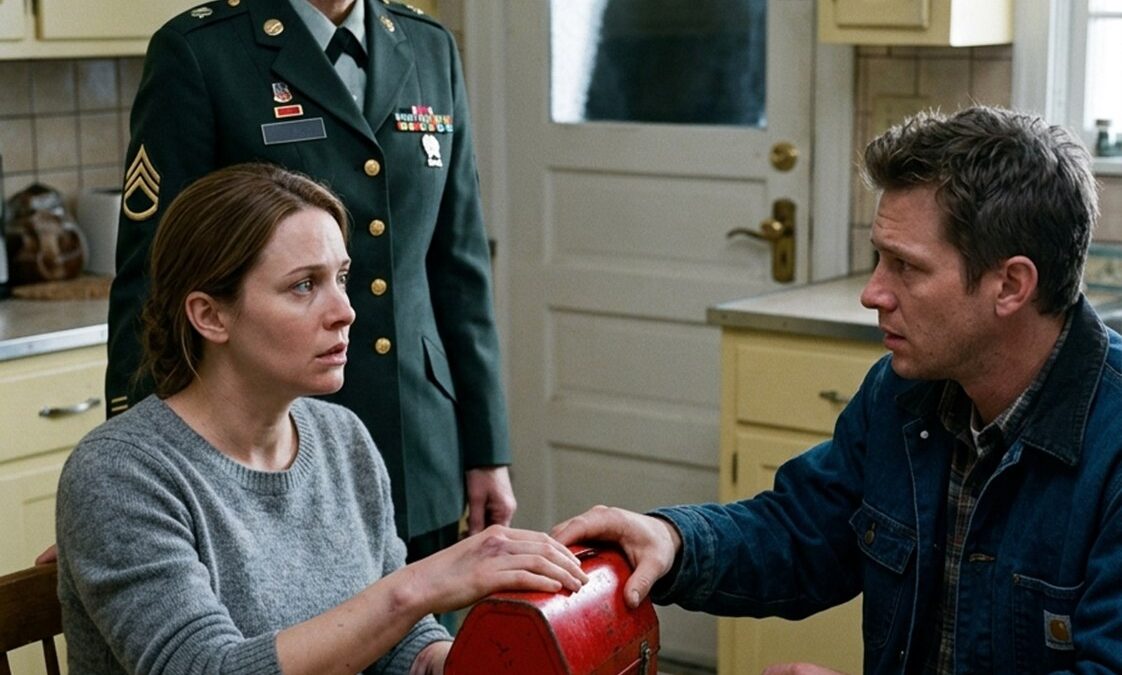
Chapter 2: What Mother Left Inside
The handle turned again.
Then somebody knocked.
Celia stayed beside me.
“Are you expecting anyone?”
Wes answered first.
“We made arrangements.”
“She asked me,” I said.
My voice shook.
I let it.
A man called through the door.
“Private transport for Nora Vale?”
That was my married name.
Hearing it frightened me more than the knock.
Wes reached across the table.
Celia moved my phone toward me.
“Is that yours?”
“Yes.”
“Take it.”
He stopped reaching.
She didn’t threaten him.
She simply watched his hand until he lowered it.
Then she opened the kitchen door.
A man in a company polo stood outside.
He held a tablet.
A gray passenger van waited beside the building.
“Who requested you?” Celia asked.
“Doreen Pike.”
Wes’s aunt.
Of course.
“She’s the family contact.”
“What are you transporting her for?”
“An outpatient consultation.”
The man checked his screen.
“Voluntary appointment.”
“I’m not going,” I said.
He looked past Celia.
At my wrist.
At Wes.
“All right.”
Wes straightened.
“She gets frightened by changes.”
The driver lowered his tablet.
“She said she isn’t going.”
For months, every refusal had started an argument.
This one ended a transaction.
I almost cried from the difference.
The driver stepped back.
“I’ll mark it canceled.”
“Please record who refused,” Wes snapped.
“I will,” he said.
He looked directly at me.
“The passenger.”
After he left, Celia asked whether I wanted medical help.
I nodded.
Wes folded his arms.
“We have a car.”
“I want hers.”
He laughed again, but it sounded different.
“You’ll come back.”
I picked up my wallet.
My hand wouldn’t close properly around it.
Celia waited while I used the other one.
She didn’t turn my difficulty into another reason somebody else should decide.
“Your shoes?” she asked.
“By the door.”
“Anything else?”
I looked at the lunchbox.
Wes saw me looking.
“That stays.”
“It was my mother’s.”
“You’re taking family paperwork.”
“My identification was family paperwork five minutes ago.”
Celia’s mouth tightened.
I couldn’t tell whether she was angry or trying not to smile.
I lifted the box with my good hand.
Wes stood in the doorway.
For one second, nobody moved.
Then Celia took out her phone.
“I can ask the police to help us leave.”
He stepped aside.
“You always make things bigger.”
I walked past him.
My sister followed.
Outside, the October air smelled like wet leaves.
I had forgotten that seasons could have smells.
Inside the car, Celia asked before touching my seat belt.
“Can I help?”
“Yes.”
She fastened it below my belly.
Then she laid her coat across my knees.
There was a loose thread at the cuff.
I concentrated on that.
One thread.
One breath.
One street behind us.
At the hospital, a nurse separated us for questions.
Celia accepted it immediately.
Wes always objected.
That difference hurt.
The nurse asked whether I felt safe at home.
I said the word I had practiced silently for months.
“No.”
She didn’t ask why I had stayed.
She asked what I needed tonight.
A place he couldn’t enter.
Food.
Someone to check the baby.
My wrist examined.
The list embarrassed me.
Then a sandwich arrived.
I ate half before remembering to apologize.
The nurse pushed the rest closer.
Later, a clinician fitted a splint and explained the follow-up.
The baby’s monitoring was reassuring.
They still wanted me to stay for observation.
When Celia returned, she had changed into a plain sweater from her car.
Her uniform was folded over one arm.
“I didn’t know,” she said.
“I thought you did.”
She went still.
I opened the lunchbox.
Beneath my wallet was the folded authorization.
Beneath that were three envelopes.
I had hidden them there months earlier, before Wes took the box.
My letters to Celia.
Returned unopened.
“She said you sent them back,” I whispered.
“Who?”
“Doreen.”
Celia sat down slowly.
“I never saw them.”
“The last one asked you to come.”
Her eyes filled.
“Bird.”
Nobody had called me that since Mom died.
I turned the envelope over.
There was no postal return marking.
Only a sentence in Celia’s supposed handwriting.
Handle your own marriage.
My sister took out her phone.
She found a message from me.
Or somebody using my account.
Please stop contacting me until I’m ready.
Then another.
Your visits make things worse.
I looked at the dates.
Wes had already taken my phone.
Celia set hers beside the letters.
“I thought I was respecting your wishes.”
My stomach tightened around a new kind of grief.
My sister hadn’t abandoned me; someone had taught each of us that the other wanted silence.
* * *
The next morning, a hospital advocate named Tessa sat beside my bed.
She brought paper.
Not a packet she expected me to understand immediately.
One sheet.
Three choices for that day.
“Medical follow-up,” she said.
“Somewhere safe.”
“And whether you want to speak with police.”
“All three.”
Celia was getting coffee.
Tessa waited until she returned before asking whether I wanted her included.
I did.
I wanted her close enough to hear me.
I also wanted someone to keep asking.
The police officer who came spoke gently.
He photographed my wrist with my permission.
He asked when the injury happened.
“Saturday.”
“What happened?”
“Wes grabbed me when I tried to leave.”
“Where were you going?”
“The pharmacy.”
“Did he know?”
“Yes.”
I explained the argument.
The missing card.
The blocked doorway.
I didn’t have to make it dramatic.
The truth already was.
The officer wrote down the transport company’s name.
He took copies of the forged authorization.
He explained that other records would take time.
I signed my statement myself.
Slowly.
With my uninjured hand.
Celia watched the pen like it mattered more than her uniform ever had.
That afternoon, we met an attorney Tessa had referred.
Maren Holt had silver-framed glasses and a chair that squeaked whenever she leaned forward.
She warned us about the chair.
Then she warned us about promises.
“I can explain options,” she said.
“I can’t promise what a court will decide.”
I liked her immediately.
People making decisions for me had always sounded certain.
We discussed seeking protection.
Preserving messages.
Getting replacement identification if anything was missing.
Then she asked about income.
“I used to do payroll.”
“Where?”
“A commercial laundry.”
“For how long?”
“Seven years.”
“Why did you leave?”
I looked down.
“Wes said the pregnancy was high-risk.”
“Was that your clinician’s recommendation?”
“He said he’d spoken to them.”
There was a silence.
Maren didn’t fill it.
I heard my own answer properly.
He said.
So much of my life had been built from those two words.
“What assets do you have?” she asked.
“Nothing I can use.”
“That’s a different question.”
I told her about the building.
Mom had owned a small four-unit property in Dayton.
We lived in the downstairs rear apartment.
The rent from the other three had helped her retire.
When she died, the building went into a trust.
Doreen handled it.
“She was Mom’s bookkeeper.”
“And your husband’s aunt?”
“Yes.”
“Do you have the documents?”
“I had copies.”
“Where?”
“Wes said they confused me.”
Maren wrote something down.
“Do you know the drafting attorney?”
I remembered a green business card.
A surname.
A street near the courthouse.
It was enough to start.
With my authorization, Maren contacted the attorney’s office.
The documents arrived through his successor two days later.
By then I was staying in a confidential apartment arranged through the advocacy service.
Celia had taken leave.
She slept on the sofa.
She snored quietly.
I had never loved a sound so much.
Maren called while Celia was burning toast.
The trust wasn’t a fortune.
There was a mortgage.
Repairs.
Insurance.
But it was mine.
Doreen had served as trustee during Mom’s illness and through the estate administration.
The trust required her to transfer control to me when I turned thirty.
My birthday had been in June.
It was now October.
“She said it was thirty-five,” I told Maren.
“We have the signed document.”
“Maybe Mom changed it.”
“We’re checking for amendments.”
The drafting attorney’s records contained none.
Neither did the estate file.
Doreen had requested repeated delays, citing expenses and unfinished accounting.
No one had been told I lacked access to my own bank card.
Maren asked about the lunchbox.
“Why did you keep letters in it?”
“Mom kept everything there.”
“Financial papers?”
“Mostly things she meant to file.”
I opened it on the apartment table.
My wallet was already in my purse.
The phone was charging.
The authorization lay in Maren’s evidence folder.
The box looked smaller without my captivity packed inside.
There was a faded repair label beneath the lid.
I ran my thumb along it.
Then I remembered.
Mom used the lining as a pocket.
She called it her filing cabinet’s emergency exit.
A thin cardboard panel lifted from the bottom.
Underneath lay a folded rent sheet.
And a carbon duplicate of a receipt.
Mom’s handwriting.
Apartment Two.
Roof assessment contribution.
$2,400.
I stared at the amount.
“What is it?” Celia asked.
“The tenants weren’t supposed to pay for the roof.”
I remembered that discussion.
Mom had set money aside.
She had complained about the cost over Sunday dinner.
Doreen had said the tenants wanted upgraded drainage.
Mom had told her to return their contributions.
The receipt was dated fourteen months before Mom died.
On the back, she had written a question.
Doreen—where did this go?
My hands started shaking.
Celia sat beside me.
“Do you remember anything else?”
“The laundry.”
“What about it?”
“We used numbered receipts for cash.”
I turned the carbon toward the light.
This one had a number.
1187.
I had seen that numbering format before.
On the monthly summaries Doreen brought to our apartment.
She had called them maintenance vouchers.
I asked Maren to request the underlying records.
Not just the summaries.
The invoices.
The deposits.
The canceled checks.
“The originals, if they exist,” I said.
Maren paused.
Then I heard her typing.
“That’s a useful distinction.”
For the first time in months, something I knew was useful.
Three days later, the first tenant agreed to speak.
Mr. Alvarez had lived upstairs since I was sixteen.
He arrived at Maren’s office carrying a grocery bag of receipts.
“I thought you were collecting it,” he told me.
“Collecting what?”
“The extra assessment.”
My mouth went dry.
He had paid Doreen an additional two hundred dollars every month.
So had another tenant.
The payments continued after Mom died.
Doreen’s summaries showed no such income.
Mr. Alvarez looked ashamed.
He had trusted a familiar face.
So had I.
Maren asked him to describe each payment.
She didn’t suggest answers.
She copied his receipts and returned the originals.
Later, she spread the copies beside Mom’s old carbon.
The sequence matched.
The name on the newer receipts didn’t.
Nora Vale.
A signature shaped to resemble mine.
I touched the splint on my wrist.
“She’s been signing for me.”
Maren looked at the dates.
“We need the bank records.”
Then she pointed to the first forged receipt.
It predated my marriage.
Doreen had started stealing my name before her nephew ever moved into my home.
* * *
The first threat arrived through Maren.
A letter from Doreen’s attorney.
It described me as confused.
Suggestible.
Vulnerable to my sister’s influence.
It requested that all disputes remain private for the family’s sake.
I read it twice.
Then I went into the bathroom and locked the door.
Celia waited outside.
She didn’t knock repeatedly.
She said one thing.
“I’m here when you’re ready.”
I sat on the closed toilet.
My daughter moved.
I counted the tiny taps.
When I came out, my sister had made tea.
She had also moved the chairs.
Neither faced the door.
I could sit without watching the handle.
“They’re going to say I stole it,” I said.
“They’ve already started.”
“What if people believe them?”
Celia didn’t answer too quickly.
“Then we give the people deciding this the records.”
“You’re angry.”
“Very.”
“You don’t look angry.”
“I’ve had practice waiting.”
I wanted her to promise she could fix everything.
She didn’t.
She promised to drive me to my appointment.
That was something she could keep.
The temporary protection order kept Wes from contacting me directly while the court scheduled the next hearing.
Maren explained what it covered.
What it didn’t.
What to do if he violated it.
We made copies.
One stayed in my purse.
One went to the advocate.
I hated needing instructions for living.
I followed them anyway.
Wes tried through a cousin first.
A message about his belongings.
Then a message about how upset he was.
Then one asking whether I understood what legal fees would do to our baby.
I forwarded them to Maren.
I didn’t answer.
The next attempt came from Doreen.
She called the commercial laundry.
My former supervisor, Patrice, called me afterward.
“Your aunt-in-law says you’ve had a breakdown.”
I closed my eyes.
“She says I shouldn’t give you financial work.”
“What did you tell her?”
“That personnel matters aren’t her business.”
I sat down.
Patrice continued.
“Do you want me to preserve the voicemail?”
“Yes.”
“And Nora?”
“Yes?”
“I remember who caught our duplicate overtime entries.”
I cried after that call.
Not because she offered me my old job back.
She hadn’t.
She remembered me correctly.
A week later, Celia accompanied me to a prenatal appointment.
She waited while I spoke privately with the clinician.
I explained the missed meals.
The stress.
The canceled appointments Wes had blamed on scheduling errors.
The office checked its records.
Two cancellations had come from him.
One had come from a woman who described herself as my caregiver.
Doreen.
There had been no medical recommendation that I stop working.
No instruction that Wes control my food.
No discussion with him authorizing isolation.
The clinician documented what I reported.
We made a practical plan for the remaining weeks.
I walked out with appointments printed on ordinary white paper.
My own dates.
My own instructions.
Nobody else’s interpretation.
That evening, Celia assembled a bassinet someone from the advocacy service had donated.
She laid every piece on the carpet.
Then she read the instructions three times.
“You command people,” I said.
“People generally arrive assembled.”
I laughed.
It surprised both of us.
She held up a bracket.
“This appears hostile.”
“It’s upside down.”
“So was the diagram.”
“It wasn’t.”
She looked offended for half a second.
Then she laughed too.
The baby kicked while I watched her work.
I put my hand over the movement.
Celia noticed.
“May I?”
I nodded.
Her palm rested lightly beside mine.
We waited.
Nothing.
“She’s suspicious of rank,” I said.
“A sensible woman.”
Then the baby kicked again.
My sister’s face folded.
She tried to hide it.
I pretended not to notice.
For a few minutes, nobody mentioned court.
The next morning, a detective called.
Detective Anika Shaw had been assigned the financial complaint after Maren submitted the receipts and trust documents.
She wanted to ask about a company.
Pike Property Services.
I had never heard of it.
Doreen’s summaries listed payments to it for emergency repairs.
A roof patch.
Boiler inspections.
A foundation assessment.
Shaw asked whether crews had visited.
“I was home nearly every day.”
“And?”
“The upstairs faucet got replaced.”
“Anything else?”
“Wes fixed our kitchen latch.”
I heard my own voice change.
The latch.
The one that made it harder to leave.
Shaw asked me to stay with what I knew.
Dates.
Work observed.
People present.
I pulled out my old calendar.
Before Wes took my phone, I had kept appointments on paper.
Laundry shifts.
Prenatal visits.
Mom’s final treatments.
I could tell her which days I was home.
I could tell her the week the water was shut off.
I could tell her there had never been scaffolding against the rear wall.
The supposed exterior restoration had cost eleven thousand dollars.
I had hung sheets from that wall’s washing line all summer.
Nothing had changed but the weeds.
Shaw took a copy of the calendar.
She asked careful questions about where it had been kept.
In the kitchen drawer.
Why Wes hadn’t taken it.
Because he thought paper was useless.
The financial records took longer.
I learned to stop asking every morning.
I learned that a quiet day wasn’t necessarily a lost one.
Then Maren called us into her office.
The bank had provided records through the proper process.
Doreen had sent trust money to Pike Property Services.
The company account was controlled by Doreen.
Some money went to legitimate work.
Much more went elsewhere.
Personal bills.
Cash withdrawals.
Payments to Wes.
There was also an email from Doreen to the attorney she had first approached about keeping control of the trust.
That attorney had declined to proceed without independent support for her claims.
Doreen hadn’t mentioned that refusal to me.
She had searched for another route.
The outpatient consultation.
The forged release.
A prepared statement claiming I could not manage money.
Wes had been instructed to bring the cashbox.
That was what Doreen called Mom’s lunchbox.
A container of “proof” that I required supervision.
Fourteen dollars.
A controlled allowance.
A story about reckless spending.
“Why now?” I asked.
Maren opened another document.
A demand from the trust’s accountant.
Doreen’s extended deadline for a complete accounting had expired.
If control passed to me, I could authorize a full review.
I looked at the receipt Mom had kept.
Her unfinished question.
Where did this go?
Now we knew.
Doreen had arranged the consultation to keep control of the trust and conceal the money she had stolen.
* * *
The hearing took place on a rainy Thursday.
Not a grand courtroom.
A small room with tired carpet.
A clock that clicked.
Enough chairs for the people whose lives would change inside it.
Maren had petitioned to suspend Doreen as trustee and appoint a neutral professional while the accounting dispute proceeded.
The protection case against Wes was separate.
So was the criminal investigation.
I had learned that justice didn’t arrive in one vehicle.
It came through several doors.
At different speeds.
Celia sat behind me.
She wore a navy sweater.
Her hands rested loosely together.
Doreen arrived with an attorney and a narrow leather folder.
She looked like the woman who had brought casseroles after Mom died.
The same pearl earrings.
The same careful lipstick.
I hated remembering that she had been kind sometimes.
Maren leaned toward me.
“You don’t have to deny the good memories.”
I nodded.
Doreen looked across the aisle.
“Nora, sweetheart.”
I faced forward.
Her attorney presented the argument well.
The property was old.
Expenses fluctuated.
Some records were incomplete.
Doreen had managed it during illness and bereavement.
She had taken on burdens nobody else wanted.
Then came me.
My pregnancy.
My departure from work.
My supposed confusion.
My military sister’s sudden arrival.
The attorney suggested a family disagreement had been inflated into an accusation.
He never raised his voice.
That made it harder.
Anger would have been easier to reject.
This sounded organized.
Reasonable.
Like Doreen explaining my own life while I sat beside her.
Maren didn’t interrupt every sentence.
She marked her notes.
When it was her turn, she began with the trust.
The age provision.
My birthday.
The lack of an amendment.
Then the accountant’s unanswered requests.
Then the bank transfers.
Doreen’s attorney said the transfers paid legitimate vendors.
Maren asked about Pike Property Services.
Doreen explained that she coordinated repairs through it.
“For efficiency.”
“What services did it perform?”
“General maintenance.”
“Who performed the work?”
“Various people.”
“Do you have their invoices?”
“Some were informal arrangements.”
The judge asked her to answer directly.
Doreen adjusted her folder.
“Not every invoice.”
Then Maren asked about the tenant assessments.
Doreen said they had been authorized by my mother.
Maren introduced the old receipt.
Mom’s note appeared on the enlarged copy.
Doreen—where did this go?
Doreen’s expression barely changed.
“She had questions during treatment.”
It was a skillful answer.
Soft.
Concerned.
Cruel in a way that sounded caring.
Maren asked whether the money had been returned.
Doreen said she believed so.
“Do your records show refunds?”
“They should.”
“Do the bank records show them?”
“I haven’t reviewed every page.”
Mr. Alvarez waited outside until called.
He walked in wearing the jacket he saved for church.
His hands shook when he sat.
He explained the payments.
The cash.
The receipts.
The absence of any refund.
Doreen’s attorney asked whether he might have misunderstood.
Mr. Alvarez opened his grocery bag.
This time, it held bank withdrawal slips.
“I wrote the purpose on each one.”
He had done it because his late wife used to check their budget.
The habit had outlived her.
It had also preserved the truth.
The second tenant’s records had already been submitted with a sworn statement.
The amounts matched.
The dates matched.
The deposits into the trust did not.
Then Maren called me.
My knees felt unreliable.
I remembered the fourteen dollars.
I remembered that I had once explained payroll errors to angry supervisors.
I sat down.
I answered what was asked.
When I didn’t know, I said so.
When I remembered, I gave the date.
Doreen’s attorney asked about quitting work.
“Was that your decision?”
“I submitted the resignation.”
“So it was.”
“I did so after my husband claimed medical advice.”
“Did you confirm that advice?”
“Not then.”
“Why not?”
My mouth dried.
Behind him, Doreen watched me.
Waiting for shame to finish the work.
“Because I believed him.”
He let the answer sit.
Then he asked about my sister.
Had she suggested legal action?
Had she helped select the attorney?
Was she paying some expenses?
“Yes,” I said.
“Do you depend on her?”
“Right now, for some things.”
“Financial things?”
“Yes.”
He glanced toward the judge.
I knew what he wanted that answer to become.
Another woman who couldn’t manage.
Another person required to take charge.
Maren stood for her questions.
“Did your sister take your identification?”
“She helped me recover it.”
“Does she decide whether you may leave?”
“She asks whether I need a ride.”
“Who instructed me to file this petition?”
“I did.”
Maren placed a photograph before me.
The red lunchbox.
Its lid open.
The old carbon receipt beside the lining.
“Where did this come from?”
“My mother’s lunchbox.”
“Who found the receipt?”
“I did.”
“Why did you look under the lining?”
“Because I knew where my mother kept unfinished business.”
Doreen’s fingers stopped moving.
Maren asked about the forged signatures.
I identified mine from employment records.
Then the imitations.
Close enough at first glance.
Wrong in the same places.
I crossed my capital N from the bottom.
Doreen’s copies crossed it from the top.
That alone wasn’t the case.
Maren made that clear.
There were payment records.
Tenant receipts.
The trust terms.
The company account.
And my testimony about access.
The lunchbox had preserved the earliest question.
Independent records answered it.
The judge suspended Doreen’s authority pending further proceedings.
A neutral trustee would secure records, protect the property, and complete an accounting.
There would be no private family settlement that afternoon.
Outside, Doreen stepped toward me.
Celia rose but stayed back.
Maren remained beside me.
“You have no idea what your mother cost,” Doreen said.
The words struck harder than shouting.
Her attorney told her to stop.
She didn’t.
“I kept that building standing while everyone else visited.”
I thought of Mom working overtime.
Her swollen feet.
Her careful envelopes.
Her notes reminding me to eat.
“You were paid,” I said.
“Not enough.”
It slipped out.
Small.
Certain.
Then she saw Maren’s face.
We left before she could explain it away.
Nothing ended that day.
The accounting took months.
The divorce took longer than I wanted.
Wes’s assault case moved separately.
I gave testimony.
The hospital photographs supported it.
The transport company preserved the booking record showing Doreen had arranged the ride.
The clinic confirmed that the release bearing my name had accompanied the referral materials.
The detective traced the payments Wes received.
Messages recovered during the investigation showed he knew why Doreen wanted control extended.
He had called it keeping the property in capable hands.
He later pleaded guilty to the charge arising from my wrist injury and to a financial offense connected to the payments.
His sentence included supervision and strict conditions.
Family-court orders governed contact with our daughter.
Doreen contested the financial charges until the bank trail and her business records left little room.
She eventually pleaded guilty to theft and forgery.
The court ordered restitution.
The civil case produced an additional judgment.
Some money was recovered from an account before it disappeared.
Some would be repaid slowly.
Some might never come back.
Maren told me the truth about that.
The final accounting showed that Doreen had taken more than fifty-eight thousand dollars over several years.
Not millions.
Enough to change whether a mother could buy groceries.
Enough to postpone a roof.
Enough to make control worth defending.
Months after the hearing, Maren handed me the certified order restoring control under a court-approved transition.
For once, the name on the document meant exactly what it said.
Mine.
* * *
My daughter arrived three weeks before Doreen entered her plea.
She chose a Tuesday.
Celia said this showed excellent scheduling instincts.
I said she should tell the contractions.
We named her June.
Not after the month.
After the woman who had carried a red lunchbox to work and somehow made tiredness look like love.
When the nurse placed her against me, I counted her fingers.
Then I counted them again.
Celia stood near the window.
She had helped through the long night.
Ice chips.
Phone charger.
Quiet reminders of the questions I wanted to ask.
Now she seemed afraid to step closer.
“Come here,” I told her.
She did.
June opened one eye.
My sister put a hand over her mouth.
“Strong opinions already,” I said.
“She gets that from you.”
For once, I accepted the resemblance.
The hospital had my visitor preferences.
Wes did not appear in the doorway.
His attorney received the birth information through the agreed channel.
There were arrangements to make.
There would always be responsibilities.
But the first hours belonged to us.
I learned the shape of my daughter’s ears.
The small crease beneath her chin.
The surprising force of her grip.
I ate breakfast when it arrived.
All of it.
That felt important enough to remember.
We moved into a rented two-bedroom apartment while the old building’s records and repairs were sorted out.
It was on the second floor.
The stairs annoyed Celia.
The sunlight persuaded me.
I chose yellow curtains.
Not sensible beige.
Not the color Wes said hid stains.
Yellow.
The first night, I put my wallet on the kitchen counter.
Then I moved it into a drawer.
Then I brought it back out.
Celia pretended to study the toaster.
“You can leave it anywhere,” she said.
“I know.”
I didn’t quite know yet.
She let that be true too.
Healing turned out to involve stupid little things.
Buying the expensive cereal.
Then discovering I didn’t like it.
Missing a call without inventing an excuse.
Opening the refrigerator at midnight.
Throwing away spoiled food without fearing an interrogation.
Some days I cried because June cried.
Some days I cried because she didn’t.
Celia went back to duty after her leave ended.
I had dreaded that date.
So had she.
Before leaving, she spread a calendar across my table.
“I can come most weekends.”
“Most?”
“Some.”
I looked at her.
She looked guilty.
“You have a life.”
“So do you.”
We adjusted the schedule.
Patrice visited on Wednesdays.
Mr. Alvarez offered grocery pickups when he came downtown.
The advocacy service connected me with a group that met near the library.
I attended once.
Then missed twice.
Then went again.
Nobody made me start my story at the beginning.
That helped.
Celia called every evening at first.
Then she asked whether that felt like too much.
“Sometimes,” I admitted.
She nodded on the screen.
“Every other day?”
“And I’ll call when I want.”
“Deal.”
It was a small negotiation.
I slept better afterward.
When June was three months old, Patrice asked whether I wanted part-time payroll work.
“From home to start,” she said.
“Actual work,” I asked.
She frowned.
“What other kind was I paying you for?”
I laughed.
Then I cried.
She waited through both.
We agreed on hours.
A rate.
A review after six weeks.
She sent a contract.
I read every line.
My first deposit arrived on a Friday.
I bought diapers.
Paid an electricity bill.
Transferred twenty dollars into savings.
Then I stared at the balance.
There wasn’t much left.
It was still mine to decide.
The building required decisions too.
The neutral trustee had stabilized the accounts.
A licensed contractor inspected the roof.
This time there were photographs.
Estimates.
Proof of insurance.
Invoices matching actual work.
I chose the middle bid after asking questions.
The contractor answered without calling me difficult.
I almost hired him for that alone.
Maren reminded me to check references.
I did.
He passed those too.
We replaced damaged flashing before winter deepened.
We repaired the upstairs bathroom vent.
We returned the tenants’ improperly collected assessments as recovered funds became available.
Mr. Alvarez tried to refuse his first repayment.
“Your baby needs things.”
“So does your bank account.”
“I’m an old man.”
“You’re an old man with receipts.”
He laughed so hard his glasses slipped.
Then he accepted the check.
Doreen’s theft had hurt people beyond me.
The money coming back had to acknowledge that.
Celia offered to pay the remaining contractor balance when one recovery payment was delayed.
She brought it up carefully.
“A gift,” she said.
“No strings.”
I looked at the estimate.
Then at June asleep against her chest.
“I appreciate it.”
“You don’t have to answer today.”
“I want to use the payment plan.”
“The interest—”
“I checked.”
She stopped.
I saw how hard it was.
Helping me was easy when helping meant intervening.
It was harder when it meant letting me choose something slower.
“All right,” she said.
The following week, she asked what June needed for the apartment.
“A rug she can spit up on.”
“That I can manage.”
She bought a washable one with crooked rabbits.
June adored it.
So did I.
The divorce became final in spring.
There was no dramatic final meeting.
Just paperwork.
An email from Maren.
A certified copy arriving several days later.
I made coffee while June kicked on the rabbit rug.
The kettle boiled.
The world continued.
That ordinary morning felt almost rude after everything.
Then it felt merciful.
Wes sent an apology through the permitted channel.
I read it with Tessa.
He said he had felt overwhelmed.
He said Doreen had manipulated him.
He said he never intended for my wrist to be injured.
He said he hoped I remembered the good years.
There had been good afternoons.
Trips to a diner.
A garden he helped plant.
A birthday cake with leaning candles.
I did remember.
I also remembered the doorway.
Tessa asked whether I wanted to respond.
I did.
Only once.
I wrote that his choices had harmed me.
That responsibility did not belong to Doreen alone.
That communication would remain through the approved system and concern June.
I didn’t argue about whether he had loved me.
That question couldn’t change the arrangements.
Maren reviewed the response.
Then it went.
Doreen sent nothing.
For a while, I waited.
Not for forgiveness.
For one honest sentence.
Eventually, I stopped checking the mailbox for it.
My sister’s apology was different.
It came while we folded tiny pajamas.
“I should have come sooner.”
I set down a sleeve.
“You believed messages from my phone.”
“I knew something felt wrong.”
“So did I.”
She rubbed her forehead.
“I keep thinking about that.”
“I need you to stop putting your guilt in my kitchen.”
She lowered her hand.
I worried I had been too harsh.
Then she nodded.
“You’re right.”
“I love you.”
“I know.”
“But I can’t comfort you about what happened to me.”
“You shouldn’t have to.”
We folded in silence.
A good silence.
One that didn’t require me to monitor anyone’s breathing.
After a while, she held up a pair of baby socks.
“How are there eleven?”
“June has a side business.”
“Clearly profitable.”
I laughed until my stomach hurt.
Celia stayed for dinner.
She asked before rearranging my cupboards.
I refused.
She looked wounded.
“The cups are objectively in the wrong place.”
“They’re subjectively my cups.”
She bowed with one hand over her heart.
“Yes, ma’am.”
That summer, we returned to the downstairs apartment.
I had considered selling the building.
There was enough equity to start elsewhere, though less than Doreen’s invented figures suggested.
Maren laid out the options.
So did the accountant.
Nobody told me what courage should look like.
Keeping it wasn’t automatically brave.
Leaving wouldn’t have been defeat.
I visited alone first.
The kitchen smelled like fresh paint.
A contractor had replaced the damaged latch.
The table remained.
My table.
I ran my hand over the chipped corner.
I could afford another one eventually.
I didn’t want another one yet.
I wanted to sit at the place where I had finally spoken and discover what other things I could say there.
I signed the management agreement with a reputable local company.
I kept approval over major expenses.
I resumed responsibility in steps.
That was the choice.
Not doing everything alone.
Knowing what was being done in my name.
On moving day, Celia carried the red lunchbox inside.
We had kept it on a shelf throughout the cases.
It still had a dent near the hinge.
The old lock was gone.
“Where do you want this?” she asked.
“On the table.”
She set it down.
June slept in a carrier against my chest.
Sunlight crossed the red lid.
Celia touched the handle.
“May I open it?”
The question made my eyes sting.
“Yes.”
Inside were the things I had chosen.
A copy of Mom’s receipt.
The original kept safely with the legal papers.
June’s hospital bracelet.
My first pay stub after returning to work.
And a new note beneath the handle.
Eat something, bird.
Celia read it.
Then she looked at me.
“I remembered her handwriting wrong,” I said.
“You got the important part.”
We unpacked plates.
Ordered pizza.
Left boxes against the wall.
For the first time, coming home felt like my decision.
* * *
Five years later, my daughter stood on the same kitchen chair and announced that her lunch required engineering.
Celia looked delighted.
“What appears to be the problem?”
“The strawberries touch the sandwich.”
“A serious design failure.”
I leaned against the counter.
“You have a compartment tray.”
“It’s pink.”
“An engineering objection?”
“A personal objection.”
My sister nodded gravely.
“Those matter.”
June wore rain boots with her school clothes.
The forecast was clear.
She said puddles could be unexpected.
I had learned to allow for reasonable preparedness.
The kitchen had changed.
New cabinet hinges.
A quiet refrigerator.
A narrow shelf for school papers.
The table still had its chipped corner.
June traced it sometimes when she talked.
She knew Grandma had eaten there.
She knew Aunt Celia had helped me during a hard time.
She knew she could ask questions.
We answered them in pieces appropriate to her age.
We didn’t make the past a secret.
We didn’t make it her responsibility.
Wes’s contact with her remained structured by the family court’s orders.
Changes happened through reviews and documented progress.
He paid support regularly now.
We used the approved communication system.
I could acknowledge improvement without handing him my keys.
Doreen’s sentence had ended.
Her restitution payments arrived through the proper channel.
Small amounts.
Recorded amounts.
I no longer imagined a conversation that would make her understand.
The building’s accounts were reviewed every year.
The tenants received clear statements.
The roof stayed dry.
Mr. Alvarez still lived upstairs.
He had acquired a small dog with an enormous opinion of delivery trucks.
June called him her upstairs grandpa.
He pretended to object.
Then he bought extra crackers.
I had returned to full-time work, eventually becoming the laundry’s payroll manager.
Forty-three employees had become sixty-one.
I caught mistakes.
Made some.
Corrected them.
Nobody treated correction as proof I shouldn’t hold a pen.
Celia retired from the Army the previous winter.
At her ceremony, June clapped before anyone else.
Then she kept clapping after everyone stopped.
My sister said it was the best review she had received.
Now she volunteered twice a week and complained that civilians held meetings without conclusions.
“You’re in my kitchen,” I reminded her.
“This meeting has a conclusion.”
June lifted the red lunchbox.
Mom’s lunchbox.
Its handle had been repaired.
Its interior cleaned and checked.
The treasured papers lived elsewhere now.
June had asked to carry it for her school’s family-history day.
We had practiced opening the latch.
She could do it herself.
Celia watched her place the compartment tray inside.
“Excellent solution,” she said.
June added a napkin.
Then an apple.
Then a small folded note.
“What’s that?” I asked.
“It’s private.”
“Fair enough.”
She reconsidered.
“You can see.”
Inside, in uneven letters, she had written a message for herself.
Eat your sandwich first.
Celia turned toward the window.
I knew that move.
She had used it in the hospital.
I took the note carefully.
“Good advice.”
“I know.”
We tucked it beneath the handle.
For a moment, I saw two kitchens.
The old one.
Fourteen dollars.
My hidden hand.
A man deciding whether I deserved to leave.
Then this one.
An apple rolling against a tray.
My sister wiping her eyes discreetly.
My daughter debating whether strawberry juice counted as a beverage.
The old room faded.
This one stayed.
June snapped the latch shut.
Then she looked at Celia.
“Can you carry it downstairs?”
“Absolutely.”
I reached for my bag.
My keys were inside.
So was my wallet.
Neither had an assigned hiding place anymore.
At the door, June stopped.
“Mom?”
“What?”
“Did Grandma really take this every day?”
“Most days.”
“Was she important?”
Celia looked at me.
I crouched beside my daughter.
“She helped keep us fed.”
June considered that.
“Very important.”
“Yes.”
Outside, the morning was cool.
Mr. Alvarez’s dog objected to a bicycle.
A bus sighed at the corner.
Someone upstairs opened a window.
Ordinary noises.
I welcomed every one.
Celia offered me the lunchbox while she adjusted June’s backpack.
I took it without thinking.
The handle sat comfortably in my palm.
My wrist had healed years earlier.
Sometimes, in cold weather, it still ached.
Today it didn’t.
June reached up.
“That’s mine until school ends.”
“Understood.”
I handed it back.
She hugged it against her coat.
My mother’s workday.
My worst afternoon.
My daughter’s strawberries.
All held by the same red metal.
We walked toward the car.
No hurried excuses.
No watching the doorway.
No counting what I was allowed.
Breakfast eaten.
Bills understood.
Doors that opened.
People who asked.
At the curb, Celia waited for my answer.
“Would you like me to drive?”
I looked at the clear sky.
Then at June, already explaining the lunchbox’s history to a passing neighbor.
“I’ll drive.”
Celia gave me the keys.
My daughter climbed into her seat, set the red lunchbox on her lap, and kept both hands around something that finally belonged to her.
THE END








