THE BILLIONAIRE LAUGHED WHEN A CLEANER’S TODDLER PRESSED HIS HOTEL’S BLANK ELEVATOR PANEL. THEN A FORBIDDEN FLOOR OPENED ABOVE THEM.
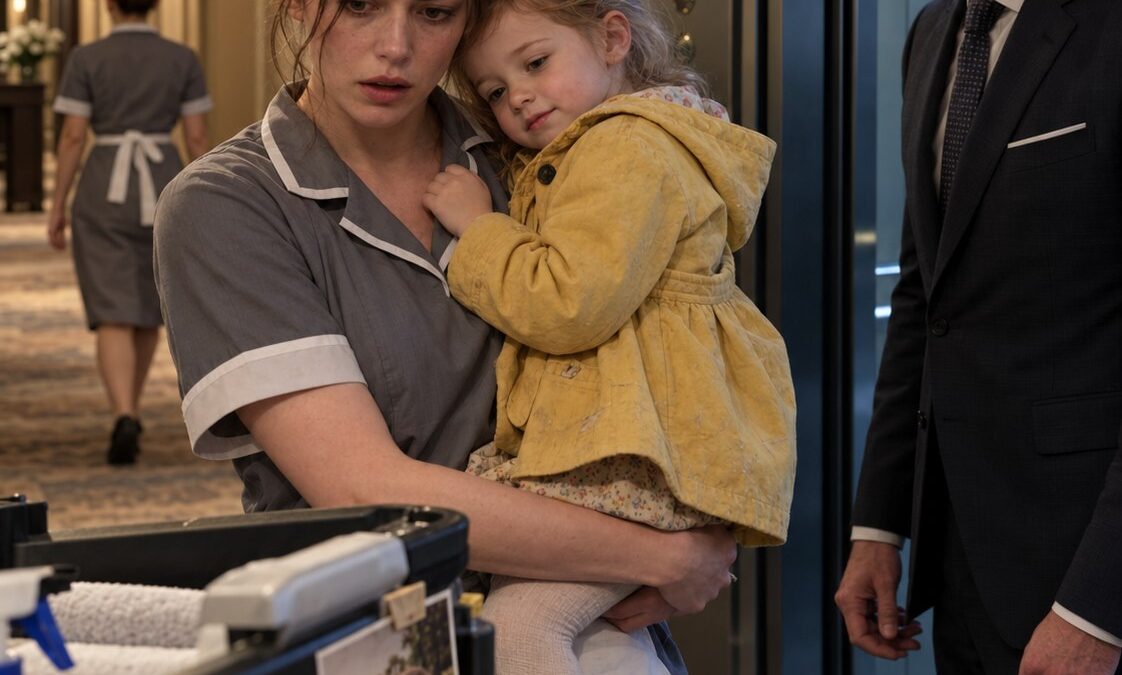
Chapter 2: The Thirteenth Floor
Graham kept his hand against the elevator door.
The empty hallway waited.
Nora stared at the place where the cart had disappeared.
“Did you see the photograph?” she asked.
“I saw a woman.”
“It was my husband.”
Graham turned toward her.
“The woman was your husband?”
“The photograph on her cart.”
Bea pressed her cheek against Nora’s shoulder.
“I want to go home.”
Nora kissed her hair.
“We will.”
Graham took his hand away.
The doors began to close.
Nora stopped them with her shoe.
“Wait.”
“You can’t take her up there,” Graham said.
“Then stay with us.”
“I don’t know what this is.”
“Neither do I.”
He glanced toward the dining room.
The investors had returned to the table, drawn away by a server.
Only Nora, Bea, and Graham remained in the hall.
Graham called the hotel manager.
“Close the elevator bank.”
He listened.
“No, I’m standing beside it.”
His expression changed.
“What do you mean there’s no thirteenth floor?”
Nora could hear the manager’s voice rising through the phone.
Graham ended the call.
Bea pointed at the blank square.
“It’s warm again.”
Nora caught her hand.
Graham looked at Bea’s thin coat, then at the open elevator.
“Your daughter needs somewhere safe.”
“Your hotel has somewhere to hide a floor.”
“I’m trying to find out where.”
Nora studied him.
His confusion looked real.
That did not make him safe.
“My husband inspected this building,” she said.
Graham went still.
“What was his name?”
“Eli Vale.”
Graham’s gaze dropped to the photograph in the letter Nora pulled from her wallet.
It showed Eli holding newborn Bea.
On the back, his careful handwriting named the day.
“He disappeared before the renovation finished,” Nora said.
“He was dismissed.”
“That’s what your letter said.”
Graham read the company seal.
“My signature isn’t on this.”
“It came from your office.”
“I believe you.”
It was the first time anyone from the hotel had said those words.
Bea tucked her cold hands under Nora’s collar.
Graham took off his jacket and offered it.
Nora hesitated.
Then she wrapped it around Bea.
The elevator doors shuddered.
A voice sounded from its ceiling speaker.
A woman’s voice.
“Mr. Voss, please step away from the car.”
Graham looked up.
“Identify yourself.”
“Your general counsel has been notified.”
Nora knew that title.
Margot Saye had signed the letter in Nora’s wallet.
The speaker clicked off.
Graham stared at the seal again.
“Margot told me Eli left the country.”
Nora gripped the photograph.
For four years, she had believed one cruel account of what happened.
Now she understood something worse.
Graham had been given one, too.
* * *
Graham led them into the staff office beside the elevators.
He locked the door.
Nora put Bea on a couch with a blanket and a packet of crackers.
Through the office window, the elevator display stood at thirteen.
Graham photographed it.
Then he called his building engineer.
The man answered on the third ring.
“I’m at the service entrance,” he said.
“Why?”
“Ms. Saye requested a system check.”
“When?”
“Ten minutes ago.”
Graham looked at Nora.
“Don’t touch the controls,” he told the engineer.
He ended the call and rang the front desk.
“Find the woman in the gray uniform.”
“There’s no one scheduled upstairs,” the clerk said.
“Find her anyway.”
Nora unfolded the letter completely.
She had carried it through two moves and three cleaning jobs.
The creases had nearly erased Eli’s name.
“Why keep that?” Graham asked.
“Because Eli signed everything neatly.”
She pointed to the copy of his alleged inspection approval.
“Look at his middle initial.”
Graham read it.
“T.”
“His middle name was Thomas.”
“Then that’s correct.”
“He never used it.”
Nora showed him Bea’s birth certificate on her phone.
Eli’s signature appeared beneath the same name.
No initial.
“He said the T made him sound like a lawyer.”
Graham looked closer at the letter.
“That alone won’t prove forgery.”
“I know.”
Nora had heard those words before.
She had taken the letter to a lawyer when Eli vanished.
Without a sample of the original report, the lawyer could do little.
Graham opened his laptop.
He searched the hotel’s archived renovation files.
The approved inspection report appeared.
Eli’s signature filled the last page.
Nora leaned over his shoulder.
“That isn’t his handwriting.”
“Can you show me?”
She opened a photograph on her phone.
Eli had written a grocery list across the back of a receipt.
Milk.
Oranges.
The brand of crackers Bea now held.
Nora had saved it because it was the last list he wrote.
Graham placed the images side by side.
The signatures differed, but he did not claim more than he could see.
“I’ll have someone qualified compare them.”
“First find out what he was inspecting.”
Graham scrolled to the report’s scope.
Electrical service.
Passenger elevators.
Fire exits.
A diagram showed twelve occupied floors.
Below it sat a note about a former mechanical level.
Abandoned.
Access removed.
“That level is above twelve,” Nora said.
Graham enlarged the diagram.
“It was supposed to be sealed.”
“It has carpet.”
“And someone is paying to light it.”
He searched maintenance invoices.
The thirteenth floor had no listed expenses.
Nora took the laptop.
“Try laundry.”
“Why?”
“I clean this hotel.”
She opened a supply ledger.
Every floor used a numbered delivery code.
One code appeared each Tuesday and Friday.
S13.
Fresh linens.
Cleaning fluid.
Coffee.
“Your hidden floor gets better service than I do,” Nora said.
Graham’s jaw tightened.
He called the independent accounting firm that handled the hotel’s annual review.
He asked for copies of the original invoices, not the summaries sent to his office.
While they waited, Nora remembered the gray woman’s cart.
“The photograph was clipped to her cart, facing outward.”
“That sounds deliberate.”
“She wanted me to see it.”
“Or someone wanted you to follow.”
Nora looked at Bea.
The child had fallen asleep under Graham’s jacket.
“Either way, she knew my face.”
The engineer called back.
The elevator had stopped responding to the lobby console.
He had photographed its service log.
Graham asked him to send the image without entering the car.
The log showed a private maintenance credential used that evening.
It belonged to Margot Saye.
Graham sat back.
“She told me the floor was sealed.”
“Did she approve the work?”
“She approved the entire renovation.”
Nora touched Eli’s photograph.
The woman upstairs had given them a direction.
Margot had given them a reason to follow it.
* * *
A quiet knock sounded at the office door.
Graham checked the camera feed before opening it.
The woman in gray stood outside.
Her cart was gone.
She held both hands where he could see them.
“My name is June Kessler,” she said.
“I work nights upstairs.”
Nora moved toward her.
“Where is Eli?”
June looked at Bea on the couch.
“May I close the door?”
Graham let her in.
June was in her fifties, with tired eyes and a hotel badge bearing another name.
“Eli isn’t there,” she told Nora.
Nora gripped the edge of the desk.
“Then why that photograph?”
“Because he asked me to show you.”
“When?”
“Four years ago.”
June took a breath.
“He said if you ever came near this floor, I should help you find the truth.”
Nora stared at her.
“You knew him?”
“I worked with him.”
“Where is he now?”
June’s eyes filled.
“I don’t know.”
She explained slowly.
The mechanical level had been rebuilt during the hotel renovation.
It held a private archive and offices for property companies Margot controlled.
June had cleaned it since the first week.
Eli had discovered the space while checking fire exits.
“He found people working where the approved plans showed an empty floor.”
“What kind of work?” Graham asked.
“Property records.”
June described cabinets of deeds, settlement agreements, and tenant lists.
The hotel was only one building in a larger redevelopment plan.
Margot’s companies had bought surrounding properties through intermediaries.
Several owners had supposedly agreed to sell.
Eli had found their signatures on documents they said they had never signed.
“He copied what he could,” June said.
“Then Margot found out.”
“What happened to him?” Nora asked.
“I saw him leave with two attorneys.”
“Were they hers?”
“One said he represented the city.”
June had never seen Eli again.
Weeks later, Margot told the staff he had stolen records and fled.
June had kept the photograph because Eli left it behind with a note.
She handed Nora a folded paper.
The handwriting was unmistakable.
If Nora comes here, tell her I tried to get home.
Nora lowered herself into a chair.
Graham knelt beside Bea when the child stirred.
He gave her a fresh cracker and let Nora read.
June had waited years to share the note.
“Why tonight?” Graham asked.
“Margot ordered us to clear the archive.”
“When?”
“Before morning.”
A phone buzzed on Graham’s desk.
His manager had sent a message.
Margot Saye was on her way to the hotel.
June reached beneath her badge and removed a small storage card.
“Eli hid copies in the elevator service cabinet,” she said.
“I found them after he left.”
“Why keep them hidden?”
“Because I was afraid.”
She held the card toward Nora.
“Tonight I saw them shredding the originals.”
Nora did not take it immediately.
“Have you opened it?”
“No.”
Graham called the city’s fraud investigations unit from the office phone.
He stated his name, the location, and what June had brought.
He asked for an officer to collect the card.
Then he called his outside lawyer.
He wanted a preservation notice sent to every company that held hotel records.
Margot could arrive whenever she liked.
She would find witnesses waiting.
June looked at Nora.
“There’s something else about that floor.”
Nora braced herself.
“The private offices paid for the building work,” June said.
“The money came from the settlement fund for the displaced owners.”
Graham looked up sharply.
He had established that fund himself.
Margot had used it to finance the place where she kept the forged claims.
* * *
Margot arrived in a dark coat without her usual assistant.
She stopped when she saw June in the office.
“I asked you to go home,” she said.
June stayed beside Nora.
Graham stepped into the doorway.
“The police are coming.”
Margot looked past him at the sleeping child.
“You’ve frightened your staff over a maintenance error.”
“A maintenance error with desks and payroll?”
“The mechanical level was converted for temporary records.”
“You told me it was sealed.”
“I told you it wasn’t occupied by guests.”
Graham did not move.
Nora understood why Margot had succeeded for so long.
She spoke as if everyone else had misheard.
Margot turned to Nora.
“I’m sorry about your husband.”
Nora held Eli’s note against her palm.
“Tell me what happened to him.”
“I wish I knew.”
June took a step forward.
“You knew he came upstairs.”
“I knew he stole confidential documents.”
“He found forged deeds,” Nora said.
Margot’s eyes narrowed.
“Do you have proof?”
“An investigator can decide.”
“An investigator will ask why June waited four years.”
June’s face flushed.
“I was afraid.”
“Of what?”
“You.”
Margot gave a small, weary shake of her head.
“I provided you steady work.”
“You paid me to clean a floor you said did not exist.”
The elevator chimed beyond the office.
Two city investigators entered with a uniformed officer.
Graham introduced them.
He did not hand over June’s card himself.
June placed it in an evidence envelope the investigator provided.
She signed the seal.
The officer noted the time.
Margot watched every step.
“That card may contain stolen material,” she said.
“Then you can tell us what’s on it,” one investigator replied.
Margot smiled.
“I don’t know.”
The investigators did not inspect it in the office.
They asked for the hotel’s access records and secured the service cabinet.
They took statements separately.
Nora answered what she knew.
Eli’s job.
His disappearance.
The letter.
The woman upstairs.
The photograph on the cart.
When she finished, Bea was awake.
Graham had found a paper cup of milk.
Bea drank it with both hands.
“Are we leaving?” she asked.
“Soon.”
“Is Daddy here?”
Nora felt the question strike everyone in the room.
“I don’t know, sweetheart.”
Bea accepted that.
She leaned against Nora’s leg.
An investigator returned to the office.
They had contacted the attorney whose name appeared in June’s account.
He had left city employment three years earlier.
He agreed to meet them the next morning.
The investigators also had grounds to preserve the records upstairs.
They could not promise immediate answers about Eli.
Margot heard that part.
“There,” she said softly.
“None of you know where he went.”
Nora folded Eli’s note.
“No.”
She met Margot’s eyes.
“But now they know where to look.”
* * *
By morning, the thirteenth floor was closed.
Its computers and paper files were being cataloged.
Nora took Bea home and slept for three hours.
When she woke, there was a message from an investigator.
The former city attorney wanted to speak with her.
Graham offered a car.
Nora took the bus.
She wanted time to think.
The attorney, Daniel Price, met her at a municipal office.
An investigator sat beside him.
Graham arrived separately and waited outside until Nora invited him in.
Price looked older than June had described.
He admitted that Eli had brought him copies of disputed property agreements.
Eli feared the originals would disappear.
“He came to me because I’d worked on the redevelopment,” Price said.
“I told him to make a formal complaint.”
“Did he?” Nora asked.
“He tried.”
Price opened a folder.
The complaint had been filed.
It had been marked withdrawn three days later.
A signature resembling Eli’s sat at the bottom.
Nora looked once.
“That isn’t his.”
Price nodded.
“I believe you.”
“Where did he go?”
“I met him again after the withdrawal.”
“Where?”
“At a bus station.”
Eli had told Price someone had followed him from work.
He planned to visit his mother in Ohio while Price sought help.
“He called me from the road,” Price said.
“What did he say?”
“That he was turning back.”
Nora gripped her chair.
“He said Margot had contacted him.”
“She offered to meet you both?”
“She said she could clear his name if he returned.”
Price had urged him not to go.
That was their last conversation.
The investigator explained that Price’s old notes had dates and call details.
They could be checked against other records.
Nobody asked Nora to accept his account on trust.
For the first time, the last week of Eli’s life had a shape.
He had been trying to protect his family.
He had turned back for them.
Outside the office, Graham stood beside a vending machine.
Nora told him what Price had said.
Graham closed his eyes.
“I signed the redevelopment agreement,” he said.
“Margot handled the purchases.”
“You let her.”
“Yes.”
Nora studied him.
He looked as if he wanted her to say it was not his fault.
She could not.
“Help them find him,” she said.
“I will.”
Over the following weeks, the investigation moved slowly.
The storage card contained copies of deeds, emails, and a spreadsheet tracking payments.
Independent bank records confirmed that settlement money had gone to Margot’s private companies.
Several property owners confirmed their signatures had been forged.
A document examiner found clear differences between Eli’s known writing and the inspection approval.
The records also showed Margot directing hotel staff to keep the thirteenth floor off ordinary schedules.
The investigation into Eli remained harder.
One camera recording from the renovation had survived in an insurance archive.
It showed him entering the hotel on the evening he turned back.
Margot entered twelve minutes later.
Eli never appeared on the available exit footage.
That did not establish what happened inside.
Nora watched the recording once.
Then she asked the investigator to keep searching.
She went back to work.
Bea went back to preschool.
Life kept demanding lunches, bus fare, and clean uniforms.
Graham did not ask Nora to trust him.
He gave investigators access to company servers.
He replaced the hotel’s counsel.
He placed the disputed settlement fund under independent oversight.
Then he waited for the public hearing.
At that hearing, Margot argued that every purchase had been lawful.
Some owners, she said, regretted selling after property values rose.
She presented experts who questioned whether the storage card had been altered.
For an hour, her explanation nearly held.
Then June testified about the supply ledger.
S13 appeared twice weekly for four years.
The accounting firm supplied matching invoices from its own files.
Margot said those deliveries went to storage.
Graham showed the elevator service log.
Her credential had opened the thirteenth floor hundreds of times.
A former clerk identified the deeds she had been instructed to copy.
Finally, Price produced his dated notes from Eli’s complaint.
The complaint bore a withdrawal signature Nora had challenged for four years.
The document examiner showed the court why it was false.
Margot stopped looking at Nora.
Months later, she pleaded guilty to fraud and falsifying records.
The court ordered restitution from her companies.
The disputed owners received their properties back where possible and compensation where it was not.
Investigators continued looking into Eli’s disappearance.
In spring, they found a second insurance archive.
Its camera faced a side entrance.
Eli had left the hotel alone that night.
He carried a folder.
He boarded a bus heading west.
The trail ended two states away, at a motel registered under his name.
The investigator visited Nora before sharing the next finding.
Eli had died there from an undiagnosed heart condition.
There had been no evidence of violence.
The motel had tried to contact the number in his wallet, but it belonged to an old apartment.
A clerical error in his surname had kept Nora’s missing-person report from matching the record.
The investigator brought copies.
Nora read every page.
She hated the smallness of the mistake.
She was grateful to know.
At the sentencing hearing, Margot turned to her.
“Your husband could have come home,” she said.
Nora stood.
“He was trying.”
Margot looked away.
Nora sat beside Bea and held her hand.
There was nothing more she owed Margot.
* * *
Summer changed the shape of their days.
Bea grew tall enough to reach the kitchen counter.
Nora bought a secondhand bicycle and taught her to balance in the park.
They visited Eli’s mother in Ohio.
Nora brought the grocery list.
Bea asked why Daddy had written oranges twice.
“Because he always forgot them,” Nora said.
Bea laughed.
For years, Nora had feared that telling happy stories about Eli would make his absence hurt more.
Instead, Bea began asking for them.
She liked the one about his terrible singing.
She liked how he always checked a door twice.
She liked knowing he had chosen her name.
Graham asked to meet Nora at the hotel in September.
She brought Bea because it was Saturday.
The thirteenth floor had been stripped of its private offices.
The hotel planned to turn it into a public records center for residents affected by the redevelopment.
Graham showed Nora the proposal.
Free access.
Independent staff.
Copies of the investigation’s findings.
A room for property owners to meet with legal advisers.
“It should be named for Eli,” he said.
Nora read the pages.
“He wasn’t the only one who told the truth.”
“Then we’ll ask the others.”
She pointed to a section about funding.
“You’re offering me a job running it.”
“Yes.”
“I’m a cleaner.”
“You kept the record that opened this case.”
“I want training before I take responsibility for anyone else’s papers.”
Graham nodded.
“We can arrange that.”
“And I want the board to choose me.”
“It will.”
“Without you in the room.”
He accepted that, too.
Bea wandered toward the elevators.
Nora called her back before she reached the panel.
Graham watched them.
“I owe you an apology,” he said.
“For laughing at her?”
“For that.”
He glanced up at the thirteenth-floor display.
“And for believing the easy answer about Eli.”
Nora considered him.
“I accept the apology.”
She folded the proposal.
“I’ll decide about the job after the training.”
“That’s fair.”
Bea tugged Nora’s sleeve.
“Does the secret floor belong to people now?”
Nora looked at the open records room.
“It will.”
The board approved the center that winter.
Nora completed a records course at the community college.
June joined the center as its first staff member.
Other witnesses helped decide what the walls would display.
Eli’s name appeared beside theirs.
Nora kept cleaning part-time while she learned the new work.
On her last cleaning shift, her supervisor handed her the old warning about bringing Bea to work.
Nora expected him to tear it up.
Instead, he asked whether she wanted it for the center’s archive.
She looked at the paper and smiled.
“Only if you include what happened next.”
* * *
Five years later, Bea stood in the Bellwether elevator wearing a school backpack.
She was eight and tall enough to press every numbered button.
Nora stood beside her with a folder of newly restored records.
The elevator stopped at twelve.
Bea reached toward the plain steel square above the panel.
It had never been given a number.
“May I?” she asked.
Nora nodded.
Bea pressed it.
A pale bar appeared.
The doors opened on a bright hallway.
At its end, residents waited for the records center to open.
June waved from the desk.
Graham stood with a group of former property owners, listening while they argued about the best place to hang a photograph.
No one moved aside for him.
Bea stepped out first.
“Why is it warm?” she asked, touching the square again.
Nora remembered the cold hallway.
Graham’s laughter.
The photograph on the cart.
The four words that had sent her after it.
“It works,” Nora said.
They walked toward the open door.
Inside were deeds returned to their owners.
Names restored to the public record.
Eli’s complaint, filed where anyone could read it.
Nora placed her folder beside his.
Bea took her hand.
Together, they welcomed the first visitors.
THE END








