THE BILLIONAIRE LAUGHED WHEN A CLEANER’S TODDLER TOUCHED HIS PRIZE GLASS WALL. THEN A NAME APPEARED THAT SHOULD NOT HAVE BEEN THERE.
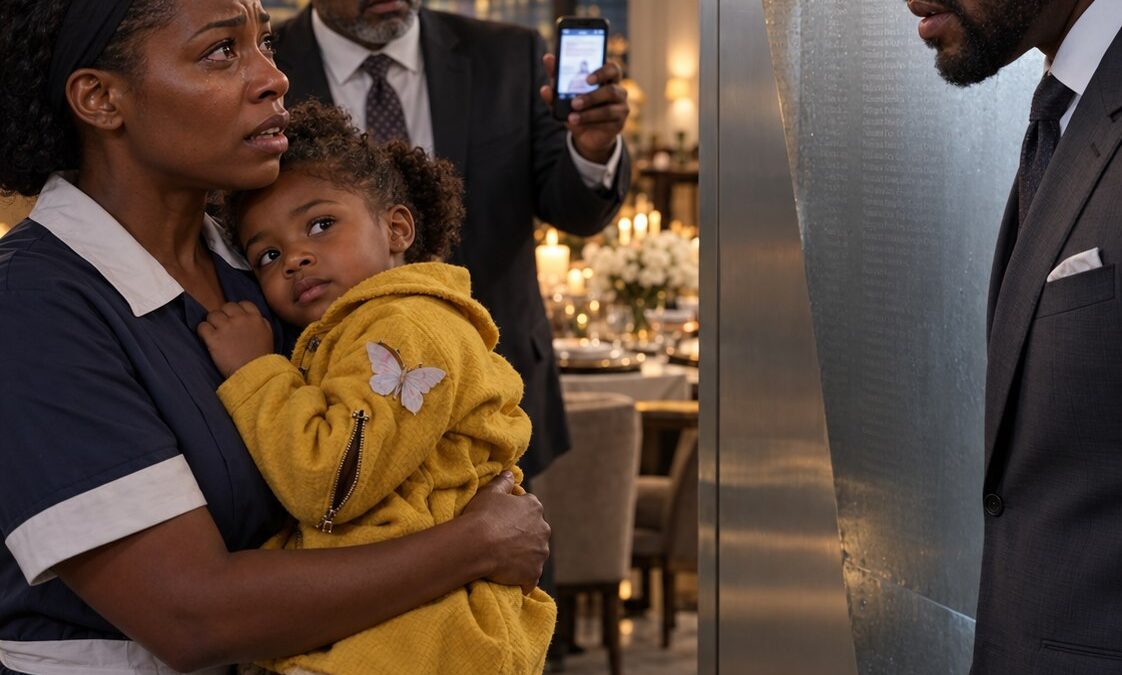
Chapter 2: The Names Beneath
“Who sent that?” Julian asked.
The guest turned his phone over.
“A number I don’t know.”
Nora held Wren tighter.
The child’s butterfly had fallen beside the wall.
Julian bent to pick it up.
Nora caught his wrist.
“Leave it.”
He looked at her hand.
Then at the little shape on the floor.
“You think I’ll destroy it?”
“I think you own the building.”
He withdrew his hand.
“Fair.”
The guest with the phone was Julian’s chief financial officer, Peter Dace.
His thumb hovered above the message.
“Meredith knows,” Peter said.
“How?”
“She receives the building alerts.”
Julian looked at the peeled film.
“The wall has an alert?”
“Facilities reports damage automatically.”
Nora glanced at the ceiling camera.
A red light shone above it.
Someone had watched Wren touch the glass.
Julian called the building manager.
“Lock the loading dock,” he said.
“Hold every contractor until I get there.”
He listened.
His face tightened.
“Who authorized that?”
He ended the call.
“The wall is scheduled for removal at midnight.”
“It wasn’t scheduled this afternoon,” Nora said.
“No.”
“Then call the police.”
“I’m calling my lawyer first.”
Nora stepped away from him.
He saw it.
“You’re right,” he said.
He dialed again.
This time, he asked for the police nonemergency line and reported a possible attempt to remove evidence related to the factory fire.
He gave his name.
He gave the address.
He asked that the call be logged.
It did not make Nora trust him.
It kept the wall standing.
Wren laid her cheek against Nora’s coat.
“Can we go home?”
“Soon.”
Julian noticed her bare ankle above one slipping sock.
He took off his suit jacket and offered it to Nora.
She hesitated.
“For her,” he said.
Nora wrapped it around Wren without thanking him.
A building guard appeared at the doors.
Julian told him no one was to touch the wall.
The guard studied the exposed names.
“Sir, there’s more under there.”
“How much more?”
“I don’t know.”
Nora did.
She had polished that wall every Friday for eleven months.
Near the bottom edge, the film always trapped bubbles.
One bubble sat beside each engraved line.
She had reported it twice.
Both reports had vanished from the maintenance system.
“I thought it was bad installation,” she said.
Julian turned.
“You saw this before?”
“I saw the bubbles.”
“And never told me?”
“I told facilities.”
“That isn’t what I asked.”
Nora felt Wren’s weight against her.
“I’m paid to clean your walls.”
She met his eyes.
“I wasn’t paid to accuse your family.”
Julian had no answer.
The guard crouched beside the engraving.
“Six names,” he said.
“There were six people on the overnight crew.”
Nora looked at him.
“Publicly, there were five,” she said.
“Evan was called a fugitive.”
Peter moved toward the door.
Julian stopped him.
“Stay.”
“I have a board call.”
“Cancel it.”
Peter’s phone lit again.
He showed Julian a second message.
The sender had used the same unknown number.
YOU ARE STANDING BESIDE THE PROOF.
Julian looked at the date beneath Evan’s name.
Then at the initials below the approval line.
M. R.
He had believed his sister buried a memorial because it named a man she thought guilty.
Now he understood the wall had been made before anyone called Evan a fugitive.
“Meredith knew he died,” Julian said.
* * *
By morning, the wall had guards.
Nora had a lawyer.
Julian’s lawyer had recommended both.
They met in a conference room across the river, away from Rourke property.
Wren sat beside Nora, drawing butterflies on scrap paper.
A woman named Helen Cho spread documents across the table.
Helen represented workers in wage and injury disputes.
Nora had called her once after the fire.
She had not been able to afford the retainer.
“You can now,” Helen said.
“Julian’s paying?”
“No.”
Helen tapped a signed agreement.
“A legal aid fund accepted the case overnight.”
Nora looked at Julian.
He shook his head.
“I didn’t arrange it.”
“The fund saw the report,” Helen said.
“Your police call is public record.”
Nora was relieved to hear it.
She wanted someone at that table who owed Julian nothing.
Helen had obtained the original design order for the glass through the installation company.
The order listed six names.
It was dated two weeks after the fire.
“The names came from the county’s preliminary missing-person list,” she said.
“Where did the county get that list?” Nora asked.
“From Rourke Textiles.”
Julian leaned forward.
“Who submitted it?”
“Meredith’s office.”
Peter stood near the window.
He had agreed to attend because the first message had come to his phone.
Helen turned a page.
Three weeks after the engraving order, someone amended the company’s account.
The amended report described Evan as a suspected arsonist who had left the building before the roof fell.
His name disappeared from the missing-person list.
The five others remained.
But the engraving had already been finished.
“Why cover every name?” Julian asked.
“The wall wasn’t meant to be public yet,” Helen said.
“We need the installer’s account.”
Nora studied a photograph of the original design.
Six engraved names.
A dedication.
No silver film.
At the edge of the photograph stood a man holding a roll of transparent installation tape.
She recognized him.
“Mr. Vale.”
Everyone looked at her.
“He maintained the lobby plants.”
“What does that have to do with the glass?” Peter asked.
“He didn’t maintain them.”
Nora remembered his old canvas bag.
His dusty sleeves.
The way he watched contractors through the lobby reflection.
“He came after the installation.”
“How do you know?” Helen asked.
“Because I washed the adhesive off the floor.”
It had taken three nights.
The clear tape stuck to her gloves.
Mr. Vale had stood nearby, apologizing each time she scraped another strip free.
“You knew him?”
“He gave me clean cloths.”
Nora remembered one more thing.
“When I asked why they covered the glass, he said it wasn’t his choice.”
Helen called the installation company.
Mr. Vale had retired six months earlier.
His name was Aaron Vale.
He had supervised the engraving.
Helen found a current number in the company’s old files.
Aaron agreed to meet them that afternoon.
Before they left, Nora asked Helen to request the maintenance reports she had filed.
Julian’s building manager said they no longer existed.
Nora took out her phone.
She had photographed the bubbles for her supervisor.
She had kept the images in a folder labeled GLASS, along with every work problem she was told had never happened.
One photo showed the date.
Another showed a bubble directly over Evan’s name.
Helen sent copies to herself.
“That’s why I want you here,” she told Nora.
At Aaron Vale’s apartment, a kettle steamed on the stove.
He listened without interrupting.
When Helen showed him the exposed engraving, he closed his eyes.
“I hoped someone would find it,” he said.
“Why leave it there?” Nora asked.
“Because they wouldn’t let me take it.”
Aaron had built the panel for a memorial approved by Meredith.
He showed them the invoice, the proof sheet, and a delivery receipt.
Then he found an email.
Meredith had ordered the silver film four days before the opening.
She called it a temporary design change.
Aaron had argued that covering the engraving might damage the glass.
Meredith had told him to proceed.
Julian read her message twice.
“She said the families requested privacy.”
“They never asked us,” Nora said.
Aaron opened a drawer.
Inside lay a narrow strip of the original film.
“I kept this,” he said.
“Why?”
“I thought someday I might need to prove what I installed.”
The back carried a manufacturer’s batch number.
Helen photographed it.
Julian examined the purchase order.
The film had been billed to a company he owned.
But the authorization came from his private office.
He looked at Peter.
“Who approved expenses for my office then?”
Peter swallowed.
“Meredith had signing authority.”
Nora watched Julian search the page.
The signature was unmistakable.
His sister had hidden Evan’s name using his money and his authority.
* * *
That evening, Nora returned to her apartment.
Wren fell asleep halfway through a sandwich.
Nora carried her to the small bedroom and set the paper butterflies beside her pillow.
Then she heard a noise downstairs.
A delivery truck idled outside.
Two men in work jackets entered her building with a tall crate.
Nora called Helen.
“Don’t open the door,” Helen said.
“I’m calling the police.”
The men never reached her floor.
By the time officers arrived, they had left the crate in the lobby.
It contained six rolls of silver window film.
A card lay on top.
FOR YOUR NEW HOME.
No signature.
No address for a new home.
Nora stared at it while an officer photographed everything.
The message was clear enough.
Someone knew where she lived.
Julian arrived forty minutes later.
He stopped at the lobby door when Nora saw him.
“I didn’t invite you,” she said.
“Helen told me.”
“She shouldn’t have.”
“I asked her to call if there was a problem.”
“That was her decision to make.”
He accepted the correction.
“Are you and Wren safe?”
“The officers are handling it.”
Julian looked at the crate.
“I can move you somewhere.”
“No.”
“I can pay for security.”
“Then offer it through my lawyer.”
He nodded.
“Okay.”
The officer asked whether Nora recognized the card.
She did not.
Julian did.
The lettering matched the stationery used for Rourke executive gifts.
That fact went into the report.
No one arrested Meredith that night.
The card and film could have come from several offices.
The truck’s plates led to a rental company.
The driver had been hired through an account in Peter Dace’s department.
Peter denied ordering it.
He offered his phone to police.
The unknown messages were still there.
Helen told Nora to keep her routine for Wren as steady as possible.
That was easier said than done.
At breakfast, Wren asked why the butterflies had moved from the kitchen to the bedroom.
“So they can watch you sleep,” Nora said.
“Paper can’t watch.”
“You caught me.”
Wren considered that.
“Can Daddy?”
Nora sat beside her.
She had told Wren that Evan died before they met.
She had never told her how much she still wondered about that sentence.
“We’re finding out what happened to him,” she said.
Wren pressed her palm against Nora’s.
“Like the glass?”
“Like the glass.”
After preschool drop-off, Nora went with Helen to see a retired fire investigator.
He had handled the original inquiry.
His files had been transferred when the case closed, but he kept copies of his own interview notes.
“The company controlled the building records,” he said.
“Did you receive the door logs?” Helen asked.
“Not the originals.”
He handed them a copy.
At 9:14 p.m., the fire doors on the third floor had supposedly opened.
That supported Meredith’s account that Evan escaped.
Nora knew those doors.
She had visited Evan at work twice.
The third-floor exit emptied onto a loading ramp behind the factory.
“There should be a camera,” she said.
“There was,” the investigator replied.
“It failed that night.”
“Who reported the failure?”
He checked his notes.
“Meredith Rourke.”
The fire had damaged most of the building.
No footage survived.
But Nora remembered Evan complaining about the exit before the fire.
He had drawn a sketch on the back of a grocery list.
She had kept it because it was the same list where he wrote the name Wren for a future daughter.
At home, she found it inside a cookbook.
Helen spread it beside the copied door log.
Evan’s sketch showed a third-floor door jammed by a new storage cage.
He had dated the note six days before the fire.
“I told him to report it,” Nora said.
“He did?”
“He said he would.”
The investigator searched another file.
A safety complaint had arrived four days before the fire.
It described the storage cage.
The name of the employee had been blacked out in his copy.
The company said the cage was moved the next morning.
Nora looked at Evan’s sketch again.
“Who checked?”
“No independent inspection.”
Julian called while they sat there.
His voice came through Helen’s speaker.
“I found the storage order.”
A Rourke subsidiary had installed the cage to secure a room of new machines.
The machines were leased.
Their insurance policy required working exits.
“Meredith signed the order,” he said.
The investigator asked for the policy.
Julian sent it.
Then he sent one more document.
Three months after the fire, the insurer paid Rourke Textiles forty-eight million dollars for destroyed equipment and interrupted work.
The payment depended on the building meeting its stated safety conditions.
Julian had thought his sister hid Evan’s death to protect the company from bad publicity.
Now he saw a more concrete reason.
“If the exit was blocked,” he said, “the claim was in trouble.”
Helen checked the signature on the claim certification.
Meredith Rourke.
* * *
The board met the next morning.
Julian had called an emergency session.
Meredith came in carrying a slim leather folder.
She greeted every director by name.
She did not greet Nora.
Helen sat at Nora’s side.
The retired investigator waited outside with a detective from the reopened case.
Peter sat opposite the directors, his phone on the table.
Julian presented the original engraving order first.
Then Nora’s dated photographs.
Then Aaron Vale’s email and the surviving strip of film.
Meredith let him finish.
“You found a memorial we delayed,” she said.
“Why did you delay it?” Julian asked.
“Because one name became disputed.”
“You ordered it covered before the report changed.”
“Preliminary reports change.”
“Evan’s family wasn’t told he was on the list.”
“Neither were other families.”
Nora looked up.
“The others knew their relatives died.”
Meredith turned to her.
“I’m sorry for what you’ve endured.”
“Please answer him.”
Several directors shifted in their seats.
Meredith opened her folder.
She had prepared a statement from a former supervisor.
It claimed Evan had argued with management on the afternoon of the fire.
It said he threatened to make the company pay.
Julian looked at Nora.
Evan had argued.
He had told her that much.
“He wanted the cage moved,” she said.
Meredith nodded gently.
“That may have been part of it.”
She was careful.
She did not say Evan lit the fire.
She only let the room consider it.
Then she showed the directors a photograph of the blocked exit.
The cage was gone.
A date appeared in the corner.
Two days before the fire.
Nora’s stomach tightened.
Helen asked for the original file.
Meredith offered a printed copy.
“The server was lost in the fire.”
Julian studied the image.
“The camera angle is from the loading ramp,” he said.
“Yes.”
“The ramp camera failed.”
“That night.”
Nora leaned closer.
She knew the ramp, too.
Near its railing was a painted white square where drivers parked empty pallets.
In Meredith’s photograph, the square was unbroken.
In Nora’s photograph of Evan visiting her at the ramp, taken a week before the fire, a broad scrape cut through it.
A forklift had made it while they stood there.
She still remembered Evan laughing at the driver’s embarrassed wave.
“The paint is wrong,” she said.
Meredith turned.
“What?”
“This photograph is older.”
Helen placed Nora’s image beside Meredith’s.
The scrape was clear.
It had been there six days before the fire.
Meredith’s supposed photograph was dated two days before the fire.
A director leaned across the table.
“Could the square have been repainted?”
“No one repainted that ramp,” Julian said.
He checked the maintenance expense records on his tablet.
There was no paint purchase.
Helen held up a hand.
“That alone doesn’t prove when the cage moved.”
“It proves this photograph doesn’t.”
Meredith closed her folder.
“You’re relying on a widow’s memory and an old picture.”
Nora felt the familiar heat in her face.
Then she set down Evan’s grocery list.
His drawing showed the cage still blocking the door six days before the fire.
The paper had a store receipt stapled to it.
The receipt bore the same date.
“It stayed up after this,” she said.
“Evan filed a complaint two days later.”
Meredith glanced at the list.
“Anyone could draw that.”
“Yes,” Nora said.
“That’s why investigators should check it.”
Julian turned to the detective waiting by the door.
He brought him inside.
The detective accepted copies of the sketch, the safety complaint, both photographs, and the insurance claim.
He did not announce an arrest.
He asked Meredith to preserve her devices and company records.
A second officer delivered preservation notices to the board secretary.
Meredith spoke again before they left.
“You know what happens if the insurer challenges the claim,” she told Julian.
“People lose their jobs.”
“You should have thought of them when you signed it.”
“I did.”
She looked around the table.
“I kept the company alive.”
For a moment, Nora understood why the directors had followed her.
Meredith could make a terrible choice sound like the only choice.
Then Aaron Vale entered with Helen’s permission.
He carried the original engraving proof.
On it were all six names.
He also carried an email Meredith had sent after the company publicly named Evan as a fugitive.
It instructed him to keep the film in place permanently.
The subject line read: NO CHANGES TO THE WALL.
Meredith’s attorney asked for a break.
The detective requested an interview.
Meredith agreed through her attorney and left with him.
At the door, she stopped beside Nora.
“You’ll get money now,” she said quietly.
“Is that enough?”
Nora looked at her.
“No.”
The board placed Meredith on leave that afternoon.
An independent review of the insurance claim began.
Months passed before prosecutors filed charges related to false statements and records.
The insurance dispute took longer.
Investigators never determined what started the fire.
They did establish that the exit had remained obstructed and that Evan’s disappearance had been falsely described.
A court later approved settlements for the affected families.
Evan’s death was officially recognized.
At the hearing, Nora brought Wren’s paper butterfly in her purse.
She did not need to take it out.
Her husband’s name had finally been spoken aloud.
* * *
Spring came slowly.
Nora kept her cleaning job for three more weeks.
Then she accepted a position at a school near Wren’s preschool.
The hours let her pick Wren up before dark.
The pay was steady.
On her last night at the Rourke building, she found Julian waiting near the wall.
The silver film was gone.
All six names stood in the glass.
“I didn’t know you were leaving tonight,” he said.
“You know now.”
He handed her an envelope.
She did not take it.
“It’s a copy of the corrected record,” he said.
“Your lawyer has the original.”
Nora accepted it.
They stood before the names.
Julian had offered her a larger payment beyond the legal settlement.
She had turned it down.
Instead, she asked him to fund independent safety inspections and a scholarship for the children of the workers who died.
His board approved both.
A separate trust administered the scholarship.
Nora had insisted on that.
“I owe you an apology,” Julian said.
“You gave me one.”
“I gave you one for the dinner.”
“This is for the four years before it.”
He looked at Evan’s name.
“I accepted a story because it was convenient for me.”
Nora folded the envelope.
“You did.”
“I should have asked harder questions.”
“You should have asked his wife.”
He nodded.
“I’m sorry.”
She let the words sit.
“I believe you,” she said.
“That doesn’t make us friends.”
“I know.”
Wren appeared from behind the lobby desk.
The night guard had given her a sheet of scrap paper.
She held up a crooked butterfly.
“It has a name,” she told Julian.
“What name?”
“Window.”
“That suits it.”
Wren examined him.
“You don’t laugh now.”
“No,” Julian said.
“I don’t.”
The guard walked her back to Nora.
On the train home, Wren pressed the butterfly against the window.
It fell twice.
The third time, she held it there with her palm.
Nora watched the city slide past behind it.
The settlement paid the debt left by Evan’s missing wages.
It gave Nora room to sleep.
It did not give Wren memories of him.
So Nora began making a small book.
She put in photographs.
Evan at the lake.
Evan burning pancakes.
Evan asleep beside the half-painted crib.
She included his grocery list.
On its back, beneath the sketch of the blocked exit, he had written WREN? and circled it three times.
Wren liked that page best.
“Did he pick me?” she asked.
“We picked you together.”
Years later, Nora would remember how carefully she said it.
She could give Wren the truth without giving her every fear.
One afternoon, Julian called Helen.
He wanted permission to ask Nora about a public dedication.
He had arranged for the names to remain visible and for the families to choose the wording beneath them.
Helen passed the question along.
Nora spoke to the other families.
They disagreed about the first draft.
They changed two lines.
They removed a sentence praising the company.
Julian accepted every change.
At the dedication, he stayed at the back.
Nora stood with Wren and the other families.
No one asked her to thank him.
Afterward, Wren approached the glass.
She lifted one finger toward Evan’s name.
Then she looked at Nora.
“Can I?”
“Yes, honey.”
Her fingertip touched the letters.
This time, nothing had to be uncovered.
* * *
Six years later, Wren was nine.
She came to the building with a class project in her backpack.
The lobby had changed.
The expensive chairs were gone.
The glass remained.
Visitors passed it every day.
Some stopped.
Some read every name.
Wren had written a report about her father.
She had used Nora’s photographs and the corrected records.
Helen had helped her find the dates.
She had not written that a little girl solved the fire.
She knew she hadn’t.
She had found a loose corner.
Other people had kept the proof.
Nora met her after school beside the wall.
Wren took a paper butterfly from her backpack.
This one was cut from a copy of her report.
She held it beside Evan’s name.
“Remember the first one?” she asked.
“It was made from a receipt.”
“It was ugly.”
“It had character.”
Wren smiled.
Behind the glass, the names caught the afternoon light.
Six workers.
Six families who had been told less than the truth.
A widow who no longer searched every room for an answer.
A daughter who knew her father had tried to make a door safe.
Wren placed her palm against the glass.
“There are people in there,” she said.
Nora stood beside her.
“Yes,” she said.
“And now everyone can see them.”
THE END








