THE BILLIONAIRE LAUGHED WHEN A CLEANER’S TODDLER TOUCHED HIS SILENT PIANO. THEN A DEAD WOMAN’S WARNING FILLED THE HALL.
Chapter 2: The Original
“Turn it off,” Noah said.
Nobody moved.
The second voice belonged to a man.
“Where is the paper?” he asked.
Celeste answered faintly.
“With the person you blamed.”
A sharp scrape followed.
Then the recording stopped.
The buyer lowered his phone.
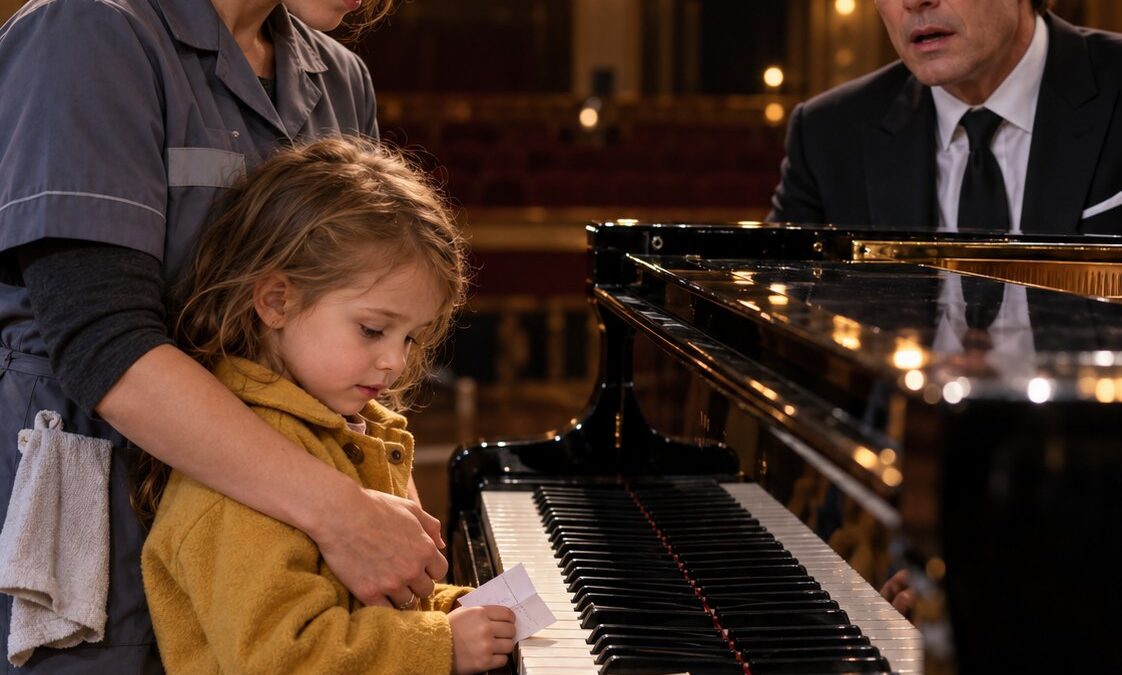
Wren reached Junie first.
Her daughter held the folded paper between two fingers.
It was not part of the yellow tag.
It was a narrow strip of blue stationery, stiff with age.
“Did I break it?” Junie asked.
“No,” Wren said.
She held Junie against her coat.
Junie’s heart beat quickly beneath the faded yellow fabric.
The buyer took one step toward them.
“May I see that?”
Wren closed her hand around the blue paper.
“Please stay there.”
He stopped.
Noah stared at the piano.
“Play it again.”
The buyer moved toward the keys.
“Please don’t touch it,” Wren said.
He stopped.
Noah looked at her.
“You heard Celeste.”
“I heard my name.”
“That recording was erased.”
“Apparently it wasn’t.”
For years, Wren had imagined this meeting.
She had imagined telling Noah what his accusation cost Eli.
She had never imagined doing it while Junie trembled in her arms.
Noah noticed the little girl’s bare hands.
He took off his suit jacket and offered it.
Wren hesitated.
Junie was cold.
Wren accepted it.
The jacket swallowed Junie’s shoulders.
She tucked her hands beneath the sleeves.
The hall manager appeared at the door.
Noah asked her to keep everyone inside until the police arrived.
The buyer protested.
“I’m allowed to leave.”
“You are,” Noah said.
“Please send me the video first.”
The buyer studied his face, then sent it.
Wren watched the transfer complete.
She had learned to distrust promises that left no record.
“Send it to me too,” she said.
The buyer glanced at Noah.
Noah gave him Wren’s number.
A moment later, her phone lit up.
She checked the first seconds without pressing play.
Junie’s small figure stood beside the piano.
The buyer’s camera had caught the paper leaving the key.
Wren put the phone away.
Noah turned back to the piano.
“Eli told me there was another recording.”
“He told everyone.”
“He said Celeste left it for him.”
“And you said he was lying.”
Noah had no answer.
Wren unfolded the blue strip.
It carried three handwritten words.
ASK FOR ORIGINAL.
Beneath them was a date from the fundraiser.
Celeste’s initials sat at the bottom.
“Is that her writing?” Noah asked.
“You tell me.”
He leaned close without taking the paper.
“I think so.”
“Thinking wasn’t enough for Eli.”
Noah stepped back.
Junie touched the crooked key again.
This time it played a clear note.
The piano had never been broken.
Someone had jammed that key with Celeste’s note.
* * *
Police arrived before the auction guests left.
An officer photographed the key, the note, and the yellow service tag.
She asked Wren how Junie had reached the paper.
“From underneath,” Wren said.
“There was a narrow gap below the keyboard.”
Junie demonstrated from Wren’s arms.
She pointed to the place her fingers had fit.
The officer photographed that too.
She asked the buyer to preserve his original video.
He agreed to send it directly to the department.
Noah explained that the piano had a built-in recorder.
Its final session remained listed on the screen, but pressing play had produced silence for years.
A technician had told him the sound file was damaged.
The officer asked for the technician’s name.
Noah looked at the floor.
“Calder Voss.”
Wren knew the name.
Calder was Sloane Arts’ chief financial officer.
He had managed the fundraiser.
He had also supplied the documents that accused Eli.
The officer asked whether the piano could be moved.
“After it’s examined,” she said.
Noah canceled the sale.
The buyer asked about his deposit.
The hall manager promised a refund in writing.
Wren watched her make a copy for him.
By then, Junie was nearly asleep.
Noah offered to call them a car.
Wren gave the officer her address instead.
The officer wrote it beneath Wren’s statement.
“You may hear from us tomorrow,” she said.
“I’ll answer.”
Wren carried Junie past the waiting auction guests.
Nobody laughed this time.
The next morning, a forensic audio specialist inspected the recorder with both sides’ lawyers present.
Wren brought Junie to her neighbor’s apartment.
Then she returned with Eli’s old work notebook.
It contained sketches of the piano’s wiring.
The specialist found a tiny mechanical switch beneath the crooked key.
When the key stayed down, the recorder’s playback signal routed to a silent test channel.
When Junie freed it, playback returned to the speakers.
The specialist showed them without changing the recorder’s settings.
He pressed the switch with a plastic tool.
The speakers went quiet.
He released it.
A low hiss returned.
“Could that happen by accident?” Noah asked.
“The paper was folded to fit,” the specialist said.
“The switch was held down deliberately.”
He made a verified copy of the audio.
The officer sealed the original device for further examination.
Wren placed Eli’s notebook beside her chair.
She did not want it passed around without a record.
The recording continued for twenty-seven minutes beyond what the hall had heard.
Most of it was empty-room noise.
Then came Celeste’s footsteps.
She spoke close to the piano.
“Eli, I’m leaving you a copy.”
Paper rustled.
“The board packet is false.”
Wren gripped Eli’s notebook.
The specialist paused the recording.
“No changes to the source file,” he said.
“I’ll mark our place.”
Noah looked at Wren.
“Did Eli ever mention a packet?”
“He mentioned a contract.”
“What contract?”
“He said Celeste refused to sign away the children’s clinics.”
Eight years earlier, Celeste had founded three neighborhood clinics through the family charity.
They treated children whose parents could not pay in full.
The fundraiser celebrated an expansion.
That same night, the board approved a sale of the buildings to a development company.
The clinics were later told to move.
Two had closed.
Noah had believed Celeste approved the sale.
He had seen her signature.
Eli said it was forged.
Then the last recording vanished.
Wren opened his notebook to a page covered with careful measurements.
At the bottom, Eli had written: Blue original, bench rail.
The bench had been replaced years ago.
Wren’s stomach dropped.
“Where did the old bench go?”
Noah called the hall manager.
It sat in storage, wrapped for the auction.
An officer accompanied them downstairs.
The storage room smelled of cardboard and furniture polish.
Three benches stood against the far wall.
Wren found Eli’s pencil mark beneath one seat.
He had drawn a small circle around a screw.
“That one,” she said.
The officer photographed the mark.
The hall manager found the inventory record.
It confirmed the bench had belonged to the piano.
Inside the bench’s narrow rail, they found an envelope.
Celeste had addressed it to the foundation’s outside counsel.
Its seal had never been broken.
Wren knew why Eli had hidden it.
Security had searched his bag that night.
They had never searched the bench he serviced.
The lawyer arrived that afternoon and opened it in front of them.
Inside lay the unsigned sale agreement.
Across its first page, Celeste had written: I will not approve this transfer.
The date matched the recording.
The lawyer turned each page slowly.
One paragraph promised the clinics continued use of their buildings.
It had been crossed out in Celeste’s hand.
“She wanted new terms,” the lawyer said.
“She never authorized these.”
Noah asked why she had addressed it to the firm.
“She called us that evening.”
The lawyer looked at Wren.
“She said a technician could deliver it.”
Wren touched the edge of Eli’s notebook.
He had tried.
The signature Noah had trusted came later.
* * *
Calder learned about the recording before sunset.
His office sent every staff member a notice calling it an altered file.
By morning, a law firm had written to Wren.
It demanded that she surrender Eli’s notebook.
It also accused her of damaging valuable property by bringing Junie into the hall.
Wren read the letter twice.
Then she took it to her lawyer.
She had met Dana Price during Eli’s final appeal.
Dana had worked without charging him for the last four months.
“The notebook stays with you,” Dana said.
“We’ll offer a documented copy through counsel.”
Wren nodded.
“And Junie?”
“The officer saw the key.”
Dana tapped the letter.
“This is pressure.”
She copied the letter and put it in a folder.
Wren watched her write the date on the cover.
“Can they sue her?”
“They can try to make you afraid.”
“Will they?”
“Let them put a claim on paper.”
Wren thought of Junie apologizing in the hall.
“She thinks she broke it.”
“Tell her what the technician found.”
Wren put the folder in her bag.
She had come in clutching the letter.
She left holding a plan.
That afternoon, Wren’s cleaning agency removed her from the hall schedule.
The manager apologized over the phone.
A Sloane contract paid most of the agency’s bills.
Wren thanked her and wrote down the call’s time.
She asked whether another site had an evening opening.
The manager promised to check.
Wren did not ask her to promise more.
Then she made Junie toast.
Junie dipped a corner into her soup.
“Is the piano better?”
“Yes.”
“Was Daddy right?”
Wren looked at her daughter.
“He was.”
Junie considered that.
“Good.”
She ate another corner of toast.
“Did the lady know Daddy?”
“She trusted him.”
“Did you?”
“Every day.”
Junie smiled into her soup.
Wren went to the sink before her voice gave way.
Noah called later.
He offered to cover the wages Wren had lost.
She asked him to send the offer through Dana.
“I’m sorry,” he said.
“For the agency?”
“For more than that.”
Wren stood by the kitchen window.
Across the street, a clinic that Celeste had founded was now a furniture showroom.
The windows displayed expensive lamps.
Wren remembered pushing Junie’s stroller through those doors when they still led to a waiting room.
A nurse had taught her how to bring down a fever.
Nobody had asked for payment first.
“Start with what you signed,” she said.
Noah grew quiet.
“I signed the accusation against Eli.”
“I know.”
“I relied on Calder’s audit.”
“You were the person Eli begged to hear him.”
Noah did not defend himself.
The next day, he gave investigators his personal files from the fundraiser.
Among them was a message Celeste had sent hours before the board meeting.
She asked Noah to delay the sale until she could show him “the original figures.”
Calder had told Noah she meant attendance figures.
She meant the clinic accounts.
Dana and a forensic accountant compared the unsigned agreement with the signed version.
The pages looked identical at first.
Then the accountant found a changed account number in the payment instructions.
She asked for the bank records behind both numbers.
Dana requested copies through the foundation’s lawyers.
Noah authorized the foundation to cooperate.
The development company was supposed to pay the foundation.
The signed version directed the first payment to another company.
That company belonged to Calder’s brother.
Noah brought Wren the corporate filing himself.
She read the names slowly.
Then she read them again.
The company’s address matched one in Eli’s notebook.
He had written it beside a question mark.
Wren showed Noah the page.
“He got this far,” she said.
Noah stared at Eli’s handwriting.
“He asked me to look at his notes.”
“Did you?”
“No.”
Wren closed the notebook.
A knock came at her apartment door.
It was the agency manager.
She had found Wren two short shifts across town.
Wren took them.
Noah waited until the manager left.
“I can help with this.”
“You already can,” Wren said.
“Give the investigators everything.”
Calder had forged Celeste’s approval to divert the clinic sale proceeds.
He blamed Eli because Eli had the recording.
* * *
The foundation board met ten days later.
Its members sat beneath a portrait of Celeste.
Wren attended with Dana.
Noah sat across from them.
Calder arrived with two attorneys and a calm expression.
The board chair explained the meeting’s purpose.
They would decide Calder’s duties and refer any evidence requiring investigation.
They were not a court.
Nobody pretended otherwise.
Calder set a binder before each trustee.
Dana placed a smaller folder beside Wren.
The yellow tag rested on top.
Wren held it by one corner.
Eli had once clipped it to his shirt pocket.
Calder began with the clinics.
He spoke about repairs, unpaid invoices, and declining donations.
He did not deny the company belonged to his brother.
He said the payment was a legitimate consulting fee.
He did not deny Celeste’s note.
He said she had changed her mind later.
He did not deny the recording.
He said an angry employee could have arranged it.
Several trustees listened closely.
Calder knew their fears.
Reversing the sale could cost the foundation years of litigation.
Publicly admitting a forged signature could threaten its grants.
He presented a thick folder of clinic expenses.
“The buildings were draining money,” he said.
“I found a buyer who kept two open for another year.”
A trustee checked a page in his binder.
“These repair estimates were substantial.”
“They were,” Calder said.
Wren looked at the dates.
One estimate had been prepared after the sale.
She marked it on Dana’s copy.
Dana leaned close.
“Good catch.”
Calder continued speaking.
He described the first payment as a fee for finding a buyer.
“The foundation received the balance.”
“How much was the fee?” the chair asked.
Calder named a figure.
A trustee’s pen stopped moving.
The fee would have paid several clinic nurses for a year.
A trustee asked Noah whether he had approved the transaction.
“I approved what I believed Celeste had signed,” Noah said.
Calder leaned forward.
“You were there.”
“I was.”
“You read the agreement.”
“I read the summary you prepared.”
Calder spread his hands.
“Then we share the mistake.”
For a moment, Wren thought he might win.
He had turned theft into a difficult business decision.
He had made the closed clinics sound like an unfortunate cost.
Dana passed the yellow service tag to the board chair.
Eli had written on its reverse.
Wren had found the words only after the hall recording.
They were so faint that the officer’s angled photograph brought them out.
BENCH COPY TO CELESTE. ORIGINAL TO COUNSEL.
Calder’s attorney objected.
“A dead employee’s note proves very little.”
Wren agreed.
By itself, it proved very little.
That was why Eli had kept the notebook.
She opened it to a page showing the recorder’s service log.
The handwriting matched his tag.
The page listed the exact time Celeste made the recording.
An independent technician had recovered the same time from the device.
The board chair compared the two records.
“Who installed the switch?” she asked.
“Eli serviced the piano,” Calder said.
“He could have arranged anything.”
Wren felt the old accusation rise again.
This time, she had a document in her hands.
“The switch belonged to the manufacturer’s system,” she said.
“The technician’s report explains it.”
She pointed to the relevant page.
“The paper held it down.”
Calder looked at the report.
For the first time, he lost his place.
Then Dana asked the outside counsel to speak.
The lawyer held up Celeste’s sealed envelope.
“My office logged an expected delivery that night,” she said.
“It never arrived.”
She showed the trustees her firm’s eight-year-old intake record.
Celeste had called to say Eli was bringing the unsigned original.
Eli never made it out of the hall with the bench.
Security had stopped him after Calder accused him of taking charity money.
The chair turned toward Calder.
“Who made that accusation?”
“I reported a discrepancy.”
“Who told security to stop him?”
Calder’s attorney touched his sleeve.
Calder said nothing.
The security log answered.
Noah had obtained it from the hall’s archive.
Calder’s name appeared beside the instruction.
Calder’s face tightened.
The board chair asked why the forged agreement carried Celeste’s signature.
Calder said nothing.
Dana produced the independent confirmation.
A bank had supplied its records under subpoena.
The diverted payment entered his brother’s company.
Over the next month, most of it moved to an account Calder controlled.
Dana laid the transaction dates beside the sale agreement.
The first transfer had arrived the morning after the vote.
The next had moved while Eli was being questioned.
Calder’s attorney stood.
“This meeting should end.”
“It will,” the chair said.
She voted to refer the findings to investigators and remove Calder from all foundation duties.
The other trustees agreed.
No one applauded.
The chair asked the trustees to preserve their board packets.
Noah agreed to provide the original summary Calder had sent him.
Wren gave Dana the yellow tag.
Dana placed it back inside its protective sleeve.
Outside the room, Wren called her neighbor.
Junie wanted to know whether Wren would be home for dinner.
“Yes,” Wren said.
“Is the piano still better?”
“Yes.”
Two months later, prosecutors filed fraud and forgery charges.
A separate review cleared Eli of the theft allegation.
The foundation settled its claim against his estate and corrected its public records.
Wren read the correction at her kitchen table.
She printed a copy for Junie to see when she was older.
Calder pleaded guilty the following spring.
Before he left the boardroom that day, he stopped beside Wren.
“Your husband could have walked away,” he said.
Wren held his gaze.
“He tried to walk a document to a lawyer.”
* * *
Winter came slowly to the harbor.
Wren found work at a public library.
The hours matched Junie’s preschool schedule.
She shelved books in the morning and helped visitors use the computers in the afternoon.
She liked knowing where things belonged.
One older visitor came every Thursday to print a bus schedule.
He always thanked her as though she had invented the printer.
Wren began setting aside a chair for him.
At home, Junie lined up her picture books along the couch.
She called it her library.
The overdue fine was one hug.
Noah asked to meet at the library after closing.
Dana came too.
He brought a proposal from the foundation.
It offered Wren a large personal payment.
It also offered to fund a new clinic in Eli’s name.
Wren read every page.
“The settlement for Eli’s reputation is separate,” Dana said.
“It’s already agreed.”
Wren nodded.
She pointed to the clinic proposal.
“Who runs it?”
“The foundation,” Noah said.
“Who decides whether it stays open?”
“The trustees.”
“Then I don’t want his name on it yet.”
Noah accepted the answer.
He asked what she wanted instead.
Wren had spent three evenings speaking to parents who remembered the old clinics.
They wanted ordinary things.
A nearby doctor.
Evening hours.
A place that accepted their insurance.
A place that would explain a bill before sending it.
One father had taken two buses to get his daughter’s prescription renewed.
A grandmother had kept a folder of unanswered billing letters.
Wren brought their written suggestions.
She did not bring their names without permission.
Wren wanted the recovered money committed to those needs through an independent local nonprofit.
Noah took notes.
“You’ve thought about this.”
“Eli did,” she said.
“He kept a list.”
She showed him the back pages of the notebook.
Between wiring diagrams, Eli had written clinic addresses, bus routes, and names of families who had called him after the closures.
He had thought a repair could begin with facts.
Noah read for a long time.
“May I make a copy?”
Wren looked at Dana.
Dana nodded.
“Only these pages,” Wren said.
“And remove the families’ names.”
Noah agreed.
A month later, the foundation transferred the recovered funds to a community health group.
The group announced evening appointments at one reopened clinic.
Wren attended the first open house.
She recognized the old waiting-room windows.
Someone had put plants on the sill.
Junie found a basket of crayons and drew a piano with twenty keys.
Noah arrived after the speeches.
He stood near the door until Wren saw him.
“I owe you an apology,” he said.
“You’ve said that.”
“I never said what I did.”
Wren waited.
“I chose Calder’s report because it made the problem simple.”
He looked toward Junie’s drawing.
“I let Eli carry it.”
“Yes,” Wren said.
“I did that.”
Wren folded her arms.
“I can accept the apology.”
“I understand if you can’t forgive me.”
“I didn’t say that.”
He looked up.
“I said I can accept it.”
She glanced at the families signing up for appointments.
“What happens after this matters more.”
Noah nodded.
He did not ask for anything else.
In spring, the concert hall reopened for public performances.
Noah asked whether Junie might like to visit the piano.
Wren asked Junie.
Junie said she would, provided it no longer sounded sad.
The hall had kept the instrument.
Its recorder had been inspected, documented, and disconnected from automatic playback.
A music teacher showed Junie where to put her hands.
Junie pressed three keys at once.
They sounded terrible.
She laughed.
Wren laughed too.
The teacher showed her a single middle key.
Junie pressed it gently.
“There,” she said.
“That one sounds better.”
For the first time in years, she could think of Eli in that room without thinking only of his last fight.
Noah watched from a distance.
When Junie asked for the yellow service tag, Wren let her hold it.
“Daddy wrote this?”
“He did.”
“Why did he keep it?”
“He was waiting for someone to find the right thing.”
Junie studied the faded pencil.
“Did I?”
“You found a start,” Wren said.
“Then a lot of people helped finish it.”
* * *
Six years later, the concert hall filled with children.
A community music program held its annual recital there.
Its fees were low enough that Junie’s classmates could come.
Junie was nine now.
She wore a dark blue dress and carried her music in a folder bent at one corner.
Before her turn, she asked Wren to walk to the piano with her.
The yellow service tag hung in a small frame beside the instrument.
Below it, a plaque named Eli Kessler as the technician who preserved Celeste’s final recording.
Wren had approved every word.
Junie stood beneath the old keyboard.
“One is crooked,” she said.
Wren looked up.
Every key was level.
“I know,” Junie said.
“I just wanted to see your face.”
Wren shook her head.
Junie climbed onto the bench.
Across town, the reopened clinic was finishing its evening appointments.
Eli’s record had been cleared.
Celeste’s unsigned agreement rested in the foundation archive, where anyone with a reason could request it.
Calder had answered for what he took.
Noah sat in the last row, a guest among other guests.
Junie found the first note.
Then the second.
Wren listened as the hall filled with music.
THE END








