The Billionaire Offered a Cleaner’s Daughter $400,000 to Prove His Painting Was Fake—Then She Pointed at the Frame
Chapter 2: The Seventh Arch
Dorian lowered the microphone.
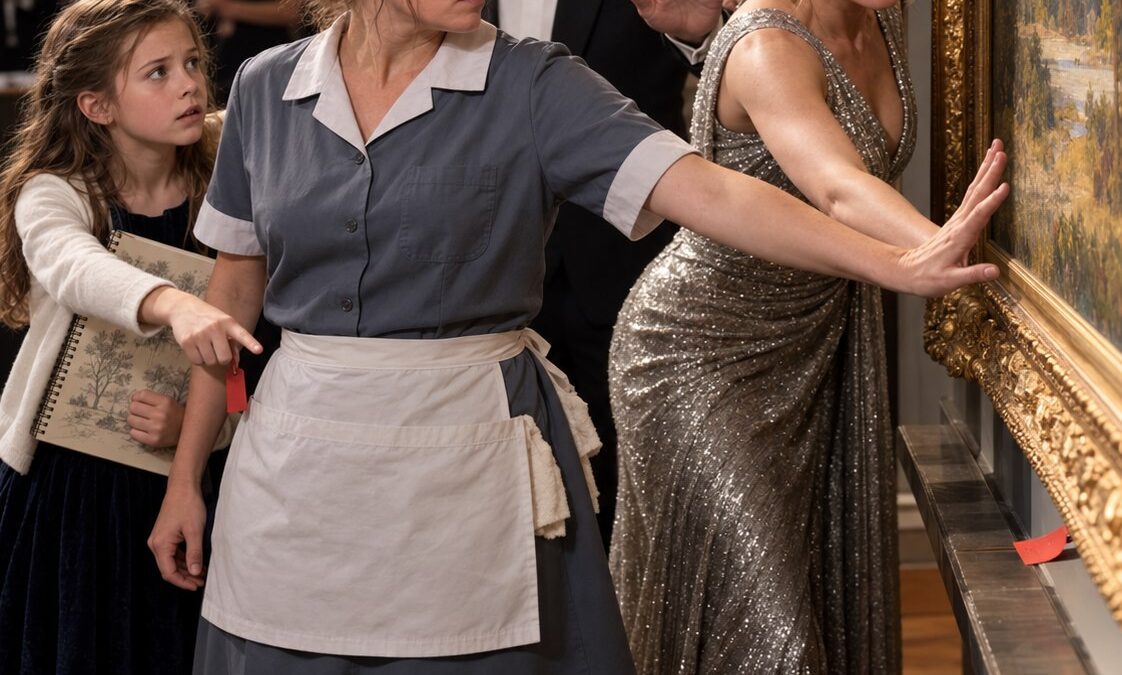
Kit kept pointing.
Nora moved closer.
The tag caught beneath the frame looked old.
Its edges were soft.
Its string was new.
Someone had tied it through a brass loop behind the auction placard.
“Step away,” a woman said.
Helena Voss crossed the gallery.
She directed the Bellwether Museum.
She also approved Nora’s shifts.
Her silver dress caught the camera lights.
“Is there a problem?” she asked.
Kit looked at Nora.
Nora read the date again.
September seventeenth.
Elias had died that June.
“There is,” Nora said.
Helena’s eyes settled on the tag.
For one brief second, her face changed.
Then she smiled.
“This belongs in our records.”
She reached for it.
Nora put herself between Helena and the frame.
“Please don’t touch it.”
A security guard approached.
Dorian glanced at the cameras.
“Put those down.”
Several guests lowered their phones.
One did not.
Helena kept her hand extended.
“Nora, you’re an employee.”
“I know.”
“Then let me handle museum property.”
“The child found it in public.”
“She found a loose tag.”
Kit’s voice came softly.
“It isn’t loose.”
Everyone looked at her.
“The string goes behind the placard.”
Helena turned.
“Darling, please.”
“Her name is Kit,” Nora said.
Dorian pulled the microphone away from his mouth.
He set it on a table.
“Can we see the back without moving the painting?”
A security guard said they could remove the placard.
Helena answered first.
“That would interrupt the auction.”
Dorian checked his watch.
“It hasn’t started.”
“The bidders are waiting.”
“So am I.”
The guard looked at Helena.
Then at Dorian.
Neither was his supervisor for tonight.
He stayed still.
Nora knew him.
His name was Calvin Rusk.
He had helped her carry a leaking bucket past the freight lift last Tuesday.
“Calvin,” she said, “could you ask the registrar to come?”
Helena’s smile sharpened.
“The registrar is busy.”
“That’s all right,” Nora said.
“We can wait.”
Kit touched Nora’s sleeve.
“I remember where I saw it.”
“What?”
“That number.”
Nora crouched.
Kit showed her Elias’s tag.
The old ink had faded to brown.
There was a small 7 beside the accession number.
Elias used to add it when a frame had been fitted with seven narrow wooden braces.
“Grandpa put sevens on the ones he fixed,” Kit said.
Nora remembered his workbench.
A jar of blunt pencils.
Cotton gloves drying by the window.
Elias turning a frame over and asking her what she noticed.
She had been twenty then.
She had noticed dust.
He had taught her to notice where it stopped.
The tag behind the placard also bore a small 7.
But the visible frame had six braces.
Nora could see their shallow join lines along its side.
“How do you know?” Dorian asked.
“My grandfather made that mark,” Nora said.
“It records the frame, not the painting.”
Helena folded her arms.
“Your father’s private system was never adopted here.”
“Maybe not.”
Nora pointed.
“But someone copied it.”
Calvin’s radio crackled.
He spoke quietly into it.
Helena stepped closer to Dorian.
“You came to buy a painting,” she said.
“This family is using your auction for attention.”
Kit’s cheeks colored.
Nora put a hand on her shoulder.
“She didn’t ask you for anything.”
Dorian looked at Kit’s sketchbook.
“Where did that drawing come from?”
“Grandpa’s notebook,” Kit said.
“He let me copy it.”
“When?”
“Before he got sick.”
“Did he show you the painting?”
Kit nodded.
“He was fixing the frame.”
Helena shook her head.
“A child’s memory isn’t authentication.”
“No,” Dorian said.
“It isn’t.”
His answer gave Helena a little room.
She took it.
“Then we can proceed.”
“But the tag is still there,” he said.
A woman in a dark suit appeared at the gallery door.
“Someone asked for me?”
Calvin lifted his hand.
“Ms. Chen.”
Ruth Chen was the museum’s registrar.
Nora had seen her working late among shelves of boxes.
She carried a tablet and wore flat shoes.
Helena’s expression cooled.
“This can wait until morning.”
Ruth looked at the tag.
“It shouldn’t.”
She asked Calvin to keep the guests behind the rope.
Then she photographed the frame from both sides.
She took a wider picture.
It showed the painting, the placard, and the tag together.
Nora watched her work.
Elias had taught her that a record needed a place and a time.
A number alone could travel anywhere.
Ruth read the visible digits.
Her thumb stopped over the tablet.
“What is it?” Dorian asked.
Ruth did not answer him.
She looked at Helena.
“Why does this tag say the painting returned in September?”
Helena’s jaw tightened.
“Because it returned in September.”
“Elias Bell signed the receipt.”
Nora heard Kit inhale.
“He couldn’t,” she said.
Ruth turned the tablet toward the group.
A digital receipt carried Elias’s name.
It also carried that September date.
Nora took Kit’s hand.
Dorian looked from the screen to the frame.
“The museum accused him of losing it in March.”
“Yes,” Ruth said.
“And its own records say he checked it back in six months later.”
* * *
The auction did not resume.
Dorian asked for a pause.
Helena called it unnecessary.
The board chair, who had finally arrived from the dining room, agreed to pause it anyway.
The painting stayed on the wall.
Calvin closed the gallery.
Ruth asked everyone who had handled the frame to remain available.
Guests complained behind the doors.
Nora listened to the voices rise and fall.
Her next shift would begin at dawn.
The agency might cancel it before then.
Kit leaned against her leg.
“Did I get Grandpa in trouble again?”
Nora knelt.
“He isn’t in trouble.”
“He hated when people said he stole it.”
“I know.”
“Are they going to say that about us?”
Nora looked at the closed door.
“I’m going to make sure they hear us.”
Ruth invited them into the registrar’s office.
It was small and crowded.
Boxes lined the walls.
A desk lamp lit a stack of folders.
Dorian came too.
Helena followed without being asked.
Ruth laid a blank page on the desk.
“I’m going to write down who says what,” she told Kit.
“You can tell me if I get anything wrong.”
Kit nodded.
Ruth asked about the sketchbook.
Kit had copied Elias’s drawing the summer before he died.
Nora had kept the notebook after his apartment was cleared.
It was at home.
She had not known it contained anything useful.
“He drew lots of places,” Kit said.
“Did he write the painting’s title?”
“I think so.”
“Don’t guess,” Ruth said gently.
“We’ll look when we have it.”
Ruth asked for a photo of Kit’s page.
Nora agreed.
Kit held the sketchbook steady.
Dorian watched the seven arches appear on Ruth’s screen.
“Could the artist have painted six?” he asked.
“The original catalog photograph shows seven,” Ruth said.
Helena leaned over the desk.
“Print quality varies.”
“The bridge doesn’t,” Ruth said.
She opened a record from the museum archive.
The photograph was old.
Its colors had shifted.
But seven dark openings crossed the river.
Kit counted them aloud.
“One.”
“Two.”
She stopped at seven.
Dorian sat down.
“The canvas on the wall is different.”
“It appears so,” Ruth said.
“I need a conservator to examine it.”
Helena gave a thin laugh.
“That photograph was taken decades ago.”
“Then the examination will help.”
Ruth pulled up the September receipt.
It had been entered three years earlier.
The account named Elias as the person releasing the painting from conservation storage.
The destination field said “collections imaging.”
Nora frowned.
“Why would a dead man release it?”
“Someone may have selected the wrong name,” Ruth said.
“Who entered it?”
“I can check the audit trail.”
Helena placed her hand on the desk.
“The database migrated that year.”
“It keeps older user records,” Ruth said.
“Some may be incomplete.”
“Then check them.”
Ruth looked at her.
“I intend to.”
Nora studied the paper receipt displayed beside the entry.
Elias’s signature sat near the bottom.
It looked right.
Almost.
He made the B in Bell like two small boxes.
The second box always hung lower.
Here both boxes sat level.
She had watched him sign school forms.
Birthday cards.
A note giving her permission to sell that drafting table.
“That isn’t his hand,” she said.
Helena looked annoyed.
“It was scanned from a paper form.”
“Scanners don’t move letters.”
Ruth enlarged the signature.
Nora pointed to the B.
“He couldn’t make them even.”
Kit stood on tiptoe.
“He said the pencil went downstairs.”
Nora nodded.
“Every time.”
Dorian stared at the screen.
“Who had access to the form?”
“That is a longer question,” Ruth said.
Helena turned to him.
“You see why I resisted a spectacle.”
Nora met her eyes.
“The spectacle was his idea.”
Dorian did not defend himself.
Ruth opened a different folder.
Elias had been suspended in March.
A small landscape had gone missing during a storage count.
Six months later, the September receipt put that same work back in the system.
The missing item report had never been closed.
“Why?” Nora asked.
Ruth checked the file.
“Someone marked the return as a different version.”
“How many versions were there?”
“One recorded original,” Ruth said.
“And one study owned by a private lender.”
Dorian straightened.
“Which lender?”
Ruth scrolled.
“The Sloane Collection.”
He stared at her.
“My collection lent a study?”
“Yes.”
“When?”
“Two years before the missing item report.”
Dorian shook his head.
“My office handles loans.”
Helena spoke quickly.
“You inherited a large portfolio.”
“My mother left me the collection,” he said.
“I know what it holds.”
Ruth opened the lender file.
A study was listed.
A photograph showed a rougher bridge.
Six arches.
Kit looked at it.
“That’s the one on the wall.”
The office went still.
Ruth compared the two images.
The brushwork differed around the river.
The six-arch study had been considered less valuable.
Its documented owner was Dorian’s late mother.
“Why would you offer eleven million for your own painting?” Nora asked.
“I was told the original was being sold,” Dorian said.
“By whom?”
He looked at Helena.
She looked at Ruth’s screen.
“That study was deaccessioned from your family trust,” Helena said.
“You may not remember the paperwork.”
“I remember signing the offer for the original.”
Ruth made a note.
Nora glanced at Kit.
She had grown quiet.
“Can she have some water?” Nora asked.
Ruth found a paper cup.
Dorian reached toward the cooler first.
Kit accepted the water from Nora.
He stepped back.
The small gesture surprised her.
It did not settle anything.
Ruth opened the audit log.
The September entry had been created at 11:42 p.m.
A staff account had submitted it.
Elias’s name was attached as the releasing conservator.
The username belonged to a collections assistant who had left the museum two years ago.
Helena gave a relieved breath.
“There.”
Ruth kept reading.
The assistant’s permissions had been temporary.
They had been granted that afternoon.
By the museum director’s office.
“Staff permissions aren’t proof of wrongdoing,” Helena said.
“No,” Ruth replied.
“But they tell us where to look.”
Nora remembered something Elias had told her near the end.
He had found a painting under a sheet in a room he was no longer allowed to enter.
He would not say which one.
He had been afraid of sounding obsessed.
Nora had asked him to leave the museum alone.
He had said he would.
Now she wished she had asked where the room was.
“He thought it came back,” she said.
Ruth turned.
“My father,” Nora said.
“He told me he’d seen something he recognized.”
“When?”
“August of that year.”
Helena’s gaze sharpened.
“Why didn’t you report that?”
“He had been suspended,” Nora said.
“The museum wouldn’t let him past the front desk.”
Dorian rubbed his forehead.
“So it was here in August.”
“Maybe,” Ruth said.
“We still need proof.”
Calvin knocked.
A woman from the museum’s legal counsel had arrived.
Ruth asked Nora’s permission to share her statement.
Nora said yes.
The lawyer read the photographs.
She recommended preserving the painting and its records.
She also recommended an outside conservator.
Helena objected to both recommendations.
The lawyer listened.
Then she wrote them down.
Ruth turned the September receipt over in its digital folder.
The scanned paper had a second page.
Most of it was blank.
At the bottom sat a routing code.
Nora knew it.
She had cleaned the basement corridor beneath that code for five years.
It led to the director’s private storage room.
* * *
By morning, Nora’s agency had removed her from the Bellwether schedule.
The message arrived while she packed Kit’s lunch.
“Pending review,” it said.
Nothing else.
Their rent was due in twelve days.
Nora counted what remained in her bank account.
Four hundred and eighty-three dollars.
She set the phone face down.
Kit watched from the table.
“Is it because of me?”
“No.”
“They sent you home.”
“Your mother can work other places.”
“That isn’t what I asked.”
Nora sat across from her.
“Someone wants this to go away,” she said.
“That was their choice.”
Kit traced a circle on her cereal bowl.
“Grandpa kept going back.”
“He did.”
“He said a picture could tell the truth.”
“He also said you should finish breakfast.”
Kit took a bite.
Nora put a banana beside her lunchbox.
At nine, Ruth called.
The museum had sealed the gallery.
The painting would stay off the auction block.
An independent conservator could come the next day.
Ruth had also copied the relevant digital records to the museum’s legal counsel.
“Did Helena agree?” Nora asked.
“The board chair did.”
Ruth paused.
“Could you bring your father’s notebook?”
Nora found it beneath the towels in a hall closet.
Its cover smelled faintly of linseed oil.
Elias had drawn the bridge in layers.
The first page showed seven arches.
The next showed the painting’s frame from behind.
Seven braces.
A third page contained measurements.
Nora photographed each page.
Then she found an envelope tucked near the back.
It held two bus tickets.
A grocery receipt.
And a folded note in Elias’s writing.
The note listed three dates.
Beside the last, he had written: “They moved the canvas, not the frame.”
Nora stared at it.
She called Ruth back.
Ruth asked her to bring the original notebook.
They met at a public library.
The museum’s lawyer joined them there.
Nora preferred the library.
Its tables belonged to everyone.
Ruth photographed the notebook and the envelope.
She recorded when Nora found them.
The lawyer asked whether anyone else had handled them.
“Kit,” Nora said.
“She uses it to draw.”
Kit sat beside her with a new page open.
“I didn’t move the note,” she said.
“I know,” the lawyer replied.
“We ask everyone the same question.”
Ruth studied the dates.
The first matched Elias’s suspension.
The second was in August.
The third was three days before the false September receipt.
“He made a timeline,” Ruth said.
Nora touched the words about the frame.
“He knew something had changed.”
The lawyer pointed at the second date.
“Why record a bus ticket?”
“That was the day he came to see me,” Nora said.
“He was upset.”
“Did he tell you why?”
“Only that the museum was making the wrong thing disappear.”
Ruth copied those words into her notes.
Nora hated how little she had understood him.
She remembered telling him to rest.
He had done his best to smile.
Across the table, Kit kept drawing.
She had made the bridge wide enough for seven arches.
“What happens now?” she asked.
“The painting gets examined,” Ruth said.
“And my grandpa?”
“We look at what happened to him.”
Kit nodded.
She returned to her sketch.
Outside the library, rain hit the windows.
Nora’s phone lit up.
A message from her agency manager said her placement review would take at least a week.
Then another arrived.
The museum had reported that Nora allowed an unauthorized child into a restricted gallery.
Her agency wanted a written response.
Nora read it twice.
“The program held class there,” Kit said.
“She was authorized,” Ruth said.
She asked Nora to forward the message.
The museum lawyer’s expression hardened.
“Who made the report?”
The agency manager’s reply came an hour later.
Helena Voss had called personally.
Nora looked at the name.
Ruth looked too.
“Keep that message,” she said.
“I’m keeping everything.”
That afternoon, an art center across town offered Nora three cleaning shifts.
A friend from the Bellwether kitchen had mentioned her.
The pay was lower.
The bus ride was longer.
Nora accepted.
She would not let Kit mistake a temporary loss for their whole future.
On the bus home, Kit fell asleep against her.
Nora opened Elias’s notebook again.
Near the back, she found a drawing she had missed.
It showed a narrow storage corridor.
A door stood at the end.
Elias had marked the door with a rectangle.
Inside it, he had written one word.
“Proof.”
The next morning, the independent conservator arrived at Bellwether.
Nora and Kit were not allowed in the examination room.
That was right.
Nora wanted the work done carefully.
Ruth called after lunch.
The six-arch canvas was the privately owned study.
Its materials matched the older record.
The frame on the wall had been built for the seven-arch original.
Someone had placed the study inside it.
The conservator could not say who.
Ruth had also checked the private storage room.
It was empty.
“The door from the notebook?” Nora asked.
“Yes.”
“Was anything there?”
“Empty shelves.”
Nora thought about Helena calling the agency.
She had been fast with that.
She might have been fast with the room too.
“Did you tell her you were going in?”
“The board told her yesterday,” Ruth said.
The lawyer would now contact the police about the missing original and the altered records.
Nora pressed the phone to her ear.
“Can they find it?”
“They can follow the transfers.”
Ruth hesitated.
“There’s something else.”
A shipping request had been drafted at 7:14 that morning.
The destination was a bonded art warehouse across town.
The requester had used the director’s account.
The item description was blank.
* * *
The police took Ruth’s report that afternoon.
They did not treat Kit’s drawing as proof of a crime.
They took the catalog photographs, the examination report, the receipt, the audit log, and Nora’s messages.
They interviewed the staff who controlled the gallery.
They asked about the warehouse request.
Nora gave them Elias’s notebook.
A detective photographed it in her apartment.
He left the original with her.
His name was Malik Price.
He spoke to Kit only with Nora beside her.
He asked what she had seen.
Kit described the arch.
She described the red tag.
She did not guess who had moved anything.
“That helps,” he told her.
After he left, she asked whether Grandpa would be cleared.
“I hope so,” Nora said.
She wanted to promise more.
She could not.
Three days passed.
Nora cleaned an art center’s classrooms each evening.
Paint water had stained the sinks.
Children’s names covered the drying racks.
She liked seeing them.
On Thursday, Dorian Sloane appeared in the lobby.
The center’s receptionist recognized him immediately.
Nora wished he had called.
Kit was at a table inside, painting a row of houses.
Dorian stayed near the door.
“I owe you an apology,” he said.
“You owe one to her.”
“I know.”
“Then wait until she’s ready.”
He nodded.
“I also owe the program four hundred thousand dollars.”
Nora folded her cloth.
“You made that promise in front of cameras.”
“I’ve instructed my office to prepare the gift.”
“Don’t put my daughter in another video.”
“I won’t.”
He looked through the classroom window.
“She was right about the painting.”
“She was.”
“And I made her defend it.”
Nora let him stand with that.
The receptionist returned to her desk.
Dorian lowered his voice.
“My family owned the study.”
“I heard.”
“My mother lent it years ago.”
“Did you know Helena had it?”
“No.”
“I need you to be certain before you answer.”
He faced her.
“I didn’t.”
Nora believed he meant it.
Whether he should have noticed more was another question.
“Why did you bid on the original?” she asked.
“My mother loved it.”
“That isn’t what I asked.”
He accepted the correction.
“I wanted the museum to have the money,” he said.
“And I wanted her name on the children’s wing.”
“Both can be true.”
“Yes.”
Nora rinsed her cloth.
“Ask your office how the study left your collection.”
“I have.”
“What did they say?”
“The transfer paperwork bears my signature.”
“Did you sign it?”
“I signed a stack of documents the year she died.”
“That sounds like a yes.”
“It might be.”
Kit looked up through the window.
She saw him.
Her brush stopped.
Nora opened the classroom door.
“Mr. Sloane is here,” she told her.
“You don’t have to talk.”
Kit came into the lobby.
She held a paper towel around her brush.
Dorian bent slightly.
He did not come closer.
“I’m sorry I mocked you,” he said.
Kit watched him.
“You said I had to apologize.”
“I was wrong.”
“You laughed first.”
“I did.”
“Other people laughed because you did.”
Dorian’s face tightened.
“Yes.”
Kit nodded once.
“I wanted them to see the arch.”
“They should have listened.”
She looked at Nora.
“Can I go finish the roof?”
“Of course.”
Kit went back inside.
Dorian did not ask whether she forgave him.
Nora respected that much.
Later that night, Ruth called.
The police had asked the warehouse to preserve its records.
A shipment booked under a museum foundation account had been scheduled to leave the next morning.
It was canceled after the preservation request.
“What was in it?” Nora asked.
“The manifest says framed artwork,” Ruth said.
“No title.”
“Who paid for the warehouse?”
“A company called North Pier Holdings.”
Nora had never heard of it.
Ruth had.
North Pier had donated money to Bellwether.
Its owner was hidden behind another company.
The police were obtaining business records.
Nora sat on the edge of her bed.
Kit slept in the next room.
“Why would Helena risk this?” she asked.
Ruth took a moment.
“The museum has been short of cash.”
“Short enough to sell its painting?”
“The board never voted to sell it privately.”
“Then what was the auction for?”
“I don’t know yet.”
Nora thought of the invitations.
A new children’s wing.
Fresh rooms.
Her daughter’s name on a donor list someday.
The promise had been easy to believe.
On Friday, the art center director told Nora a woman had called about her.
The caller asked whether Nora had access to its collections storage.
The director had refused to discuss employees.
“She didn’t leave a name,” he said.
Nora showed him Helena’s earlier report to the agency.
He asked if she wanted someone to walk her to the bus.
“Yes,” Nora said.
She did not pretend she felt safe.
The threat was small enough to deny.
It still made her check the locks twice.
At home, Kit had built a bridge from cereal boxes.
Seven openings stood beneath it.
One collapsed when Nora set down her bag.
Kit looked horrified.
Nora picked up the fallen piece.
“Your engineer is tired.”
“She needs tape.”
“She needs dinner first.”
Kit smiled a little.
They ate rice and beans at the kitchen table.
Nora told her the art center wanted to display the houses she had painted.
Kit asked if they would put her name on the label.
“Only if you want them to.”
“I do.”
Nora thought about the museum gallery.
About a child whose name had been reduced to “the cleaner’s daughter.”
She wrote “Kit Bell” on a clean sheet of paper.
Kit copied it beneath her painting.
Later, Malik called.
The police had received records from North Pier Holdings.
The company belonged to a trust controlled by Helena’s brother.
It had been paying the warehouse fees for two years.
The foundation had also wired it money listed as conservation expenses.
“How much?” Nora asked.
“Enough that we’re examining all of it.”
“Was the original there?”
“We’re seeking authority to inspect the stored work.”
Nora closed her eyes.
She could picture the seven arches behind a door.
Malik continued.
“Ms. Voss’s brother planned to sell a landscape overseas next month.”
There was no room left for the story Helena had told them.
The architect was Helena Voss.
The motive was the museum’s money.
* * *
Bellwether’s board convened an emergency meeting the following week.
Nora had been invited to speak.
She brought Kit because Kit asked to come.
She also brought Elias’s notebook.
Ruth met them outside the conference room.
“The original has been recovered,” she said.
Nora stopped.
“Where?”
“In the warehouse.”
“Is it damaged?”
“The conservator’s first look found no visible damage.”
Kit gripped Nora’s hand.
“Seven arches?”
“Seven,” Ruth said.
The police had obtained legal authority to inspect the crate.
Its shipping records connected it to North Pier.
The work remained with authorities while the ownership and criminal investigation continued.
Ruth told them only what she could confirm.
Inside the room, Helena sat beside her attorney.
Dorian sat across from her.
Board members lined the table.
A court reporter had been hired to make a record.
The police were not there to make a public arrest.
The board’s counsel explained that at the start.
This meeting concerned museum decisions.
The criminal investigation was separate.
Helena listened without blinking.
Then she stood.
“I protected this institution during an impossible period.”
Her voice was calm.
She described canceled grants.
A roof that leaked over the education rooms.
Donors who wanted their names on walls but refused to fund repairs.
“The original could have sat unseen in storage,” she said.
“The study could be displayed safely.”
“Only if people knew what it was,” Dorian replied.
Helena turned to him.
“You saw it and offered eleven million.”
“I trusted the label.”
“You trusted the price.”
A board member shifted.
Helena had found an opening.
She took it.
“The study is real,” she said.
“It came from your family.”
“None of that made it the original.”
“I intended to disclose the attribution before the sale.”
“When?” the board chair asked.
“After the bidding established its value.”
The chair stared at her.
“That is not how an auction works.”
Helena faced the rest of the board.
“The museum was facing closure.”
“Our accounts show a shortfall,” one member said.
“They don’t show a vote authorizing North Pier.”
“I used a lender willing to move quickly.”
“You used your brother’s trust.”
“He could offer favorable terms.”
Nora watched the board members exchange looks.
Helena had prepared answers.
Some were almost persuasive.
Nora remembered cold nights in old classrooms.
She knew buildings needed money.
She also knew exactly whose reputation Helena had spent.
The board’s counsel invited Ruth to present the records.
Ruth showed the original catalog photograph.
Seven arches.
She showed the study’s photograph.
Six.
She showed the independent examination report.
She showed the frame.
Then the red tag appeared on the screen.
It had been removed by the conservator and placed in a protective sleeve.
The front bore the accession number.
The small 7 sat beside it.
The back bore Elias’s name and the impossible date.
Helena leaned forward.
“A clerical error.”
“Perhaps,” Ruth said.
She displayed the paper receipt.
Its signature matched the mark on the tag.
The two level boxes of the B were identical.
“A copied signature,” Ruth said.
“Again, perhaps a staff shortcut.”
Nora could see doubt returning to two board members.
Ruth opened another image.
The tag’s reverse had a shallow indentation.
A pencil had once been pressed against paper laid on top of it.
Under angled light, the impression became legible.
A few words.
Then a number.
“North Pier, bay twelve,” Ruth read.
Helena sat very still.
“The tag was used as a writing surface,” Ruth said.
“Possibly by accident.”
The board chair looked at Helena.
“Does North Pier have a bay twelve?”
“It has many bays,” she replied.
Dorian spoke.
“Mine did not.”
Everyone turned.
He placed a folder before the board counsel.
His family office had traced the study’s transfer.
Dorian’s signature authorized a loan renewal.
A later page, changing the owner to North Pier, had been attached after he signed.
The page carried a digital creation date six weeks later.
His office had obtained the original electronic file from its document system.
An outside examiner had confirmed when the added page was created.
Helena’s attorney objected to the board treating that as conclusive.
The counsel agreed.
“This board is deciding what to preserve and report,” she said.
“A court will decide criminal liability.”
Ruth added the warehouse records.
The crate holding the seven-arch original had entered bay twelve on the date written on the tag.
A security camera still showed the crate arriving.
The driver’s bill named the museum foundation as shipper.
Helena had approved its transport invoice.
She answered quickly.
“I approve hundreds of invoices.”
“The specific request came from your account,” Ruth said.
“My staff use delegated access.”
“Then we’ll give investigators that explanation.”
The board chair asked Nora to speak.
Nora stood.
Her uniform was clean.
Her hands still smelled faintly of soap.
“My father knew the frame had seven braces,” she said.
“He put a 7 on every record about it.”
She held up his notebook.
“When he saw that canvas disappear, he reported it.”
Helena looked away.
“He was suspended,” Nora said.
“The museum let people call him a thief.”
“That was before my appointment as director,” Helena replied.
“You were head of collections.”
“I did not make the suspension decision.”
“You knew the painting came back.”
Helena’s attorney touched her arm.
She ignored him.
“I knew a work had been returned under a disputed record.”
“You put my father’s name on that record.”
“I did not personally enter it.”
Nora looked at the board.
“Then find the person who did.”
“We will,” the chair said.
Nora continued.
“Please find the people who repeated it, too.”
She did not want a speech.
She wanted a correction with names and dates.
Kit rose beside her.
Nora turned.
“You don’t have to.”
“I want to.”
The board chair invited Kit to speak.
Kit looked at Helena.
“My grandpa showed me how to draw the bridge.”
She held up her sketchbook.
“He said if I made a mistake, I should look again.”
Helena pressed her lips together.
“I looked again,” Kit said.
“So should you.”
Nora put an arm around her.
The board voted to suspend Helena’s authority.
They appointed outside accountants to examine the foundation transfers.
They referred the records to the district attorney.
They also voted to issue a public correction about Elias.
Helena’s attorney said his client disputed the findings.
That was entered into the record.
As Nora and Kit reached the door, Helena spoke behind them.
“Your father broke museum rules to enter that room.”
Nora turned.
“He may have.”
“He was never innocent of that.”
Nora considered the woman who had hidden a painting and forged his name.
“He came back to find the truth,” she said.
“I can say that in my own name.”
They left together.
Months later, the district attorney announced charges against Helena and her brother involving false records and diverted funds.
The case moved slowly.
There were hearings.
There were motions.
There were documents Nora never saw.
Helena eventually pleaded guilty to offenses involving the false transfer and misuse of foundation money.
Her brother entered a separate plea for his role in the planned sale.
Neither plea brought back Elias.
Bellwether’s written correction reached every newspaper that had carried the old accusation.
Nora kept a copy.
She placed it inside his notebook.
* * *
Spring came late that year.
The art center’s radiators still knocked in April.
Nora had learned which one needed a firm turn before closing.
Her shifts had become steady.
The director offered her a permanent position.
It included health coverage.
She accepted at the little table where Kit painted after school.
Kit had become particular about roofs.
Every house needed a different one.
“People should know which house is theirs,” she said.
Nora thought that was reasonable.
Bellwether reopened its education rooms under new management.
The board asked Nora to return.
They offered more money than her old agency had paid.
She thanked them.
Then she asked whether the cleaners would be hired directly.
The board chair said they were reviewing contracts.
“Let me know when you finish,” Nora said.
She kept her art center job.
Dorian’s promised gift arrived in a separate account for the museum’s free art program.
Nora asked for the gift agreement before Kit’s name appeared anywhere.
The program’s director read it with her.
The money could fund supplies, transit passes, and paid teaching hours.
It could not require Kit to attend events.
It could not use her image.
Dorian signed those terms.
He also wrote an apology.
Nora read it once.
Then she gave it to Kit.
Kit put it in a drawer.
She was neither grateful nor angry that afternoon.
She wanted to finish a painting.
That was enough.
A week later, Dorian came to the art center by appointment.
He waited in the lobby.
Kit had agreed to speak with him for ten minutes.
Nora sat beside her.
Dorian brought no camera.
He brought a plain envelope.
Inside was a letter from his family office explaining how the study had left his mother’s collection.
Kit read the first paragraph.
Then she handed it to Nora.
“Did you believe me that night?” she asked.
“No,” Dorian said.
“Why?”
“I thought I knew more than you.”
“You did know more about money.”
“Yes.”
“That didn’t help with the bridge.”
“No.”
Kit considered him.
“I accept your apology,” she said.
Dorian’s shoulders lowered.
“But I don’t want to stand onstage with you.”
“I understand.”
“And I want to choose which pictures go in the show.”
“You should.”
“Good.”
She went back to class.
Nora followed a moment later.
Dorian stayed in the lobby until the receptionist showed him out.
The program bought sturdy easels.
It bought brushes that did not shed into paint.
It funded a bus pass for every child who needed one.
At the first Saturday class, twelve new students arrived.
One carried a sketchbook wrapped in a grocery bag.
Kit gave the child a seat beside her.
She did not ask why the bag was there.
Nora watched through the glass.
The room smelled of tempera paint and damp coats.
A boy mixed every color into brown.
He called it a storm.
The teacher asked what kind.
He said he had not decided yet.
Nora smiled.
The promised children’s wing at Bellwether was delayed.
The museum had to review its finances first.
When plans resumed, the board invited families to describe what they needed.
Nora attended with three other parents.
She asked for a place where children could sit.
She asked for water fountains they could reach.
She asked for evening classes that working parents could use.
The architect took notes.
Dorian attended one session.
He did not speak over anyone.
When asked, he said the wing should carry his mother’s name only if the board still wanted it.
They did not decide that day.
Nora liked that.
Some decisions deserved time.
Ruth visited the art center in June.
She brought photographs from the conservation lab.
The original seven-arch landscape had been examined.
The painting needed cleaning around one edge.
Its frame needed two braces repaired.
“Would Elias have done that?” Kit asked.
“He made those braces,” Ruth said.
Kit touched the photograph.
“Can I see it?”
“When it’s ready,” Ruth replied.
She looked at Nora.
“I have another question.”
Bellwether wanted to exhibit Elias’s notebook beside the painting.
Only with Nora’s permission.
The museum would acknowledge his work and the false accusation.
Nora asked for the proposed label.
Ruth had brought a draft.
It said Elias had been “associated with a disputed inventory event.”
Nora slid it back.
“He reported the missing work.”
Ruth took out a pen.
“He did.”
“And the museum suspended him.”
“Yes.”
“Say that.”
Ruth wrote it down.
The revised label arrived the next week.
It named the suspension.
It named the later false record.
It explained that the museum had withdrawn its accusation.
Nora read every line.
Then she asked Kit what she thought.
“They should say he drew the bridge,” Kit said.
The label added that too.
Nora lent the notebook for the exhibition.
The agreement said it would return to her afterward.
She signed.
Kit watched her put the pen down.
“Are you okay?”
“I will be.”
“Can we still draw from it?”
“We have copies.”
“That isn’t the same.”
“No,” Nora said.
“It isn’t.”
So they spent one evening with the original notebook before Ruth collected it.
Kit chose a page Elias had never finished.
It showed only the beginning of a street.
She drew the rest.
Nora drew a crooked lamp.
Kit said the lamp looked ready to fall.
Nora said it had survived worse.
They left it standing.
The correction about Elias had traveled farther than Nora expected.
A former museum worker mailed a photograph.
It showed Elias in the conservation studio, sleeves rolled, smiling at a frame.
The woman wrote that he had taught her to label every removed screw.
Nora placed the photograph on her shelf.
Another letter came from a man Elias had trained.
He remembered how patient Elias was with apprentices.
Nora read it twice.
These people could have spoken years earlier.
Perhaps they had not known what to say.
She could be glad for their words now and still regret the wait.
Kit put the letters in a folder.
On its cover, she wrote “Grandpa Elias.”
No accusation.
No correction.
Just his name.
* * *
Three years later, Bellwether opened its new children’s gallery.
It stood beside the room where the auction had stopped.
The ceiling still held its painted clouds.
The seven-arch landscape hung on a secure wall.
Its frame had been repaired.
A small label credited Elias Bell for the earlier work.
Beside it hung one page from his notebook.
Nora stood in front of both.
Kit, now thirteen, stood at her side.
She had grown taller.
Her sketchbook was newer.
The old red tag rested in a display case nearby.
Ruth had asked again before including it.
Nora had agreed after reading its label.
The tag’s front showed Elias’s careful number.
Its back showed the false date.
Together, the two sides explained how the record had been altered and how it was found.
Visitors could read that without seeing Kit’s photograph.
Dorian arrived quietly.
He greeted Nora.
Then he asked Kit whether she wanted to show him her work in the children’s gallery.
Kit thought about it.
“Yes,” she said.
“But my mom’s coming.”
“Of course.”
On one wall, children had painted bridges from places they knew.
A footbridge near a school.
An overpass above a bus stop.
A narrow crossing behind an apartment building.
Kit’s painting showed the river from the old landscape.
She had added people on both banks.
Nora found herself in a blue coat near the corner.
Elias stood beside her with a pencil behind his ear.
Kit had painted herself on the bridge.
“Your arch count?” Dorian asked.
“Seven,” Kit said.
“Are you certain?”
She looked at him.
He looked at the painting.
Then he said, “I’ll count.”
Kit almost smiled.
Nora walked back to the display case.
For years, the red tag had been proof that someone could put a dead man’s name to a lie.
Now it helped tell what he had actually done.
He had measured the frame.
He had noticed the missing canvas.
He had left a line for someone else to follow.
Nora pressed her palm lightly against Kit’s back when she returned.
The gallery filled with children in raincoats.
One pointed at the old landscape.
“Why are there seven arches?” he asked.
Kit stepped forward.
“Because someone looked again.”
Nora watched her daughter take out a pencil.
She offered the boy a blank page.
Together, they began with the river.
THE END








