The Blue Paper Bird on a Museum Worker’s Badge Revealed Why a Wealthy Mother Had Mourned Her Daughter for Twenty-Five Years
Chapter 2: The Other Side of the Fold
“Stop him,” Evelyn said.
The words barely carried.
Nora heard them anyway.
So did Martin Creed.
He kept walking.
A security guard glanced between them.
Evelyn raised her voice.
“Mr. Creed, please stay.”
Martin stopped near the doors.
He wore the patient expression Nora had seen wealthy guests use when service took too long.
“Evelyn,” he said.
“We should speak privately.”
“We will.”
She turned to Nora.
“If you’ll let me.”
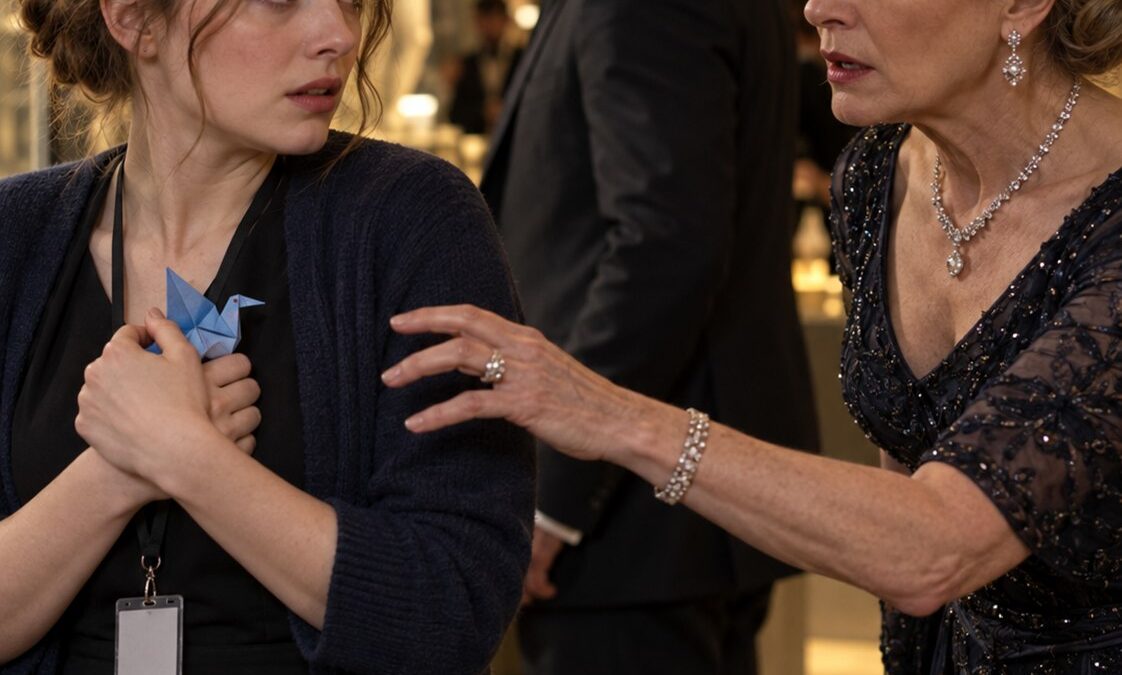
Nora held the paper bird against her chest.
The gallery smelled of floor polish and lilies.
Guests stood beside a row of glass cases.
Nobody touched their drinks.
Nora wanted to leave.
Her shift ended in forty minutes.
Her rent was due Friday.
And the woman who raised her was waiting for news after a heart appointment.
“You said I died,” Nora told Evelyn.
“I believed it.”
“For twenty-five years?”
“Yes.”
Martin took one step closer.
“This is upsetting her.”
Nora looked at him.
“Which one of us?”
His face tightened.
Evelyn moved between them.
“Martin, I asked you to stay.”
“I heard you.”
“Then do it.”
He returned to the nearest case.
The guard remained by the doors.
Evelyn’s gaze fell to the bird.
“May I hold it?”
Nora did not hand it over.
“What’s on the back?”
“A red dot.”
“How do you know?”
“I made a mistake.”
Evelyn showed Nora the side of her thumb.
An old, pale scar crossed it.
“I cut myself while trimming the paper.”
“That doesn’t explain the dot.”
“I marked the reverse so I’d remember which fold to open first.”
Nora examined the bird.
There were two narrow wings.
One was tucked over the other.
The red dot sat beneath the lower wing.
Her mother had taught her that fold.
Every time she tried to make another bird, she got it wrong.
“You could have seen it tonight,” Nora said.
“Yes.”
“You could be guessing.”
“Yes.”
Evelyn accepted both objections.
That unsettled Nora more than an argument would have.
A museum coordinator approached.
“Nora, do you need a break?”
Nora nodded.
“I’ll cover the desk,” the woman said.
She left without asking questions.
It was a kindness.
Evelyn noticed Nora watching her go.
“Will you lose pay?”
“No.”
“Are you certain?”
“I know my supervisor.”
Evelyn stepped back.
“I’m sorry.”
Nora’s phone vibrated.
A message from her mother filled the screen.
Home now. Doctor says I’m doing fine. Eat something.
Nora’s shoulders loosened.
Evelyn noticed.
“Is she all right?”
“She will be.”
“Good.”
Nora slipped the phone away.
“You haven’t answered me.”
Evelyn nodded.
“My daughter was born in August.”
“Mine too.”
“At St. Agnes Hospital.”
Nora’s mouth went dry.
Her adoption papers named St. Agnes.
She had read them often enough to memorize every line.
“Lots of babies were born there.”
“I know.”
“I was adopted.”
“I thought you might have been.”
Martin reached them.
“Evelyn, this has gone far enough.”
Evelyn looked at him.
“You told me the hospital had confirmed it.”
“It had.”
“You brought me a letter.”
“I did.”
“You said she died before I could see her.”
Martin’s eyes flicked toward Nora.
“This is not a conversation for a public gallery.”
Nora took a step backward.
Evelyn turned at once.
“You can go.”
Martin said nothing.
Evelyn kept her eyes on Nora.
“You owe me nothing.”
Nora thought of the bird.
Of her mother’s careful hands.
Of the adoption papers in the kitchen drawer.
“Who wrote the letter?” she asked.
Martin answered first.
“The hospital.”
Evelyn’s gaze did not leave his face.
“Martin brought it to me.”
Nora slipped the bird back onto her badge.
“Then I want to see it.”
Martin gave a small, tired sigh.
“After all this time?”
“Yes,” Nora said.
“After all this time.”
Evelyn reached into her evening bag.
She took out a card and wrote a number on its back.
“My lawyer is not Martin.”
Martin’s jaw shifted.
Evelyn handed the card to Nora.
“Call tomorrow.”
Nora looked at the number.
“Why should I trust your lawyer?”
“You shouldn’t, yet.”
Evelyn swallowed.
“Bring your own.”
Nora had never hired a lawyer.
Evelyn seemed to understand.
“There are adoption advocates who can help you find one.”
Martin checked his watch.
“I’m going to call your driver.”
“No,” Evelyn said.
“I’ll call him myself.”
Martin moved away.
The guard watched him.
Nora watched Evelyn.
“What did you name her?”
Evelyn’s expression changed.
“Wren.”
Nora touched the bird.
“That’s why you made it.”
“Yes.”
“My name has always been Nora.”
“Then Nora is your name.”
Nora blinked hard.
Her mother was the only person who had ever said it quite like that.
Evelyn looked down at her empty hands.
“I need to tell you something else.”
Nora waited.
“I never signed papers giving my daughter away.”
* * *
By morning, Nora had slept three hours.
She made toast anyway.
Her mother, Della, sat at the kitchen table in her old green robe.
At fifty-four, she still inspected every piece of toast as though it might be burned.
Nora put a plate before her.
“Before you say anything,” Della said, “my heart is fine.”
“The doctor said it needs watching.”
“The doctor also said I could have coffee.”
“He said one cup.”
“This is my first.”
Nora sat down.
Della saw the bird on her badge.
“You forgot to take that off.”
“No.”
Nora had worn it through the night.
Della set down her mug.
“What happened?”
Nora told her.
The microphone.
The red dot.
The name Wren.
The letter Martin had carried.
Della listened without interrupting.
When Nora finished, the refrigerator motor clicked on.
“I knew this day might come,” Della said.
“You knew about Evelyn?”
“No.”
“You knew someone might find me?”
“Every adopted child has people somewhere.”
“You said my first mother gave me the bird.”
“She did.”
Della looked directly at her.
“That was written in the placement file.”
“Did you see her?”
“No.”
Della folded her hands.
“We met you through the county agency.”
Nora knew that much.
Della and her late husband had taken her home at eleven months.
“You were holding the bird,” Della said.
“They kept it with you.”
“Who did?”
“The foster family.”
“Do you know their names?”
“Mrs. Keene and her husband.”
Nora had seen those names too.
“They were kind to you,” Della said.
“How can you tell?”
“You reached for them when they left.”
Nora looked at her toast.
Della reached across the table.
“You can find out everything.”
“I don’t want to hurt you.”
“You came home with us.”
Della waited until Nora met her eyes.
“You can ask where you came from too.”
They spent the morning making calls.
The first adoption lawyer had a two-week wait.
The second referred them to Elise Tran.
Elise returned Nora’s call before lunch.
She explained what records Nora could request herself.
She also explained which sealed files might require a court order.
“I won’t promise the bird proves anything,” Elise said.
“Neither will I.”
“Good.”
Nora glanced at Della.
Elise asked for copies of the adoption papers.
Nora scanned them at the museum office.
Her supervisor gave her the afternoon off.
She also found an empty meeting room.
Nora called Evelyn from there.
Elise joined the call.
Evelyn had hired a separate lawyer named June Patel.
Martin was absent.
Nora made sure of that first.
“He used to handle my family’s legal affairs,” Evelyn said.
“He doesn’t anymore.”
“Since when?” Elise asked.
“Since last night.”
June spoke next.
“We have the letter Mr. Creed delivered in 2001.”
“We also have Ms. Vale’s hospital discharge papers.”
“Do you have a death certificate?” Elise asked.
A pause followed.
“No,” June said.
“Have you searched?”
“We have begun.”
Nora stared at the grain in the table.
For twenty-five years, a woman had mourned a baby.
And nobody on the call could produce a record of that baby’s death.
Elise did not rush.
She asked permission to contact St. Agnes.
She requested Nora’s nonidentifying adoption file.
June would ask Evelyn to release her own medical records.
Then Elise proposed a DNA test.
“Use a lab with documented collection,” she said.
“Both of you should have your own counsel.”
Evelyn agreed.
So did Nora.
The following week moved slowly.
There were forms.
Identity checks.
A court clerk who explained the same rule twice.
Nora worked her shifts.
She ate dinner with Della.
Some nights they said nothing about Evelyn.
Other nights they talked until midnight.
On Thursday, Elise called.
She had received a copy of an old placement summary.
Nora stood in a museum storage room.
“What does it say?”
“That you entered temporary foster care at six weeks.”
“Why?”
“The file says your birth mother signed a voluntary relinquishment.”
Nora sat on a wooden crate.
“Is there a name?”
“The copy hides it.”
Elise turned a page.
“There is a date.”
Nora wrote it on her palm.
The date fell nine days after Evelyn had been discharged.
“And the signature?” Nora asked.
“We need the original order to see it.”
Across town, June found something else.
Evelyn’s hospital chart recorded a live birth.
Her baby had needed observation for a breathing problem.
The chart listed a transfer to the hospital nursery.
It recorded no death.
“There could be a separate chart,” June warned.
“Find it,” Evelyn said.
Nora learned that detail later.
At the time, she noticed another date.
The placement summary had been prepared by a private lawyer.
His name appeared in a faint stamp.
M. Creed.
Nora enlarged the scan.
She had learned to inspect damaged labels at work.
The same habit caught a second mark beneath the stamp.
It was a file number.
Elise used it to request the original agency correspondence.
The agency found a box in offsite storage.
Three days later, Elise called again.
Nora answered outside the museum.
“It contains a cover letter,” Elise said.
“From Martin?”
“Yes.”
“Who was it addressed to?”
“The county placement office.”
Nora gripped the phone.
Elise read the first line slowly.
“It says he represented the child’s father.”
Nora closed her eyes.
Evelyn had never mentioned a father.
Elise checked the signature.
“Martin did not act for the hospital.”
* * *
Evelyn asked to meet at Della’s house.
Nora chose the time.
Della chose the tea.
Elise came too.
Evelyn arrived alone in a plain dark coat.
Nora had seen her only beneath museum lights.
In daylight, she looked tired.
Della opened the door.
“I’m Della Bell.”
“Evelyn Vale.”
They shook hands.
Neither let go too quickly.
Evelyn saw the bird on the shelf.
Nora had put it there before the meeting.
“You can sit,” Della said.
Evelyn sat at the kitchen table.
Elise laid out what they knew.
The live birth.
The nursery transfer.
The agency file.
Martin’s letter claiming he represented the father.
“The father was my husband,” Evelyn said.
“His name was Peter.”
Nora had read that he died years ago.
“Did he ask Martin to help?”
“I don’t know.”
Evelyn clasped her hands.
“Peter died in 2012.”
“What did he tell you?” Nora asked.
“That our daughter’s breathing worsened.”
“Did you see her?”
“I saw her when she was born.”
Evelyn’s voice thinned.
“I held her for a little while.”
Della pushed the sugar bowl toward her.
Evelyn shook her head.
“I woke from surgery the following day.”
“Peter said she was gone.”
Nora waited.
“He told me the hospital had moved her for care.”
“He said I couldn’t visit.”
“I believed him.”
Elise asked about the surgery.
Evelyn had needed treatment after the birth.
Recovery had taken weeks.
By then, Peter and Martin had arranged the burial.
Or said they had.
“Did you go?” Nora asked.
“To a memorial service.”
“Was there a grave?”
“A plaque.”
Evelyn looked up.
“I never saw a grave.”
Nora stood.
Della touched her wrist.
Nora stayed by the counter.
“I’m sorry,” Evelyn said.
“I know that doesn’t help.”
“No,” Nora said.
“It doesn’t.”
Evelyn nodded.
Elise gathered the papers.
“The DNA results are due Monday.”
No one suggested a shortcut around them.
After Evelyn left, Della rinsed untouched cups.
Nora dried them.
“She seems frightened,” Della said.
“So am I.”
“I know.”
“I used to wish my first mother would find me.”
Della kept rinsing.
“Then I stopped wishing.”
“Why?”
“Because you were here.”
Della turned off the tap.
“You’re still here.”
That evening, Nora returned to work.
Her badge had been deactivated.
The security desk could not explain why.
Her supervisor arrived within minutes.
“It’s an administrative error,” she said.
Nora showed her the screen.
The request came from an outside event sponsor.
The sponsor was listed as Vale Arts Foundation.
Martin chaired its finance committee.
The supervisor restored Nora’s access.
She documented the interruption.
Nora forwarded the record to Elise.
An hour later, Nora received an email.
Its sender used a generic address.
It contained one sentence.
People are already asking how much she offered you.
Nora did not answer.
She saved the message.
Elise asked her to forward it.
Evelyn called that night.
“I heard about your badge.”
“From whom?”
“My lawyer.”
“Can Martin get me fired?”
“He tried to influence a sponsor decision.”
Evelyn paused.
“I’ve told the museum director he cannot speak for me.”
Nora leaned against her kitchen wall.
“You shouldn’t have to do that for me.”
“I should do it because he did it.”
Della appeared in the doorway with two bowls of soup.
Nora took one.
“Thank you,” she told Evelyn.
The next day, June found a retired St. Agnes records clerk.
Her name was Ada Larkin.
She had preserved an index of infant transfers.
It recorded Evelyn’s baby as alive on the day Martin’s letter claimed she died.
Ada would speak to investigators.
She would not speak to reporters.
Nora liked her immediately.
Monday brought the DNA results.
Elise read them first.
Then Nora read them twice.
Evelyn was her biological mother.
Nora called Della.
Then she called Evelyn.
For a moment, neither spoke.
“Are you sitting down?” Nora asked.
“Yes.”
“So am I.”
Evelyn made a sound Nora could not name.
Nora watched a bus pass her window.
She had a mother at home.
She had another at the other end of the line.
Both were real.
“I need time,” Nora said.
“You have it.”
“I want to know who did this.”
“So do I.”
June’s office had already requested the original court packet.
That afternoon, it arrived.
The relinquishment carried Evelyn’s name.
The signature did not resemble hers.
A notary had certified it.
The notary was Martin’s sister.
* * *
Her name was Celia Creed.
She had retired to a town two hours away.
Elise advised Nora to let investigators handle the first contact.
June agreed.
They brought the papers to the county prosecutor.
A detective took statements.
She obtained the original agency file through lawful channels.
She requested the notary’s records.
Nobody promised an arrest.
Nobody promised a deadline.
Nora kept going to work.
She took the bird off her badge.
The pin had begun to wear through the paper.
Della found an archival sleeve for it.
“You work in a museum,” she said.
“You can tell me if this is wrong.”
“It’s right.”
“I checked online.”
“I can tell.”
Della smiled.
Nora had missed that smile.
The museum director asked to see her.
Nora brought her supervisor.
The director showed her another email.
It accused Nora of approaching a donor for money.
It offered no evidence.
The message had come through Martin’s assistant.
“I’m sorry,” the director said.
“We should have told you sooner.”
“You should have.”
The director accepted that.
Nora asked for the email in writing.
She gave it to Elise.
The detective later obtained the original sender records.
Martin’s office had sent the message.
He had also asked the foundation to withdraw funding from Nora’s department.
The museum board refused.
Evelyn did not make that decision.
Nora was relieved.
She wanted her job kept for her work.
For her birthday, Della made a lemon cake.
Nora turned twenty-six with six people at her table.
Evelyn was not one of them.
Nora had invited her for tea the next afternoon.
She needed the first celebration to remain familiar.
Della understood.
Evelyn understood too.
She sent a card.
Inside, she wrote only one sentence.
I hope today is gentle with you.
Nora put it beside the cake.
The next afternoon, Evelyn arrived with flowers.
Della answered the door.
“You can leave those on the counter.”
“Thank you.”
They had tea in the backyard.
Evelyn brought a small photograph.
She did not push it across the table.
“Would you like to see it?”
Nora nodded.
The photograph showed a newborn wrapped in white.
A blue paper bird rested by the blanket.
The baby’s eyes were closed.
Evelyn’s finger was visible at the edge.
A red mark stained the tip.
Nora looked from the photograph to the bird in its sleeve.
“Who took this?”
“Peter.”
Nora looked again.
“Do you have the original?”
“Yes.”
“Keep it safe.”
“I will.”
Evelyn folded her hands.
“I thought I had only one photograph.”
“You had me.”
Evelyn’s eyes filled.
Nora set the photograph down.
“I’m not saying you could have known.”
“I understand.”
“Sometimes I’m angry anyway.”
“You can be.”
Della came outside with more tea.
She set down the tray.
Nora leaned into her shoulder.
Evelyn looked away.
It gave them privacy.
Two days later, Celia Creed called the detective.
She agreed to an interview.
She admitted notarizing documents at Martin’s request.
She said Evelyn had signed them privately.
The detective asked why Celia’s journal listed an office visit on that date.
Celia could not explain it.
Nor could she explain why Evelyn’s hospital chart placed her in St. Agnes that morning.
Celia hired counsel.
The investigation widened.
June reviewed old foundation accounts.
She discovered why Martin had spent twenty-five years guarding the lie.
Evelyn’s father had created a trust for his first grandchild.
If that grandchild survived, the trust would pass to her at twenty-five.
Until then, its income supported a children’s arts program.
If no grandchild survived, the principal went to the Vale Arts Foundation.
Martin had managed that foundation since Peter’s death.
There was more.
Nora’s twenty-fifth birthday had passed the year before the museum gala.
June found large payments approved shortly after it.
The invoices named consultants who had done little visible work.
One company shared an address with Martin’s private office.
The trust had not made him rich overnight.
It had given him access to money for years.
“And Peter?” Nora asked.
They were in June’s office.
Evelyn sat beside her.
June did not guess.
“We have no proof of his part yet.”
“You think he knew.”
“I think Martin’s letter claimed Peter instructed him.”
Evelyn stared at the floor.
Nora had never met Peter.
She still felt the room change around his name.
“Why would he let this happen?” Evelyn asked.
June waited.
The detective had found Peter’s archived correspondence.
Most of it concerned business.
One folder held letters to Martin.
Peter had worried that a child would inherit money outside his control.
He had argued with Evelyn’s father about the trust.
Then the baby was born.
Then she disappeared.
June opened a copy of one letter.
It was dated three days before Nora’s birth.
Peter had asked Martin to find a way to delay any future transfer.
“That isn’t an order to take a child,” June said.
“No,” Evelyn answered.
Her hand shook against the chair.
“But he opened the door.”
The detective called an hour later.
Celia had agreed to make a fuller statement with her lawyer present.
She named the person who brought her the forged papers.
Martin.
She also described the plan.
Peter had first wanted the trust changed.
When Evelyn’s father refused, Martin proposed another route.
Nora’s hospital stay made it possible.
Peter told Evelyn their daughter had died.
Martin arranged a placement under false papers.
Celia certified Evelyn’s forged signature.
The county agency had believed the documents.
Nora’s foster family knew nothing of the fraud.
Neither did Della.
The detective cautioned them again.
Celia’s account needed corroboration.
Her role gave her reason to shift blame.
June asked about the money.
The detective said financial investigators were following it.
Nora stood at the window.
Outside, people crossed the street with shopping bags.
A bus stopped.
A man chased it and missed.
The city kept moving.
“Peter died before the trust came due,” Nora said.
“Yes,” June answered.
“Martin kept going.”
“He did.”
Nora looked at Evelyn.
“He was afraid I’d find you.”
Evelyn’s face hardened.
“He was afraid you’d both find out what he took.”
* * *
Evelyn called a special meeting of the foundation board.
June advised her to wait until the investigators had copied the records.
She did.
Martin remained a director.
The board could remove him.
The board could also preserve its records and cooperate with the investigation.
Evelyn wanted Nora there.
Nora asked Elise whether it was wise.
“You are allowed to attend,” Elise said.
“You are also allowed to stay home.”
“I want to see him answer.”
“Then I’ll come with you.”
The meeting took place in a plain conference room.
Nora preferred it to the gala.
There were no flowers.
No stage.
No microphone to drop.
Seven directors sat at the table.
Martin occupied the far end.
Celia was absent.
The detective did not attend.
This was a board meeting, not a trial.
June gave each director a packet.
It contained records the foundation was legally allowed to review.
The rest remained with investigators.
Martin glanced at Nora.
“I object to her presence.”
Evelyn looked at the board chair.
“I invited her.”
Martin turned to the others.
“You know why this is happening.”
“Tell us,” the chair said.
“A woman made a claim.”
Martin kept his voice even.
“Evelyn has been hurt before.”
Nora felt Elise shift beside her.
Martin continued.
“She is entitled to sympathy.”
“She is not entitled to overturn a foundation on suspicion.”
A director asked about the DNA test.
Martin accepted its result.
“I never disputed that Evelyn had a child.”
He looked toward Nora.
“I dispute the story being built around it.”
Evelyn remained still.
Martin addressed her.
“Peter told you the baby had died.”
“He told me,” Evelyn said.
“He was your husband.”
“That doesn’t make it true.”
Martin spread his hands.
“He is no longer here to answer.”
The chair interrupted.
“The documents carry your office stamp.”
“I represented Peter.”
“Did you represent Evelyn?”
“No.”
“Why did you deliver her a hospital letter?”
“Peter asked me.”
June slid a copy across the table.
The letter had no hospital letterhead.
It had been typed on Martin’s office stationery.
Its final line claimed that St. Agnes had confirmed the death.
There was no name beneath that claim.
Martin glanced at it.
“The hospital spoke to Peter.”
“Which employee?” June asked.
“I don’t know.”
“You wrote that it had confirmed the death.”
“I wrote what my client told me.”
It was an answer.
It was almost a good one.
Nora saw two directors exchange a glance.
Martin saw them too.
He turned to the money.
“The foundation funded hundreds of programs.”
“It did,” the chair said.
“Some invoices were poorly documented.”
“Yes,” June replied.
“We’re reviewing them.”
Martin folded his arms.
“Then let investigators do their work.”
“They are,” Evelyn said.
Martin looked at her.
“You’re making a public accusation before they finish.”
Nora understood his advantage.
Some facts remained under investigation.
He could demand certainty where certainty took time.
A director asked about the adoption papers.
Martin said Celia had witnessed Evelyn’s signature.
“She says something different now,” June replied.
“She faces consequences herself.”
“Which is why her account isn’t our only source.”
June took out the photograph.
Nora had agreed to its use.
The blue bird lay beside the newborn.
The red ink showed on Evelyn’s finger.
Martin stared at it.
“That establishes sentiment,” he said.
“Nothing else.”
Nora stood.
Elise touched her elbow.
Nora nodded.
She had decided what to say.
“The bird isn’t a birth certificate.”
Her voice sounded steadier than she felt.
“It came through my placement.”
She opened the archival sleeve.
“The agency inventory listed it.”
June handed the directors a copy.
The inventory had been signed by a county worker.
It described a folded blue paper bird with a red mark beneath one wing.
The date was six weeks after Nora’s birth.
Before Della.
Before the foster family had met Evelyn.
Before the gala.
“The photo shows where it began,” Nora said.
“The inventory shows where it went.”
Martin leaned back.
“It still does not identify who filed the papers.”
“No,” Nora said.
“That’s what the other records are for.”
June passed out one final page.
It was a copy of the notary journal.
The entry for Evelyn’s supposed signature carried Martin’s office address.
The time was 10:15 a.m.
St. Agnes had independently confirmed Evelyn was receiving treatment there at that hour.
A hospital records custodian had certified the chart.
Martin read the page.
His thumb stopped moving.
The board chair looked up.
“Do you have an explanation?”
“Celia handled the signing.”
“At your office?”
“Yes.”
“While Evelyn was hospitalized?”
Martin closed the packet.
“I want counsel before answering.”
“That is your right,” the chair said.
Nora sat down.
Evelyn reached toward her.
Then stopped.
Nora took her hand.
The chair asked Martin to leave while the board considered his position.
Martin rose.
At the door, he turned to Nora.
“You were loved where you landed.”
It was meant to end the matter.
It nearly did.
Nora thought of Della’s kitchen.
Of the lemon cake.
Of a little girl folding blue paper beside the woman who raised her.
“I was,” she said.
“Your part in that was an accident.”
Martin opened the door.
He did not answer.
The board voted to remove him from its committees.
It suspended his access to foundation accounts.
It authorized an independent financial review.
The chair called the prosecutor’s office afterward.
June had already arranged secure copies.
No one celebrated.
Nora and Evelyn walked outside together.
It had begun to rain.
Evelyn had no umbrella.
Nora held hers over both of them.
“I keep thinking about Peter,” Evelyn said.
“You probably will.”
“I loved him.”
“I know.”
“I need to learn what he did.”
“You will.”
The legal work continued for months.
Financial investigators traced payments from the foundation to a company Martin controlled.
Celia’s journal and office records supported her revised account.
A former assistant produced copies of instructions Martin had told her to destroy.
She had kept them because a payment dispute frightened her.
The county agency turned over its original placement file.
The file showed Martin had submitted the forged relinquishment.
The prosecutor charged him with financial offenses and crimes tied to the forged documents.
Celia reached an agreement requiring her testimony.
Peter could not be prosecuted.
The investigation established that he had approved the false death story.
His letters and Martin’s files showed his role.
Evelyn read them with June beside her.
She did not ask Nora to read them too.
Nora chose to read the summary later.
Martin pleaded guilty to several charges the following spring.
The court ordered restitution where the records supported it.
Other trust questions went through civil court.
The process was slow.
The outcome did not give anyone twenty-five years back.
It did tell Nora what had happened.
That mattered.
* * *
The trust case settled before Nora turned twenty-seven.
June explained every option.
Elise checked the explanation.
Nora invited Della.
Evelyn brought no proposal of her own.
The trust belonged to Nora under its terms.
That did not make the number easy to look at.
“It could buy the apartment building,” Della said afterward.
Nora looked up.
“Please don’t give me ideas.”
“I didn’t say you should.”
“You sounded interested.”
“I like your neighbors.”
They sat on Della’s porch.
A delivery truck rattled past.
Nora had kept her museum job.
She had taken a course in paper conservation.
Her supervisor said she had the hands for it.
Nora thought she had learned those hands from Della.
She also knew where the bird had begun.
Both things could be true.
She used part of the trust to pay off Della’s mortgage.
Della argued for three weeks.
Nora waited her out.
She set aside enough for her own security.
Then she funded an independent program at the museum.
It offered free conservation workshops for public schools.
Children brought drawings, photographs, ticket stubs, and cards.
They learned how to care for things they loved.
Nora insisted the program have its own oversight.
Evelyn respected that.
The foundation made a separate gift.
It had new directors and new accounting rules.
Nora did not join the board.
She did attend one exhibition.
A child had repaired a torn photograph of his grandmother.
He showed it to anyone who would stop.
Della stopped twice.
Evelyn stopped three times.
They had begun speaking without Nora present.
At first, their conversations were careful.
Then Della told Evelyn how Nora had tried to dye the family dog purple at seven.
Evelyn laughed so hard she had to sit down.
Nora heard about it later.
“The dog was already gray,” she protested.
“That was your argument then,” Della said.
Evelyn shook her head.
“Did it work?”
“On the dog?” Della asked.
“On the jury.”
“Absolutely not.”
They were still learning one another.
Some days were awkward.
Evelyn once brought Nora an expensive coat.
Nora returned it.
“I know you meant well.”
“I did.”
“I need you to ask first.”
Evelyn took the bag back.
“You’re right.”
She looked at the coat.
“I used to send things when I didn’t know what to say.”
“Try saying it.”
Evelyn sat down.
“I wanted you to be warm.”
“I am.”
Nora thought for a moment.
“Come to dinner next week.”
“I’d like that.”
“Bring bread.”
“I can do that.”
“And no coat.”
Evelyn smiled.
“No coat.”
Later that year, they visited St. Agnes.
The old maternity floor had become offices.
The hospital allowed them into its records room.
Ada Larkin met them there.
She wore thick glasses on a chain.
“I remember the blue bird,” she said.
Evelyn gripped her bag.
“Why?”
“I checked the nursery inventory.”
Ada looked at Nora.
“You held onto it.”
Nora had been six weeks old when she left the hospital.
“I still do.”
Ada showed them the surviving transfer index.
Its ink had faded.
The entry remained clear.
A living baby had gone from the nursery to temporary care.
Nora traced the line without touching it.
Ada had kept the index because old records mattered.
That simple habit had helped expose the lie.
“Thank you,” Nora said.
Ada waved a hand.
“I wish someone had read it sooner.”
Evelyn answered.
“So do I.”
Outside, Evelyn stopped near the steps.
“I owe you an apology.”
“You’ve given me one.”
“I need to give this one.”
Nora waited.
“I believed Peter because I trusted him.”
Evelyn looked at her.
“Afterward, I let Martin answer every question.”
“I should have asked the hospital myself.”
Nora thought of the years Evelyn had spent grieving.
“You were hurt.”
“I was.”
“It doesn’t erase what happened.”
“No.”
Nora held the rail.
“I don’t want you apologizing every time we meet.”
“I can stop.”
“I want you to ask me things.”
Evelyn looked surprised.
“What things?”
“Ordinary things.”
“Like what you had for lunch?”
“Yes.”
“What did you have for lunch?”
“A granola bar.”
“That is a terrible lunch.”
“There.”
Nora smiled.
“That sounded like family.”
Evelyn reached into her bag.
Then she stopped.
“I have something to ask.”
“Ask.”
“Would you come away with Della and me for a weekend?”
“Where?”
“There’s a place by the lake.”
“Is it enormous?”
“It has three bedrooms.”
“Then it’s probably enormous.”
“It has a small kitchen.”
“That doesn’t answer me.”
Evelyn smiled.
“We could cook.”
“Della will want to.”
“I know.”
“I’ll ask her.”
“Take your time.”
They went in October.
Della brought too much food.
Evelyn brought one loaf of bread.
Nora approved.
At night, they played cards beside a rattling heater.
Della accused Evelyn of hiding a winning hand.
Evelyn accused Della of teaching Nora to cheat.
Nora won anyway.
The next morning, she found them on the porch.
They were talking about Peter.
Della did not defend him.
Evelyn did not ask her to.
When Nora joined them, they made room.
Nothing about the weekend fixed the past.
It gave them a place to begin.
* * *
Five years later, Nora stood beneath the museum lights again.
She was thirty-one.
Her paper conservation team had opened a new gallery.
Children from the workshops had helped choose its first display.
It held objects their families had saved.
A recipe card.
A bus ticket.
A photograph repaired with patient hands.
At the center sat the blue paper bird.
Nora had placed it there herself.
The red dot remained beneath its wing.
The original photograph rested beside it.
So did a copy of the agency inventory.
Visitors could see where the bird had begun.
They could see where it had traveled.
Della stood near the case.
She read the label twice.
“You made me sound very sensible,” she told Nora.
“You were.”
“I let you sleep with a paper bird.”
“In a sleeve.”
“Eventually.”
Evelyn joined them.
She wore a plain blue jacket.
No diamonds.
“Did the school group arrive?” she asked.
“Ten minutes ago,” Nora said.
“They’re taking turns at the repair table.”
Evelyn looked at the case.
For years, she had kept the photograph in a drawer.
Della had kept the bird in a kitchen box.
Nora had brought them together.
A little girl approached.
She studied the bird.
“Can paper last that long?”
“Yes,” Nora said.
“If people take care of it.”
The girl considered this.
“Who made it?”
“I did,” Evelyn answered.
The girl looked at Della.
“Who kept it?”
“I did.”
Then she looked at Nora.
“Who put it here?”
Nora smiled.
“I did.”
The girl nodded as though the arrangement made perfect sense.
She hurried back to her class.
Evelyn watched her go.
“Where did you get that bird?” she asked softly.
Nora recognized the words from the gala.
She took Della’s hand.
Then Evelyn’s.
“From both of you.”
The gallery doors opened.
Children came through carrying things worth keeping.
THE END








