The Boy Beneath Our Glass Roof Held a Red Flood Chart, and the Truth About My Wife’s Warning Changed Our Family Forever
Chapter 2: What the Water Kept
Vivian stared at Otis.
Then she looked at me.
“Take June upstairs,” she said.
“She’s already upstairs.”
“Check on her.”
It was the first thing we agreed on.
I called June’s room.
She answered, annoyed and sleepy.
“Are you coming up?”
“In a minute, sweetheart.”
“Is it raining?”
“Only in the conservatory.”
She hung up.
Vivian watched my face.
“She’s fine,” I said.
“For now,” Otis whispered.
Vivian took one step toward him.
I moved between them.
“What happened at Gate Four?” I asked.
“Nothing happened.”
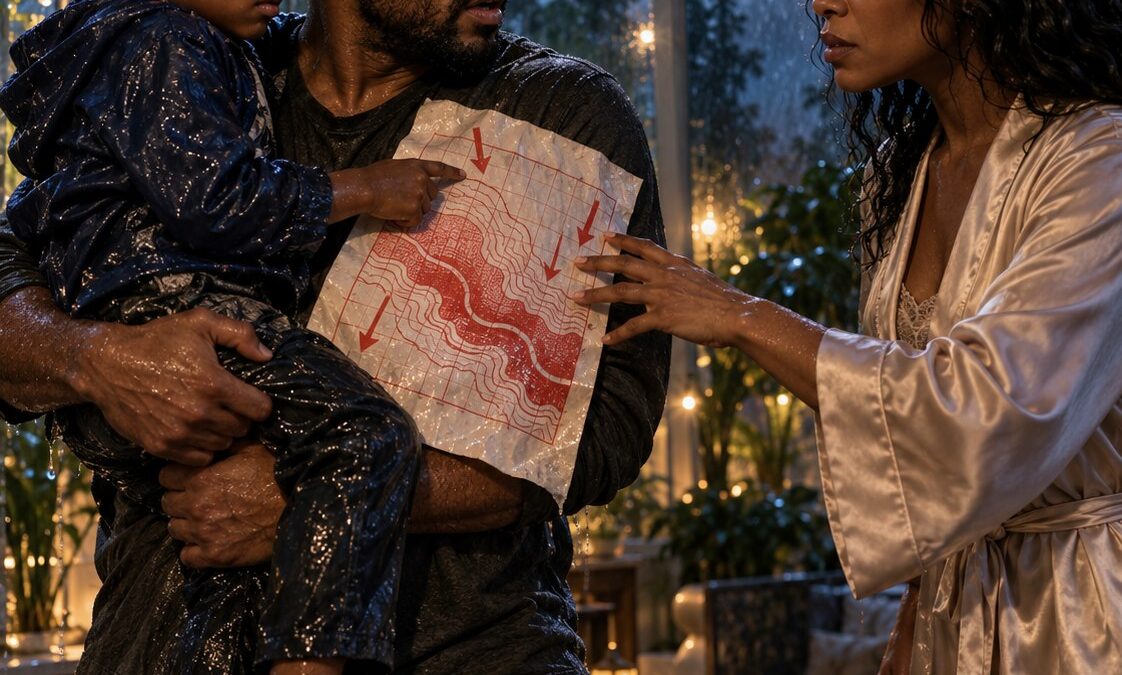
“Then why does Nora have this?”
Vivian’s eyes settled on the chart.
“It was stolen.”
“You haven’t looked at the serial number.”
“I don’t need to.”
A car stopped outside.
Blue light crossed the glass.
Vivian had called the police.
Otis’s hand tightened around mine.
“They’ll take me back,” he said.
“Back where?”
He glanced at Vivian.
She said, “He needs his mother.”
“Where is she?”
Otis pointed toward the street.
“She told me to come inside if the man followed us.”
The doorbell rang.
I opened the conservatory’s outer door for two officers.
I knew one of them.
Sergeant Hale had helped us evacuate the riverfront during a storm the previous spring.
“A child may be in danger,” I told her.
“From whom?” Vivian asked.
Hale looked between us.
Otis held up his wet sleeve.
“A man took my mom,” he said.
“Did you see him take her?” Hale asked.
“I saw him make her get into his car.”
Vivian let out a slow breath.
“Nora’s been unstable.”
“Have you spoken with her?” I asked.
“Not since she was fired.”
Otis looked up.
“That’s wrong.”
Nobody moved.
“She was here last Thursday,” he said.
Vivian’s expression changed for less than a second.
I had spent seventeen years reading her face.
That second was enough.
Hale asked for the chart.
I handed it over by the dry edge.
Vivian said it contained confidential company information.
Hale slipped it into a clear evidence sleeve.
“Then we’ll keep it secure.”
Otis shivered.
Vivian reached for a towel.
He recoiled.
She stopped.
I found a clean beach towel in the cabinet and wrapped it around him.
“Can you tell the sergeant about the car?”
He nodded.
Hale led him a few steps away.
Vivian leaned close to me.
“You don’t understand what she’s done.”
“Tell me.”
“Nora came here demanding money.”
“What did she want?”
Vivian looked toward the officers.
“She said she could ruin us.”
“Did she show you that chart?”
“She showed me a photograph.”
I thought of September 18.
I thought of the signature I had placed beneath the test summary.
That morning, Vivian had come into my office with coffee and a story about Nora.
A missing file.
A locked cabinet.
A technician who said he saw Nora leave after hours.
I had accepted all three.
I had never asked the technician myself.
Outside, Hale spoke into her radio.
I heard the words missing adult.
Vivian folded her arms.
“Nora didn’t steal the test results,” she said.
I waited.
“She stole the original.”
* * *
Hale called an ambulance for Otis.
He insisted he felt fine.
His teeth disagreed.
While a paramedic checked him, I called our head of engineering.
Caleb Rusk answered on the fourth ring.
He sounded as though he had been awake.
“Do we have the original Gate Four recorder?” I asked.
A pause.
“Why?”
“Where is it?”
“In storage, I think.”
“That isn’t an answer.”
Vivian watched me from the doorway.
Caleb cleared his throat.
“The archived chart is a scan.”
“Of which original?”
“I’ll need to check.”
I ended the call.
Hale had sent officers to look for Nora’s car.
Otis said the man had stopped her outside a closed pharmacy two blocks away.
He could describe the car.
He could not read its plate.
Nora had told him to run to our house if she could not follow.
“She said he would open the gate for me,” Otis told Hale.
He meant me.
I had met Nora’s son once.
He had been five, asleep in a chair at our office while she worked late.
I had carried him to her car.
That was all.
It was enough for her to remember.
Hale took Vivian’s statement separately.
I called my company’s outside lawyer, Priya Shah.
I told her about the chart.
Then I told her about Vivian.
“Don’t touch the company archive,” Priya said.
“I wasn’t going to.”
“I need you to hear me say it.”
She called a forensic accountant and an independent engineer.
She also told me to step away from any decision about Gate Four until someone checked the test.
That hurt.
It was sensible.
By morning, Otis had warm clothes and a paper cup of cocoa.
Nora was still missing.
June came downstairs before sunrise.
She saw the police car through the window.
“Is the river up?”
“No.”
“Then why are they here?”
I told her a boy needed help.
She asked whether he had found it.
“He’s safe with us right now.”
She looked at the wet towel on the floor.
“Can he have my old sweatshirt?”
I said yes.
Vivian stood behind her.
June took one look at us and stopped asking questions.
That was the first cost of the night.
By eight, Priya had obtained a court order preserving our company’s test files and security records.
She arranged for another executive to manage urgent operations.
I gave her my access badge.
I had spent thirteen years building that company.
I had never felt lighter after handing over its keys.
Hale called from her car.
Officers had found Nora.
She was at a precinct across town.
The man who had driven her there was a private investigator.
He claimed Vivian had hired him to escort Nora to a meeting with police.
Nora claimed he had blocked her car and taken her phone.
The officers were sorting out what had happened.
“Can I speak with her?” I asked.
“After we finish her statement.”
“Tell her Otis is safe.”
“I already did.”
I sat on the kitchen step.
My hands were shaking.
At noon, Priya brought the independent engineer to our office archive.
I stayed home.
She called me over video.
The engineer held up the scan we had used for Gate Four.
Its serial number matched the wet chart.
The date matched.
The recorded pressure did not.
“Which is authentic?” I asked.
“We can’t settle that from copies,” she said.
I remembered something Nora had taught me when we bought the test recorder.
Each roll had tiny feed holes.
The pen dragged ink through the paper at the same speed as the machine.
A scan could show the drawing.
It could not show how hard the pen had pressed.
“Check the back,” I said.
Priya turned the wet chart over.
The engineer angled it under a lamp.
Indentations ran beneath the red line.
There were none beneath the lower line.
“Someone added the lower trace later,” she said.
Vivian had not merely hidden a test.
She had drawn a second result on Nora’s original.
* * *
The company suspended Gate Four’s certification that afternoon.
The city sent crews to inspect it.
The school district changed June’s school to remote classes until engineers could assess the flood route.
No water was coming.
We had time to use what Otis had brought us.
Vivian called the decision theatrical.
She said the gate had passed six later checks.
I asked for those reports.
She said she had never handled engineering files.
Priya found her name on the approval chain.
Vivian said a signature proved nothing.
By then, Hale had taken Nora’s full statement.
The investigator’s contract told a different story from Vivian’s.
He had been hired to find the original chart.
His instructions said to persuade Nora to surrender it.
Nora said he had followed her for three days.
When he stopped her outside the pharmacy, she sent Otis to our house.
Hale interviewed him again.
He admitted blocking Nora’s car.
He denied touching her.
Officers found Nora’s phone beneath his passenger seat.
He said it must have fallen there.
The police kept the phone.
I wanted to see Nora.
She said she would speak to me with her lawyer present.
I deserved that condition.
We met at Priya’s office the next morning.
Nora looked older than she had three years before.
Her voice had not changed.
“You saw the chart,” she said.
“Yes.”
“Did you believe it?”
“I believe the independent engineer.”
She gave me a hard look.
“That wasn’t what I asked.”
“I believe you.”
She sat back.
I had never said those words when they might have kept her job.
Nora had worked on the Gate Four prototype.
The trial on September 18 had pushed it above the promised pressure limit.
The gate had bent enough to let water through.
Not a flood.
A warning.
She had marked the run as a failure.
The next day, her test folder disappeared.
The day after that, Vivian accused her of taking confidential designs.
“Nobody showed me proof,” Nora said.
“Vivian told me there was a witness.”
“There was a witness.”
“Who?”
“Caleb.”
I stared at her.
Caleb had run engineering since the company’s first year.
He had stood beside me at my father’s funeral.
“He said he saw me carrying the folder,” Nora said.
“I was carrying my lunch.”
After she was fired, Nora had kept the original chart because Vivian had returned it to her during a private meeting.
Vivian wanted her to sign a statement saying the machine had malfunctioned.
Nora refused.
Vivian had added the false lower line by then.
Nora took the chart to a lawyer.
The lawyer advised her to preserve it and find independent records.
For three years, she had tried.
Our archive held scans.
The test lab had changed owners.
Caleb would not speak with her.
Last Thursday, she had come to the house with a photograph of a purchase agreement.
Vivian had met her at the front gate.
“Why the agreement?” I asked.
“Because the test wasn’t the whole plan.”
Nora slid the photograph across the table.
A holding company had bought several riverfront warehouses months before the city selected Gate Four.
The prices were low.
The owners had believed the district would face severe flood restrictions.
After the gate won approval, the properties rose in value.
“Vivian knew the city’s confidential flood projections,” Nora said.
“Lots of people did.”
“She sold the projections to the buyers.”
I studied the holding company’s name.
I did not recognize it.
Priya did.
She pulled up its public filings.
The directors led through two other companies.
One ended at a bank account controlled by Vivian’s brother.
The other ended at Caleb Rusk.
The failed gate test had given them a problem.
Approving it had given them a fortune.
* * *
Vivian came to the emergency board meeting with a binder.
She had always arrived prepared.
That morning, she arrived early enough to speak privately with three directors.
I watched them avoid my eyes.
Priya sat beside Nora.
The independent engineer sat across from them.
A city safety officer joined by video.
Hale waited outside the room.
The board chair began with the urgent matter.
Gate Four would remain out of service until it passed a new test.
Temporary barriers were being placed along the affected section.
The city had arranged for extra monitoring.
Those decisions had already been made.
Vivian waited until the chair turned to the original test.
Then she opened her binder.
“Eli has every reason to blame me,” she said.
“He signed the approval.”
“I did,” I said.
She laid copies of my signature around the table.
“His memory of that morning has changed.”
“My signature hasn’t.”
Nora shifted beside Priya.
Vivian glanced at her.
“This employee removed proprietary material after her dismissal.”
“I kept my own test record,” Nora said.
“The company paid for that paper.”
“And for the test it recorded.”
One director asked whether Nora had reported the failure.
Priya produced her dated email.
Caleb had replied that he would review it.
Vivian turned to the next page.
“A failure during development is normal.”
The engineer agreed.
“That is why it must be documented.”
Vivian said the prototype had been repaired before installation.
The engineer asked for the new test record.
Vivian pointed to six later checks.
The city officer examined the dates.
“All six happened after installation,” she said.
“They don’t establish what was certified in September.”
Vivian’s argument had nearly carried the room.
She sounded calm.
She used the right terms.
She reminded everyone how many families relied on the flood system.
I had used some of those same arguments when we sought the contract.
Then the engineer placed Nora’s red chart under a document camera.
The line rose past the limit.
The false line sat beneath it.
“The lower trace was drawn without the recorder,” she said.
Vivian leaned forward.
“You cannot identify who drew it.”
“No,” the engineer said.
“I can identify when it was drawn.”
She showed the back of the paper.
The machine’s pen had cut a shallow path beneath the true line.
The second line had left no matching impression.
A director rubbed his forehead.
Vivian closed her binder.
“You’re looking at one compromised object.”
Priya opened a second file.
She had obtained records from the company that serviced our recorder.
Its technician had photographed the machine’s counter when he collected it after the September test.
The counter reading appeared on Nora’s chart.
It also appeared in the service log.
The archive scan, created two days later, showed a different chart under the same serial number.
That was independent of Nora’s copy.
Vivian looked at Caleb.
He stared at the table.
The chair asked him to explain the altered archive.
Caleb said he needed counsel.
Nobody argued.
Priya then presented the property records.
Vivian objected that land purchases had nothing to do with a pen trace.
She was right about the question.
So Priya asked a narrower one.
“Did you share the city’s confidential projections with the buyers?”
“No.”
“Did you know your brother controlled their account?”
“He invested in many things.”
“Did you receive money from that account?”
Vivian looked at the board chair.
“This has become a family dispute.”
The chair asked her to answer.
She did not.
A bank compliance officer had already supplied records under legal process.
The payments went to a consulting company Vivian owned.
Their dates matched the property purchases.
The account descriptions named the projected flood zones.
One director pushed his chair back.
Vivian reached for my arm.
“You know what happens if this becomes public.”
“It already has to,” I said.
“June’s name will be dragged into it.”
I moved my arm.
“Leave her out of this room.”
For once, Vivian did.
The board suspended Vivian and Caleb.
The city officer referred the certification issue to investigators.
Hale came in to speak with both of them.
There was no dramatic arrest.
There were questions.
There were records to collect.
There were lawyers on their way.
That afternoon, I gave a full statement about my signature and Nora’s dismissal.
I also told investigators what I had failed to check.
Weeks later, Caleb pleaded guilty to falsifying company records.
He testified that Vivian had directed him to replace the chart and had promised him a share of the land profits.
Vivian fought the charges longer.
Her lawyer challenged every document.
The original chart survived that challenge.
So did the service photograph, the bank records, and the messages Caleb had kept.
Vivian eventually pleaded guilty to fraud and unlawful use of confidential information.
The court ordered restitution.
The company lost its Gate Four contract.
The gate was replaced before the next flood season.
At sentencing, Vivian looked directly at me.
“You let a child decide whom to believe.”
I thought of Otis under the glass roof.
“No,” I said.
“I finally listened to the engineer.”
* * *
The conservatory smelled of soil again.
I had turned off its automatic sprinklers.
June watered the plants with a dented green can and considered herself better at it.
She probably was.
Otis came over on Saturdays.
At first, he stayed close to Nora.
Later, he and June began inventing games that involved every cushion in the house.
Nora returned to engineering.
Another firm hired her after reviewing her work.
Our company paid the wages and benefits she had lost.
The settlement came with a written acknowledgment of what had happened.
It did not ask her to be grateful.
I apologized to her without a lawyer present.
“I should have checked the accusation,” I said.
“Yes,” she replied.
“I’m sorry.”
“I know.”
That was where she left it.
We could work with that.
The board asked me to come back as chief executive.
I agreed to stay through the investigation and replacement work.
Afterward, I stepped down.
I had signed a certification I did not understand well enough to defend.
The new board wanted me to call that a misunderstanding.
I called it my responsibility.
I kept a smaller role reviewing designs for communities that could not afford a private engineer.
Priya helped establish a fund for independent safety testing.
The money came from the company’s settlement and my shares.
Nora agreed to advise the fund.
She made one condition.
Engineers had to be able to publish failed results.
The board accepted it.
June asked why I worked fewer evenings.
I told her I had made room for other people’s work.
She asked whether that meant I would cook more.
I said yes.
She said, “That seems risky.”
Her judgment was sound.
I learned three dinners she would eat.
Otis rated the pasta highest.
Nora said he gave generous scores to anyone who remembered the cheese.
Vivian wrote to June from prison.
The first letter blamed everyone but herself.
I did not give it to June.
I told her it had arrived.
I let her decide whether she wanted it kept.
She said yes.
Months later, another letter came.
Vivian named what she had done.
She did not ask June to forgive her.
June read that one twice.
Then she put it in a drawer.
“I want to write back,” she said.
“Okay.”
“Will you read it first?”
“Only if you want me to.”
She did.
Her letter said she missed her mother.
It also said the school had closed because adults needed to check whether the gate was safe.
She asked Vivian to tell her the truth from now on.
Vivian answered that she would try.
June stared at the word try.
“She could have said yes.”
“She could have.”
June kept writing when she wanted to.
She stopped when she did not.
I helped arrange visits after she asked for them.
I sat nearby.
I did not ask her to carry my anger or Vivian’s regret.
One spring afternoon, Nora came to pick up Otis.
He and June had built a cardboard city across the conservatory floor.
Every building had a paper door.
Some had three.
Otis showed me a bridge with a gate made from a ruler.
“It stays up,” he said.
“Did you test it?”
He rolled his eyes.
Nora laughed.
Then she stopped beside the empty shelf where the wet chart had once dried.
“The museum asked about it,” she said.
“The chart?”
“The city museum.”
“They want to display it?”
“With the story of Gate Four.”
She had the right to decide.
It was her record.
“It belongs to you,” I said.
She looked toward the children.
“I wanted to ask them first.”
Otis came over when she called.
Nora explained the request.
He considered it.
“Will they say I brought it?”
“Only if you want them to.”
He looked at June.
“Would you go see it with me?”
June picked up the cardboard bridge.
“Can we bring this?”
“We can ask,” Nora said.
Otis nodded.
Then he looked at me.
“Can you come too?”
I said I could.
That was the invitation I had wanted to earn.
* * *
Four years later, the glass roof needed washing.
Otis, now twelve, stood beneath it with June.
They argued about whose turn it was to hold the hose.
Nora sat beside me with two cups of coffee.
At the city museum, the red chart hung behind glass.
Its label named the failed test.
It named Nora.
At Otis’s request, it said he had carried the chart to safety.
The museum had displayed June’s cardboard bridge nearby for a month.
She still mentioned that more often.
The new flood barrier had passed its inspections.
The property buyers had repaid part of their profits.
The rest became a matter for courts and years.
Our lives moved on in ordinary ways.
Nora led a larger engineering team.
Otis learned to swim.
June loved her mother and knew what her mother had done.
I had become a better cook.
Mostly.
The children turned on the hose.
Water struck the glass.
June shouted for Otis to aim higher.
He raised his arms.
For a moment, I saw him as he had been that night.
Soaked sneakers.
A shaking voice.
A red chart held above his head.
“Don’t let her wash it,” he had said.
We had kept the chart.
We had also kept the truth it carried.
Otis lowered the hose and waved through the wet glass.
I waved back.
Then June opened the conservatory door.
“Dad,” she called, “come help us see what we missed.”
I set down my coffee and went inside.
THE END








