The boy who wrapped his knitted mittens around a freezing child, then his mother recognized the brass harbor token
Chapter 2: The Brass Harbor Token
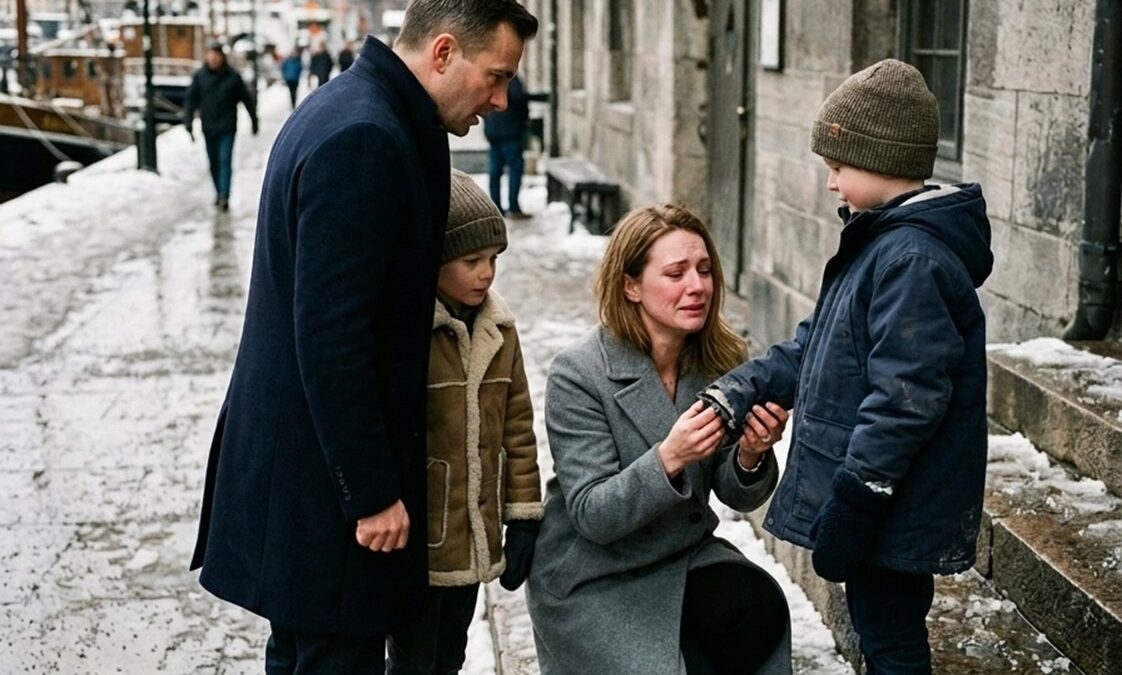
The wet slush soaked through Eleanor’s wool trousers.
She did not feel the cold.
She only felt the hammering in her ribs.
Marcus reached down to pull her up.
“Eleanor, get off the pavement.”
“Look at his coat, Marcus.”
Marcus looked down with a frown.
“He is a street urchin.”
“Look at the cuff.”
Beneath the ragged hem of the canvas sleeve, faded yellow thread formed a small cross.
It was an uneven stitch.
Eleanor had sewn that stitch herself five years ago on an island cottage.
The small boy began to weep silently from terror.
“Please,” the child gasped.
“I did not steal them.”
“He gave them to me.”
Julian stood between his mother and the boy.
“I gave them to him, Mom.”
“He was freezing to death.”
Eleanor reached out with trembling fingers.
She did not touch the boy’s face.
She touched the brass token dangling from Julian’s mitten.
Her finger traced the third notched star.
A tiny indentation sat right on the edge of the bronze rim.
“Julian,” Eleanor whispered.
“Where did you find this token?”
“In your jewelry desk,” Julian said.
“Three weeks ago.”
“You said it was an old spare.”
Eleanor closed her eyes for one long second.
“It was not a spare.”
Marcus grabbed Eleanor’s arm firmly.
“The partners are sitting in the boardroom right now.”
“We are closing the shipping merger in twelve minutes.”
“Let the doorman call child services.”
“No,” Eleanor said.
The word was quiet.
It was absolute.
She looked up at her husband.
“Look at his eyes, Marcus.”
Marcus looked at the shivering child.
The boy had dark hazel eyes.
A small cleft marked the center of his chin.
The street grime could not hide the shape of his jaw.
Marcus took half a step backward.
His hand fell away from Eleanor’s shoulder.
“That is impossible,” Marcus said.
“He died at sea.”
“We buried an empty box.”
Eleanor turned back to the boy.
“What is your name, sweetheart?”
The boy wiped his wet nose on the thick wool of Julian’s mitten.
“Caleb,” he whispered.
“Just Caleb.”
Eleanor’s hand covered her mouth.
“Who gave you that canvas coat?”
“Old Silas,” the boy said.
“Down at the dry docks.”
“Silas told me never to come up to the financial square.”
“Why did you come today?” Julian asked gently.
Caleb looked at his bare feet inside split leather shoes.
“Silas didn’t wake up this morning.”
“His hands were like ice.”
“I was hungry.”
A gust of harbor wind tore down the concrete canyon.
Caleb began to shake uncontrollably.
Julian took off his cashmere scarf.
He wrapped it twice around Caleb’s neck.
“We have to take him inside,” Julian told his parents.
“Now.”
Marcus looked at the glass doors of Vance Maritime.
Three senior vice presidents stood behind the glass, watching them.
“We cannot bring a vagrant into the merger meeting,” Marcus muttered.
“He is not a vagrant,” Eleanor said, rising to her feet.
She lifted Caleb directly into her arms.
The boy stiffened in shock.
He was light as dry wood.
His wet canvas jacket smeared black city soot across her pale cream coat.
She did not care.
“Cancel the meeting, Marcus.”
“Eleanor, forty million dollars depends on that vote.”
“Then let it drown,” she said.
Eleanor turned her back on the glass doors.
She walked straight past the bronze doorman toward the waiting town car at the curb.
Marcus jogged two paces behind her.
“Eleanor, listen to reason for thirty seconds.”
“I have listened to your reason for five years, Marcus.”
“We have shareholders.”
“We have a nephew.”
The driver leaped from the front seat and pulled the door wide.
Eleanor stepped into the leather warmth and set Caleb on the seat.
Julian scrambled in beside him, pulling the door shut against the freezing spray.
Marcus stood on the wet curb, rain dripping from his hat.
“Get in,” Eleanor told him through the open window.
“Or stay on your sidewalk.”
Marcus grabbed the handle and climbed inside.
The leather groaned as he pulled the door closed.
“Drive to St. Jude’s Clinic,” Eleanor said.
The car surged forward into the dark slush.
* * *
Dr. Kenneth Ward adjusted his wire-rimmed glasses in the private clinic three blocks away.
He had been the Vance family physician for thirty years.
A warm radiator hissed softly in the corner of the examination room.
Julian sat on a leather stool, watching quietly.
Caleb sat on the examination table wrapped in two heated cotton blankets.
A bowl of warm chicken broth sat empty beside him.
His dirty canvas jacket lay folded on a stainless-steel tray.
Dr. Ward gently turned the boy’s head to the left.
Behind Caleb’s small earlobe lay a tiny brown birthmark shaped like an almond.
Dr. Ward stopped breathing for a moment.
He lowered his pen to the desk.
“Eleanor,” the old doctor said softly.
“You know what this mark is.”
“I know what it looks like, Kenneth.”
“I need science.”
“I need truth.”
Dr. Ward nodded slowly.
He took a sterile cotton swab from a sealed glass jar.
“Open your mouth, Caleb,” Julian coaxed gently from the stool.
“It does not hurt at all.”
Caleb opened his mouth.
Dr. Ward swabbed the inside of the boy’s cheek.
He placed the swab into a sealed plastic vial.
Then he turned to Eleanor.
She extended her hand without hesitation.
A second swab was taken and sealed.
“The laboratory in the basement has the rapid genetic sequencer,” Dr. Ward said.
“Because of Marcus’s donations, we have the latest equipment.”
“How long?” Eleanor asked.
“Two hours for a direct maternal marker match.”
Marcus paced the length of the hardwood floor.
His coat was unbuttoned.
His tie was crooked.
“Kenneth, this is insane,” Marcus insisted.
“Arthur’s trawler sank six miles off North Reef.”
“The Coast Guard found the wreckage in eighty feet of water.”
“Arthur was my brother.”
“If Arthur had survived, he would have come home.”
“Arthur loved this family.”
“Did he?” Eleanor asked quietly.
Marcus stopped pacing.
“What does that mean?”
Eleanor walked over to the tray where the ragged canvas coat lay.
She picked up the right cuff.
“Arthur gave this coat to Silas before he sailed.”
“Arthur always wore this coat when he checked the reef nets.”
“Why was Caleb wearing it?”
Julian leaned forward.
“Silas had a trunk under his cot,” Caleb said in a small voice.
Everyone stopped.
“What trunk, Caleb?” Eleanor asked softly.
“A green wooden box,” Caleb whispered.
“Silas kept it locked with an iron padlock.”
“He told me if he ever stopped breathing, I was supposed to take the key around his neck.”
“Did you take it?” Julian asked.
Caleb reached inside his shirt.
On a piece of frayed fishing line hung a small, rusted iron key.
Eleanor stared at the key.
“Arthur’s boathouse key,” she murmured.
Marcus looked out the window into the gathering sleet.
His jaw was set like concrete.
“Silas was an old drunk who worked the slipways,” Marcus said.
“He probably scavenged the coat from the shore.”
“And the boy?” Eleanor countered.
Marcus did not answer.
Julian stood up and walked to the window beside his father.
“Dad,” Julian said.
“Why are your hands shaking?”
Marcus pulled his hands into his pockets.
“It is cold, Julian.”
“The radiator is on high,” Julian replied.
Marcus stared down at his shoes.
“You don’t understand how businesses run, Julian.”
“I understand promises,” Julian answered.
Eleanor did not look away from Marcus.
“You took care of Claire’s legal affairs after she fell ill.”
“You said her investments had collapsed.”
“You said there was nothing left for her care.”
“The markets turned,” Marcus said quickly.
“Did they?” Eleanor asked.
Dr. Ward stepped between them and held up one hand.
“This is an examination room,” Dr. Ward said sternly.
“Not a boardroom.”
“We will wait for the sequencer.”
The minutes passed in heavy silence.
Outside, the sleet scratched against the glass like fingernails.
Julian picked up a small plastic cup of apple juice and handed it to Caleb.
Caleb held it with both hands, drinking slowly.
His dark eyes watched Marcus from above the rim of the cup.
A knock sounded at the heavy oak door.
A lab technician entered carrying a single sheet of printed paper.
She handed it directly to Dr. Kenneth Ward.
Dr. Ward read the columns of numbers twice.
He looked over the top of his glasses at Eleanor.
Then he looked at Marcus.
“The maternal markers are identical,” Dr. Kenneth Ward said.
The room went completely silent.
“He is not Arthur’s son,” Dr. Ward continued.
“Eleanor, this boy is your sister Claire’s child.”
Eleanor dropped into a leather armchair.
Her breath came in ragged, painful gasps.
“Claire died in the hospice five years ago,” Eleanor cried.
“They told me her infant died three days before her.”
“They showed me a death certificate.”
“Who showed you?” Julian asked.
Eleanor raised her head slowly.
Her eyes moved across the room until they rested on Marcus.
“Your father handled the arrangements,” Eleanor said.
Marcus pressed his back against the wall.
He looked smaller in the dim light of the clinic.
“Eleanor, you have to let me explain.”
“Explain a forged death certificate?”
“It wasn’t my idea,” Marcus whispered.
“Whose idea was it, Marcus?”
Marcus looked at the floor and refused to speak.
Eleanor stood up from the armchair.
“We are going to Pier 14,” she said.
“To Silas’s shed.”
“To that green trunk.”
* * *
The sleet turned to heavy wet snow over the harbor district.
The streets around Pier 14 were dark, narrow, and slick with grease.
A single yellow bulb burned outside the door of a rotting salt-timber shed.
Julian sat in the back of the car beside Caleb.
Caleb was wearing Julian’s spare woolen coat from the trunk.
The coat was too large, but it was dry and smelled of lavender.
“Is this where Silas lived?” Julian asked.
Caleb pointed a mittened finger at the timber door.
“In the back corner,” Caleb whispered.
“Behind the net racks.”
Marcus sat in the front passenger seat, staring straight ahead through the windshield wipers.
“We should not be here without private security,” Marcus said.
“The police should handle this.”
“You did not want the police at the clinic,” Eleanor reminded him.
Her voice had no anger in it.
It was colder than the ocean wind.
She opened her door and stepped out into the slush.
Marcus followed immediately, grabbing her sleeve.
“Eleanor, listen to me.”
“I am listening, Marcus.”
“You have been listening to half-truths.”
“Then tell me the whole truth before I open that door.”
Marcus looked down the dark alleyway.
Between two rusted cargo containers, a dark sedan was parked with its engine idling.
Its parking lights were switched off.
Marcus noticed it, and his shoulders tightened.
“We had debts five years ago,” Marcus whispered.
“The shipping line was insolvent.”
“Claire’s trust held the controlling shares of the harbor terminal.”
“If Claire’s son inherited, the bank would have foreclosed on the docks.”
“We would have lost everything.”
“So you killed a baby?” Eleanor’s voice cracked.
“No!” Marcus hissed.
“Never.”
“I swear to God, Eleanor, never.”
“Then why was he with Silas?”
“Arthur found out what the board was doing,” Marcus said.
“Arthur took the child to keep him safe from the creditors.”
“Arthur was going to sail him to Canada.”
“Then Arthur’s boat went down.”
“Arthur died saving him?” Eleanor asked.
“Arthur died in the storm,” Marcus said.
“Silas pulled the boy from the skiff on the outer beach.”
“Silas came to me three days later.”
Eleanor stared at her husband in horror.
“Silas came to you?”
“Yes.”
“And what did you do, Marcus?”
The door of the idling dark sedan down the alley opened with a dull thud.
A tall man in a heavy black coat stepped out into the falling snow.
He held an unlit cigar between thick fingers.
Julian rolled down the window of the car by two inches.
“Mom,” Julian called out.
“Someone is coming.”
The man in the black coat stopped under the amber glow of the harbor lamp.
It was Harrison Croft.
The senior partner of Croft & Vance Logistics.
The man who was supposed to chair the forty-million-dollar merger meeting that afternoon.
“Marcus,” Croft called out in a jovial, booming baritone.
“I wondered why you walked out of the boardroom.”
“The buyers were quite offended.”
Croft walked slowly toward them, his heavy boots splashing in the salt mud.
He looked at Eleanor.
Then his eyes drifted toward the rear window of the car, where Caleb’s small face peered out.
Croft did not look surprised.
He looked annoyed.
“I told you Silas was getting sloppy, Marcus,” Croft said smoothly.
“Three months ago I told you the old sailor was drinking himself to death.”
“I told you to let me move the problem upstate.”
Eleanor stepped in front of the car door, shielding Julian and Caleb from view.
“You knew,” Eleanor said to Croft.
“Of course I knew, my dear,” Croft replied, tapping his cigar against his palm.
“Marcus is a sentimental man.”
“He could not bring himself to leave the boy at an orphanage where records could be traced.”
“So he paid Silas five hundred dollars a month to keep him in a net shed.”
“Five hundred dollars a month to keep my nephew sleeping on dirt?” Eleanor screamed.
“It kept him alive, didn’t it?” Croft said calmly.
“And it kept your family name on the harbor gates.”
“Now, Marcus, we have a contract to sign.”
“Drive the car back to the office.”
“I will have my driver take care of the net shed.”
“And the boy?” Eleanor asked, her voice shaking with rage.
Croft smiled thinly in the cold air.
“A farm in Vermont,” Croft said.
“Quiet.”
“Far from the water.”
“No questions asked.”
Eleanor looked Croft in the eyes.
“You disgust me, Harrison.”
“Disgust does not pay maritime mortgages, Eleanor.”
“Your husband knows that better than anyone.”
Croft turned toward Marcus.
“Get in the car, Marcus.”
“We will drive back to the boardroom and finish what we started.”
“The partners will overlook your absence if the contracts are signed by five.”
Marcus looked between Croft and Eleanor.
“And Silas?” Marcus asked.
“Silas is dead,” Croft said flatly.
“A coroner from the fifth district will sign the certificate tomorrow.”
“Natural causes.”
“Exposure.”
“A common end for dock workers who drink.”
“You arranged that too?” Eleanor demanded.
Croft laughed softly.
“I don’t arrange the winter weather, Eleanor.”
“The cold does its work without any help from me.”
* * *
Julian reached down into Caleb’s hand.
Caleb was trembling so hard his teeth clicked together.
“He wants to send me away,” Caleb whimpered into Julian’s sleeve.
“He will not,” Julian said.
“I promise you.”
Julian reached into the canvas coat sitting between their seats.
His hand found the small iron key on the frayed cord.
Then his fingers brushed against a stiff piece of folded paper inside the lining.
It was tucked deep into a torn seam near the hem.
Julian pulled it out into the dim interior car light.
It was not money.
It was a small blue logbook wrapped in wax paper.
Across the front, in faded black ink, was written:
*S.S. Osprey — Log and Manifest — Arthur Vance, Master.*
Julian opened the front cover.
Folded inside was an official document with an embossed silver notary seal.
Julian was only nine, but he read his father’s business contracts every evening in the library.
He knew what an affidavit looked like.
He pressed the window button.
“Mom,” Julian called out through the opening.
Eleanor turned her head.
Julian held the wax paper packet out through the open car window.
“Uncle Arthur wrote down everything,” Julian said clearly into the cold air.
Harrison Croft stopped smiling.
His eyes narrowed as he looked at the blue notebook in the boy’s hands.
“Marcus,” Croft said softly, his voice dropping all friendliness.
“Tell your son to put that inside his coat and roll up the glass.”
Marcus did not move.
“Where did you get that, Julian?” Marcus asked.
“Inside Caleb’s sleeve,” Julian answered.
“Uncle Arthur signed it before he sailed.”
“It has the harbor master’s stamp on it.”
Croft took two quick steps toward the car.
“Give that to me, boy.”
Eleanor moved instantly, placing herself directly between Croft and the rear door.
“Do not touch my son,” Eleanor said.
“Eleanor, be reasonable,” Croft said, his hand reaching into his heavy overcoat.
“That notebook contains nothing but the ramblings of a drowned sailor.”
“Then why do your hands shake, Mr. Croft?” Julian asked from the window.
Croft froze.
From the end of the alley came the low, steady rumble of heavy diesel engines.
Two blue-and-white harbor police cruisers turned the corner into the slush.
Their tires sprayed dark water against the brick walls.
Their blue lights flashed silently against the falling snow, painting the alley in rhythmic pulses of sapphire.
Marcus turned around.
He held his mobile phone in his open hand.
The screen showed an active call to the Port Authority Commissioner.
“I called them from the clinic, Croft,” Marcus said.
Croft stared at Marcus with cold contempt.
“You fool,” Croft spat.
“You will destroy the company.”
“You will destroy yourself.”
“The company was built on blood,” Marcus said, his voice cracking.
“Let it fall.”
Two armed port officers stepped out of the first cruiser.
Between them walked an elderly harbor inspector in a yellow oilskin slicker.
The inspector looked at the blue notebook in Julian’s hand.
“Arthur’s log?” the inspector asked.
“Yes, Inspector Reid,” Eleanor said, taking the book from her son.
“Arthur gave it to Silas before the Osprey went down.”
“It names the bank accounts.”
“It names the offshore shell company that forged Claire’s death papers.”
Inspector Reid turned his gaze toward Harrison Croft.
“Mr. Croft,” Reid said evenly.
“Step away from the vehicle and keep your hands where I can see them.”
Croft looked at the alley exit.
A third cruiser was pulling in, blocking the lane completely.
He dropped his cigar into the slush.
“Marcus,” Croft whispered as an officer took his arm.
“You signed those checks too.”
“I know,” Marcus said quietly.
“I have my coat.”
Two officers led Croft toward the second police car.
Croft did not resist, but his mouth twisted with malice as he passed Eleanor.
“You have ruined everything, Eleanor.”
“We will see what you have left when the banks are finished.”
Eleanor did not blink.
“We have our souls, Harrison.”
“Something you sold thirty years ago.”
The officers pushed Croft into the back of the cruiser and slammed the door.
Inspector Reid walked up to Marcus.
“You need to come with us to the central precinct, Mr. Vance.”
“I understand,” Marcus replied.
Marcus walked over to the open window where Julian was watching.
He looked at his son’s face.
“Julian,” Marcus whispered.
“I am sorry you had to see this.”
“I am glad I saw it, Dad,” Julian said quietly.
“Now I know what to fix.”
Marcus swallowed hard and nodded.
He walked toward the inspector’s vehicle without looking back.
Eleanor stepped back into the town car and sat beside Caleb.
She pulled the boy close against her side.
“Home,” Eleanor told the driver.
“Take us home.”
* * *
The state supreme courtroom in the county seat was lined with dark walnut paneling.
Three months had passed since the afternoon in the harbor fog.
Spring had arrived outside the tall arched windows, bringing pale green leaves to the elm trees.
Caleb sat between Eleanor and Julian in the second row of the gallery.
Caleb wore a crisp gray wool suit with polished brown shoes.
His cheeks were full and pink.
The dark circles under his eyes had disappeared.
His small hands were clean, folded neatly on his lap.
At the defense table sat Harrison Croft, surrounded by four defense attorneys in charcoal suits.
At the side table sat Marcus Vance, accompanied by a single public defender.
The presiding judge, Justice Miller, adjusted his spectacles and looked over the tall stack of shipping records.
“The court has reviewed the deposition of the deceased seaman, Silas Green,” Justice Miller said.
“His sworn testimony, recorded by harbor authorities before his passing, corroborates the logbook of Arthur Vance.”
Croft’s lead attorney stood up immediately.
“Your Honor, Silas Green was an indigent laborer with documented alcohol dependence.”
“His statements are inherently unreliable hearsay.”
“The court would agree with counsel,” Justice Miller said calmly.
“Were it not for the physical evidence recovered from the vessel.”
The judge held up an evidence bag containing a small brass harbor token.
It was identical to the one on Julian’s mitten, but this one bore the master registration number: 409.
“This medallion was found in Arthur Vance’s safety locker,” the judge continued.
“It matches the child’s trust registration recorded with the Port Commission in 2018.”
“The bank transfers from Croft Holdings into the sham overseas account are unbroken.”
Justice Miller looked directly at Harrison Croft.
“Mr. Croft, you used your position as managing partner to declare an infant legally deceased.”
“You attempted to seize sixty percent of the waterfront terminal for your private consortium.”
“You will be remanded without bail pending grand jury indictment for conspiracy, fraud, and unlawful endangerment.”
Croft did not look at the judge.
He turned in his chair and looked straight at Caleb.
“You will never run those docks, boy,” Croft sneered under his breath.
“You are nothing but an alley rat.”
Caleb did not flinch.
He looked Croft directly in the eyes.
Julian reached over and placed his hand over Caleb’s.
“He does not have to run the docks,” Julian said in a clear, carrying voice.
“He has a brother now.”
The bailiff tapped his gavel.
“Order in the court.”
Marcus Vance stood up from his table.
He did not look at Croft.
He turned toward his wife and son.
“Your Honor,” Marcus said quietly.
“I have entered a full plea of guilty to misprision of felony.”
“I ask the court’s permission to speak to my family before I am taken into custody.”
Justice Miller looked at Marcus with stern sorrow.
“Two minutes, Mr. Vance.”
Marcus walked to the wooden railing that separated the gallery from the well.
He looked down at Caleb.
“I am sorry,” Marcus whispered.
“I was a coward.”
“I was afraid of losing the ships.”
“I was afraid of going poor.”
Caleb looked at the man who had paid five hundred dollars a month to keep him in a net shed.
The child reached into his suit jacket.
He pulled out the rusted iron boathouse key Silas had given him.
He laid it on the polished wood railing in front of Marcus.
“Silas told me you gave him this key ten years ago,” Caleb said softly.
“He said you were a kind boy once.”
“I hope you find that again, Uncle Marcus.”
Marcus covered his face with his cuffed hands.
The bailiff led him through the heavy side door into the holding cells.
Eleanor stood up.
She took Caleb’s left hand.
She took Julian’s right hand.
Together, they walked down the wide center aisle of the courtroom and out into the warm spring light.
* * *
Six months later, the Vance residence on the bluff was quiet.
The large formal dining room had been converted into an open study.
The shipping merger had collapsed entirely, but the old port terminal remained in trust.
Every share of Claire’s estate had been placed into an independent conservatorship overseen by the court.
Eleanor stood at the kitchen island, rolling out fresh pastry dough for apple tarts.
Through the tall bay window, she could see the back lawn sloping down toward the water.
Julian and Caleb were racing two golden retriever puppies across the clover.
Caleb’s laughter carried up on the salt breeze, bright and clear as a bell.
A knock sounded at the back porch door.
Eleanor wiped her hands on a linen apron and opened it.
Standing on the porch was a tall, gray-haired woman in a modest wool blazer.
It was Sarah Higgins, the director of the Regional Child Welfare Board.
She carried a thick manila folder tied with red ribbon.
“Good afternoon, Eleanor,” Sarah said with a warm smile.
“Come inside, Sarah,” Eleanor welcomed her.
“The tea is just steeping.”
Sarah sat at the wooden kitchen table and opened the folder.
She laid three stamped documents on the table.
“The court has finalized the adoption decree,” Sarah said.
“Caleb is legally and permanently your son.”
Eleanor touched the blue seal on the paper.
Her eyes filled with tears, but she did not let them spill.
“Thank you, Sarah.”
“There is one more matter,” Sarah noted, sliding a second document forward.
“The board of trustees met yesterday regarding the terminal properties.”
“They have offered you the position of executive trustee.”
“It carries a significant annual stipend.”
“Over three hundred thousand dollars.”
Eleanor looked out the window at the two boys playing on the grass.
“No,” Eleanor said gently.
Sarah blinked in surprise.
“You are turning down the stipend?”
“I have my teaching credentials from before I married Marcus,” Eleanor said.
“I began teaching literature at the community college last month.”
“We live comfortably on that, and on my mother’s small legacy.”
“Then what shall we do with the trust revenue?” Sarah asked.
“Build a shelter,” Eleanor replied without a moment’s hesitation.
“Right on Pier 14.”
“Where Silas lived?”
“Yes.”
“A warm shelter with fifty beds, hot food three times a day, and a medical clinic.”
“Name it after Arthur and Silas.”
Sarah smiled broadly, her eyes shining with genuine respect.
“The board will approve that unanimously, Eleanor.”
Out on the lawn, the back door burst open.
Julian and Caleb ran into the kitchen, their cheeks flushed red from running.
“Mom!” Julian shouted.
“Caleb beat me to the boat slip!”
“Did he?” Eleanor laughed.
“He is fast,” Julian admitted, grinning at his brother.
“He runs like an otter.”
Caleb walked up to Eleanor’s side.
He reached into his pocket and pulled out a small wooden carving of a seagull.
It was rough, carved with an old pocketknife from a piece of harbor driftwood.
“I made this for you,” Caleb said, looking at the floor shyly.
“The gardener showed me how to use the small chisel.”
Eleanor took the wooden seagull in both hands.
She held it against her heart.
“It is the most beautiful thing in this house, Caleb.”
Caleb looked up, his eyes shining.
“Can we go to the bakery by the ferry today?”
“The one with the cinnamon rolls?”
“We certainly can,” Eleanor said.
She leaned down and kissed Caleb’s forehead, right above the small brow where the sun had freckled his skin.
“Julian,” Eleanor called.
“Get your jackets.”
“It is turning chilly down by the water.”
The two boys raced up the stairs to fetch their coats.
Sarah watched them go, shaking her head with quiet admiration.
“You have given him a wonderful life, Eleanor.”
“He gave us our lives back,” Eleanor said softly.
“We were asleep in this house until he sat on those steps.”
* * *
Seven years later.
The October sun cast long, amber shadows across the granite pier.
The harbor wind still smelled of salt, diesel oil, and incoming rain.
A new brick building stood proudly at the corner of Pier 14.
Above the heavy oak doors, carved into polished stone, were the words:
*The Arthur & Silas Haven — Warmth and Rest for All Mariners.*
A plume of fragrant steam rose from the bakery exhaust pipe across the street.
Julian stood on the wide sidewalk outside the haven.
He was sixteen now, tall and broad-shouldered, wearing a navy pea coat.
Beside him stood Caleb, fourteen, his hair curling at the collar, a sketchpad tucked under his arm.
Caleb was an apprentice draftsman now, studying marine architecture at the technical institute.
A young mother with two shivering children hurried past them toward the haven doors.
A staff member in a clean white apron opened the door immediately, welcoming them inside out of the biting fog.
Julian looked down at his right hand.
He reached into his pocket and pulled out an old pair of navy blue knitted mittens.
The wool was faded.
The thumbs were mended with neat gray thread.
Dangling from the left cuff was the small brass harbor token, polished until it gleamed like gold in the autumn light.
“You still carry those?” Caleb asked, a gentle smile tugging at his lips.
“Every winter,” Julian replied.
“They are too small for your hands now,” Caleb said.
“I do not carry them to wear them,” Julian said softly.
He looked at his brother.
“I carry them so I never forget how easy it is to keep walking.”
Caleb reached out his hand.
He touched the brass anchor and the three notched stars.
“You didn’t keep walking,” Caleb said.
“You stopped.”
Julian smiled, wrapping his arm around Caleb’s shoulders as the harbor fog rolled across the water.
“You were cold, Caleb.”
“You looked like you needed them.”
A cold wind blew off the North Reef, whistling through the iron railings of the pier.
The city moved on around them, hurried, loud, and indifferent.
Commuters rushed toward the ferry gates with their collars turned high against the frost.
Inside the haven windows, warm yellow lights flickered to life against the gathering dusk.
A home restored.
A stolen name returned.
Two brothers standing together in the wind, unbroken and warm.
THE END








