The Campus Rowing Captain Tried to Take a Blue Receipt from a Student Worker—Then the Quiet Transfer Stepped Between Them
Chapter 2: The Other Copy
The officer held the door.
Leena did not move.
Neither did Kieran.
Beckett had already crossed the plaza, but he stopped near the bike racks.
He wanted to see whether they went in.
Kieran took the receipt from Leena only after she nodded.
He folded nothing.
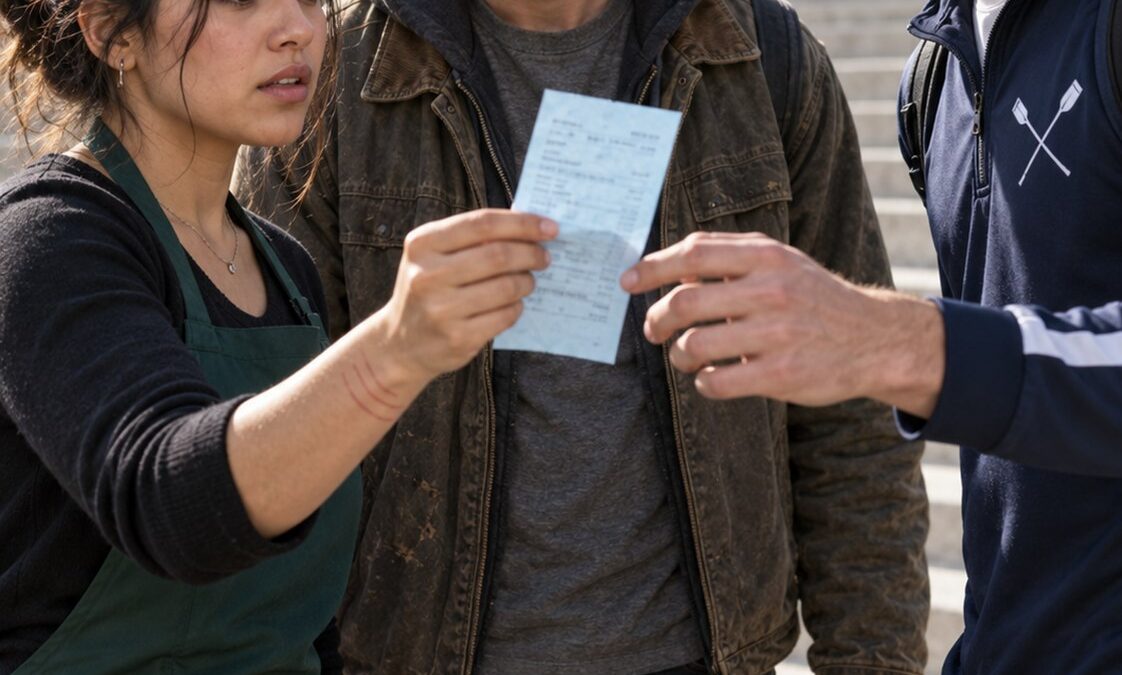
The blue sheet was thin enough to show the dark outline of his fingers behind it.
“Do they have a copy?” she asked.
“Apparently.”
“You said the initials aren’t yours.”
“They aren’t.”
“That’s what you’ll tell them?”
“Yes.”
She studied him.
Six weeks earlier, she had delivered a sealed deposit pouch to his freight window.
He had checked the seal.
He had written the amount in the desk ledger.
Then he had told her to go home.
Two days later, the missing money became her problem.
She had asked him for help.
He had said his company was reviewing the records.
After that, he had stopped answering.
“You could have told me sooner,” she said.
“I should have.”
The officer looked toward the clock inside.
“I can give you one minute.”
Leena rubbed the red marks on her wrist.
Kieran opened his lunch tin.
He took out a clean napkin and offered it to her.
She almost laughed.
“For what?”
“The ink.”
Blue carbon had stained her thumb.
She took the napkin.
It was a small thing.
He knew that.
He also knew she had spent six weeks watching people pull their hands away from her.
“I asked my supervisor for the ledger,” he said.
“What happened?”
“He told me the university had closed the question.”
“And you believed him?”
“No.”
He looked at the receipt again.
“I looked for my own copy.”
The officer cleared his throat.
Leena tucked the napkin into her pocket.
“Did you find it?”
“I found the place it should have been.”
They followed the officer inside.
The disciplinary room had six chairs and no windows.
A camera sat above the door.
Across the table were an associate dean, a student affairs officer, and a lawyer from the university counsel’s office.
A folder lay in front of each of them.
The lawyer introduced herself as Dana Price.
She spoke first.
“Ms. Ortiz, we received your request to add evidence.”
Leena placed the blue receipt on the table.
Price read it without touching it.
The associate dean glanced at Kieran.
“Mr. Shaw is here as a witness?”
“Yes,” Leena said.
“He has personal knowledge of the transfer?”
“I do,” Kieran said.
Price opened her folder.
She drew out a white sheet.
Same form.
Same number.
4187.
On that version, Leena’s name appeared on the line marked RELEASED TO.
Kieran’s initials appeared beneath it.
The amount was $2,400.
Leena stared at the paper.
“That’s not what I signed.”
Price pushed it toward her.
“We need you to look carefully.”
“I am.”
Kieran put the blue copy beside it.
The boxes lined up.
The writing did not.
On the blue sheet, $38,400 sat firmly within the amount box.
On the white sheet, $2,400 floated slightly higher.
The associate dean frowned.
“Could someone have altered one of these?”
“That’s why we’re here,” Price said.
Kieran looked at the bottom edge.
The white copy had a straight cut.
The blue one had a small crescent missing from its lower corner.
Every packet at the freight desk had that cut.
It helped staff stack the copies in the proper order after a jam.
He had made the cut himself that week.
He pointed.
“That’s the original packet.”
Price looked up.
“You’re certain?”
“I cut the corners.”
“On every form?”
“On the batch containing 4187.”
She examined the edge.
Kieran kept his hands on his knees.
“The white page isn’t from that packet,” he said.
A chair scraped.
The associate dean looked from one page to the other.
Price did not speak for several seconds.
Leena finally asked the question she had carried into the room.
“Who wrote my name?”
Kieran saw the shape of the letters.
Then he saw something worse.
The false initials under them were not merely copied from his writing.
They matched the block letters on an old employment form he had signed when he joined the freight contractor.
Someone with access to his personnel file had supplied them.
He looked at Leena.
“The money was never missing from your shift.”
The lawyer turned the white page over.
On its back was a routing stamp.
It had been entered into the case file three days after Leena lost access to the freight desk.
Kieran’s voice stayed level.
“Somebody made that copy after they accused you.”
* * *
Price ended the disciplinary meeting.
She called it a pause.
Leena called it the first decent thing anyone at the university had done in six weeks.
The associate dean suspended the housing deadline while the records were checked.
He put the decision in writing before they left.
Leena read the letter twice on the hallway bench.
“You get to stay?” Kieran asked.
“Until they finish.”
“That’s enough for tonight.”
“It’s Tuesday.”
“I work nights.”
That made her smile, briefly.
Kieran had to be at the freight desk by six.
Before then, he needed to tell his supervisor why a university lawyer would be asking about a missing form.
He used the phone at the end of the hall.
His supervisor, Ed Fenwick, answered after four rings.
“I heard you went to the panel,” Fenwick said.
“I was called as a witness.”
“You didn’t clear that with me.”
“The panel called me by name.”
A pause followed.
Then Fenwick said, “Come to the depot before your shift.”
Kieran returned to the bench.
Leena had set the blue receipt on her knees.
She protected it with both palms whenever someone passed.
“Your boss?” she asked.
“He wants to talk.”
“Because of me.”
“Because his records are wrong.”
Kieran had learned the difference young.
People could carry blame for years when an institution preferred a neat file.
His mother had worked at Bellwether University’s accounts office until he was nineteen.
A missing deposit had ended her job.
There had been no criminal charge.
There had also been no apology.
She now kept books for a hardware store forty minutes away.
Kieran had taken the freight job because it paid enough to make a transfer year possible.
He had not expected to find another missing deposit.
Price came into the hall carrying both copies in separate sleeves.
“I’m requesting the freight records,” she said.
“Ask the contractor,” Kieran replied.
“I will.”
“Ask for the paper log.”
“Is there a digital one?”
“Yes.”
“Why the paper?”
“Because the digital log can be corrected.”
Price considered that.
“Can the paper one?”
“Someone tried.”
He told her about the empty binder slot where his shift’s duplicate should have been.
Then he told her who had access to the desk.
Two clerks.
Fenwick.
The campus courier.
And any university officer escorted inside by security.
“Do you know who requested the case copy?” Price asked.
“No.”
“Can you find out?”
“I can tell you where that request gets recorded.”
He gave her the name of the contractor’s regional records manager.
He did not promise to copy anything himself.
Price wrote it down.
That afternoon, she sent preservation requests to the freight contractor, campus security, and the university finance office.
She also told Leena to keep the receipt in its sleeve.
“Don’t mark it,” she said.
“Don’t even flatten the fold.”
Leena nodded.
“Will I get it back?”
“Yes.”
“Will I get my name back?”
Price looked at the two forms in her hands.
“That is what we’re investigating.”
At the depot, Fenwick waited behind the counter.
He had already pulled Kieran from the evening schedule.
“You disclosed a shipment amount,” he said.
“I was present when it was accepted.”
“You disclosed it publicly.”
“Beckett Rourke said Leena stole it publicly.”
Fenwick folded his arms.
“That isn’t our policy.”
“No,” Kieran said.
He set his time card on the counter.
“I know.”
Fenwick seemed to expect an apology.
Kieran offered the facts instead.
“The receipt in the case file isn’t from our packet.”
“You’re sure?”
“I cut the packet corners.”
“That’s a strange thing to remember.”
“It jammed twice.”
Kieran pointed to the stack of forms beside the scale.
“You told me to fix it without ordering a new box.”
Fenwick glanced at the forms.
His mouth tightened.
“Go home,” he said.
“Am I fired?”
“You’re off shifts pending review.”
Kieran left without raising his voice.
Outside, he called his mother.
She listened while he explained the two receipts.
She asked for the number.
“4187,” he said.
The line went quiet.
“Kieran,” she said, “when did you say the transfer happened?”
“Six weeks ago.”
“That number is old.”
“How old?”
“Three years.”
She had designed the numbering schedule when the emergency fund began.
Each semester had its own range.
The forms for that spring should have started with six.
Kieran leaned against the depot wall.
“The blue copy is from the desk packet.”
“That’s possible,” his mother said.
“But the packet was never supposed to be there.”
She told him she still had the supply orders from her last year.
The university had kept a box of unused forms after she left.
Someone had brought them back into service.
“Why?” he asked.
“I don’t know.”
“Would your records show who ordered the old stock?”
“No.”
“They might show who reported it destroyed.”
His mother was quiet again.
Then she said a name.
“Paige Rourke signed my dismissal memo.”
Kieran watched a delivery truck roll past.
Beckett’s aunt ran the emergency fund now.
Three years earlier, she had helped remove the person who tracked its receipts.
* * *
Kieran did not go home.
He went to the public library across from campus.
His mother met him there with a cardboard folder.
She arrived in her work sweater, carrying the smell of sawdust from the hardware store.
“You look tired,” she said.
“I am.”
“Have you eaten?”
“I brought lunch.”
“That wasn’t my question.”
They sat at a table beneath the library’s old clock.
She laid out supply orders, policy pages, and the letter that had ended her job.
No confidential donor information.
Only documents she had been allowed to keep.
Her dismissal memo said she had failed to reconcile a transfer.
The transfer was small.
$6,800.
The case had never reached police.
The university had written it off and replaced her.
Kieran studied the date.
The disputed transfer had been recorded on a form from the same old series as Leena’s receipt.
“Did you notice?” he asked.
“I told them.”
“Who?”
“Paige.”
“What did she say?”
“She said old forms were still valid.”
“Were they?”
“Yes, if they were entered in order.”
He placed the dismissal memo beside the supply schedule.
The numbers had not been entered in order.
His mother had flagged that too.
“I couldn’t prove who moved the money,” she said.
“That’s why I stopped.”
Kieran looked at her.
She had spent three years telling him she was fine.
She was good at it.
“I thought you stopped because you were afraid,” he said.
“I was afraid.”
She tapped the old memo.
“I was also right.”
Price called while they were still at the table.
The freight contractor had agreed to preserve records.
Campus security had preserved two camera systems.
One camera above Kieran’s desk showed Leena handing over the pouch.
A second camera watched the service corridor.
The footage was archived.
Price would need an authorized review to see it.
“The university has its own interests here,” she said.
“I understand.”
“I’m recommending an outside accountant.”
“That would help.”
“Your mother called my office,” Price added.
Kieran looked across the table.
His mother gave a small shrug.
“She knows I worked there.”
Price continued.
“She told me about the numbering.”
“Will you look at her case?”
“I’ll look at the records relevant to this one.”
It was a careful answer.
Kieran respected it.
The next morning, Leena received an email from an unfamiliar address.
It contained a photograph of her dorm room door.
There were no words.
She showed Price.
Price told campus security and helped Leena make a police report.
The officer who took it did not promise an arrest.
He recorded the message and asked whether anyone had entered the room.
No one had.
Leena stayed that night with her friend Tessa, who lived in the same building.
Tessa made toast.
Leena ate three pieces.
Kieran came by only after Leena invited him.
He brought a replacement lockbox for her papers.
It cost fourteen dollars at his mother’s store.
“You don’t have to pay me,” he said.
“I know.”
“You can if you want.”
“I know that, too.”
He put the box on the table.
Leena held the blue receipt in its sleeve.
“For weeks, I thought you saw something and walked away.”
“I did walk away.”
“You’re back.”
“I should have come back sooner.”
She traced the sleeve’s sealed edge.
“My dad keeps asking if I need money for a lawyer.”
“Do you?”
“Price says the university will let me bring one.”
“Would you feel better with one?”
“Yes.”
“Then tell him.”
She gave him a tired look.
“He’s already working overtime.”
Kieran had no clever answer.
He knew what an extra shift cost.
He also knew her father would rather pay a lawyer than watch her face that room alone.
“Let him decide,” he said.
Leena stared at the toast.
Then she called her father.
Kieran went to the hallway while she spoke.
Later that day, Price’s outside accountant found that the emergency fund had paid an equipment company called Northline Performance twelve times in three years.
The invoices described rowing gear, safety upgrades, and storage.
The shipping records described almost nothing.
No freight deliveries matched most of the invoices.
The company’s registered address belonged to a small office across town.
Price sent the findings to the university’s audit committee.
She also asked the contractor for the staff file access log.
Kieran’s personnel form had been viewed twice in the previous month.
Once by Fenwick.
Once through a credential assigned to the emergency fund office.
Leena’s false receipt had carried Kieran’s initials.
The source was no longer a guess.
Then Price received a message from the outside accountant.
Northline Performance’s bank account had paid a private loan held in Paige Rourke’s name.
The fund director had not been covering a team expense.
She had been paying her own debt.
* * *
The audit committee met on Friday.
It was supposed to be private.
Leena’s lawyer asked for a separate session in which she could present her evidence.
Price arranged one.
The university president, two trustees, an independent accountant, and a student representative attended.
Paige Rourke came with her own lawyer.
Beckett sat behind her.
Kieran arrived in his faded coat.
His contractor had not restored his shifts.
He had borrowed forty dollars from his mother to cover the week’s groceries.
She had insisted on calling it a loan.
He had insisted on writing it down.
Leena sat beside her father.
He wore his work uniform because he had come straight from the bus depot.
He set one hand on the table near hers.
He waited until she moved hers closer.
Price began with the two receipts.
The accountant displayed enlarged images.
Blue.
White.
Same number.
Different amount.
Different signatures.
Paige studied them without showing surprise.
“The blue sheet appears irregular,” she said.
“It has the packet cut,” Price replied.
“That proves someone found old stock.”
“Yes.”
“It does not prove my office altered a record.”
Her lawyer leaned forward.
“We also object to linking an unrelated supplier review to an individual student’s conduct.”
The president asked Price to stay with Leena’s case.
It was a fair request.
Paige knew it.
She answered every question in the narrowest possible way.
The pouch could have been short when Leena delivered it.
Beckett could have signed without counting.
The blue receipt could have been altered later.
Kieran could have mistaken an ordinary staff initial for his own.
None of those claims was impossible by itself.
Together, they gave the trustees somewhere comfortable to stand.
Leena’s father clenched his hands.
She touched his sleeve.
Price called Kieran.
He explained the form packet.
He described the crescent cut.
He told them how the desk camera faced the acceptance window.
Paige’s lawyer asked whether Kieran had been dismissed from his job.
“No,” Kieran said.
“You were removed from shifts.”
“Yes.”
“Your employer questions your judgment?”
“He’s reviewing it.”
“You have a personal reason to dislike Ms. Rourke, don’t you?”
“My mother lost her job while Ms. Rourke supervised the fund.”
The lawyer turned toward the trustees.
“There it is.”
Kieran kept his eyes on him.
“Did that happen?” the lawyer asked.
“Yes.”
“Have you wanted to challenge that decision?”
“Yes.”
“Could that affect what you remember?”
“It could.”
Several heads lifted.
Kieran continued.
“That’s why I asked you to check the records.”
He had not come to be believed without proof.
Paige had counted on making him look bitter.
She had not counted on his being willing to sound human.
The accountant asked to show the footage.
The president nodded.
On the first camera, Leena slid a pouch through the freight window.
Kieran checked its seal.
He wrote in the paper log.
The image had no sound.
The second camera showed the service corridor twelve minutes later.
Beckett walked through carrying the same style of pouch.
He passed it to a woman waiting by the fund office door.
Her face was turned away.
Paige’s lawyer spoke immediately.
“You cannot identify that pouch from this image.”
The accountant agreed.
“No, I cannot.”
Beckett shifted in his chair.
Paige remained still.
The room had reached the place where a good lie could survive.
Then Leena raised her hand.
“When I sealed the pouch,” she said, “the adhesive strip folded over.”
She pointed at the screen.
“There’s a white triangle on the right side.”
The accountant enlarged the freight-window image.
A small white triangle showed near the seal.
He enlarged the corridor image.
The same fold appeared.
Paige’s lawyer leaned back.
“Many seals fold,” he said.
“That alone would not be enough,” the accountant replied.
He turned to the blue receipt.
The original transfer line listed a seal number.
He read it aloud.
The freight camera showed Leena holding the pouch close enough to make the number visible.
It matched.
Beckett stared at the screen.
Leena’s father looked at her.
She was watching Beckett.
“I asked you that morning,” she said.
“I asked where you took it.”
Beckett’s mouth opened.
Paige put a hand on his arm.
He stopped.
The accountant moved to the next record.
The fund office’s secure deposit log showed the same seal number received at 10:29.
That log had been saved automatically by a third-party storage provider.
Its entry could not be changed through the university’s system.
The named recipient was Paige Rourke.
The president turned toward her.
“Did you receive this pouch?”
“I receive many deposits.”
“This one.”
“I would need to review my calendar.”
Price slid a printed record across the table.
“We preserved your calendar.”
Paige did not pick it up.
The accountant explained what followed.
The fund office recorded only $2,400 from the pouch.
That same day, $36,000 moved through a payment to Northline Performance.
Bank records obtained during the outside review showed Northline made a loan payment for Paige two days later.
The committee had not obtained every record it would need for a criminal case.
It had enough to stop treating Leena as its suspect.
Paige’s lawyer asked for a recess.
The president refused until Leena’s disciplinary matter was resolved.
He asked the associate dean to speak.
The dean looked at Leena.
“The allegation against you is withdrawn.”
Her father covered his eyes.
Leena stayed very still.
She had prepared six weeks of arguments for that moment.
There was nothing left to argue.
Price turned to Beckett.
“You signed the blue receipt?”
“Yes.”
“Did you take the pouch to the fund office?”
“Yes.”
“Why did you deny it?”
He looked at his aunt.
Paige’s hand had left his arm.
“She told me it had already been reconciled,” he said.
“When?”
“The next day.”
“Did you ask Leena for the receipt today?”
“Yes.”
“Why?”
“Aunt Paige said it was a duplicate.”
The president’s face hardened.
Beckett looked down.
“I grabbed her,” he said.
“I shouldn’t have.”
Leena did not answer him.
His apology belonged in the room.
It did not require a gift from her.
Paige stood.
“The fund was facing a cash shortage,” she said.
“A temporary one.”
The accountant looked at her.
“Your personal loan was not a fund expense.”
“My home secured the bridge financing that kept our program open.”
“You did not disclose that financing,” a trustee said.
“I knew how the board would react.”
She looked around the table.
“You enjoyed the boathouse.”
“You enjoyed the scholarships it attracted.”
“You signed every expansion plan.”
For a moment, no one spoke.
She had helped build the program.
Several people in the room knew it.
Then the student representative asked, “Did students agree to pay your debt?”
Paige turned toward him.
“No one lost a scholarship.”
Leena moved her chair back.
“I almost lost mine.”
Paige looked at her as if she had forgotten she was there.
“You were going to be cleared.”
“When?”
“Once the accounts settled.”
Kieran spoke before Leena’s father could rise.
“She was living with the accusation.”
Paige faced him.
“And your mother has spent three years doing the same.”
The sting found its mark.
Kieran did not look away.
“Yes,” he said.
“That’s why we checked.”
The president called a recess then.
Paige’s access to fund accounts was suspended that afternoon.
The board appointed an independent firm to review three years of transfers.
The university sent its findings to state investigators.
It did not announce charges.
That was not its decision.
A month later, the contractor restored Kieran’s shifts.
Fenwick offered the nights back without an apology.
Kieran took them until he found better work.
The university formally cleared Leena and corrected her records.
It paid for the legal help she had needed to answer its accusation.
Beckett lost his captaincy after a conduct hearing about grabbing her on the steps and misleading the first review.
He completed his degree the following year without the team’s endorsement.
The criminal investigation took longer.
Investigators obtained bank records, vendor files, and the original paper log.
They found that Paige had directed false invoices over three years.
Northline’s owner cooperated.
Paige pleaded guilty to financial crimes the next spring.
The court ordered restitution and imposed a sentence under state law.
Leena did not attend the hearing.
Neither did Kieran.
His mother went.
She wanted to hear the facts entered into a record no one could quietly replace.
* * *
By summer, the student center steps belonged to ordinary things again.
Students carried iced coffee.
Someone practiced trumpet badly near the side doors.
Leena passed the spot where Beckett had grabbed her almost every day.
At first, she looked down.
Then she stopped noticing the exact step.
She kept the blue receipt in a flat folder at her apartment.
The university had returned it after the investigation copied and documented it.
She never framed it.
She had no interest in seeing it whenever she made breakfast.
Kieran finished the semester with a narrow pass in statistics and a high mark in everything else.
He paid his tuition bill two days late.
The bursar waived the fee after his adviser explained the lost shifts.
He was embarrassed by the favor until Leena reminded him that the university had given him plenty of paperwork without asking.
His mother received a letter from the board.
It withdrew the finding that she had failed to reconcile the old transfer.
It acknowledged the control problems she had reported.
A trustee visited the hardware store to apologize in person.
His mother made him wait while she finished helping a customer choose screws.
Then she heard him out.
“You were right to review the records,” he told her.
“Yes,” she said.
“I was.”
The trustee offered her a senior job in the rebuilt fund office.
The salary was more than she made at the store.
She asked for a day to think.
That night, she invited Kieran and Leena to dinner.
She made chicken and rice in the pan Kieran had nearly ruined at sixteen.
Leena washed dishes with her.
Kieran dried them badly.
“You’re leaving water on the plates,” his mother said.
“I’m preserving their natural environment.”
Leena laughed.
His mother pointed the dish towel at him.
“Try again.”
After dinner, she told them about the offer.
Kieran expected her to refuse on principle.
Leena expected her to take the money.
She did neither that night.
“What do you want?” Leena asked.
“I want the job done properly.”
“Would they let you?”
“They said I could rewrite the controls.”
Kieran leaned against the counter.
“That sounds like something you’d enjoy.”
“It does.”
She smiled at him.
“I’m allowed to enjoy it.”
A week later, she accepted.
She required the university to fund an outside audit every year.
She also required the student emergency fund to publish a plain-language report showing how much money came in and where it went.
The board agreed.
Kieran watched her carry a new desk lamp into the office that had once removed her name from its door.
She had chosen the lamp herself.
It had a crooked green shade.
“It was on sale,” she said.
“I can tell.”
“You’ll survive.”
Leena’s own offer came from the university president.
He asked her to serve on a committee redesigning student worker protections.
There would be a stipend.
There would also be meetings.
She read the proposal with her lawyer before answering.
She accepted for one semester.
At the first meeting, she asked why a student accused of misconduct could lose housing before anyone checked the underlying records.
No one had a good answer.
By the last meeting, the housing rule had changed.
A disputed financial accusation could no longer end a student worker’s room assignment before an independent review.
Leena knew a rule could still be ignored.
She also knew it was harder to ignore once someone could point to the page.
Beckett sent her an apology by email.
It was short.
He admitted grabbing her wrist, lying about the pouch, and helping his aunt pressure her over the receipt.
He did not ask to meet.
Leena read it twice.
Then she wrote back.
“I accept that you said this.”
“Do not contact me again.”
He did not.
Kieran never asked what she had written.
One evening, she told him anyway.
He nodded.
“That sounds clear.”
“It is.”
They sat outside a cheap diner near the freight depot.
Kieran had brought his first paycheck from a new job at a shipping cooperative.
He had left the contractor at the end of the term.
The cooperative paid a little more.
It also let him leave on time for classes.
Leena reached for the bill.
“I invited you,” he said.
“You bought dinner last time.”
“That was pizza.”
“It was food.”
“You’re making a strong legal argument.”
“I learned from an expensive lawyer.”
They split it.
For months, people had made choices about Leena without asking her.
Kieran had noticed.
He had become careful about even small invitations.
They walked toward the bus stop.
At the corner, he stopped.
“There’s a street fair Saturday,” he said.
“I heard.”
“Would you want to go with me?”
“As what?”
He considered lying lightly.
He decided she deserved the real answer.
“As a date.”
A bus hissed to a stop behind them.
Leena looked toward its open door.
Then she looked back.
“Yes,” she said.
“If we leave whenever I want.”
“Of course.”
“And you’re buying the terrible lemonade.”
“That sounds expensive.”
“It’s seven dollars.”
“I’ll start saving.”
She got on the bus smiling.
Kieran stood under the shelter until it pulled away.
His phone buzzed.
A message from his mother.
Had he eaten?
He typed back.
Yes.
Then another message arrived.
Did he dry the dishes properly anywhere he went?
He put the phone away without answering.
* * *
Four years later, the student center steps were crowded for graduation.
Kieran had finished his degree while working at the cooperative.
Leena had finished hers a year earlier.
She now helped run a housing nonprofit that advised students on their rights before a crisis became a hearing.
Kieran’s mother still managed the emergency fund controls.
Its annual report had become boring.
She considered that a triumph.
The morning was warm.
Families filled the plaza.
Somebody had tied blue ribbons to the railings.
Leena stood on the lowest step with a flat folder under her arm.
Kieran recognized it.
“You brought that?”
“The archive asked for it.”
The university had requested the original blue receipt for an exhibit about the fund’s reform.
Leena had agreed on conditions.
Her name would appear beside her own account of what happened.
The exhibit would include the false white copy.
It would explain why the first review failed.
Kieran opened the folder.
The receipt sat inside a clear sleeve.
Number 4187.
A crescent at the corner.
A signature Beckett had once tried to deny.
“It looks smaller,” he said.
“It always was.”
Across the plaza, a student worker rolled a cart toward the service entrance.
Another student held the door.
Leena watched them pass.
“Do you remember what you said here?”
“I said a lot.”
“You said you could testify.”
“I could.”
“You did.”
Kieran handed the folder back.
Leena closed it.
They climbed the steps together, leaving enough room for the cart behind them.
The fund was whole.
His mother’s name was clear.
Leena had her degree.
The records told the truth.
At the top, Kieran held the door while Leena carried the blue receipt inside.
THE END








