The Campus Star Blamed a New Transfer for the Dead Captions—Then She Turned Over the Orange Remote He Wanted Hidden
Chapter 2: What the Remote Remembered
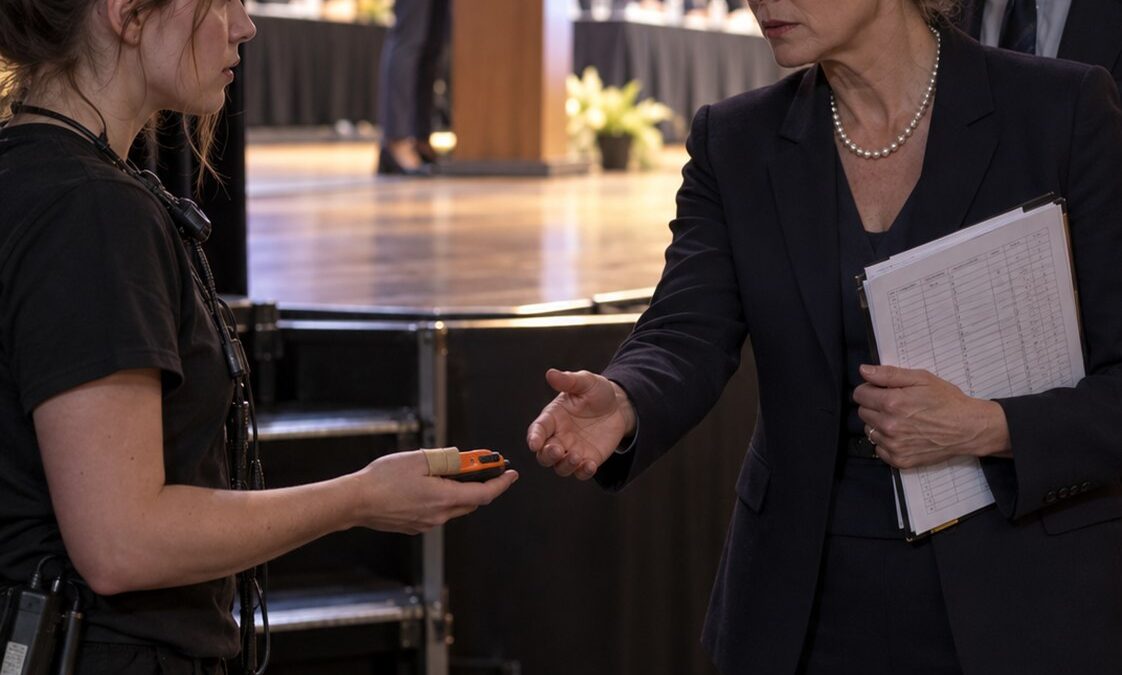
Dr. Hale came down the aisle.
The applause faded.
June stayed by the stage steps.
The orange remote rested in her open hand.
The tape clung to her thumb.
“Thank you,” Dr. Hale said.
She held out her palm.
“I’ll take that.”
June could see her own name on the sign-out sheet.
She could also see Bennett moving closer.
“I need to return it to my supervisor,” June said.
“I oversee this event.”
“My supervisor is here.”
“He works for me.”
That was true.
It did not make the remote hers.
Imani stood at the foot of the steps.
“Are my captions staying on?” she asked.
Dr. Hale turned toward her.
“The technical issue is resolved.”
“That wasn’t my question.”
June checked the screen.
The feed still worked.
“For now,” she told Imani.
Dr. Hale’s hand remained out.
June felt the judges watching.
She could lose eleven dollars an hour.
She could lose the campus job that came with it.
Rent was due in twelve days.
“I found tape on the switch,” June said.
Bennett folded his arms.
“You were holding it.”
“Yes.”
“You were alone at the table.”
“For thirty seconds.”
“You signed for it.”
“That part is true.”
June offered the sheet a glance.
“When did I sign?”
Dr. Hale lowered her hand.
“At setup.”
“What time?”
“June,” her supervisor warned.
She looked at him.
Mr. Pike had trained her carefully.
He had shown her where the spare batteries lived.
He had told her to document every handoff.
Now he looked frightened.
June turned back to Dr. Hale.
“I’d like the time.”
Dr. Hale checked the paper.
“Nine thirty-two.”
The presentation had begun at ten fifteen.
June had arrived at the sound table at ten twelve.
For forty minutes, the remote had been in a locked drawer.
Mr. Pike carried the key.
“I signed for the drawer,” June said.
“Not the remote.”
Dr. Hale’s eyes narrowed.
Mr. Pike stood.
“She’s right.”
Bennett looked at him.
“You told me she ran the equipment.”
“She did.”
“Then what are we arguing about?”
Imani came closer.
“Because I lost two minutes.”
“You got them back,” Bennett said.
“I got some of them back.”
The timer had not stopped.
The judges had written while she searched for words she could not see.
June looked at Imani’s hands.
One trembled.
June held out the remote.
“Would you take a picture of this?”
Imani took out her phone.
Dr. Hale spoke sharply.
“That’s university equipment.”
“I’m photographing it.”
“You need permission.”
“Then ask the judges to witness it,” June said.
The nearest judge rose.
He was Professor Arden, from engineering.
“I can witness a photograph.”
Dr. Hale gave him a fixed smile.
“This can wait.”
“No,” Imani said.
Her voice was quiet.
She raised her phone.
June held the orange remote beside the tape.
Imani took three pictures.
The first showed the switch.
The second showed the letters.
The third showed the remote’s serial number.
Dr. Hale watched every one.
Mr. Pike stepped beside June.
“You can give it to me now.”
June placed the remote in his hand.
He put it in a clear equipment pouch.
He sealed the pouch with a numbered label.
June had seen him use those labels for damaged microphones.
She had never loved one so much.
Dr. Hale turned to the judges.
“We should continue.”
Professor Arden looked at Imani.
“Do you want a fresh presentation slot?”
“Yes.”
“Then we’ll discuss it.”
Bennett made an incredulous sound.
“She already gave the presentation.”
“With the clock running,” Imani said.
“The rules allow technical restarts,” Arden replied.
Dr. Hale opened her mouth.
Then she closed it.
June finally looked at Bennett.
He was staring at the tape.
“Why did you ask for it?” she said.
“My aunt told me to collect it.”
“When?”
He looked toward Dr. Hale.
The auditorium doors opened behind him.
Students were leaving for their next classes.
One stopped to watch.
Bennett swallowed.
“Before the captions failed.”
* * *
Mr. Pike took the pouch to campus security.
June walked beside him.
Imani followed.
No one asked her to.
She came anyway.
The security desk occupied a bright room beside the library.
A radiator clicked beneath the windows.
Officer Shaw gave them a form.
Mr. Pike described the failure.
June described the tape.
Imani supplied the photographs.
Shaw wrote down the time.
She asked each of them to sign only their own statement.
June liked that.
Bennett had been so sure that one signature settled everything.
Shaw looked at the pouch label.
“Who had access to the drawer?”
Mr. Pike counted on his fingers.
“Him, me, and event administration.”
“Who is him?”
“Bennett Hale.”
June turned.
Mr. Pike looked miserable.
“He helped unload this morning.”
“Did he have the key?”
“For about five minutes.”
Bennett had been backstage at nine.
That was trouble.
It was also not proof.
June had learned the difference at nineteen.
At her old community college, a camera had caught her leaving a lab late.
Someone had broken a costly display after she left.
She had reported that the door latch did not catch.
The report disappeared.
Her scholarship review took three months.
She transferred before the decision arrived.
She still remembered the word “unresolved” on the form.
Shaw asked about the system.
Mr. Pike explained that the orange remote controlled the caption receiver.
It paired with one unit in the auditorium.
The side switch put that unit into standby.
The captions could also be paused from the control computer.
“Can we check which happened?” Imani asked.
“Probably,” Mr. Pike said.
“The receiver keeps an event history.”
Shaw wrote that down.
She did not open the pouch.
“I’ll ask our digital team to preserve the logs,” she said.
“Can they do it today?” Imani asked.
“They can preserve them today.”
“Will they tell me what happened?”
“When we know.”
Imani nodded.
Her patience looked painful.
Outside, June’s phone buzzed.
Her shift had ended twenty minutes earlier.
The scheduling app showed tomorrow’s hours gone.
So did Thursday’s.
She stared at the empty boxes.
Mr. Pike saw her face.
“I didn’t change those.”
“Somebody did.”
He checked his own phone.
His jaw tightened.
“Event administration.”
June put the phone away.
She had thirty-eight dollars in her account.
Imani noticed.
“I’m sorry,” she said.
“You didn’t touch my schedule.”
“This started with me.”
“It started before you spoke.”
They walked toward the student union.
Imani bought three coffees.
June protested.
Imani slid one across the table anyway.
“Then pay me back when you’re rich.”
“That seems unlikely.”
“Good,” Imani said.
“I hate collecting.”
It was the first time she had smiled.
Professor Arden joined them ten minutes later.
He had asked another judge to cover the remaining presentations.
“I’ve reviewed the rules,” he said.
“Imani gets another slot.”
“When?” Imani asked.
“Tomorrow morning.”
“Before awards?”
“Yes.”
“Are the same judges coming?”
“They should.”
She caught the word.
“Should?”
“Dr. Hale has raised an objection.”
Of course she had.
Arden put a printed page on the table.
The rules allowed a restart for equipment failure.
They also gave the chair authority to decide whether the failure was “external.”
“External to whom?” June asked.
“That’s the question.”
Arden tapped the page.
“I’m asking for a committee vote.”
Imani looked at June.
“Can they say you caused it?”
“They can say anything.”
“They need evidence,” Arden said.
June thought of her old file.
Evidence had not saved her quickly.
But it had eventually saved her.
Four months after she transferred, the college found the broken latch.
They restored her record.
The scholarship money did not follow her.
She had framed the clearance letter once.
Then she had sold the frame.
Mr. Pike’s phone rang.
He walked to the window.
He listened without speaking.
When he came back, his face had changed.
“That was security’s digital technician.”
“Already?” June asked.
“The receiver recorded a local standby command.”
“From the remote?”
“Yes.”
Imani gripped her cup.
“Then the tape did it.”
“Maybe.”
Mr. Pike took a breath.
“The standby command was sent at nine fifty-eight.”
June looked at Arden.
Imani’s presentation had begun at ten fifteen.
The captions had been off before she took the stage.
* * *
At seven the next morning, June found a letter under her apartment door.
It came from campus employment.
She had been placed on paid leave while the event was reviewed.
Paid leave meant she could meet rent.
It also meant she could not touch the sound booth.
She read the letter twice.
Then she went to Imani’s second presentation.
The auditorium was half full.
Bennett sat in the third row.
His two teammates sat apart from him.
Dr. Hale did not appear.
An assistant handled the timer.
A different technician ran the captions.
Imani walked onto the stage.
She paused beneath the screen.
Every word appeared.
June had never been so pleased to read “Good morning.”
Imani presented a small device that made classroom discussions easier to follow.
It paired a microphone with a private text display.
She had built the first version after missing questions in a crowded lecture hall.
The judges asked about cost.
She gave them numbers.
They asked about battery life.
She had tested that too.
They asked what would happen when several people spoke at once.
“It struggles,” she admitted.
“That’s the next problem.”
June watched Professor Arden smile.
Bennett did not.
When Imani finished, he approached her in the aisle.
June stood.
He stopped two steps away.
“I didn’t know the captions were off early,” he said.
“Now you do,” Imani replied.
“My aunt said the tech crew messed up.”
“Did she say why you should take the remote?”
“She said equipment goes missing after disputes.”
June came closer.
“Did she tell you that before my shift?”
“Yes.”
“Did you put tape on it?”
“No.”
He answered quickly.
June believed he meant it.
She did not yet know whether it was true.
Bennett glanced toward the exit.
“Someone posted the video.”
“Which video?” Imani asked.
“The one from yesterday.”
June had forgotten the student with the phone.
The clip showed Bennett holding June’s sleeve.
It showed June saying the scene was already made.
It ended before the captions returned.
Its caption accused June of sabotaging Imani.
The account had no name.
It had already been shared hundreds of times.
June opened her phone.
Messages filled the screen.
Some asked questions.
Others had made up answers.
Her mother had called four times.
June stepped into the hallway.
She called back.
Her mother answered immediately.
“Are you safe?”
“Yes.”
“That video looks awful.”
“It stops early.”
“Can you explain?”
“I’m trying.”
Her mother worked nights at a distribution center.
She slept during June’s classes.
Today she had stayed awake to watch strangers accuse her daughter.
June rubbed her eyes.
“I’m on paid leave.”
“You need that job.”
“I know.”
“Come home tonight.”
“After Imani’s hearing.”
Her mother was quiet.
Then she said, “Eat something first.”
June promised.
When she returned, Imani held out a breakfast sandwich.
“Your mother and I agree,” she said.
June took it.
She managed half.
Campus security called before noon.
Officer Shaw wanted another statement.
June brought Mr. Pike.
Shaw had the receiver log.
She also had the sign-out sheet.
The local standby command had come from the orange remote.
At nine fifty-eight, the receiver accepted its unique radio code.
The tape had held the switch in place until the battery was removed.
“Who removed the battery?” June asked.
“Pike did during setup,” Shaw said.
“I changed it at ten eleven,” he confirmed.
“The taped switch sent the command when I put the new one in.”
That explained the delay.
The remote had been prepared earlier.
Mr. Pike frowned.
“I checked the battery at eight.”
“Was the tape there?” Shaw asked.
“No.”
“Are you sure?”
“I would have seen it.”
June believed him.
He had shown her how to check that switch on her first shift.
Shaw placed a photograph on the desk.
It showed the remote at eight forty-seven.
Orange casing.
Clean underside.
Mr. Pike had taken it for the equipment inventory.
“So the tape went on after that,” June said.
“And before ten eleven,” Shaw replied.
“Who opened the drawer?”
“We’re checking access records.”
The drawer key had no electronic record.
The backstage door did.
Bennett had entered twice.
An event assistant had entered once.
Dr. Hale had entered at nine twenty-six.
She had told the judges she spent the morning in her office.
That was one lie.
Shaw would not call it one yet.
She showed them the sign-out sheet.
June’s signature stood beside nine thirty-two.
Below it, a second line had been added.
“Remote transferred to B. Hale, nine forty-one.”
Bennett’s initials sat in the final box.
June stared at them.
“He said his aunt asked him to collect it.”
“He did,” Shaw said.
“He gave it back at nine fifty.”
“Who took it?”
Shaw turned the page.
The return box held two initials.
C.H.
June felt the old lab door swing open in her memory.
The missing report.
The word unresolved.
This time, a record had stayed where someone left it.
Dr. Hale had signed for the remote.
* * *
The fellowship hearing began at four.
The committee met in a seminar room.
Imani could attend with an adviser.
June came as a witness.
Mr. Pike came as the equipment custodian.
Bennett came because his own presentation was under review.
Dr. Hale chaired the meeting.
She had objected to stepping aside.
The university counsel had required it.
Professor Arden sat at the head of the table instead.
There were six voting members.
Two faculty.
Two alumni.
One student representative.
One disability services director.
A counsel from the university sat near the door.
She explained that the meeting would decide two things.
Whether Imani’s interrupted presentation counted.
Whether the award decision should be delayed.
Security would handle the equipment investigation separately.
Dr. Hale listened without expression.
Bennett sat beside her.
His shoulders were stiff.
Imani had brought her design notebook.
June had brought nothing.
The orange remote remained sealed with security.
Professor Arden began.
“Imani, what do you want?”
“A fair evaluation.”
“Of which presentation?”
“The second one.”
Dr. Hale leaned forward.
“The rules address an external technical failure.”
“Yes,” Imani said.
“The captions failed before I began.”
“We don’t yet know who caused it.”
“I didn’t.”
“I haven’t said you did.”
“You keep saying ‘we don’t know’ when you mean June.”
The student representative looked down.
Dr. Hale folded her hands.
“I’m protecting the process.”
June recognized that voice.
It sounded like a door clicking shut.
Arden asked Mr. Pike to explain the equipment.
He did.
He described the taped switch.
He described the battery change.
He gave the receiver times.
He did not guess who had placed the tape.
Dr. Hale seized on that.
“Any event worker could have accessed the drawer.”
“Not any,” Mr. Pike said.
“Four people had the key.”
“June was one.”
“Yes.”
June kept her face still.
The disability services director asked about the captions.
“Could Imani reasonably have continued without them?”
“No,” Mr. Pike said.
“Why not?”
“The room audio was poor at the podium.”
Imani answered too.
“I could hear some words.”
“I could not follow the questions.”
Dr. Hale turned a page.
“Yet she finished.”
“I did,” Imani said.
“Under the original time.”
“Because the clock kept running.”
“You could have stopped.”
“I thought stopping meant losing.”
That landed.
Even Bennett looked at her.
The counsel asked for the sign-out sheet.
Dr. Hale passed it over.
She did not touch the lines near the bottom.
Counsel read them.
“Bennett, why did you take the remote?”
“My aunt asked.”
“For what purpose?”
“To check whether it had been charged.”
Mr. Pike shook his head.
“It uses batteries.”
Bennett flushed.
“She said check the power.”
“Did you?” counsel asked.
“No.”
“Then what did you do?”
“I carried it to her office.”
Dr. Hale interrupted.
“That was a routine handoff.”
“Let him answer,” Arden said.
Bennett looked at his hands.
“I put it on her desk.”
“Did you see tape?”
“No.”
“Did she give it back?”
“She said she would.”
June felt Imani shift beside her.
Counsel turned to Dr. Hale.
“Your initials show the return.”
“Yes.”
“Where did you find it?”
“On my desk.”
“Who else entered your office?”
“Several people.”
“Names?”
“My assistant.”
“Anyone else?”
“I don’t keep a guest ledger.”
Counsel set down the sheet.
“Security does.”
Dr. Hale’s expression did not change.
The room waited.
Counsel did not reveal the record.
She asked the committee to consider a narrow question first.
Would they count Imani’s second presentation?
Dr. Hale argued that a second slot gave Imani extra preparation.
Another finalist had no second chance.
Imani had heard competing presentations by then.
She could adjust her answers.
“She presented the same project,” Arden said.
“That doesn’t erase the advantage.”
June wanted to stand.
She stayed seated.
Dr. Hale’s argument was unpleasant.
It was also clear.
The alumni members listened.
One asked whether the second presentation had been recorded.
It had.
The first had been recorded too.
“Then compare them,” Imani said.
“Every answer I changed is visible.”
The student representative asked for time.
They watched parts of both recordings.
Imani’s opening words matched.
Her cost figures matched.
The captions failed.
Her eyes lifted.
She lost her place.
Then June appeared beneath the screen.
The second recording showed Imani answering one new question.
There was no hidden advantage in that.
Professor Arden called the vote.
Five members accepted the second presentation.
Dr. Hale did not have a vote.
She asked that her objection be recorded.
It was.
The committee then voted to delay the award.
That decision was unanimous.
Bennett leaned toward his aunt.
She whispered something.
He recoiled.
June could not hear the words.
After the meeting, counsel asked June to stay.
Shaw came in with a folder.
They had preserved the office access log.
Dr. Hale’s assistant had not entered between nine forty-one and nine fifty.
Neither had a visitor.
Dr. Hale had opened the office door twice.
“Does that prove she taped it?” June asked.
“No,” Shaw said.
“It narrows the window.”
Counsel added, “We also found a conflict disclosure.”
Dr. Hale had filed it when she joined the committee.
It listed Bennett as her nephew.
That was public to the committee.
Then counsel turned a second page.
At the start of the semester, Dr. Hale had signed a grant recommendation.
If Bennett won, a paid placement would open at a company called Halden Audio.
Her brother owned it.
The placement would be funded through the fellowship.
“Was Bennett aware?” Imani asked.
“He says no,” Shaw replied.
“Why did you look?” June asked.
“Because of the disclosure,” counsel said.
“Once Dr. Hale handled evidence involving her nephew, we checked the rest.”
There it was.
A choice with a price tag.
Dr. Hale had chaired the competition.
Her nephew was a finalist.
Her brother stood to receive the fellowship placement money.
June looked through the glass wall.
Bennett waited beside a vending machine.
Dr. Hale stood a few feet away from him.
For the first time, they did not look like a team.
Shaw closed the folder.
“Her office computer also created the placement agreement.”
“Before the award?” June asked.
“Six weeks ago.”
The fellowship had not yet begun.
Dr. Hale had prepared Bennett’s prize before Imani applied.
* * *
Security interviewed Bennett that evening.
June did not hear the interview.
She heard its result the next morning.
He admitted that Dr. Hale had asked him to carry the remote.
He had also been told to collect it after Imani’s presentation.
Dr. Hale said the equipment crew had a history of carelessness.
Bennett had repeated that accusation.
He had no basis for it.
He did not admit to touching the switch.
The university did not ask June to trust his denial.
It checked.
Mr. Pike had used a silver paint marker on the remote’s battery cover.
He marked a tiny line across the seam after inspecting it.
The mark appeared in his inventory photograph.
It was still unbroken when security opened the pouch.
The tape had been applied without opening the cover.
There were no useful fingerprints.
Too many people had handled the casing.
The black initials on the tape mattered more.
At first, June thought C.H. meant Celeste Hale.
Counsel would not accept that.
Anyone could write two letters.
Shaw looked for a reason they were there.
The tape was a transparent repair strip from the administration office.
A box of those strips sat beside Dr. Hale’s desk.
The office used them to label temporary access badges.
On the back of each strip, staff wrote the badge holder’s initials.
A strip had been torn from a used badge.
The letters C.H. had been written days earlier.
Security found the matching badge log.
Celeste Hale had signed out the badge for a committee meeting on Monday.
The log included a photograph.
Its strip was longer.
Its torn edge matched the piece found on the remote.
That did not prove who tore it.
It proved where the tape came from.
The independent confirmation came from the office camera.
It faced the door.
It did not see the desk.
At nine forty-three, Bennett entered.
He left without the remote.
At nine forty-seven, Dr. Hale shut her door.
At nine forty-nine, she opened it.
The orange remote was in her hand.
At nine fifty, she gave it to Bennett.
Her return entry claimed she had handed it to the equipment crew.
She had not.
Bennett carried it backstage.
The video showed that too.
The facts lined up.
Then they grew uglier.
Security reviewed the anonymous campus post.
The account had been created that morning.
Its first login came from Dr. Hale’s office network.
That alone could include several people.
The campus communications office had the full video.
The bystander who filmed it came forward.
He said a woman from event administration asked for his clip.
He sent it.
The version online ended just before June restored the captions.
The account had edited it.
Counsel interviewed the woman.
She had received an email from Dr. Hale.
It asked her to “circulate the relevant portion.”
The relevant portion made June look guilty.
The missing thirty seconds cleared her.
By Friday, the university sent June a letter.
Her leave ended.
Her hours were restored.
She received pay for the missed shifts.
The letter also stated that no finding of misconduct had been made.
June showed it to her mother.
Her mother read every line.
Then she put it on the refrigerator.
“Keep the original somewhere safer,” June said.
“I am.”
“It’s under a grocery magnet.”
“It’s where I can see it.”
June left it there.
Imani came over that night.
They ate noodles from paper containers.
She had received a message from the committee.
The award would be announced Monday.
“Do you think you won?” June asked.
“I think I should know by now.”
“That wasn’t my question.”
Imani pointed a fork at her.
“You’re getting annoying.”
“I’ve had a good teacher.”
They laughed.
For a little while, the case did not fill the room.
Imani showed June a new case for her device.
It had a better grip.
Her aunt had printed it at a small workshop.
June tried it.
The corners were smooth.
“You changed this after the judges asked.”
“Yes.”
“You are using your unfair advantage.”
“Don’t tell Dr. Hale.”
They stopped laughing at the same moment.
Imani set down her fork.
“She knew what that screen meant to me.”
June nodded.
“I know.”
“She watched me stand there.”
“Yes.”
“I keep thinking she might have stopped it.”
June did not answer quickly.
“She had time.”
That was the hardest fact.
Dr. Hale had stood close enough to see Imani searching the blank screen.
She had known about the tape.
She had waited.
Imani folded the cardboard lid.
“Bennett came to my lab.”
“What did he want?”
“To apologize.”
“Did you let him?”
“I listened.”
“Was it any good?”
“He said he believed his aunt.”
“That’s true.”
“He also said he wanted to believe her.”
June looked at her.
“That sounds truer.”
“He asked if I could forgive him.”
“What did you say?”
“I told him to stop asking me for a job.”
June smiled faintly.
“That sounds fair.”
“He has to give a statement.”
“He did.”
“To the committee too.”
“He will.”
“You sound sure.”
“I told him.”
Imani pushed aside the empty container.
“Does he know about the placement?”
“Yes.”
“Did he want it?”
“I don’t think so.”
“Wanting the award was enough.”
June could not argue.
Bennett had blocked her path.
He had grabbed her sleeve.
He had accused her loudly.
He had done those things without knowing his aunt’s plan.
They belonged to him.
On Monday, the committee announced two decisions.
Imani won the fellowship.
The university removed Dr. Hale from committee work.
It opened a formal employment review.
Bennett’s project placed second.
He lost eligibility for the Halden placement.
The university referred the altered video and the false sign-out entry to its legal office.
It did not announce criminal charges.
June appreciated the restraint.
The facts were serious enough without invented endings.
Three weeks later, Dr. Hale resigned.
Her attorney said she had made administrative errors under pressure.
The university’s final report used plainer words.
She had concealed a financial conflict.
She had interfered with equipment.
She had misrepresented its custody.
She had tried to influence the fellowship outcome.
The report was sent to the grant sponsor.
Halden Audio lost its approved placement status.
The sponsor required the fellowship money to be spent directly on Imani’s tuition and project costs.
No portion would go to Halden.
Dr. Hale’s attorney objected.
The sponsor declined to change the decision.
The last time June saw Dr. Hale, it was outside the library.
She was carrying a cardboard box.
Bennett was beside her.
Dr. Hale stopped when she saw June.
“You’ve made yourself useful,” she said.
June had no audience.
Only Bennett and the wind.
“I did my job.”
“You know this won’t make the world fair.”
June thought of the refrigerator letter.
She thought of Imani’s new grip.
She thought of the clock that had kept running.
“No,” she said.
“It made one decision fair.”
Dr. Hale walked away.
Bennett stayed.
“I should have moved,” he said.
“Yes.”
“I should have watched the whole video.”
“Yes.”
“I’m sorry.”
June looked at him.
“I believe you.”
He waited.
She had nothing more to give.
After a moment, he followed his aunt.
* * *
Spring changed the auditorium slowly.
The heating still knocked.
The stage lights still warmed one side of June’s face.
The caption receiver worked.
Mr. Pike taped a note inside its case.
CHECK THE SIDE SWITCH.
June added another beneath it.
CHECK THE WHOLE STORY.
Mr. Pike pretended to disapprove.
He left both notes there.
Her hours increased in April.
She moved from event setup to the regular audiovisual crew.
The raise was small.
It bought groceries without counting each item.
Her mother took the refrigerator letter down in May.
June found it in a folder with her old clearance letter.
“Why did you keep both?” she asked.
“So you remember they finished the work.”
June considered that.
Her old college had cleared her.
Bellwether had paid her.
Neither had returned the months spent waiting.
Still, both letters had names and dates.
They were evidence of answers.
Imani used her fellowship to finish the device.
She tested it in three classrooms.
The first trial failed when someone dropped a microphone.
The second failed when the battery door cracked.
The third lasted a whole seminar.
Imani came out grinning.
“Forty-six minutes,” she told June.
“Without fire?”
“Without interruption.”
“That’s less exciting.”
“It’s a better product.”
They celebrated with a late dinner.
Mr. Pike joined them.
He ordered the most expensive dessert and claimed it was quality assurance.
Bennett kept his distance.
He finished the semester.
He also appeared at the student conduct meeting.
June was asked to describe the moment at the stage steps.
She did.
He was required to complete a conduct program and community service with the campus events office.
Mr. Pike gave him the dullest work.
He counted folding chairs.
He checked cable ties.
He learned that equipment could be ruined by one careless inch.
One afternoon, he approached June in the storage room.
He held a crate between them.
“I found the missing receiver,” he said.
“Good.”
“It was labeled wrong.”
“That happens.”
“I can fix the labels.”
“Ask Mr. Pike.”
Bennett shifted his weight.
“I don’t want you thinking I’m here to bother you.”
“I don’t.”
“Could we start over?”
June looked at the crate.
There were fifteen receivers inside.
Each needed a fresh battery test.
“We can work on the same crew,” she said.
“We aren’t starting over.”
He nodded.
That was their boundary.
It held.
In June, an alumni donor heard about Imani’s project.
He offered her a private development grant.
It was generous.
It also required exclusive access to the design.
Imani brought the offer to June.
“What do you think?”
“You built it for classrooms.”
“I could still sell to schools.”
“At his price.”
Imani turned the page.
“It’s a lot of money.”
“Yes.”
“My aunt says I should take it.”
“Your aunt printed the better case.”
“She also likes paying rent.”
June read the terms again.
The donor could choose which institutions received the device.
He could also delay release for two years.
Imani called a legal clinic for advice.
The clinic confirmed the terms were as restrictive as they looked.
Imani declined the offer.
Then she found a smaller grant through a public research fund.
It paid less.
It let her keep the design available to the campuses that had helped test it.
June did not tell her she was brave.
She helped pack the trial units.
There were twelve.
Each had a numbered card.
Mr. Pike found foam inserts.
Bennett carried the boxes to the loading dock.
Imani let him.
He did not ask for gratitude.
That summer, the university asked June to speak at a staff training.
The topic was evidence preservation.
She agreed.
She stood before thirty event workers.
Most were older than she was.
She held a sample equipment pouch.
“Write down who had it,” she said.
“Write down when.”
She looked at the front row.
“And preserve the boring photographs.”
Mr. Pike raised a hand.
“Are you calling my inventory boring?”
“Yes.”
“Good,” he said.
“Then it’s accurate.”
The room laughed.
Afterward, the disability services director approached Imani.
The university wanted to buy ten trial devices.
Imani asked for a written agreement.
It specified testing, feedback, repairs, and ownership.
She signed after the clinic reviewed it.
The first order paid for her final semester’s living costs.
She called June from the bus.
“I bought groceries,” she said.
“With numbers?”
“With a list.”
“That’s alarming.”
“I bought the expensive peaches.”
“Now you’re reckless.”
For months, they had measured everything.
Minutes on a clock.
Hours on a schedule.
Dollars before rent.
Peaches seemed worth celebrating.
In August, Imani asked June to visit the auditorium.
It was empty.
The orange remote lay on the sound table.
Security had released it after the investigation.
Mr. Pike had tested it.
He had replaced the damaged switch.
He had kept the original casing.
Imani turned it over.
A faint mark remained where the tape had been.
“Can I use this at the demonstration?” she asked.
“The remote?”
“The story.”
June leaned against the table.
“What would you say?”
“That I lost my captions.”
“That you got another chance.”
“That people checked what happened.”
June nodded.
Imani waited.
“I don’t want to use your name unless you’re comfortable.”
June looked at the stage.
She remembered Bennett between her and the steps.
She remembered the clock.
“You can use my name.”
“Are you sure?”
“Yes.”
Imani smiled.
“Then come stand beside me.”
June shook her head.
“You can present without me.”
“I know.”
Imani held out her hand.
“I’m asking.”
June took it.
* * *
Four years later, June entered the auditorium carrying a toolbox.
The heating still knocked.
The stage lights had been replaced.
The screen was brighter.
Her crew had installed the new caption system that morning.
She had graduated the previous spring.
Mr. Pike had retired.
He still called to ask whether she checked the side switch.
She always said yes.
Imani was speaking that afternoon.
Her devices were in more than sixty classrooms.
The first twelve had worn out.
She kept one on a shelf.
June kept the orange remote in the equipment cabinet.
Its casing still bore the faint tape mark.
The university had offered to replace it.
She had ordered a backup instead.
A student worker arrived early.
He wore a clean campus badge.
He looked nervous.
“Where should I stand?” he asked.
“Near the receiver.”
“What if something fails?”
“Tell me.”
“And if I caused it?”
“Tell me that too.”
He nodded.
They tested the captions together.
Every word appeared.
Students began filling the seats.
Imani came through the side door.
She carried no notes.
“Forty-six minutes?” June asked.
“I’m aiming for thirty.”
“Without fire?”
“Without interruption.”
They grinned.
Imani stepped onto the stage.
June stood by the sound table.
For a moment, the old image returned.
A woman beneath a screen.
A remote in June’s hand.
People waiting to see what happened next.
Then Imani began.
The words appeared behind her.
Every one of them.
The clock ran.
Nobody lost a minute.
THE END








