THE CHIMNEY GIRL WHO MADE THE ECLIPSE BEAST KNEEL / THE COPPER FUNNEL THAT EXPOSED A STOLEN DYNASTY
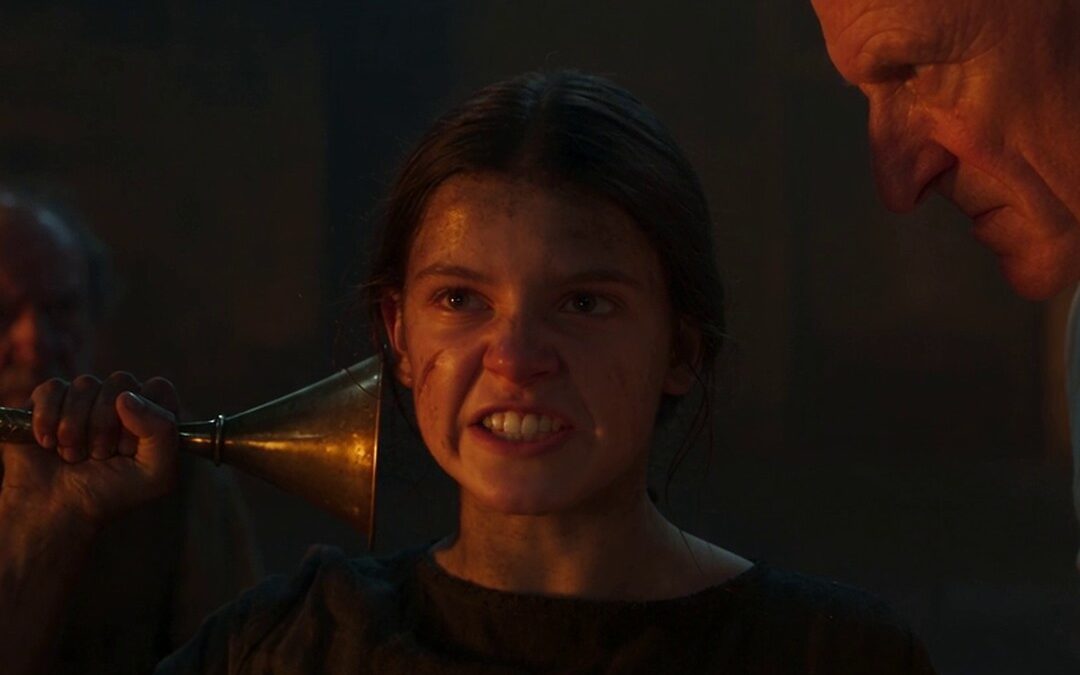
Chapter 2: The Name Beneath Light
The second knock bent the floor grate.
Oren pulled Kestra backward.
Halvek lunged for the funnel.
Maudren stepped between them.
“Touch her and I testify.”
His hand stopped.
“You already testified.”
“I lied.”
The furnace doors groaned.
Kestra felt the sound in her teeth.
The creature outside lifted its head.
“Release the draft.”
She stared at its enormous eyes.
“What?”
“The upper vent.”
That she understood.
The wheel stood beside Halvek.
He didn’t move.
Kestra shoved past him and seized it.
Too hot.
She folded her apron around the spokes.
Oren took the other side.
Together, they turned.
The vent opened overhead.
Black smoke rushed upward.
Something beneath the floor stopped pushing.
Kestra’s shadow shrank.
Her knees followed.
Oren caught her before she struck stone.
“Easy.”
She clutched his sleeve.
“Did you hear her?”
“Yes.”
“Was that real?”
“Yes.”
Halvek reached for the wall cord.
Maudren caught his arm.
“The household guard answers that.”
“They should.”
“Then summon them.”
He hesitated.
Kestra saw Maudren’s expression change.
It wasn’t courage appearing.
It was fear finding an object more important than itself.
She pulled the cord herself.
A bell rang somewhere beyond the chamber.
The Eclipse Beast lowered its face to the window.
The glass remained whole.
Its breath smelled of rain on warm dust.
“Your name,” Kestra said.
“Thessel.”
“Are you going to hurt anyone?”
“No.”
“Then stay where you are.”
The vast antennae dipped.
“As you ask.”
Halvek stared at her.
Kestra stared back.
“I asked.”
The chamber doors opened.
Six guards entered behind a gray-haired woman wearing an unadorned chain.
Kestra recognized the chain.
A circuit magistrate.
Not a palace servant.
Maudren had apparently summoned more than the guard.
“Magistrate Dey,” she said.
“Seal this chamber.”
Halvek found his voice.
“On whose authority?”
“Mine, for the present,” the magistrate replied.
“I heard an alarm.”
“There has been a mechanical failure.”
The creature outside blinked.
Magistrate Dey looked at it.
Then at Halvek.
“An ambitious description.”
She ordered the furnace isolated.
Two guards remained beside the doors.
Two escorted Halvek into the adjoining inspection room.
He protested without being touched.
The final pair brought water.
Kestra didn’t drink.
“What’s underneath us?”
Maudren lowered herself onto the floor.
Her expensive skirts spread through soot.
“There are chambers below.”
“I clean the lower flues.”
“Below those.”
“What’s in them?”
Maudren’s mouth trembled.
Kestra stood too quickly.
The room tilted.
Oren steadied her.
“Tell me.”
“Your mother.”
No one spoke.
Water trembled inside the cup.
Kestra had imagined her mother often.
Usually while angry.
Usually with a convenient excuse.
A fever.
A lost road.
A woman forced to leave.
Never a voice beneath the furnace.
“You said I was found.”
She looked at Oren.
“You were.”
“Did you know?”
“No.”
The answer came immediately.
That mattered.
She turned back to Maudren.
“Did you?”
“Yes.”
Oren’s hand tightened on her shoulder.
Maudren accepted the hatred in his face.
“I thought she was dead.”
“Then why did that frighten you?”
Kestra raised the funnel.
“Because I knew her voice.”
Magistrate Dey approached.
“Who is the woman below?”
“Queen Ilyra.”
“The queen died seventeen years ago.”
“That was announced.”
“Did you see her body?”
“No.”
“Who did?”
Maudren looked toward the inspection room.
Kestra started walking.
Oren followed.
The magistrate blocked the door.
“You will have answers.”
“Move.”
“You will have answers that survive his denial.”
Kestra looked at the magistrate’s plain chain.
At the guards.
At the creature waiting outside.
She could order it to break the palace.
She understood that suddenly.
The knowledge frightened her more than Halvek had.
“What happens to him meanwhile?”
“He remains here.”
“And my mother?”
“We find the way below.”
Kestra nodded once.
Maudren reached toward her.
Then stopped herself.
“May I look at your hand?”
Kestra opened it reluctantly.
A copper-red mark circled her thumb.
Three small branches extended toward her wrist.
Maudren covered her own mouth.
“What is it?”
“Your mother had that mark.”
“People have similar marks.”
“Yes.”
“So prove the rest.”
Maudren nodded.
For the first time, Kestra believed she had heard her.
Outside, Thessel folded his wings.
The eclipse thinned.
Light returned in narrow strips.
“Why did you kneel?” Kestra asked him.
“Because I recognized your charge.”
“My what?”
“The life entrusted to you.”
“I clean chimneys.”
“And keep others breathing.”
Beneath her palm, the funnel warmed again.
The voice inside it breathed a single word.
“Kestra.”
Her name.
The one Oren said had been stitched into her blanket.
Maudren bent forward as if struck.
“That wasn’t a message,” she whispered.
Kestra looked toward the floor.
Her mother was still speaking.
* * *
They opened the palace plans in a washroom.
It was the nearest room with a table.
Kestra liked that.
She couldn’t have endured a throne room.
Oren remained beside her.
Someone offered him a chair.
He looked behind himself before sitting.
Kestra hated that, too.
Magistrate Dey noticed.
“Master Pell, you are a witness.”
His back straightened.
A clerk arrived with paper.
Another brought the furnace maintenance books.
Maudren supplied a sealed packet from her apartments.
Kestra wouldn’t let her open it alone.
The magistrate broke the seal.
Inside lay a marriage record.
A birth entry.
A royal physician’s signed attendance.
Queen Ilyra.
King Edric.
One daughter.
Born seventeen years and four months earlier.
Named Kestra.
Her father had died three weeks afterward.
The northern lightworks had collapsed during an evacuation.
The queen’s death was announced the following day.
Their infant daughter supposedly died with her.
Kestra studied the birth entry.
A small print marked the bottom.
An infant’s thumb.
Three branching lines.
She laid her hand alongside it.
Nobody told her what to feel.
That helped.
“Copies can be forged,” she said.
“They can,” Dey agreed.
“We’ll request the temple register.”
“And the physician?”
“Deceased.”
Kestra’s stomach tightened.
“Convenient.”
“His apprentice survives.”
The magistrate wrote the order herself.
Maudren watched the pen.
“I should have done this years ago.”
“Yes,” Kestra said.
The word landed between them.
Maudren didn’t try to move it.
Kestra turned to the maintenance books.
There were seventeen volumes.
One for every year since the collapse.
She opened the oldest.
The paper smelled of oil.
Ordinary entries filled its first pages.
Coal weights.
Worker hours.
Broken grates.
Then the handwriting changed.
LOWER FEED ESTABLISHED.
No fuel quantity followed.
Kestra traced the line.
“That isn’t right.”
Dey leaned closer.
“Explain.”
“You count what feeds a furnace.”
“Perhaps another book—”
“No.”
She pointed lower.
“Look at the ash.”
The furnace had produced almost no ash for seventeen years.
Yet the palace sold light to every district.
Street globes.
Hospital lamps.
Winterhouses.
All filled from royal reservoirs.
All said to burn refined furnace oil.
Kestra had cleaned their vents.
She remembered the strange fine powder.
White.
Almost silver.
It never blackened cloth.
She had once asked her supervisor why.
He’d docked her an hour’s pay for wasting time.
Kestra brought the funnel near the page.
Its inner surface brightened.
Tiny symbols appeared.
The same open hands.
And words between them.
Maudren read slowly.
“Breath freely given.”
The room quieted.
“Not oil,” Kestra said.
Outside the washroom window, an enormous eye lowered.
Thessel had moved around the palace.
The clerk dropped his pen.
Kestra barely noticed.
“What is this?”
She held up the funnel.
“A speaking mouth,” Thessel answered.
“For whom?”
“The keepers of the covenant.”
“What covenant?”
“The shelter between your people and mine.”
Maudren bowed her head.
Thessel continued.
“Your mother carried our night.”
“Carried it where?”
“Into human shape.”
Kestra looked at her own hands.
Dirty nails.
A small burn.
The crooked finger she had trapped in a ladder.
“Was my father human?”
“Yes.”
“And she wasn’t?”
“She loved him in a human life.”
That wasn’t quite an answer.
Perhaps it was the only honest one.
The magistrate’s clerk had recovered his pen.
“Can this be verified?”
Thessel’s great eye moved toward her.
“The covenant stone survives.”
“Where?”
“Beneath the eastern archive.”
Maudren looked up sharply.
“The royal crypt?”
“It was a meeting place first.”
Dey issued another order.
Two archivists.
Two independent witnesses.
No palace official alone.
Kestra pointed at the funnel’s pale seam.
“Why is it broken?”
“It was silenced.”
“By whom?”
“I did not see.”
She appreciated that answer.
The creature could have told her anything.
It had chosen a limit.
The palace physician’s former apprentice arrived after noon.
His name was Temren.
His hands shook until he began describing his work.
Then they steadied.
He remembered the queen’s labor.
The king bringing heated towels himself.
The infant’s strange mark.
He also remembered being dismissed after the king died.
“By Halvek?”
“No.”
“Who, then?”
“The keeper of royal names.”
Maudren’s eyes closed.
Kestra knew that office.
Everyone in the foundling houses knew it.
Keeper Brynd assigned their apprenticeships.
Approved their bread.
Chose the words used for them.
Unclaimed.
Dependent.
Service-bound.
Brynd had given Kestra her first winter coat.
A brown one.
Too large.
She had said gratitude would help her grow into it.
“What reason did she give?” Dey asked.
“The queen required privacy.”
“Did you see her again?”
“No.”
“Did you receive wages?”
“Six months.”
“For silence?”
Temren looked at the table.
“Yes.”
The magistrate recorded it.
No shouting.
No forgiveness.
Just a fact given its proper weight.
The archivists returned before dusk.
They carried a rubbing of the covenant stone.
Its text matched the funnel.
Not merely its words.
The little open hands, too.
The old agreement permitted the night-born sovereign to share a measured breath with the kingdom.
In exchange, the kingdom maintained her sanctuary.
Her freedom.
Her right to withdraw.
Kestra read that last part twice.
“Where’s the sanctuary?”
The oldest archivist touched the furnace plans.
“Here.”
Beneath the drawing, under later ink, lay an older name.
THE QUIET HOUSE.
Kestra remembered a sealed shaft.
She had cleaned around it every autumn.
Its iron cap was warm even when the furnace slept.
“I know the entrance.”
Oren stood.
“So do I.”
Dey ordered engineers to inspect it.
Kestra wanted to go immediately.
The funnel gave a weak pulse.
Her mother’s voice returned.
“Not the door.”
Kestra gripped the table.
“Why?”
Only breath answered.
Then one more word.
“Roof.”
Kestra looked at the plans.
The lower chamber fed six upright pipes.
She had assumed they carried smoke.
Their valves pointed inward.
They carried pressure down.
Opening the door would leave that pressure nowhere else to go.
She showed the engineers.
One turned pale.
“We’ll vent them first.”
For the first time that day, Kestra felt useful in a way she recognized.
Then a final packet arrived.
The foundling house register.
Dey had requested it that morning.
Oren leaned over her shoulder.
There was his name.
The date he had reported finding her.
Beside it lay an earlier entry.
Three weeks earlier.
An unnamed royal infant.
Transferred into service custody.
A familiar signature approved it.
Keeper Brynd.
Under that signature, four words.
DO NOT SEEK FAMILY.
* * *
Brynd arrived with supper.
That was the worst part.
Not guards.
Not a threat.
A covered dish of barley and mushrooms.
Kestra knew the smell.
Brynd brought it to sick apprentices during inspection weeks.
People called her the kingdom’s second mother.
She stood inside the washroom doorway wearing the same gray wool Kestra remembered.
“My poor child.”
Kestra stayed seated.
Brynd glanced at the open register.
Her expression barely changed.
“You’ve had a frightening day.”
“Did you write that?”
“I wrote many instructions.”
“That one.”
Brynd set the dish down.
“May we speak privately?”
“No,” Kestra said.
Dey closed the door behind her.
“You may speak here.”
Brynd studied the magistrate’s chain.
Then she folded her hands.
“The infant’s identity was dangerous.”
“To whom?”
“To the infant.”
“Why?”
“Her mother’s people might have taken her.”
Outside, Thessel shifted.
The window darkened.
Brynd didn’t look toward it.
“Instead, you put me in service.”
“I placed you beyond court attention.”
“In a basket?”
“That wasn’t my instruction.”
Oren spoke quietly.
“Then whose was it?”
Brynd looked at him.
For a moment, her gentleness disappeared.
“You were paid to raise her.”
The room went still.
Kestra turned.
Oren’s face drained.
“I received the foundling allowance.”
“How much?” Dey asked.
“Two pennies weekly.”
“For how long?”
“Until she was seven.”
Brynd spread her hands.
“You see?”
Kestra remembered watered porridge.
Oren’s boots with string through the holes.
The winter he sold his good saw.
“You’re saying he bought me.”
“I’m saying he benefited.”
Oren looked at his cap.
Kestra reached across the table.
She placed her hand over his.
“He fed me.”
Brynd’s mouth tightened.
Dey called the clerk back.
The keeper was informed that her records were subject to preservation.
She could leave the washroom.
She could not enter the registry.
Her seal would remain with the magistrate until its use had been examined.
Brynd unfastened it slowly.
“This will unsettle people.”
“Then be precise,” Dey said.
Brynd left the supper untouched.
An hour later, the palace lamps dimmed.
Then the infirmary messenger arrived.
The reservoir gauges were falling.
So were those in the winterhouses.
A royal notice had gone out.
The furnace disturbance threatened the city’s light supply.
Residents were instructed to remain indoors.
The notice bore Brynd’s seal impression.
Prepared before she surrendered it.
Kestra stood.
“She’s frightening them.”
“She may also be describing a real shortage,” Dey said.
“We establish both.”
Engineers hurried between the washroom and the lower shafts.
Their findings were worse than Kestra expected.
The sanctuary had been converted into a pressure chamber.
Its six pipes drew light upward.
Shutting one increased the pull through the others.
Stopping all six without opening the roof vents would trap the stored force below.
Opening the chamber door first could destroy the only safe passage.
Her mother had warned them correctly.
Kestra bent over the plans.
“There should be an overflow.”
The chief engineer shook his head.
“None is marked.”
“Old furnaces always had one.”
“This wasn’t built as a furnace.”
“No.”
She touched the earliest drawing.
“It was built as a house.”
A sanctuary needed air.
Not merely a door.
She searched the wall measurements.
There.
An extra thickness beside the eastern stair.
A chimney disguised as a buttress.
Oren leaned closer.
“The blind stack.”
Kestra nodded.
Every apprentice knew it.
No soot.
No birds.
No reason to climb.
Unless something below needed to breathe.
They went with the engineers.
Kestra led.
Dey insisted on a guard.
Oren insisted on himself.
Nobody argued long.
The eastern stair smelled of damp limestone.
At its base, Kestra found the seam she expected.
Mortar newer than the wall.
She touched it.
Warm.
The engineers removed a small section.
Behind it waited a narrow lever.
Not rusted.
Recently oiled.
Someone had maintained the secret.
Dey’s clerk recorded that.
The lever opened the sanctuary’s original air shaft.
A slow breath traveled through the stone.
Kestra pressed her palm to the wall.
“Mother?”
Nothing.
Then the funnel warmed beneath her apron.
“Here.”
Kestra shut her eyes.
Such a small word.
Enough to change the size of the world.
The engineers worked through the night.
By dawn, they had isolated two pipes.
The city still had light.
Less than usual.
Enough for the infirmaries.
Oil merchants were ordered to release emergency stocks at the established winter rate.
Public buildings opened their stores.
The magistrate posted the actual reservoir readings.
Fear didn’t disappear.
But people had numbers.
Instructions.
Somewhere to bring empty lamps.
Kestra spent the morning carrying water.
Nobody had asked her.
She needed something she could finish.
Oren found her beside the stair.
He had bread wrapped in a cloth.
“You haven’t eaten.”
“Neither have you.”
“I’m older.”
“That doesn’t make hunger polite.”
He broke the loaf.
They sat on the bottom step.
For several minutes, they said nothing.
Then Oren reached into his coat.
He brought out a folded piece of faded linen.
Kestra’s baby blanket.
Only a corner remained.
He had saved the stitched name.
“I should have shown you sooner.”
“Why didn’t you?”
“You always asked whether someone had left a letter.”
She ran her finger over the tiny stitches.
“I didn’t want this to disappoint you.”
“It wouldn’t have.”
“I know that now.”
She leaned against his shoulder.
He smelled of soot and bread.
Familiar things.
“You’re still my father.”
His eyes closed.
“You don’t have to decide that today.”
“I decided it years ago.”
A messenger interrupted them gently.
The original foundling nurse had been located.
Retired.
Living outside the city.
She had brought her own records.
They heard her in the washroom.
Her name was Hesta.
She remembered the infant.
She remembered Brynd’s instruction.
No family searches.
No public baptism entry.
No adoption into a prosperous household.
“Why did you leave her outside?” Kestra asked.
Hesta flinched.
“I didn’t.”
“Oren found me there.”
“I put you where he would find you.”
The room stilled.
“Why him?”
“He repaired our stove every winter.”
Hesta looked toward Oren.
“He never charged for the children’s room.”
She had overheard a second instruction.
The infant was to be sent to the remote saltworks.
No visitors.
No correspondence.
Hesta moved Kestra first.
Then falsified the departure book.
It had cost her position.
She had kept the original order.
Dey unfolded it.
Brynd’s signature.
A routing note.
A second document attached.
Ownership of the royal light revenues, held in trust until the royal line was declared extinct.
The named beneficiary was not Halvek.
It was the Office of Names.
Brynd’s office.
Kestra felt the bread turn heavy inside her.
“She needed me gone.”
Dey read the attached calculation.
Seventeen years of fees.
Renewal rights.
Hereditary control after the final extinction decree.
Brynd hadn’t hidden a dangerous child.
She had erased the owner.
* * *
The hearing took place in the old petition hall.
Three days had passed.
Kestra had slept badly through two nights.
On the third, Oren sat outside her door.
She slept.
Now she stood beneath windows opened to daylight.
The lamps had been extinguished deliberately.
Nobody wanted Brynd controlling the room’s brightness.
Seven judges sat at a plain table.
Guild delegates filled the benches.
District wardens.
Temple registrars.
Representatives from the winterhouses.
The people who paid for light.
The people who kept its records.
Thessel waited beyond the open doors.
Only his face could fit within sight.
Kestra had asked him to stay outside.
“I don’t want them agreeing because they’re frightened.”
“They will be frightened regardless.”
“Then help me give them another reason.”
He had lowered his head.
Now he watched without speaking.
Brynd arrived unbound.
She had counsel.
So did Halvek.
Dey had explained that the hearing could suspend authority and preserve evidence.
Final criminal judgments required fuller proceedings.
Kestra had hated the delay.
Then she imagined being condemned because Halvek pointed at her.
She stopped arguing.
Brynd wore the same gray dress.
Her counsel placed a stack of district reports before the judges.
She began with those.
“Seventeen winters.”
She let the words settle.
“No dark infirmaries.”
“No frozen public shelters.”
“No child turned away for lack of a lamp.”
Kestra heard someone murmur agreement.
Brynd turned toward her.
“You have found something astonishing.”
Her voice softened.
“That does not make every frightened decision a crime.”
One judge leaned forward.
“Explain the infant’s transfer.”
“The royal household was collapsing.”
“And the queen’s confinement?”
“A necessary restraint.”
Kestra’s fingers curled.
Oren touched her elbow.
She kept them still.
Brynd described the northern collapse.
The king’s death.
The queen withdrawing into a luminous shell.
Her grief darkening the palace.
The reservoirs failing.
She claimed the sanctuary had been reinforced to protect her.
The extraction system, she said, preserved a light supply the queen had already promised.
“The covenant permitted withdrawal,” Dey said.
“An ancient phrase.”
“A specific right.”
“Rights exist among living obligations.”
Brynd faced the winterhouse delegates.
“Which of you would have closed your doors that winter?”
Nobody answered.
Kestra understood why.
That was what made it dangerous.
Brynd wasn’t asking them to defend her fortune.
She was asking them to defend people they had saved.
Halvek’s counsel submitted furnace reports.
The queen’s condition had been described as unstable.
The authorizing signatures included Maudren’s.
Kestra looked at her aunt.
Maudren stood.
“I signed.”
Brynd nodded.
“Because you understood.”
“Because you told me she would die without isolation.”
“And she survived.”
“Because she is stronger than our cruelty.”
A judge raised one hand.
“Lady Maudren, facts.”
Maudren swallowed.
She described the closed door.
The physicians turned away.
The infant’s supposed death.
Then her own failure.
“I accepted reports I did not inspect.”
“Why?” Brynd’s counsel asked.
“My brother was dead.”
“Grief affected your judgment.”
“Yes.”
“And does it affect it now?”
Maudren’s face emptied.
For a moment, Kestra thought she would sit.
Instead, she placed both hands on the witness rail.
“That is why I brought records.”
She submitted the physician’s original requests for access.
Denied.
Signed by Brynd.
The room shifted.
Not enough.
Brynd answered each document.
Emergency authority.
Risk of disturbance.
Imperfect choices.
Then she pointed toward Thessel.
“And now an unknown creature recognizes an untested girl.”
Kestra stepped forward.
“I didn’t ask you to believe him.”
“Yet his arrival is your claim.”
“No.”
She set the funnel on the evidence table.
“This is.”
A judge examined it.
“A furnace implement?”
“That is what I was told.”
Dey presented the covenant rubbing.
The archival dates.
The old inventory describing a copper speaking mouth used to record consent.
Brynd’s counsel rose.
“An object that produces voices cannot be questioned.”
“Agreed,” Dey said.
Kestra glanced at her.
The magistrate continued.
“That is why we tested it.”
Two archivists entered.
They described the test.
The funnel transmitted a living voice when held by someone bearing the covenant mark.
When warmed without that touch, it revealed its stored impressions.
The pale seam wasn’t a repair.
It was a removable sleeve.
A later addition.
Kestra had found the edge while cleaning soot from the copper.
The sleeve covered the original control.
Removing it required no spell.
Only the patience of someone accustomed to finding joints under dirt.
One archivist demonstrated.
The narrow copper strip slid free.
Beneath it lay another inscription.
CONSENT MAY BE REVOKED.
Brynd’s face hardened.
Only slightly.
Kestra saw it.
So did Dey.
The archivist set the funnel over a small warming bowl.
Its copper surface brightened.
A woman’s voice filled the hall.
“I withdraw my breath.”
Kestra’s throat closed.
Her mother sounded younger.
Stronger.
Another voice answered.
“Your withdrawal would endanger the city.”
Brynd.
Unmistakable.
“I withdraw it.”
“You are not thinking clearly.”
“Bring me my daughter.”
A pause.
Then Brynd again.
“Sign the permanent grant.”
“Bring her to me.”
“Sign, and I will.”
The recording ended.
No one moved.
Brynd’s counsel recovered first.
“No independent witness establishes that exchange.”
“One does,” Dey said.
Halvek looked up sharply.
The magistrate called the sanctuary’s former engineer.
He had been found through pension records.
A quiet man named Veskar.
He walked with two sticks.
Kestra had watched him give his account the previous evening.
He had wept then.
Now his voice stayed level.
He had fitted the extraction pipes.
He had heard the queen refuse.
He had witnessed Brynd ordering the speaking mouth silenced.
“Why comply?” a judge asked.
“I was told the infant’s life depended on stable light.”
“Did you believe it?”
“At first.”
“And afterward?”
“I wanted my wages.”
The plainness of it hurt.
No grand excuse.
Just a man admitting the price had been sufficient.
He brought his work journal.
Measurements matched the hidden system.
Dates matched the recorded exchange.
A payment matched the treasury ledger.
Three sources.
None dependent on Kestra’s blood.
Brynd stood before her counsel could stop her.
“The city still required light.”
Kestra faced her.
“You could have asked.”
“She refused.”
“You could have bought oil.”
“The treasury was depleted.”
“You could have charged less afterward.”
Brynd said nothing.
Dey submitted the revenue accounts.
Public charges rising.
Emergency costs falling.
Private estates purchased through office trusts.
The northern collapse compensation fund diverted.
Kestra watched the district delegates read.
People who had defended warm shelters now saw what their gratitude had concealed.
One of the judges addressed Halvek.
“You maintained this system.”
“Yes.”
“Knowing the source was unwilling?”
Halvek looked at Brynd.
She didn’t look back.
“Yes.”
The word seemed to age him.
His counsel sat down.
The judges withdrew.
Kestra remained standing.
She could hear her own pulse.
Outside, Thessel’s wings shifted against the courtyard.
When the judges returned, the eldest read the interim orders.
Brynd’s authority suspended.
Halvek’s office suspended.
Their records and assets secured.
The queen’s release placed under independent supervision.
Kestra’s identity provisionally recognized pending the final succession inquiry.
No one was crowned.
No one cheered.
Guards stepped forward.
Brynd turned toward Kestra.
“You will have to keep them warm.”
It was her last weapon.
Not denial.
Burden.
Kestra looked at the winterhouse delegates.
Then at the physicians.
Then at the engineers waiting near the door.
“Yes.”
Brynd’s eyes sharpened.
“You cannot do it alone.”
“I know.”
For the first time, Brynd had no answer.
The work took six more days.
Kestra spent most of them beside the eastern shaft.
The engineers vented one pipe at a time.
The city used stored oil.
Some streets went unlit.
Neighbors hung shared lamps in doorways.
The infirmaries stayed open.
Finally, the sanctuary door could be touched.
Dey stood beside Kestra.
Oren stood behind her.
Maudren waited farther back.
The door swung inward.
Silver threads filled the chamber.
At their center sat a woman.
Dark-haired.
Barefoot.
Eyes closed.
A pale cord joined her wrist to the last extraction pipe.
Kestra couldn’t move.
The woman opened her eyes.
They were the same brown as hers.
“May I?” Kestra whispered.
Her mother held out her hand.
Kestra crossed the room.
Behind them, the engineer opened the final release.
The silver cord dissolved.
For seventeen years, the kingdom had called her dead.
Now Queen Ilyra stood.
* * *
Her mother didn’t leave the chamber walking.
Standing had cost everything she had.
Kestra caught her.
Oren caught them both.
For one startled moment, they were an awkward knot of elbows and silver threads.
Then the physicians brought a chair.
Ilyra apologized.
Kestra shook her head too hard.
“Don’t.”
“I frightened you.”
“You can frighten me upstairs.”
Her mother looked at her.
Then she smiled.
Small.
Uncertain.
Real.
They carried her into a garden room.
The windows opened toward ordinary trees.
Kestra had requested that.
No furnace.
No pipes.
No locked interior door.
The first week passed strangely.
There were audiences Kestra refused.
Clothes she wouldn’t try.
A crown brought in a velvet box.
She sent it away unopened.
Her mother slept.
Woke.
Asked the date.
Slept again.
Sometimes she called for Edric.
Those were the worst mornings.
Kestra learned not to answer too quickly.
The physicians explained only what they knew.
Long confinement had weakened her.
Recovery would take time.
Her other nature complicated every estimate.
Ilyra could still make light.
She was forbidden to try.
Not by decree.
By three exhausted physicians and a daughter who knew how to stand in a doorway.
“I’m stronger today,” Ilyra said.
“Then finish your broth.”
“That sounds like an order.”
“It’s a request with witnesses.”
Oren looked into his bowl.
His shoulders moved.
Kestra hadn’t heard him laugh in weeks.
The sound nearly undid her.
Their meals became a small ritual.
Bread.
Broth.
Whatever fruit the market had.
Oren cut apples too thin.
Ilyra ate them anyway.
Neither asked the other to leave.
That mattered to Kestra more than either understood.
One afternoon, Ilyra watched Oren mend Kestra’s work coat.
His stitches wandered.
The sleeve had been repaired so often that almost none of it matched.
“You raised her,” Ilyra said.
He kept sewing.
“I tried.”
“She trusts your hands.”
The needle stopped.
Ilyra looked toward Kestra.
“May I thank him?”
Kestra nodded.
Her mother reached across the table.
She placed her hand beside his.
Not over it.
“You gave her what I couldn’t.”
“What you were kept from giving,” he said.
Ilyra’s eyes filled.
Oren went back to sewing.
Kestra stayed until the sleeve was finished.
The legal proceedings continued through autumn.
She attended when needed.
So did her mother, once she could manage the stairs.
The final succession inquiry confirmed the birth records.
The temple copy matched.
Temren’s testimony held.
The covenant mark supplied supporting evidence.
It wasn’t required to carry the whole claim.
Kestra was declared the surviving royal heir.
Ilyra’s sovereignty was restored.
The council that had permitted the confinement lost its emergency powers.
Its individual members faced separate examinations.
Some had been deceived.
Some had avoided asking.
Several had profited.
Dey refused to call those the same thing.
Kestra began to admire her deeply.
Halvek admitted his role before the full hearing ended.
He provided the maintenance orders Brynd had kept from the public registry.
His cooperation reduced his sentence.
It did not restore his office.
He lost his estates and received a fixed term of supervised labor maintaining public roads.
Kestra saw him once afterward.
From a carriage window.
He was measuring drainage beside a muddy ditch.
She asked the driver to continue.
She didn’t need him to see her.
Brynd contested every charge.
Her counsel challenged the recordings.
The signatures.
The witnesses’ motives.
The judges considered each objection.
The process lasted four months.
Kestra wanted it over.
She also wanted the judgment to endure.
Eventually, Brynd was convicted of unlawful confinement, falsifying royal records, and taking public revenues.
Her purchased estates went into restitution.
Her sentence required confinement under the ordinary civil authority.
No secret chamber.
No vanished name.
Her relatives retained property they could prove was theirs.
Her servants received unpaid wages.
Kestra read that part twice.
She didn’t want punishment spreading through households simply because it could.
The northern collapse was examined separately.
The inquiry found damaged foundations and ignored repair petitions.
No secret attack.
No final monstrous trick.
Her father had died helping workers leave a failing building.
Brynd had exploited his death.
She hadn’t caused the storm that brought the walls down.
Kestra was grateful for that distinction.
Grief was difficult enough without lies added for satisfaction.
Ilyra told her about him slowly.
He disliked formal shoes.
He counted steps when anxious.
He had once spent an entire council meeting holding a sleeping kitchen cat.
Kestra liked that story best.
“Was he brave?”
“Yes.”
“Always?”
“No.”
Her mother smiled sadly.
“He went anyway.”
They visited his burial place before winter.
Oren waited at the gate until Ilyra beckoned him closer.
Kestra left no jewels.
She placed a clean chimney brush beside the stone.
Something from her own life.
Then she told him her name.
As if introducing herself.
As if there might still be time for that somewhere.
Maudren came the next day.
She asked to speak in the garden.
Kestra agreed.
They sat beneath a tree losing its last leaves.
Her aunt had brought no gifts.
That was wise.
“I owe you an apology.”
“Yes.”
“I failed your mother.”
“Yes.”
“And I failed you.”
Kestra studied her hands.
Maudren had testified fully.
She had surrendered correspondence without being compelled.
She had also ignored seventeen years of closed doors.
Both things were true.
“I was afraid,” Maudren said.
“I believe you.”
“That doesn’t excuse it.”
“No.”
A leaf landed between them.
Neither picked it up.
“I don’t want you deciding what protects me,” Kestra said.
Maudren nodded.
“If you know something, you tell me.”
“Yes.”
“If I ask you to leave, you leave.”
“Yes.”
Kestra finally looked at her.
“You can come to supper on Thursday.”
Maudren covered her mouth.
Kestra waited.
“But don’t call that forgiveness.”
“I won’t.”
Thursday became difficult.
Then less difficult.
Eventually, it became Thursday.
Hesta received her pension arrears.
She refused a palace position.
“I’ve managed enough children.”
Kestra looked at the courtiers behind her.
“Are you certain?”
Hesta’s mouth twitched.
“Especially those.”
Oren’s name was restored to the workers’ roll.
So were the wages Halvek had withheld.
He insisted the clerk calculate them properly.
Every hour.
Every missing penny.
Kestra sat beside him while it was done.
The amount wasn’t enormous.
His expression when he signed mattered more.
For once, no one hurried his hand.
The foundling houses received independent inspections.
Apprentices could no longer be assigned without recorded terms.
Wages went into accounts they could inspect.
Complaints went beyond the officials who employed them.
Kestra visited the first hearing.
A girl with a shaved head complained about stolen boot money.
The overseer called it a misunderstanding.
The clerk asked for receipts.
Kestra nearly smiled.
That sounded like change.
The light question took longer.
Winter would not wait for justice.
Engineers repaired ordinary furnaces.
Merchants supplied oil under public contracts.
The restored treasury paid for shared lamps in the poorest streets.
The palace used fewer rooms.
Some nobles objected.
Ilyra offered them blankets.
Her own strength returned gradually.
One evening, she raised her hand over supper.
A small white glow rested above her palm.
Kestra dropped her spoon.
“Mother.”
“Only this.”
The light flickered softly.
“I wanted you to see it without being afraid.”
Kestra studied it.
No pipe.
No locked room.
No account measuring its value.
Just her mother’s hand.
“Does it hurt?”
“No.”
“Can you stop?”
The light vanished.
Ilyra waited.
Kestra picked up her spoon.
“All right.”
The palace eventually offered Kestra her father’s apartments.
Six rooms.
A private stair.
A view over the city.
She asked for two rooms near the garden.
One for herself.
One for Oren, if he wanted it.
He didn’t.
Not at first.
He preferred his workshop.
His neighbors.
The little stove he understood.
So she helped repair his roof.
She visited on market days.
She learned that love didn’t require moving everyone into the same building.
When his knees worsened, he accepted the garden room.
On his terms.
With his own chair.
And a written promise that no servant would polish his tools.
The crown question waited until spring.
Ilyra placed the velvet box on the table.
Kestra stiffened.
Her mother didn’t open it.
“I can rule for now.”
“Then do.”
“I intend to.”
Kestra looked up.
Ilyra’s smile was almost mischievous.
“I’m asking what you want to learn.”
“Everything they thought I wouldn’t.”
“An extensive curriculum.”
“Dey can start.”
“She has already sent books.”
“Of course she has.”
They laughed together.
Then Ilyra grew serious.
“You may choose another life.”
“Would they let me?”
“I will.”
Kestra touched the box.
She thought of Brynd’s final warning.
The winterhouses.
The girl asking for boot money.
“I want to learn first.”
“Then we begin there.”
Outside, Thessel rested beyond the orchard.
His wings made a pale hill.
Kestra visited him that evening.
“Do you have to kneel?”
“No.”
“Then why did you?”
“I offered allegiance.”
“To my blood?”
“To the promise your blood carries.”
“What if I refuse it?”
“Then I will be sad.”
He tilted his enormous head.
“And you will be free.”
Kestra leaned against his folded wing.
The silver dust no longer frightened her.
For the first time, the future felt like a door she could open herself.
* * *
Five years later, Kestra returned to the furnace chamber.
She was twenty-two.
Her work coat no longer fitted.
She had kept it anyway.
The chamber had changed more.
The great iron doors remained.
Their hinges had been cleaned.
The furnace behind them was cold.
Above it, the circular window stood open.
Morning air moved through the room.
The royal lightworks operated elsewhere now.
With counted fuel.
Published costs.
Paid workers.
Nothing living imprisoned beneath them.
The sanctuary below had become Ilyra’s private retreat.
Its door opened from inside.
Its windows faced the restored eastern garden.
Sometimes she spent a night there.
Sometimes she didn’t.
Nobody kept a ledger of her breathing.
Today, the upper chamber held petition benches.
Anyone could enter during the appointed hours.
Kestra had chosen this place deliberately.
She wanted to remember how a denied appeal sounded against stone.
Oren sat beside the window.
His cap rested on his knee.
A cane leaned against his chair.
He wore a new coat that looked suspiciously like his old one.
The tailor had complained.
Oren had won.
Maudren arranged papers at the side table.
She held no deciding office.
She volunteered two mornings weekly.
Kestra trusted her with schedules now.
Trust had returned in pieces.
Neither pretended otherwise.
Magistrate Dey arrived late.
That was unusual.
She carried a petition from three villages.
A disputed bridge toll.
Kestra read the opening paragraph.
“Will this be simple?”
“No.”
“Good morning to you, too.”
Dey took her seat.
Beyond the window, Thessel’s antennae rose.
He visited each spring.
The rest of the year, he traveled the high dark beyond the western ranges.
He was no longer the kingdom’s prisoner of legend.
Schoolbooks had been corrected.
Children argued over whether his wings looked more like leaves or sails.
He endured both opinions.
Ilyra entered without an announcement.
She kissed Oren’s cheek.
Then her daughter’s.
She had stepped down the previous autumn.
Not because she was weak.
Because she wanted a life that included leaving the palace without arranging a council.
Kestra had accepted the crown publicly.
After years of study.
After the revised charter.
After the city confirmed the succession through its lawful assemblies.
On that day, she had worn no wings.
Today, she wore ink on her thumb.
A clerk approached with a small wooden case.
Inside lay the copper funnel.
The speaking mouth.
Its false sleeve rested separately.
The seam was visible.
So was the inscription beneath it.
Consent may be revoked.
The object belonged to the public archive now.
It came here once a year.
Witnesses checked its condition.
The records were read.
The names were spoken.
Nobody called that unnecessary ceremony.
Kestra lifted it.
The copper was cool.
No voice emerged.
Her mother stood beside her.
Alive.
Present.
Free to answer without an instrument.
“Ready?” Ilyra asked.
Kestra nodded.
The doors opened.
A young furnace apprentice entered first.
Beside him walked an older woman with white dust on her sleeves.
A mill worker.
She clutched a folded wage claim.
The apprentice looked at the guards.
Then at the crown on Kestra’s table.
He lowered his head.
“My mother was told—”
“Sit down,” Kestra said gently.
They sat.
The woman’s hands shook.
Kestra remembered Oren’s cap.
His lowered eyes.
Three pennies falling beneath a grate.
She put the funnel aside.
“What were you told?”
“That the roll is already closed.”
“Then we open it.”
The apprentice stared.
He had expected a struggle before being heard.
Kestra knew that look.
She hoped one day to stop recognizing it.
A shadow crossed the window.
The woman stiffened.
Outside, Thessel lowered his vast head.
His forehead approached the courtyard.
Kestra raised one hand.
“Stay where you are.”
The creature paused.
Then settled comfortably beneath the sun.
No kneeling required.
Oren smiled into his cap.
The clerk uncapped the ink.
Dey leaned forward.
The woman unfolded her claim.
A name restored.
A door unlocked.
A mother upstairs.
A father in his chair.
Light honestly made.
Darkness no longer feared.
Kestra listened until the woman finished.
Then she reached for the pen.
Beside her, Ilyra poured the tea.
THE END


