The Demolition Boss Crushed an Old Man’s Lunchbox at the Train Station, Until the Man Told Him to Close the Gate
Chapter 2: Three Knocks
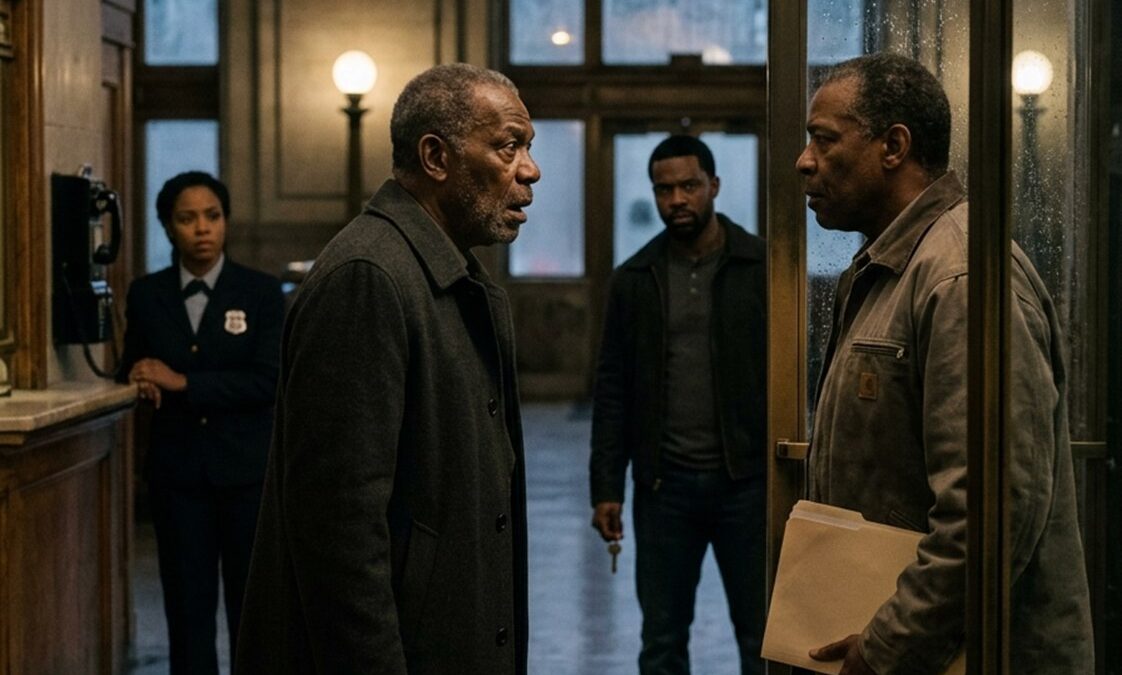
The knocking came again.
Three blows.
A pause.
Three more.
Nolan kept the key hidden.
“Open it,” Wade said.
“Demolition area.”
“Someone’s inside.”
“That’s a pipe.”
Tessa was already moving.
She reached the counter telephone.
Nolan turned toward her.
“Put that down.”
Tessa dialed emergency services.
Wade stepped between them.
He had spent the last hour watching Nolan fill the doorway with his shoulders.
Now Nolan seemed unable to pass him.
“Give me the key,” Wade said.
Nolan looked at the brass seal.
“You could have bought that.”
“The dispatcher can check.”
Tessa gave the address.
She reported a person behind a locked gate.
Nolan finally threw the key.
It skidded beneath a bench.
Wade crouched too quickly.
Pain caught along his old left knee.
Tessa reached the key first.
“Let me,” she said.
She unlocked the gate.
A man in a dust-covered maintenance jacket stumbled through.
He was perhaps sixty.
Blood had dried along one wrist.
He held a flat folder against his chest.
“Eli?” Wade said.
The man stopped.
For seventeen years, Wade had believed Eli Navarro died in the station fire.
He had signed a statement saying so.
Eli looked past him at Nolan.
“Did he get the box?”
Nolan backed away.
Wade pointed to the bench.
“Sit down.”
Eli shook his head.
“Take this.”
He pushed the folder into Wade’s hands.
A firefighter’s inspection notice lay on top.
Beneath it sat photographs of the east wall.
Fresh drill holes pierced old brick.
Tessa held the telephone out.
“The operator wants to know if he’s hurt.”
Eli swayed.
Wade caught his elbow.
“Tell her he needs an ambulance.”
Nolan reached for his own phone.
“Your crew can wait outside,” Wade said.
“They work for me.”
“Then tell them to stay.”
Nolan made the call.
His voice had lost its edge.
Wade helped Eli into a chair.
He touched the man’s sleeve.
It was real.
“You watched us carry a bag out,” Eli said.
“I identified your watch.”
“It was mine.”
Eli’s fingers tightened around the folder.
“They told you whose body it was.”
* * *
The ambulance took Eli to County General.
Police took Nolan’s key.
They asked him to remain at the station while they established who had locked the gate.
He said a worker must have done it.
The two workers said they had never touched the lock.
Wade gave a statement.
So did Tessa.
A state investigator named Priya Shah arrived before the last train.
She worked in Wade’s office.
She had not known he planned to visit.
Wade showed her the photographs.
“I should step back,” he said.
Priya looked at the folder.
“Because you knew Navarro?”
“Because of the fire.”
She nodded.
“I’ll take the evidence.”
Wade surrendered the folder.
He also gave her the folded paper from his lunchbox.
Its edges were damp.
He had carried it for seventeen years.
Priya read the heading.
East Wall Access Log.
The page listed Wade as the inspector who approved sealing the service passage on the night of the fire.
His signature sat at the bottom.
“That’s yours?” she asked.
“That’s the question.”
At the hospital, a doctor checked Eli’s wrist and lungs.
He would be discharged that evening.
Wade waited in the hall until Eli invited him inside.
Eli had gone gray.
So had Wade.
For a moment, neither knew what to say.
“I went to your funeral,” Wade said.
“My sister did too.”
“Why didn’t you come home?”
Eli watched rain move down the window.
“After the fire, I was charged with stealing copper.”
“That case was dropped.”
“Six months later.”
Eli had been injured escaping through a drainage opening.
He woke in a hospital under another patient’s name.
By the time the error was corrected, the company that employed him had reported him missing.
Then the police came with questions about the missing copper.
His attorney told him to stay with family out of state while she obtained the job records.
The records disappeared.
The attorney retired.
Eli stayed away.
“I should have called you,” he said.
“Yes.”
“I thought you signed that page.”
Wade did not answer.
The accusation had followed him into every room since the fire.
His son Ben had been seventeen then.
Ben had watched his father refuse to explain why he approved a locked passage.
He moved out at eighteen.
They still spoke on birthdays.
Sometimes.
“I was there that night,” Wade said.
“I remember an alarm.”
Eli nodded.
“I pulled it.”
“I remember three knocks.”
“I made them.”
Wade gripped the chair.
He had heard the sound from across the loading floor.
He had run toward it.
A supervisor stopped him and said the passage was clear.
Then smoke filled the space between them.
“I never approved that lock,” Wade said.
Eli studied him.
“I know that now.”
“How?”
“Your signature was put on the page before the wall was sealed.”
Wade frowned.
“The form didn’t exist before the fire.”
“It did,” Eli said.
“They printed it for you.”
Priya returned the next morning with copies from three offices.
The station operator had kept its fire records.
The demolition contractor held the original building plans.
The city clerk had a scanned permit file.
Each copy carried a different version of the access log.
One bore Wade’s signature.
One left the inspector line blank.
The earliest scan had no inspector line at all.
Priya set them across a conference table.
Wade knew the paper stock.
He had spent thirty years inspecting public buildings.
“The dated sheet came from a replacement pad,” he said.
“Can you prove that?”
“The printer changed its form in October.”
“The fire was in August.”
Priya photographed the small code in the lower corner.
She sent it to the printer.
An employee found the order history.
The replacement pad had been delivered six weeks after the fire.
The signed page could not have existed that night.
Wade called Ben.
His son answered after the fourth ring.
“I found the form,” Wade said.
“What form?”
“The one with my signature.”
Ben was quiet.
Wade explained only what Priya had verified.
He did not ask to be believed.
Ben asked where the page came from.
“Your old office?”
“No,” Wade said.
“The station operator.”
A chair scraped on Ben’s end.
“Dad, Mom kept a copy.”
Wade closed his eyes.
His wife had died three years earlier.
She had never mentioned a copy.
“She found it in our mailbox,” Ben said.
“After the hearing.”
“Where is it?”
“In her cedar chest.”
“Will you let Priya see it?”
Ben took a breath.
“Yes.”
Inside the chest lay the same false log.
It had been mailed without an envelope.
Across the back, in pencil, someone had written a date.
Ben remembered his mother placing it there.
She had told him that paper sometimes outlived the people who made it.
Priya placed the copy beneath a scanner.
A faint mark showed through from the other side.
It was the station operator’s internal routing stamp.
The sheet had passed through an office on the second floor.
Wade knew that office.
His wife had worked there.
* * *
Wade sat in his car for twenty minutes.
His wife, Ruth, had been a payroll clerk.
She liked exact figures.
She disliked secrets.
Yet she had kept that sheet from him.
He called Ben again.
“Did she say who gave it to her?”
“No.”
“Did she know it was false?”
“I don’t know.”
Ben came to Wade’s house that evening.
He brought Ruth’s old appointment calendar.
She had kept notes in narrow blue handwriting.
On the date written behind the form, she had drawn a square around one name.
Celia Voss.
At the time, Celia was the station operator’s financial officer.
Now she directed the company buying the property for redevelopment.
The same company employed Nolan Pike.
Ben set the calendar down.
“Mom met her?”
“It says she planned to.”
“That’s all?”
“That’s all we have.”
Priya asked for the calendar.
She also obtained Ruth’s old payroll records through the company’s archive.
Ruth had entered overtime for six maintenance workers during the week of the fire.
The final payroll showed two workers.
Four entries had been removed.
Eli recognized every name.
“All four were working behind that wall,” he said.
“Why erase them?” Priya asked.
“So no one asked why they were there.”
The station operator had received a state repair grant.
The money was intended to shore up the east wall.
Instead, a contractor had begun pulling valuable copper from a sealed service passage.
The work had continued after an engineer flagged the wall.
Priya found the warning in the city’s permit file.
The operator’s copy omitted it.
At noon, Nolan called Tessa.
She put him on speaker for Priya.
“You should tell the police you never saw me lock anything.”
“I didn’t see you lock it,” Tessa said.
“Good.”
“I saw you keep the key.”
Nolan hung up.
That night, someone slid a blank sheet beneath Tessa’s apartment door.
It held her work schedule for the coming month.
Every shift had been crossed out.
Tessa photographed it.
Then she called the police.
The station operator suspended Nolan while it reviewed the threat.
It kept Tessa’s shifts.
Her manager said he had never approved a new schedule.
The paper had been printed from an account assigned to Nolan’s crew.
Wade offered to drive Tessa home.
She agreed.
At her door, she looked at the crushed lunchbox on his back seat.
“Why bring that today?” she asked.
“I always take it when I travel.”
“Even empty?”
“Ruth packed my first lunch in it.”
Tessa touched its bent handle.
“My father has one like that.”
“Does he still use it?”
“He calls it a toolbox now.”
Wade smiled.
For a minute, they spoke about fathers and objects they refused to discard.
Then Tessa opened her door.
“You looked scared when Eli came through,” she said.
“I was.”
“I didn’t know inspectors were allowed to be scared.”
“Most of us are.”
Across town, Priya met Eli’s sister.
She had kept the letters Eli sent from another state.
One included the name of the attorney who tried to recover the job records.
The attorney had died.
Her files had gone to a successor.
Priya found them there.
A copy of the engineer’s warning lay inside.
So did a letter from Celia Voss offering the attorney a settlement if Eli stopped asking about the east wall.
The letter named the amount.
It also named the project Celia feared losing.
A private redevelopment deal depended on the station being declared unsafe.
The repair money had paid for the damage that made that declaration possible.
* * *
The public meeting filled the library hall.
The redevelopment company wanted city approval to demolish the station.
The city wanted a clean account of the fire.
Priya had sent its clerk the verified documents that morning.
She had also referred possible fraud to the state prosecutor.
Wade attended as a witness.
Ben sat beside him.
They had shared breakfast first.
It was the longest meal they had eaten together in years.
Celia Voss spoke before either of them.
She was sixty-two.
Her gray suit fit perfectly.
She brought charts.
The east wall was unstable, she said.
The building cost too much to save.
The new terminal would have accessible platforms.
It would bring jobs.
Several people nodded.
Celia turned toward Wade.
“Mr. Mercer was the inspector at the fire.”
“Yes,” Wade said.
“He has a painful history here.”
“Yes.”
“He also directs the office investigating us.”
“I removed myself from this case.”
“After collecting evidence personally.”
Wade felt the room turn.
Celia had chosen the strongest fact she had.
He let it stand.
“I found a man behind your contractor’s gate,” he said.
“And I gave the evidence to another investigator.”
Celia addressed the council.
“Mr. Navarro’s appearance is extraordinary.”
“It doesn’t change the engineering report.”
The city engineer rose.
She had inspected the wall that morning.
“The wall needs support,” she said.
“It can be repaired.”
Celia looked at her.
“Your estimate is preliminary.”
“Yes.”
“Then the city cannot rely on it.”
A council member asked about the old grant.
Celia held up a thick binder.
“All expenditures were audited.”
Priya stood at the back.
The clerk called her forward.
She carried the three access logs.
She explained the printing dates.
She explained the routing stamp.
Celia’s expression stayed calm.
“Companies make replacement copies,” she said.
“That proves poor filing.”
“It doesn’t prove fraud.”
For a moment, Wade thought she might persuade them.
Poor filing was common.
Seventeen-year-old memories were weak.
Eli had stayed away.
Ruth was gone.
Then Priya unfolded the paper from Wade’s lunchbox.
She had dried it flat.
Its lower edge still smelled faintly of coffee.
“This was delivered to Mr. Mercer after the fire,” she said.
“It is the copy he kept.”
She turned it over.
A deep indentation ran beneath the typed approval.
The sheet had rested on another page when someone pressed a pen into it.
Priya had sent it to the state document examiner.
The examiner had photographed the marks under angled light.
They formed a sentence.
“Use Mercer’s name.”
And beneath that, two initials.
CV.
Celia looked toward Nolan.
He stared at the floor.
“That could mean anything,” she said.
“It could,” Priya replied.
The clerk admitted a second record.
Ruth’s payroll archive showed Celia’s account deleting the four worker entries.
A former company bookkeeper had confirmed the account assignment.
The system’s audit log showed the time.
The deletion occurred two days after the fire.
Celia gripped the edge of the table.
“You cannot run a station on every old grievance,” she said.
“You have to make decisions.”
Eli stood.
“Four men worked that passage.”
Celia did not look at him.
“I made choices with the information I had.”
“You removed their pay,” he said.
“You knew their names.”
The mayor asked for a recess.
The city attorney recommended postponing the demolition vote.
The council agreed.
Nobody was arrested in the hall.
The prosecutor’s office would have to examine the records and interview the witnesses.
Celia left by a side door.
Before she did, she stopped near Wade.
“Your wife had that page,” she said.
“She let you carry the blame.”
Wade watched Ben rise from his chair.
He put a hand on his son’s arm.
“Ruth tried to bring it to you,” Celia said.
“She came to my office instead.”
Then Celia walked out.
Wade wanted to follow her.
He stayed.
The city attorney had one more question about the old inspection process.
He answered it.
Outside, Ben waited under the library awning.
“You all right?” he asked.
“No.”
Ben accepted that.
Rain struck the steps.
“Mom kept it,” Ben said.
“She made sure it survived.”
Wade looked at his son.
“Yes,” he said.
“She did.”
Four months later, Celia entered a plea to grant fraud and falsifying company records.
The prosecutor said the evidence did not establish who ordered the passage locked on the night of the fire.
Nolan admitted locking Eli behind the gate this time.
He had done it after finding Eli photographing the new drill holes.
He pleaded guilty to unlawful restraint.
Both men who had worked with him testified that they heard the knocking.
The court took that into account.
The city recovered part of the misused grant.
Its new repair plan named the four workers who had been erased from payroll.
Wade read each name twice.
* * *
Spring came slowly.
The east wall stood behind scaffolding.
The station reopened its waiting room before work began on the platforms.
Tessa returned to her counter.
Her manager apologized for doubting her account of Nolan’s call.
She accepted the apology.
She kept a copy of the phone report.
The redevelopment contract was canceled.
A new public tender funded the wall repair and accessible platforms.
It would take longer.
Tessa told passengers exactly how much longer when they asked.
Most thanked her.
A few complained.
She helped them anyway.
Eli came back for the first time without an investigator.
He stood beneath the departure board.
Wade found him there.
“Still looks the same,” Eli said.
“The roof doesn’t leak.”
“That part’s new.”
They bought coffee.
Wade carried the repaired lunchbox.
A metalworker had straightened the sides.
The lid still refused to close neatly.
“That cost you money,” Eli said.
“Less than a new one.”
Ben arrived ten minutes later.
He had asked Wade if he could join them.
Wade had said yes.
For years, their conversations had ended at the first mention of the fire.
Now Ben asked Eli what he remembered.
Eli answered what he could.
He said he had knocked against the pipe because he knew sound traveled through it.
He said Wade had been running toward him when a supervisor blocked the aisle.
Ben listened.
“I thought he left,” Ben said.
Eli stirred his coffee.
“He didn’t.”
Wade looked out toward the tracks.
He had wanted that sentence for seventeen years.
He had also learned he could live without demanding it.
After Eli left, Ben stayed.
“Mom should have told us,” he said.
“Yes.”
“She must have had a reason.”
“Probably.”
“That doesn’t fix it.”
“No.”
Ben turned the cup between his hands.
“I was hard on you.”
“You were a kid.”
“I’m not now.”
Wade gave him time.
“I’m sorry,” Ben said.
“I know.”
Ben nodded once.
Then he asked if Wade wanted to come to dinner Sunday.
“May I bring the lunchbox?”
“Only if it has food.”
At home, Wade opened Ruth’s calendar again.
After the meeting with Celia, she had written one more note.
Spoke to attorney. Keep copy safe.
Priya had found the attorney’s old phone bill.
The call had happened.
Ruth had tried to put the page into someone else’s hands.
Wade wished she had trusted him with it.
He could not ask her why she hadn’t.
He placed the calendar beside her photograph.
The state offered him an award for his work on the station inquiry.
He declined it.
Priya had conducted the investigation.
Tessa had called for help.
Eli had carried the photographs through the gate.
Wade used the award ceremony to name them.
Afterward, the transportation department asked him to advise a new public records project.
He agreed on one condition.
Workers could request copies of safety reports without asking a supervisor.
The department accepted it.
That summer, Ben took him to a ballgame.
They missed the first inning because Wade wanted to inspect the station’s new platform ramp.
Ben waited beside him.
“Is it straight?” he asked.
“Close enough.”
“From you, that’s high praise.”
Wade smiled.
They caught the next train.
* * *
Three years later, Wade stood beneath the departure board again.
The east wall had been repaired.
A plaque beside it named the workers from the old payroll.
Eli’s name was there too.
He had insisted the plaque say he survived.
Tessa’s father had suggested the wording.
Tessa now managed the station.
She greeted Wade from the counter.
Ben stood beside him with two paper cups.
His daughter waited near the gate.
She was old enough to read every destination aloud.
Wade carried the blue lunchbox.
Inside were three sandwiches.
A small container of apple slices.
And the brass seal he no longer used.
He had retired that winter.
Ben’s daughter spotted the dented lid.
“Why do you keep that old thing?”
Wade looked at the wall.
Then at the people moving safely past it.
“Someone took good care of it,” he said.
Ben opened the gate.
Tessa called that their train was on time.
Eli had a seat waiting.
Ruth’s calendar rested at home.
Her photograph stood beside it.
The four workers had their names back.
Tessa had kept her job.
Ben reached for the lunchbox.
“Let me carry it.”
Wade handed it over.
Together, they walked through the gate.
THE END








