The Ferry Boss Ground an Old Woman’s Warning Tag Into the Pier—Until She Stopped His Boat With One Sentence
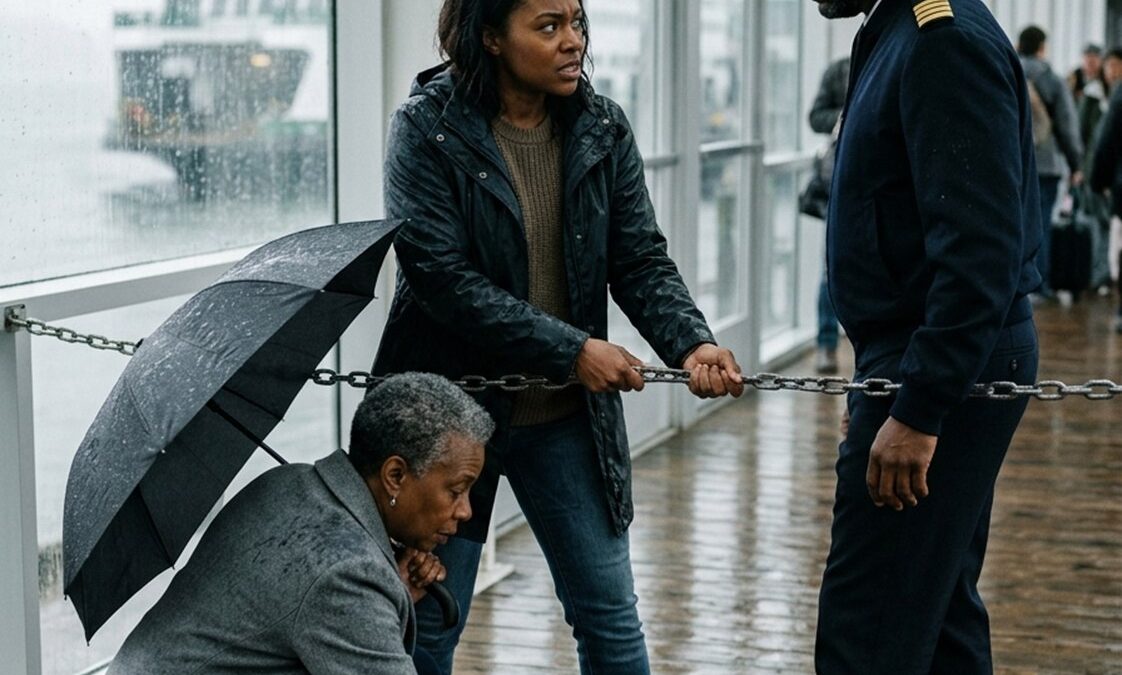
Chapter 2: The Name Underneath
Nora took the tag from Shaw.
Rain had loosened its paper backing.
Under Nora’s writing sat another name.
DANIEL BELL.
Her father.
She turned the tag sideways.
The name appeared only when light struck the wet surface.
“What is that?”
“An impression,” Shaw said.
Mercer reached for it.
Shaw moved it away.
“Don’t touch evidence.”
“You came aboard under a false name.”
“I bought a ticket.”
“You set us up.”
“No,” Nora said.
“The pump did.”
A horn sounded from the ferry.
Someone aboard needed an answer.
Nora looked toward the passengers.
Shaw saw where she was looking.
“Is there another crossing?”
“The county boat,” Nora said.
“An hour and a half.”
“Call its dispatcher.”
Mercer took out his phone.
“You’ll ruin this route.”
“Make the call,” Shaw said.
He did not move.
Nora used the terminal radio.
She gave the county dispatcher their location and passenger count.
Then she told the ferry crew to help people ashore.
Her hands shook afterward.
Shaw noticed.
She held out her umbrella.
Nora almost refused it.
Then rain ran down her collar.
She took it.
“I sent the complaint,” Nora said.
“I know.”
“You came because of me?”
“I came because your inspection notes were specific.”
Mercer watched them.
“You two know each other?”
“No,” Nora said.
Shaw studied the name beneath the ink.
“I knew her father.”
Nora’s grip tightened on the umbrella.
“Then you know what they said he did.”
“I know what the report said.”
“That’s enough for most people.”
“It wasn’t enough for him.”
Mercer shifted his weight.
Shaw turned to him.
“Go help your passengers.”
“You can’t order my crew.”
“I ordered the vessel held.”
For a moment, nobody moved.
Then the first passengers came down the ramp.
Nora guided them toward the warm terminal.
A woman asked whether she could reach the island that day.
Nora promised to find out.
She would not promise a crossing she could not deliver.
When the last passenger passed, Shaw folded the tag into a clean evidence sleeve.
She wrote the time on its seal.
Nora watched every stroke.
“What happened to my father?” she asked.
Shaw looked at Mercer.
Then back at her.
“He reported a failed pump before that grounding.”
* * *
The county boat took forty-six passengers.
A second trip carried the rest.
Nora helped load bags and checked names off the manifest.
Nobody thanked her for the delay.
Nobody had to.
The island pharmacist asked about a refrigerated delivery.
Nora found the driver and called the county captain.
They put the medication aboard the first trip.
Mercer stayed in his office.
By noon, two state inspectors arrived.
One photographed Pump Two.
The other tested it with the engine off.
It did not start.
They sealed the control cabinet and took Nora’s maintenance log.
Shaw asked Nora to remain available.
Mercer called that a suspension.
Shaw wrote down his exact words.
The tag lay between them on a table in the terminal office.
Its top layer was Nora’s.
The older impression belonged to a form once clipped beneath it.
Orange tags came in numbered books.
Each carried a carbon sheet.
A hard pen could mark several tags below the one being written.
Nora had taken hers from an open book that morning.
“Who issued this book?” Shaw asked.
“Operations.”
“Who keeps the old books?”
“Records, if they followed the schedule.”
Mercer gave a short laugh.
“Eleven years of paper?”
Nora looked at him.
“We keep manifests longer.”
That was something her father had taught her.
The route was small.
When weather closed it, people needed proof they had tried to travel.
When a vessel changed hands, inspectors needed its history.
Paper survived software changes.
Shaw asked for the book’s cover.
Mercer said it had gone in the trash.
Nora knew the trash collection schedule.
The bins had been emptied at six.
She also knew the cover was not there.
At five that morning, she had seen it under a stack of new forms in the supply room.
She told the inspectors.
They retrieved it.
The cover carried the same starting serial number.
Eight K, four hundred.
It should have been issued that spring.
Instead, a handwritten sticker said it had been transferred from an older warehouse lot.
Shaw called the state records office.
Nora waited beside the silent ticket window.
Her father’s name sat in her head like a stone.
Daniel Bell had been a mechanic.
On the night of the grounding, he had worked the late shift.
The ferry struck a shoal half a mile from shore.
Nobody died.
Three passengers were hurt.
The vessel took on water before help arrived.
A report said Daniel had signed off on both pumps that afternoon.
He denied it.
Two months later, he died of a heart attack.
Nora was nineteen.
She remembered him at their kitchen table, writing letters.
She remembered her mother asking him to sleep.
She remembered a man from the company bringing a final paycheck.
That man was Gideon Voss.
He still chaired the ferry operator’s board.
He had paid for Daniel’s funeral.
Nora had never known what to make of that.
Shaw returned with an archivist on speakerphone.
The archivist had located the 2015 tag register.
It listed serial eight K, four seventeen as destroyed.
“Destroyed when?” Nora asked.
“June twenty-third, 2015,” the archivist said.
“The grounding was in July,” Shaw said.
The archivist checked again.
“Same date.”
The room seemed to narrow.
The book Nora had used was new to her.
Its number was old.
Someone had put it back into service.
Shaw asked for the destruction order.
The archivist found it in another file.
It bore the initials of the operations director.
Mercer’s initials.
He had held that job in 2015.
Mercer looked at the floor.
“I handled hundreds of boxes.”
“You signed for this one,” Shaw said.
“I signed whatever records sent me.”
“Who gave you the order?”
He said nothing.
Nora stepped closer to the tag.
The letters in her father’s name were uneven.
He pressed hard when he wrote.
She knew that, too.
At home, she still had his grocery lists.
Each word left a faint mark on the sheet beneath.
“If he used the tag book,” she said, “there should be more impressions.”
Shaw nodded.
The inspectors photographed each remaining sheet under angled light.
Most showed ordinary checks.
One carried part of an older warning.
PUMP TWO FAILED.
A date followed.
July seventeenth, 2015.
The grounding happened that evening.
Mercer gripped the edge of the table.
“That doesn’t prove anyone received it.”
Nora looked at the sheet again.
A narrow receipt box sat along its bottom edge.
Her father had drawn a line through the words NOT DELIVERED.
Beside it was another impression.
Two initials.
W.M.
* * *
Shaw had the tag book sealed.
She did not let Nora carry it home.
Nora understood.
By evening, the state had closed Mercer’s ferry pending inspection.
The operator announced temporary service on the county boat.
Nora went home in her damp uniform.
Her mother was making soup.
She took one look at Nora’s face and turned off the burner.
“Was it the boat?”
“The boat’s safe at the pier.”
Nora set her bag down.
“They found Dad’s warning.”
Her mother sat slowly.
Nora told her about the tag.
She told her about the date.
She stopped before the initials.
Her mother reached across the table.
Nora let her take her hand.
For years, they had spoken around Daniel.
They said his name on birthdays.
They told funny stories at Christmas.
They never spoke about the report for long.
It exhausted them both.
“He kept copies,” her mother said.
“I know.”
“I kept them.”
Nora looked up.
“They’re in the hall closet.”
“Why didn’t you tell me?”
“I thought you’d seen them.”
“I saw his letters.”
“Not the receipts?”
Her mother stood.
She came back with a flat cardboard envelope.
Inside were copies of Daniel’s warnings.
There were envelopes, too.
Each carried a postmark.
One had gone to the company.
One to the state office.
One to Gideon Voss.
The last had been returned unopened.
Nora touched its folded corner.
“Did he know?”
“Your father knew someone was lying,” her mother said.
“He didn’t know who.”
The state copy mattered most.
It had arrived two days after the grounding.
That was too late to stop the boat.
It could still have changed the inquiry.
Shaw came to the house with a records investigator the next morning.
She asked permission before entering.
Nora’s mother put the envelope on the table.
The investigator photographed each page.
He recorded where it had been kept.
He found the state letter in an archive scan.
Its date matched the postmark.
Its final page was missing from the public inquiry file.
Shaw read that page twice.
It named the broken pump.
It described a temporary bypass.
It said Daniel had refused to approve departure.
Nora watched Shaw’s face.
“You had this.”
“My office had it,” Shaw said.
“I was a commissioner then.”
“Did you read it?”
“No.”
The answer hurt because it was plain.
Shaw did not soften it.
“I should have found out why.”
Nora went to the window.
Across the street, a neighbor hauled trash bins to the curb.
Normal things kept happening.
Behind her, the investigator asked about Voss.
Nora’s mother remembered the funeral.
“He brought a check,” she said.
“I gave it back.”
“He told me Daniel had been under pressure.”
“From whom?” Shaw asked.
“He wouldn’t say.”
That afternoon, the inspector called from the ferry.
Pump Two had not failed overnight.
A valve had been tied open to hide a leak.
Someone had wrapped the tie with fresh tape.
The tape bore a warehouse mark.
Nora had seen the roll in Mercer’s office.
She told the inspector.
He photographed the roll.
Then Nora’s work phone stopped accepting her login.
A letter arrived by email.
Her access had been suspended for disclosing internal documents.
Shaw called the company lawyer.
Nora asked her to wait.
She wanted a copy of the letter first.
She sent it to her own lawyer through the union’s legal program.
Then she answered Shaw’s call.
“Now,” she said.
That night, someone left a wet orange tag on Nora’s porch.
It was blank.
Her mother found it.
Nora photographed it where it lay.
A police officer collected it.
No one claimed to have seen who left it.
Nora kept her mother inside while the officer worked.
Then they ate cold soup together.
Her mother asked whether Nora wanted to leave town.
“Maybe later,” Nora said.
“Not because of this.”
Her mother covered Nora’s hand again.
For the first time, Nora did not pull away.
The next day, Shaw found the missing inquiry page.
It had been removed under a written request.
The request carried the name of the company’s board chair.
Gideon Voss.
* * *
The hearing took place nine days later.
The ferry remained tied to the pier.
County service ran three crossings a day.
Island residents filled the hall.
Some were angry about the reduced schedule.
Nora understood their anger.
She had carried their bags.
She had watched them miss appointments.
Mercer sat beside a lawyer.
Voss sat two seats away.
His hair was silver now.
His voice was still gentle.
He nodded to Nora as she entered.
She did not nod back.
Shaw chaired the hearing.
Two other commissioners sat with her.
A state investigator presented the pump findings first.
The valve was damaged.
The tie had hidden the leak.
The ferry could not sail safely until repairs passed inspection.
Mercer’s lawyer asked whether the tie could have been used during maintenance.
The inspector said yes.
He added that it should have been removed before service.
Mercer had approved service.
The morning checklist bore his signature.
Then Nora testified.
She described the sound of the pump.
She described writing the tag.
She described Mercer tearing it down.
She kept her voice even.
Mercer’s lawyer stood.
“You were hoping for another investigation into your father.”
“Yes.”
“You disliked my client.”
“I reported a failed pump.”
“You wanted to embarrass him.”
“I wanted the ferry held.”
The lawyer showed her the complaint she had sent Shaw.
She confirmed every word.
Nothing in it mentioned her father.
Nothing mentioned Mercer.
It described the pump.
The lawyer sat down.
Voss spoke after the lunch break.
He did not deny Daniel’s letter.
He called it one mechanic’s opinion.
He said the grounding had several causes.
Weather.
Visibility.
An aging vessel.
He said the old inquiry had done its best.
He said reopening it would hurt a community still dependent on the crossing.
People in the hall listened.
He had kept the route alive for decades.
He had donated to the island clinic.
He knew their names.
For a few minutes, Nora felt the room lean toward him.
Voss noticed.
“I paid for that man’s funeral,” he said.
“I did it because his family was suffering.”
Nora’s mother sat behind her.
Nora heard her chair shift.
Shaw asked Voss about the removed page.
He said counsel had sought a cleaner copy.
“Why remove the original?”
“I didn’t.”
“Your signature authorized it.”
“I signed many requests.”
He sounded almost reasonable.
Then the investigator placed the orange tag under a camera.
Its serial appeared on the wall.
Eight K, four seventeen.
He showed the commission the 2015 destruction order.
Voss had approved that order.
Mercer had carried it out.
The investigator explained what happened when the old stock returned.
The carbon sheets had stayed inside.
Daniel’s warning appeared across three layers.
So did Mercer’s receipt initials.
Voss looked at the screen.
“That proves an old warning existed.”
“It does,” Shaw said.
“It doesn’t prove a scheme.”
The investigator agreed.
Then he called the former company bookkeeper.
She had brought bank records.
In 2015, the operator received a grant for pump repairs.
The money had gone instead to a consulting firm.
Voss’s brother owned it.
The firm had done no pump work.
A state auditor had verified the payments and the ownership records.
The bookkeeper explained why she kept copies.
She had questioned the invoices at the time.
Voss told her the repairs were being handled elsewhere.
Later, when the grounding happened, he told her the files could be needed.
She had kept them in the company archive.
Mercer’s lawyer objected to her conclusion about the money.
Shaw accepted the records.
She left the conclusion to the audit.
Voss stood.
“The route would have closed without private help,” he said.
“I moved funds to keep it open.”
“You moved repair funds,” one commissioner said.
“You chose the risk.”
Voss looked toward the island residents.
“You all used that boat.”
An older man in the front row rose.
His wife tugged his sleeve.
He sat again.
Nora knew him.
He took the early crossing for dialysis.
He deserved a dependable boat.
He did not owe Voss gratitude for an unsafe one.
The investigator displayed one final document.
It was a memo from Voss to company counsel, dated four days after the grounding.
The bookkeeper had found it with the invoices.
The state had obtained the original from company records.
The memo requested a revised chronology.
It instructed counsel to place Daniel’s pump approval before the departure decision.
Daniel had never given that approval.
Voss stopped speaking.
Mercer stared at him.
The hall stayed still.
Shaw let the record remain on the screen.
The commission suspended the operator’s permit until an independent repair and management review.
That was all it could decide that day.
The auditor referred the grant findings to state investigators.
Months passed before charges were filed against Voss for the financial records.
Mercer faced separate charges over the altered maintenance records.
Both men contested them.
Nora attended only when she had to.
The old grounding inquiry was formally corrected.
Its revised finding said Daniel had reported the failed pump.
It said his warning had been withheld.
It no longer placed blame on him.
Outside the records office, Voss approached Nora once.
“Your father would hate seeing this route suffer.”
Nora held her copy of the finding.
“He tried to keep its passengers safe.”
She walked past him.
* * *
Winter brought a new operator.
The boats were inspected before service resumed.
The county kept one backup crossing on the schedule.
Nora returned to work under a new supervisor.
Her first shift started at six.
She was there at five forty.
Old habits stayed.
So did the rent.
Her reinstatement included the wages she had lost.
She paid the landlord.
She replaced her mother’s rattling stove.
Then she bought herself a coat that kept out the rain.
The union lawyer called it a sensible use of back pay.
Her mother called it overdue.
Shaw visited the terminal in March.
This time, she wore a bright blue raincoat.
Nobody mistook her for a passenger.
She brought a proposal.
The commission wanted Nora in a regional safety role.
The salary was much better.
The work meant traveling between ports.
Nora read the offer at the ticket window.
“You should take it,” her supervisor said.
“You didn’t read it.”
“I saw the number.”
Shaw waited outside.
Nora went to meet her.
“I’m grateful,” Nora said.
“That isn’t an answer.”
“I know.”
She wanted the work.
She also wanted to stand on that pier without feeling chased away.
She asked for two weeks.
Shaw gave her two.
During those weeks, Nora helped the new operator rewrite the morning checklist.
Crew members had to test pumps in pairs.
A failed item went straight to the state system.
No supervisor could erase it.
The paper tag remained at the gate until an inspector cleared the fault.
Her supervisor called her thorough.
A deckhand called her a pain.
He said it with a grin.
Nora told him to test Pump Two.
He did.
At home, her mother framed Daniel’s corrected finding.
Nora thought it looked too official above the kitchen table.
They hung it in the hall instead.
Her mother also found an old photograph.
Daniel stood on the pier holding a paper cup.
Nora, aged twelve, stood beside him in a yellow raincoat.
She was laughing at something outside the frame.
For years, she had looked past that picture.
Now she put it near the front door.
One evening, Shaw came for dinner.
Nora’s mother made too much food.
Shaw ate two helpings.
Afterward, she helped dry dishes.
“I owe you an apology,” she told Nora.
Nora set a plate on the shelf.
“You gave me one.”
“I owed you a better one.”
Shaw placed the dish towel down.
“Your father’s letter reached my office.”
“I know.”
“I trusted the file I was given.”
Nora waited.
“I should have checked it.”
“Yes,” Nora said.
Shaw accepted that.
Nora took up the towel.
“I can work with you,” she said.
“I can’t pretend you were never part of it.”
“I wouldn’t ask you to.”
They finished the dishes.
That was enough for the night.
Two weeks later, Nora declined the regional job.
She proposed something else.
A local training post.
Half her time on the crossing.
Half teaching crews how to document faults without pressure from management.
The commission and the new operator agreed to share the cost for one year.
After that, the program would need to prove its value.
Nora liked those terms.
They meant the work had to work.
In May, the first class met in the terminal.
Eight crew members came.
One was older than Nora.
One had never filled out a paper tag.
Nora showed them where the serial number went.
A trainee raised his hand.
“What if the captain tears it down?”
“Take a picture,” Nora said.
“Call the inspector.”
“And if the captain fires me?”
“Call your union.”
She paused.
“Then call me.”
After class, her mother waited by the gate.
She asked whether she could come watch Nora teach next time.
Nora smiled.
“You can sit in the back.”
“I’ll behave.”
“You won’t.”
“I won’t,” her mother agreed.
They walked home together.
* * *
Five years later, Nora stood on the same pier.
Rain tapped against the boarding gate.
A new deckhand held an orange tag.
Pump Two had failed its test.
The boat sat quiet.
Passengers waited under the terminal roof.
The deckhand looked miserable.
Nora remembered that feeling.
She walked over.
“Did you call the inspector?”
“Yes.”
“Did you tell the passengers?”
“Yes.”
“Then you’ve done your job.”
The deckhand turned the tag in his hands.
“A tag has a number,” Nora said.
He showed her.
Eight K, nine hundred and twelve.
They checked it against the log.
Everything matched.
Across the water, the county boat appeared through the rain.
It would carry the first group.
The deckhand went to help them.
Nora stayed by the gate.
Her mother stood in the terminal window, waving a paper cup.
She still brought coffee on cold mornings.
Shaw had retired the year before.
She sent Nora postcards from places with no ferry service.
Daniel’s name remained in the corrected record.
Mercer no longer worked on vessels.
Voss had repaid the misused grant funds under the court’s order.
The crossing had survived them all.
The county boat reached the pier.
Nora opened the gate for its crew.
Then she took the warm cup from her mother.
The orange tag moved in the wind.
Nobody stepped on it.
THE END








