The Fire Curtain Fell Toward His Daughter, So I Took the Chain—Then Her Billionaire Father Saw the Star She Held
Chapter 2: What the Star Held
The footsteps above us stopped.
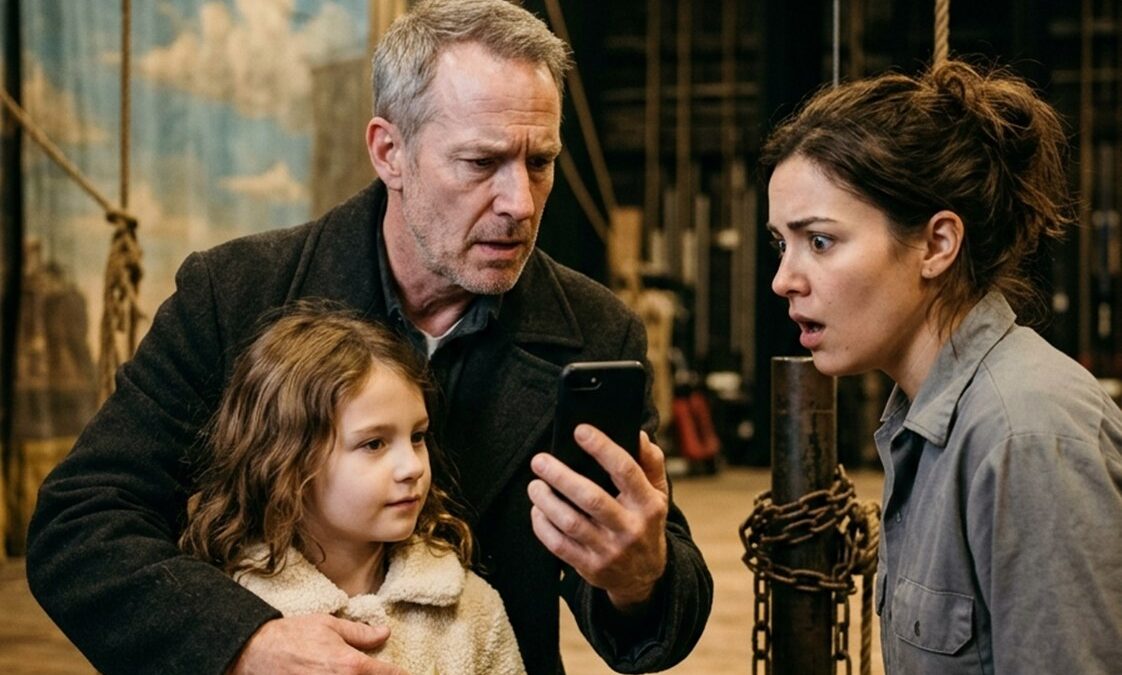
Gideon put his phone away.
“Stay with Wren,” he said.
“I’m staying with my hands.”
“You need a doctor.”
“I need to know who took that picture.”
He glanced at the upper gallery.
I knew the stairs behind it.
I also knew he would take them.
“Your daughter first,” I said.
That stopped him.
Wren pressed against his side.
“I can walk,” she said.
“You’re coming with me,” he told her.
A second employee reached the stage.
Her name was Tess.
She had helped me sweep the balcony that morning.
Gideon asked her to stay beside us while he called the police.
He did it where I could hear.
He gave the dispatcher the theater’s address.
He reported the failed curtain, the photograph, and the threat.
Then he asked for an ambulance.
Nobody ran upstairs.
By the time officers arrived, my palms had started to swell.
A paramedic cleaned them.
The cuts were shallow, but my shoulder needed an examination.
I sat on the edge of the stage while Wren sat beside me.
She watched the bandages go on.
“Does it hurt?” she asked.
“Yes.”
“Because of me?”
“Because of whoever dropped that curtain.”
She considered that.
Then she offered me the star.
Gideon moved closer.
“Let an officer see it first.”
“Agreed,” I said.
An officer photographed the outside.
She put on gloves before opening it over a clean envelope.
The paper unfolded into a long strip of old ticket stock.
Inside lay a small brass key.
Wren leaned forward.
“That was making the square.”
I knew the key.
Or I knew its shape.
My father kept a row of them on a board in the maintenance office.
Each opened a narrow locker in the basement.
After the fire, investigators had emptied that room.
Every locker was gone.
The officer held the key up.
A number was stamped into the bow.
Seventeen.
“There is no locker seventeen now,” I said.
Gideon looked at me.
“How do you know?”
“I worked here before the restoration.”
“No lockers survived?”
“The insurance company removed them.”
“When?”
“After they blamed my father.”
He looked toward the curtain.
“I was told the old equipment was destroyed.”
“Someone told you wrong.”
The officer slipped the key into an evidence sleeve.
I pointed to the ticket stock.
“The dates are written in my father’s hand.”
“How can you tell?” she asked.
“He made the sevens with a line through them.”
Gideon examined the paper without touching it.
There were five dates.
Each fell in the month before the fire.
Beside them were short groups of numbers.
“Could be ticket sales,” he said.
“No.”
I knew the Calder’s ticket system.
Those numbers were too short.
They looked like work orders.
The officer noted that.
Then Wren spoke.
“The woman said it was a game.”
“What game?” Gideon asked.
“I had to find Nell before the curtain came down.”
The paramedic stopped wrapping my hand.
Gideon knelt in front of Wren.
“Those were her words?”
Wren nodded.
“She said Nell would catch me.”
He shut his eyes for one second.
When he opened them, he looked at me.
“I didn’t know anyone would put her onstage.”
“I believe you.”
He seemed surprised.
“I still need you to tell me everything you knew.”
“I will.”
The paramedic helped me stand.
My shoulder protested.
Gideon offered his arm.
I took it because the floor tilted.
Not because he was rich.
Not because I trusted him.
Because Wren watched us both.
At the stage door, Gideon said, “Mateo didn’t leave that door unlocked.”
I stopped.
He did, too.
“What did you say?”
Gideon looked at the star inside the evidence sleeve.
“My father locked it himself.”
* * *
At the hospital, an X-ray showed no broken bone.
The doctor called my shoulder badly strained.
My hands would heal.
I could not grip anything heavy for several weeks.
Gideon heard that from the hallway.
I asked him to come in.
“You said your father locked the door.”
“He told me he did.”
“When?”
“The morning after the fire.”
“Why didn’t you tell investigators?”
“I did.”
The doctor had left us alone.
Wren sat outside with Tess and a police officer.
Gideon pulled up a chair.
“I was nineteen,” he said.
“My father said he checked every exit before closing.”
“Did he put that in writing?”
“Yes.”
“I never saw it.”
“Neither did I after his interview.”
His father, Arthur Rourke, had owned the Calder then.
Arthur died six years later.
Gideon had built his fortune elsewhere before buying the building back.
He told me the investigator had said Arthur’s statement changed nothing.
The report claimed my father reopened the door afterward.
“That wasn’t possible,” I said.
“Why?”
“Because Dad left through the front lobby.”
“How do you know?”
“He called my mother from a pay phone across the street.”
“Is there a record?”
“The phone company didn’t keep one.”
My mother had repeated that call for twelve years.
It proved where he said he was.
It did not prove where he had been before.
Gideon did not pretend otherwise.
“The key may help,” he said.
“If the locker still exists.”
“I’ll find the removal records.”
“The police should find them.”
“They can.”
I watched him.
He understood what I meant.
His money could open doors quickly.
It could also make evidence look purchased.
“I’ll give the records to the detective,” he said.
“Good.”
He stood to leave.
Then he stopped.
“The employee who arrived first told the officers something.”
“What?”
“The upper gallery was locked at six.”
“Who had a key?”
“Building management.”
“And?”
“The reopening committee.”
Gideon’s sister chaired it.
I said her name.
“Marian.”
He did not answer immediately.
“She was in another building tonight.”
“That can be checked.”
“Yes.”
He looked at my bandages.
“I’m sorry about your father.”
“You don’t know what happened yet.”
“I know nobody listened to him.”
That was harder to dismiss.
The next morning, Detective Hana Bell called me.
She had obtained the theater’s security footage.
The camera above the aisle showed Wren entering with a woman in a dark coat.
The woman’s face was obscured by a wide hat.
Her badge reflected the light.
The camera over the stage had been disconnected during painting.
The upper gallery camera stopped recording seven minutes before the curtain fell.
“Could be a technical fault,” Bell said.
“Could be,” I answered.
She asked me to come identify the old maintenance keys.
My mother drove me.
She had not entered the Calder since the fire.
At the police station, she held my elbow while Bell showed us photographs.
Three keys had been recovered from Arthur Rourke’s estate years ago.
None matched the one inside the star.
They had rounded heads.
My father’s locker keys were squared.
Bell had also requested the theater’s old insurance inventory.
The removal company had stored the lockers, then auctioned the contents when nobody claimed them.
I felt my stomach drop.
“Contents,” I said.
“Not the cabinets,” Bell replied.
The cabinets had gone to a salvage warehouse outside the city.
That warehouse still existed.
Bell had already asked for its records.
My mother stared at the photograph of key seventeen.
“Mateo asked me to look for that.”
“When?” Bell asked.
“The morning of the fire.”
I turned toward her.
“You never told me.”
“He said it wasn’t safe.”
“What was inside?”
“He wouldn’t say.”
My mother pressed her fingers against her mouth.
“He called again before dinner.”
“What did he say?”
“That he had proof.”
Bell waited.
My mother looked at me.
“Then he told me to keep you away from the theater.”
I had been fourteen.
I remembered her locking our front door early that night.
I remembered being angry.
For years, I thought she had known the fire was coming.
Now I understood she had been afraid of something else.
Bell asked why she had withheld the call.
“The investigator said Mateo had set the fire,” my mother said.
“He said repeating his claims would make things worse for Nell.”
“Who was the investigator?”
She remembered the name.
Bell wrote it down.
By afternoon, the salvage warehouse had found its old ledger.
Seventeen cabinets had arrived from the Calder.
Sixteen had been sold.
Locker seventeen had been picked up privately, three days before the auction.
The receipt carried a signature.
Marian Rourke.
* * *
Gideon called his sister while Detective Bell listened.
Marian answered on the second ring.
He asked about the locker.
She said she barely remembered it.
He asked where it was now.
“In storage, probably.”
“Which storage?”
“I’ve used several.”
Bell had instructed him to avoid accusations.
He followed that instruction.
When he ended the call, she sent a team to request the theater’s current access records.
Marian’s badge had opened the upper gallery the night before.
She said she had lent it to her assistant.
The assistant said she had never touched it.
Neither statement proved who released the curtain.
Bell needed more.
So did I.
I returned to the Calder with a splint, a police escort, and permission to walk.
The falling curtain had been secured.
Technicians had already photographed its mechanism.
One brake component had been loosened with a tool.
It had not failed on its own.
Bell showed me the upper rail.
“Someone could have prepared it earlier,” she said.
“Then triggered the drop from here.”
I looked down at the stage.
From that angle, Wren would have been hidden behind the curtain until it moved.
The person above could have seen her enter through a small inspection window.
The thought made me cold.
Tess met us near the lobby.
She had remembered the woman with Wren.
“She asked where Nell was working.”
“Did you see her face?” Bell asked.
“No.”
“She spoke?”
“Yes.”
Tess looked at me.
“She said the Calder owed Nell a conversation.”
I knew that voice might belong to anyone.
I also knew Marian had spoken those exact words at a public hearing four months earlier.
I had asked the board to release my father’s personnel file.
Marian refused.
“The Calder owes you a conversation,” she told me afterward.
She never arranged one.
Bell recorded Tess’s memory.
It was useful, but memory alone was fragile.
We needed the locker.
Gideon arranged for his lawyers to send the addresses of every storage unit his sister had used.
Bell obtained warrants for the units that matched the removal period.
The first held furniture.
The second held theater programs.
In the third, officers found a narrow gray locker.
Its number plate was missing.
The lock had been drilled.
Inside lay a stack of old maintenance logs and an empty metal box.
Nothing else.
I saw the photographs at Bell’s desk.
The locker was my father’s.
He had painted one hinge green so he could find it quickly.
The logs showed routine inspections.
No confession.
No proof.
Marian told Gideon she had taken it because Arthur wanted a piece of the original theater preserved.
That explanation was plausible.
It was also incomplete.
The paper star bothered me.
My father made them with a peculiar fold.
He left one point loose, so a child could pull it apart without tearing the paper.
This star had been opened by the officer.
Before it was folded, someone had written dates on the outside.
The writing was his.
But the key was inside.
I asked Bell for photographs of every side.
She sent them through the evidence system while I sat with her.
I lined up the dates with the maintenance logs.
Each date matched an inspection.
Each short number was a page number.
The pages themselves looked ordinary.
I asked for closer images.
My father had added tiny marks in the margins.
A dot beside one entry.
Two beside another.
On the fifth page, a line beneath a name.
The logs recorded deliveries of fire safety equipment.
That name belonged to a supplier.
The supplier had been paid for replacement doors that never appeared in the building.
Bell checked old invoices.
The sums were large.
The payments came from a city restoration grant.
“Your father found a billing scheme,” she said.
“And someone burned the records?”
“We don’t know that yet.”
She was right.
The original fire had several possible causes.
The fraud gave someone a reason to silence him.
It did not identify the person.
That evening, Wren called from Gideon’s phone.
She asked if my hands were better.
Then she asked if I had solved the star.
“Some of it.”
“Did I do the game right?”
“There was no game, Wren.”
She was quiet.
Gideon took the phone.
“Someone left another message,” he said.
Bell had already seen it.
A photograph of my mother’s front door.
No words this time.
Gideon offered to move us into one of his hotels.
My mother refused.
I did, too.
Bell arranged patrol checks and asked us to keep our doors locked.
Gideon did not argue.
He sent the detective the message and its original file.
Later, Bell called.
The image contained location data.
It had been taken by a phone registered to the theater’s reopening office.
The device was issued to Marian.
* * *
Marian requested a meeting with Gideon.
Bell asked him to accept.
The police would be nearby.
I asked to attend.
Gideon said I could decide for myself.
We met in the Calder’s restored lobby during daylight.
Marian arrived with an attorney.
She was fifty-one, elegant, and perfectly calm.
Wren was safely at Gideon’s home.
Marian knew that.
Still, she looked toward the stage doors.
“I hear Nell is recovering,” she said.
“My hands are,” I answered.
She turned to Gideon.
“This has become absurd.”
“Then explain the locker.”
“I already did.”
“And the photograph of Nell’s house?”
“My office phone disappeared yesterday.”
“Did you report it?” Bell asked.
The detective stepped forward.
Marian’s attorney answered.
“They intended to.”
“When?” Bell asked.
“After confirming it was missing.”
Marian folded her hands.
She had an answer for every question.
The badge could have been copied.
The voice Tess heard could have been mistaken.
The locker had belonged to the theater.
Her signature proved possession, not fraud.
She was right about all of those limits.
Then she looked at me.
“Your father was under pressure,” she said.
“He made accusations he couldn’t support.”
“He wrote page numbers,” I said.
“People write many things.”
“He also kept the original invoices.”
Marian’s gaze shifted.
Only slightly.
Bell had not told us whether she had found them.
I had not told Gideon, either.
It was a test.
“Where?” Marian asked.
“In locker seventeen.”
Marian smiled.
“The police searched it.”
“Yes.”
I opened my bag.
Bell took out the paper star.
She placed it on the lobby desk.
My father had folded it from ticket stock.
On the back, beneath the blue numbers, was a faded supplier stamp.
It named the print shop that made the theater’s forms.
Bell had visited that shop.
Its retired owner kept carbon copies of large custom orders.
One order included numbered receipt books for the fire safety supplier.
The carbon copies recorded payments.
They also recorded who collected them.
Marian.
Her attorney leaned toward her.
She did not move.
“Picking up stationery is not a crime,” she said.
“No,” Bell replied.
“The bank records matter more.”
Bell had obtained them under a warrant that morning.
The supplier was a shell company.
Its account had received the grant payments.
Money then moved into an account controlled by Marian.
Gideon stepped away from his sister.
“You stole from the restoration fund.”
“I borrowed against a building that would have failed anyway.”
“You put Wren on that stage.”
Her face tightened.
“I never intended for her to be hurt.”
Nobody spoke.
Marian realized what she had said.
Her attorney touched her arm.
She pulled away.
“You were supposed to reach her,” she told me.
“The curtain was supposed to stop.”
“Who told you that?”
“The man who serviced it.”
Bell’s radio sounded quietly.
Officers had located the contractor earlier that morning.
He had already given a statement.
He said Marian paid him to loosen the brake.
He claimed she told him the stage would be empty.
Bell did not repeat his claims as fact.
She asked Marian to come with her for an interview.
Marian looked at Gideon.
“Arthur knew about the invoices.”
Gideon stared at her.
“Did he?”
“He knew the grant would disappear unless we finished the work.”
“That isn’t an answer.”
She looked at me instead.
“Your father was going to ruin us all.”
“My father tried to stop you.”
“You don’t know what he would have done with the money.”
“He never took it.”
Bell guided Marian toward the doors.
Her attorney followed.
Before leaving, Marian turned once more.
“You’ll still have his name in every article.”
“Yes,” I said.
“And this time they’ll spell it correctly.”
The lobby doors closed behind her.
Gideon stood beside the paper star.
He did not reach for it.
Bell remained.
She had more to tell us.
The original fire investigation would be reopened.
The old investigator had retired.
His files still existed.
There was no promise of a quick answer.
There was only a record of fraud, a missing statement from Arthur, and a man who had tried to preserve dates before he died.
That was enough to begin.
Four months later, Marian pleaded guilty to fraud, evidence tampering, and her part in the curtain incident.
The contractor also entered a plea.
The court ordered restitution and prison time.
The reopened fire investigation found no evidence that my father had started the fire.
An electrical fault behind an unmaintained panel was the probable cause.
The city formally withdrew its accusation against him.
My mother framed the letter.
She put it beside his photograph.
* * *
By spring, I could grip a broom again.
I didn’t have to.
Gideon had offered to pay my wages for a year.
I refused that.
He paid the hospital bill because the injury happened in his building.
I accepted that.
Then he asked what I wanted from the theater.
I thought about all the people who had worked there before it reopened.
The cleaners.
The electricians.
The ushers who remembered which seats squeaked.
Their stories had never made it into the glossy brochure.
“I want the maintenance office restored,” I told him.
“Why?”
“Because someone should know who kept the place standing.”
He hired an archivist.
The archivist hired me.
My first assignment was to identify old tools and records.
The salary came with benefits.
I checked the offer twice before signing.
Wren visited on Saturdays.
She was no longer allowed near the stage without an adult.
She considered that unfair.
Gideon considered it final.
Once, she found a wrench older than both of us.
“Is it valuable?” she asked.
“To somebody.”
“How much?”
“Enough to label it.”
She wrote the label in very careful letters.
Mateo Ruiz, maintenance chief.
My mother came to see it.
She touched the edge of the display case.
Then she laughed.
“He would hate how clean that wrench is.”
I had not heard her laugh inside the Calder before.
Gideon arrived with coffee for all of us.
He handed mine over without asking how I took it.
He had learned.
We still argued.
He wanted more cameras.
I wanted staff who could see the stage without watching a screen all day.
We settled on both.
One afternoon, he asked if I would have dinner with him and Wren.
“Is that a board invitation?” I asked.
“No.”
“Is it a thank-you?”
“No.”
He waited.
Wren was in the next room, counting costume buttons.
“Then ask again,” I said.
“Would you have dinner with us?”
“Yes.”
We went to a small restaurant across the street.
Wren ordered pancakes.
Gideon ordered something he could barely pronounce.
I ordered soup.
Nobody mentioned money.
A week later, Gideon apologized for his father’s part in the old investigation.
He said Arthur should have insisted that his statement be included.
I agreed.
I also told him I could not make his family’s history disappear for him.
“I wouldn’t ask you to,” he said.
“Good.”
He looked at me.
“I want Wren to know you.”
“She already does.”
“I want to know you, too.”
That took longer to answer.
Power had followed him into every room of his life.
I needed him to leave it at the door sometimes.
He said he could try.
I said trying was where we would start.
We did.
There were evenings when he listened badly.
There were mornings when I assumed the worst.
We corrected each other.
Wren corrected us both.
The paper star stayed in the archive after the case closed.
Bell returned it with a signed release.
I placed it in a clear case.
Beside it, I put my father’s old work order pages.
The dates finally made sense together.
When visitors asked about the star, I told them the truth.
A child carried it.
A woman tried to take it.
And its numbers helped us find the people who could verify what my father knew.
I never called it magic.
My father would have laughed at that.
He believed in keeping records.
* * *
Three years later, the Calder staged its first children’s festival.
Wren was eleven.
She insisted she was too old for the puppet show.
She watched the whole thing.
I stood near the stage beside Gideon.
The fire curtain was raised.
Its painted sky had been restored.
The brake system had been rebuilt and inspected more often than the law required.
Children crossed the stage in paper crowns.
Nobody asked them to stand beneath anything dangerous.
Wren came over with a new paper star.
She had made it from a festival program.
“I folded this myself,” she said.
“It shows,” Gideon told her.
She gave him a look.
Then she handed it to me.
Inside was a small drawing.
Three people stood beneath a blue sky.
One had bandaged hands.
I smiled.
“My hands healed.”
“I know,” Wren said.
“I drew them how they were when we met.”
Gideon glanced at the curtain.
I knew he still saw it falling sometimes.
So did I.
The difference was what came after.
My mother had her letter.
My father had his name.
The Calder had its records.
Wren had grown tall enough to reach the archive’s top shelf.
And I had a life that belonged to me.
Gideon took my unbandaged hand.
Wren took the other.
Onstage, the children lifted their paper crowns.
The painted sky stayed where it belonged.
THE END








