THE FOUR-YEAR-OLD BOY WHO OPENED THE FOUNDRY TYCOON’S SEALED SMELTING CHEST WITH A RUSTED RAILROAD NAIL
Chapter 2: The Iron Will
The lock snapped shut.
The heavy glass sealed.
Nobody moved.
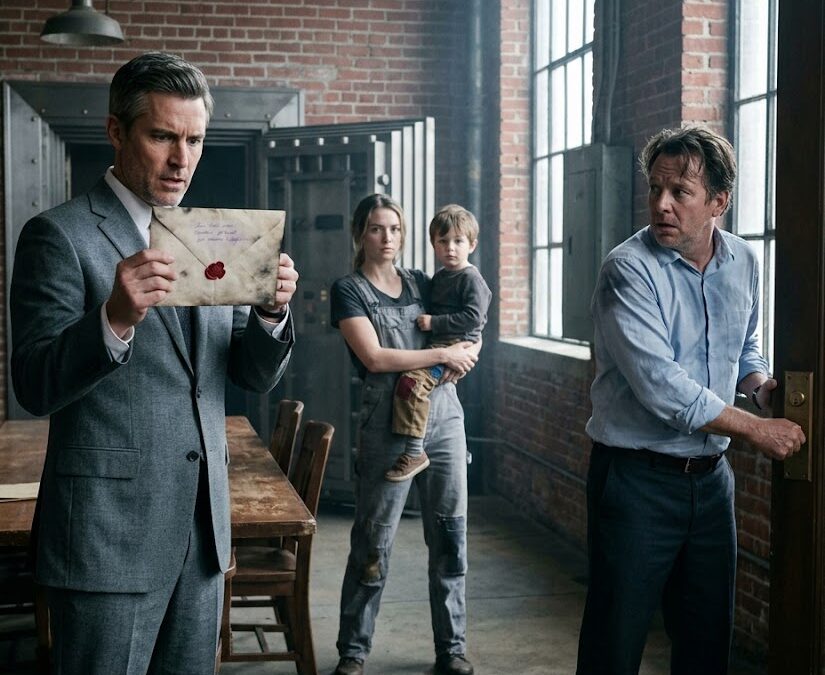
Donald Ross gripped the door handle.
He rattled the solid brass fixture with his thumb.
The deadbolt remained completely seated.
It did not yield.
“Julian,” Donald said.
His voice cracked slightly.
A bead of cold sweat broke along the ridge of his nose.
“This is an internal matter.”
“Sit down, Donald,” Julian said.
Donald did not sit.
His loafers scuffed the parquet floorboards as he shifted back.
“The European delegation is waiting,” Donald said.
“They have planes to catch, Julian.”
“Let them wait,” Julian replied.
Julian did not look at Donald.
He looked at the letter.
The ink was dry.
The seal was unbroken.
Red wax held the flap.
The stamp bore Marcus Vance’s signet.
A hammer and anvil.
The edges of the crimson wax were sharp and crisp.
No dust had touched the crease inside the recess.
Julian turned toward Nora.
She had not moved.
Her hand held Toby’s shoulder.
Her thumb stroked the coarse fabric of the boy’s collar.
“Did you know this was here?” Julian asked.
“No,” Nora said.
Her voice did not shake.
She met his gaze without blinking.
“You knew my father?”
“I never met Marcus Vance,” she said.
Julian stared at her face.
He looked for deceit.
He looked for rehearsed terror or calculated innocence.
He found only fatigue.
The deep, quiet fatigue of three generations of night shifts.
“Your father’s name,” Julian said.
“Thomas Hall,” Nora answered.
“Thomas was a puddler,” Julian murmured.
“He worked the blast furnace.”
“Number four furnace,” Nora said softly.
“For thirty-two years,” Nora said.
“He died of lung rot.”
Julian looked down at Toby.
The boy was tracing the iron edge.
The rusted railroad spike sat quietly on the stone sill.
Toby’s small fingers brushed the cold cast lip of the vault casing.
He looked fascinated by the gray dust on his fingernails.
“Open it,” Donald said from behind.
Donald took half a step out of the shadows near the corridor door.
“Open it and let us end this charade,” Donald urged.
Julian broke the red wax.
The seal cracked with a sharp, clean snap.
The paper unfolded with a crisp snap.
Julian read the first line.
His jaw tightened until bone showed through skin.
His molars ground together behind drawn lips.
“What does it say?” Donald demanded.
Julian did not answer Donald.
He read in silence.
Three pages of dense script.
A legal transfer deed.
A sworn deposition from 2012.
And a bank ledger receipt.
The handwriting did not waver.
Every line carried the heavy, downward stroke of Marcus Vance’s left hand.
Julian felt a chill spread down his spine.
The ink was dark violet.
An aniline dye his father had imported from Munich.
No one else had used that bottle.
Julian remembered the scent of it from childhood.
It smelled of clove oil and dry cedar.
The second page carried the notary public’s round blue impression.
Signed in Essex County, twelve days before Marcus stopped breathing.
Across the room, the five European partners shifted their weight.
The leather of their armchairs creaked in the silence.
The lead delegate, Herr Weber, checked his platinum watch.
He cleared his throat with dry, surgical precision.
“Mr. Vance,” Weber spoke with stiff courtesy.
“We have an eleven o’clock flight from Newark.”
Julian did not lift his gaze from the second page.
“Take the evening flight,” Julian said.
“We have a binding memorandum,” Weber said.
Weber tapped his fountain pen against the edge of his folder.
“The board approved the transfer terms yesterday afternoon.”
“The memorandum is void,” Julian said.
Weber frowned, stepping toward the conference table.
“On what grounds?”
“On grounds of title,” Julian answered.
“I cannot sell what I do not fully own.”
Donald’s breath caught in his throat.
His hands fluttered up toward his lapels.
“Julian, cease this madness!” Donald hissed.
“The firm owns the plant clear and free.”
“We cleared the municipal liens three years ago!”
Julian folded the paper slowly.
The paper made a dry, brittle rustle.
The crisp vellum settled between his fingers.
“The contracts are canceled,” Julian told the partners.
The German delegate stood up.
He gathered his leather portfolio under one arm.
“Mr. Vance, we have terms.”
“We have penalties for breach of exclusive negotiation.”
“The meeting is over,” Julian said.
He did not raise his voice.
He pressed the desk intercom button once.
The metal grille hummed with static.
“Security,” Julian said into the grille.
“Escort our guests to the ground floor lounge.”
“Provide car service to the airport or their hotel.”
“See that their baggage is carried down immediately.”
Weber stared at Julian for three long seconds.
He saw the stone in the younger man’s eyes.
There was no negotiation left in the room.
He nodded once, clicked his leather case shut, and turned.
The partners gathered their coats.
Their heavy wool coats rustled against the chairs.
Security escorted them to the lobby.
The heavy oak doors clicked shut behind them.
The room became silent.
Only the hum of the ventilation remained.
A faint clink came from below.
The afternoon pour in furnace bay three had begun.
The vibration traveled up through the iron rebar in the floorboards.
Julian looked at Nora.
“Come with me,” he said.
“Where?” Nora asked.
“To my office.”
“I have work on five,” she said.
“The floor polish is half dry by the elevators.”
“The wax will yellow if I leave it standing.”
“Your shift is finished,” Julian said.
“Am I fired, Mr. Vance?”
“No,” Julian said.
“You are not fired.”
He reached down to the sill.
He lifted the iron box by its recessed bronze handle.
It was surprisingly heavy.
The solid oak casing had absorbed forty years of foundry grease.
He did not touch the spike.
“Toby,” Julian said.
The child looked up.
His dark eyes were wide and calm.
“Bring your key,” Julian told him.
Toby picked up the rusted spike.
The heavy square iron looked enormous in his small hand.
He slipped it into the front pocket of his corduroy trousers.
The rusted head poked out over the waistband.
He held his mother’s skirt with his other hand.
Donald stood blocking the hallway threshold.
His jaw twitched.
His neck was flushed red above his starch collar.
“Julian, you are committing corporate suicide.”
Julian did not slow his step.
He carried the drafting box in his left hand.
“Move, Donald.”
Donald did not move for a second.
He planted his feet on the polished oak.
Then Julian took one stride closer.
The height and breadth of the foundry master filled the doorway.
Donald stepped aside, pressing his back against the wall panelling.
His suit jacket brushed the textured paper on the wall.
* * *
The inner office was lined with dark walnut.
A single drawing hung behind the desk.
The original 1928 foundry elevation.
The blueprints were hand-inked in cobalt on linen.
The white draft lines showed every arch, crane, and blast flue.
Julian set the letter on the desk.
He set the drafting box beside it.
The brass calipers gleamed dully under the desk lamp.
The stamped initials *M.V.* caught the light.
He poured three glasses of water from a crystal carafe.
He set one before Toby.
The boy drank thirstily.
He held the heavy cut crystal with both hands.
He finished the water in four deep gulps.
“Sit, Nora,” Julian said.
She sat on the leather sofa.
She kept Toby beside her knees.
She did not lean back.
She sat with her spine straight, the way factory girls sat when summoned to administration.
Her canvas bag of rags rested neatly against her boots.
Donald Ross stood by the bookcase.
His coat was still unbuttoned.
His fingers picked at a loose thread on his cuff.
“Julian, this is irregular,” Donald said.
“Marcus was unwell in 2012.”
“He was rambling about old debts for six months before the end.”
“He was completely lucid,” Julian said.
“He was eighty,” Donald countered.
“His heart was failing him.”
“His kidneys were shutting down.”
“His mind was sharper than yours,” Julian said.
“He wrote this by hand,” Julian added, tapping the page.
“Handwriting can be contested.”
“Any estate litigator in Manhattan will tear this up in five minutes.”
Julian looked up sharply.
His eyes were gray slate.
“Why would you contest it, Donald?”
Donald swallowed.
His collar seemed tighter now.
He ran a crooked finger between his throat and his tie.
“I protect the firm.”
“I protect thirty years of growth and stability.”
“You protect yourself,” Julian said.
“That is an unfair accusation.”
“We will see what is fair,” Julian said.
Julian opened the deep lower drawer of his mahogany desk.
The heavy drawer slid on steel rollers.
He withdrew a leather-bound personnel register.
It dated back to the mid-century.
The corners were bound in brass.
The cloth spine was worn down to white threads.
“Thomas Hall,” Julian read aloud.
He ran his index finger down the yellowed ledger column.
The ruled lines were faded blue ink from 1978.
“Hired June 14, 1978.”
“Shift four, open hearth furnace.”
“Promoted to lead puddler, 1986.”
“Injured November 3, 2010.”
“Pension denied.”
Julian looked at Nora.
“Why was his pension denied?”
“They said it was preexisting,” Nora said.
Her eyes were clear and steady.
“He had bronchitis as a boy.”
“In an unheated tenement in Scranton.”
“He worked thirty-two years in the smoke,” she said.
“He shoveled silica sand without a respirator for twelve years.”
“So they wiped thirty years of service.”
Julian’s hand remained flat against the book.
“Thirty-two years,” he corrected softly.
“Thirty-two,” Nora whispered.
“He coughed blood into cotton handkerchiefs.”
“I washed them every night after high school.”
“I soaked them in cold salt water to lift the red stains.”
“He never missed a Tuesday graveyard shift.”
“Not once in thirty-two years.”
Julian looked at Donald.
“Who signed the denial?”
Donald adjusted his cuffs.
“Standard claims procedure, Julian.”
“The committee reviewed all industrial health filings.”
“We followed the advice of our underwriters.”
“Who signed it?” Julian repeated.
Donald did not answer.
His gaze drifted toward the ceiling moldings.
Julian turned the page of the register.
The signature was cramped and angular.
*D. Ross, Claims Director.*
Julian closed the book with a heavy thud.
The sound was like a hammer striking pine.
Dust lifted from the edge of the leather binding.
“My father found out,” Julian said.
“Marcus knew everything,” Donald muttered.
“Not everything,” Julian said.
“Not until he audited the foundry trust in October of that year.”
“He asked for the claims files three weeks before he fell ill.”
Julian unfolded the purple letter again.
He held it toward the desk lamp.
The purple ink seemed to glow against the yellowed parchment.
“My father wrote that forty percent of North River Foundry never belonged to the Vance family.”
Donald took a step forward.
“That’s an old myth.”
“A ghost story from the Great Depression.”
“Old men talking over whiskey at the union picnics.”
“It is not a myth,” Julian said.
“In 1944, Thomas Hall’s grandfather provided the patent for the flux alloy.”
“The boron-titanium mixture.”
“It allowed the armor plating to cool without micro-fractures.”
“The Navy bought every foot of plate we could pour.”
“The alloy built this company.”
“There is no paper trail,” Donald insisted.
“The archives were cleared during the flood of seventy-two.”
“The basements were submerged in six feet of river water.”
“There is,” Julian said.
He tapped the wooden drafting box.
“Inside this box is the original patent assignment.”
Julian unlatched the brass hooks of the wooden box.
The lid swung open.
A clean smell of linseed oil rose into the room.
Inside lay three rolled vellum sheets tied with black ribbon.
Beneath them lay a stamped government envelope from the United States Patent Office.
Dated August 12, 1944.
Patent Number 2,356,891.
Assignor: Arthur Thomas Hall.
Assignee: Marcus Vance & Partners.
Royalty provision: six percent of all gross tonnage poured using the boron process.
Julian read the clause aloud.
His voice resonated against the walnut bookshelves.
The words filled the quiet room.
“And the railroad spike?” Julian asked Nora.
“My father kept it on his workbench,” Nora said.
“In the basement of our row house.”
“Beside his oilstone and his files.”
“He told me it was the key to the foundation.”
“I thought it was a bedtime story.”
“A story to make up for the cold rooms.”
“To make me feel like we had something hidden in the dark.”
“It was not a story,” Julian said.
The spike was the release pin.
The foundry safe was built in 1944.
Not 1994.
The outer casing was retrofitted later.
A cosmetic shell of modern Swedish steel bolted around the ancient iron core.
The locking core remained original.
Thomas Hall had installed it himself.
“Why didn’t your father open it?” Julian asked.
“He was loyal to Marcus,” Nora said.
“He respected the old man.”
“He said Marcus had given his father a wage when the banks collapsed.”
“He believed Marcus would do right.”
“And Marcus tried,” Julian said.
Julian looked down at the paper.
“Marcus left the deed in this box for Thomas.”
“He left the patent records.”
“He left the original share certificates.”
“Then Marcus died in his sleep.”
“On a Sunday morning,” Donald added quietly.
“On a Sunday,” Julian said.
“And the chest was walled in,” Julian whispered.
He looked straight at Donald.
“Who ordered the brick alcove built around the safe in 2012?”
Donald remained silent.
Julian stood up.
He towered over the vice president.
“It was you, Donald.”
“You told me it was a structural reinforcement.”
“You claimed the floor joists were sagging under the load.”
“You billed the firm forty thousand dollars for specialized masonry.”
“It was a seal.”
“You buried the chest behind sixty course of red brick.”
“Hoping no one would ever remember the base pin.”
“Hoping Thomas would die in the county hospice before he spoke.”
Donald sneered faintly.
“A four-year-old found it by accident.”
“No,” Nora spoke up.
Her voice cut through the men’s tension.
“Not by accident.”
“Thomas gave Toby that nail on the day he died.”
“He took the boy’s hand in the hospice bed.”
“His skin was yellow from liver failure.”
“He held Toby’s fingers around the rusted head.”
“He said, ‘Find the red brick by the river, little hammer.'”
“‘Push the floor until the iron wakes up.'”
Toby nodded once from the sofa.
He reached into his pocket and tapped the iron shank.
“The iron woke up,” Toby said.
* * *
Julian picked up his desk phone.
He did not dial an extension.
He dialed an outside landline from memory.
The mechanical rotary sound clicked across the receiver.
“Arthur,” Julian said when the line clicked.
“Come to the foundry.”
“Now.”
He hung up without waiting for a reply.
Julian called Marcus’s old attorney.
Arthur Vance, his uncle, arrived within thirty minutes.
Arthur was seventy-four years old.
His trench coat was damp from the sudden river fog.
He carried an ancient horn-rimmed cane.
The rubber ferrule on the cane was worn flat on one side.
He entered the office without knocking.
He looked at Nora.
Then he looked at Toby.
Arthur stopped walking.
The tip of his cane remained suspended two inches above the Persian rug.
He adjusted his glasses.
“Good God,” Arthur whispered.
“What is it, Uncle?” Julian asked.
“The boy’s face,” Arthur said.
“He looks like Thomas.”
“The same brow.”
“The same stubborn jaw.”
“Thomas had that exact set to his eyes when he watched the ladle tip.”
Arthur walked to the desk.
His cane tapped softly across the walnut planks.
He took the purple letter.
He read it without his spectacles.
His old hands did not shake.
“Marcus gave me a copy of this,” Arthur said.
Julian stared at his uncle.
“You had a copy?” Julian demanded.
“A duplicate sealed in escrow,” Arthur said.
“At the bank in Morristown.”
“In a safety deposit box with dual keys.”
“Why didn’t you bring it forward?”
“The condition was specific,” Arthur said.
“Marcus wrote the escrow terms himself.”
“The safe had to be opened from the outside.”
“By the rightful hand.”
“Marcus knew someone had tampered with the mechanism.”
“He knew someone inside the executive suite had turned.”
“He knew only a Hall could open it.”
“He told me, ‘If the boy or the girl comes to the river, the safe will open.'”
“‘If they don’t, the firm deserves to rot.'”
Donald scoffed.
“This is superstitious nonsense.”
“An old man’s senile paranoia.”
“A legal circus based on nursery rhymes.”
“It is mechanical engineering,” Arthur snapped.
He turned toward Donald, his cane striking the floorboards sharply.
“Thomas Hall held the patent for the cam latch.”
“He built the hidden detent into the casting mold.”
“He built the bypass into the masonry foot.”
“He taught his daughter.”
“I never touched it,” Nora said.
“He told me about the balance, but I never touched the iron.”
“He drew it on the back of brown paper bags when I was seven.”
“You gave Toby the spike,” Arthur said gently.
“He was playing with it this morning,” Nora said.
“He took it from his father’s wooden tool chest.”
“He had it on the rug while I packed our lunch.”
“He said the iron wanted to go home.”
Arthur smiled faintly.
The lines around his eyes softened.
“Iron remembers the hand that shaped it.”
Arthur turned to Julian.
He laid the purple parchment beside the patent deed.
“The legal position is unambiguous.”
“The patent royalties were escrowed for forty years.”
“Marcus diverted every cent of the alloy earnings out of operating revenue.”
“He refused to spend a nickel of it.”
“He locked the disbursements behind a third-party charter.”
“They sit in an interest-bearing account in Zurich.”
“Under the name of the Hall Metallurgical Trust.”
“How much?” Julian asked.
Arthur looked over his wire rims.
He held up a yellow carbon slip from his breast pocket.
“Sixty-two million dollars,” Arthur said.
Donald gasped.
The room grew colder.
The air seemed drained of breath.
Donald’s hands gripped the edge of the walnut bookcase.
“That money belongs to the foundry capital reserve,” Donald said.
“It is listed in the annex of our quarterly filings!”
“Our revolving line of credit depends on that liquidity!”
“It belongs to Thomas Hall’s heir,” Arthur corrected.
“And who is that?” Donald asked.
“Nora Hall,” Arthur said.
“And her son.”
Donald took two steps toward the window.
He looked down at the yard.
Below, the freight trucks were idling.
Steam rose in white plumes from the slag pit.
The orange glow of the furnace windows flickered through the mist.
“Julian, think of the firm,” Donald pleaded.
“If this goes public, our stock plummets.”
“The banks will call our short-term notes.”
“The credit facility will freeze by morning.”
“The merger with the Swedes is dead.”
“We will be bankrupt by Friday.”
Julian did not blink.
He looked at his father’s drawing on the wall.
He looked at Nora’s work-roughened hands.
He saw the broken skin around her fingernails.
“Then we will be bankrupt,” Julian said.
“You can’t do this!” Donald shouted.
“I built forty percent of the logistics chain!”
“I spent twenty-five years managing this yard!”
“My father built this firm on honor,” Julian said.
“You built your career on stolen pensions.”
Julian picked up his telephone.
“Get forensic accounting on the line,” Julian instructed.
“And connect me to the United States Attorney’s office in Newark.”
“Tell them Julian Vance requires an immediate field team.”
Donald moved toward the desk.
His eyes were wide, wet, and desperate.
The sweat on his cheeks caught the desk light.
“Julian, wait.”
“We can settle this quietly.”
“We don’t need federal investigators in our books.”
“We set up a separate foundation for the girl.”
“Two million, three million.”
“She signs a nondisclosure agreement.”
“We pay off her debts, buy her a house in the suburbs.”
“She will be richer than she ever dreamed!”
“Back away, Donald,” Julian said.
Donald did not back away.
He reached for the wooden drafting box.
His hand shot out toward the vellum patent.
His fingernails scraped the aged wood.
Julian caught Donald’s wrist with one hand.
Julian’s grip was forged in the foundry’s early days.
Before the executive desks.
Before the tailored wool coats.
When Julian had worked the pour beside his father at eighteen.
He had carried iron ingots with tongs in ninety-degree heat.
Donald groaned in pain.
His fingers went slack.
The ribbon fluttered back onto the box.
“Do not touch my father’s property,” Julian said.
“It isn’t yours!” Donald hissed.
“It belongs to the boy,” Julian said.
He released Donald’s arm.
Julian pointed to the leather armchair in the corner.
“Sit in that chair until the investigators arrive.”
Donald staggered back.
He held his bruised wrist against his chest.
He sank into the armchair.
His face was gray, like wet ash.
* * *
Three hours later, the office was crowded.
Two federal marshals stood by the door.
Their badges caught the lamplight.
Their sidearms sat heavy against their navy utility trousers.
A court-appointed notary was stamping documents.
The mechanical thud of the steel stamp sounded every few minutes.
Two forensic examiners from the Department of Labor worked at the conference table.
They had unspooled reams of green-bar printouts across the mahogany.
Donald Ross sat in the corner, his tie undone.
His jacket hung limp over his shoulders.
His personal laptop had been seized.
Three banker’s boxes of correspondence sat beside his feet.
The records told a ruthless story.
Donald had skimmed the dormant patent escrow since 2014.
Using Marcus’s forged signature stamp.
He had bought a replica of the signet ring in Florence.
Over eight million dollars had been diverted through shell companies in Delaware.
Through an entity named Riverstone Maritime Holdings.
The money had paid for horse farms, private jets, and offshore trusts.
He had systematically denied foundry worker pensions to balance the deficit.
When the audit loomed each November, Donald cut claims.
He found microscopic errors in medical histories.
Thomas Hall was only the first name on the list.
There were forty-two others.
Forty-two puddlers, molders, and cranemen.
Forty-two widows and sons.
All denied their rightful earnings.
All told their lungs were defective before they ever breathed the foundry smoke.
Nora sat beside Arthur.
She held Toby’s hand in her lap.
The boy had fallen asleep against her side.
His small breathing was rhythmic and slow.
His head rested against the coarse gray denim of her overalls.
Julian walked over and knelt before her.
It was an unthinkable gesture for Julian Vance.
The man who owned three blast furnaces.
The man who never negotiated.
The man who had broken two European steel cartels without smiling once.
“I owe you an apology,” Julian said.
His voice was quiet, meant only for her.
“You didn’t know, Mr. Vance,” Nora said.
“I should have known,” Julian said.
“I signed the balance sheets.”
“I signed the annual summaries without verifying the human names.”
“I trusted Donald because he was my father’s clerk.”
“Ignorance is not an excuse for cruelty.”
Nora looked down at her hands.
She rubbed the faint scar across her knuckle.
“My father suffered,” Nora said softly.
“The last winter was the hardest.”
“The oil heater went out in January.”
“We burned old wooden pallets from the scrap yard.”
“We broke them with a crowbar on the kitchen floor.”
“He coughed until his ribs cracked.”
“He never complained.”
“He said Mr. Vance was an honest man who had many burdens.”
“He said the iron masters carried the weight of the whole valley.”
Julian bowed his head for a single second.
When he looked up, his jaw was set like forged steel.
“He will have his justice,” Julian promised.
“And the other families?” Nora asked.
Julian looked at her with new respect.
“What about them?”
“My father wouldn’t take a dime while the other men starved,” Nora said.
“He shared his tobacco rations during the seventy-nine strike.”
“He shared his soup.”
“He took the night shifts for men whose wives were birthing.”
“They must be paid first.”
“Every single widow.”
“Every retired worker who had to clean streets or sell his tools.”
Arthur Vance wiped a tear from his cheek.
He took off his wire-rimmed glasses and pressed a linen handkerchief to his eyes.
“She is Thomas’s daughter, without a doubt.”
“She has his blood and his backbone.”
“She has the soul of the old yard.”
Julian stood up straight.
He turned toward Arthur.
“Arthur, prepare the paperwork.”
“What paperwork, Julian?”
“The restitution fund.”
“From company assets?” Arthur asked.
“The board will resist.”
“They will threaten injunctions.”
“From my personal equity,” Julian said.
“Every share of stock I inherited.”
“Every dividend payment from the international sales.”
“We will restore every pension with six percent compound interest.”
“From the day each claim was wrongfully denied.”
Donald Ross looked up from his chair.
A bitter, twisted grin pulled at his mouth.
His eyes were bloodshot.
“You’re a fool, Julian.”
“You are giving away your empire to cleaners.”
“To street sweepers and grease monkeys.”
“They won’t know how to keep it.”
Julian walked over to Donald.
He did not raise a hand.
He looked down at the disgraced executive.
“A cleaner gave me my honor back today,” Julian said.
“You only took it away.”
“You lived on their sweat and called it management.”
“You ate from their plates and told them they were lazy.”
The federal marshals stepped forward.
The senior agent unclipped a pair of steel cuffs from his belt.
“Mr. Ross, stand up,” the marshal said.
Donald hesitated.
The marshal gripped his shoulder and pulled him to his feet.
Handcuffs clicked around his wrists.
The double lock engaged with a cold, precise snap.
He was led past Nora and Toby.
Donald looked down at the carpet.
He did not look at them.
The heavy office door closed behind him.
The latch clicked.
The sound of his leather soles faded down the marble corridor.
The silence that followed was peaceful.
Julian turned back to the mahogany desk.
He picked up the old brass calipers.
He brought them to Toby.
He gently placed them in the sleeping boy’s hand.
Toby stirred, his little fingers closing around the cool metal.
“He has good hands,” Julian remarked.
“Foundry hands,” Nora said.
“We will teach him how to use them,” Julian replied.
“We will teach him how to build things that last.”
* * *
Six months passed.
The autumn air over the North River was crisp and smelling of cedar woodsmoke.
The foundry looked different now.
The black soot on the brick facade had been cleaned with high-pressure steam.
The red masonry shone in the October sunlight.
The tall arched windows caught the morning glare.
A new brass plaque hung beside the front archway:
*NORTH RIVER FOUNDRY & FABRICATION — FOUNDED BY MARCUS VANCE AND THOMAS HALL.*
The European partners had returned.
Herr Weber had flown back from Frankfurt.
He had sat in the newly renovated boardroom without complaint.
He had signed the supply contracts under new terms.
The contracts had been redrafted under new ownership.
Fifty-one percent remained with the Vance estate.
Forty-nine percent belonged to the Hall Family Trust.
The capital reserve in Zurich was released under court supervision.
The restitution checks had been mailed across three states.
Julian sat in the yard café across the cobblestone street.
The little café smelled of chicory and fresh rye bread.
The old ceiling fan turned lazily overhead.
He wore a simple sweater and dark slacks.
He was drinking black coffee.
A woman in a dark navy wool coat walked toward him.
It was Nora.
She carried a leather portfolio under her arm.
Her stride was confident, unhurried.
She looked rested.
The dark circles beneath her eyes had faded.
Her hair was cut neatly above her shoulders.
Her hands were still strong, but no longer burned by lye.
She sat down opposite him on the wooden bench.
“You reviewed the third-quarter numbers?” Julian asked.
“I did,” Nora said.
“The pension restorations are complete.”
“All forty-two families?”
“Every single one,” she answered.
“Mrs. Gable cried for two hours.”
“She showed me Thomas’s old locker tag.”
“A little piece of stamped aluminum from 1982.”
“Her son can go to college now.”
“He was accepted into the mechanical engineering school at Rutgers.”
Julian nodded slowly.
He took a sip of his coffee.
“That was your money, Nora.”
“You could have bought an estate in Newport.”
“You could have lived in Paris without working a single day.”
“It was their blood,” she said.
“My father would have haunted me if I bought marble while they ate beans.”
“He lived by the shift, and he died by the shift.”
Julian smiled faintly.
“You are a terrible capitalist.”
“I am an honest puddler’s daughter,” she countered.
“There is no difference in the books.”
“The balance sheet must always zero out.”
“Debts must be cleared, or the structure falls.”
Toby ran up from the brick path.
He carried a toy wooden locomotive with painted iron wheels.
He wore a warm red knit cap.
He had a smear of apple cider on his chin.
He climbed onto the bench between them.
“Did you see the big crane, Uncle Julian?” Toby asked.
“I saw it,” Julian said.
“The new electric gantry.”
“It lifts fifty tons.”
“I could lift sixty,” Toby declared.
Julian laughed.
It was a rich, warm sound the foundry staff had never heard before that year.
“Perhaps in twenty years,” Julian said.
Julian reached into his coat pocket.
He pulled out the square railroad spike.
It had been cleaned and treated with clear lacquer to prevent rust.
The dark iron grain showed through the protective coat.
He placed it on the table between their cups.
Toby touched it with his finger.
“The nail that opened the wall,” Toby said.
“The nail that told the truth,” Nora corrected gently.
Julian looked across at Nora.
He leaned forward, resting his forearms on the cedar table.
“Arthur wants to retire next spring.”
“He’s earned it,” Nora said.
“He’s been drafting contracts since Eisenhower was president.”
“His eyes get tired under the fluorescent lamps.”
“The board needs a new vice president of operations.”
Nora paused.
She set her coffee cup down carefully on the saucer.
“I don’t have an engineering degree, Julian.”
“I have a high school diploma from a public school with cracked windows.”
“I spent six years scrubbing floors and taking inventory in supply closets.”
“You know how the iron works,” Julian said.
“You know when the steel is pure.”
“You know every pipe and riser in the plant.”
“You know which foremen treat the men with decency.”
“And more importantly, you know when a man is lying.”
Nora looked toward the river.
The water was gray and rushing fast toward the bay.
Gulls wheeled above the rusted coal barges.
“Give me until the summer to learn the books,” she said.
“Arthur promised to tutor me twice a week.”
“We will go over corporate governance on Saturdays.”
“Take your time,” Julian replied.
“We have a century to make up for.”
* * *
Seven years later.
The summer sun reflected brilliantly off the glass walls of the North River Technology Center.
The old foundry building had been preserved in its entirety.
The brick was pristine.
The high arched windows were fitted with solar glass.
Inside the grand atrium, a crowd of hundreds had gathered.
Engineers, union representatives, city officials, and retired foundry veterans.
The air smelled of fresh varnish and summer rain.
On the raised wooden dais stood Julian Vance.
His temples were silver now.
His eyes were calm and content.
Beside him stood Nora Hall, elegant in a tailored charcoal blazer, holding the firm’s golden seal.
And standing between them was an eleven-year-old boy.
Toby was tall for his age, with steady shoulders and sharp, attentive eyes.
He wore a clean white shirt and dark trousers.
Before them, on a pedestal of polished white granite, rested the original sixty-ton Swedish iron chest door.
It stood permanently open.
Inside the illuminated chamber rested the wooden drafting box, the brass calipers, and the square railroad spike.
Julian stepped to the microphone.
The crowd quieted instantly.
The murmur of voices settled into respectful silence.
“Seventy years ago, two men poured the first ingot in this valley,” Julian spoke.
“One had the capital.”
“One had the craft.”
“For decades, pride and greed tried to erase the craftsman’s name.”
Julian looked down at Toby.
“A building is only as strong as its foundation.”
“And a fortune is only as honorable as the hands that hold it.”
Julian turned to Toby.
“Mr. Hall, will you dedicate the center?”
Toby stepped forward to the microphone.
He didn’t look nervous.
He looked out over the crowd of working men and women.
He saw the retired puddlers sitting in the front row with their medals.
He saw old Mrs. Gable wiping her eyes with a lace handkerchief.
He spoke with clear, steady resonance.
“My grandfather used to say that iron has no memory of who owned it.”
“It only remembers the fire.”
“Let this house be built on fire that warms everyone, and burns no one.”
The applause rose like thunder through the vaulted rafters.
The old workers stood on their feet, clapping their calloused hands until the brick echoed.
Nora smiled, tears shining in the corners of her eyes.
Julian stepped back and placed a hand on Toby’s shoulder.
The boy looked at the rusted railroad nail resting in the glass case.
It would never be used to pick a lock again.
It had completed its work.
The truth had been poured into the mold.
The steel had set.
And the foundation would never crack again.
THE END








