The Gallery Owner Offered a Cleaner’s Daughter $250,000 to Prove Her Prized Painting Was Fake Before the Auction Began
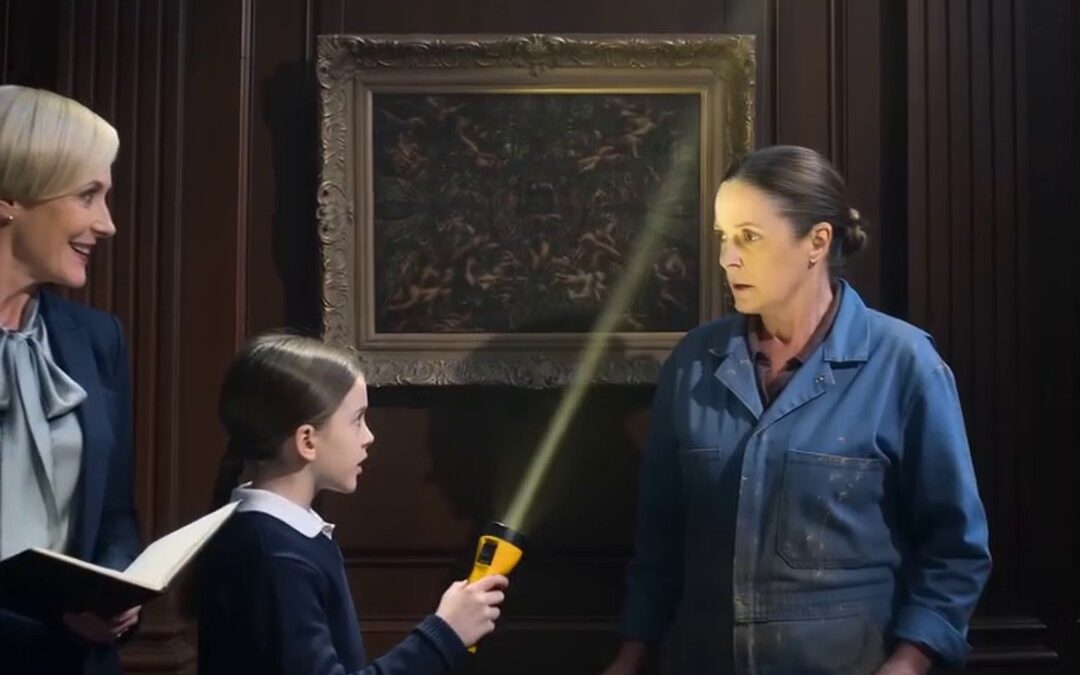
Chapter 2: What the Light Found
Maren turned.
So did everyone else.
The yellow beam had moved past the painting’s edge.
It struck the white wall beside the frame.
A narrow, dark rectangle showed through the paint.
Ruth thought it was a shadow.
Then Tessa lowered the lamp.
The rectangle vanished.
She raised it again.
It returned.
“Stop shining that at the wall,” Maren said.
Tessa’s hand shook.
Ruth steadied the lamp.
“What am I seeing?” she asked.
“Old paint,” Tessa whispered.
Maren gave the catalog to an assistant.
“An imperfection in the plaster.”
“Then why is it the same size?”
Tessa moved the beam slowly.
The shape began exactly where the missing window belonged.
The gallery’s white paint covered it thinly.
Ruth saw a blue corner.
Then a line of black.
The painting was mounted over another painted surface.
Maren stepped between the wall and the camera.
“The auction begins in four minutes.”
“Move the frame,” Tessa said.
A security guard came closer.
Ruth put herself beside her daughter.
“Nobody touches the frame,” she said.
Maren’s eyebrows lifted.
“You work for the cleaning company.”
“I know.”
“Then understand your position.”
Ruth knew it exactly.
She owed eight hundred dollars on rent.
Her contract covered no sick days.
Tessa’s scholarship interview was next Tuesday.
Maren could make every one of those facts heavier.
But the yellow lamp still shone across the wall.
Ruth had seen something like it before.
Nine years ago, another mark had appeared where an artwork should have ended.
She had written it down.
Maren had said she imagined it.
“I understand,” Ruth said.
The guard waited.
An older man near the front raised his hand.
“I’m on the museum board,” he said.
Ruth recognized him from opening nights.
His name was Bernard Shaw.
He looked at the wall.
“Let the child finish.”
Maren turned to him.
“The child has mistaken old decoration for evidence.”
“Then moving the frame settles it.”
The room watched her.
Maren looked at the painting.
For the first time, her face lost its practiced calm.
Ruth saw it.
She had seen it nine years earlier, too.
“When was this wall painted?” Ruth asked.
Maren answered too quickly.
“Before we moved in.”
Ruth remembered the date on the building’s maintenance schedule.
She had cleaned this room through two renovations.
“This wall was painted in March,” she said.
The gallery had owned the building for fifteen years.
Maren’s assistant looked down.
Tessa turned the lamp toward Ruth.
“The window is underneath.”
Maren reached for the microphone.
Ruth spoke first.
“I saw that paint nine years ago.”
* * *
Nine years earlier, Ruth had worked at Kessler Gallery as an inventory clerk.
She was twenty-eight and newly pregnant.
Her duties were ordinary.
She logged deliveries.
She checked frame numbers.
She photographed condition reports.
She liked work that left a trail.
Ada Bell’s Rain on Mercer Street arrived one wet Thursday.
The painting had seven lit windows.
Bell had painted it in 1934.
Her granddaughter had lent it for a public exhibition.
The loan agreement forbade a sale.
Ruth knew that because she had filed it.
She also knew its frame number.
Every incoming frame received a paper tag.
Rain on Mercer Street was frame 184.
Two weeks later, Ruth photographed a shipment leaving the gallery.
The paperwork called it “decorative material.”
The crate carried frame 184.
When Ruth asked her supervisor, the crate disappeared from the outgoing log.
She kept a copy of her photograph.
She also kept the original receiving sheet.
Ruth had taken both home after Maren dismissed her.
She had spent years wondering whether that was theft.
The papers sat in a sealed folder beneath her winter blankets.
Now the seventh window appeared beneath fresh wall paint.
Bernard Shaw asked the guard to keep people back.
“Call the police,” he told his assistant.
Maren’s hand closed around the microphone.
“For an old patch of wall?”
“For the records,” Bernard said.
“The police can look at records tomorrow.”
“The bidders are here tonight.”
Maren faced them.
“This is an attempt to disrupt a legitimate sale.”
Her voice filled the gallery.
Ruth felt Tessa flinch.
She knew what public certainty could do.
It had followed her out of this building once.
She knelt beside her daughter.
“You don’t have to explain anything else.”
“I want to.”
“You heard the wager.”
“I heard what she said about you.”
Ruth had never told Tessa the full story.
She had said only that she used to work in art.
Tessa had assumed Ruth missed the job because she missed paintings.
Ruth had let her.
Maren’s assistant approached Bernard.
“The catalog image came from our archive,” she said.
“Who prepared it?”
“I did.”
“Did you alter it?”
“No.”
Maren cut across her.
“The print proves nothing.”
Tessa lifted the catalog.
“It proves what the picture used to look like.”
Bernard asked Ruth about the old loan.
She gave him dates.
She gave him the frame number.
Maren laughed once.
“A former employee with a grievance.”
Ruth kept her eyes on Bernard.
“The lender was Elaine Bell,” she said.
“She lived in Providence.”
“Do you have her agreement?”
“Yes.”
The answer startled Maren.
Ruth saw it reach her.
Bernard asked where the agreement was.
“At home.”
“Can someone bring it?”
Ruth thought of the folder.
She thought of the photograph she had shown no lawyer.
She had been pregnant when she lost the job.
Every consultation had cost more than groceries.
“My neighbor has a key,” she said.
Bernard called his driver.
Ruth called her neighbor, Mrs. Patel.
She spoke quietly.
“Top shelf of the bedroom closet.”
“The blue folder?”
“No, the gray one.”
Mrs. Patel knew where Ruth kept the bills.
She had helped Ruth move twice.
“I’ll get it,” she said.
Tessa studied the painted rectangle.
“Could the original be under there?”
Ruth looked at the wall.
“It could be part of it.”
Maren heard her.
“A painting cannot live inside plaster.”
“The canvas might,” Ruth said.
Bernard frowned.
“Let’s avoid guesses.”
He was right.
Ruth had spent years living beneath someone else’s guess.
She would use only what she knew.
The photograph showed a crate.
The receiving sheet showed a frame.
The wall showed dark paint.
None proved where the original canvas was.
Tessa held the lamp lower.
“It’s not canvas,” she said.
“How can you tell?”
“The surface is flat.”
Ruth looked closer.
The wall mark had a clean edge.
It might be a photograph beneath paint.
Or a transfer.
Or something left during construction.
Tessa pointed to the corner.
“That blue matches her sky.”
Maren signaled the guard.
“Please remove them.”
Bernard stopped him.
“They’re staying.”
Maren leaned toward Bernard.
“This sale funds your museum’s new wing.”
“That makes an accurate catalog necessary.”
The bidders shifted.
One man closed his paddle.
A woman asked for her coat.
The room’s attention no longer belonged to Maren.
Ruth had imagined that moment for nine years.
It felt nothing like triumph.
It felt like opening a door whose other side she could not see.
The police arrived before the folder.
Two officers took names.
They did not seize the painting on Ruth’s word.
They asked Maren to pause the auction.
She refused at first.
Bernard showed them the signed wager.
Maren had written that the painting could be tested tonight.
The officers asked her to preserve it.
She finally announced a delay.
Her assistant carried the microphone away.
Tessa set the lamp on Ruth’s cart.
The cord lay across the floor.
Ruth wound it carefully.
Her hands needed something they understood.
Mrs. Patel arrived with the folder.
Inside was Ruth’s photograph.
The crate label was clear.
So was the frame number.
The receiving sheet named Elaine Bell.
The loan agreement had both signatures.
Maren examined none of it.
She looked at the final page.
Ruth followed her gaze.
At the bottom sat the gallery’s insurance schedule.
Someone had added a note after Ruth’s last day.
Frame 184 had been reported damaged during shipment.
Its owner had been paid a settlement.
Ruth had never seen that page.
“Who authorized the claim?” Bernard asked.
The signature was Maren’s.
But another name appeared beside it.
Elaine Bell’s.
Ruth stared.
Elaine had been told her painting was damaged.
If she had accepted payment, perhaps the ownership changed.
Perhaps the sale was lawful.
Then Tessa touched the page.
“Mom, this date is wrong.”
Ruth looked.
Elaine’s signature was dated April 12.
Elaine had died on April 9.
* * *
They checked the date before anyone repeated it publicly.
Bernard called the lawyer who had handled Elaine Bell’s estate.
The lawyer confirmed her death certificate.
He would send a copy to investigators.
He also confirmed that Elaine had never sold Rain on Mercer Street.
Her will left the painting to the city museum.
It was supposed to remain on public display.
Maren listened from across the room.
She said nothing.
The officers photographed the folder.
They asked Ruth where she had kept it.
They asked who could have accessed it.
They asked why she had waited.
Ruth answered each question.
She had reported the crate in writing.
The gallery had dismissed her.
After Tessa was born, Ruth could not afford another fight.
She had kept the papers because she hoped someone would ask.
One officer gave her a receipt for the copies.
The originals stayed with Ruth until a formal collection could be arranged.
Bernard called the museum director.
The director called the museum’s lawyer.
No one peeled paint from the wall.
No one lifted the frame.
The gallery doors stayed open for investigators.
The bidders were asked to leave their contact details.
Maren walked among them.
She told them the delay was procedural.
She offered private viewings next week.
Ruth watched her recover.
Maren could speak smoothly under pressure.
That had always been her gift.
Tessa sat on a bench by the coatroom.
Her lamp rested beside her.
“Did I make you lose your job?” she asked.
Ruth sat beside her.
“I chose to stay.”
“That’s not what I asked.”
“Maybe.”
Tessa’s face folded.
Ruth drew her close.
“We’ll handle the bus pass.”
“I know.”
“You don’t look convinced.”
“I wanted to help.”
“You did.”
Tessa pressed her forehead against Ruth’s shoulder.
Ruth thought about the scholarship application.
Maren’s foundation paid for the classes.
A rejection would hurt Tessa.
A place offered now might hurt differently.
“Your drawing still matters,” Ruth said.
Tessa nodded.
On the far wall hung three student paintings.
Tessa had studied them every cleaning night.
Ruth had seen her count brushstrokes.
She had also seen her sketch the bus shelter from memory.
Her daughter noticed what adults walked past.
That had frightened Ruth tonight.
It had also saved something.
Bernard approached.
“I’m sorry about nine years ago,” he said.
“You weren’t here.”
“I served on the board.”
“That isn’t the same.”
“No,” he said.
He sat across from them.
“The museum should have followed the loan.”
Ruth looked toward Maren.
“What happens to the painting?”
“First, we establish which painting this is.”
“And the one on the wall?”
“Same.”
Bernard had brought an independent conservator to the auction as a bidder.
Her name was Dr. Farah Iqbal.
She had worked with the museum before.
Now she showed her credentials to the officers.
They allowed a visual inspection.
Farah did not touch the art.
She used her own light.
She examined the surface from several angles.
Then she looked at the catalog.
“The missing window is one difference,” she said.
“There are others.”
Maren came back.
“Ada Bell revised her work.”
“Possibly,” Farah said.
“The materials will tell us more.”
“On whose authority?”
“The museum’s, if the loan remains valid.”
Maren raised the insurance page.
“An insurance settlement changed the owner.”
“The lender was dead when she signed.”
“Then the date was entered incorrectly.”
“It may have been,” Farah said.
“The signature needs checking.”
Maren faced Ruth.
“You see what she’s doing?”
Ruth said nothing.
“She’s keeping her options open.”
“That’s her job.”
Maren smiled without warmth.
“Your job was inventory.”
Ruth felt the old blow land.
Then she remembered the crate.
“Yes,” she said.
“I was good at it.”
The officer asked Maren to stop discussing evidence with witnesses.
Maren withdrew.
The conservator studied the wall again.
The rectangle seemed less like a painted window now.
It seemed like something exposed through paint.
Farah requested the renovation records.
The building manager had them on a tablet.
There had been no plaster repairs in March.
Only a new wall finish.
The work order included photographs taken before painting.
The building manager opened them.
The wall was bare in most.
In one, a dark rectangle appeared behind the frame.
Farah enlarged it.
A paper label.
A blue corner.
A handwritten number.
Ruth leaned forward.
“184.”
The frame tag had been painted over.
Maren had hung the new canvas on the same bracket.
Beneath it, someone had left the old tag stuck to the wall.
It did not prove where the original had gone.
It proved the old frame had once hung there.
Tessa looked from the photograph to Ruth.
“She said the wall was painted before they moved in.”
Ruth nodded.
The lie was small.
It mattered because Maren had chosen it quickly.
The building manager scrolled farther.
The renovation work order listed a storage room.
Its contents had been moved before painting.
One crate was noted separately.
The note read: PRIVATE HOLD—M. KESSLER.
Farah asked for the room number.
The manager read it aloud.
Room 3B.
Ruth knew it.
She cleaned the corridor outside.
Its door had a new lock.
Maren had moved the crate inside her own gallery.
* * *
The officers requested access to Room 3B.
Maren said it held personal property.
She offered to arrange access through her lawyer.
The officers did not force the door.
They documented the refusal.
The museum lawyer sought an emergency order the next morning.
Until then, the gallery was instructed to preserve its records.
Bernard called Ruth after breakfast.
She had slept three hours.
Tessa was at school.
“The judge granted inspection,” he said.
“Will I need to come?”
“Your statement can wait.”
Ruth looked at her cleaning uniform.
The company supervisor had left two messages.
Neither asked whether she was all right.
Both asked why she had disrupted a client event.
“I’ll come,” she said.
She wanted to see the door open.
Room 3B was smaller than she remembered.
Metal shelves filled its back wall.
There were rolled carpets.
Three sealed boxes.
One long crate stood upright.
Its shipping label had been peeled away.
A conservator, two investigators, and the gallery’s lawyer watched as the crate was opened.
Ruth stayed behind the marked line.
Inside was a frame.
Frame 184.
It held a landscape by an unknown artist.
The canvas had no rain.
No street.
No seven windows.
Maren’s lawyer folded his arms.
“An old frame.”
Farah examined its back.
“The original canvas was removed.”
“That could have happened anywhere.”
“Yes,” Farah said.
She took photographs.
The investigators logged the frame.
They also found a storage invoice.
It named a private warehouse outside the city.
Maren’s company had paid it for nine years.
The invoice alone proved little.
Ruth knew that.
She had learned to distrust the leap between a clue and an answer.
At noon, her supervisor called again.
He said Maren had demanded her removal.
He said the gallery was their largest client.
He said he hoped Ruth understood.
“I understand,” Ruth said.
He offered two shorter shifts elsewhere.
Together, they paid less.
She accepted them for now.
That afternoon, Tessa came home carrying a folded sheet.
The arts program had invited her to interview.
The letter had been mailed before the auction.
Its envelope bore yesterday’s postmark.
Ruth placed it on the table.
Tessa did not open the sheet.
“What if she’s there?” she asked.
“Then we’ll leave.”
“I wanted the classes.”
“You can still want them.”
Tessa sat down.
“I don’t want her to own my drawings.”
Ruth understood.
She called the program office.
A staff member explained that Maren funded the program but did not select students.
Three teachers served on the panel.
The interview would be at a public school.
Ruth wrote down the teachers’ names.
She did not decide for Tessa.
They made dinner.
Tessa washed the carrots.
Ruth cut them.
For a while, the loudest sound was the tap.
Then Tessa said, “Was she the one?”
“Who?”
“The person who fired you.”
“Yes.”
“Why didn’t you tell me?”
“I didn’t want your world to shrink around her.”
Tessa thought about that.
“Mine got bigger last night.”
Ruth put down the knife.
Her daughter looked embarrassed.
“I mean, the painting.”
“I know.”
The next morning, the warehouse records arrived.
The private warehouse had a photograph for every stored item.
It showed a flat crate entering in April, nine years ago.
The sender was Kessler Gallery.
The receiving description read “Bell study.”
Farah said the crate size fit the missing canvas.
The warehouse required a court order before opening it.
The museum’s lawyer filed for one.
Meanwhile, investigators examined the gallery’s account records.
They found an invoice from the year Elaine died.
It billed the gallery for a high-quality copy of Rain on Mercer Street.
The copyist had signed a confidentiality agreement.
Her name was Iris Dane.
She was still alive.
An investigator visited her.
Iris said Maren had commissioned the copy for “educational display.”
She had copied from a photograph.
The photograph showed only six windows because a label covered the seventh.
Iris had asked whether that mattered.
Maren told her to paint what she saw.
The copy had hung in the gallery ever since.
Farah checked its materials.
They were modern.
The painting Maren planned to auction was the copy.
Tessa’s observation had been right.
The wager was now a debt Maren could dispute only through lawyers.
Ruth cared more about the original.
The warehouse order came through on Friday.
The crate opened under camera.
Inside was Rain on Mercer Street.
Seven windows glowed through the painted rain.
Its condition was stable.
Elaine’s estate lawyer confirmed the accession number.
The museum confirmed the old exhibition photographs.
Farah confirmed Bell’s hand and materials.
The original belonged to the museum under Elaine’s will.
Bernard called Ruth.
“We found it.”
Ruth closed her eyes.
Tessa was drawing at the kitchen table.
She looked up.
Ruth gave her the news.
Tessa ran to her.
For one moment, that was enough.
Then Bernard added something else.
The warehouse bills had not come from gallery funds alone.
They had been paid by the youth arts foundation.
Money raised for children had hidden the stolen painting.
The architect was Maren Kessler.
* * *
Maren called a press conference before investigators announced charges.
She stood outside the gallery.
Ruth watched on a borrowed laptop.
Maren said she had protected a fragile artwork.
She said the copy had allowed the public to enjoy Bell’s work.
She said Elaine had discussed transferring ownership.
She said paperwork sometimes lagged behind intentions.
Then she addressed Ruth.
She never spoke Ruth’s name.
“A former employee has used a child to revive an old dispute.”
Tessa closed the laptop.
“I didn’t need anyone to use me.”
Ruth opened it again.
“We need to know what she’s saying.”
Maren announced she would honor the wager if an independent panel ruled against her.
The wording sounded generous.
The signed catalog said something simpler.
Prove the painting was a copy tonight.
Tessa had done that before midnight.
Ruth had photographed the signed page.
Bernard had shown it to the officers.
The catalog itself was in evidence.
A civil lawyer named Natalie Price met Ruth at a community legal clinic.
Natalie explained the difference between criminal charges and Ruth’s claim.
The investigators would decide what to pursue against Maren.
Ruth could separately seek the promised money.
The written wager, video, and witness statements gave her a strong case.
Maren might still fight.
“She can afford to,” Ruth said.
“Yes.”
“Can I?”
Natalie explained her fee agreement.
She would take payment only if they recovered money.
Ruth read every page.
She asked what costs could come out first.
Natalie answered plainly.
Ruth signed.
She did not sign away Tessa’s story.
The press conference changed things quickly.
A reporter came to the apartment building.
Mrs. Patel turned him away.
A stranger left flowers at the door.
Tessa wanted to know who had sent them.
There was no card.
Ruth placed them in the hallway.
The school principal called.
She offered to let Tessa use a separate entrance for a few days.
Tessa said she wanted her usual one.
Ruth agreed.
At school, a classmate asked whether Tessa was rich now.
She said no.
Another asked whether she had memorized the painting.
She said she counted what was there.
The principal told Ruth the class handled it well.
Ruth was less sure about the adults.
The cleaning company canceled her remaining shifts.
Its letter cited “client sensitivity.”
Natalie asked to see her contract.
Ruth sent it.
The company owed her final wages.
She received them two weeks later.
No one apologized.
Ruth began looking for work.
Bernard offered her a temporary museum job helping review collection files.
Ruth asked whether the museum had posted the position.
It had.
She applied.
She interviewed with two staff members who had never met Maren.
They asked about her records experience.
They also asked how she would handle missing documentation.
“I would record what’s missing,” Ruth said.
“Then I would find out when it disappeared.”
She got the job.
It paid more than cleaning.
It lasted six months.
On her first morning, she received a badge.
It had her name spelled correctly.
Ruth kept it beside the front door.
Tessa went to the scholarship interview.
The three teachers sat behind a table.
Maren was not there.
They asked Tessa to draw a room from memory.
She drew the staff kitchen.
The locked door.
The chipped blue mug.
The light above the sink.
Then she drew the view from its small window.
One teacher asked why the window mattered.
“Because people stand there,” Tessa said.
They asked her about the auction.
She looked at Ruth.
Ruth nodded once.
“I saw a missing window,” Tessa said.
“That’s all I saw.”
The teachers did not press.
A week later, Tessa received a place.
The letter said her application drawings were the reason.
Ruth pinned it to the refrigerator.
The criminal investigation moved slowly.
The prosecutor interviewed Elaine’s estate lawyer.
She reviewed the death certificate.
She obtained the insurer’s original file.
Its records showed the claim had been submitted after Elaine’s death.
The signature on its release did not match Elaine’s earlier agreements.
A document examiner supported that finding.
Bank records showed where the settlement had gone.
The gallery had received part of it.
A company controlled by Maren received the rest.
The prosecutor also traced foundation payments to the warehouse.
No one piece carried the whole case.
Together, they told a steady story.
Maren had kept the original.
She had sold the loss as an accident.
She had used children’s donations to store the evidence.
The public confrontation came at the museum’s board meeting.
It was open because donors had asked what had happened.
Maren attended with counsel.
Ruth sat with Tessa near the back.
The board chair presented the verified records.
Farah explained the canvases.
Elaine’s lawyer explained the will.
Natalie asked permission to speak about the wager.
Maren’s lawyer objected.
The chair said the wager was relevant to the public account.
Maren stood.
“You are turning conservation into theater,” she said.
She spoke well.
She described a small gallery protecting a valuable work.
She described complicated old paperwork.
She argued that a private storage decision had been made in good faith.
A few board members looked uncertain.
Then Farah showed the two paintings side by side.
One had seven windows.
One had six.
The label from the wall appeared next.
Frame 184 had hung there before the renovation.
The copyist’s invoice appeared after that.
The museum’s lawyer read Iris Dane’s sworn statement.
She had been hired to make a copy.
She had been told not to mention it.
Maren sat down.
The chair asked her one question.
“Why did you offer to sell the copy as the original?”
Maren looked at Tessa.
“She forced a foolish public challenge.”
Ruth stood.
“No.”
Her voice surprised her.
Maren turned.
“You made the offer,” Ruth said.
“My daughter answered it.”
Maren’s last glance held the old contempt.
“You taught her to count windows.”
“I taught her to look.”
The chair ended the meeting.
The board voted to suspend every transaction involving Maren.
It commissioned an audit of the foundation.
The police did not arrest Maren in the room.
Weeks later, the prosecutor filed charges for fraud and false records.
Maren’s lawyers contested them.
Months passed.
The original painting went through careful examination.
Then it entered the museum’s collection.
The copy was retained as evidence.
Maren eventually pleaded guilty to two counts.
The court ordered restitution, a fine, and a period of supervised release.
The gallery closed.
The foundation’s remaining funds went under independent control.
Ruth read the judgment twice.
It did not give back nine years.
It did put the facts where anyone could find them.
* * *
The civil case ended after the criminal one.
Maren’s insurer refused to cover the wager.
Maren’s lawyers offered a smaller settlement.
Natalie brought the offer to Ruth.
It was enough to pay old debts.
It was not the amount Maren had signed.
“What would you do?” Ruth asked.
“I’d prepare for trial.”
“How long?”
“Possibly another year.”
Ruth looked at the catalog photograph.
Maren’s handwriting crossed the back.
The cameras had recorded every word.
Tessa had carried the catalog home in her thoughts for months.
Ruth wanted the promise kept.
She also wanted evenings back.
They rejected the first offer.
Maren settled two months later for the full $250,000.
After fees and taxes, Ruth received less.
It was still more money than she had ever held.
She paid what she owed.
She set aside Tessa’s education fund.
She bought a reliable used car.
Then she asked the museum about its public drawing classes.
The museum had a long waiting list.
Many families could not cover supplies or bus fares.
Ruth gave enough to fund those costs for five years.
She put the gift in Elaine Bell’s name.
She wanted Elaine’s generosity remembered accurately.
Bernard asked whether Ruth wanted her own name on the program.
“No,” she said.
“The children need the rides.”
He accepted that.
Ruth’s temporary job became permanent.
She liked opening old files.
Some were orderly.
Others made her work.
She found a missing receipt for a sculpture that had been safely in storage for decades.
She found a mislabeled photograph of a mural before its repair.
Every correction made the collection a little more honest.
Tessa came after school on Thursdays.
She sat at a table near Ruth’s desk.
Her drawings changed.
She still loved windows.
Now she drew people standing behind them.
Mrs. Patel appeared in one sketch, holding a watering can.
Ruth appeared in another, reaching for a high shelf.
Tessa showed that one to her.
“You made me too tall.”
“You always reach anyway.”
Ruth kept the drawing.
The scholarship classes began in winter.
Tessa liked the printmaking teacher.
She liked the heavy rollers.
She disliked having strangers ask about the auction.
Her teacher helped by introducing her through her drawings.
Soon the other students knew her as the girl who could draw a room after one look.
Some wanted to test her.
Tessa said no when she felt like it.
Ruth was proud of that.
One Sunday, Bernard invited them to see the restored Bell painting.
The museum had placed it in a quiet gallery.
The wall label told the full ownership history.
It named Elaine’s gift.
It named the false loss.
It named the investigation.
It did not make Tessa into a spectacle.
Ruth had asked for that.
Tessa stood before the original.
The seventh window glowed near its edge.
“It’s smaller than I thought,” she said.
“The window?”
“The whole painting.”
Ruth smiled.
“Things grow on screens.”
They sat on a bench.
A visitor read the label.
Another walked past.
Nobody pointed at Tessa.
She took out a sketchbook.
She drew the bench.
Ruth watched her.
Maren sent a letter that spring.
Natalie reviewed it first.
It contained an apology.
Maren admitted she had used Ruth’s employment to frighten her.
She admitted Tessa had been right.
She did not excuse the forged records.
Ruth read the letter once.
Then she placed it in the same folder as the settlement.
Tessa asked whether Ruth would answer.
“I don’t need to.”
“Do you forgive her?”
“I hope she keeps telling the truth.”
“That isn’t an answer.”
“It’s the answer I have.”
Tessa accepted it.
Later, Ruth received an invitation from the museum board.
They wanted her on a committee reviewing how loans were recorded.
She hesitated.
Boards had once looked like rooms where people with money decided what counted.
Natalie urged her to attend one meeting.
Ruth did.
The first discussion involved a painting lent by a family that had moved twice.
Its paperwork was incomplete.
Ruth asked for the old shipping labels.
A staff member found them.
The lender’s new address was on the second one.
The matter was solved in twenty minutes.
Bernard asked her to join.
This time, Ruth said yes.
It was volunteer work.
She could say no to it later.
She also knew what her experience was worth.
Tessa noticed the change at home.
Ruth no longer answered every unknown number with dread.
She bought oranges without calculating each one.
She left one evening a week free.
They made soup together.
They watched old movies.
Sometimes Tessa asked about the gallery.
Ruth answered what she knew.
She did not fill the gaps with guesses.
One night, Tessa brought out the yellow lamp.
Its switch had started sticking.
Ruth opened the casing.
A wire had loosened.
She fixed it at the kitchen table.
“Can I keep it?” Tessa asked.
“You’ve kept it for months.”
“I mean when I’m older.”
Ruth looked at her daughter.
The lamp had been part of a cleaning cart.
It had helped her see what other people missed.
Now it sat between their dinner plates.
“Yes,” Ruth said.
“When you’re older.”
Tessa touched the switch.
A circle of light appeared on the table.
“May I take it to class tomorrow?”
“For what?”
“We’re drawing things that changed our lives.”
Ruth looked at the lamp.
“It changed mine too.”
Tessa slid it closer.
“Then we can share it.”
* * *
Six years later, the museum opened a new education room.
Its windows faced Mercer Street.
Ruth had helped choose the shelves.
Tessa had helped paint the tables.
At seventeen, she was taller than Ruth.
She still carried a sketchbook.
She had earned a place in a summer art program across the country.
Ruth had read the acceptance email three times.
On opening day, the room filled with children.
Some arrived with parents.
Some came by bus.
Every child received paper and charcoal.
No one had to pay.
Elaine Bell’s name appeared beside the door.
A small photograph showed her smiling in her studio.
Rain on Mercer Street hung one floor below.
Its seven windows were safe.
The sixth one was Ruth’s favorite.
It was easy to see.
The seventh asked for a closer look.
Tessa placed the yellow lamp on a table.
She had replaced its old cord.
A younger student picked it up.
“Can I use this?”
Tessa looked at Ruth.
Ruth nodded.
“On the wall,” Tessa told the child.
“Keep it clear of the paintings.”
The child aimed the beam at a blank panel.
A pale rectangle appeared where the morning light met it.
Tessa showed her how shadows changed.
Ruth stood by the door.
Years ago, she had feared a room like this.
A wealthy woman had held a microphone.
Her daughter had held a lamp.
A promise had been written across a catalog.
Now the catalog rested in the museum archive.
Beside it lay Ruth’s photograph of frame 184.
The record gave each object its proper name.
The art program had its own teachers.
The museum had its painting.
Elaine’s gift had reached the public.
Maren had answered for what she did.
Tessa had room to become herself.
The younger student drew seven windows.
Then she added an eighth.
Tessa laughed softly.
“Where did that one come from?”
“It’s mine,” the child said.
Tessa handed her another sheet.
Ruth watched the lamp move across the table.
Nothing was hidden beneath the light.
There was simply more to see.
THE END








