The homeless boy was branded a thief… Until an antique silver compass silenced the entire museum benefit.
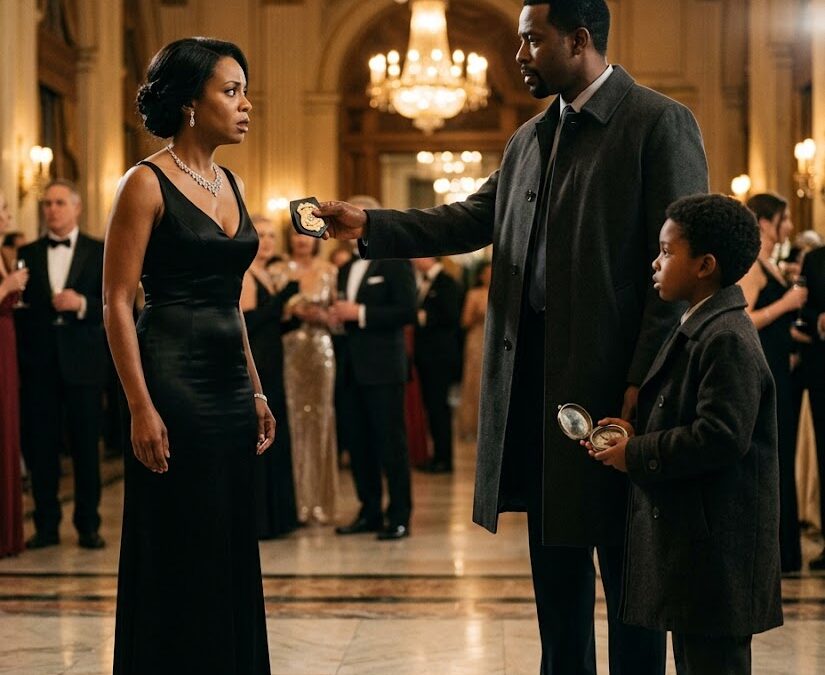
Chapter 2: The Truth in the Brass
The parchment lay flat on the velvet runner.
Water dripped from the boy’s coat onto the gold fringe.
Marcus Thorne did not touch the paper with his bare hands.
He drew a pair of sterile latex gloves from his inner pocket.
The snap of rubber broke the ballroom quiet.
Three hundred people watched his fingers work.
Nobody whispered.
Nobody moved.
The parchment was stiff with salt and yellowed by harbor bilge.
It bore three lines written in blue indelible ink.
“Read it,” Judge Sterling said.
The old magistrate took one step closer.
His cane tapped softly against the polished floor.
Thorne tilted the scrap toward the chandelier light.
“Latitude forty-four, sixteen minutes north,” the detective read aloud.
His voice filled the marble hall.
“Longitude sixty-eight, twenty-two minutes west.”
Clara Vance did not blink.
Her jaw remained set like carved granite.
Her breath came in thin, controlled measures.
“That is nautical gibberish,” she said.
Her voice sounded dry.
“There is a third line,” Thorne noted quietly.
He turned the slip slightly under the crystal glow.
“What does it say?” the boy asked from the floor.
Julian leaned forward on his bruised knees.
The detective looked down at the child.
“It says: Clara knows the anchor dragged.”
A collective murmur broke from the guests.
Phones continued to record every second.
Screen lights shimmered like fireflies against the dark wood paneling.
“This is absurd,” Clara said, turning toward the archway.
Her black silk skirt rustled sharply against the runner.
“Stay right there, Mrs. Vance,” Thorne said.
“On what authority?” she countered.
“On mine,” Judge Sterling answered.
Clara stopped in her tracks.
She glared at the retired magistrate.
“Arthur, you are permitting a street urchin to slander me.”
“The boy has a name,” Sterling said.
He leaned down slightly.
“What is your name, son?”
“Julian,” the boy whispered.
“Julian what?”
“Julian Miller Cole.”
A woman in the fourth row gasped.
Two elderly trustees exchanged stunned glances.
“Officer,” Clara called to the building security guard.
“Clear this room immediately.”
“Nobody is clearing anything,” Thorne stepped between her and the exit.
“This document is evidence in an active felony matter.”
“An active matter?” Clara laughed bitterly.
“The case was closed by the harbor commission six years ago.”
“Disappearances remain open until remains are accounted for,” Thorne answered.
“You are creating a spectacle out of whole cloth.”
“The ink is marine grade,” Thorne said, slipping the parchment into an envelope.
“The handwriting matches Jonathan Miller’s maritime certifications.”
“Anyone could copy an old man’s script,” she said.
“We will let the state crime laboratory decide that.”
Clara smoothed her gloves, though her fingers trembled slightly.
“My attorney will meet you at headquarters.”
“He had better hurry,” Thorne said.
The detective reached down with his gloved right hand.
“Come on, Julian.”
The boy took the large hand.
He stood up slowly on stiff, aching legs.
His wet boots squeaked against the slick marble.
The guests parted before them like the tide.
* * *
The boy sat on a wooden bench inside Precinct Four.
The room smelled of stale coffee, wet wool, and damp radiators.
Pipes clanked inside the plaster walls.
Thorne brought two paper cups of hot chicken broth from the canteen.
Julian took one with both hands.
His fingernails were dark with harbor grime.
Steam rose into his hollow, pale face.
He drank slowly, watching the frosted glass door.
“Where is your mother, Julian?” Thorne pulled up a metal chair.
The chair legs scraped harshly on the linoleum.
“She died three weeks ago,” Julian said.
He did not cry.
His eyes had the flat stillness of someone who had cried until nothing remained.
“At the shelter on Wharf Street?”
Julian nodded once.
“She gave me the coat,” he said.
“And the compass?”
“She kept it sewn inside her mattress.”
“How long was it there?”
“Since the night the police came to our apartment.”
“Six years ago?” Thorne asked.
“They had papers with red stamps,” Julian remembered.
“A man with gray hair told us we had to leave.”
“Was that Charles Higgins?”
“He had gold teeth in the back,” the boy said.
“That was him.”
“Did she tell you who took the compass from the boat?”
“My grandfather gave it to her before he sailed.”
“Jonathan Miller?”
“Yes.”
The detective opened a manila folder on the desk.
Inside were yellowed newspaper clippings from six years before.
Photographs showed a forty-foot sloop named The Sea Witch.
Found overturned against the jagged rocks of Dead Man’s Shoal.
No body ever recovered.
One six-man life raft missing.
The insurance settlement had been six million dollars.
Every cent had transferred to Vance Heritage Maritime within eighteen months.
“Your mother was Evelyn Miller,” Thorne said, reading a faded birth certificate.
“They called her crazy,” Julian murmured into his cup.
“Who called her crazy?”
“The lawyers in the tall building with the brass elevators.”
“Did you ever go there?”
“She brought me once when I was five.”
“What happened, son?”
“A lady told security to throw our bags in the street.”
“Which lady?”
Julian pointed across the precinct bullpen.
Through the heavy plate glass of the interrogation room, Clara Vance sat beside her private counsel.
Her tailored coat hung over the back of the metal chair.
Her hands rested flat on the laminate table.
Her posture was rigid, upright, unyielding.
She was not looking at the junior detectives or the tape recorder.
She was looking through the glass, straight at Julian.
Her gaze was cold as harbor ice.
“She knew,” Julian whispered.
“We will find out,” Thorne stood up.
He picked up a clear plastic evidence bag from the desk.
The silver compass lay inside, gleaming under the fluorescent tube.
“Wait here, Julian.”
“Don’t lose it,” the boy said, his voice tightening.
“I won’t,” the detective promised.
* * *
The lawyer was Charles Higgins, senior partner at Higgins & Cross.
His cufflinks were monogrammed gold anchors.
His silk tie was knotted with theatrical precision.
“Detective Thorne, this is an embarrassment,” Higgins began without preamble.
He did not rise from his seat.
“A vagrant child interrupts a private charity gala.”
“He carried stolen estate property.”
“My client has exercised remarkable restraint in not pressing charges tonight.”
Thorne sat down opposite Clara.
He placed the evidence bag on the table between them.
The silver casing caught the buzzing overhead light.
“You recognized this immediately tonight, Clara,” Thorne said.
“Jonathan carried it on every voyage,” she replied smoothly.
“It sat on his desk for fifteen years before that.”
“So it belongs to the estate?”
“Of course it does.”
“Then why was it logged in your private safe inventory four years ago?”
Clara’s eyes flickered toward her attorney.
Higgins raised an open hand to cut off her response.
“The inventory was filed during probate closure,” Higgins said.
“A simple clerical oversight by a junior associate.”
“A six-inch naval compass listed as ‘miscellaneous nautical relic’?”
“Probate was settled four years ago,” Higgins insisted.
“The statutory window for contesting estate distributions has expired.”
“I am not investigating probate fraud, Mr. Higgins,” Thorne leaned forward.
“Then what are you doing here at two in the morning?”
“I am investigating the disappearance of Captain Miller.”
“That case was closed as an accidental drowning,” Clara said.
“No body,” Thorne noted.
“The Coast Guard found his slicker caught on the boom.”
“They found his life jacket trapped under the keel.”
“And the raft was never recovered.”
“Ships sink at sea, Detective,” Clara leaned back.
“They do,” Thorne agreed.
“Especially when their bilge pumps are disconnected from the primary battery.”
Clara’s jaw tightened.
It lasted half a second.
A small muscle leaped beneath her cheekbone.
“What are you implying?” Higgins stood halfway up.
“Sit down, counselor,” Thorne did not raise his voice.
He opened a secondary file with blue cardboard tabs.
“Three days ago, a dredging team working the channel by Pier Nine pulled up an old anchor chain.”
“What does that have to do with Jonathan?” Clara asked.
“The chain was shackled to a metal chest.”
The small room went cold.
The hum of the fluorescent tube seemed louder.
“Inside the chest were two marine logbooks,” Thorne continued.
“Both kept in waterproof rubber sleeves.”
“Both signed in Jonathan Miller’s distinctive cursive hand.”
“He was an old man suffering from progressive dementia,” Clara said quickly.
“Too fast, Clara,” Thorne smiled without humor.
“You haven’t heard what the logs say yet.”
“I don’t need to listen to fabrications from a derelict vessel.”
“The last entry was made six hours after the boat supposedly sank.”
Clara did not move a single muscle.
Her hands remained flat on the table.
“He wrote from the old bait shack on Outer Heron Island.”
“That island is completely uninhabited,” Higgins said.
“It was,” Thorne replied.
“Until someone paid the caretaker forty thousand dollars to keep the gates locked.”
Thorne slid a canceled bank draft across the table.
The signature at the bottom was bold, angular, unmistakable.
Clara Vance.
“A maintenance fee for a navigation beacon,” Higgins countered quickly.
“Outer Heron has no navigation beacon, Charles,” Thorne said.
“The Coast Guard decommissioned the light tower in nineteen-seventy.”
“This is baseless harassment,” Higgins snapped.
“Then let us discuss the insurance payout,” Thorne said.
“The payout went directly to company debt,” Clara stated.
“It went to an offshore shell named Orion Marine,” Thorne corrected.
“Registered in Nassau.”
“With Clara Vance listed as the sole beneficial owner.”
Clara leaned forward, her eyes narrowing.
“Jonathan ran that company into the ground, Detective.”
“He was building wooden cutters when the world wanted steel containers.”
“He spent hundreds of thousands of dollars restoring historic slipways.”
“He refused to sell Yard Three to commercial developers.”
“He cared about his workers,” Thorne said.
“He cared about relics,” Clara spat out.
“And you cared about the harbor frontage,” Thorne answered.
“That land is worth eighty million dollars today.”
“It was worthless swamp until my trust invested capital.”
“Capital stolen from Jonathan Miller’s private accounts.”
“Show me an indictment,” Higgins said, snapping his briefcase shut.
“We are done answering questions for tonight.”
“We are just getting started,” Thorne stood.
“Mrs. Vance is free to leave the precinct for the moment.”
“However, she is not to leave the jurisdiction.”
Clara stood up gracefully, pulling her fur collar around her throat.
“You are wasting your career on an orphan’s fantasy, Marcus.”
“We shall see,” Thorne said, opening the door.
* * *
Julian sat on the narrow cot in the family services alcove.
He had eaten half a ham sandwich.
The other half he had wrapped carefully in a white paper napkin.
He tucked it deep into his woolen coat pocket.
A social worker named Martha entered carrying a fresh wool blanket.
“You don’t have to save the food, sweetheart,” she said softly.
“We have plenty of sandwiches in the kitchen.”
Julian looked at the linoleum floor.
“Tomorrow might be cold,” he said.
Martha swallowed hard against the lump in her throat.
She sat on the edge of the cot and laid the blanket over his small shoulders.
“Detective Thorne is working very hard for you,” she told him.
“He won’t let her take the compass, will he?”
“That is official evidence now, Julian.”
“My grandfather made it with his own hands.”
“He was a sea captain, wasn’t he?”
“He built boats,” Julian said.
He reached into his inner shirt pocket and pulled out a small, flat brass washer.
It hung on a piece of frayed tarred twine around his neck.
“What is that?” Martha asked gently.
“It came from the shop,” Julian said.
“Which shop?”
“Miller Yard Three.”
“The old shipyard by the dry docks?”
“My mother told me to never take it off.”
“Why did she say that?”
“She said it fits the master lock on the slipway office.”
Thorne stood in the doorway.
He had been listening for two minutes in silence.
The detective stepped inside the alcove.
“Julian,” Thorne said quietly.
The boy looked up.
“May I see that washer?”
Julian hesitated.
His thin fingers closed over the dark brass disc.
“I will give it right back,” the detective promised.
Julian lifted the twine over his head.
Thorne held the washer under the desk lamp.
It was not a washer.
It was an old brass key-blank, cut down to a circular template.
Three microscopic notches were carved along the inner rim.
A safe deposit key for a marine heavy vault.
“Your mother was smarter than all of them,” Thorne breathed.
“She was tired,” Julian said simply.
“She was very tired, and then she went to sleep.”
Thorne handed the twine back to the boy.
“Put it under your shirt, Julian.”
“Are we going somewhere?”
“Not yet.”
“Is that lady going to jail?”
“The law takes time, Julian.”
“My mother said the law takes too long.”
Thorne did not answer.
He could not tell an eight-year-old boy that his mother had been right.
The boy pulled the blanket up to his chin.
“My grandfather had a big dog,” Julian whispered.
“A retriever?” Thorne asked.
“A Newfoundland named Barnaby.”
“What happened to Barnaby?”
“He died when the boat went down.”
“Did your grandfather love the yard?”
“He said the wood talks to you if you listen.”
Julian closed his eyes.
Within three minutes, his breathing slowed to a deep, exhausted rhythm.
Thorne walked back to the bullpen.
He poured himself another cup of burnt black coffee.
He dialed a home number from memory.
“Arthur?” Thorne said into the receiver.
“I am awake, Marcus,” Judge Sterling’s voice sounded crisp despite the hour.
“The boy has the template key to the vault at Yard Three.”
There was a long pause on the line.
“Then Jonathan did keep the second set of ledgers,” Sterling said.
“We need access before morning,” Thorne said.
“Vance’s lawyers are already moving,” Sterling warned.
“They will attempt to seal the property under the corporate restructuring act.”
“Can they do that?”
“If they find a sympathetic judge before breakfast, yes.”
“I will meet you at the federal courthouse at seven,” Thorne said.
“Bring the boy’s affidavit,” Sterling replied.
“And Marcus?”
“Yes, Arthur?”
“Keep that child safe tonight.”
* * *
At eight o’clock in the morning, the heavy rain stopped.
The sky over Boston harbor was the cold color of weathered zinc.
Judge Sterling arrived at the precinct accompanied by two men in dark civilian suits.
One was an assistant United States attorney named Davis.
The other was an archivist from the state maritime registry named Miller-no relation.
They gathered in Thorne’s small office, surrounding the battered steel desk.
“Clara has filed an emergency injunction,” Sterling said, leaning heavily on his horn cane.
“On what grounds?” Thorne asked.
“Unlawful seizure of private corporate property.”
“The compass was presented by the lawful heir,” Thorne argued.
“Evelyn Miller’s birth certificate has a clerical error,” Davis said, opening a blue legal folder.
“The father’s middle name is misspelled on the county record.”
“Higgins found it at three this morning in the basement archives.”
“They are trying to void the direct paternity link,” Thorne said.
“They already have, temporarily,” Davis replied with regret.
“A probate judge in district two signed the stay twenty minutes ago.”
“Who is the probate judge?”
“Vance’s second cousin, Walter Vance,” Thorne cursed under his breath.
“It gives them seventy-two hours to claim the physical evidence for probate review,” Davis said.
“If that compass enters the Vance family depository, it will disappear forever,” Thorne stated.
“Not if we open the vault at Yard Three first,” Sterling said.
Thorne looked at the old magistrate.
“You know about the vault?”
“Jonathan Miller built that yard in nineteen-eighty,” Sterling said.
“He told me once that if he ever died at sea, his will was not with Higgins.”
“Where is it?”
“Inside the bulkhead locker behind the machine lathe.”
“We need a warrant to enter private industrial property,” Thorne said.
“Yard Three is scheduled for demolition at noon today,” Davis pointed at the morning paper.
On the front of the business page was a large photograph of a yellow wrecking crane.
VANCE TRUST TO BREAK GROUND ON LUXURY CONDOS AT FORMER MILLER SHIPYARD.
“They aren’t building condos today,” Thorne said.
“They’re burying the evidence beneath five hundred tons of crushed brick,” Sterling finished.
“We have four hours,” the detective grabbed his overcoat.
“Take the boy,” Sterling told him.
“Why?”
“Because the property belongs to him.”
“He is an eight-year-old child, Arthur.”
“He is the only living person who can authorize immediate entry without a forty-eight-hour notice,” Sterling said firmly.
“The original deed of Miller Yard Three stipulates that direct lineage grants immediate access upon presenting the property key.”
“The brass ring,” Thorne realized.
“The brass ring,” Sterling nodded.
“Davis, bring your federal credentials,” Thorne said.
“If Higgins tries to block the gate, I want him facing obstruction charges on the spot.”
“I am already drafting the federal summons,” Davis said.
They walked out into the cold morning air.
Julian was waiting in the hallway, his oversized coat buttoned to his chin.
“Are we going to my grandfather’s shop?” the boy asked.
“Yes, Julian,” Thorne said.
“We are going home.”
* * *
The rusted iron gates of Miller Yard Three groaned against the salt wind.
Two massive yellow excavators sat idling near the perimeter fence.
Diesel fumes mixed with the smell of low tide and rotting pilings.
A foreman in a yellow hard hat stood near an aluminum job trailer, holding a clipboard.
Beyond him stood Charles Higgins and two private security guards in black nylon jackets.
A long black town car was parked near the water’s edge.
Clara Vance sat in the back seat with the tinted window rolled down two inches.
Thorne parked the police cruiser nose-to-nose with the main gate.
He stepped out, followed by Julian and Judge Sterling.
Davis followed in a second unmarked sedan.
The foreman spat a stream of dark tobacco into the gravel mud.
“Private property, Officer,” the foreman said, pointing to a red sign.
“This is Detective Thorne, State Police,” Thorne badged him.
“I have strict orders from the Vance Heritage Trust to clear this parcel by two o’clock,” the foreman insisted.
“The wrecking permit is suspended by federal order,” Judge Sterling stepped forward.
Higgins walked over through the wet gravel, his fine leather shoes sinking into the mire.
“Judge Sterling, your judicial commission expired three years ago,” Higgins said smoothly.
“You have no legal authority to issue an order on this site.”
“I am not issuing an order, Charles,” Sterling said.
“I am acting as guardian ad litem for Julian Miller Cole.”
“That boy has no legal standing recognized by this Commonwealth.”
“He holds the key to the master workshop,” Thorne said.
Julian stood between the detective and the old judge.
He looked tiny against the towering corrugated iron walls of the old dry docks.
Gulls wheeled overhead against the zinc sky, crying into the raw harbor wind.
Clara stepped out of the town car.
She had changed into a dark tailored coat and heavy black leather gloves.
She walked across the gravel without looking at the oily puddles.
“Give the boy twenty thousand dollars, Arthur,” she said.
Her voice was calm, almost conversational, carried by the sea breeze.
“Set up a trust for his education.”
“Send him to a proper boarding school upstate.”
“Let us finish this demolition today.”
“You want to buy his silence, Clara?” Sterling asked.
“I want to build a harbor that actually provides employment,” she retorted.
“Jonathan was a romantic dreamer who drove this company into the mud.”
“He built fifty-six patrol boats for the Navy during the war,” Thorne said.
“And he died a bankrupt recluse,” Clara replied.
“Because you bled his private accounts dry,” Julian said.
The silence that followed was broken only by the wind rattling a loose sheet of zinc on the roof.
Clara looked down at the child.
Her eyes were cold and sharp as chipped flint.
“Children should not repeat things they hear in soup kitchens,” she said.
Julian did not answer.
He reached inside his coat.
He took the tarred twine from his neck.
He pulled the brass ring free from the knot.
He walked past her toward the padlocked steel door of the tool house.
“Stop him,” Clara told her security guards.
The two men stepped forward.
Thorne placed his hand firmly on his holster.
“Touch that boy and I will arrest both of you for felony interference with a homicide inquiry.”
The guards stopped.
They looked at Thorne’s steady hand.
Then they looked at Higgins.
Higgins looked at Davis, who held up an official blue folder bearing the seal of the United States Attorney.
Neither guard moved an inch.
Julian reached the heavy door.
The padlock was not on the exterior handle.
It was recessed inside a heavy cylindrical steel collar welded directly to the iron frame.
He inserted the brass ring into the circular slot.
He turned it ninety degrees to the left.
He felt the internal pins engage.
Then he turned it forty-five degrees to the right.
A heavy internal bolt clicked with the solid, resonant clunk of forty-year-old oiled steel.
The door swung inward into the musty darkness.
* * *
The shop smelled of machine oil, dried cedar shavings, and ocean rot.
Dust motes danced in the shafts of gray light falling from the high clerestory windows.
Long workbenches lined the concrete walls, covered with rusting chisels, wooden planes, and brass ship fittings.
In the center of the vast concrete floor sat the keel of a thirty-foot wooden cutter.
It lay unfinished, gray with dust and age, like the skeleton of a great sea beast.
Thorne pulled a heavy duty flashlight from his belt.
The beam cut through the shadows, illuminating ancient naval blueprints tacked to the timber pillars.
“Where is the machine lathe, Julian?” Thorne asked.
The boy walked without hesitation toward the back wall.
He knew this place.
His mother had brought him here when he was very small, before the bailiffs had chained the exterior gates.
He pointed to a massive cast-iron lathe bolted to a concrete plinth.
Behind it, painted dark machinery green, was an iron electrical service panel.
“It isn’t electrical,” Julian said.
Thorne stepped up to the panel.
He wiped the cobwebs and dust from the face with his sleeve.
There was no meter, no exterior switch, and no high-voltage warning sign.
Only a small brass keyhole at the bottom right edge.
Thorne looked down at Julian.
“The compass,” Julian said.
“The hinge pin,” Thorne understood.
He took the plastic evidence bag from his inner coat pocket.
He broke the red paper seal.
He withdrew the silver compass.
He pressed the release catch, swinging the back plate wide open.
From the top of the hinge mechanism projected a tiny squared brass stem, no thicker than a matchstick.
Thorne inserted the stem into the hole on the green panel.
It slid in precisely, fitting the internal tumblers.
He twisted it clockwise.
A pneumatic hiss escaped from the seams.
The steel wall did not swing open.
It dropped down six inches on counterweights, revealing a recessed steel locker built directly into the granite bedrock behind the wall.
Inside sat a gray fireproof lockbox.
Thorne lifted it out with both hands.
It was heavy, solid, untouched by dampness.
He carried it to the nearest workbench and set it down in the thick dust.
The box was unlocked.
Thorne lifted the heavy lid.
Inside lay three thick ledger notebooks bound in black buckram cloth.
Beneath them lay a videotape in a hard plastic industrial shell, dated November twelfth, six years prior.
And beneath the tape lay a single sealed envelope addressed in bold ink to:
United States Attorney, First District.
“Arthur,” Thorne called out toward the open door.
Judge Sterling walked into the shop, accompanied by Davis.
Clara Vance stood in the open doorway.
Her silhouette was framed against the gray morning light.
She did not enter.
She seemed incapable of crossing the threshold into Jonathan Miller’s shop.
“Read the date on the tape, Marcus,” Sterling said.
“November twelfth,” Thorne said.
“The night The Sea Witch was lost,” Davis noted.
“Bring the box out,” Sterling said.
“We do this in the daylight.”
* * *
The black town car’s hood served as an improvised conference table.
Thorne laid the contents out in the open harbor air.
The workers from the excavators had gathered near the chain-link fence, watching silently.
Higgins stood three feet behind Clara, his leather briefcase held against his ribs like a shield.
Davis put on wire-rimmed reading glasses and opened the top ledger.
“These are transfer logs,” Davis said.
His voice was steady, carrying across the gravel.
“Vance Heritage Trust Account Number four-four-zero-one.”
“Transferring seven hundred thousand dollars to an offshore registry in Grand Cayman.”
“Every month for fourteen consecutive months prior to Jonathan’s death.”
“Jonathan authorized those transfers,” Clara said.
Her voice had lost its sharpness; it was flat now, hollow as a dry barrel.
“He didn’t,” Davis turned a page with a gloved finger.
“The authorization signatures are electronic stamps.”
“He was aboard a marine research vessel in the Bering Sea during six of these dates.”
“He couldn’t have stamped them,” Thorne added.
“And here,” Davis pointed to an entry dated October twenty-eighth.
“A stop-payment order filed by Jonathan Miller in person at First Harbor Bank.”
“Followed forty-eight hours later by the cancellation of his life insurance exclusion clause.”
“He knew you were looting the trust, Clara,” Sterling said.
“He was going to the federal prosecutor on Monday morning.”
“The Sea Witch sank on Sunday night,” Thorne said.
Clara looked down at the wet gravel.
“You can’t prove I was anywhere near that boat,” she said.
Thorne picked up the heavy videotape.
“Do you remember the security system Jonathan installed at Slipway Four?”
Clara looked up.
Her eyes were wide now, the pupils dilated with sudden panic.
“The system was destroyed in the gale,” she said.
“The cameras on the outer dock were destroyed,” Thorne corrected.
“The recording deck was located right here, inside this shop.”
“In an insulated vault connected to a marine backup battery.”
Thorne tapped the hard plastic casing of the tape.
“He recorded the entire harbor slip from seven in the evening until midnight.”
“You don’t have a playback monitor,” Higgins stammered.
“This is unverified magnetic media.”
“You cannot admit this into evidence without strict chain of custody.”
“Mr. Higgins,” Davis looked at the attorney over his glasses.
“I am impounding this entire site as an active federal crime scene.”
“You have five minutes to advise your client regarding her Fifth Amendment rights.”
“Because when we play this tape at the federal building, she will be under arrest for conspiracy to commit murder.”
Clara did not look at her lawyer.
She looked at Julian.
The boy was holding his compass again.
He had wiped the dust from the glass with the sleeve of his oversized coat.
“You should have stayed where you were,” she said to him.
Her voice was barely a whisper against the rising wind.
“In the cellar on Wharf Street.”
“Where nobody cared what happened to you.”
Julian looked at her.
He did not flinch.
He did not look away.
“My grandfather built this shop,” the boy said.
“He built the boats that kept the fishermen safe in the winter.”
“You only built fences.”
Two state police cruisers pulled through the gate, their tires crunching loudly on the crushed stone.
The blue emergency lights flashed against the gray metal of the dry docks.
Thorne stepped behind Clara Vance.
“Hands behind your back, Mrs. Vance.”
She did not resist.
The metal cuffs clicked shut with a small, sharp sound.
* * *
Three weeks later, the winter snow began.
It fell soft and heavy over the city, covering the grime of the harbor in clean, brilliant white.
Julian sat in the private office of Judge Sterling.
A coal fire burned brightly in the brick hearth.
The Persian rug was warm beneath his clean leather shoes.
He wore a new navy wool coat that actually fit his small shoulders.
Martha, the social worker, sat on the sofa beside him holding a warm cup of tea.
Thorne entered through the heavy mahogany doors, carrying a worn leather briefcase.
He took off his wet fedora and shook the snow into the brass umbrella stand.
“It’s over,” the detective said.
He sat in the leather armchair by the fire, stretching his long legs.
“Did she take the plea?” Sterling asked from behind his mahogany desk.
“Twenty-two years,” Thorne said.
“Federal penitentiary at Danbury.”
“Higgins?”
“Disbarred yesterday morning by the state supreme court.”
“Indictment for wire fraud and accessory after the fact comes down on Friday.”
Julian looked up from his large book.
He had been looking at detailed drawings of nineteenth-century sailing ships.
“Did they find the boat?” Julian asked.
Thorne looked at the boy with gentle, tired eyes.
“The salvage crew reached Dead Man’s Shoal on Tuesday, Julian.”
“Did they find him?”
“They found the cabin,” Thorne said quietly.
“He wasn’t there.”
Julian’s face fell, his eyes searching the fire.
“He didn’t stay on the boat, Julian,” Thorne said softly.
He reached into his briefcase and pulled out a small, blue-enameled metal box.
“They found this inside the life raft.”
“Where was the raft?”
“Washed up on the sandbar at Seal Rock, buried under six feet of drift logs.”
Thorne placed the blue box gently in Julian’s hands.
The boy opened the brass clasp with a click.
Inside lay a heavy gold pocket watch.
The back was engraved:
To Evelyn. Hold fast through the gale. Dad.
Julian pressed the watch against his woolen chest.
He closed his eyes.
A single tear cut through the warmth of his cheek.
“He got off the boat,” Julian whispered.
“He got off,” Thorne confirmed.
“He made it to the island.”
“The medical examiner said he died of exposure two days later, Julian.”
“He was waiting for someone to come.”
“He wasn’t afraid,” Julian said.
“No,” Thorne said.
“He wasn’t afraid at all.”
Sterling cleared his throat softly.
The old judge took a thick sheaf of legal documents from his leather blotter.
“Julian,” Sterling said gently.
The boy turned to face the desk.
“The probate court has vacated all previous rulings.”
“The Miller Heritage Trust has been fully restored to the lawful bloodline.”
“The dry docks, the slipways, the bank accounts in Boston and New York.”
“They all belong to you.”
Julian looked at the legal papers.
Then he looked down at his new shoes.
“I don’t know how to run a shipyard,” he said.
Sterling smiled.
It was the first time Thorne had seen the old magistrate smile in three years.
“You don’t have to run it, Julian.”
“Not for a very long time.”
“What happens to it now?”
“The court will appoint a board of trustees,” Sterling explained.
“We are reopening the apprenticeships in the spring.”
“For boys and girls from Wharf Street.”
“Children who need to learn how to build things with their hands.”
Julian looked up at Martha.
“Can we build a boat for the harbor patrol?”
“I think Detective Thorne would like that very much,” Martha said, squeezing his hand.
* * *
Ten years later.
The summer sun turned the harbor water into hammered brass.
The scent of cedar shavings and hot pine tar drifted from the open doors of Miller Yard Three.
The sound of mallets striking white oak echoed across the busy slipways.
Twenty young apprentices in canvas aprons worked along the staging of a sixty-foot training schooner.
Her hull was painted deep ocean green with a bright gold stripe along the sheer line.
Julian stood on the main deck.
He was nineteen now, tall and broad-shouldered, with his grandfather’s dark, focused eyes.
He held a brass bevel gauge in his hand, checking the angle of the deck beams.
Footsteps sounded on the wooden gangway.
Marcus Thorne, his hair now entirely silver, walked aboard carrying a brown paper sack from the bakery.
“The tide turns at three, Julian,” Thorne called out.
Julian looked down and grinned.
“The rudder isn’t hung yet, Marcus.”
“She won’t float without a rudder.”
“You said that yesterday about the caulking.”
“The caulking was wet yesterday.”
Thorne climbed down the companionway ladder into the cool main cabin.
The woodwork was immaculate.
Honduras mahogany, oiled and hand-polished until it shone like dark honey.
Set into the center of the navigation table was a circular brass gimbals.
Resting inside it was the old silver naval compass.
The glass face had been replaced with clean, thick crystal.
The silver casing had been buffed until the anchor and the laurel leaves stood out in sharp relief.
The needle swung smoothly, steady as a heartbeat, pointing toward the open sea.
Julian followed him down, wiping his hands on a clean cotton rag.
“How is the judge?” Julian asked.
“Complaining about the soup at the home,” Thorne laughed.
“He wants to know if he’s invited to the launch.”
“He has to break the bottle,” Julian said.
“He’s been practicing with club soda all morning,” Thorne set the pastries on the chart table.
He looked down at the compass.
“You never moved it.”
“It belongs on a ship,” Julian said simply.
“Not in a bank safe.”
“Your grandfather would have liked this boat, Julian.”
“She’s built for heavy weather.”
“Like the old man.”
Julian looked through the open brass porthole toward the city skyline.
The glass towers rose above the red brick warehouses of the waterfront.
The Vance Trust building was still there, but the letters had been stripped from the stone facade five years ago.
Now it was just another office block.
The harbor belonged to the tide again.
To the wood, the salt, and the men who worked with their hands.
Julian touched the brass rim of the compass.
“Clara died last winter,” Thorne said quietly.
Julian did not look surprised.
“I know,” he said.
“Did she ever say anything?”
“At the end?” Thorne shook his head.
“Only that she didn’t understand how someone like you could beat someone like her.”
Julian picked up his pencil from the chart.
“She thought the truth was something you could buy,” he said.
“She forgot that a compass only works if you let it point where it wants to.”
Thorne smiled.
He took a warm pastry from the bag and handed it to the young shipwright.
Outside, the ship’s bell struck four times.
The apprentices began to clear the tools from the deck.
The tide was rising fast against the ancient granite pilings.
A cool breeze blew in from the outer islands, carrying the smell of open water and clean salt.
Julian stepped back onto the main deck.
He looked out past the harbor lights, toward the blue horizon where the bay met the Atlantic.
The sun was high.
The wood was sound.
The course was set.
THE END








