The Maid’s Son Held an Orange Visitor Badge Up to the Feared Portland Boss and Whispered, “She Went to See Grandma”
Chapter 2: What the Badge Remembered
Celeste stared at the number on the badge.
Then she looked at June.
“Who gave him that?”
“The desk attendant,” June said.
“She asked me to return something.”
“What?”
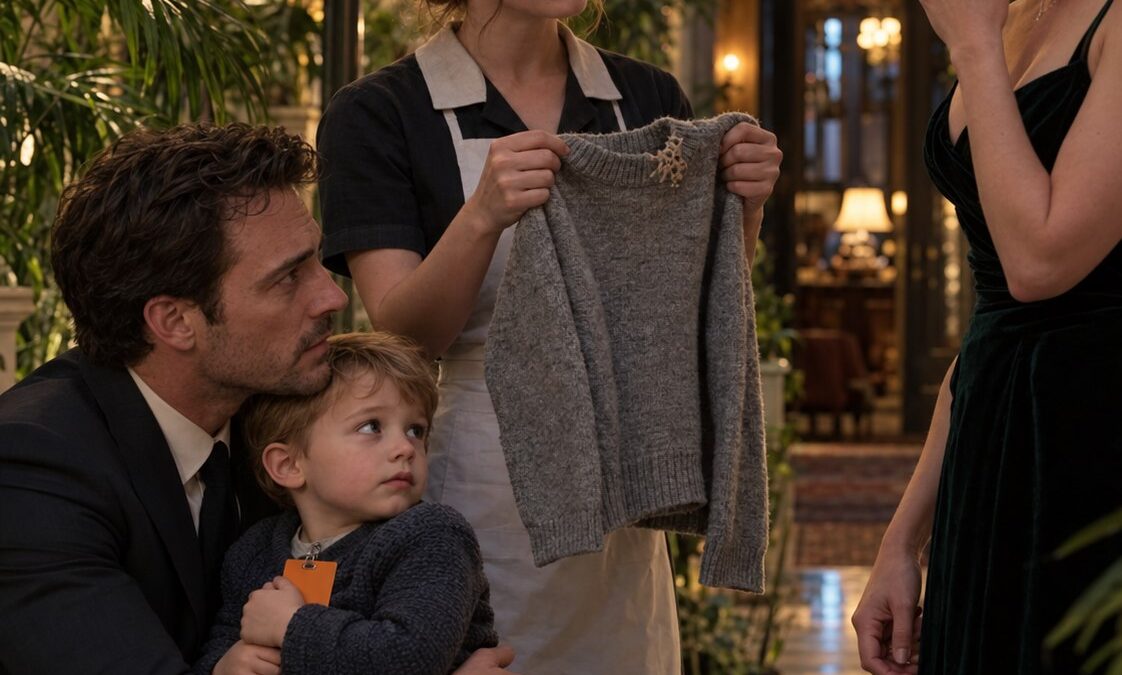
“Teresa’s sweater.”
Celeste folded her arms.
“All this over a sweater?”
Kit pressed his face against Nico’s shoulder.
Nico could feel him trembling.
The conservatory door opened, and Dario, Nico’s security chief, stepped inside.
He stopped when he saw Kit.
“Please take our guests into the dining room,” Nico said.
Dario nodded and left.
Celeste glanced toward the door.
“Am I allowed to go?”
“Yes.”
“I’ll need my car.”
“It will be brought around.”
She searched Nico’s face.
He gave her nothing.
June stood beside the potting bench, her hands shaking.
Kit reached for her, and Nico set him down.
“I should have told you,” June said.
“Yes.”
She flinched.
Nico regretted his tone.
“Tell me why you couldn’t.”
June looked at Celeste.
“She said Teresa could lose her nursing care.”
“That’s absurd,” Celeste said.
“She showed me a letter with your signature.”
Nico felt the room tighten around him.
“What did it say?”
“That the nurses would be reassigned if I questioned the sale.”
“I never signed that.”
June studied him.
“I tried to call you.”
“Who answered?”
“A man named Anton.”
Anton Rusk was Nico’s general counsel.
He had handled the clinic’s paperwork while Nico was away.
He knew which calls reached Nico.
“I kept the letter,” June said.
“We’ll get it together.”
Celeste shook her head.
“She’s collecting scraps to make me look cruel.”
Kit lifted his face.
“You made Grandma cry.”
Nobody answered.
Rain tapped against the glass.
Nico remembered Teresa patiently helping Kit count the roses.
She had never cried during his visits.
Perhaps she had waited until he left.
“Go home, Celeste,” Nico said.
“We’ll speak tomorrow.”
“Teresa already approved the sale.”
“Then she can tell me herself.”
Celeste stopped.
June touched Kit’s hair.
“There’s something else,” she said.
“The desk attendant said Teresa requested her sweater.”
“Why?”
“She’d sewn a note inside.”
* * *
June led Nico and Dario through the service corridor.
The fundraiser continued beyond the wall.
A pianist played for guests who smiled whenever Nico entered a room.
He let them keep eating.
June opened her locker and handed him a plain envelope.
Inside was the letter she had described.
Nico’s name appeared at the bottom.
The signature looked nearly right.
Its first letter slanted too far.
“When did she give you this?” he asked.
“Last Thursday.”
“May Dario photograph it?”
June nodded.
“It’s evidence you kept,” Nico said.
“Then keep the original.”
The letter said Teresa’s care arrangements were “subject to immediate review” if June interfered with authorized family decisions.
The wording was careful.
It had frightened her anyway.
June lifted a gray cardigan from the locker.
Pale green thread showed where she had mended one cuff.
“Teresa asked me to check my stitches.”
She worked a fingertip beneath the collar label and drew out a folded note.
The writing was uneven.
Teresa had used her left hand since the stroke.
Nico held it beneath the corridor light.
Nico, ask for the paper they brought me Tuesday.
I told them no.
Anton said you had already said yes.
Ask June about the sweater.
Do not let them close the clinic.
Only Teresa’s initials followed.
Kit watched him read.
“Grandma said sweaters keep things safe.”
“She was right,” Nico said.
He called Teresa’s rehabilitation center.
The night nurse said she was resting and could speak in the morning.
Nico asked the duty administrator to preserve the visitor records and notes from Tuesday.
Then he called Marian Price.
She had represented Teresa long before Anton joined Nico’s office.
“I have her original clinic agreement,” Marian said.
“Can Celeste sell it?”
“Not alone.”
“What about Anton?”
“He can prepare papers.”
“He says Teresa approved.”
“Then there should be a record.”
“Meet me at the center at eight.”
“Bring June,” Marian said.
“Keep the child home.”
The next morning, June left Kit with her sister.
At the center, the desk attendant recognized June and the orange badge.
“I wrote the room number,” she said.
“Teresa’s sweater had been moved there during a room transfer.”
She opened the visitor ledger.
Celeste had arrived Tuesday at 2:14 p.m.
Anton had signed in five minutes later.
They had met Teresa in a consultation room beside records.
The administrator brought out the center’s note about that meeting.
Teresa had become distressed afterward.
Patient stated, “I said no.”
Visitor stated patient was confused.
Patient requested June Mercer.
June touched the page.
“A nurse called me,” she said.
“I arrived after they left.”
The administrator showed Marian another document.
Celeste and Anton had asked for an assessment of Teresa’s ability to make decisions.
The center had refused to release it.
Their authorization named a doctor who no longer worked there.
At the bottom, a typed statement claimed Nico had approved access.
Beneath it was another signature with the steeply slanted N.
Marian asked the administrator to preserve the originals.
He agreed to involve the center’s legal office.
Outside, June stopped beside Nico’s car.
“You believed her before you believed me.”
“Yes.”
“I could see it.”
“I’m sorry.”
June looked across the parking lot.
“I didn’t need to be treated like family.”
“I needed you to listen.”
“I should have.”
Marian joined them with her phone.
She had reached Irene Cho, the clinic’s bookkeeper.
A buyer had already wired a deposit into escrow.
The sale contract carried Teresa’s signature and Nico’s.
Neither had signed it.
* * *
Teresa’s clinic occupied the first floor of a brick building near the river.
She had opened it thirty years earlier with two examination rooms.
Now it had six, and patients came because the nurses remembered them.
Irene laid the sale file across her desk.
“Anton said you’d approved it,” she told Nico.
“Did you speak to me?”
“No.”
She looked down.
“I should have.”
Marian examined the contract.
Northbank Partners planned to close the clinic within ninety days.
Its offer was far below the building’s assessed value.
The papers claimed Teresa’s health required a quick sale.
“The deposit is still in escrow,” Marian said.
“I’ll notify them that both signatures are disputed.”
She called the escrow officer from Irene’s desk.
After reviewing the documents, the officer agreed to pause the transaction under the company’s dispute procedure.
It was a pause.
They still needed proof.
A black car crossed the street for the second time.
Dario moved toward the window.
June noticed.
“Do you know them?”
“No,” Nico said.
The car turned the corner.
June’s phone lit up.
An unknown number had sent a photograph of the clinic entrance.
Your son waits here sometimes.
June gripped the phone.
“He does,” she said.
“My sister picks me up after work.”
Marian asked her to save the message.
Dario called the police nonemergency line.
Nico gave the officer what they knew about the car and the threat.
Then he turned to June.
“What do you need?”
“A way home.”
“And to warn my sister.”
She made the call herself.
Her sister would keep Kit inside.
Dario arranged a driver June already knew.
Nico offered to pay.
She accepted.
While June waited, Marian read the rest of the contract.
A large fee would go to a “transaction adviser” when the sale closed.
The adviser’s company had formed eight months earlier.
Irene brought three years of accounts.
The clinic needed repairs, but its reserve remained intact.
Anton’s sale memo said that money was gone.
“I sent him the correct numbers twice,” Irene said.
The messages remained in her sent folder.
Marian asked her to preserve them.
That afternoon, Nico visited Teresa.
June stayed outside until Teresa called her in.
Teresa sat beneath a blue blanket.
Her speech was slow.
Her eyes were steady.
“I found your note,” Nico said.
“Good.”
“I’m sorry I wasn’t here.”
“You’re here now.”
June came in and took Teresa’s outstretched hand.
“Celeste said you’d be fired,” Teresa told her.
“She told me that too.”
“She lied.”
June unfolded a drawing Kit had made.
Three green circles hovered above a square building.
“He says that’s the clinic.”
Teresa studied it.
“He’s generous to my trees.”
June smiled.
Nico remembered Teresa keeping him company all night when he was fourteen and frightened of the men outside their door.
He had promised never to abandon what she built.
He had nearly let someone sell it under his name.
Marian stepped forward.
“Can you tell me about Tuesday?”
“Anton brought papers.”
“What did he say?”
“That Nico wanted the sale.”
“And your answer?”
“No.”
“Did you sign?”
“No.”
Teresa looked at Nico.
“Celeste said June would lose her job if I made trouble.”
June bent her head.
Teresa squeezed her hand.
“I told them to leave.”
Marian asked whether Teresa would speak with an independent attorney and, if needed, an investigator.
“Yes.”
She sounded tired.
Marian put away her pen.
At the door, Teresa called Nico back.
“Anton knew I kept copies.”
“Of what?”
“The old clinic agreement.”
Marian turned.
“The one I drafted?”
Teresa nodded.
It required her written approval for a sale and set conditions to protect the patients.
Anton’s contract mentioned none of them.
Outside the room, Marian opened the adviser’s registration on her phone.
She showed Nico the owner.
Anton’s brother.
* * *
Nico called a Friday meeting at the clinic.
He invited its board, Irene, Marian, Anton, and Northbank’s representative.
Celeste asked to attend.
He told her she could.
In the two days before the meeting, Marian gathered what she could through the proper channels.
The rehabilitation center supplied certified visitor entries and its note about Teresa’s refusal.
The bank supplied statements.
Nico’s office preserved messages sent from Anton’s department.
A document examiner compared Nico’s known signatures with the disputed ones.
Her preliminary opinion supported his account.
It was not a court finding, and Marian said so.
Police followed up on June’s threatening message.
A street camera showed that the black car belonged to a driver hired through Northbank’s office.
The driver said he had been sent to photograph the property.
He denied sending the message.
June stayed with her sister while police checked the number.
Kit missed Teresa.
She sent him a recording about the three trees in his drawing.
He listened to it seven times.
On Friday morning, the clinic’s largest room filled with board members.
Photographs of longtime nurses hung above their chairs.
Anton arrived in a dark suit.
Celeste came behind him.
She stopped when she saw June beside Marian.
“I thought this was a family matter.”
“It’s a clinic matter,” Irene said.
Northbank’s representative sat near the door with his attorney.
Nico took the last chair.
Marian began with the disputed signatures and the paused deposit.
“Teresa asked us to move quickly,” Anton said.
“She says she refused.”
“Teresa has difficult days.”
“Her care team documented that day.”
“She may not recall every detail.”
“Then why didn’t you seek an independent assessment?”
Anton looked toward Nico.
“I believed her wishes were clear.”
Celeste opened a folder.
“She wanted the clinic preserved.”
“She also knew it couldn’t survive like this.”
Irene set the accounts on the table.
“We have a repair reserve.”
“Not enough for everything,” Celeste said.
“Enough to make a plan.”
Celeste faced the board.
“Teresa was afraid of becoming a burden.”
“She asked us to make the decision Nico wouldn’t.”
Several members looked troubled.
The building did need repairs.
Teresa had been tired.
Celeste was using true details to support a lie.
Anton produced a document bearing Nico’s signature.
“He delegated authority to me.”
Marian asked for the original.
“In my office.”
“Who saw him sign?”
“No witness was required.”
“Where was he that day?”
Anton hesitated.
Nico had been out of town with outside counsel.
Marian had dated records of the meeting.
Anton changed direction.
“Teresa’s approval stands on its own.”
June looked at Nico.
He nodded.
She took the orange badge from her bag.
“This was issued Tuesday,” she said.
“The desk wrote the records room number on it.”
“I visited Teresa,” Celeste replied.
“You told Nico you were in Vancouver.”
“My plans changed.”
June placed Teresa’s note beside the badge.
“She asked me to check her sweater after you left.”
“She put this inside.”
Marian read the note aloud.
When she finished, nobody moved.
Anton touched the edge of the table.
“A note doesn’t prove forgery.”
“No,” Marian said.
“It records what Teresa told June.”
She slid over the center’s certified note.
“A nurse recorded the same refusal that afternoon.”
Celeste read it.
“She might have agreed the next day.”
“When?” Marian asked.
“Wednesday morning.”
“The center logged no visit.”
“We spoke by phone.”
“Which phone?”
“Her personal one.”
June took out a repair receipt.
“Her phone was with me Wednesday.”
“I was getting the screen fixed.”
Anton stood.
“I won’t conduct a trial here.”
“Neither will we,” Marian said.
“The police have the questioned signatures.”
“The escrow officer has notice.”
“The board can decide what happens to this sale.”
Northbank’s attorney whispered to his client.
The representative rose.
“We’re withdrawing,” he said.
“We’ll address the deposit through counsel.”
Marian put Teresa’s old operating agreement on the table.
“Your contract omitted this.”
“I know what it says,” Anton replied.
“Teresa never amended it.”
He looked at Nico.
“You would have let the building fall apart rather than admit she needed help.”
“Maybe,” Nico said.
“That gave you no right to sign for us.”
The board suspended the sale.
It ordered an independent review of the clinic’s finances and repairs.
Its chair agreed to preserve every document from the meeting.
Police interviewed the adults that afternoon.
June gave them the threatening message.
The document examiner submitted her full report the following week.
Investigators traced the message to a phone bought by a contractor connected to Northbank.
The contractor admitted taking the photograph.
He said Anton’s brother had hired him to frighten June.
The brother denied knowing about the message.
The forged signatures became the center of the case.
Teresa’s account, the center’s records, and June’s letter showed how the pressure had worked.
Months later, Anton pleaded guilty to fraud-related charges.
He received a prison sentence and an order to repay his fee.
His brother’s company surrendered the money it had collected.
Celeste pleaded guilty for her role in the false documents and the effort to pressure witnesses.
She received probation, paid restitution, and was barred from contacting June or Teresa.
The court did not determine who first suggested selling the clinic.
It established who had signed, who had lied, and who had to answer.
On the courthouse steps, Celeste approached Nico.
Her lawyer stayed beside her.
“You trusted June because she had a child,” she said.
June heard.
Nico started to answer.
June spoke first.
“He had the badge because I was working.”
“I had the note because Teresa trusted me.”
“You made me afraid for my son.”
“You didn’t make me wrong.”
She took Kit’s hand and walked away.
* * *
Spring came slowly to Portland.
A leak appeared above the clinic’s smallest examination room.
Irene obtained two estimates and made the board vote before hiring a roofer.
Nico attended the meeting.
He sat in the back.
Teresa returned home with a cane and a schedule she disliked.
Her physical therapist forbade the conservatory steps without help.
Teresa argued.
The therapist won.
June resumed work at the house three mornings a week.
She no longer lived there.
On two other days, she worked at the clinic, helping patients arrange rides and understand appointment forms.
Teresa claimed June had invented the position.
Irene said it was overdue.
Kit went to preschool.
On Saturdays, he visited Teresa.
He still called her Grandma.
She let him.
The board’s review found that the clinic needed repairs but could afford a careful plan.
Teresa also established a fund for patients who missed visits because they could not afford transportation.
Nico offered to pay for every repair.
“You can give through the fund,” Teresa said.
“You can’t own the decisions.”
He gave through the fund.
The board listed his donation with the others.
One afternoon, Nico found June replacing a cracked pot in the conservatory.
Kit had lined up three stones beside her.
“Those are trees,” he told Nico.
“They look shorter than before.”
“They’re far away.”
Nico accepted the correction.
The orange badge hung from the watering can.
Kit had asked to keep it after the case ended.
“He calls it his ticket,” June said.
“To where?”
“To Grandma.”
Kit held the badge against his shirt.
“It helped you find her.”
Nico sat on the low bench.
He had apologized to June outside the rehabilitation center.
He still owed her the part he had avoided.
“I believed Celeste because she stood beside me,” he said.
“I questioned you because you worked for me.”
“I let Anton keep your call from reaching me.”
June brushed soil from her palms.
“Yes.”
“I’m sorry.”
“I believe you.”
She watched Kit move a stone.
“I need something clear.”
“Tell me.”
“If anyone in this house threatens my job again, I leave.”
“You should.”
“I won’t ask you to decide whether the threat counts.”
“You won’t have to.”
She studied him.
“Then we understand each other.”
Nico had ended his engagement the night of the conservatory meeting.
He returned Celeste’s ring through her attorney.
Teresa kept the old family photographs on her shelves.
“Taking them down won’t make that year disappear,” she said.
Nico left them alone.
In June, Teresa invited the clinic staff to lunch.
Nico carried chairs onto the terrace.
June brought plates.
Kit carried three napkins at a time and demanded credit for every trip.
Teresa raised a glass of lemonade.
“To the people who kept the doors open.”
Irene named the nurses.
June named Irene.
Kit named the roofer.
Everyone laughed.
After lunch, Teresa walked through the conservatory with June.
Nico waited by the doorway.
“Sit,” Teresa told him, pointing to the bench.
“I’m thirty-eight.”
“And still slow to take a hint.”
June smiled.
Teresa continued her walk without them.
Nico sat.
June remained standing.
“May I take you to dinner?” he asked.
“I work here.”
“That matters.”
“Yes.”
“I need time to decide what it means.”
“You have it.”
“And you’ll accept no?”
“I will.”
Kit appeared from behind a planter.
“Are we having dinner?”
“Tonight, yes,” June said.
“With him?”
“We haven’t decided.”
Kit considered Nico.
“He eats broccoli.”
“I’ve seen it.”
“That’s useful,” June said.
Two weeks later, she called Nico.
She chose a small restaurant across town.
They talked about the clinic, their families, and the years before either had lived in Teresa’s house.
Nico answered her questions about his business honestly.
When he could not answer one, he said so.
They had another dinner.
Then a walk.
Then months in which neither hurried the other.
When June finally brought Kit to dinner with Nico, Kit insisted on the middle seat.
Nico gave it to him.
* * *
Four years later, the conservatory doors stood open to the summer air.
The clinic had added two examination rooms.
Teresa visited weekly to criticize the filing system and bring pastries.
Irene accepted both.
June managed the patient transport program.
She still asked before using Nico’s name.
Most days, she had no reason to.
Kit was seven.
He could count every rose correctly.
He preferred counting bees.
That morning, he found Nico beside the palms where they had first met.
Kit held up the orange badge.
Its ink had faded.
The room number remained on the back.
“Mom says I can put it away.”
“Do you want to?”
“Maybe after today.”
It was the anniversary of Teresa’s return to the clinic.
Downstairs, she was telling the staff she had come only for the pastries.
June entered carrying a new plant.
Nico took the pot from her.
She glanced at Kit’s hand.
“Still your ticket?”
Kit looked at them both.
“It helped you find Grandma.”
“And it helped you listen.”
Nico nodded.
Teresa was safe.
The clinic was open.
June chose where she worked and where she went home.
Kit could hang the badge on its hook without help.
Someone called them down to lunch.
Kit ran ahead.
June slipped her hand into Nico’s.
Holding the plant carefully, he followed her through the open door.
THE END








