The New Greenhouse Worker Held Up a Glass Bottle When the Campus Star Blamed a Freshman for Twelve Dead Seedlings
Chapter 2: What the Water Kept
“Ashford,” Rusk said again.
Beckett turned toward her.
“You know Nell?”
Rusk’s expression settled.
“I read every hiring form.”
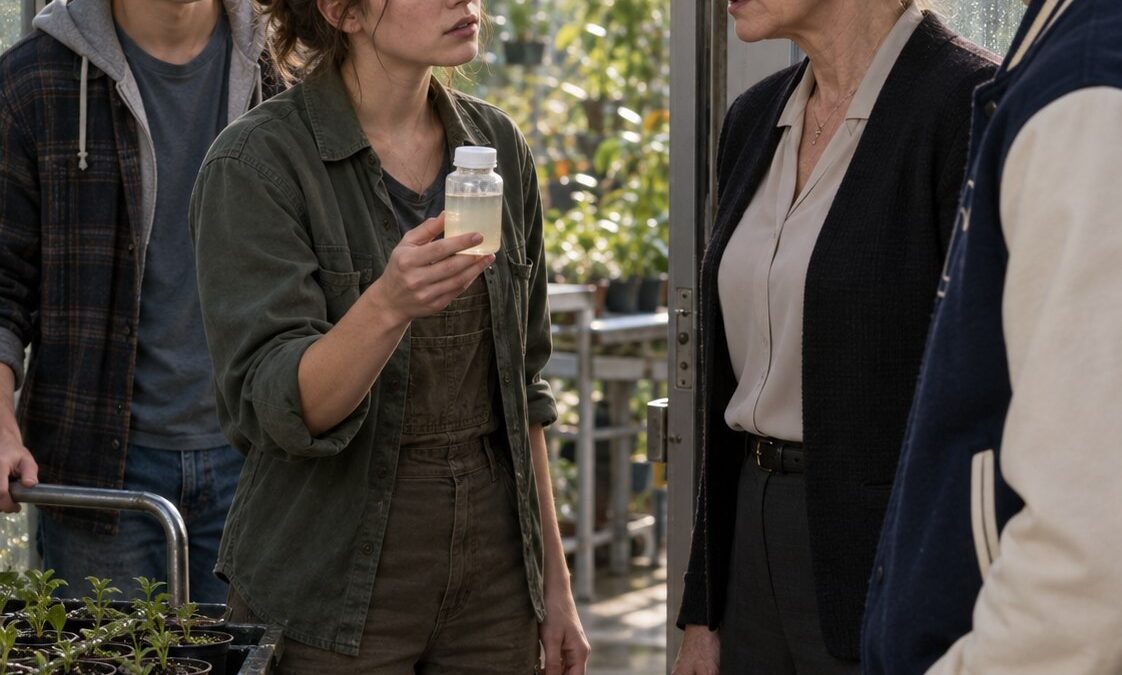
Nell kept the bottle raised.
“Then you know my father worked here.”
“I do.”
“What happened to his samples?”
Rusk looked at the phone.
The student lowered it.
“This isn’t the place.”
“Perry’s being accused here.”
“Perry hasn’t been accused formally.”
Beckett opened his mouth.
Rusk lifted one hand.
He closed it.
“Bring the bottle inside,” she said.
“And leave the cart.”
Perry gripped the cart’s handle.
“Am I suspended?”
“No decision has been made.”
“That’s not an answer.”
Rusk watched him.
“You’re off the greenhouse schedule today.”
Perry’s knuckles whitened.
Nell could guess the calculation.
No shift meant no hours.
Too many missed hours meant a housing review.
“I’ll stay with him,” Nell said.
“You’re scheduled until noon.”
“I know.”
Rusk’s gaze sharpened.
“You understand that leaving costs you those hours?”
“Yes.”
Nell had six dollars left until Friday.
She wished Rusk hadn’t said it aloud.
Perry let go of the cart.
“You don’t have to.”
“I know that too.”
A drop ran down the bottle.
Nell tightened its cap.
She had rinsed the outside before filling it.
Her father had taught her that much.
At the greenhouse office, Rusk opened a meeting room.
The room smelled of wet paper.
Beckett remained by the door.
Perry sat.
Nell put the bottle on the table.
Rusk did not touch it.
“Where exactly did you collect this?”
“The inlet tap beside the north wall.”
“At what time?”
“Six twelve.”
“Did anyone see you?”
“The delivery driver.”
“You have his name?”
“It’s on the morning delivery log.”
Rusk glanced at Beckett.
“Get the log.”
He went.
Perry leaned toward Nell.
“Why that tap?”
“Your feed tank is downstream.”
“So if there’s something in this—”
“It was there before your shift.”
Nell stopped.
The test still had to prove it.
Rusk noticed.
“You can’t identify contamination by looking.”
“No.”
“Then don’t tell him you can.”
“I didn’t.”
Perry looked between them.
Rusk folded her hands.
“Your father used that tap.”
Nell felt Perry turn.
“He collected water there?”
“He collected samples everywhere.”
“And what did they show?”
“Nothing conclusive.”
Nell thought of the framed university report.
She had found a copy in a kitchen drawer.
At the bottom sat her father’s name.
Below it, a short admission.
He had blamed an incorrect feed setting.
“His report said he caused it.”
“He signed it.”
Nell looked at the bottle.
“My father says he didn’t.”
For five years, that had sounded weak.
Even to her.
Rusk leaned back.
“People remember difficult days differently.”
The door opened.
Beckett returned with the delivery log.
Behind him came a woman in gray coveralls.
Nell recognized the facilities technician.
She had repaired a fan last week.
“I saw her at six twelve,” the woman said.
“Thanks, Mina,” Nell said.
Mina set her toolbox down.
“I was working on the inlet meter.”
Rusk’s face changed by a fraction.
“You didn’t tell me.”
“You didn’t ask.”
Mina nodded at the bottle.
“Seal it now.”
Rusk frowned.
“That’s university property.”
“The water is,” Mina said.
“The evidence needs a record.”
She pulled out her phone.
With everyone watching, she photographed the cap.
She photographed Nell’s hands.
Then she wrote the collection time on a clean evidence form.
Nell signed.
Mina signed.
Beckett signed as a witness.
Rusk held the pen longest.
Perry’s knee stopped bouncing.
It was a small thing.
Nell wanted to thank Mina.
Instead she watched Rusk write.
Her handwriting slanted hard to the right.
The same slant marked her father’s old report.
Nell looked up.
Rusk was watching her.
“Your father never signed that report,” Mina said.
* * *
Nobody spoke.
The greenhouse fans hummed beyond the door.
Rusk placed the pen down.
“Mina, that’s a serious allegation.”
“It is.”
“Then make it through the proper channel.”
“I intend to.”
Beckett looked at the report in Nell’s memory.
Or perhaps at Nell herself.
“How would you know?” he asked Mina.
“I handled the archive.”
Rusk stood.
“This meeting is over.”
“No,” Perry said.
His voice surprised him.
He cleared his throat.
“You took me off the schedule.”
“I did.”
“I need that in writing.”
Rusk studied him.
“By this afternoon.”
“And the plants?”
“We’re investigating.”
Perry nodded once.
It was all he could get.
Outside, Mina guided them past the ruined cart.
Beckett followed at a distance.
He had stopped looking certain.
Mina led them to the facilities office.
A framed fire map hung beside the door.
Inside, she called the university’s compliance office.
She gave her name.
She described the current crop loss.
She described the disputed old report.
Then she requested an independent review.
Nell listened without interrupting.
Mina ended the call.
“They’ll assign someone outside the program.”
“Will they test the bottle?”
“Yes.”
“Will Perry keep his room?”
“That’s a separate decision.”
Perry’s shoulders fell.
“We’ll ask housing for a temporary hold,” Mina said.
“I can help you write it.”
Perry rubbed his forehead.
“My mom thinks this job is safe.”
“It should be,” Nell said.
Mina opened a locked cabinet.
She took out a thin folder.
She did not hand it to Nell.
“Records have rules,” she said.
“I can tell you what I remember.”
Five years ago, a crop of research lettuce had failed.
Nell’s father, Evan, managed the greenhouse.
He found unusual mineral deposits near the inlet.
He collected three samples.
The program told him to wait for lab results.
Two days later, the university announced his resignation.
“Did you see the results?” Nell asked.
“No.”
“Why didn’t you say anything?”
“I did.”
Mina’s voice stayed level.
“I told a supervisor his report looked wrong.”
“What happened?”
“The supervisor sent me to another building.”
Rusk was then deputy director.
She had controlled the greenhouse files.
Mina still had a copy of her transfer request.
It showed the date.
It showed who approved it.
Dr. Celia Rusk.
“That doesn’t prove she changed anything,” Nell said.
“I know.”
Mina gave her a brief look.
“Your father taught you caution.”
“He taught me to clean bottles.”
“He taught me that too.”
The room grew quiet.
Nell had not known they were friends.
Mina explained that Evan had helped her study for a certification exam.
He had stayed late to show her the pumps.
After he lost his job, he stopped answering work calls.
“He answered mine once,” she said.
“He asked me to leave it alone.”
“That sounds like him.”
“He was worried about your tuition.”
Nell stared at her.
Five years ago, she had been finishing high school.
Her father had promised to help pay for college.
Then he lost the job.
Nell enrolled at a community college instead.
She worked nights.
She told herself he had chosen silence.
Mina opened a blank notebook.
“Tell me exactly what you saw.”
Nell described the morning.
The north tap.
The faint cloud at the bottle’s bottom.
The dry mineral crust on the tap.
Perry’s untouched feed tank.
She described how Beckett had moved the seedling cart into the corridor before she arrived.
“Was it always there?” Mina asked.
“No.”
“What makes you sure?”
“I carry the morning soil bags through that space.”
Mina wrote it down.
“Anything else?”
Nell hesitated.
“The watering sheets were changed.”
Perry looked at her.
“Changed how?”
“The room numbers were printed in a different order.”
“I thought I was tired,” Perry said.
“Where did the sheets come from?” Mina asked.
“Beckett handed them out,” he said.
Beckett appeared in the doorway.
“I got them from Rusk’s office.”
Mina shut the notebook.
“How long have you been there?”
“Long enough.”
Perry stood.
Beckett remained where he was.
“I didn’t print them,” he said.
“That wasn’t the question,” Nell replied.
“No,” Beckett said.
“It’s the one I should have asked.”
He had led the crop team for two years.
He had won awards for its yields.
Now he admitted he had trusted the dashboard.
He had not checked the inlet.
He had not asked Perry which tap supplied the tanks.
“I thought he was covering himself,” Beckett said.
“You said it in front of people,” Perry replied.
“I know.”
“People believe you.”
Beckett had no answer.
Mina’s phone rang.
Compliance had arranged collection by a laboratory.
The same office would preserve controller records.
“Don’t touch the dashboard,” Mina told Beckett.
“I won’t.”
“Don’t touch the sheets.”
“I won’t.”
“And don’t warn anyone about the records.”
Beckett glanced down the hall.
“I think she already knows.”
Nell thought of Rusk’s eyes on the bottle.
Mina’s phone lit again.
She read the message.
Then she looked at Nell.
“The old files weren’t destroyed,” she said.
“They were transferred to Rusk’s private program archive.”
* * *
At noon, Perry got a housing notice.
It was not an eviction.
It was a review appointment for Monday.
That still gave him one weekend to imagine losing his room.
Nell sat with him outside the student center.
Rain tapped the covered walkway.
He kept the notice folded small.
“My sister’s couch is three hours away,” he said.
“You can stay while they investigate.”
“Can I?”
“We’ll find out.”
She had no authority to promise him.
He seemed grateful she had tried.
Her phone buzzed.
Her father had sent a message.
Mina had called him.
Are you all right?
Nell typed yes.
She erased it.
Then she called.
Evan answered before the second ring.
“You shouldn’t be carrying this,” he said.
“That sounds familiar.”
“I know.”
She watched students cross the wet courtyard.
“You told me you didn’t sign.”
“I did.”
“I didn’t believe you.”
“I know that too.”
Nell closed her eyes.
He did not ask her to apologize.
That made it harder.
“Why did you leave?” she asked.
“The university offered three months’ pay.”
“For admitting fault?”
“For not contesting their finding.”
“That’s different.”
“I know.”
“Then why didn’t you tell me?”
“I thought we could challenge it later.”
“Could we?”
“Not with what I had.”
His voice roughened.
“The lab never sent my results.”
They spoke for eleven minutes.
He described the failed crop.
He described calling about the samples.
He described a meeting with Rusk.
She had said the grant might collapse.
Student jobs could disappear.
He had asked for another test.
The next day, his badge stopped working.
“Did you sign anything?” Nell asked.
“A resignation letter.”
“Not the report?”
“No.”
“And you kept a copy?”
“Of the letter.”
He still had it at home.
Nell asked him to send a scan to the investigator.
“I’ll do it today.”
She heard the hardware store bell ring.
He had to go.
“Nell?”
“Yes?”
“You don’t owe me this.”
“I know.”
After the call, Perry offered her half his sandwich.
She shook her head.
He put it in her hand anyway.
“You missed lunch.”
“I missed breakfast.”
“Then it’s urgent.”
She laughed.
It felt strange.
By three, compliance assigned an investigator.
Her name was Dana Cole.
She worked for a firm the university used when senior staff were involved.
Cole called Nell first.
She asked for times.
She asked who had handled the bottle.
She did not ask Nell to guess a culprit.
At four, a laboratory courier took the bottle.
Mina watched the seal transferred.
Nell signed again.
Cole requested the controller data.
She requested purchase records for the irrigation system.
She requested access to Rusk’s archive.
Rusk’s office answered with a letter.
The records were being organized.
They would be ready next week.
Mina read the letter twice.
“That’s time to move things,” she said.
Cole obtained a preservation notice that afternoon.
It instructed the program to retain records.
Facilities saved a copy of the controller data.
The university’s lawyers handled access to the archive.
No one forced a door.
No one needed to.
That evening, Nell went home.
Her apartment was one room above a laundromat.
She ate the other half of Perry’s sandwich.
She placed her bus fare beside her keys.
Her father sent the resignation letter.
He had signed it.
The signature looked like his.
Underneath was the date.
Three days after the report said he admitted fault.
Nell studied both documents.
She noticed a small mark in the report signature.
Her father’s first letter began with a loop.
On the report, it began with a hard stroke.
She showed Cole.
Cole promised to send both documents for examination.
She warned that handwriting alone might not decide the case.
Nell understood.
The next morning, Rusk closed the greenhouse.
She told staff the closure protected the investigation.
It also cut their hours.
Nell found Beckett outside the locked door.
He had the watering sheet in his hand.
He did not offer it to her.
“I sent a copy to Cole,” he said.
“Good.”
“Perry won’t answer me.”
“Give him time.”
“I’ve apologized.”
“You’ve said you’re sorry.”
Beckett looked away.
“I didn’t listen.”
“No.”
“I liked being the person everyone asked.”
“That part was obvious.”
He managed a brief smile.
Then it vanished.
“Rusk told me Perry had already been warned.”
“Was he?”
“No.”
“Did you check?”
“No.”
Rain darkened Beckett’s team jacket.
“She told me your father’s case was settled,” he said.
“People kept bringing it up.”
Nell faced him.
“Why?”
“Because the inlet failed again last spring.”
* * *
The laboratory called on Monday.
The water in Nell’s bottle had elevated salts.
Cole did not call it proof of a crime.
She called it proof worth following.
Facilities collected fresh samples.
They tested the north inlet.
They tested water before the greenhouse branch.
They tested water after it.
Only the greenhouse branch showed the same pattern.
Perry listened to the results from Cole’s speakerphone.
“So I didn’t do it?”
“The water reached you that way,” Cole said.
“That matters.”
“It matters to me.”
“It should.”
Housing postponed his review.
His placement stayed paused.
The missed wages still hurt.
A community emergency fund covered that week’s rent and food.
Nell knew the coordinator.
She helped Perry complete the form.
Neither of them liked asking.
Both were glad the fund existed.
The greenhouse remained closed.
Cole’s team found an old controller backup.
Mina had saved it during a software upgrade.
The backup showed irregular readings the previous spring.
It also showed Rusk’s office had received alerts.
A current dashboard displayed only recent averages.
That difference explained Beckett’s confidence.
It did not explain the older failure.
Cole brought Nell and Evan together at the facilities office.
Nell arrived early.
Her father arrived holding a paper envelope.
He looked older than the man in her memory.
His hands were still careful.
He put the envelope on the table.
“My resignation letter.”
Cole had the scan already.
She checked it against the original.
Evan also brought pay records.
They showed the university’s three-month payment.
“The letter said I accepted the settlement,” he said.
“It didn’t say I caused the loss.”
Cole nodded.
She had found the original report in the archive.
The signature appeared on a scanned page.
There was no signed original.
Rusk had filed it as a replacement copy.
“For what?” Nell asked.
“She wrote that the original was water damaged.”
Mina gave a short, incredulous sound.
Evan stared at the table.
“That room never flooded.”
Cole did not treat that as enough.
She had asked the records office for its intake log.
The office had never received an original.
Only Rusk’s scan.
She had also found an old laboratory invoice.
It billed the greenhouse for three tests.
The results were missing from the archive.
“Can the lab retrieve them?” Nell asked.
“They’re searching.”
Evan looked up.
“That lab closed.”
“A larger company bought its records.”
Cole had made a formal request.
Nell watched her father fold and unfold his hands.
He had lived five years without those results.
“Did you know about the spring alerts?” she asked him.
“No.”
“Beckett said the inlet failed.”
“I wish someone had called.”
“I almost didn’t.”
Evan looked at her.
“You called this weekend.”
It was not an answer to the years between them.
It was true anyway.
After the meeting, they walked to a bus stop.
Neither hurried.
A grounds crew carried empty pots past them.
“I was angry,” Nell said.
“You had reason.”
“I thought you let them blame you.”
“I let them think I agreed to leave.”
“Why?”
“I was tired.”
He watched the road.
“And I was afraid we’d lose the house.”
They had lost it a year later.
Nell knew that.
She had helped pack.
“I wish you’d told me about the letter.”
“I should have.”
That apology landed without decoration.
The bus approached.
Nell could have taken it.
She let it pass.
They sat together until the next one.
On Wednesday, the lab’s successor found the old results.
All three samples had elevated salts.
They had been collected before the feed tanks.
The numbers resembled Nell’s new sample.
The report had been sent to Rusk’s office.
Cole confirmed the address.
She confirmed the delivery date.
Rusk had received it two days before Evan lost access.
Then Cole found an invoice for replacement parts.
The university had paid for a new inlet valve.
The invoice showed a costly valve.
Facilities’ photographs showed a cheaper one.
Mina checked the part number in person.
The costly valve had never been installed.
The cheaper valve was vulnerable to mineral buildup.
It could not explain everything alone.
It explained enough to demand more records.
Cole obtained them.
For three years, Rusk had approved invoices from a supplier called Calder Systems.
The company billed the university for premium valves, filters, and service visits.
Many visits appeared in no campus entry logs.
Some parts were absent.
Beckett had never seen a service crew.
Mina had signed for no deliveries.
Cole traced the supplier’s ownership through public business records.
A former colleague of Rusk’s was listed as manager.
That could have been poor oversight.
Then the bank records requested by the university’s lawyers showed payments.
The supplier had paid consulting fees to a company Rusk owned.
The fees rose after each campus invoice.
Cole told Nell and Evan together.
Evan sat very still.
“Who chose the supplier?” he asked.
“Rusk did.”
“Who received my samples?”
“Rusk.”
“Who wrote the report?”
Cole did not claim to know yet.
But she had obtained a draft from Rusk’s old email account.
It carried the false admission.
It had been created before Evan’s meeting.
Nell looked at the date.
The words had existed before her father heard the accusation.
Rusk had planned to blame him.
* * *
The university called a special board meeting.
It was not a trial.
Cole made that clear.
The board could act on employment and contracts.
Police and prosecutors would decide any criminal case.
Civil claims would take longer.
Perry asked to attend.
Evan did too.
Nell wondered if she should stay home.
Then Perry showed her his housing notice.
It had been withdrawn.
The placement decision remained open.
“I want them to see who they did this to,” he said.
So she went.
The meeting room overlooked the greenhouse roof.
Students were not allowed inside the closed session.
But the board heard statements in an open session first.
Beckett came without his team jacket.
He sat two rows behind Perry.
Rusk sat at the front with a lawyer.
She looked rested.
That unsettled Nell more than anger would have.
The board chair introduced Cole.
Cole described her investigation.
She did not tell a dramatic story.
She gave dates.
She gave sources.
She gave the lab’s confirmed results.
She gave the controller backup.
She gave the missing parts.
Rusk’s lawyer objected to one inference.
Cole corrected the wording.
Then she continued.
When the chair offered Rusk a response, she stood.
“Greenhouse systems fail,” she said.
“That is why we keep procedures.”
She said Evan had resigned.
She said Perry had followed an outdated sheet.
She said a water sample collected by an untrained student could be contaminated.
Nell felt Perry stiffen.
Rusk did not look at him.
“The program grew under my leadership,” she said.
“We fed three community gardens last year.”
That was true.
She named workers who had benefited.
That was true too.
She argued the supplier had been selected for continuity.
She said its pricing was competitive.
She said her consulting company advised many organizations.
The board listened.
For several minutes, Nell understood how Rusk had stayed in charge.
She offered facts.
She chose which ones to place beside each other.
The chair asked about the consulting payments.
Rusk said she had disclosed them.
Cole produced the annual disclosure forms.
The relevant boxes were blank.
Rusk said she had misunderstood the form.
Her lawyer spoke.
He reminded the board that a blank box did not prove deliberate concealment.
The chair acknowledged that.
Rusk sat.
Beckett leaned toward Nell.
“She’s going to make this sound like paperwork.”
“Maybe,” Nell said.
Then Cole asked to display a photograph.
It showed Nell’s bottle.
The cap seal was visible.
So was the collection label.
Beside it appeared the courier record.
Beside that, the lab’s intake photograph.
The bottle had traveled without a broken seal.
The lab had tested a second sample collected by facilities.
It had found the same salt pattern.
Rusk’s contamination argument had no support.
Cole asked Nell to describe the collection.
Nell stood.
She felt every eye in the room.
At the greenhouse door, she had spoken to three people.
Here there were thirty.
“I collected from the north inlet at six twelve,” she said.
“I rinsed the bottle’s outside.”
“I did not rinse its inside.”
“I sealed it in front of Mina.”
Rusk watched her.
“Why did you collect it before your shift?”
“Because the tap had a crust.”
“Did you know what it meant?”
“No.”
“Then you guessed.”
“I asked for a test.”
Nell sat down.
Her hands shook under the table.
Perry slid a cup of water toward her.
She took it.
Cole displayed another page.
The old lab report.
Three inlet samples.
Three elevated readings.
One delivery confirmation.
Rusk’s office had accepted it.
The chair looked over his glasses.
“Why wasn’t this in the program archive?”
“I can’t answer that,” Rusk said.
“You directed the archive.”
“I directed a program.”
Mina stood when called.
She described her transfer.
She described the archive procedures.
She described the absence of an original signed report.
She did not claim to have witnessed forgery.
Then a records officer spoke.
He confirmed Rusk had submitted the scan.
No original had been logged.
Evan’s resignation letter was different.
It had an original signature.
It did not admit fault.
Rusk’s lawyer asked whether Evan might have signed another paper.
The records officer said it was possible.
Then Cole displayed the draft email.
The supposed admission appeared in an attachment.
It was dated before Evan’s meeting.
Rusk’s face lost color.
Her lawyer whispered to her.
She looked at Nell.
“The language was prepared for discussion,” she said.
Evan stood.
“No one discussed it with me.”
“You resigned,” she answered.
“I did.”
“You took the payment.”
“I did.”
“You knew the board needed closure.”
“I knew my family needed rent.”
The chair asked both to sit.
Cole had one more witness.
A former administrative assistant joined by video.
She identified the draft.
Rusk had asked her to prepare it.
After Evan refused to sign an admission, Rusk told her to attach a signature image from another form.
The assistant had objected.
She had kept the email.
She had left the program two months later.
Rusk’s lawyer asked why she had waited five years.
“My supervisor told me the matter was settled,” she said.
“I was wrong to accept that.”
Her voice held.
“I came forward when Ms. Cole contacted me.”
Nell looked at the bottle on the screen.
It had started with a cloudy inch of water.
Now a woman who had been afraid was speaking.
The chair ended the open session.
The board went into private deliberation.
Everyone waited in the hall.
Beckett approached Perry.
“I made them stop listening to you,” he said.
“Yes.”
“I told Cole everything I knew.”
“That helps.”
“I’m sorry.”
Perry folded his arms.
“I heard you.”
Beckett nodded.
He did not ask for more.
Rusk passed them on her way to another room.
She stopped in front of Nell.
“Your father had choices,” she said.
Nell looked at her.
“So did you.”
Rusk walked on.
An hour later, the chair returned.
Rusk was placed on leave.
The university would terminate her contract after its required process.
The supplier contract was suspended.
The university referred its findings to authorities.
It also opened a review of past crop losses.
Perry’s placement was restored.
His missed wages would be paid.
Evan’s record would be corrected.
The chair did not call it justice.
Neither did Nell.
Three months later, Rusk pleaded guilty to a charge related to false supplier invoices.
The court ordered restitution.
The separate document case ended with a settlement and a public correction from the university.
Evan received compensation through that settlement.
Perry got a written apology.
Nell read his copy at his request.
It named what had happened.
He kept it.
* * *
Spring arrived slowly.
The greenhouse stayed closed until the water line was replaced.
Mina supervised the work.
No supplier entered without a facilities log.
No payment cleared without another person checking it.
Beckett helped carry soil bags.
He did it without a camera.
Perry noticed.
He still made Beckett ask before helping with his trays.
That seemed fair.
Nell worked fewer mornings.
The university paid her for the hours she had lost.
She bought groceries.
Then she paid back the emergency fund that had helped Perry.
The coordinator tried to refuse.
“Use it for the next student,” Nell said.
That settled it.
Her father visited on Saturdays.
At first, he stood awkwardly near the doorway.
Then Mina put a wrench in his hand.
He and Nell worked together on a bench.
They replaced rotted slats.
They argued over measurements.
Mina told them both they were wrong.
They usually were.
One afternoon, Evan brought lunch.
He had made the same egg sandwiches Nell remembered from childhood.
She took one bite.
“Still too much mustard.”
“I thought you liked that.”
“I was being polite at twelve.”
He looked wounded.
Then he laughed.
There were still years between them.
A sandwich could not repair them.
It could give them somewhere to sit.
They talked about college.
Nell had one year left.
She had considered dropping a course to work more.
Evan offered to cover the difference.
She hesitated.
His settlement money was finite.
“I don’t want you spending it all on me.”
“I won’t.”
“You said that before.”
“I know.”
He let her decide.
In the end, she accepted a small amount.
They wrote it down as a loan.
Evan smiled at the paper.
“You have my caution.”
“I have your handwriting too.”
His smile faded.
Then she showed him the old report.
The university’s correction was clipped to it.
“I’m keeping both,” she said.
“Why keep the false one?”
“So I remember what the correction means.”
He nodded.
He did not ask her to throw away the years she had doubted him.
Perry returned to his work placement.
He requested a different supervisor.
The program granted it.
Beckett wrote an apology for the public accusation.
He sent it to the students who had heard him.
He did not mention how much he had helped the investigation.
Nell noticed that.
She still kept her distance.
One day, Beckett found her testing a fresh inlet sample.
“I was offered the team lead job again,” he said.
“Are you taking it?”
“No.”
“Why?”
“Perry applied.”
Nell raised an eyebrow.
“That isn’t an answer.”
“It’s the answer I should have given first.”
Perry got the position.
He insisted on a second person checking every feed sheet.
The team complained for two weeks.
Then the first seedlings sprouted.
Nobody complained after that.
The university offered Nell a paid role helping design the new water checks.
She accepted the work.
She refused the public award they proposed.
The chair had suggested a ceremony.
Nell had spent enough time in rooms full of people.
“Put the award money into student wages,” she told him.
The chair asked how much.
She gave him a number.
He approved it.
That summer, Perry invited Nell and Evan to the community garden.
The new seedlings had been planted there.
Children carried watering cans.
Adults argued about tomatoes.
Mina arrived with a measuring tape.
She claimed the beds were uneven.
Perry told her plants could not read rulers.
She measured them anyway.
Nell watched her father help a volunteer tie a loose trellis.
He looked comfortable giving advice again.
Later, he found her by the gate.
“Can I come next week?” he asked.
“You don’t need my permission.”
“I want it.”
That was new.
Nell looked toward the beds.
“Yes,” she said.
He did not turn the answer into a promise about everything.
He simply stayed for dinner.
* * *
Four years later, the greenhouse doors were open before sunrise.
Nell crossed the threshold carrying a bottle.
The glass had a fresh collection label.
She had kept the original at home.
Its test record belonged to the university archive.
This bottle held ordinary water.
The laboratory would confirm that later.
She checked anyway.
Perry, now the greenhouse manager, was already inside.
“You’re early,” he said.
“So are you.”
“I live closer.”
“You say that every time.”
“It stays true.”
The north inlet had a new valve.
The controller showed each reading.
A paper log hung beside it.
Mina liked the paper log.
Beckett, who worked for a regional garden nonprofit, called it old-fashioned.
He signed it whenever he visited.
That morning, students arrived for their first shift.
One stopped at the door.
She held a work sheet.
She looked uncertain.
Perry went to meet her.
Nell remembered him behind her.
The ruined cart.
The raised phone.
The cold bottle in her hand.
The student pointed to the feed tank.
“I don’t know this system,” she said.
“Neither did I,” Perry answered.
“I’ll show you where the water enters.”
He took her to the north wall.
He showed her the tap.
He showed her the log.
He waited while she asked questions.
Nobody told her to hurry.
Outside, a cart of healthy seedlings waited for the community garden.
Evan had helped grow them.
His name appeared on no award.
It appeared on the greenhouse training guide.
Mina had insisted.
Nell had written the first page.
Perry had corrected her measurements.
Beckett had carried the finished boxes to the printer.
Different work.
Shared credit.
Nell lifted the bottle to the light.
The water looked clean.
This time, she knew how to check.
Perry opened the greenhouse door wide.
The new student pushed the cart into the morning.
THE END








