The New Radio Technician Held Up One Red Cable While Three Campus Stars Tried to Blame a Freshman for a Cruel Broadcast
Chapter 2: The Other Voice
The shredder stopped.
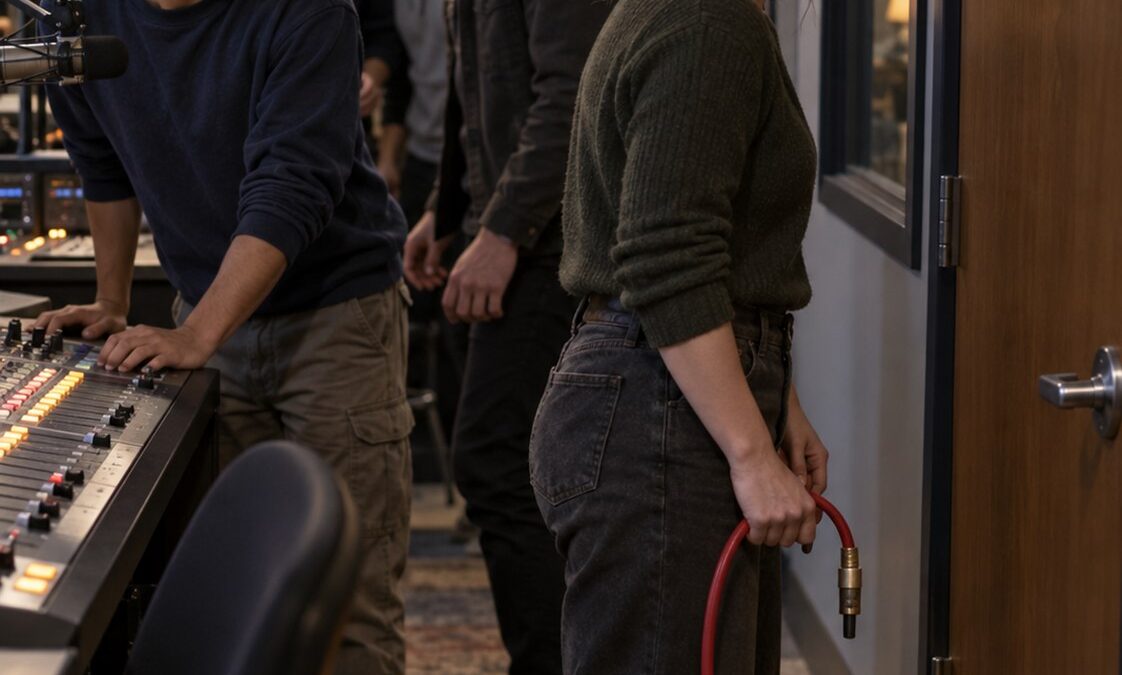
Tessa kept the cable in her hand.
Cole looked toward the director’s door.
“Give me that.”
“No.”
“It belongs to the station.”
“That’s why it stays here.”
Benny remained at the console.
His raised hands had begun to shake.
Tessa saw him notice.
He lowered them slowly.
“Was it me?” he asked.
The question came out thin.
Tessa turned to him.
“Your microphone was off.”
“That isn’t an answer.”
“It’s the answer I have.”
Cole knocked on the director’s door.
“Dr. Pike?”
No one answered.
One of Cole’s friends tried the handle.
Locked.
From the other side came a faint scrape.
Paper against paper.
The student filming through the glass moved closer.
Cole pointed at her.
“Put your phone away.”
She did not.
Tessa recognized her from the campus newspaper office.
Her name was Dani Cho.
She held her phone steady.
“You asked people to witness this,” Dani said.
“I asked them to hear it.”
“They did.”
A key turned.
Dr. Owen Pike opened the door.
He directed Bellweather’s student media program.
His tie sat crooked.
A gray strip of paper clung to his sleeve.
“What’s going on?” he asked.
Cole spoke first.
“Benny played a vicious clip.”
Benny rose.
“I didn’t.”
Pike looked at the red cable.
For one second, he forgot everyone else.
Then his expression settled.
“That’s a maintenance lead,” he said.
“It was under his chair,” Tessa replied.
“Then he shouldn’t have touched it.”
“Where was it supposed to be?”
“In storage.”
“The director’s office signed it out yesterday.”
Pike blinked.
“You’ve misunderstood the sheet.”
“Then show us.”
Cole laughed once.
“You can’t demand records from him.”
Tessa looked at Pike.
“I can ask.”
Pike rubbed his sleeve.
“The office is being cleaned.”
“Before the complaint?”
“There is no complaint yet.”
Cole pulled out his phone.
“There will be.”
Benny gripped the edge of the desk.
Tessa moved beside him.
“Don’t sign anything today,” she said quietly.
Pike heard.
“Ms. Ward, come into my office.”
“Benny comes too.”
“No.”
“Then we stay here.”
The station’s lobby had filled.
Students stood outside the glass.
The clip played again from somebody’s phone.
The cruel words sounded loud.
Benny stared at the floor.
Tessa wanted to turn off every speaker.
Instead, she checked the cable.
A bright, narrow scratch crossed its brass collar.
The cabinet jack left that mark when its bent retaining clip caught the metal.
Tessa had filed a repair request for it Friday.
Only that jack had the defect.
The cabinet carried a backup feed.
It could send audio into a show without using the host’s microphone.
Pike watched her thumb pass over the scratch.
“Where is the patch log?” she asked.
He answered too quickly.
“Archived.”
“Today’s?”
“We log maintenance later.”
“Since when?”
His eyes moved to the phone outside.
Then to Cole.
Then to Benny.
“We need to handle this privately.”
Benny gave a short, unhappy laugh.
“It stopped being private three minutes ago.”
Tessa set the cable on the desk.
She used both hands.
She did not want anyone claiming she had hidden it.
“We need a copy of the station recording,” she said.
“The broadcast is online.”
“The broadcast isn’t the source.”
Pike’s jaw tightened.
“You sound like your father.”
Tessa went still.
Benny looked between them.
Cole frowned.
“Who’s her father?”
Pike seemed to regret speaking.
Tessa answered.
“Daniel Ward.”
Pike took a step back.
Benny knew the name.
Everyone who worked in that room eventually heard it.
Five years earlier, Daniel Ward had been Bellweather’s engineer.
The university said he erased an emergency broadcast during a winter blackout.
Students missed a closure warning.
Several spent the night in an unheated residence hall.
Nobody was badly hurt.
Daniel lost his job.
His daughter lost the money that had made college possible.
For five years, Tessa had believed he made the mistake.
Pike looked at the cable.
Then at the damaged jack.
His face gave her a different answer.
“My father didn’t erase that warning,” Tessa said.
Pike did not deny it.
* * *
Pike asked Cole to clear the lobby.
Cole refused.
“This is about Benny.”
“It’s about the station,” Pike said.
“I’m student body president.”
“You don’t direct its records.”
Cole flushed.
Tessa had never heard Pike challenge him.
Neither, apparently, had Cole.
His two friends followed him into the hall.
Dani stayed by the glass.
Tessa asked her to keep filming the door.
She gave no instructions about Benny.
He could decide whether to be recorded.
He stepped away from the console.
“I want a copy,” he told Dani.
“You’ll get one.”
Pike led Tessa and Benny into his office.
The shredder stood beside a wastebasket.
Long strips of paper filled its clear bin.
Tessa did not touch it.
Pike followed her gaze.
“I was cleaning old schedules.”
“Today?”
“I clean when I’m nervous.”
Benny sat down.
“That must take a lot of paper.”
Pike almost smiled.
Then he stopped.
Tessa placed the red cable on an empty folder.
“Show us the patch log.”
Pike opened a binder.
The current page listed three maintenance actions.
One cable check Friday.
One transmitter test Saturday.
Nothing Monday.
“Who records after-hours use?” Tessa asked.
“Facilities security.”
“Who gets a key?”
“Me, two engineers, and the vice president’s office.”
Benny looked up.
“Why does the vice president need a radio key?”
“Emergency messages.”
Tessa studied the page.
The blank space beneath Saturday’s entry looked too clean.
A sheet had been removed.
Two tiny holes remained in the binder rings.
Pike noticed her looking.
“I need to call university counsel,” he said.
“Yes,” Tessa replied.
“And you need to preserve everything.”
He folded his hands.
“Ms. Ward—”
“The console.”
“I know.”
“The patch cabinet.”
“I know.”
“The shredder bin.”
Pike closed his eyes.
“Yes.”
Benny rubbed his palms on his jeans.
“What happens to me while people decide?”
Pike looked at him.
“I can suspend the accusation until we review the source.”
Cole’s voice carried through the glass.
“He’s deleting it!”
Dani’s phone remained pointed at the office door.
Pike stood.
“I’ll put that in writing.”
Benny did not relax.
He had reason.
An email could be sent.
A rumor had already crossed campus.
The housing office would learn his name before lunch.
Tessa asked to see the station’s raw recording.
Pike hesitated.
Then he opened the engineering computer.
The station saved two tracks for every show.
One contained the final broadcast.
The other captured microphone activity before the patch cabinet.
They were separate files.
Each received an automatic time stamp.
Tessa had learned that system as a teenager.
Her father used to bring home outdated training manuals.
She read them at the laundromat while he worked nights.
Pike found Benny’s show.
The broadcast file contained the insult.
The microphone file contained Benny clearing his throat.
Then nothing.
His microphone had been off.
“That proves it,” Benny said.
“It proves you didn’t say it,” Tessa replied.
Benny stared at the screen.
“I’ll take that.”
They listened to the insulting clip.
Tessa heard a soft click before the voice.
Then a low hum.
The hum belonged to the cabinet’s backup player.
She had heard it during Friday’s repair check.
“The source came through the cabinet,” she said.
Pike paused the file.
“Yes.”
“Who used it?”
“We need the access record.”
He reached for the keyboard.
Tessa stopped him with a raised hand.
“Can counsel make a copy first?”
Pike looked wounded.
She held his gaze.
Her father had trusted him once.
“I don’t know what you shredded,” she said.
“Neither do I.”
He took his hand away.
Campus counsel sent an investigator within an hour.
Her name was Elise Grant.
She arrived with a small case and no opinion.
She photographed the cable where it lay.
She photographed its collar.
She photographed the jack.
Then she sealed the cable in a numbered evidence bag.
Tessa watched her write the location and time.
Benny watched even more closely.
“Do I get that number?” he asked.
“Yes.”
Grant handed him a copy of the receipt.
He read it twice.
Grant copied both audio files.
A university security analyst verified their time stamps.
Pike watched from across the office.
Cole waited outside.
He kept checking his phone.
Grant asked why the cable mattered.
Tessa showed her Friday’s repair request.
It described the bent retaining clip.
It included a photograph.
The fresh scratch on the brass collar matched the jack’s position.
Grant measured both.
“That suggests a connection,” she said.
“It doesn’t identify the person.”
“I know.”
Tessa appreciated the distinction.
It was the kind her father had needed.
Grant asked for the patch cabinet’s access log.
Pike retrieved it from the campus security system.
A staff credential had opened the cabinet at 8:42.
Benny’s show began at nine.
The credential belonged to Tessa.
She read her own name.
Then read it again.
Benny made a small sound.
Cole saw her face through the glass.
He stepped closer.
Pike whispered, “That’s impossible.”
Tessa had been at the bus stop at 8:42.
She could prove the bus arrival.
She could not prove where her badge had been.
She reached for her lanyard.
The plastic holder hung beneath her jacket.
She had left it on a hook in the repair room Friday.
For perhaps twenty minutes.
Grant looked at her.
“Who had access to that room?”
Tessa thought of the open door.
The crowded station.
The tour that Pike had given campus operations.
A woman in a navy coat had asked to see the transmitter cabinet.
Tessa remembered her name.
Vice President Evelyn Sloane.
* * *
Grant asked Tessa to remain available.
She asked Benny the same.
Neither was accused formally.
Cole disliked that answer.
He sent a campus-wide statement by noon.
It said the station had broadcast a cruel message.
It said students deserved accountability.
It named no one.
A photograph of Benny at the console appeared beneath it.
By lunch, his inbox had filled.
Some messages defended him.
Others called him a fraud.
His housing coordinator asked whether Student Conduct had contacted him.
Benny showed Tessa the email.
His hand trembled.
“My mother can’t take me back,” he said.
“She would if she could.”
“Her apartment has one room.”
Tessa had no easy answer.
She bought them sandwiches from the vending café.
Her bank account had enough for two.
Not enough for the week’s groceries.
Benny noticed her checking the price.
“I can pay.”
“You can buy dinner.”
“That sounds unfair.”
“It’s a schedule.”
He ate half the sandwich.
Then he folded the wrapper neatly.
“My mother listens every Monday,” he said.
“She heard it?”
“She heard Cole call me a liar afterward.”
Tessa looked at him.
“She knows you.”
“That didn’t stop her asking if I panicked.”
He sounded more hurt than angry.
“I think she was scared.”
“I know.”
That made it worse.
They sat outside the station’s service entrance.
The air smelled of damp concrete.
A delivery truck idled nearby.
Tessa told him why she had transferred.
Bellweather offered a degree in audio engineering.
It also kept the records from her father’s dismissal.
For years, Daniel Ward had asked for them.
The university sent summaries.
It did not send the source files.
He stopped asking after his second stroke of bad luck.
First the lost job.
Then a repair business that never quite found customers.
He was alive.
He worked now at a community theater.
But he stopped entering radio rooms.
“I thought he made the mistake,” Tessa said.
Benny turned toward her.
“Did he?”
“I don’t know yet.”
“That’s why you came?”
“It’s one reason.”
“What’s the other?”
She glanced at the station door.
“I still like this work.”
Benny nodded.
That answer mattered to him.
Pike appeared at the entrance.
He carried a folder.
“Grant asked for you,” he said.
Tessa rose.
“Why?”
“We found another access record.”
Inside, Grant had printed two photographs.
One showed Tessa’s badge at the station entrance Friday.
The other showed it at a copier in the operations suite.
Both bore the same minute.
Tessa stared.
“I was repairing the jack.”
“I believe you,” Grant said.
“A copied badge?”
“Possibly.”
Grant explained only what she knew.
The entry readers stored a small credential number.
Someone had presented the same number in two buildings.
One physical badge could not have crossed campus that fast.
The operations suite reader also captured a hallway image.
It showed the edge of a navy coat.
No face.
Benny leaned forward.
“Can you get another angle?”
“I’m requesting it.”
Cole burst through the outer office door.
He had no authorization to enter.
Pike intercepted him.
“What are you hiding?”
“An investigation,” Grant said.
Cole saw the photograph.
His expression changed.
“That’s Evelyn’s coat.”
Grant turned the paper over.
“You shouldn’t be looking.”
“My father gave it to her.”
Everyone paused.
Cole seemed surprised by his own words.
“Her coat,” he clarified.
“It was a campaign gift.”
Pike led him back out.
Tessa watched through the glass.
Cole stood rigid beside his friends.
He looked less certain now.
Grant’s phone rang.
She listened.
Then she asked the caller to repeat something.
She ended the call.
“The board office received a preservation notice,” she said.
“From whom?” Tessa asked.
“Vice President Sloane’s attorney.”
Benny frowned.
“Why would she need an attorney?”
Grant looked at Pike.
Pike had no answer.
Tessa thought of the shredder.
She thought of Cole’s confidence.
Then she thought of how quickly his confidence had broken.
Evelyn Sloane had reached the board before anyone accused her.
* * *
By Tuesday morning, the recording had crossed the state.
A local reporter called Benny.
He did not answer.
Cole’s statement circulated with the clip.
North Hall residents organized a meeting.
Their leaders had been arguing against the university’s plan to sell the residence building.
Now some students thought one of their own had insulted people facing displacement.
Benny had never joined the campaign.
He had offered its leaders airtime.
That was enough to pull him into it.
Tessa came to the station before sunrise.
Her shift had been canceled.
Her supervisor said the investigation required distance.
The lost hours meant she would be short on rent.
She sat outside with her tools in her backpack.
Pike found her there.
“You shouldn’t be on site.”
“I’m outside.”
He sat beside her.
For a while, he watched the buses arrive.
“I knew your father’s file was incomplete,” he said.
Tessa kept her eyes on the road.
“How long?”
“Five years.”
“You signed the summary.”
“Yes.”
The admission landed quietly.
No one nearby heard it.
Tessa wished that made it smaller.
Pike rubbed his hands.
“I was told the raw file had been overwritten.”
“By whom?”
“Evelyn.”
“Was she vice president then?”
“Associate dean for operations.”
“You could have asked for the storage drive.”
“I did.”
“Once?”
He looked down.
“Yes.”
Tessa stood.
Pike did not stop her.
“I’m giving Grant this,” he said.
“Good.”
“That doesn’t repair anything.”
“No.”
She walked away before her voice changed.
Her father answered on the third ring.
He was measuring lumber for a theater set.
She heard someone ask him for a pencil.
“I can call later,” she said.
“You sound like you need now.”
Tessa sat on a low wall.
She told him about the broadcast.
She told him about the cable.
Then she told him what Pike had said.
Daniel went quiet.
“Tess,” he said, “do your own work first.”
“I am.”
“I don’t want my file deciding what you see.”
She closed her eyes.
“That’s the most annoying good advice.”
He laughed softly.
Then he said the thing she needed.
“I believe the boy.”
Grant spent Tuesday gathering records.
She obtained the station’s access logs through campus security.
She requested the hallway videos.
She interviewed the two engineers who held keys.
Tessa gave her the bus receipt.
Benny gave her his show notes.
Dani submitted the original phone video.
She also gave Grant the file information from her device.
It showed when she began filming.
Nothing in it identified who played the clip.
It showed Benny’s hands away from the console afterward.
Grant treated it for exactly that.
She asked the campus computer security team to review the copied credential.
The team found a service request from the previous Thursday.
Someone in operations had ordered a temporary duplicate for an emergency drill.
The request used Sloane’s staff account.
It listed Tessa’s credential number.
Tessa had never agreed to a duplicate.
The team preserved the request and its approval trail.
Sloane’s lawyer called it an administrative error.
Grant did not argue over the phone.
She asked for the drill plan.
None existed.
That afternoon, Cole came to the station alone.
His expensive jacket looked slept in.
Tessa was leaving an interview with Grant.
Cole blocked her path.
Then he stepped aside.
“I owe Benny an apology,” he said.
“Yes.”
“I didn’t make the recording.”
“I didn’t say you did.”
“I thought he did.”
“Because you saw his hands?”
“Because Evelyn told me.”
Tessa waited.
“She called me before the show,” Cole said.
“She said the housing group might try something ugly.”
“Why tell you?”
“I’m president.”
“Is that the only reason?”
Cole glanced down the hall.
“My father’s company is bidding on North Hall.”
There it was.
A reason for Cole to attack.
Also a reason to ask whether he had been used.
“I asked her what she knew,” he said.
“She said she had a source.”
“Who?”
“She wouldn’t say.”
Cole pulled out his phone.
He showed Tessa the call time.
8:37 a.m.
Five minutes before her credential opened the cabinet.
“Give that to Grant,” Tessa said.
“I will.”
“Tell Benny first.”
“I will.”
He stayed where he was.
Tessa understood he wanted relief.
She had none to offer.
Benny listened when Cole came in.
Dani stayed because Benny asked her.
Cole kept his hands at his sides.
“I accused you in front of people,” he said.
“I was wrong.”
“You said I could lose my room.”
“I know.”
“You knew that before you said it.”
Cole swallowed.
“Yes.”
“Then say that too.”
Cole did.
He did not ask to be forgiven.
For once, he made the right choice.
After he left, Benny sat down hard.
“I wanted to yell.”
“You still can.”
“Later.”
He put his head on the desk.
Tessa brought him water.
Grant called an hour later.
The hallway camera showed Sloane entering the operations suite with Tessa’s duplicate credential.
It did not show her entering the radio cabinet.
The cabinet camera had failed months earlier.
That gap worried Tessa.
Sloane could argue that an aide used the duplicate.
She could claim someone borrowed the cable.
Then Grant found the payment records.
The university had hired a crisis communications firm two weeks before the broadcast.
Sloane signed the contract.
The firm’s owner was a former employee of Cole’s father.
Its invoice described “resident sentiment intervention.”
Nobody at the firm would explain the phrase.
Grant referred the records to outside counsel.
The board’s audit committee froze the North Hall sale process.
Sloane called the pause an overreaction.
That evening, Benny’s mother came to campus.
She hugged him until he protested.
Then she hugged him again.
Tessa watched from the doorway.
Benny’s mother thanked her.
Tessa shook her head.
“His microphone was off,” she said.
“I’m glad somebody listened.”
Across campus, Grant’s team received another file.
It came from the station’s automatic off-site backup.
The backup held an audio test made at 8:31.
A woman’s voice checked levels.
She used no name.
The voice said the same cruel words that aired later.
The recording did not prove who she was.
But the file had been uploaded from Sloane’s office computer.
* * *
The board called a special public meeting Friday.
It was not a trial.
Grant made that clear to everyone.
The board would hear enough to decide whether to pause contracts, protect students, and refer possible misconduct for further review.
Benny could speak.
He could also stay home.
He chose to speak.
Tessa asked whether he wanted company at the table.
“Yes,” he said.
“But don’t answer for me.”
“I won’t.”
North Hall residents filled the auditorium.
Students who had shared Cole’s statement sat beside students who had defended Benny.
Cole sat in the front row.
His father sat several rows behind him.
Pike arrived early.
He had submitted a written correction to Daniel Ward’s old file.
It admitted that the raw source had never been reviewed.
Tessa carried a copy in her bag.
She had not shown her father yet.
He wanted her to finish the present case first.
The board chair opened the meeting.
Sloane sat with her attorney.
She looked composed.
Her navy coat hung over the chair.
Grant began with the broadcast.
She played the final audio.
Benny looked down.
Then she played his isolated microphone track.
A throat cleared.
A chair moved.
No insult.
The room stayed quiet.
Grant explained the two files.
A security analyst confirmed their separate sources and time stamps.
Sloane’s attorney rose.
“No one disputes that Mr. Ortiz did not speak those words.”
Benny looked up sharply.
It was the first time anyone on her side had said so.
The attorney continued.
“But a technical mistake is being turned into an accusation against my client.”
She had a point to argue.
A cable could be moved.
A credential could be copied for an authorized drill.
An invoice could be poorly described.
The board needed more than suspicion.
Sloane took the microphone.
“I requested a duplicate credential,” she said.
“I expected an emergency systems test.”
“Why Ms. Ward’s?” the chair asked.
“That choice came from a technician.”
“Which technician?”
“I do not remember.”
Her attorney placed a hand on the table.
Sloane continued anyway.
“I have spent twelve years keeping this campus functioning.”
She looked toward North Hall.
“Some of you dislike a sale I recommended.”
“That does not make every mistake a conspiracy.”
A few people nodded.
Tessa understood why.
The evidence still had gaps.
Grant introduced the red cable.
It sat inside its clear evidence bag.
She showed a close photograph of the scratch.
Then a photograph from Friday’s repair request.
“The collar was scratched by the backup jack,” she said.
“The mark places the cable in that jack after Friday’s inspection.”
Sloane’s attorney stood.
“It cannot tell us who connected it.”
“Correct,” Grant said.
Tessa felt some of the audience shift.
The attorney had scored a fair point.
Then Grant called the technician who maintained the station’s off-site backup.
He explained the system in plain words.
Before a file entered the backup player, the system made a small copy.
It recorded the upload time.
It recorded the sending computer.
It also created a digital fingerprint for the file.
That fingerprint let the team compare files without guessing from sound.
Grant displayed two fingerprints.
They matched.
The 8:31 test from Sloane’s office was the same file that played during Benny’s show.
Sloane leaned toward her attorney.
Grant gave the board the independent confirmation.
Campus computer security had traced the upload through Sloane’s authenticated office session.
The session required her password and a security prompt sent to her university phone.
A hallway camera showed her entering the office.
It showed no one else entering before the upload.
Sloane’s attorney asked whether someone could have used her phone.
“Yes,” the analyst said.
“Could someone have known her password?”
“Yes.”
“Then you cannot identify the operator absolutely.”
“The records identify her account, device, phone approval, and occupied office,” the analyst answered.
He left the conclusion to the board.
Sloane took the microphone again.
“I previewed a file,” she said.
“I was told it documented language already circulating among residents.”
“Who told you?” the chair asked.
“The communications firm.”
Its owner sat near the back.
He had been called to attend.
He did not move.
Grant produced the firm’s invoice.
The phrase “resident sentiment intervention” appeared above a second line.
“Placement through live campus channel.”
Sloane’s attorney objected to drawing a conclusion from billing language.
The chair allowed her objection into the record.
Then the firm’s owner stood.
He had provided a statement to outside counsel that morning.
He read it aloud.
Sloane had commissioned a fabricated clip.
She had approved its words.
She had requested that it air during Benny’s show because he had invited North Hall organizers onto the station.
The owner said he believed it was a political advertisement.
Grant had a copy of the messages.
Sloane’s attorney asked for a break.
The board chair granted ten minutes.
People rose all at once.
Benny stayed seated.
His mother touched his shoulder.
Cole crossed the aisle.
He stopped a few feet away.
“I gave Grant my call record,” he said.
Benny nodded.
Cole did not come closer.
When the meeting resumed, Sloane looked tired.
Her attorney said she disputed the firm owner’s account.
The board chair asked one question.
“Did you authorize a fabricated recording to play during Mr. Ortiz’s show?”
Sloane looked at the red cable.
“Yes.”
A chair scraped somewhere behind Tessa.
The board chair waited.
“Did you arrange to blame him?”
Sloane’s attorney whispered to her.
Sloane answered anyway.
“I expected his show to take the blame.”
Benny’s mother held his hand.
Tessa watched the board members.
They did not cheer.
They wrote things down.
That felt right.
The chair suspended Sloane pending an independent employment investigation.
The board kept the North Hall sale frozen.
It directed counsel to refer the credential misuse and contract records to the appropriate authorities.
Pike was placed on leave while his handling of records was reviewed.
Cole’s statement was entered into the record.
Benny’s conduct file received a written finding that he had not caused the broadcast.
The board also instructed housing staff to protect his scholarship status.
That last sentence made Benny bend forward.
For three days, he had been holding himself upright by effort.
Now he let his mother lean against him.
Sloane rose to leave.
She stopped near Tessa.
“You came here for your father,” she said.
Tessa looked at her.
“I came here for a degree.”
“You won’t get his years back.”
“No,” Tessa said.
Sloane waited for anger.
Tessa gave her the answer she had earned.
“But he gets his name back.”
Over the following months, outside investigators reviewed the contracts.
The firm turned over its messages.
A financial audit found that Sloane had failed to disclose a family interest in a company positioned to manage North Hall after the sale.
The board canceled that procurement.
The matter went to prosecutors.
Sloane later pleaded guilty to a charge involving the false records used to obtain the station credential.
The court imposed restitution and a period of supervised probation.
The university settled Daniel Ward’s employment claim after reviewing the old blackout file.
The off-site backup showed that the closure warning had been sent.
The operations office had failed to release it.
Daniel had not erased it.
Pike’s old signature remained on the incomplete summary.
He accepted that it should.
* * *
Benny returned to the radio booth in January.
His mother called before every show.
Sometimes she called twice.
He began answering with, “My mic is on, Mom.”
She never laughed the first time.
By spring, she laughed a little.
North Hall stayed open.
The university commissioned a new housing plan with resident input.
The plan moved slowly.
Students complained about every meeting.
Tessa took that as a healthy sign.
The station replaced the bent patch jack.
She supervised the repair.
Benny offered to hold the flashlight.
“You point it at your own shoes,” she told him.
“Creative lighting.”
“Unhelpful lighting.”
He aimed it correctly.
Cole resigned as student body president before his term ended.
He also corrected his statement publicly.
He named Benny.
He stated that Benny had not played the clip.
He acknowledged that he had used Benny’s housing status as a threat.
Dani asked why he had waited.
Cole said he was ashamed.
Dani published that answer too.
Benny read the article.
Then he closed it.
“That enough?” Tessa asked.
“It’s what happened.”
“Is that enough?”
“No.”
He picked up his show notes.
“I can live with that.”
He kept his distance from Cole.
When Cole asked whether he could visit the station, Benny said no.
Cole accepted it.
The boundary stayed where Benny put it.
Pike asked Tessa to meet him once.
She chose a public café.
He brought no folder.
“I owe you an apology,” he said.
“You owe my father one.”
“I wrote him.”
“He received it.”
Pike looked surprised.
“Did he answer?”
“No.”
Tessa let him sit with that.
Pike had cooperated with the old file review.
He had also failed Daniel when cooperation mattered.
Those facts could stand together.
“I should have asked again,” he said.
“Yes.”
“I should have kept a copy.”
“Yes.”
“I was afraid of losing my job.”
Tessa stirred her coffee.
“My father lost his.”
Pike nodded.
He did not defend himself.
That was the only useful thing left for him to do.
Daniel visited campus in April.
He walked into the station carrying two paper bags.
One held sandwiches.
The other held an ancient pair of headphones.
“I thought these might still work,” he said.
Tessa examined the cracked ear pad.
“They belong in a museum.”
“Then they’ve found the right building.”
She plugged them in.
One side worked.
The other crackled.
Daniel grinned.
“Like me.”
“Your warranty expired years ago.”
He laughed.
Benny entered with his show notes.
Daniel recognized his voice.
“You’re the host?”
“Yes, sir.”
“Don’t call me sir.”
“Then don’t call me the host.”
Daniel offered him a sandwich.
They ate in the control room.
Tessa expected her father to study every old machine.
He mostly watched her use them.
Later, he asked to see the patch cabinet.
She opened it.
The new jack gleamed.
For a moment, Daniel did not move.
“That old warning,” he said.
“I know.”
“I checked the send twice.”
“I know now.”
He touched the cabinet frame.
“I wish you’d known then.”
Tessa’s throat tightened.
“So do I.”
He turned toward her.
“You believed what they told you.”
“I did.”
“You were nineteen.”
“I still hurt you.”
Daniel nodded.
She appreciated that he did not erase it.
“I’m sorry,” she said.
“I know.”
He stepped back.
“May I hug you?”
Tessa crossed the room before he finished asking.
They stayed there until Benny began rustling his sandwich bag with excessive force.
“Some of us are trying to host a show,” he said.
Daniel let Tessa go.
“Then go host it.”
That summer, the university offered Tessa a paid staff position.
It came with a better wage.
It also came with a title that would take her away from the console.
She read the offer three times.
The salary could clear her debts faster.
Her rent would stop feeling like a monthly cliff.
Then she asked for a different arrangement.
She wanted the position split.
One part would pay her to maintain the station.
The other would fund a student training shift.
The university could hire someone for that second part.
She recommended Benny apply.
The dean warned her that splitting the job meant less money.
“I can count,” Tessa said.
He approved the arrangement after a budget review.
Benny got the training shift on his own interview.
He made sure everyone knew it.
Tessa made sure the pay arrived on time.
In August, Daniel received the university’s formal correction.
It named the error.
It cleared him of deleting the warning.
It came with the settlement he had earned.
He used some of it to repair the community theater’s sound system.
He put the rest away.
When Tessa asked why, he said, “I’m learning to enjoy a boring bank account.”
She called that growth.
He called it overdue.
They did not recover five years.
They got the years ahead.
* * *
Three years later, the station lobby filled before nine.
New students lined up for tours.
Someone had brought coffee.
Someone else had spilled it.
Tessa stood by the glass with a roll of paper towels.
She was now the station engineer.
Benny ran the training program.
His voice came through the lobby speakers.
“Welcome to the only room on campus where we ask you to check your microphone twice.”
The students laughed.
Tessa did too.
A first-year volunteer stood at the console.
Her hands hovered over the controls.
Benny waited beside her.
He did not reach past her.
“You ready?” he asked.
“I think so.”
“That counts.”
The student pressed the button.
Her introduction went out cleanly.
Through the glass, Tessa saw Daniel arrive.
He carried lunch.
He always carried too much.
Behind him came Benny’s mother.
She waved at her son without interrupting.
The red cable hung in a clear display case near the entrance.
It had been returned after the investigation.
Tessa had asked to keep it.
A small label explained how a repair mark had helped trace a false broadcast.
Another explained what the recording and access records had confirmed.
The cable alone had never told the whole story.
It had told them where to look.
A student stopped beside the case.
“Did you find it?” she asked Tessa.
“A freshman did.”
“What did you do?”
“I listened when he said his mic was off.”
Inside the booth, Benny raised one hand.
The new volunteer smiled and raised hers back.
No one blocked the doorway.
No one asked her to prove she belonged.
Tessa set the paper towels down.
Then she opened the door for the next student.
THE END








