The New Student Stopped a Campus Star from Blaming a Stagehand—Then She Held Up the Tag He Wanted Hidden
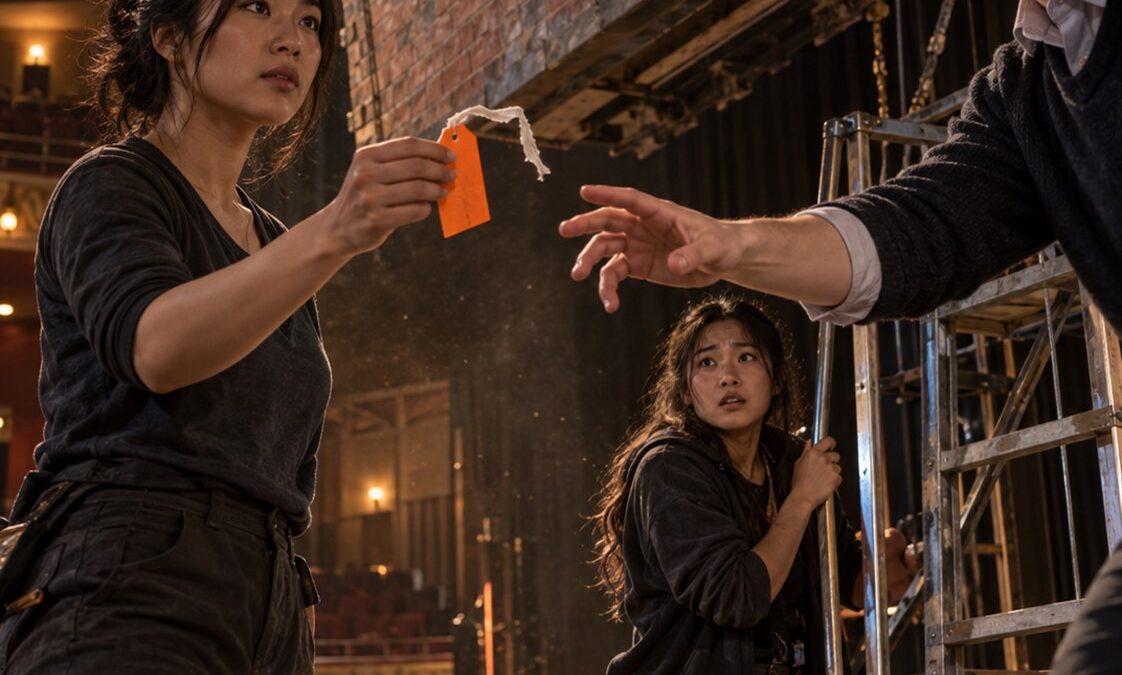
Chapter 2: The Wrong Motor
“Clear the stage,” Tessa said.
The wall had moved an inch.
Perhaps less.
From beneath it, any movement was enough.
Iris stayed beside the ladder.
“Now,” Tessa told her.
Iris backed away.
Gavin looked toward the control booth.
His two friends were already moving from the door.
“Keep them here,” Tessa said.
Gavin bristled.
“I know what to do.”
“Then do it.”
One of his friends, Owen, stopped at the foot of the booth stairs.
The other, Pierce, reached for his phone.
Tessa pointed at the red switch beside the stage door.
“The emergency stop.”
Pierce hit it.
A buzzer sounded once.
The wall stopped.
For several seconds, nobody spoke.
The student who had been recording lowered her phone.
Iris crossed the floor on unsteady legs.
Tessa met her halfway.
“Are you hurt?”
Iris shook her head.
Tessa handed her a bottle of water from her bag.
The cap took Iris two tries.
Gavin came down from the booth.
“The controller was running a cue,” he said.
“Who started it?”
“I don’t know.”
“Who programmed it?”
His jaw tightened.
“The system keeps a log.”
“Good.”
Gavin reached for the orange tag again.
Tessa held it by the edge.
“Campus safety can take it.”
“It’s theater property.”
“It’s evidence,” Iris said.
Her voice was quiet.
Gavin looked at her.
For the first time, he seemed to remember she could speak.
Owen came back from the stairs.
“There’s nobody in the booth.”
“Lock the controller,” Tessa said.
“I already did.”
“You said it was running a cue,” Iris told Gavin.
“It was.”
“I never learned that console.”
“I didn’t say you did.”
“You said I caused this.”
Gavin glanced at the raised phone.
“That tag was beside your station.”
Iris stared at him.
“You put me there.”
Gavin opened his mouth.
A woman’s voice came from the auditorium.
“Everybody off the stage.”
Dr. Maeve Callow stood in the aisle.
She taught stage technology and supervised every student crew.
Her gray coat was still wet from outside.
Behind her came a campus safety officer with a radio.
Tessa had met Callow only twice.
Both times, the professor had noticed whether the equipment was put away properly.
Now she noticed the wall.
Then Iris.
Then the tag.
“Who called?” Callow asked.
“I did,” said the student with the phone.
“Thank you, Nia.”
The officer walked to the stage edge.
“Is everyone accounted for?”
Gavin counted aloud.
Nine students.
Two at the door.
One in the aisle.
Nobody injured.
The officer asked them to leave the stage as a group.
Tessa stayed long enough to give him the tag.
She did not let Gavin touch it.
The officer wrote her name on an evidence envelope.
He asked where she had found the tag.
“I didn’t,” Tessa said.
“Iris did.”
Iris described the floor beside the ladder.
She remembered the white tie already torn.
Callow listened without interruption.
Gavin stood with his arms folded.
“It was a rehearsal mistake,” he said.
Callow looked up at the wall.
“Then we will find the mistake.”
Outside, the corridor felt too bright.
Iris leaned against a trophy case.
Her water bottle crackled in her grip.
Tessa took a step toward her, then stopped.
Iris had spent the last ten minutes with people telling her where to stand.
“May I sit here?” Tessa asked.
Iris nodded.
They sat on the floor.
Inside the theater, the officer’s radio murmured.
“I reported something yesterday,” Iris said.
Tessa waited.
“The D motor skipped during the afternoon cue.”
“Who took the report?”
“I told Gavin.”
“Anyone else?”
“I entered it online.”
Iris looked down.
“He said I had used the wrong form.”
“Did he?”
“He said he would fix it.”
Tessa thought of the painted wall.
She had watched its left edge dip while the right stayed steady.
That was why she had stepped between Iris and Gavin.
She had wanted Iris away from the load.
“I checked the form,” Iris said.
“It disappeared.”
“From your account?”
“Yes.”
“Do you have a confirmation email?”
Iris searched her phone.
Her thumb paused.
“There.”
The email showed a submission number.
It showed the time.
It showed equipment D.
Gavin had been standing beside her when she filed it.
Through the theater door, Callow called Tessa’s name.
She came out carrying a printed equipment sheet.
The professor knelt beside them.
“Iris,” she said, “your report reached the system.”
Iris looked up.
“It wasn’t deleted?”
“No.”
“Gavin said—”
“I heard what he said.”
Callow held the sheet so both students could see it.
Motor D had been marked out of service yesterday evening.
The order carried Callow’s name.
“It should not have moved,” she said.
Iris’s bottle stopped crackling.
Tessa looked at the orange envelope in the officer’s hand.
The tag for B had been beside Iris.
The machine that moved was D.
Callow followed her gaze.
Then she gave them the fact Gavin had left out.
“Your report is the reason D was locked yesterday.”
* * *
The officer’s name was Porter.
He asked everyone to stay available for statements.
He did not accuse anyone.
He closed the theater until facilities staff could inspect it.
The students waiting for rehearsal drifted toward the lobby.
Some stared at Iris.
Others looked away when she met their eyes.
Nia, the student who had filmed, came over.
“I have the whole thing,” she said.
“Please keep the original,” Porter told her.
“I can send it.”
“Wait for my secure upload link.”
Nia nodded.
Gavin watched from the far wall.
He had stopped smiling.
Owen and Pierce stood near him.
Neither seemed eager to defend what he had said.
Callow led Iris and Tessa to her office upstairs.
A narrow window overlooked the loading dock.
A row of miniature stage models lined one shelf.
One had lost its roof.
Callow pulled three chairs to her desk.
“You are both being paid for this shift,” she said.
Iris blinked.
“The theater is closed.”
“You reported a hazard and stayed to give a statement.”
“That still counts?”
“It does.”
Iris glanced at Tessa.
Tessa understood the question behind it.
“Yes,” Callow said.
“Both of you.”
Callow logged into the reporting system.
She turned her monitor toward them.
Iris’s report had been entered at 4:18 yesterday afternoon.
At 4:31, Callow had issued the hold.
Facilities had acknowledged it at 5:02.
At 5:16, a technician had applied a numbered lock to D’s power disconnect.
There was a photograph.
A black lock hung from a closed switch.
A yellow label carried the work order number.
The technician’s hand was visible at the edge.
“Where does the orange tag belong?” Tessa asked.
“Motor B’s manual brake.”
“Was B being used today?”
“No.”
Callow opened another record.
B had been removed from rehearsal cues a week earlier.
Its brake had stuck during a routine check.
The orange tag should have remained at the brake lever across the stage.
Somebody had taken it off.
The torn white tie mattered.
A tie could break when pulled.
It could also be cut.
Tessa did not pretend to know which had happened.
“Who can change a cue?” Iris asked.
“Three people,” Callow said.
“Myself, the theater technician, and Gavin.”
“Could the program run on its own?”
“It could execute a scheduled cue.”
“Was one scheduled?”
“That is what we need to check.”
Callow picked up her desk phone.
She called facilities.
Then she called the university’s information technology office.
The console was networked for updates.
Its event history was stored on a campus server.
No one should reset it before the logs were copied.
The technician on the phone agreed.
Callow wrote down his name and the time.
Tessa liked that.
Details had saved her before.
A touring company had once claimed she approved a load chart.
She had kept the text asking her to inspect it.
The text had arrived an hour after the equipment was packed.
She never got the lost wages back.
She did get her name removed from the report.
Callow hung up.
“Porter is coming upstairs,” she said.
“I need separate statements from you.”
Iris’s eyes went wide.
“Am I in trouble?”
“I can’t promise what someone else will decide.”
Callow moved closer.
“I can tell you the report was proper.”
That helped.
It did not make Iris’s hands steady.
Tessa waited outside while Porter spoke with her.
The hallway held a vending machine and a bulletin board.
Gavin came around the corner.
He stopped when he saw Tessa.
“You think you solved it?” he asked.
“No.”
“You told everyone that tag was wrong.”
“It is wrong.”
“That doesn’t tell you who put it there.”
“I know.”
He studied her.
That answer seemed to irritate him more than an accusation.
“You’ve worked shows before,” he said.
“Yes.”
“Then you know things go bad fast.”
“They can.”
“People look for someone to blame.”
“They do.”
For a moment, he sounded almost tired.
Then the office door opened.
Porter called Tessa inside.
Gavin walked away.
Porter asked for her account from the first click she heard.
Tessa described the wall’s movement.
She described the emergency stop.
She described the tag.
She made clear what she had seen and what she had inferred.
When she was done, Callow asked one question.
“Why did you look at the motor letter?”
“Because Iris was stationed at D.”
“How did you know?”
“The ladder had D taped on its side.”
Callow nodded.
She wrote it down.
Porter asked about Gavin’s words.
Tessa repeated them as closely as she could.
She did not repeat his tone.
Nia’s recording would have that.
By the time they finished, rain had begun against the office window.
Iris waited by the stairs.
She held a paper cup of tea from Callow’s office.
“I thought a report was supposed to fix things,” she said.
“It gives people a chance to fix them,” Tessa answered.
“I wish I’d told someone else.”
“You told the system.”
“Maybe I should have told you.”
“We met yesterday.”
Iris gave a small, surprised laugh.
They walked down the hall together.
At the landing, they heard Callow’s office phone ring.
A few seconds later, Callow called them back.
Her face had changed.
Information technology had found an access record.
Someone had opened the D cue after the safety hold.
The record showed a staff account.
Callow looked at Tessa.
“It was mine.”
* * *
Callow shut the office door.
She left it unlocked.
Porter was still there.
“Did you open that cue?” he asked.
“No.”
“Where were you?”
“At the faculty meeting.”
“That will be easy to verify.”
Callow sounded calm.
Her hand rested flat on the desk.
The login had happened at 8:47 that morning.
The meeting had started at eight.
It had ended at nine thirty.
Six faculty members had attended in person.
Porter wrote that down.
“Could someone use your password?” he asked.
“They should not be able to.”
Callow thought for a moment.
“Gavin had temporary access last month.”
“Through your account?”
“Through a shared teaching station.”
The distinction mattered.
The station signed users into a staff profile for training.
Callow had asked for that access to be removed after the course.
She pulled up the request.
It was marked complete.
“Who approved it?” Tessa asked.
“Information technology.”
“Who checked it afterward?”
Callow did not answer at once.
“I didn’t.”
Porter asked for the workstation location.
“Control booth,” Callow said.
They went back to the theater with him.
The doors remained closed to students.
A facilities technician named Rafael joined them.
He had inspected the suspended wall and installed a second physical support.
He pointed out the locked disconnect for D.
The lock was still attached.
Its metal shackle was unmarked.
“So how did the wall move?” Iris asked.
“Residual power can move a motor briefly,” Rafael said.
“Not twice,” Tessa said.
“No.”
He showed them a second drive cabinet.
The scenery wall used two motors to stay level.
The left side was D.
The right side was E.
The console could command both during a cue.
The safety hold for D should have disabled the paired cue.
Instead, the record showed someone had created a temporary single-motor test.
E had pulled against the locked side.
That explained the tilt.
It also explained the second click.
A control relay had tried to repeat the cue until Pierce hit the emergency stop.
“Could that pull the wall down?” Iris asked.
“Eventually, it could damage something,” Rafael said.
“We’re taking it apart before anyone rehearses again.”
He spoke plainly.
Iris seemed grateful for that.
In the booth, Porter photographed the console.
An information technology specialist arrived with a small case.
She copied the local files while Porter watched.
Nobody touched the controls.
The specialist checked the workstation account.
The training access request had been marked complete.
The actual permission remained active.
A box on an administrative page had never been cleared.
Callow stared at it.
“That is my oversight.”
“It is an access problem,” Porter said.
“We still need to know who used it.”
The login came from the booth computer.
That narrowed the place.
It did not identify a person.
The booth door had a card reader.
Porter requested its entry log.
He also requested the camera view from the hallway.
Tessa and Iris gave him room.
In the empty auditorium, they sat two rows apart.
The stage looked smaller with the work lights on.
Iris spoke first.
“People saw the video.”
“Which part?”
“All of it.”
Nia had not posted hers.
Someone else had filmed from the aisle.
That clip stopped when Tessa held up the tag.
It made Gavin look foolish.
It also left out the wall moving again.
Comments were already choosing sides.
Tessa held out her hand.
Iris gave her the phone.
“Don’t read them,” Tessa said.
“I wasn’t going to.”
“You had them open.”
“I know.”
Tessa turned the screen down on the seat.
Her mother texted while they waited.
Did the first big rehearsal go okay?
Tessa typed, Complicated, but I’m safe.
Then she added, I’ll call tonight.
Iris noticed the message.
“Your mom worries?”
“Professionally.”
Iris smiled.
For a minute, they watched Rafael measure the wall.
Then Porter came down the aisle.
“The card log shows three entries,” he said.
“Gavin, Owen, and Dr. Callow’s card.”
Callow was upstairs during the last entry.
Her card had been used at 8:42.
The shared profile was opened five minutes later.
“Someone took my card,” she said.
“Where was it?”
“In my office.”
“Was the office locked?”
“I left it open during the meeting.”
Porter asked who knew that.
“Half the theater department.”
A door opened at the back.
Gavin entered with Owen.
Porter had asked both to return for statements.
Owen saw Callow and stopped.
Gavin kept walking.
He had changed into a dry sweatshirt.
“You asked for us?” he said.
Porter explained what the access logs showed.
Gavin’s expression sharpened.
“So her account ran the cue.”
“It was accessed through the booth,” Porter said.
“Then ask who had her card.”
“That’s what I’m doing.”
Gavin looked at Iris.
“You were in the building early.”
“So were you,” Iris said.
“I was getting ready for rehearsal.”
“Then you know I was painting flats.”
Owen stared at the floor.
Porter noticed.
“Is there something you want to add?”
Owen rubbed his palms together.
He had been with Gavin since dawn.
He said they had carried cables from storage.
They had stopped at the booth.
Gavin interrupted.
“We checked the sound feed.”
Owen looked at him.
“Sound doesn’t run from that computer.”
Gavin’s cheeks colored.
“I meant the control feed.”
Porter asked Owen to continue.
Owen said Gavin had gone into Callow’s office first.
Gavin said he had borrowed a stapler.
Owen had not seen what he took.
Callow’s card normally sat on the desk beside her keys.
Now it hung from her coat pocket.
She had found it there after the meeting.
“Someone returned it,” she said.
Gavin folded his arms.
“That proves nothing.”
“No,” Porter said.
“It doesn’t.”
Gavin seemed relieved.
Then Porter’s phone rang.
The information technology specialist had recovered the booth camera file.
The camera faced the corridor.
It did not see inside.
It did show Gavin entering Callow’s open office at 8:39.
It showed him leaving with her card in his hand.
Owen took one step away from him.
Gavin looked toward the stage.
He did not deny the picture.
“Why?” Callow asked.
Gavin’s answer came softly.
“Because her report would shut down the show.”
* * *
The show was a campus showcase.
Families, alumni, and prospective students had tickets.
Gavin had spent eight months directing it.
His father’s company had paid for the scenery wall.
The performance was three days away.
None of that made the wall safe.
Callow said so.
Gavin said he knew.
He had told himself he was testing a workaround.
“If E could carry the cue alone, we could rebuild the timing.”
Rafael stood beside the aisle.
“That wall was designed for two motors.”
“I see that now.”
“You had the manual.”
“I read it.”
“Then you saw that warning.”
Gavin’s mouth closed.
Porter asked him when he had entered the new cue.
Gavin answered after a pause.
At 8:47.
He said he meant to test it before anyone reached the stage.
Iris had been on the stage at 8:47.
The crew call had been eight thirty.
He knew that.
“Why did you leave it running?” Porter asked.
“I thought I canceled it.”
The specialist’s log showed two attempts to run the cue.
The first had tilted the wall.
The second began after the emergency stop was released during the evacuation check.
Gavin said he had not understood the repeat setting.
Rafael asked to see the program.
He read it in the booth.
Then he came back.
“The repeat was set to three.”
“I must have touched it by accident,” Gavin said.
No one argued.
Porter wrote down the claim.
Tessa looked at the orange tag.
It sat sealed in its envelope on Porter’s clipboard.
“The tag from B,” she said.
Gavin looked at her.
“You found it.”
“Iris found it.”
“How did it get beside her ladder?”
“I don’t know.”
“Neither do I.”
That was a careful answer.
It was also the first time Gavin had admitted uncertainty.
Callow asked why he had accused Iris before checking the equipment.
“She had already reported D,” Gavin said.
“That made her more careful, not less,” Callow replied.
Gavin looked away.
Owen cleared his throat.
“I saw him carrying the orange tag.”
Gavin turned.
“When?”
“Before the others got there.”
“It was loose,” Gavin said.
“You said you were putting it back.”
Porter asked Owen to describe where they were.
Owen placed them at the motor B side of the stage.
He remembered Gavin holding the torn tie.
“I didn’t think about it,” he said.
“Why would you?” Gavin asked.
“Because you blamed her with it.”
Owen’s voice shook.
He stayed where he was.
Porter collected another statement.
He did not promise a criminal charge.
He explained that the university would investigate the safety breach.
The access logs and equipment would be preserved.
If the evidence supported a crime, the appropriate office would review it.
For now, Gavin was barred from the theater.
Callow canceled that night’s rehearsal.
She told every student the same thing.
The wall would remain closed until facilities approved it.
No student would be penalized for reporting a problem.
Gavin stood at the stage door while she spoke.
A few crew members looked at him.
Most looked at Iris.
She held their eyes this time.
A woman from student employment arrived to check on her.
Iris asked whether she still had a job.
“Yes,” the woman said.
“We’ll place you on another paid shift this week.”
Iris asked her to put that in writing.
The woman did.
Tessa admired the speed of the request.
The next morning, Bellwether’s safety office interviewed everyone separately.
Nia submitted her original video.
It showed the tag passing from Iris to Tessa.
It showed Gavin reaching for it.
It showed the wall move while Gavin stood in the corridor.
The hallway camera supplied another view.
The booth logs supplied times.
Rafael’s inspection found no failure in D’s lock.
The machine had done what the lock required.
The unsafe command had gone to E.
A technician examined the orange tag.
Its white tie had been cut.
The cut edge was clean under magnification.
That did not prove whose hand held the scissors.
The booth camera and Owen’s statement placed the tag with Gavin shortly before rehearsal.
Gavin’s statement placed him at motor B.
Callow had enough to begin student conduct proceedings.
She did not run those proceedings herself.
The dean’s office appointed a staff investigator.
Tessa gave a second interview.
She was asked whether Gavin had threatened her.
“He said I would regret making it public.”
“Did you take that as a threat?”
“I took it as pressure.”
The investigator wrote down her exact words.
Iris was interviewed for nearly an hour.
When she came out, she found Tessa waiting with two sandwiches.
“I wasn’t sure what you liked,” Tessa said.
“Food.”
“That narrowed it.”
Iris laughed with her mouth full.
A week later, the showcase opened without the moving wall.
Students painted a new backdrop.
It took one night and twelve volunteers.
From the audience, it looked like a street at dusk.
Gavin did not attend.
The school had suspended him from production work while the review continued.
His father complained to the dean.
He also offered to pay for a faster repair.
The dean told him the wall would return only after inspection.
No one accepted the money as a reason to hurry.
At the conduct meeting, Gavin brought an adviser.
He spoke clearly.
He argued that he had tried to save the performance.
He said the shared account was available because of a university error.
He said Iris had found a loose tag on the floor and he had made a bad assumption.
He admitted moving it from B.
He said the tie had already been damaged.
For several minutes, his account sounded possible.
Then the investigator displayed the booth log.
Gavin had named his test file “D hold bypass.”
Rafael had saved the matching local file.
The server copy showed when Gavin created it.
The local copy showed the same settings.
He had not stumbled into a single motor cue.
He had built one.
Gavin looked at the screen.
His adviser leaned toward him.
They spoke quietly.
When Gavin answered, he stopped calling it an accident.
“I thought I could control it.”
Porter sat near the back of the room.
He did not move.
Iris’s hands were flat on her knees.
Tessa felt hers tighten.
Gavin turned toward them.
“I never meant for anyone to get hurt.”
Iris answered before Tessa could.
“I believe you.”
Gavin looked surprised.
“That doesn’t mean I was safe.”
He had no reply.
* * *
By December, the theater had a new rule.
No student production director could override an equipment hold.
A staff technician had to clear it in person.
The rule fit on one page.
Callow read it to every crew.
She also read the older rules they had ignored.
Gavin’s conduct decision came after finals.
He lost his production position for the rest of the academic year.
He had to complete a safety course before working in any campus theater again.
His use of Callow’s card went to the university’s security office.
That office issued its own finding and restricted his access.
The university referred the equipment incident for outside review.
No one promised Iris or Tessa a particular legal result.
Weeks later, the reviewer concluded that the evidence supported a serious safety violation.
The university imposed the remedies it controlled.
Callow told the crew what had changed.
She did not share Gavin’s private student record.
The students already knew he would not return that season.
Iris kept her job.
She moved to the costume shop while the rigging system was inspected.
She discovered she was good at repairs.
One afternoon, she held up a jacket with a new seam.
“Will anyone see it?” Tessa asked.
“Only if I did it wrong.”
“Then I see nothing.”
Iris grinned.
Tessa’s shifts moved too.
She helped catalog equipment.
It was dull work until she opened the old inventory book.
Someone had recorded every motor by hand.
Serial number.
Purchase date.
Repair.
Inspection.
A history nobody noticed until it mattered.
She spent three nights correcting missing entries.
Callow paid her for all three.
Tessa used the money for train fare home.
Her mother met her at the station with one cane.
“You look taller,” her mother said.
“You look faster.”
“I beat the elevator.”
“By how much?”
“Enough to mention it.”
They ate soup at the kitchen table.
Tessa told her about Iris.
She told her about the stage.
Her mother listened without interrupting.
When Tessa finished, she asked, “Did you feel like you were back there?”
Tessa knew which job she meant.
“For a minute.”
“And then?”
“I looked at the equipment.”
Her mother reached across the table.
Tessa took her hand.
She had spent years wondering whether refusing that false report had cost too much.
At Bellwether, she had not made a speech.
She had read one letter on a tag.
The next week, Gavin asked to speak with Iris and Tessa.
He sent the request through the dean’s office.
Iris considered it for two days.
Tessa told her she could say no.
“I want to hear him,” Iris said.
They met in a conference room.
An adviser sat near the door.
Gavin looked older without a crew around him.
“I accused you to protect myself,” he told Iris.
“I knew you had reported D.”
“I noticed that,” Iris said.
“I moved the tag.”
“We know.”
“I’m sorry.”
Iris let him wait.
Then she said, “You made everyone watch me defend myself.”
“I did.”
“I won’t work under you again.”
“I understand.”
He turned to Tessa.
“I tried to scare you off.”
“You did.”
“I’m sorry for that too.”
Tessa nodded.
She did not offer him relief.
Gavin seemed to accept it.
Before leaving, he gave the adviser a written correction to his first statement.
It named the tag.
It named the cue.
It said Iris had not touched either motor.
The adviser gave copies to Iris and Tessa.
Iris read hers twice.
Outside, she folded it into her coat pocket.
“Feel better?” Tessa asked.
“A little.”
“That’s allowed.”
“I’m still angry.”
“That is too.”
They walked through the winter courtyard.
Students hurried past with scarves over their mouths.
Iris stopped at the steps.
“I’ve been thinking about applying for crew lead next fall.”
“Do it.”
“I thought you’d say I should wait.”
“You know where the reporting form is.”
“That’s a low standard.”
“It’s one some people missed.”
Iris laughed.
Then her face grew serious.
“I want to do the job well.”
“You will.”
“I might make mistakes.”
“So will everyone.”
Iris held out her hand.
Tessa shook it.
The gesture made them both laugh again.
In January, Callow offered Tessa a paid student coordinator role.
The job came with more hours.
It also came with responsibility for training new crew.
Tessa asked whether she could share the position with Iris.
Callow said Iris was still learning.
Tessa agreed.
She proposed a second role with a training wage.
Callow found room in the budget.
Neither job carried Gavin’s old title.
The titles mattered less than the work.
Before Tessa accepted, she asked one condition.
“Can any student stop a cue?”
“Yes,” Callow said.
“Will the crew hear that on the first day?”
“They will hear it from you.”
Tessa signed.
* * *
Three years later, the painted brick wall was gone.
The theater still had a moving backdrop.
It had new motors and a slower cue.
Tessa stood beside a rolling ladder on opening night.
The ladder had a large D taped to its side.
She had kept that letter through two productions.
Iris, now the crew lead, came over with a clipboard.
“Everyone is clear,” she said.
“Both sides?”
“Both sides.”
“Locks removed?”
“Rafael checked.”
“Cue ready?”
“Waiting for your permission.”
Tessa looked at her.
“You don’t need mine.”
“I know.”
Iris smiled.
“I wanted to ask anyway.”
Around them, first year students found their marks.
One held a phone.
This time, he was filming the set for his family.
The stage smelled of fresh paint.
From the auditorium came the low noise of an audience taking seats.
Tessa stepped back from the ladder.
“Run the cue,” she said.
The backdrop rose evenly.
Nobody had to move out of its way.
After rehearsal, Iris had mounted the old orange tag inside a clear case.
It hung beside the crew room door.
Under it was a small label.
B MOTOR.
REMOVED FROM SERVICE.
The tag did not name Gavin.
It did not name Iris.
Iris had chosen the words herself.
Across the hall, a newer sign said that anyone could stop unsafe work.
Tessa checked it every term.
The promise stayed where new people would see it.
Gavin had finished his degree.
He had not returned to the theater.
Owen worked on sets again after giving his statement.
Callow locked her office.
Rafael still complained about people leaving tape on ladders.
Iris had been accepted into a graduate design program.
Tessa had a full time theater job waiting after commencement.
Her mother planned to sit in the third row.
She claimed it offered the best view.
As the house lights dimmed, Iris came back to the ladder.
“You okay?” she asked.
Tessa looked at the stage.
At the crew.
At the wall rising cleanly into place.
“I am.”
Iris touched the edge of the clear case.
“That tag was wrong,” she said.
“It was.”
“But you looked.”
Tessa held the door while the crew filed through.
“So did you.”
THE END








