THE ORPHAN WHO MADE THE ROOT KING KNEEL / PART 1 — THE CLAY MEASURE THAT REMEMBERED HER MOTHER
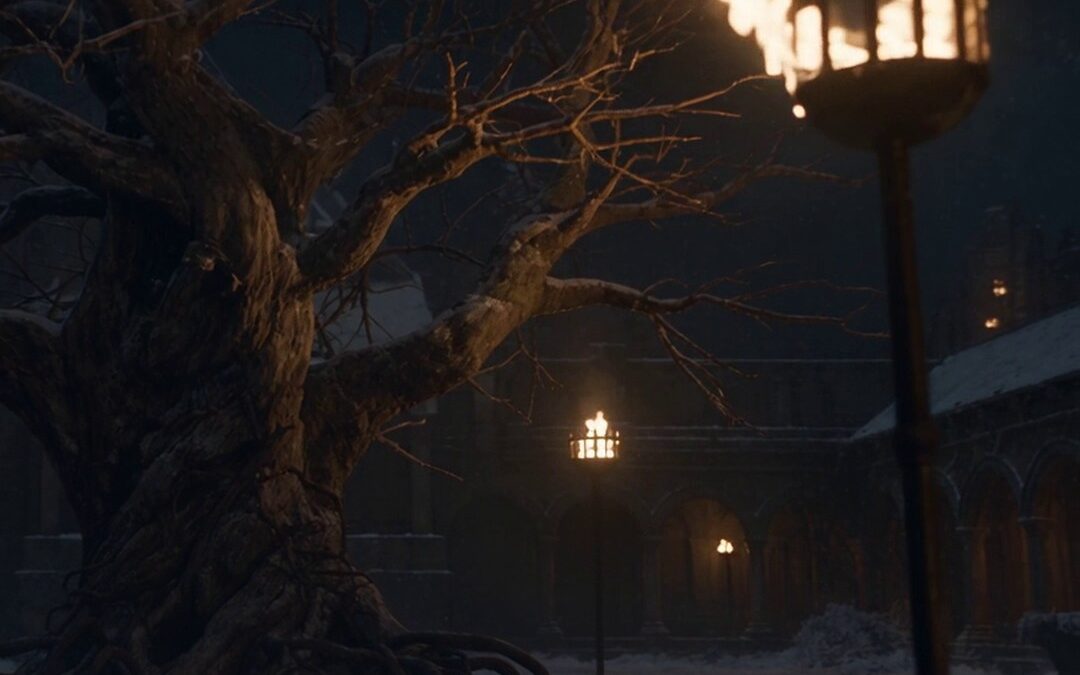
Chapter 2: What the Roots Kept
The measure warmed between her hands.
Nerith almost flung it away.
Pell caught her elbow.
That small touch steadied her.
“Does it hurt?”
“No.”
She could not tell whether she was lying.
White lines traveled beneath her skin.
They branched toward her shoulders.
Hadrik moved toward the door.
A root settled across the threshold.
He stopped.
The creature watched him.
“Open it,” Nerith said.
The root withdrew immediately.
Hadrik stared at her.
So did Odel.
Nerith felt something worse than fear.
Responsibility.
“Pell needs to leave.”
The creature lowered its head.
“The passage is safe.”
Odel reached for the boy.
Pell clung to Nerith instead.
“You promised.”
“I’m coming too.”
Hadrik straightened his coat.
“Nobody is going anywhere.”
Nerith looked at the open doorway.
“Then call the watch.”
His face hardened.
“Do you understand what you’ve disturbed?”
“No.”
She lifted the cup.
“But you do.”
The creature’s antlers shed a little earth.
“Water,” it said.
Nerith looked toward the bench.
A pitcher stood beneath it.
Hadrik moved first.
“Leave that.”
The creature’s eyes narrowed.
Nerith stepped between them.
“No one touches him.”
The roots became still.
Hadrik’s surprise was naked.
Nerith picked up the pitcher.
She poured carefully.
The pale hand reappeared inside the measure.
A woman’s voice followed.
“If this vessel opens, my child has survived.”
Odel began crying.
Nerith did not.
She could not.
The voice was ordinary.
A little tired.
A little breathless.
Someone speaking while working.
Someone who might turn around.
“My name is Queen Istren.”
Nerith’s knees weakened.
Pell pressed against her side.
“My daughter bears the springmark behind her left ear.”
Hadrik looked away.
“The mark is proof of kinship, not fitness to rule.”
The voice paused.
Nerith heard a door closing inside the recording.
Then the woman spoke faster.
“This measure holds my witness.”
“The clay was pressed beneath the covenant tree.”
“It cannot hold a living soul.”
Nerith looked sharply at the creature.
“You said she was inside.”
“What she could leave,” it answered.
Hope collapsed so quickly it hurt.
Odel reached for her.
Nerith stepped away.
“Don’t.”
The old woman withdrew her hand.
Inside the cup, the voice continued.
“My husband has found cuts in the foundation roots.”
“We have ordered the nursery evacuated.”
“If anything happens, take our daughter to the western orchard.”
“Trust Odel.”
The water cleared.
Nerith waited.
Nothing more came.
“Again,” she whispered.
The creature lowered its muzzle.
“The vessel must rest between witnesses.”
“How long?”
“Until sunrise.”
Hadrik made a small movement.
Odel saw it too.
“He wants the cup,” she said.
“Of course I want it.”
His voice regained its official weight.
“It is royal property.”
Nerith held it against her chest.
“You can ask a magistrate.”
“There is no magistrate above the Protector.”
“The covenant bench,” Odel said.
Hadrik turned on her.
“You have remembered your education suddenly.”
“I should have remembered it sooner.”
Nerith looked between them.
“What bench?”
“Three judges,” Odel said.
“Chosen before a reign begins.”
“Their seals cannot be held by the crown.”
Hadrik’s mouth tightened.
“They handle succession disputes.”
The creature lifted its head.
“And breaches of covenant.”
Snow slid down the glass roof.
For a moment, nobody spoke.
Then Nerith looked at Pell.
His lips had begun trembling.
The garden was freezing.
Her sleeve was ruined.
Whatever she was, she could not keep him standing here.
“Odel.”
“Yes.”
“Find those judges.”
The old woman nodded.
“And somewhere warm for him.”
“For both of you.”
Nerith hesitated.
Hadrik watched her hesitation.
“Come under my protection,” he said.
“We can settle this privately.”
She remembered the salt works.
His dry voice.
His outstretched hand.
“You had your chance.”
Odel opened the garden door.
This time, Hadrik did not stop her.
The creature began folding downward.
“Wait,” Nerith said.
Green eyes returned to her.
“What are you?”
“Keeper of the covenant.”
“Are you a king?”
“That was the human translation.”
“Do you have a name?”
“Therren.”
She held the measure tighter.
“Did my mother know you?”
“I carried her through these roots.”
“When?”
“When she was smaller than your boy.”
Nerith’s throat closed.
Odel whispered from the doorway.
“They told us he was a monster.”
Therren looked at the old stump.
“I tried to open the nursery.”
A root touched the seventeen-year-old cut.
It fit exactly.
“I was not attacking the palace.”
* * *
The covenant bench occupied an old grain exchange.
Its doors had no royal crest.
Nerith noticed that first.
Second, the hearth was lit.
Third, nobody asked her to kneel.
A gray-haired clerk brought bread.
Pell looked at Nerith before taking it.
“You don’t owe anything,” the clerk said.
The boy still waited.
Nerith nodded.
Only then did he eat.
Odel sat across the table.
Her hands shook around untouched tea.
Outside, the palace bells sounded.
Not an alarm.
An announcement.
Hadrik was already telling his version.
Magistrate Dessa entered carrying three bound books.
A younger clerk followed.
He introduced himself as Fen.
He spoke to Nerith directly.
“May I record your account?”
“Yes.”
“Your own words.”
She began with Pell.
Not the creature.
Not the queen.
The boy’s transfer had brought them there.
Dessa listened without interruption.
When Nerith finished, the magistrate asked about the cup.
“Who gave it to you?”
“The kitchen steward.”
“When?”
“Two winters ago.”
“Did you recognize it?”
“No.”
Odel lowered her eyes.
Nerith saw.
“Did you?”
“Yes.”
The answer made the warm room colder.
Odel rubbed her thumb against a scar.
“I put it among the kitchen measures.”
“Why?”
“I couldn’t keep it hidden anymore.”
“From whom?”
“The matron was searching my room.”
“Veyra?”
Odel nodded.
Nerith leaned forward.
“You could have told me.”
“I thought the vessel would stay quiet.”
“What did you want?”
“To put it near you.”
“That isn’t an answer.”
The old woman shut her eyes.
“No.”
Dessa waited until Odel looked up.
“You will give a separate statement.”
“I understand.”
“And surrender any papers you kept.”
Odel swallowed.
“There are some.”
“Where?”
“Inside my mattress.”
Nerith remembered sleeping against that mattress.
Once.
During a winter fever.
Odel had held her hand all night.
Secrets beneath them.
Secrets everywhere.
Dessa turned to Fen.
“Send two clerks.”
“No palace servants.”
He left.
Nerith placed the cup on the table.
Its surface had cooled.
“What happens now?”
“We establish what can be established.”
“The voice sounded real.”
“That matters.”
“Isn’t it enough?”
“For me to investigate.”
Dessa opened the oldest book.
“For a judgment, we need more.”
She showed Nerith a drawing.
A handleless measure.
Five fingers inside.
A crescent beneath the rim.
Nerith turned the cup.
There it was.
She had always thought it a chip.
“Witness clay,” Dessa said.
“Used before ink became common.”
“Can someone put false words inside?”
“Yes.”
Nerith stiffened.
“The vessel preserves speech.”
“It does not make speakers honest.”
“Then how do we prove anything?”
“We compare it with independent records.”
Dessa touched the drawing.
“We also examine the seal.”
The cup’s crescent had tiny divisions.
Nerith counted seven.
The picture showed seven too.
Dessa fetched a magnifying lens.
Pell climbed onto the adjacent chair.
“Is it broken?”
“Repaired,” Dessa said.
Nerith leaned closer.
A thin band crossed the clay.
Kitchen grease had concealed it.
Now water had washed it clean.
She knew the yellow grit embedded there.
Every root washer did.
“South kiln clay,” she said.
Dessa looked up.
“Why?”
“It stains pale vegetables.”
“The palace stopped buying those pots.”
“When?”
“Last spring.”
Fen returned during her explanation.
Dessa sent him out again.
“To the potters’ guild.”
“Bring their oldest repair ledger.”
Odel watched Nerith.
“What?”
“You sound like her.”
Nerith’s fingers tightened.
“You don’t get to say that yet.”
Odel bowed her head.
“No.”
By afternoon, the room had filled with records.
Nursery accounts.
Burial rolls.
Old building inspections.
A woman from the potters’ guild examined the measure.
Her name was Jannet.
Her father had repaired it.
She brought his ledger.
The entry was dated nineteen years earlier.
Two years before Nerith’s birth.
Royal witness measure.
Hairline fracture.
Seven-part seal preserved.
Payment received from Queen Istren.
Jannet traced her father’s signature.
“He taught me that hand.”
Dessa had Fen copy the entry.
The original went into a locked cabinet.
Nerith watched every movement.
“Why lock it?”
“So nobody can change it.”
“Will you lock mine away too?”
“The cup?”
Nerith nodded.
“Only with your agreement.”
She considered that.
Then pushed it toward Dessa.
“Until sunrise.”
The magistrate gave her a receipt.
Nerith read it twice.
An object belonging to her.
Protected because she had asked.
It felt stranger than the roots.
The clerks returned from Odel’s room.
They carried a flat packet.
Inside lay a nursery evacuation order.
Odel’s name appeared at the bottom.
Beside it, an infant’s weight.
A description of the springmark.
A destination.
Western orchard refuge.
Nerith touched the words.
“That’s where she told you to go.”
“Yes.”
“Did you?”
“Yes.”
“What happened?”
“The refuge was empty.”
“Why?”
“I don’t know.”
Dessa lifted another sheet.
A transfer acknowledgment.
Dated the following morning.
Nerith recognized the orphanhouse seal.
The little roof.
The three windows.
She had scrubbed that shape off floors.
“Read it,” she said.
Odel’s face crumpled.
“Please.”
“Read it.”
The old woman obeyed.
“One unnamed female infant.”
“Relinquished without surviving family.”
“No claim of rank.”
“No future right of recovery.”
Nerith stared at the signature.
Odel’s.
Clear and deliberate.
“You told them I had nobody.”
“I was told they would find you.”
“Who?”
“The people who cut the roots.”
“Who told you that?”
Odel could hardly speak.
“The woman receiving the children.”
Dessa set down the page.
“Matron Veyra?”
Odel nodded.
Nerith remembered the matron brushing her hair.
Checking behind her ear.
Every year.
Calling it an inspection for lice.
“Did she know?”
Odel’s silence answered first.
Then came the words.
“She chose the orphanhouse because she owned it.”
* * *
At sunrise, the cup spoke again.
Three magistrates listened this time.
Dessa.
A broad man named Orven.
A quiet woman named Senn.
Their clerks sat at separate tables.
Each recorded the words independently.
Nerith stood beside the hearth.
Pell slept upstairs.
Odel had been given another room.
Nerith had asked for that.
Nobody had argued.
Queen Istren’s voice emerged clearly.
“The lower sluice has been shut.”
“The gardeners deny receiving instructions.”
“My husband has sent for the inspection book.”
A pause.
A muffled voice.
Then Istren again.
“Someone is removing the western refuge staff.”
“Do not use the official road.”
The recording ended.
Nerith gripped the hearthstone.
Odel had used that road.
Someone had placed the orphanhouse in her path.
Someone had expected a frightened nurse.
Dessa closed her notes.
“We need the sluice records.”
Orven nodded.
“And the nursery engineer.”
“He died eleven years ago,” Fen said.
“His apprentice?”
“I’ll find out.”
Nerith looked toward the window.
Snow had stopped.
Across the street, a notice was being nailed up.
Two men in palace colors stood nearby.
Fen went to read it.
He returned pale.
“The Protector has declared an emergency.”
Dessa held out her hand.
Fen gave her a copied notice.
All root-connected buildings were to be evacuated.
All covenant artifacts surrendered.
All wards returned to registered guardians.
Nerith heard only the last part.
“Pell.”
“He stays here,” Dessa said.
“Veyra is his guardian.”
“She is now subject to inquiry.”
“Does Hadrik care?”
“He will care about three judicial seals.”
The door opened.
A watch captain entered.
She removed her gloves.
“My name is Captain Brida.”
Nerith stood straighter.
The captain noticed.
“I have come to protect this building.”
“From the roots?”
“From whoever thinks fear cancels the law.”
For the first time, Nerith sat.
By noon, the city wells tasted bitter.
By two, water had stopped reaching the grain mills.
By three, people gathered outside the exchange.
Their voices rose through the shutters.
Send her away.
Put the creature back.
Open the wells.
Nerith pressed her palms together.
The white lines had faded.
She could still feel something beneath them.
A vast patient attention.
“Therren.”
A fine root emerged between two hearthstones.
No larger than thread.
Dessa watched from the table.
“Can you hear him?”
Nerith nodded.
“Ask about the water.”
She did.
The answer came as pressure.
Darkness.
A closed gate.
She struggled for words.
“He says the western channel is blocked.”
Fen looked up.
“The same sluice?”
Nerith nodded again.
Captain Brida reached for her coat.
Dessa handed her an order.
“Take an engineer.”
“And witnesses.”
The captain looked at Nerith.
“Will the roots let us pass?”
Nerith touched the thin white strand.
“Please help them.”
It slipped back beneath the floor.
Outside, the crowd struck the shutters.
Pell appeared on the stairs.
He held his shoes.
“Should I get ready?”
Nerith crossed the room.
“For what?”
“To go back.”
She knelt before him.
“No.”
“They’re shouting.”
“I hear them.”
“I can say I ran away.”
Her chest hurt.
“That wouldn’t be true.”
“It would help.”
“No.”
She pulled his shoes from his hands.
“You aren’t evidence to hide.”
He looked down.
“Am I expensive?”
Nerith could not answer immediately.
He had heard the bargaining.
The forty crowns.
The price of himself.
She opened one shoe.
The lining had worn through.
“We’re getting these mended.”
“That costs money too.”
“Yes.”
“Do you have enough?”
She remembered her forfeited wages.
The eighteen pennies.
Then Dessa placed a small account book on the table.
“Witness lodging includes necessary clothing.”
Pell looked suspicious.
“Do I work for it?”
“No.”
“Later?”
“No.”
He studied her face.
Finally, he let Nerith help him dress.
Captain Brida returned at dusk.
Mud covered her boots.
Behind her came an elderly man.
He carried a rolled maintenance chart.
“The channel was deliberately closed,” Brida said.
“By whom?”
“The gate crew had written orders.”
She laid them on the table.
Hadrik’s seal.
Veyra’s countersignature.
The elderly man stared at Nerith.
Dessa introduced him.
“Berren was the nursery engineer’s apprentice.”
He bowed awkwardly.
Nerith hated the movement.
“Please don’t.”
He straightened.
“I know that mark.”
Her torn sleeve had slipped.
The branching lines remained visible.
“From where?”
“Your father’s hands.”
Nerith had barely thought about him.
“Was he like me?”
“No.”
Berren set down the chart.
“He married into the covenant.”
“The marks appeared after his oath.”
“What was his name?”
“King Osric.”
“What happened to him?”
Berren looked toward Dessa.
The magistrate nodded.
“He went below the nursery.”
“The foundation roots were drying.”
“Someone had shut the water.”
Nerith stared at the new orders.
Seventeen years.
The same act.
The same machinery.
“Who gave the old order?”
Berren opened his chart.
A faded instruction had been stitched inside.
Veyra’s name appeared beneath a different title.
Royal Steward of Living Lands.
Nerith read it slowly.
“She worked for my parents?”
Berren’s mouth tightened.
“She was your father’s sister.”
The room blurred.
All those inspections.
All those coins.
Her father’s sister had watched her scrub floors.
Dessa held the chart beneath the lamp.
“There’s an annex.”
Berren nodded.
“I kept it because my master told me to.”
The annex described a replacement covenant.
Living land vested in one permanent steward.
Root-grown food distributed under license.
No royal heir required.
Nerith read the proposed steward’s name.
Veyra Osric’s-daughter.
Her aunt had not merely hidden her.
“She wanted the kingdom to pay her for spring.”
* * *
The public hearing began six days later.
Dessa had wanted more time.
Hadrik had demanded less.
The compromise filled the old assembly house.
Guild masters sat beside district elders.
Watch officers stood along the walls.
Representatives from the orphan wards occupied the front benches.
Pell sat with the clerk who had brought bread.
Nerith stood at a plain table.
The clay measure rested before her.
Veyra entered without chains.
Her dark dress was immaculate.
Nerith remembered those sleeves.
How they stayed clean.
Even when the children scrubbed until midnight.
Veyra glanced at her.
Then at the cup.
Only the second look showed concern.
Hadrik took the chair beside her.
He wore the Protector’s silver collar.
Dessa called the hearing to order.
“This is an inquiry into immediate public danger.”
“Final criminal judgments will follow separately.”
Hadrik rose.
“Then let us discuss the danger.”
He gestured toward Nerith.
“She commands a creature beneath our streets.”
Faces turned.
Nerith felt their fear.
She understood it.
Yesterday, she had feared the same thing.
“Can she control it?” Hadrik asked.
Dessa looked toward her.
Nerith answered honestly.
“I’m learning.”
A murmur moved through the benches.
Hadrik waited for it to settle.
“Exactly.”
He spread his hands.
“A frightened child.”
“A buried power.”
“A city held together by old foundations.”
Nerith’s face burned.
Dessa did not rescue her.
This was what evidence meant.
Letting the other person finish.
Veyra stood next.
Her voice was softer.
“I have fed this girl since infancy.”
Nerith stared at her.
“She knows hardship.”
“I regret that.”
Veyra turned toward the elders.
“But hardship is not proof of sovereignty.”
Several nodded.
“Nor is an unusual mark.”
Dessa leaned forward.
“Nobody has ruled on sovereignty.”
“Yet she is presented as a queen.”
“By whom?”
Veyra hesitated.
Hadrik spoke.
“The creature knelt.”
Dessa’s expression stayed level.
“Creatures do not appoint this bench.”
A few heads lifted.
Nerith looked down at the measure.
Her mother had said the same thing differently.
Kinship.
Not fitness.
Veyra adjusted her cuffs.
“The witness clay may be genuine.”
That surprised Nerith.
“But a genuine vessel can preserve a lie.”
Dessa nodded.
“Correct.”
“My brother’s wife feared everyone.”
“Her household was divided.”
“She may have misunderstood necessary maintenance.”
Berren shifted on the witnesses’ bench.
Veyra glanced toward him.
“An apprentice cannot know a sovereign’s concerns.”
Hadrik placed a chart on the table.
“Three harvests failed before the collapse.”
Orven examined it.
“The figures are accurate.”
Hadrik faced the room.
“The roots were consuming water needed by farms.”
“I closed the lower sluice this week.”
“I did so to protect the city.”
Nerith stood.
“The mills stopped.”
“A temporary consequence.”
“The wells turned bitter.”
“An unfortunate disturbance.”
“People blamed me.”
“They feared what you summoned.”
She wanted to shout.
She could almost feel Therren below.
Waiting.
One word from her would bring him.
One word would turn every face.
She kept her hands flat on the table.
Dessa noticed.
“Let us examine the water orders.”
Captain Brida testified first.
The western sluice had been closed fully.
Its safety bypass had been sealed.
An independent engineer described the result.
Water pressure had forced stagnant storage into the wells.
The roots had not caused it.
They had opened an older channel.
Without that channel, the mills would still be dry.
Hadrik folded his arms.
“I acted on expert advice.”
Veyra remained still.
Dessa turned to her.
“Yours.”
“The system was ancient.”
“But your instructions were precise.”
“They followed an old emergency plan.”
“The same plan used seventeen years ago.”
Veyra’s chin lifted.
“Yes.”
Nerith heard the word land.
No denial.
No trembling.
Veyra believed she could explain everything.
Berren took the witness chair.
He described the blocked water.
The drying nursery foundations.
His master’s objections.
Then he placed the old annex before the judges.
Veyra studied it.
“A rejected proposal.”
“Rejected by whom?” Senn asked.
“My brother.”
“Why?”
“He was sentimental.”
The room became very quiet.
Veyra corrected herself.
“He distrusted administrative reform.”
Nerith looked at the words again.
Permanent steward.
Licensed growth.
No heir required.
Senn asked the next question.
“Why preserve the infant?”
For the first time, Veyra looked directly at Nerith.
“Because I am not a monster.”
Nerith felt her nails bite her palms.
“You sent Pell to the salt works.”
“To a licensed apprenticeship.”
“He’s nine.”
“The contract complied with the Protector’s decree.”
Hadrik shifted.
Veyra had handed him something.
A piece of the blame.
Dessa lifted another document.
“The contract granted your orphanhouse a placement fee.”
“Necessary operating income.”
“Paid for each child.”
“Yes.”
Nerith heard someone behind her whisper.
Then another.
Veyra spoke more sharply.
“Do any of you know what feeding children costs?”
Nerith raised her head.
“Four pennies.”
Veyra frowned.
“Each week.”
“That was your contribution.”
“From six.”
“You were clothed.”
“With donated clothes.”
“You were housed.”
“In a house the crown had already paid for.”
Fen brought forward the funding ledger.
Nerith had told him where to look.
Veyra made the older girls carry the accounts.
Nerith remembered the blue volume.
The one nobody could touch with wet hands.
The ledger showed royal support.
Charitable gifts.
Placement fees.
And grain purchases from a company Veyra owned.
At twice the market price.
Veyra’s jaw tightened.
“Those entries require context.”
“They will receive it,” Dessa said.
“During the financial trial.”
Hadrik looked toward the doors.
Captain Brida stood before them.
Not blocking them.
Present.
Nerith understood the difference.
Then Dessa turned to the cup.
“There is one remaining witness.”
Veyra’s eyes sharpened.
“The vessel has already spoken.”
“Only its first chambers.”
Jannet stepped forward.
She brought her father’s repair drawing.
“The crescent has seven divisions.”
“Seven recordings.”
“Opened in order.”
“Most were sealed.”
Veyra looked at Nerith’s hands.
The white lines had returned.
Nerith picked up the measure.
Over six mornings, she had heard her mother.
Preparations.
Fears.
Instructions for servants.
An apology to a gardener.
A lullaby cut short.
Dessa had kept the last chamber sealed.
For independent witnesses.
For this room.
Nerith poured the water.
Then placed her thumb against the crescent.
Her mother’s voice filled the assembly.
“Veyra has offered me terms.”
Veyra took one step forward.
Captain Brida moved beside her.
The recording continued.
“She will reopen the sluice if I surrender the living lands.”
“She says Hadrik will recognize her stewardship.”
Hadrik stood abruptly.
“I never agreed to the closure.”
Dessa raised a hand.
He sat.
Inside the measure, Istren drew a shaky breath.
“I have refused.”
“The roots are not property.”
“My daughter must never be made their jailer.”
Another sound emerged.
Someone entering.
Then Veyra’s voice.
You always mistake kindness for government.
The real Veyra gripped the table.
The recorded voice continued.
The child can remain alive.
She need never know what she is.
The water stilled.
Nerith could hear her own heartbeat.
Orven asked Veyra to identify the voice.
She refused.
Jannet confirmed the seal had remained intact.
Berren identified the room’s striking clock.
It had been removed from the nursery ruins.
Its uneven fourth chime appeared in both his maintenance notes and the recording.
Then Fen produced the independent confirmation.
A sealed letter from the royal registry.
Hadrik’s reply to Veyra’s proposed stewardship.
Conditional approval.
Pending extinction of the existing line.
The registry keeper authenticated his signature.
Hadrik put both hands on the table.
“I believed the family had already died.”
“The letter predates the collapse,” Senn said.
He did not answer.
Veyra looked at Nerith.
“All this because you cannot forgive poverty.”
Nerith’s fingers steadied around the cup.
“No.”
“Because you sold it to us.”
The judges issued their temporary orders.
Removal from office.
Protected evidence.
Frozen disputed accounts.
Separate supervised residences pending trial.
Captain Brida approached Hadrik first.
He unclasped the silver collar himself.
It struck the table softly.
Veyra remained standing.
“You think the creature loves you?”
Nerith said nothing.
“It serves your blood.”
“You will discover the difference.”
Nerith looked at the measure.
Then at the watching children.
“I intend to give it a choice.”
The financial trial lasted seven weeks.
The covenant trial lasted three more.
Nerith attended what she could bear.
She submitted testimony when she could not.
Hadrik’s defense established one thing.
He had not ordered the fatal collapse.
It did not erase his conspiracy.
His later concealment.
His present sabotage.
He lost his office and estates gained through the scheme.
His sentence included confinement under judicial supervision.
Veyra’s accounts supplied the rest.
Payments to the original gate crew.
A purchase of the emptied western refuge.
Instructions to register Nerith without a name.
Both received rights of appeal.
Neither could purchase silence anymore.
On the final day, Veyra spoke without looking at her.
“I kept you because the roots would need a living key.”
Nerith waited.
Her aunt’s voice broke at last.
“I never expected the key to speak.”
* * *
Spring arrived while Nerith was learning fractions.
That seemed unfair.
The roots beneath the city knew her.
She still confused three eighths with three sixths.
Her tutor waited patiently.
Nerith disliked that too.
“Say something.”
“You have made the denominator smaller.”
“I can see that.”
“What happened to the amount?”
“It grew.”
“Exactly.”
She stared at the paper.
A month earlier, nobles had argued about her blood.
Now she was losing an argument to a pie diagram.
Outside, Pell shouted her name.
She looked toward the window.
He stood beside a gardener.
Both held muddy onions.
“Those are flowers,” she called.
Pell looked down.
The gardener looked away.
Too slowly.
Nerith almost smiled.
Then did.
It surprised her.
Her tutor closed the lesson book.
“An excellent place to stop.”
“Because I understood?”
“Because you are seventeen.”
She spent the afternoon outside.
The royal kitchen garden had become a teaching garden.
The children came twice weekly.
By choice.
Nobody counted their harvest against supper.
Pell liked planting things crookedly.
He said straight rows looked frightened.
Nerith showed him how to leave space.
Roots needed room.
So did people.
She did not say that aloud.
She simply moved one seedling.
He moved the next.
Nearby, Therren’s muzzle emerged from the soil.
Only his muzzle.
He had discovered that full appearances frightened the horses.
Pell placed an onion before him.
“Can you eat?”
“Yes.”
“Do you need to?”
“No.”
“Then leave that one.”
The great creature blinked.
Nerith laughed once.
A short, startled sound.
Pell beamed.
Later, the council offered her the crown.
They came carrying velvet.
And speeches.
And an estimate of household expenses that made her feel ill.
Dessa attended as an observer.
Nerith asked everyone to sit.
Then she remained standing.
“I have questions.”
The senior councillor bowed.
“Of course, Your Majesty.”
“That’s the first one.”
He stopped.
“I haven’t agreed.”
A faint flush touched his cheeks.
“My apologies.”
“What happens if I refuse?”
“The covenant still recognizes your kinship.”
“And the government?”
“We appoint another Protector.”
Nerith looked at Dessa.
“Must we?”
“No.”
The councillor seemed less pleased.
Dessa opened the recovered charter.
“The crown and stewardship are separate.”
“They became joined by custom.”
“Not necessity.”
Nerith had read that page eleven times.
She wanted everyone else to hear it.
“And the living lands?”
“Cannot be privately sold.”
“Even by a queen?”
“Especially by a queen.”
Nerith placed her hands on the table.
She had thought about refusing everything.
The palace.
The name.
The way strangers watched her.
But refusal would not restore her parents.
It would not shelter Pell.
It would leave decisions to people already reaching for the velvet.
“I will accept a limited crown.”
The councillor blinked.
“Limited how?”
“The elected districts will control taxes.”
“The bench will remain independent.”
“The wards will have outside inspections.”
“Those are substantial conditions.”
“Yes.”
“And your household?”
She pushed the expense estimate back.
“I need rooms.”
“Not forty servants.”
“There are expectations.”
“I have some too.”
Negotiations took nineteen days.
Nobody got everything.
Nerith discovered that this was different from losing.
The district representatives wanted regular accounts.
The guilds wanted stable water agreements.
The farmers wanted the old sluices repaired.
Nerith wanted children’s placements reviewed before departure.
Dessa insisted on enforceable language.
Therren attended one meeting.
Through a root in a flowerpot.
The clerk recorded his objections with extraordinary seriousness.
He objected to being called infrastructure.
Nerith supported him.
The final charter separated the covenant keeper from the crown.
Therren would serve the living lands.
He would not become anyone’s weapon.
The bench could hear complaints against royal officers.
The crown’s private purse would be published yearly.
Nerith signed slowly.
Her handwriting remained uneven.
Nobody corrected it.
The recovered estates became a trust.
Its first work was ordinary.
Roof repairs.
Clean bedding.
A schoolroom with windows.
Paid apprenticeships for older children who wanted them.
Independent guardians for those who did not.
Pell chose to stay at the exchange until summer.
Nerith visited every evening.
Some nights, he came to the palace.
Some nights, he preferred the clerk’s noisy household.
At first, that hurt.
Then she realized why.
He had somewhere else he felt safe.
One evening, Odel came to the garden.
Nerith had agreed to see her there.
Not in her rooms.
Not alone.
A gardener worked within calling distance.
Odel noticed.
She did not complain.
“I brought nothing,” she said.
“Good.”
“I used to bring things.”
“Apples.”
“Ribbons.”
“Winter socks.”
Nerith remembered all of them.
She wished she did not.
Odel sat on the bench.
“I thought small kindnesses could cover cowardice.”
“They couldn’t.”
“I know.”
Nerith pulled a weed.
Its roots came free intact.
“Did you ever plan to tell me?”
“Yes.”
“When?”
Odel stared at her hands.
“There was always another winter.”
Nerith let the weed fall.
That answer hurt because it sounded true.
“Why didn’t you return to the palace?”
“I heard it had collapsed.”
“And Veyra said I would be blamed.”
“For taking me?”
“For helping your mother escape.”
“But she didn’t escape.”
“No.”
Odel’s voice thinned.
“She went back for your father.”
Nerith had learned the rest during the trial.
The inspection reports.
The recovery accounts.
The burial witnesses.
Her parents had died together beneath the nursery’s western arch.
There was no hidden chamber left to open.
No miraculous return waiting beyond grief.
Only the measure.
Only what they had done.
Odel wiped her face.
“I loved you.”
Nerith looked at her.
“I believe you.”
The old woman’s shoulders moved.
Relief.
Too early.
“I don’t trust you.”
Odel became still.
“I understand.”
“You may come on Thursdays.”
“Here.”
“For now.”
“Yes.”
“And you don’t decide what I’m ready to know.”
“Never again.”
Nerith nodded.
It was not forgiveness.
It was a gate left unlatched.
That was all she could offer.
That evening, Therren rose beside the fountain.
His antlers carried new leaves.
Nerith sat on the edge.
“Was Veyra right?”
“About what?”
“You serving my blood.”
The creature considered.
“Yes.”
The answer struck harder than she expected.
Then he continued.
“It lets me hear you.”
“Does it make you obey?”
“The old covenant does.”
She looked down at her hands.
“What if I release you?”
“I would become free.”
“Would you leave?”
“I cannot promise otherwise.”
Nerith swallowed.
She had lost enough.
She wanted one thing that could not go.
That was the truth.
It was also the beginning of Veyra’s plan.
Nerith stood.
“Then I release you.”
The white lines beneath her skin brightened.
A quiet pressure lifted.
Therren stepped backward.
For the first time, he seemed uncertain.
Nerith forced herself to keep her hands open.
“Will you stay?”
The creature lowered his head.
“May I?”
* * *
Five years later, the winter garden opened before sunrise.
Nerith arrived carrying the clay measure.
She wore a wool coat.
Her crown stayed in the council chamber.
There were mornings for ceremony.
This was not one.
Pell waited beside the old stump.
He was fourteen now.
Too tall for the sleeves he insisted still fit.
An apprentice horticulturist’s badge hung from his collar.
He had chosen the work himself.
Changed his mind twice.
Returned to it freely.
Nerith considered those changes a triumph.
“You’re late,” he said.
“The eastern districts argued about drainage.”
“Did they win?”
“They got another inspection.”
He considered this.
“So nobody won.”
“The drains might.”
He smiled.
Behind him, the stump stood open.
Living wood bordered the old wound.
Its center held soil now.
A young tree grew there.
Not the old royal tree restored.
Nothing could restore that.
A new tree.
Grafted from the western orchards.
Its first blossoms had opened overnight.
Nerith set the measure on the bench.
The crack remained visible.
Jannet had offered to smooth it.
Nerith had declined.
The repair was part of its history.
Across the garden, children entered in pairs.
New arrivals from the ward houses.
Each accompanied by someone they trusted.
No numbers on their coats.
No contracts waiting by the door.
They had come to choose trees.
That was the annual custom now.
Every child entering public care could plant something here.
Something nobody could charge them to visit.
One small girl lingered at the threshold.
Her boots were wet.
Nerith recognized the way she stood.
Ready to leave before being dismissed.
Pell approached her.
“Do you want an apple tree?”
The girl shook her head.
“A pear?”
Another shake.
“What do you like?”
She whispered something.
Pell bent closer.
Nerith waited.
“Plums,” he reported.
“We have those.”
“Do they cost more?” the girl asked.
Nerith came beside her.
“No.”
“Are you sure?”
“Yes.”
The child looked at the measure.
“Is that the queen’s cup?”
Nerith picked it up.
“It belonged to my mother.”
“Does that mean we can’t touch it?”
“It means we handle it carefully.”
She offered it.
The girl did not reach immediately.
Nerith kept waiting.
Finally, small hands closed around the clay.
At the far end of the garden, Odel opened the water tap.
Age had bent her further.
She came every Thursday still.
Sometimes they spoke about Istren.
Sometimes they worked without speaking.
Nerith had never moved her into the palace.
Odel had never asked again.
The boundary remained.
So did the visits.
Outside the glass, the city stirred.
The mills turned.
The public wells ran clear.
Hadrik had completed his confinement the previous autumn.
His remaining years would be spent without public office.
Veyra remained in a supervised estate.
The court had rejected her final appeal.
Her private grain company no longer existed.
Its warehouses belonged to the districts.
Nerith received formal reports.
She did not visit.
She had learned that justice did not require keeping someone close.
Dessa had retired from the bench.
Her successor had ruled against the crown twice.
Nerith had obeyed both judgments.
The second involved a road she particularly wanted.
Pell still mentioned it when she grew impatient.
Near the stump, the little girl filled the measure.
A drop escaped down its cracked side.
She froze.
“I’m sorry.”
Nerith crouched beside her.
“For what?”
“I spilled some.”
“So did I.”
“Did you get punished?”
Nerith looked toward the earth.
The floor rose gently.
Roots braided upward.
Shoulders.
Antlers.
Green, patient eyes.
The children stepped back.
Then stopped.
Therren folded his front legs.
He knelt beside the young tree.
The little girl stared.
“Is he bowing to you?”
Nerith shook her head.
Therren lowered his muzzle toward the cup.
“To the water,” he said.
“And the person carrying it.”
The girl looked at Nerith.
“What do I do?”
“Give the tree enough.”
“How much is enough?”
“We’ll learn together.”
She poured.
Water darkened the soil.
Therren closed his eyes.
Nerith rested her hand against his great brow.
She still heard him.
The bond had survived its chains.
“Little branch,” he murmured.
His old greeting warmed her now.
“Who taught you to ask?”
Nerith looked around the garden.
At Pell’s muddy knees.
At Odel holding clean towels.
At the child guarding an empty cup.
Bread without a debt.
Work without ownership.
Names restored.
Doors left open.
She touched the pale hand inside the clay.
Then placed the measure beside the seedlings.
“Someone who stayed.”
THE END


