The Quiet Transfer Student Held Up One Orange Tag, and Northlake’s Basketball Captain Suddenly Stopped Smiling
Chapter 2: What the Number Held
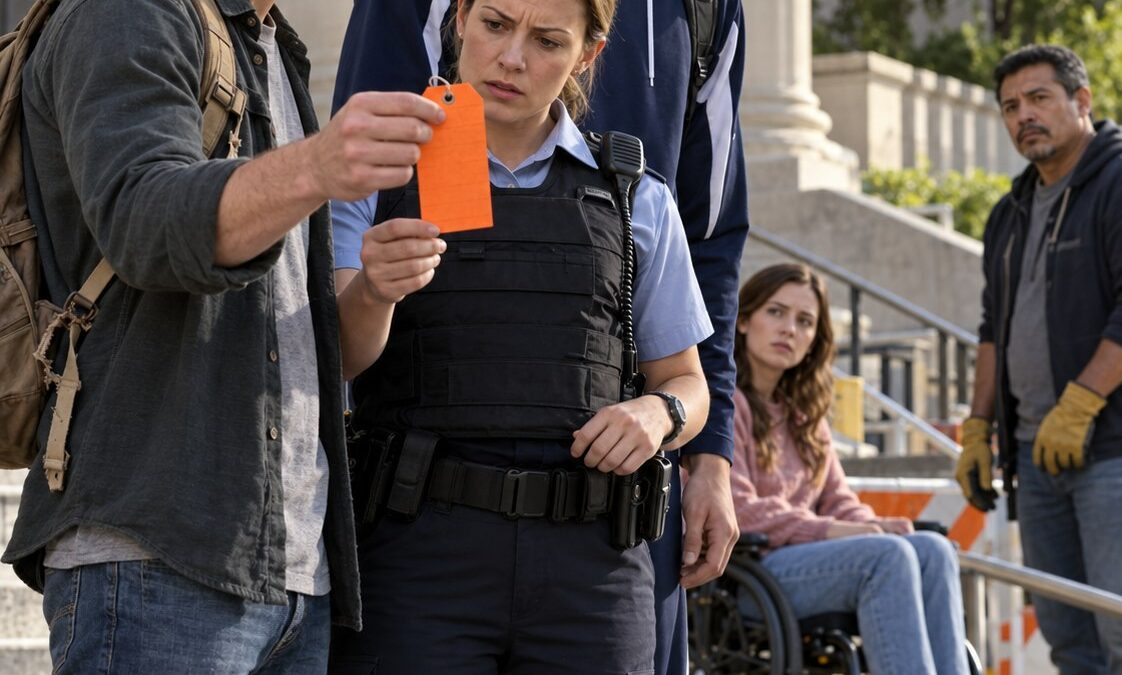
The officer held out her hand.
Nolan gave her the tag.
“Where did you get this?”
“On the rail.”
“Who put it there?”
“That’s what we’re asking.”
Brent folded his arms.
“Convenient answer.”
Officer Dena Price ignored him.
She read the tag again.
“Everyone stays off the ramp.”
Kira checked her phone.
“Eight minutes.”
Price looked toward the library doors.
“I can call the testing office.”
“Please do,” Kira said.
Brent moved closer.
“You can’t delay her exam for everybody.”
“The plate is open,” Price said.
“I can see that.”
Tomas bent to retrieve a screw.
Price stopped him.
“Leave it where it is.”
Tomas straightened.
His gloves trembled.
Nolan noticed the tremor.
He had worked with Tomas before.
Tomas arrived before dawn, kept spare batteries for the automatic doors, and knew which students needed the snow cleared first.
He had also signed the first complaint about this ramp.
That signature had nearly ended both their jobs.
Price called the testing office.
The proctor agreed to hold Kira’s seat and arrange access through the staff entrance.
Kira listened closely.
“How far?”
“Two minutes by cart.”
“Can my chair fit?”
Price measured the path with her eyes.
“Yes.”
“Then let’s move.”
Brent shifted into her path.
“I was trying to help you.”
“You could help now,” Kira said.
“Move.”
He did.
Price asked Tomas to guide Kira to the side door.
Tomas hesitated beside Nolan.
“You don’t need to stay.”
“I know.”
“They’ll use your record.”
“I know that too.”
Tomas’s mouth tightened.
Eighteen months earlier, Nolan had filed a safety report after the same plate tilted under a delivery cart.
By evening, Brent had accused him of shoving him during an argument in the athletics building.
The university had suspended Nolan before the week ended.
No police report followed.
His scholarship disappeared anyway.
The loading dock hired him because it did not ask for transcripts.
Price finished a second call.
“Facilities management wants the tag brought in.”
“Who requested it?” Nolan asked.
“Director Rusk.”
Brent’s eyes flickered.
It lasted less than a second.
Nolan had learned to count small things.
Rusk had overseen the earlier complaint.
He had also signed the letter saying Nolan’s account could not be trusted.
Price slipped the tag into a clear evidence sleeve from her cart.
“This number matters?”
“Yes.”
“Tell me why.”
Nolan looked toward the uncovered plate.
The metal beneath it had a black stamped mark.
He remembered crouching there eighteen months ago, writing down that same mark while a delivery cart rattled above him.
“The university paid to replace that plate,” he said.
“When?”
“The week after they suspended me.”
Price turned the tag over.
“Then why is the old plate still here?”
Nolan met her eyes.
“That’s what I came back to find out.”
* * *
Kira made her exam.
The proctor logged her arrival at 8:59 and gave her the full allotted time.
Price sent Nolan and Tomas to the campus safety office, where a staff member photographed the ramp from every side.
Brent was told to wait in a separate room.
His friends waited with him.
No one was asked to settle anything with a fist.
Nolan sat across from Price with his torn backpack at his feet.
She had the orange tag between them.
“You recognized the number immediately.”
“My first complaint was ticket 4187.”
“Do you have a copy?”
“Yes.”
“Why?”
“Because they said I never filed it.”
Nolan opened his phone.
The copy lived in three places.
One was his email.
One was on a drive his aunt kept in her kitchen drawer.
The third had gone to the attorney who handled his appeal.
Price read the confirmation message.
Its date was eighteen months old.
The ticket number matched.
So did the ramp location.
She asked him to send the message as an attachment.
He did it while she watched.
A forwarded screenshot could lose its context.
The original email kept its sender, date, and subject.
Price wrote those details beneath the tag number.
Tomas leaned forward.
“Mine was a separate report.”
“Did you keep it?” Price asked.
“I thought the system did.”
Price wrote that down.
The university’s facilities database showed ticket 4187 as resolved.
The closing entry claimed the ramp plate had been replaced by an outside contractor.
It listed a cost of $38,400 for the plate, anchoring hardware, labor, and temporary access.
The attached inspection said the work was complete.
Tomas stared at the screen.
“I cleaned around that plate last Friday.”
“Could it look the same?” Price asked.
“No.”
Nolan pointed to the photograph on his phone.
“The old plate has a welded corner.”
The photograph showed it clearly.
He had taken it before filing the complaint.
Price enlarged the fresh campus safety photo.
The same lumpy weld crossed the same corner.
She asked Nolan who had made it.
“I don’t know.”
“Then how can you identify it?”
“There are three short beads.”
He held up the older image.
“One points toward the rail.”
Price placed the images side by side.
The beads matched.
The black stamped mark matched too.
She did not declare fraud.
She sent both images to the facilities records manager and requested the contractor’s completion file.
By lunchtime, Nolan’s attorney called.
Her name was Imani Wells.
She had spent nine months getting his suspension removed from his transcript.
“I heard you found your old ramp,” she said.
“It found me.”
“That usually costs money.”
“I’ve got forty-six dollars until Friday.”
“Then let me do the talking.”
Wells met them at her office across town.
Tomas came with permission from his supervisor.
Kira joined after her exam, carrying a paper cup of tea she had forgotten to drink.
Her hands were steady around the cup.
Her voice was not.
“I finished,” she told them.
“Did they shorten your time?” Wells asked.
“No.”
“Did you have to ask twice?”
“Once was enough.”
Kira sat beside Tomas.
“That’s the first good thing today.”
Wells laid out the records Nolan already possessed.
His original report.
The university’s acknowledgment.
A photograph of the old plate.
The suspension notice.
The appeal decision.
Each document had a date.
Each date mattered.
“Your appeal restored your enrollment,” Wells said.
“It did not determine who gave false information.”
“Rusk,” Nolan said.
“Possibly.”
“He signed everything.”
“A signature proves he approved the decision.”
Wells tapped the table.
“We need to learn what he knew.”
Kira looked at Tomas.
“And who put my name in this.”
Price had forwarded a photograph of the tag with Tomas’s initials.
Tomas studied it for a long time.
“I make my T with a line across the top.”
The tag’s T had a loop.
Wells wrote that down.
“Can you prove where you were this morning?”
“I clocked in at six.”
“Anyone see you near the ramp?”
“I was in the library basement until eight.”
“Cameras?”
“There’s one at the service elevator.”
Wells asked him to request that footage through his union representative.
The union had already contacted him.
Its steward, Leland Park, arrived an hour later.
Park had the shift log.
Tomas had checked out floor equipment at 7:41.
Another custodian signed beside him.
The orange tag claimed Tomas had hung it at 7:42.
He could have crossed the building in a minute only if he had run through two locked doors.
He had not.
Still, Wells said, the shift log was only the beginning.
“Someone could say the time was written wrong.”
Park opened his notebook.
“The other custodian remembers him.”
“Get that in writing,” Wells said.
“I already asked.”
He slid a page across the desk.
Tomas read his coworker’s statement.
It described the equipment and the wet floor they had cleaned.
It also described Tomas complaining about the elevator music.
“That part sounds like me,” Tomas said.
“Most useful sentence on the page,” Park replied.
Nolan turned the tag photograph sideways.
“What about the punch?”
A small notch cut its upper corner.
Tomas frowned.
“Our current tags are square.”
“The old ones had that notch,” Nolan said.
“I remember inventorying them.”
He had helped facilities count supplies during his first semester.
Back then, the tags came in numbered books.
A tear-off stub stayed in the book.
The tag number appeared on both pieces.
“Where are the books now?” Wells asked.
Tomas considered.
“The records cage.”
“Who controls it?”
“Facilities.”
“Who controls facilities?” Kira asked.
Nobody answered immediately.
They all knew.
Wells requested preservation of the tag books, the database audit trail, elevator footage, and contractor files in writing.
She sent the request to the university’s general counsel and copied Price.
Before they left, she showed Nolan one older email.
It had been buried in his appeal materials.
Rusk had written to the dean after Nolan’s first safety report.
Delay the replacement until after the donor walk-through.
Nolan had seen that sentence before.
He had focused on the delay.
Wells pointed to the recipient list.
Brent Calder’s father was copied.
* * *
The next morning, Nolan found his class schedule gone from the student portal.
The page showed a blank grid.
His tuition payment had cleared.
His appeal decision remained valid.
Nobody could explain the hold.
Wells could.
“Someone wants you busy fixing your enrollment.”
Nolan stood outside the registrar’s office while she called general counsel.
A line formed behind him.
The student ahead needed a transcript.
The student behind needed a parking permit.
Nolan had already missed the first half of a lecture.
A clerk printed his account screen.
“It says administrative review.”
“Whose review?”
“There’s no name.”
“Can you put that in writing?”
The clerk looked uncomfortable.
She printed the screen instead.
Nolan thanked her.
He sent Wells a photograph.
By ten, his schedule returned.
By eleven, Tomas was removed from his library shift pending review.
Park filed a grievance.
Kira received an email inviting her to speak with a university public relations officer about her “experience of campus access.”
The message asked her to avoid speculation about ongoing maintenance.
She forwarded it to Wells.
“Is that a threat?” she asked.
“It’s a request you can decline.”
Kira declined.
They met at a diner near campus.
Tomas ordered soup and did not touch it.
Nolan ordered the cheapest breakfast on the menu.
Kira pushed the bowl toward Tomas.
“You’ve been up since five.”
“I’m not hungry.”
“Take three bites.”
He gave her a look.
She held up three fingers.
He took three bites.
Nolan smiled despite himself.
Kira caught him.
“You can eat yours too.”
“I am.”
“You’re arranging the potatoes.”
“They need direction.”
For a few minutes, the ramp stayed outside the booth.
Tomas told them about his wife’s vegetable garden.
Kira described an exam question that seemed written by someone who had never met a human being.
Nolan admitted the loading dock had sent him a text asking whether he could cover a shift.
“Will you?” Kira asked.
“I need the money.”
“You also have class.”
“I’ve missed class before.”
The joke landed badly.
He set down his fork.
“The first time they suspended me, I thought the appeal would take a week.”
Tomas looked at the table.
“I should have spoken sooner.”
“You signed the report.”
“I let them tell me it was finished.”
“You trusted the record.”
“I knew the plate was still there.”
Tomas’s voice dropped.
“I kept thinking someone else would reopen it.”
Nolan did not absolve him.
He also did not move away.
“Help us now,” he said.
Tomas nodded.
He took another spoonful of soup.
It had gone cold.
Kira caught the server’s eye and asked her to warm it.
Tomas started to protest.
“It’s soup,” she said.
“I can ask.”
Nolan’s phone buzzed.
His loading dock supervisor needed an answer by noon.
He typed that he could work Saturday.
He could not miss another class.
The supervisor replied with a single word.
Fine.
Nolan turned the phone over.
The decision still cost him Friday’s shift.
He ate the potatoes.
That afternoon, Park brought news from the records cage.
The old tag books were gone.
A clerk said they had been transferred to storage.
The storage list did not mention them.
Price opened an inquiry into the missing materials and asked the university to preserve access logs.
Wells advised everyone to stop visiting the cage.
Evidence moved better through requests than through locked doors.
A contractor named Halden Works supplied the completion file.
It contained a photograph of a new ramp plate.
The photograph had no library doors, no rail, and no identifying view of the site.
Its invoice referenced ticket 4187.
The metal in the photograph had a smooth factory corner.
The plate at Northlake had Nolan’s old weld.
Wells called the contractor.
A manager refused to discuss the account without the university’s permission.
Twenty minutes later, he called back.
He had checked their delivery records.
Halden Works had supplied a plate.
It had been sent to Northlake’s athletics training center.
The charge had later been reassigned to ticket 4187.
The manager would provide the records to an auditor.
“Who authorized the reassignment?” Wells asked.
He read the name.
Director Adrian Rusk.
* * *
Rusk agreed to meet in the university counsel’s conference room.
He arrived in a navy suit with a slim folder.
His expression softened when he saw Tomas.
“You should have called me,” he said.
“I reported the plate.”
“Recently?”
“Eighteen months ago.”
Rusk sat.
“That report was resolved.”
Nolan watched him place the folder squarely before him.
Rusk never looked at the photograph Wells had brought.
Counsel introduced a risk officer and an internal auditor.
Price attended because the tag had been reported as possible falsified safety documentation.
Park sat beside Tomas.
Kira had asked to be present.
The university allowed it because the ramp closure had affected her exam.
Wells began with the contractor’s delivery record.
Rusk studied it.
“A coding error.”
“On a $38,400 repair?” the auditor asked.
“Budgets cross departments.”
“The invoice says library ramp.”
“The vendor may have used the wrong description.”
Wells slid over the photograph of the old weld.
“Was this plate replaced?”
Rusk looked once.
“I don’t inspect plates personally.”
“Who certified the work?”
“My deputy.”
“Your signature approved payment.”
“That is an administrative approval.”
The auditor unfolded a copy of the inspection.
“Your deputy’s name is typed here.”
“Yes.”
“He was on leave that week.”
Rusk glanced at the page.
“Someone may have entered it later.”
“Did you ask who?”
“I had no reason to.”
He had an answer for each document.
Some answers were possible.
That was why Wells had waited.
Kira leaned forward.
“Why was there an orange tag yesterday?”
Rusk turned to her.
“We closed a ramp that appeared unsafe.”
“Who?”
“Facilities staff.”
“Tomas was in the basement.”
Rusk’s expression did not change.
“I haven’t seen the footage.”
Price spoke.
“Neither have I.”
Kira sat back.
Rusk looked toward Nolan.
“You understand why we take conflicts seriously.”
Nolan said nothing.
“Last time you raised this issue, an altercation followed.”
“You accused me of one.”
“Brent reported one.”
“Brent is your nephew,” Wells said.
Rusk’s pen stopped.
“That relationship was disclosed.”
“It wasn’t in Nolan’s disciplinary file.”
“It wasn’t relevant to the plate.”
“It was relevant to your letter about Brent’s credibility.”
Rusk closed the folder.
“Counsel, I would like a moment.”
The meeting paused.
In the hallway, Nolan found Brent beside a vending machine.
Brent had not been invited inside.
He watched Nolan approach.
“You really think this ends with a tag?”
“I think it starts there.”
“My uncle kept this place running.”
“Then he should know where the repairs went.”
Brent stepped forward.
Nolan held his ground.
Wells opened the conference door behind him.
“Back inside, Nolan.”
Brent laughed once.
“He always needs somebody to save him.”
Nolan turned.
“You had eighteen months.”
Brent’s smile faded.
“You could have told the truth any day.”
Inside, the auditor had received another document.
Halden Works had sent a purchase authorization bearing Rusk’s electronic approval.
The new plate had gone into the training center.
A different budget line paid for its installation there.
The library ramp had been charged for both.
Rusk called it an internal allocation problem.
The auditor did not agree.
Yet the missing tag books and the false initials remained unexplained.
Without those, Rusk could still argue that yesterday’s closure was a good-faith response to danger.
Wells asked whether the old incident report had been reviewed independently.
Counsel said the university had relied on witness statements.
“Whose?”
“Brent Calder and two teammates.”
Nolan knew both teammates.
They had been beside Brent at the ramp.
The auditor made a note.
“Were they interviewed separately?”
Counsel checked the file.
“The statements were submitted together.”
“On the same day?”
“Within an hour.”
Nolan remembered the hearing.
He had asked to see any camera footage.
The conduct officer said none was available.
He had asked why Brent’s teammates used the same phrase for the shove.
The conduct officer said friends often remembered events alike.
Price’s phone rang.
She stepped out.
When she returned, she gave the auditor a small nod.
The service elevator footage had been retained.
At 7:42, Tomas and another custodian were unloading equipment in the basement.
At 7:44, a person carrying an orange tag crossed the library’s exterior camera view.
The image showed a dark jacket and a red athletic duffel.
No face.
Rusk spread his hands.
“That could be anyone.”
Price agreed.
“It could.”
Then she put a still photograph on the table.
The duffel carried Brent Calder’s team number.
* * *
Brent entered the room with his coach.
He looked first at the photograph.
Then at his uncle.
Coach Wallace stayed by the door.
He had coached Brent for three years and looked exhausted enough to have coached him for ten.
“Tell them what happened,” Wallace said.
Brent pulled out a chair.
“Someone asked me to put up a warning.”
“Who?” Price asked.
“My uncle.”
Rusk’s jaw tightened.
“That isn’t accurate.”
“You said the ramp needed closing.”
“I said maintenance would handle it.”
“You gave me the tag.”
Wells turned toward Rusk.
“From an old numbered book?”
“I don’t know where it came from.”
The auditor asked Brent about Tomas’s initials.
Brent stared at the orange tag.
“I didn’t write them.”
“Who did?”
“I don’t know.”
Price kept her voice even.
“You carried the tag at 7:44.”
“I clipped it to the rail.”
“And then?”
“I waited.”
“For whom?”
Brent glanced at Nolan.
“My uncle said Nolan was coming back.”
The room changed around that sentence.
The coach looked at Rusk.
Rusk looked at the ceiling.
Brent kept talking.
“He wanted someone there when Nolan saw the tag.”
“Why?” Wells asked.
“To show he was still making trouble.”
Nolan felt his hands tighten beneath the table.
Wells noticed.
She placed her pen beside him.
A small, ordinary gesture.
He let his hands open.
Rusk recovered first.
“My nephew misunderstood a conversation.”
Brent snapped toward him.
“You told me he’d recognize the number.”
“Because he filed the original complaint.”
“You told me to make him touch it.”
“I did not.”
“Then why was I there?”
“Brent,” Wallace said.
Brent fell silent.
The auditor lifted the tag’s evidence sleeve.
“Who wrote Tomas Ibarra’s initials?”
Rusk looked at counsel.
“I won’t speculate.”
That answer kept him out of one admission.
It did not answer the access log.
The records clerk had found the old tag book in a locked cabinet in Rusk’s office that morning.
The university had opened the cabinet with his department’s key in the presence of counsel and the auditor.
The book was numbered.
A stub for the orange tag remained.
Its back carried a carbon impression.
The writing on the tag and stub matched.
So did the initials.
Beside them, in a space marked AUTHORIZED BY, stood Rusk’s signature.
Tomas leaned forward.
He did not touch the sleeve.
“Is that my name?”
“It appears to be,” the auditor said.
“I didn’t give it to him.”
“Your statement is on record.”
Tomas sat back.
For the first time that morning, he looked angry.
Rusk studied the stub.
“That book may have been in my office for years.”
“Of course,” Wells said.
“That’s where you took the tag.”
Rusk gave her a sharp look.
The auditor placed a second record beside the stub.
It was an electronic request to reopen ticket 4187 at 6:18 the previous evening.
Rusk had submitted it from his university account.
The request named Nolan’s return as a “communications concern.”
It directed staff to close the ramp before morning foot traffic.
No repair crew was scheduled.
Tomas had not been notified.
“I wanted people protected,” Rusk said.
“You wanted the ramp closed,” Kira said.
“Your safety mattered.”
“You used my way into the library.”
Rusk’s face hardened.
“You cannot know the pressures on this institution.”
“Tell us,” the auditor said.
Rusk did.
The training center renovation had been promised to a major donor before the season began.
Delays threatened the gift.
Money had been shifted between facilities accounts to keep construction moving.
He insisted the library ramp would have been repaired later.
The auditor asked how many later invoices remained unpaid.
Rusk would not answer.
“You got the center open,” Nolan said.
“You got suspended.”
“That was the conduct process.”
“Three statements from Brent’s friends.”
Rusk leaned forward.
“You put yourself in that hallway.”
“I went there to ask about the repair.”
“You confronted my nephew.”
“I asked him to stop kicking the plate.”
“He said you grabbed him.”
Nolan looked at Brent.
Brent’s ears had gone red.
Wallace spoke quietly.
“Tell the truth.”
Brent rubbed his face.
“He grabbed my sleeve.”
“After what?” Price asked.
“I shoved him.”
“Hard?”
“Hard enough.”
Nolan remembered the wall against his shoulder.
He remembered staying upright while Brent’s friends shouted.
There had been no fight.
The original security camera had faced the hallway.
During Nolan’s appeal, the university said its recording had already been overwritten.
Wells had never claimed otherwise.
Now the auditor explained that building security also kept entry logs for the athletics wing.
Brent’s card had opened the equipment room two minutes before the alleged assault.
Both teammates had used their cards immediately after.
Nolan’s card had not opened any door.
The logs did not show a shove.
They did place the three witnesses together before they gave nearly identical statements.
That mattered.
The auditor closed the file.
“Those statements need another review.”
“They’ll say I lied,” Brent said.
“You just told us they were incomplete,” Wallace replied.
Brent looked at Nolan.
Nolan gave him no reassurance.
He had spent eighteen months with a finding in his file.
Brent could spend one afternoon facing his own words.
Price made a separate note about the false tag.
She said police would determine whether any crime had been committed.
The university placed Rusk on leave that afternoon.
It suspended Brent from team activities pending a conduct review.
The damaged ramp stayed closed.
A contractor installed a temporary accessible route that week.
The permanent repair followed after an independent inspection.
Those were immediate steps.
The slower ones took months.
An outside firm reviewed the facilities accounts.
It found several charges moved from library and classroom repairs to the athletics renovation.
The total exceeded $200,000.
The university referred the findings to prosecutors.
Wells called Nolan when the referral became public.
He was on a break at the loading dock.
A truck backed toward the bay.
He asked her to repeat the amount.
She did.
Nolan looked at his gloved hand.
He had earned less than that during the eighteen months away.
“Does this change my case?” he asked.
“It gives us records we didn’t have.”
“Will they read my old report?”
“Yes.”
He thanked her.
Then he finished unloading the truck.
Rusk eventually pleaded guilty to falsifying business records and misusing university funds.
A judge ordered restitution and probation.
The university removed him from office.
Brent’s conduct case ended with a season suspension, community service, and a written correction to Nolan’s old file.
He was allowed to finish his degree under conduct conditions.
Tomas was restored to his regular shift and paid for the days he had lost.
At the final university hearing, Rusk saw Nolan in the corridor.
“You’ve made a career out of one loose plate,” he said.
Nolan lifted his repaired backpack.
“No.”
He passed him without raising his voice.
“I came back for my education.”
* * *
October brought rain to Northlake.
It also brought Nolan’s first midterm in eighteen months.
He arrived with two pencils, a calculator, and a receipt for a bus pass he could barely afford.
Tomas waited outside the classroom building.
“You’re early.”
“I’m nervous.”
“That’s allowed.”
“You didn’t have to come.”
“I know.”
Tomas held out a paper bag.
Nolan looked inside.
A sandwich.
An apple.
Three cookies.
“I only have a two-hour exam.”
“Then you can eat after.”
Nolan took the bag.
“Did Kira tell you to do this?”
“She told me you forget lunch.”
“I don’t forget it.”
“You postpone it until dinner.”
“That’s different.”
Tomas smiled.
Nolan went inside.
He knew some people still recognized him.
A video of Brent grabbing his backpack had traveled farther than the correction to his disciplinary file.
A few students had watched both.
Most had only watched the first.
He could live with that.
The university had offered him a settlement through Wells.
It covered tuition he had lost, legal costs, and part of the wages he could show he would have earned in a campus job.
The amount was real money to him.
It was also smaller than the eighteen months it could not return.
Wells read every line before he signed.
She had him read it too.
He stopped at the paragraph about his transcript.
“Will this remove the suspension?”
“It already has.”
“Then what does this do?”
“It requires the university to send a corrected record to anyone who received the old one.”
Nolan thought of the internship that had stopped replying.
“Can they do that?”
“They can send the correction.”
“They can’t make someone read it.”
“No,” Wells said.
Nolan signed anyway.
He wanted the record to tell the truth.
Nolan used part of it to clear his debts.
He set aside enough for the rest of his degree.
Then he paid Tomas back for the mornings Tomas had driven him to work after his bus route changed.
Tomas returned the envelope.
“You’re ridiculous.”
“It’s gas money.”
“You repaired my kitchen sink last winter.”
“That was twenty minutes.”
“It flooded for three days before you came.”
Tomas tucked the envelope into Nolan’s backpack anyway.
Nolan found it later with a note.
Buy a second strap.
The rest of the settlement funded a small emergency grant through the student access office.
Students could use it for transport when a broken entrance, elevator, or route kept them from class.
Kira helped write the rules.
She insisted the application fit on one page.
“You shouldn’t need an essay to get across campus,” she said.
The access office agreed.
At the first meeting, an administrator suggested three approvals.
Kira asked how long those would take.
“Perhaps two business days.”
“And if the exam is today?”
The administrator crossed one approval off.
Nolan suggested posting a phone number beside every route closure.
Someone suggested an online form.
“Both,” Kira said.
“My phone can die.”
The grant did not solve every broken thing.
It paid for rides while repairs happened.
That was enough to matter on certain mornings.
Brent sent Nolan an apology in November.
It was typed, signed, and delivered through the conduct office.
Nolan read it once.
Brent admitted lying about the hallway encounter.
He admitted using his friends’ statements to support it.
He said he had been afraid of losing his place on the team.
Nolan believed that part.
Fear could explain a choice without excusing it.
Brent asked to speak in person.
Nolan said yes to one meeting with Wells present.
They sat in her office, where Brent looked less imposing without a crowd behind him.
“I’m sorry,” he said.
Nolan waited.
“I should’ve told them I shoved you.”
“Yes.”
“I should’ve left Tomas alone.”
“Yes.”
“And Kira.”
“Yes.”
Brent looked at his hands.
“I thought if I backed down, everyone would see it.”
“They did.”
“That’s fair.”
Nolan did not offer him forgiveness.
He gave him a boundary.
“Don’t contact Tomas or Kira again unless they ask you to.”
Brent nodded.
“Will you tell people I apologized?”
“No.”
Brent accepted that too.
After he left, Wells asked Nolan whether the meeting had helped.
“A little.”
“That’s enough for today.”
Tomas’s relationship with Nolan took longer to mend.
At their weekly breakfasts, Tomas began telling him things he had once avoided.
He had seen Rusk at the ramp after the original complaint.
Rusk had promised a repair before winter.
Tomas had believed him because people in suits signed the work orders.
When Nolan was suspended, Tomas had written one letter for his appeal.
Then he had stopped pressing.
“I thought I’d lose my job,” Tomas said.
“You might have.”
“That doesn’t change what you lost.”
“No.”
Nolan ate half a pancake.
“I still want breakfast next week.”
Tomas looked up.
“That, I can do.”
Kira finished the semester with strong marks.
Her scholarship stayed in place.
She and Nolan became friends in the ordinary way: shared notes, bad vending-machine coffee, arguments about movies neither wanted to admit they liked.
One evening, she rolled beside him past the repaired library ramp.
The new plate sat flush with the path.
Its bolts were easy to see.
She stopped at the bottom.
“May I ask you something?”
“Sure.”
“Would you come to the access committee meeting with me?”
“I’m not on the committee.”
“They can invite students.”
“I’m terrible at meetings.”
“You’re good at noticing what people walk past.”
Nolan looked at the ramp.
He had noticed it before anyone wanted him to.
“Yes,” he said.
“But you’re presenting.”
Kira grinned.
“I was already going to.”
They went together.
Nolan brought photographs and a list of other campus routes that needed inspection.
He also brought one rule for himself.
He would ask before speaking for someone else.
Kira approved.
* * *
Three years later, Nolan crossed the library steps in a navy graduation gown.
He had finished his engineering degree one semester later than planned.
Tomas called that an impressive recovery from an eighteen-month interruption.
Nolan called it a scheduling problem.
The repaired ramp was busy.
Students used it with chairs, carts, bicycles, luggage, and coffee balanced in dangerous towers.
A first-year student stopped near the rail.
An orange tag hung from her hand.
Nolan felt himself pause.
Then he saw her smile.
The tag was clean.
No false initials.
No closed ticket.
Kira had made it for him.
On one side, she had printed ticket 4187.
On the other, she had written:
OPEN.
Tomas arrived carrying a camera.
“Stand together,” he ordered.
“You sound like security,” Nolan said.
“I learned from the best.”
Kira rolled between them.
Tomas gave his phone to a passing graduate.
“Please get the ramp in the picture.”
The graduate stepped back.
Nolan held the orange tag.
It no longer claimed a repair had happened.
It marked the work they had seen through.
The contractor had replaced the plate.
Tomas had kept his job.
Kira had kept her exam and scholarship.
Brent had corrected his lie.
Rusk had answered for his records.
And Nolan had come back for his education.
The graduate raised the phone.
“Ready?”
Kira looked at Nolan.
“You can still step away.”
“I know.”
Tomas put an arm around his shoulders.
Nolan stayed.
The camera caught all three of them at the foot of the ramp, with its clear path rising into the library behind them.
THE END








