The Restoration Worker Made His Silent Sister Laugh Over a Paper Boat—Then the Crime Boss Read the Name Beneath It
Chapter 2: The Name Beneath
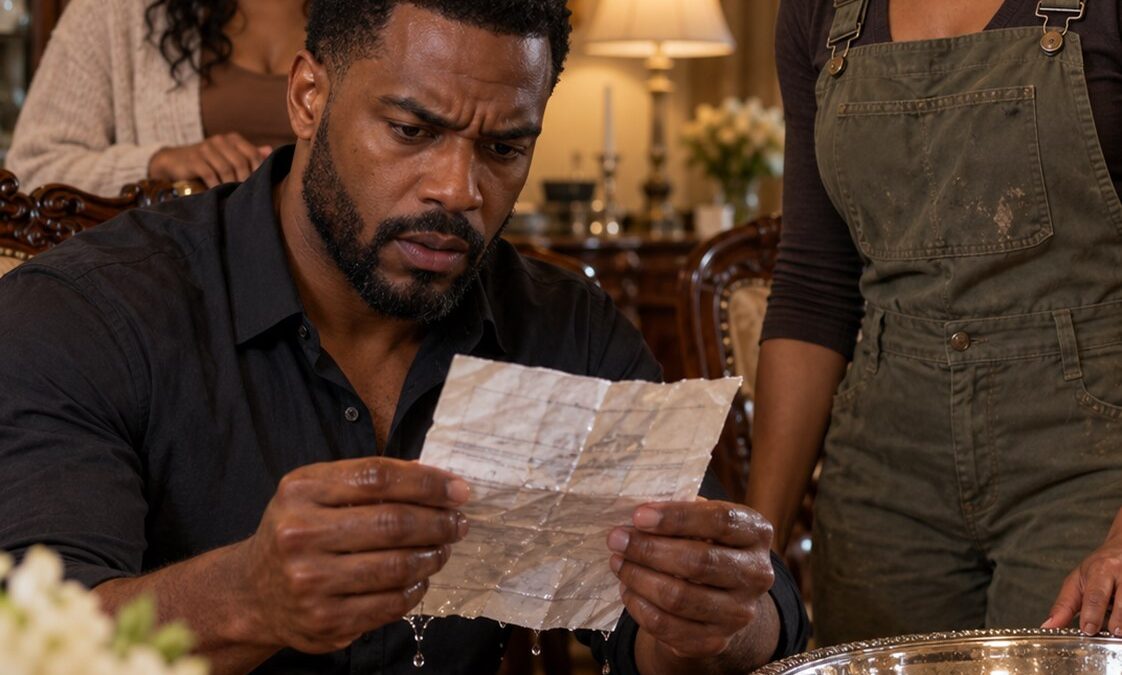
Adrian held the wet paper by its corners.
The ink had spread, but the signature remained clear.
Elena Bellandi.
His mother had died in the Marlowe Theater fire on October ninth.
The receipt was dated October twentieth.
“Who gave her this?”
The restoration worker glanced at Wren.
“Ask her.”
Wren had backed against the dining room wall.
Adrian lowered his voice.
“Was it Uncle Rafe?”
She flinched.
The worker stepped between them.
“She’s trying to answer.”
Adrian looked at his sister.
He had mistaken her silence for an empty space he had to fill.
“Did Rafe give it to you?”
Wren shook her head.
She reached for the silver serving tray.
Adrian moved aside.
With one finger, she traced three circles in the water.
Then she drew a line through them.
“The pedestrian bridge?” Adrian asked.
Wren nodded.
“The one behind the theater?”
Another nod.
“You found it there?”
She shook her head.
“I found it,” the worker said.
“My father kept it with the theater records.”
Adrian turned toward her.
“Who is your father?”
“Graham Pike.”
He knew the name.
Graham had been accused of moving theater money before the fire.
Rafe had shown Adrian the records himself.
“Your father stole from us.”
“No.”
“Rafe had proof.”
“Rafe had copies.”
She laid the receipt on a dry napkin.
“My father kept the originals.”
“What’s your name?”
“Tessa Pike.”
Adrian looked at Wren.
“You knew who she was?”
Wren nodded.
She had known something about this woman that he had never thought to ask.
A fold opened as the paper dried.
Beneath the bank stamp sat a second name.
Wren Bellandi.
“She was in the hospital that day,” Adrian said.
“I know.”
Wren covered her ears.
Adrian stopped speaking.
Tessa pulled out a chair and waited.
Wren sat when she was ready.
Adrian had spent six years approving her treatments.
He could not remember the last time he had waited for her.
“Why bring the receipt here?” he asked.
“Dad found it last month,” Tessa said.
“He tried to send you a letter years ago.”
“I never got one.”
“Your office returned it unopened.”
Rafe had managed Adrian’s correspondence then.
Wren touched the boat with one finger.
“She recognized the bank stamp,” Tessa said.
“I’d folded a copy while I worked.”
“Where was this one?”
“In the lining of Wren’s coat.”
Adrian studied the worn crease.
She had carried the receipt since the fire.
She had kept it through appointments, moves between rooms, and every search he had ordered for something that might help her.
No one had asked about her coat.
Wren took the pencil from Tessa’s pocket.
She wrote on the napkin.
MOM DID NOT SIGN.
Adrian reached for his phone.
“I’ll call my attorney.”
Wren caught his sleeve.
He looked at her.
“I’ll tell him what you found,” Adrian said.
“Is that all right?”
She released him.
Then she nodded.
* * *
Paul Sethi arrived with the theater account records.
Graham Pike came an hour later.
He carried a canvas case and did not offer Adrian his hand.
Wren entered when she heard his voice.
Graham stopped beside the table.
“You got tall,” he said.
She held up six fingers.
“I know,” he said.
“I should have come sooner.”
She took his hand.
Adrian had known Graham as a name on a dismissal report.
Wren knew him well enough to cross the room.
Graham spread the ledgers across the dining table.
The receipt recorded a $480,000 theater deposit.
It called the money a gift from Elena and Wren.
“Where did it come from?” Paul asked.
Graham opened another ledger.
Two days earlier, $480,000 had left Wren’s trust.
It passed through North Pier Holdings.
Then it returned to the theater.
“Rafe owns North Pier,” Adrian said.
Graham nodded.
“He approved the trust transfer.”
The trust owned most of the theater land.
Rafe managed it while Wren could not.
Adrian controlled the family shipping company.
He had assumed Rafe protected Wren’s interest.
He had signed acknowledgments of the trust reports without examining the transfers behind them.
“Why call her money a gift?” Adrian asked.
“To hide the trust advance,” Graham said.
“And make the theater look dependent on family donations.”
Paul studied the entries.
“These are your originals?”
“These are the theater’s originals,” Graham said.
“I took copies when Rafe dismissed me.”
“We need the bank’s image,” Paul said.
“I asked for it,” Graham replied.
“They would only release it to the account holder.”
Adrian turned to Paul.
“Request it.”
Paul placed the receipt in a clear sleeve.
He would also demand a full trust accounting.
That would take time.
The bank image might arrive sooner.
Wren slid a drawing across the table.
It showed the theater’s rear bridge.
Near one end, she had drawn a square.
“The maintenance box?” Graham asked.
Wren shook her head.
She added an arrow beneath the bridge.
“The bracket below it?” Tessa asked.
Wren nodded.
“Your mother hid spare keys there,” Graham said.
“After the fire, Wren tried to take us across.”
Adrian remembered.
Rafe had said the bridge was unsafe.
Wren had pointed toward the canal.
Adrian had told her to listen to their uncle.
She had followed him back to the car.
He had remembered the moment as grief.
She had been giving him directions.
“Someone will inspect it,” he told her.
“We’ll go if it’s sound.”
Paul’s phone rang.
The bank had found an electronic image.
Its record said Elena presented the deposit in person.
Graham pushed back his chair.
Wren remained still.
“Who handled it?” Tessa asked.
“Marion Keene,” Paul said.
Graham recognized the name.
Marion had worked at the branch for decades.
As Paul called to find her, Wren took her pencil again.
She wrote UNCLE beneath the bridge.
“Rafe took you there?” Adrian asked.
Wren shook her head.
She underlined the word and pointed to the bracket.
Rafe knew where their mother hid things.
Adrian looked toward the windows.
The bridge was beyond them, past the canal bend.
He had driven over the nearby road hundreds of times.
The next morning, a medical transport van arrived outside his house.
Rafe came through the gate carrying a leather folder.
Two attendants waited by the front steps.
Adrian met his uncle in the hall.
“What is this?”
“An independent assessment.”
“For Wren?”
“She missed three appointments.”
Adrian had canceled them after seeing her fear.
He had meant to find another doctor.
He had not done it.
Rafe opened the folder.
“The trust requires an assessment before the property vote.”
“What vote?”
“The city offered to buy the theater block.”
“You said that was months away.”
“The vote is Monday.”
It was Thursday.
Paul had received no notice.
Rafe looked past Adrian toward the dining room.
Wren stood there with Tessa.
“She’s been agitated,” Rafe said.
“She’s been trying to tell us something.”
“For years.”
Rafe shut the folder.
“That worker is Graham Pike’s daughter.”
“I know.”
“She came here for a reason.”
“Yes,” Tessa said.
“I wanted someone to check the books.”
Rafe looked pleased by her answer.
“She admits it.”
“She applied under her real name,” Adrian said.
Rafe faced her.
“What exactly are you restoring?”
“The theater fixtures you brought here.”
Adrian had seen their boxes in storage.
He had never asked who had sent them.
“The assessment still happens,” Rafe said.
“No.”
“I’m the trustee.”
“And this is my home.”
Rafe studied him.
Then he waved the attendants back to the van.
No one touched Wren.
She still held the doorway until they left.
Paul reviewed the notice that morning.
He advised Adrian to keep Wren’s regular doctor involved and challenge Rafe’s request through the court.
“We’ll do it properly,” he said.
Adrian called the doctor himself.
He explained what he had canceled and why.
The doctor offered to review Wren’s records and arrange an appointment she could attend by choice.
By noon, Paul had found Marion Keene.
She lived twenty miles away.
Adrian drove there with Tessa and Graham.
Wren chose a longtime family friend to stay with her.
Adrian asked before leaving.
Marion invited them onto a porch lined with herbs.
She remembered Elena.
Elena had opened the theater’s youth program account.
“I didn’t take a deposit from her after the fire,” Marion said.
“Can you be certain?” Paul asked over the phone.
“I remember Rafe coming in that week.”
He had asked whether a family representative could make a deposit for an estate.
Marion told him anyone could deposit money.
“He asked if I’d need to see the signer.”
“What did you say?” Adrian asked.
“Only for a withdrawal.”
Another teller handled the deposit after Marion’s shift ended.
Marion remembered leaving early for a dentist appointment.
She agreed to give Paul a statement.
On the drive home, Adrian asked Tessa why she had taken the restoration job.
“Your mother let Dad bring me to the theater after school,” she said.
“I grew up backstage.”
“And Wren?”
“She let me sit beside her during rehearsals.”
Tessa watched the canal through the window.
“She noticed me when nobody else did.”
Adrian kept his eyes on the road.
He had thought of the theater as Elena’s project.
He had never understood how many people had belonged there.
Back home, Wren handed him the dry paper boat.
He tried to refold it.
The weakened paper bent unevenly.
“I’ll ruin it,” he said.
Wren drew a boat on a clean sheet.
She pushed the drawing toward him.
A copy.
Adrian understood.
That evening, Paul called with the bank scans.
The teller had checked “presented by agent.”
On the reverse was a name.
Rafe Bellandi.
Paul had found something else.
Three weeks before the fire, North Pier had prepared an offer to buy the theater.
Rafe had told Adrian it was failing.
He had been trying to buy it.
* * *
Adrian wanted to confront Rafe.
Paul asked him to wait for the records.
He obtained a temporary court order preserving the trust files.
Adrian gave Paul every acknowledgment he had signed.
His own name appeared beneath reports that left out the transfer.
He did not ask Paul to hide them.
On Friday, an engineer inspected the rear bridge.
The railings needed repair.
The structure was sound.
With city permission and an officer present, the engineer opened the bracket.
A narrow tin case lay inside.
Paul unwrapped its oilcloth at his office.
The first page was Elena’s letter to her attorney.
She had discovered transfers from Wren’s trust through North Pier.
She intended to remove Rafe as trustee and audit the theater.
The second page instructed the bank to require independent approval for trust withdrawals.
“We’re checking whether they received it,” Paul said.
The final item was a photograph.
Elena, Wren and Graham stood on the bridge.
On its back, Elena had written:
Wren knows where the originals are.
Adrian faced his sister.
“Where?”
She pointed to the photograph.
Behind them stood the theater sign.
Graham leaned closer.
“Your mother kept a fireproof contract box in its cabinet.”
The sign had been removed after the fire.
It sat in the same warehouse as the fixtures.
Rafe paid the storage bill.
Paul arranged access before the storage company released anything to him.
At the warehouse, a technician opened the sign cabinet.
Inside sat a metal box.
Its lock had been forced.
It was empty.
Wren’s face tightened.
Adrian felt an old promise rising in his throat.
He could not promise that the papers were there.
“What did you expect?” he asked her.
She wrote three words.
THE OTHER SIDE.
The technician removed the backing panel.
An envelope was taped behind it.
It held original bank notices, Elena’s audit request and a letter from Rafe’s lawyer.
The letter proposed selling Wren’s theater interest to North Pier.
Elena had marked it REJECTED.
The offer came before the fire.
The false family deposit came after.
Rafe had taken trust money, passed it through his company and returned it as a supposed gift.
The theater books then hid the trust advance.
The forged signatures suggested Elena and Wren approved.
“What was the sale worth to him?” Adrian asked.
Paul checked the proposal.
“Control of the land and the canal frontage.”
North Pier owned the warehouse parcel beside it.
Together, the properties would make a much larger redevelopment site.
Graham found a maintenance log in the envelope.
Before the fire, he had reported faulty dressing room wiring.
Rafe canceled the repair order during sale negotiations.
“That doesn’t prove he started the fire,” Paul said.
“No,” Adrian replied.
He read Rafe’s signature on the cancellation.
“But he knew about the warning.”
Wren touched the log.
Adrian waited for her to write.
She wrote nothing.
For once, he let the silence remain hers.
That evening, Tessa stayed to review the fixture inventory with Graham.
Wren joined them at the dining table.
Adrian brought the silver tray from the sideboard.
He paused before setting it down.
Wren pulled it toward herself.
She drew the bridge in the last of the water.
Graham recognized the shape at once.
“She used to watch us cross from the rehearsal window,” he said.
Wren added a small square beside the line.
“The sign,” Tessa said.
Wren nodded.
Adrian thought of the fire, the years after it, and every expensive attempt he had made to reach her.
A tray of water had brought them farther because someone had followed where her finger went.
He set a towel beside her drawing.
She used it when she was finished.
* * *
On Monday, Rafe entered Paul’s office with two lawyers.
Wren sat beside an independent attorney appointed to advise her on the property decision.
Graham and Tessa sat across from them.
Adrian took the last chair.
Paul laid out the trust transfers.
Rafe listened calmly.
“The theater needed money,” he said.
“I used the trust for Wren’s benefit.”
“You routed it through North Pier,” Paul replied.
“To protect the family’s privacy.”
“You reported it as a gift from Elena and Wren.”
“I did not sign for either of them.”
Rafe turned toward Wren’s attorney.
“This account comes from a distressed young woman.”
“Graham Pike’s daughter has encouraged it.”
Tessa remained still.
Rafe looked at Adrian.
“You know how Wren was after the fire.”
“She couldn’t explain what happened then.”
Adrian thought of the tray.
The circles.
The bridge.
The sign.
“She showed us where to look,” he said.
“She kept that receipt for years,” Rafe answered.
“Why bring it out now?”
“She tried before.”
Adrian met his uncle’s eyes.
“I didn’t listen.”
Rafe’s expression tightened.
Paul slid forward the certified bank image.
Rafe’s name appeared as the presenting agent.
Marion’s statement described his questions before the deposit.
“The deposit alone isn’t a crime,” Rafe said.
“The false signatures and accounting are under investigation,” Paul replied.
Wren’s lawyer opened the hospital records.
Wren had remained in care throughout October twentieth.
Elena’s death certificate established she could not have signed that day.
Rafe suggested Graham had altered the paper.
Paul showed him the bank’s own archived image.
The bank had retained a still from its camera after a teller filed an incident note about Rafe’s request to waive a signature check.
Rafe stood at the counter holding the red form.
Then Paul placed Elena’s rejected offer beside the letter from Rafe’s former counsel.
Neither document came from Graham’s files.
Rafe’s lawyers stopped taking notes.
Wren reached for her pencil.
She wrote one sentence and handed it to Adrian.
YOU TOLD ME I CAUSED IT.
Adrian read it aloud.
Rafe leaned back.
“She was near the dressing room,” he said.
Wren wrote again.
YOU SENT ME THERE.
Graham opened the maintenance log.
Before a buyer’s private tour, Rafe had asked Wren to check the dressing room lights.
He had already canceled the repair.
“You blamed her for following your instruction,” Adrian said.
Rafe looked at Wren.
“She wouldn’t stop asking what happened.”
Wren set down her pencil.
She had waited six years to hear that admission.
Rafe straightened the papers in front of him.
“The fire would have happened anyway.”
“No one here can know that,” Wren’s attorney said.
Rafe turned to Adrian.
“If you had managed the theater yourself, you might have seen the same repair order.”
Adrian felt the sting.
He had stayed away from Elena’s work.
He had trusted Rafe with Wren’s future.
Neither failure made the signatures real.
“I should have checked,” he said.
“You still forged their names.”
Paul ended the meeting.
He gave the financial records to the authorities investigating the transfers.
He petitioned the court to suspend Rafe as trustee.
The city postponed its vote.
Investigators interviewed bank staff and theater employees.
They traced the money through North Pier and compared the signatures with known originals.
Rafe’s former lawyer confirmed his office had sent the rejected offer.
The bank located no independent approval for the trust withdrawal.
Months later, Rafe admitted forging the signatures and filing false trust accounts.
The court ordered restitution and barred him from managing Wren’s trust.
The fire was examined separately.
The maintenance records showed Rafe ignored a warning.
They did not prove he started the fire.
No one claimed they did.
Before sentencing, Rafe asked to speak with Wren.
She declined.
He sent a letter.
At her request, Paul read it first.
Rafe wrote that everything he had done was for the family.
Wren wrote her answer beneath his final line.
I AM THE FAMILY.
* * *
In spring, Wren began eating breakfast downstairs.
Some mornings she wrote.
Sometimes she said a word.
Sometimes she wanted quiet.
Adrian stopped measuring one day against another.
He asked before inviting visitors.
He asked before changing appointments.
When he offered to replace the dining room’s blue curtains, she wrote that she had chosen them.
He apologized and left them hanging.
Tessa finished restoring the fixtures stored in the house.
She repaired the chandelier above the dining table.
Adrian paid her invoice.
Then he offered her a permanent contract and a larger workshop.
Tessa read it.
“You wrote ‘exclusive.’”
“I did.”
“I want other clients.”
Adrian crossed out the word.
She agreed to quote separately for restoring the theater sign.
Graham received a formal correction from the accountants who had supported his dismissal.
They acknowledged relying on records Rafe controlled.
It did not return six years of work.
It helped him find new work.
Adrian went to Providence to apologize.
Graham let his coffee cool between them.
“You could have checked,” he said.
“Yes.”
“You knew Elena trusted me.”
“Yes.”
“And you believed Rafe anyway.”
Adrian looked at the table.
“I did.”
He gave Graham the documents that cleared his name.
Graham accepted those.
He made no promise of forgiveness.
One afternoon, Adrian found Wren and Tessa folding paper boats.
Tessa’s leaned sideways.
Adrian’s sank in the silver tray.
Wren laughed.
“Again,” she said.
It was the first word he had heard her speak since the fire.
He reached for another sheet.
“Again,” he answered.
The theater required more than trust money to reopen.
Inspectors found damaged wiring, basement water and a failing roof.
The trust could pay for repairs by selling the parking lot.
Adrian offered to buy it.
Wren read Paul’s summary.
Then she asked for another option.
Paul found an arts group willing to lease the theater after repairs.
A bank would finance the work against that lease.
The plan paid less than a land sale.
It kept the stage.
Adrian told Wren the choice was hers.
She wrote in large letters.
KEEP IT.
“Do you want me at the planning meetings?” he asked.
YES.
Beneath that, she added:
LISTEN FIRST.
He did.
At the first meeting, the arts group proposed using the lobby for the same youth program Elena had started.
Wren studied their schedule.
She moved the rehearsals earlier so children could get home before dark.
The director accepted the change.
When an architect proposed restoring the dressing room exactly as it had been, Wren left.
Adrian almost followed.
Tessa touched his arm.
Wren returned with a drawing.
She wanted a quiet room for performers and new electrical panels visible behind glass.
The architect revised the plans.
Wren came to every meeting after that.
Adrian reviewed his own business as well.
He ended contracts with partners who expected threats to settle disagreements.
Some left.
He did not ask Wren to admire the decision.
One evening, he found her beneath the repaired chandelier.
“I owe you an apology for the bridge,” he said.
“You’ve apologized,” she wrote.
“I told you to listen to Rafe.”
Wren rested her pencil.
“I’m sorry,” Adrian said.
She wrote slowly.
ASK NEXT TIME.
“I will.”
She returned to her drawing.
Tessa packed her tools.
Adrian walked her to the door.
“Would you have dinner with me Friday?” he asked.
“At a restaurant.”
“If you’re free.”
Tessa looked at him.
“You’re asking me?”
“Yes.”
“Then let me answer.”
He waited.
“Friday,” she said.
* * *
Three years later, the Marlowe Theater reopened.
Its restored sign shone above the canal.
Graham checked the ticket drawer twice.
Tessa had saved him a seat.
Adrian stood with Wren at the back of the auditorium.
She had chosen the spot herself.
The first performance belonged to Elena’s youth program.
A child walked onto the stage carrying a violin.
Wren slipped a paper boat into Adrian’s hand.
It was folded from a copy of the bank receipt.
The original remained with the case records.
The false signatures showed on one side.
On the other, Wren had written:
KEEP IT.
Adrian looked toward the stage.
The words had saved the theater.
They had also kept him from deciding what Wren needed without asking her.
He turned to her.
“Ready?”
Wren nodded.
Then she reached for Tessa’s hand.
Near the stage, a chair scraped.
Wren laughed softly.
“Again?” Adrian whispered.
“Only if they want to,” she said.
The child raised the violin.
The music began.
THE END








