The Secret Behind the Woman at the Ferry Terminal Who Kept a Yellow Umbrella for the Daughter She Was Forbidden to See
Chapter 2: The Letters She Kept
Nolan took the envelope.
The ferry horn sounded outside.
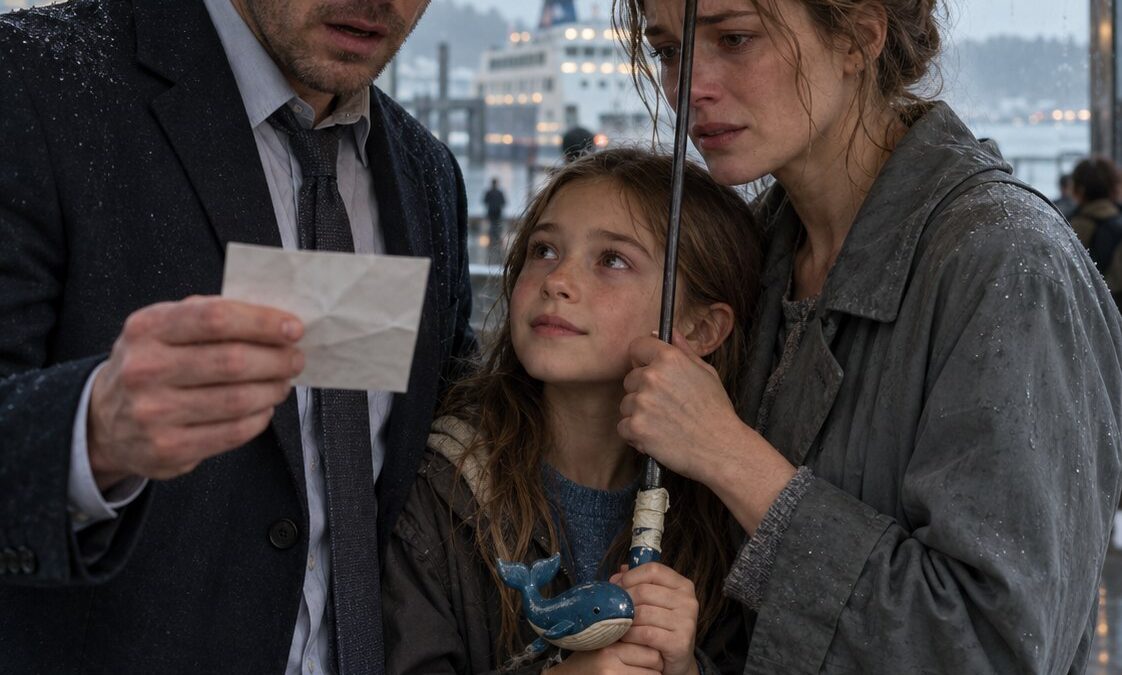
Wren stood between them, holding the yellow umbrella by its repaired handle.
“Answer her,” Wren said.
“I can’t yet.”
“Then open it.”
Nolan eased up the flap.
The paper inside had been folded so often its edges had softened.
Tessa watched his hands.
“I wrote that one in February,” she said.
Wren had turned six that month.
Nolan unfolded the page.
Dear Wren, I saw a boat today with a green door.
I wondered if you would have counted its windows.
He stopped reading.
Wren leaned closer.
“There’s more.”
He read the rest aloud.
Tessa had written about the first snow.
About a dog that refused to board a ferry.
About how she still tied her shoes with the double knot Wren had taught her.
At the bottom, she had written that Wren never had to answer.
She only wanted her to know where to find her.
Wren looked up.
“Did you get this?”
“No.”
“Did you ask Grandma for my mail?”
“No.”
That answer hurt more.
Tessa rested a hand against the window.
“I sent sixty-one,” she said.
“I moved twice.”
“I sent them to this office too.”
Nolan saw the terminal address on the next envelope.
His name appeared beneath it.
He had managed this building for nine years.
“Who handled deliveries?” Tessa asked.
“My assistant opened the business mail.”
“And your mother?”
“She collected anything marked family.”
Wren stared at him.
Nolan heard the weakness of his answer.
Five years of birthdays.
Five years of silence he had allowed someone else to administer.
A boarding announcement crackled overhead.
Wren did not turn toward the gate.
“Did Grandma read them?”
“I don’t know,” Nolan said.
“Did she tell you Mom stopped writing?”
“She said Tessa stopped trying.”
Tessa flinched at the sound of her name.
“She knew I hadn’t,” she said.
Nolan looked at the delivery slip again.
The signature was clear.
Still, he wanted one small uncertainty.
A mistaken delivery.
A single envelope overlooked.
The packet inside the umbrella gave him neither.
Wren pulled another letter halfway out.
It had a purple stamp.
“Can I read this later?”
“Whenever you want,” Tessa said.
“What if I don’t want to?”
“Then you don’t.”
Wren pushed it back gently.
Tessa swayed.
She caught the window frame before either of them could move.
Wren moved anyway.
“Are you sick?”
“I skipped lunch.”
“You always say that when you’re worried,” Wren said.
Tessa’s eyes filled.
Wren remembered.
A small thing.
Enough to make Tessa’s knees bend.
Nolan pulled a chair from the waiting area.
“Sit down.”
“I’m working.”
“I’ll speak to your supervisor.”
Tessa gave him a hard look.
“Please don’t make decisions about my job.”
He let go of the chair.
“You’re right.”
She sat because Wren asked her to.
Nolan bought crackers and a bottle of water from the machine.
Tessa accepted both.
The crackers broke when she opened them.
Wren held out her palm for the pieces.
They ate from the same packet.
Nolan stood with the unopened water.
“Do you need anything else?”
“A minute,” Tessa said.
He nodded.
For once, a minute was something he could give.
Wren knelt beside the chair.
“Were you looking for me?”
“Yes.”
“Today?”
“Every Thursday.”
Nolan frowned.
“We take the Thursday ferry to her violin lesson.”
“I know.”
“How?”
“Tessa showed me the schedule.”
Wren glanced at her father.
“I found her picture last spring.”
Nolan went still.
“Where?”
“In the old yearbook.”
Tessa worked her thumb along the umbrella’s crooked handle.
“Wren wrote to the address on the page,” she said.
“She found me?”
“I never answered.”
“Why?”
Tessa looked at Wren.
“I thought the order still covered letters.”
Wren’s face changed.
“You knew it was me?”
“I knew.”
“Then why didn’t you tell Dad?”
“I was afraid the letter would get you in trouble.”
“I wasn’t in trouble.”
“I didn’t know that.”
Wren pressed her lips together.
“What did my letter say?”
“You asked whether I still liked the rain.”
“I didn’t know what else to ask.”
“You asked enough.”
A ferry worker approached with a concerned glance.
Nolan recognized her from the ticket desk.
“Is everything all right?”
“We need a little time,” he said.
She looked at the fallen mop.
Tessa started to rise.
“I’ll get it.”
“I’ve got it,” the worker said.
She set the mop against the wall and walked away.
Nolan sank into the chair opposite her.
The court order had limited Tessa’s contact while a financial investigation remained open.
He remembered hearing that much.
He remembered the lawyer saying it was temporary.
Then his mother said the investigation had ended badly.
Nolan had never asked to see the final papers.
“I need the case number,” he said.
Tessa reached into her coat.
Her hand emerged with a worn plastic card.
A county clerk had written the number across its back.
“I’ve carried it since the hearing.”
Nolan copied it onto his phone.
Wren leaned against Tessa’s knees.
Tessa looked at Nolan before touching her hair.
For once, he understood the question.
“Yes,” he said.
Tessa laid her palm gently on Wren’s head.
“She can come home with me,” Nolan said.
Wren lifted her face.
“I’m not ready to leave.”
“The ferry leaves in twelve minutes.”
“Then we’ll miss it.”
Nolan looked toward the boarding gate.
His mother expected them at dinner.
The terminal staff expected him upstairs.
Wren needed him here.
He put the tickets on the empty chair.
His phone lit up.
Celeste.
He let it ring.
“Is that Grandma?” Wren asked.
“Yes.”
“Are you going to tell her?”
“After I know what happened.”
Wren studied him.
“Will you tell me first?”
“Yes.”
He had not earned how quickly she nodded.
Tessa studied his face.
“The court order expired four years ago,” she said.
* * *
The clerk could not discuss the file over the phone.
Nolan took the next morning off.
He had never taken a Friday off during the fall sailing schedule.
Celeste called before he reached the courthouse.
“Your assistant says you won’t be in.”
“I have a family appointment.”
“Wren’s lesson was yesterday.”
“It concerns Tessa.”
A pause followed.
Then Celeste said, “Call the attorney first.”
“I want the file.”
“You know what happened.”
“I know what you told me.”
“I protected you.”
Nolan ended the call.
Tessa was waiting inside the courthouse entrance.
She had changed into dark jeans and a clean sweater.
Wren stayed at school with a promise that Nolan would call at lunch.
Tessa noticed the promise written on a note in his hand.
“She still likes things on paper?”
“Yes.”
“She used to make me sign mine.”
They waited behind a man requesting a marriage record.
Tessa kept the plastic card between two fingers.
The edges had gone cloudy.
“You could have requested this without me,” she said.
“I know.”
“I need to see what you see.”
“I asked you here.”
“That isn’t the same thing.”
Nolan took a step back.
“You’re right.”
When their number was called, Tessa gave the clerk the card herself.
The clerk brought out the public portion of the case.
Nolan and Tessa sat at a table beneath a buzzing light.
The financial complaint came first.
Tessa had been accused of moving money from the Harbor Families Fund, the emergency fund Celeste chaired for ferry workers.
There were twenty-three transfers.
All appeared under Tessa’s employee login.
The total was $218,400.
Nolan remembered the newspaper story.
He had refused to read past the headline.
“I didn’t take it,” Tessa said.
“I believe you now.”
She turned a page.
“Believing me now doesn’t change what you said then.”
Nolan looked down.
At the custody hearing, he had testified that Tessa was unstable and had disappeared for days.
She had spent those days meeting an investigator.
He knew that now.
At the time, Celeste had told him Tessa was hiding from the police.
“I repeated what my mother told me.”
“You were under oath.”
“I know.”
Tessa pointed to a date beside one transfer.
“I was with the investigator that afternoon.”
“You have proof?”
“He gave me receipts.”
“Do you still have them?”
“I kept a box.”
“Why didn’t your lawyer show them?”
“They proved where I was during the day.”
“The transfer happened at night?”
She nodded.
“I thought they would check the building.”
Nolan turned the page.
Nobody had.
The temporary contact order sat near the back.
It had lasted ninety days.
It required both parents to arrange supervised visits through a county service.
It had not barred letters after the ninety days.
The signature below the service notice was Nolan’s.
His stomach tightened.
“I signed this.”
“You did.”
“I thought it renewed automatically.”
“Did you read it?”
“No.”
Tessa folded her hands.
For a moment, he thought she might walk away.
Instead, she drew out the yellow umbrella’s sleeve.
The envelopes had dried overnight beneath her radiator.
She placed three delivery slips beside the court file.
Each showed the terminal office address.
Each showed Celeste’s signature.
The dates were years apart.
“This is why I kept them,” Tessa said.
“The postal clerk gave you the slips?”
“I paid for tracked delivery.”
“The letters came back.”
“Some did.”
“Where are the others?”
“I hoped Wren had them.”
Nolan opened the docket again.
The investigation against Tessa had ended without charges.
He found the entry himself.
The prosecutor had declined to proceed for insufficient evidence.
The date was four years and eleven months ago.
“Why didn’t you tell me?”
“I called your office.”
“I never got a message.”
“I went to your house.”
“Celeste said you’d been drinking.”
“I was standing outside with the dismissal notice.”
Nolan shut his eyes.
He remembered that evening.
His mother had arrived shaking, saying Tessa had frightened Wren.
Wren had been asleep upstairs.
He had believed his mother.
“Was it raining?” he asked.
“Hard.”
“I remember her coat was wet.”
“She took the paper from me at the door.”
Tessa touched the corner of the docket.
“I thought she would bring it inside.”
Nolan remembered Celeste drying her coat by the stove.
He had never asked what she carried.
Tessa had lost her bookkeeping job when the allegations became public.
She had taken cleaning shifts and rented rooms where she could.
She never stopped paying for the tracked letters.
“How did you get the documents now?” Nolan asked.
“I requested the file after Wren wrote to me.”
“Why wait?”
“I wanted to be certain the order had ended.”
“It ended years ago.”
“I know that now.”
Nolan asked the clerk for certified copies.
Then he called his attorney, a woman named Priya Shah who had handled a ferry contract for him the previous year.
She agreed to meet them that afternoon.
Before they left, Nolan studied the original complaint.
The transfers had been approved electronically from a terminal office computer.
The login time was printed in small type.
11:42 p.m.
Nolan turned to the next page.
Another transfer.
11:39 p.m.
The ferry terminal closed to the public at ten.
Tessa had worked mornings in the fund office across town.
“Someone used my login,” she said.
“Who had access to that computer?”
“Celeste’s staff.”
Nolan remembered a detail from the old security system.
The upstairs office logged staff cards separately from computer passwords.
He had kept those logs because the terminal’s insurer required seven years of records.
“They may still exist,” he said.
At Priya’s office, Tessa sat nearest the door.
Nolan placed the certified copies on the desk.
Priya read the contact order first.
Then the dismissal entry.
“Who told you the order continued?” she asked Tessa.
“Celeste.”
“Did you receive anything in writing?”
“No.”
Priya looked at Nolan.
“Who told you the investigation ended badly?”
“My mother.”
He heard how often the answer repeated.
Priya listened to the history without interrupting.
She told them the closed investigation did not prove who made the transfers.
The returned letters could support a claim that contact had been obstructed.
The old access logs might show who had entered the terminal, if they had been retained intact.
“Get copies through the normal process,” she said.
“Don’t confront anyone with a theory yet.”
Nolan nodded.
Tessa looked at the umbrella between their chairs.
“We need to tell Wren something.”
“The truth we can prove,” Priya said.
At lunch, Nolan called his daughter.
“The order ended years ago,” he told her.
Wren was quiet.
“Did Mom know?”
“She knows now.”
“Did you know?”
“I should have.”
“Is she coming back?”
“She wants to see you.”
“That’s not what I asked.”
Nolan gripped the phone.
“I don’t know what our days will look like yet.”
“Can she call me tonight?”
“Yes.”
“I’ll be home by four.”
“I know.”
Wren hung up after saying goodbye.
Nolan wrote four o’clock on his note.
When the call ended, Priya turned another page in the fund file.
The destination account belonged to a company called North Quay Services.
Nolan knew the name.
It had maintained the terminal’s boarding equipment for years.
Priya pointed to the registered agent.
The address was Celeste’s home.
* * *
By Monday, Nolan had copies of the access logs.
He had requested them from the terminal’s records officer, copying Priya and the board secretary.
He did not touch the originals.
The officer sent a preservation notice to the storage vendor before anyone knew why the files mattered.
Celeste arrived at Nolan’s office just after nine.
She closed the door.
“You’re embarrassing the family.”
“I’m reviewing an old complaint.”
“You’re bringing a woman who abandoned her child back into this building.”
“She didn’t abandon Wren.”
“You have letters?”
“I have a court order.”
Celeste’s expression barely changed.
“A temporary order doesn’t erase her choices.”
“No.”
“Then remember all of them.”
She placed a folder on his desk.
Inside was a proposed settlement.
Tessa would receive $80,000.
She would agree to make no public claim against the Harbor Families Fund.
A separate page offered supervised visits with Wren.
Nolan stared at the amount.
“Who authorized this?”
“The board can consider it.”
“Has the board seen it?”
“Not yet.”
“Then this is your offer.”
“It’s a way forward.”
“For whom?”
Celeste tapped the folder.
“For a child who needs stability.”
Nolan noticed Wren’s name appeared nowhere in the draft.
“What happens if Tessa refuses?”
“Then she refuses.”
“And the visits?”
Celeste closed the folder with one finger.
“That becomes more complicated.”
The menace was quiet.
It sounded like scheduling.
Nolan left it on the desk.
After she went, he photographed the pages for Priya.
Then he called Tessa.
“Celeste offered you money.”
“She called me last night.”
“What did she say?”
“That you might lose the terminal.”
“She hasn’t spoken to the board.”
“She knows how to frighten people without raising her voice.”
They met after Wren’s school day at a small café near the harbor.
Nolan had asked Wren if she wanted Tessa there.
Wren had said yes.
Nobody made her hug anyone.
She sat between them with a paper cup of hot chocolate.
Tessa had brought the umbrella.
It rested against the wall, closed.
“I have a question,” Wren said.
Nolan set down his coffee.
“All right.”
“Why did you write about boats?”
Tessa smiled faintly.
“Because I thought you’d still like counting windows.”
“I do.”
“Then I guessed right.”
Wren picked at her sleeve.
“Did you come to my concerts?”
“I wasn’t allowed inside your school.”
“But you came?”
“Twice.”
Wren’s eyes filled.
“I played badly the first time.”
“I heard the last piece through an open door.”
“That was the bad one.”
“It was loud.”
Wren laughed once.
It startled all three of them.
Then Tessa began to cry.
Wren reached across the table and took her hand.
Nolan looked out toward the harbor.
He had told himself for years that silence kept Wren safe.
Watching them, he could see what silence had cost.
Wren turned her cup slowly.
“Did Grandma know you came?”
“I told her once,” Tessa said.
“What did she say?”
“She said you wouldn’t want me there.”
Wren looked at Nolan.
He could have defended Celeste’s intention.
He no longer trusted himself to know it.
“I’m sorry she spoke for you,” he said.
Wren took a sip.
“I don’t want her to call me tonight.”
“All right.”
“Will she be mad?”
“That’s mine to handle.”
Tessa squeezed Wren’s hand once.
She let go before Wren had to ask.
Priya called before they finished.
The access logs were useful.
On six of the nights when transfers had occurred, Celeste’s personal card had entered the upstairs office.
Tessa’s card had not.
The computer records showed Tessa’s password.
They did not show Tessa at the keyboard.
“It’s a start,” Priya said.
“I’m sending the files to an independent forensic accountant.”
“Should we go to the police?”
“Soon.”
“I want the evidence preserved first.”
That evening, the terminal’s records officer called Nolan.
Someone had asked the storage vendor to delete the old access archive.
The vendor had refused because of the preservation notice.
“Who asked?” Nolan said.
“The request came from the foundation office.”
“Name?”
“Celeste Price.”
“Do you have the request?”
“The vendor saved the email.”
“Please send it to Priya.”
“I already copied the board secretary.”
Nolan thanked her.
He sent the call details to Priya.
Within an hour, Celeste texted him.
You know how many families that fund has helped.
He read it twice.
Tessa called.
“Wren got home?”
“She’s eating.”
“Good.”
“Nolan, what happened?”
“My mother tried to erase the logs.”
Tessa was quiet.
“Will they stop her?”
“The vendor kept them.”
“Then let the law handle it.”
“I intend to.”
He looked through the kitchen door.
Wren was drawing a whale on a scrap of paper.
The whale held an umbrella.
“Does she know about the money?” Tessa asked.
“No.”
“She shouldn’t hear it from someone else.”
“I’ll tell her there’s a review.”
“That’s fair.”
After the call, Nolan sat beside Wren.
He told her adults were checking what had happened at the fund.
He did not tell her Celeste was guilty.
He did not tell her everything would be fine.
“Can I still love Grandma?” Wren asked.
“Yes.”
“Even if she lied?”
“Yes.”
Wren drew another line on the whale.
“I don’t want to see her right now.”
“You don’t have to.”
The accountant’s preliminary findings arrived the next morning.
North Quay Services had charged the fund for repairs never requested by the terminal.
The vendor’s real owner had died before several invoices were issued.
Its registered agent had remained unchanged.
Celeste had kept the company active.
Priya asked why she would risk everything for that money.
Nolan had an answer only after he checked the dates.
The transfers began the month Celeste’s private foundation lost its largest donor.
She had used workers’ emergency money to keep her foundation solvent.
* * *
The board met on Thursday.
Priya attended for Tessa.
Nolan attended as terminal manager and as Wren’s father.
Tessa sat beside Priya with the umbrella at her feet.
Three ferry workers sat at the back.
Each had once applied to the emergency fund.
Celeste had invited them.
She knew how to make a room look like it stood with her.
Before the chair arrived, one worker approached Tessa.
“Did you handle applications?”
“Yes,” Tessa said.
“My husband got help after his surgery.”
“I’m glad he did.”
“I remember you finding the form.”
Tessa held the woman’s gaze.
“Your family should have been helped.”
The woman nodded.
She returned to her seat without choosing a side.
“I welcome a review,” Celeste told the board.
“No one has done more for these families.”
The chair, Mr. Bell, asked her to address the transfers.
Celeste opened a binder.
“Every payment supported harbor services.”
Priya asked for the service reports.
“They’re being collected.”
“The invoices span five years.”
“Older records take time.”
Nolan recognized the rhythm.
His mother could make a missing answer sound like patience.
Celeste turned toward Tessa.
“This woman had access to the fund.”
“So did I,” Nolan said.
“She was investigated.”
“And cleared.”
“She left her daughter.”
Wren was not in the room.
Nolan had insisted on that.
“She tried to write to her daughter,” he said.
Celeste glanced at the umbrella.
“That is a separate family matter.”
“It became a board matter when you offered fund money to keep her quiet.”
Mr. Bell looked up.
“What offer?”
Priya passed him the settlement proposal.
The board members read it in silence.
Celeste lifted her chin.
“I was exploring a resolution.”
“Without approval?” Bell asked.
“The fund has discretion.”
“Not that much,” he said.
A board member turned to the final page.
“This includes a restriction on contact.”
“A temporary arrangement,” Celeste said.
“With a child?” the member asked.
“Nolan would decide what was appropriate.”
“I wasn’t asked,” Nolan said.
Celeste stared at him.
“You knew I would protect Wren.”
“I knew you would take control.”
The worker at the back lowered her eyes.
Celeste turned to Nolan.
“You know why I took her letters.”
Tessa gripped the chair arms.
“Tell us,” Nolan said.
“She was under investigation.”
“For ninety days.”
“Wren needed protection.”
“For five years?”
“You let me manage it.”
The words landed where she intended.
Nolan did not argue.
“I did,” he said.
“I was wrong.”
Celeste seemed surprised.
“You were exhausted.”
“I was.”
“You asked me to help.”
“I did.”
“And now you want to pretend you knew better?”
“No.”
Nolan kept his voice steady.
“I want Wren to know I should have checked.”
Tessa’s grip loosened.
Mr. Bell asked about the accounting records.
Priya handed him the independent report.
The accountant had verified six transfers against the terminal’s maintenance records.
No work order existed for any of them.
The access logs placed Celeste’s card upstairs on each night.
The accountant had traced the receiving account to North Quay Services.
Celeste argued that her staff had used her card.
That was possible.
She argued that maintenance sometimes happened without a work order.
That was possible too.
“Then we need more,” Bell said.
Celeste looked almost relieved.
“Our records deserve a full review.”
“They do,” Priya said.
She placed the vendor’s saved email beside the report.
“The storage company also received this request.”
Bell read the sender’s name.
Celeste folded her hands.
“Routine housekeeping.”
“After a preservation notice?” Bell asked.
“The archives took up space.”
The board member beside him made a note.
Tessa bent to pick up the umbrella.
Celeste watched her.
The repaired whale handle had carried sixty-one returned letters through rain and snow.
Inside its fabric sleeve, Tessa had kept the delivery slips.
She drew them out.
“These went to Wren,” she said.
“Why bring them here?” Celeste asked.
“Because you told this room I left her.”
Tessa laid the slips on the table.
“The post office recorded who accepted them.”
Celeste’s signature appeared on each one.
An independent postal record confirmed the dates and delivery attempts.
Priya had obtained it through the postal service with Tessa’s authorization.
Celeste looked at the pages.
“I believed the contact order continued.”
“You had a copy,” Priya said.
“I may have misunderstood it.”
“You signed for a letter last month.”
Celeste said nothing.
Tessa held up the latest envelope.
It had been sent after Wren contacted her.
“You knew she was looking for me.”
Celeste’s face hardened.
“I knew you would unsettle her.”
“You don’t get to make that choice,” Nolan said.
“For years, you were glad I made it.”
Nolan absorbed the blow.
“Yes,” he said.
“And I’m ending that today.”
Mr. Bell called a recess.
The board’s counsel joined by phone.
Priya explained the preserved logs and the attempted deletion request.
Counsel advised the board to suspend Celeste’s access immediately and refer the financial records to the authorities.
The board voted.
It was not a trial.
Nobody was arrested in the room.
The worker who had spoken to Tessa remained near the door.
“My husband kept that approval letter,” she said.
“Why?” Tessa asked.
“He wanted to remember someone listened.”
Tessa could not answer.
Celeste left with her coat folded over one arm.
At the door, she stopped beside Tessa.
“When Wren is older, she’ll understand why I kept you away.”
Tessa looked down at the yellow umbrella.
Then she looked up.
“She’ll know you had a choice,” she said.
“So did I.”
Nolan and Tessa gave their statements separately the next week.
Investigators obtained bank records and interviewed former staff.
The accountant’s report helped them identify which invoices lacked supporting work.
A former foundation employee produced an archived email in which Celeste directed her to use North Quay for charges unrelated to the terminal.
The employee had saved it because she had questioned the instruction at the time.
Months passed.
Celeste’s lawyer negotiated a plea to financial charges.
The court ordered restitution and imposed a sentence.
The board replaced its grant process and invited former applicants to have their requests reviewed again.
None of it returned five years to Wren.
Nolan knew that.
He also knew the truth had finally entered the record.
* * *
Winter brought ordinary problems.
Wren lost a glove.
Nolan burned toast.
Tessa’s radiator knocked every night until the landlord fixed it.
They saw each other on Sundays at first.
Then Wednesdays after violin practice.
Every visit began with Wren’s choice.
Some days she ran to Tessa.
Some days she wanted Nolan to stay nearby.
Nobody called either choice a setback.
The first Sunday, Wren asked them both to sit at the kitchen table.
She put a sheet of paper between them.
“I made rules,” she said.
Nolan read them.
No one could answer a question for somebody else.
No one could say a visit was too short.
Wren could ask to go home.
She could ask to stay longer.
Tessa pointed to the last line.
“Can you call me if you forget?”
“I forget things,” Wren said.
“So do I.”
Nolan found a pen.
“Do we sign?”
“Yes,” Wren said.
They did.
One afternoon, Tessa brought a stack of letters.
Wren spread them across the living room floor.
“Do I have to read them all?”
“No,” Tessa said.
“Can I start with the one about the dog?”
“Of course.”
“What was its name?”
“I never found out.”
Wren looked offended.
“You wrote six paragraphs about a dog without asking?”
“It boarded before I could.”
Wren chose another envelope.
The date was her seventh birthday.
She read it quietly.
Tessa stayed across the room.
Nolan heard Wren laugh from the kitchen.
He was learning to let that sound belong to both of them.
His apology took longer than he wanted.
He had said he was sorry at the courthouse.
Tessa had nodded.
That had been the beginning.
One evening, after Wren went upstairs, he asked Tessa to stay for tea.
“I told her you chose to leave,” he said.
“I know.”
“I let my mother handle the mail because I didn’t want to see what came.”
Tessa held the warm cup between her hands.
“I needed you to say that.”
“I was angry.”
“You were.”
“I was frightened she’d lose another parent if the case went badly.”
“You could have asked me.”
“I should have.”
Tessa looked toward the stairs.
“I don’t need you to forgive everything I did either.”
“What did you do?”
“I stopped trying in person.”
“You were turned away.”
“I still stopped.”
“You kept writing.”
“I did.”
Nolan waited.
Tessa set down the cup.
“When Wren grows up, I’ll tell her I was afraid.”
“She knows you kept trying.”
“She can know both.”
He nodded.
The house settled around them.
“I want us to make decisions about Wren together,” Nolan said.
“Then call me before you make one.”
“I will.”
“And if I say no?”
“We keep talking.”
Tessa considered him.
“That’s a start.”
The fund’s new board offered Tessa a payment from a civil settlement.
She accepted the wages she had lost during the investigation.
She refused an additional payment tied to confidentiality.
With the back pay, she rented a small apartment near the ferry route and enrolled in a bookkeeping course.
The board invited her to oversee its new application desk.
She asked for the job description first.
Nolan smiled when she told him.
“What?”
“You’re making them do the paperwork.”
“I have earned that pleasure.”
She accepted a part-time position after the board agreed that workers could appeal denied requests.
The ferry staff learned her name without a newspaper attached to it.
On her first day, the worker from the meeting arrived.
Her husband needed another form.
Tessa found the current one.
She read the instructions with her.
“This section changed,” Tessa said.
“Does that make it harder?”
“It makes the decision easier to appeal.”
The woman gave her a careful smile.
“I’m glad you’re here.”
Tessa put the form in her hand.
“So am I.”
Wren learned other things.
Tessa hated canned peaches.
She folded towels into uneven thirds.
She knew every verse of a song Wren thought she had invented.
One Saturday, Wren carried the yellow umbrella to Tessa’s apartment.
Rain streaked the windows.
“Can we take a walk?”
“In this?”
“That’s what it’s for.”
They walked to a bakery and back.
The umbrella barely covered both of them.
Wren held the handle.
Tessa held the stem.
At a crossing, Wren asked, “Can I call you when I’m at Dad’s?”
“Any time he says it’s safe to use the phone.”
“I mean if I’m sad.”
“Especially then.”
“Will you answer?”
“I’ll try every time.”
Wren thought about that.
“If you can’t, you can call back.”
“I will.”
They bought three rolls.
Wren carried Nolan’s in a paper bag.
When they reached the apartment, she took off her wet shoes.
“Can I leave slippers here?”
Tessa looked at her.
“You can leave whatever you want.”
“Just slippers for now.”
“Just slippers.”
They found a pair at a neighborhood shop.
Wren chose blue ones with crooked stitching.
She placed them beside Tessa’s door.
The next visit, she went straight to them.
Spring arrived without ceremony.
A teacher asked Nolan which parents should receive the school concert notice.
He wrote both names.
He checked the addresses himself.
On concert night, Tessa sat beside him in the third row.
Wren spotted them before she raised her violin.
She played the difficult piece better than either parent expected.
Afterward, she found them in the crowded hallway.
“I want a picture,” she said.
Nolan reached for his phone.
“With both of you,” Wren said.
A teacher took it.
Tessa waited for Nolan to stand beside her.
Their shoulders touched.
Wren stepped in front and held up the yellow umbrella, closed like a bright staff.
“Why the umbrella?” Nolan asked.
“Because it got us here.”
Tessa looked at him.
He had no better answer.
* * *
Three years later, Wren returned to the terminal with a violin case in one hand and the yellow umbrella in the other.
She was thirteen.
The crooked whale handle still wore its white stitches.
Nolan had offered to buy a new one.
Wren had told him this one worked.
Outside, rain blurred the harbor.
Inside, travelers crossed the same wet tile where she had once run toward a woman holding a mop.
Tessa waited by the window.
She no longer worked at the terminal.
She had come to hear Wren play at an island school.
Nolan arrived carrying three ferry tickets.
“Everybody ready?”
Wren looked at the window.
“I stopped right there.”
“I remember,” Nolan said.
“I thought you’d pull me away.”
“I almost did.”
“But you didn’t.”
“Not the second time.”
Tessa reached for Wren’s violin case.
Wren handed it over.
Nolan took the umbrella when Wren offered it.
For a moment, all three stood beneath the departure board.
No one needed to hurry.
Wren turned to her mother.
“Did you really come every Thursday?”
“Every Thursday I could.”
“You could have missed us.”
“I knew that.”
Wren glanced toward the waiting area.
“Did you ever see me?”
“Once, from far away.”
“Why didn’t you wave?”
“I wanted you to decide when we spoke.”
Wren looked at the window again.
“I was scared when I ran over.”
“I was too.”
“You dropped the mop.”
“I did.”
“You looked like you might run.”
“I thought your father would ask me to leave.”
Nolan held the tickets carefully.
“I nearly did.”
Wren gave him a long look.
“You told me that already.”
“I know.”
“I’m glad you tell me things now.”
He could only nod.
Wren slipped her hand into Tessa’s.
The ferry horn sounded.
Nolan opened the umbrella before they stepped outside.
It sheltered all three badly.
They went anyway.
The letters had been read.
The money had been returned.
The lie had been answered.
The choices belonged to them now.
At the gangway, Wren looked up at the repaired handle.
“You kept it dry,” she said.
Tessa smiled.
“I kept it for you.”
THE END








