The Woman at the Courthouse Chess Table Held a Boy’s Missing Knight, and His Father Knew Why
Chapter 2: The Move She Kept
Vivian Mercer came down the courthouse steps with a paper cup in one hand.
She wore the navy coat she saved for board meetings.
People recognized her.
They often did.
For eleven years, her food pantry had fed families across Cleveland.
She saw Nolan first.
Then she saw Tessa.
The cup stopped halfway to her mouth.
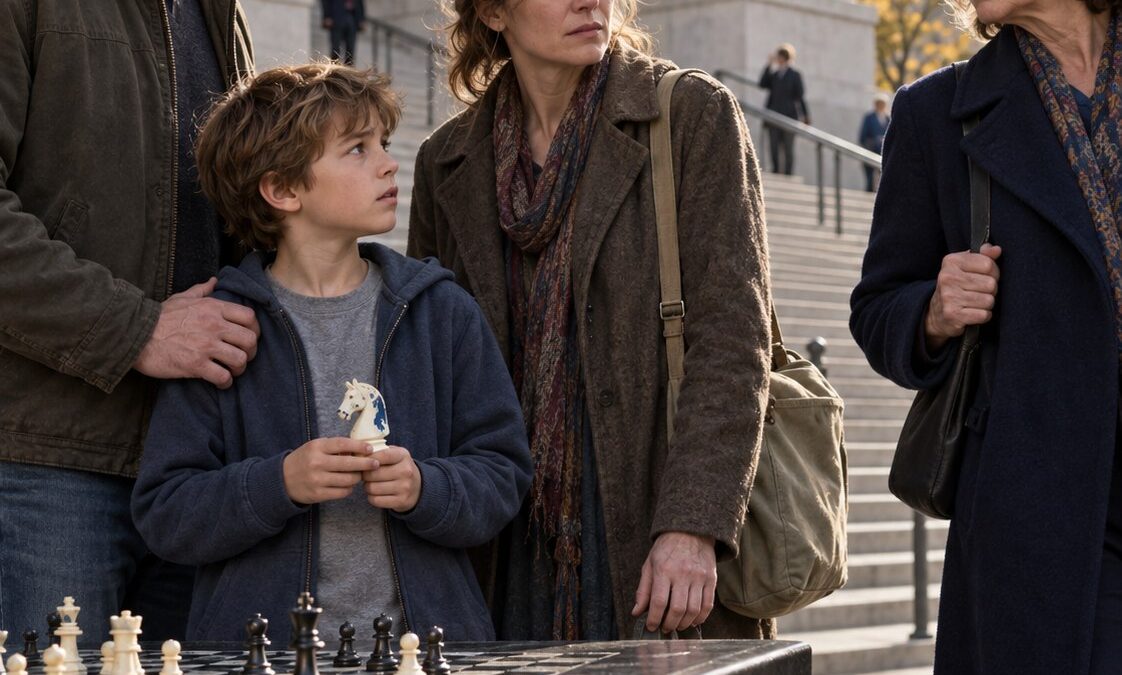
Kit held the white knight against his chest.
“Aunt Viv,” he called.
Vivian crossed the plaza.
“What’s going on?”
Tessa picked up her canvas bag.
“I asked Kit a question.”
“Without his father?”
“Nolan was here.”
Vivian looked at him.
Her expression asked for help.
For years, he had given it without being asked.
Kit stepped around the chess table.
“Did you take Mom’s letters?”
Vivian’s face changed.
Only for a second.
“I don’t know what you mean, sweetheart.”
“She said she wrote.”
“That’s something for adults to discuss.”
Kit held the knight tighter.
“It’s something for me.”
Nolan had taught him that sentence.
He wished he had listened when Kit first used it.
Vivian turned to Tessa.
“You shouldn’t have approached him.”
“I planned to speak with Nolan.”
“You had his number.”
“It was disconnected.”
Nolan’s phone had changed in April.
He had not told her.
Tessa seemed to read his face.
“I left messages before that.”
Vivian shook her head.
“There’s a reason we handle these things through court.”
“We can,” Tessa said.
She took a folded sheet from her bag.
A clerk’s stamp marked the top.
Nolan recognized the heading.
It was a request to review custody arrangements.
Not an order.
Not a demand.
A request.
“Next month,” Tessa said.
Kit looked up.
“Do I get to say anything?”
“Yes,” Tessa told him.
Vivian reached for his shoulder.
Kit moved away.
Nolan saw the hurt cross her face.
He also saw her glance at the paper.
“Let’s get him out of the heat,” Vivian said.
Kit’s cheeks were flushed.
His dental appointment was already lost.
Nolan crouched beside him.
“Are you dizzy?”
“A little.”
He had skipped lunch because his tooth hurt.
Nolan checked his forehead.
Tessa opened her bag.
“I have water.”
She offered the sealed bottle to Nolan.
He hesitated.
Then he took it.
Kit drank half.
Tessa stayed where she was.
It was the first considerate thing Nolan had allowed her to do for him in years.
Vivian watched.
A courthouse security guard opened the nearby door.
Cool air reached the plaza.
“We can sit inside,” Nolan said.
Tessa nodded.
Vivian followed them through the doors.
They found an empty bench near the records office.
Kit sat between his parents.
Neither parent had chosen that arrangement.
He had.
Vivian stood across from them.
Nolan looked at Tessa.
“What report?”
“The one I filed with the county.”
“You told me the pantry books were wrong.”
“I told you more than that.”
“You said money was missing.”
“I said somebody was moving it.”
Vivian folded her arms.
“We went through all this at trial.”
Tessa looked at Kit.
“I don’t want to explain a trial in a hallway.”
“I know you went to prison,” Kit said.
Nolan closed his eyes.
Vivian had told him the word herself.
She had called Kit mature enough to hear it.
“I’m sorry,” Tessa said.
Kit studied the knight.
“Did you steal?”
“No.”
Vivian shifted her weight.
Tessa reached into her bag again.
This time she gave Nolan a thin packet.
There were four pages.
A dated intake form.
A confirmation number.
A summary of concerns.
And the name of the person who submitted them.
Tessa Rowe.
Nolan read the date twice.
It was six days before the transfer that had sent her to prison.
“I asked them to look,” Tessa said.
Vivian leaned forward.
“Anyone could file a report.”
“Yes.”
“Reporting something doesn’t make you innocent.”
“No.”
Tessa looked at Nolan.
“But it means I saw it coming.”
He remembered that week.
Tessa staying late over the pantry accounts.
Vivian telling him she was tired.
Tessa asking him to take Kit to his mother’s place for a night.
He had thought she was frightened of what she had done.
Now he saw another possibility.
Kit laid the knight on the bench between them.
“Is that why you went away?”
Tessa’s voice was quiet.
“Yes.”
Nolan turned the final page.
The report named an account he had never heard mentioned at trial.
“Why didn’t your lawyer show me this?”
“She never had it.”
Tessa looked at Vivian.
“Someone closed my report under the wrong name.”
* * *
The records clerk could not discuss the case in the hallway.
She gave Tessa a number.
Then she sent her to the public terminal.
Vivian said she had a meeting.
Nobody asked her to stay.
Kit watched her go.
“She didn’t answer me,” he said.
“No,” Nolan said.
They sat at the terminal while Tessa opened the county records portal.
Nolan had not been near the case file since the sentencing.
He had told himself that was for Kit.
The truth was less generous.
He had been afraid to learn more.
Tessa entered her confirmation number.
A scanned form appeared.
“Two copies existed,” she said.
“One in the pantry system.”
“One here.”
“Why didn’t you find it sooner?”
“The county changed its records service.”
A public defender had found the old index during a review.
Tessa had spent the last eighteen months requesting the underlying pages.
The first request had returned only a summary.
The second had returned her signed report.
The third had come that morning.
Nolan looked at the new pages.
“What are these?”
“Closing notes.”
A county reviewer had tried to call Tessa.
The number listed beside her name did not belong to her.
Someone had entered Vivian’s office line.
The report was marked resolved after that call.
Nolan read the note.
The reviewer had spoken with a woman who said Tessa had withdrawn her concern.
The woman had given her name as Tessa.
“That wasn’t you,” Nolan said.
“I was at the pantry’s east site all day.”
“How can you prove it?”
“I signed for a delivery there.”
Kit rested his chin on the bench.
“Did someone pretend to be you?”
“Yes,” Tessa said.
He thought about that.
“Why?”
“That’s what I’m trying to prove.”
Nolan printed the pages.
The machine charged eighty cents.
He used his last dollar bill.
The clerk behind the counter looked at the documents.
She could confirm they were county records.
She could not confirm who had made the call.
She wrote down the process for requesting the call log.
Tessa thanked her.
Outside, the sky had darkened.
Nolan checked his phone.
The dentist had left a message.
He called back and apologized.
The receptionist found Kit another appointment next Tuesday.
Kit listened to the whole call.
“Are we getting the milkshake?”
Nolan looked at the courthouse clock.
“You still want one?”
“My tooth still hurts.”
“That sounds like a yes.”
Tessa almost smiled.
A café stood across the plaza.
They went there together.
Nolan bought Kit a small vanilla shake.
He offered Tessa coffee.
“I can pay,” she said.
“I know.”
She accepted a cup.
They sat near the window.
Kit put the knight beside his napkin.
Tessa watched him turn it.
“The blue mark survived,” she said.
“I drew it so I’d win.”
“You said it made him faster.”
“Did it?”
“Once.”
Kit smiled despite himself.
Nolan remembered that game.
Tessa had let Kit take her queen.
She had celebrated as if the knight had saved a kingdom.
“Where did you get it?” Kit asked.
“From the box we left behind.”
Nolan looked up.
Their old apartment had been emptied after the trial.
He had packed Kit’s clothes.
Vivian had handled the rest.
“The box at your sister’s garage,” Tessa said.
“She let you have it?”
“A neighbor found it by the curb.”
The smile left Nolan’s face.
Vivian had said the apartment’s things were in storage.
Tessa saw his expression.
“I wrote the address on every envelope,” she said.
“You moved.”
“We moved once.”
“I wrote to both places.”
Nolan had spent those years certain she had not tried.
He could hear himself telling Kit so.
He had never shown Kit a letter.
There had been none to show.
“Do you have proof you sent them?” he asked.
Tessa did not flinch.
“Some.”
She took a worn folder from her bag.
Inside were copies of envelopes.
Postmarks.
A receipt for certified mail.
Two had been returned.
Three had not.
All five were addressed to Nolan at the pantry loading office.
He had worked there until last winter.
Vivian sorted the mail.
Nolan set the pages down.
“You could have come to the house.”
“I did.”
“When?”
“After I got out.”
She named a November afternoon.
Kit had been at school.
Nolan had been on a delivery route.
Vivian had met her at the front steps.
“She said you had filed for a protective order.”
“I didn’t.”
“She said you would if I came back.”
Tessa rubbed her thumb along the coffee cup.
“I checked with the court.”
“There was no order.”
“But by then I understood you didn’t want me there.”
Nolan wanted to say he had never said that.
He had accepted every reason Vivian gave him to keep Tessa away.
He had let the silence speak for him.
Kit leaned forward.
“Did Aunt Viv have keys to our old place?”
“Yes,” Nolan said.
“Did she get our mail?”
“Sometimes.”
Kit considered the envelopes.
“Then ask her.”
Nolan looked at his son.
“That’s what we’re going to do.”
Tessa closed the folder.
“There’s another reason I came today.”
The public defender had referred her to a lawyer who handled wrongful convictions.
That lawyer had found a bank account behind the transfers.
The account belonged to a company with a rented mailbox.
They were waiting for the ownership records.
The lawyer had advised Tessa to keep the issue separate from Kit’s custody petition.
One case concerned money.
The other concerned a child.
“I didn’t come to make him evidence,” she said.
Nolan believed her.
That frightened him, too.
He had spent five years believing the opposite.
His phone vibrated.
Vivian’s name appeared.
He let it ring.
A message followed.
Don’t let her take him anywhere.
Nolan showed Tessa.
She read it once.
“Has she called you about me before?”
“Every time you were mentioned.”
“Who mentioned me?”
“Mostly Kit.”
Kit looked between them.
“I asked about you on my birthday.”
Tessa’s fingers tightened around her cup.
“I remember,” Nolan said.
Vivian had brought a cake that evening.
She had taken Kit aside after he asked.
Later, Kit had stopped asking for months.
Nolan turned back to the county form.
One detail had been entered by hand.
It was not in Tessa’s handwriting.
It was the work phone number.
Beneath it sat a familiar four-digit extension.
Vivian’s extension.
* * *
Nolan did not confront his sister by phone.
Tessa’s lawyer asked him not to.
They needed records that could survive questions.
Not an argument someone could deny.
Her lawyer, Dana Ortiz, met them the next morning.
Kit stayed with Nolan’s neighbor, Mrs. Bell.
She had looked after him since kindergarten.
Nolan told Kit where he was going.
He did not promise answers by dinner.
Dana’s office occupied two rooms above a pharmacy.
A printer clicked behind the wall.
She had Tessa’s report laid out beside the trial records.
“The new pages matter,” Dana said.
“They don’t undo a conviction by themselves.”
Tessa nodded.
She knew.
Dana showed Nolan the evidence used against her.
A transfer authorization.
Login records.
Emails from Tessa’s work account.
A cashier’s check cashed after the money moved.
Nolan had seen pieces of it at trial.
He had not studied them.
Tessa had been the pantry’s bookkeeper.
She knew the account numbers.
She also had the password.
The jury had heard both facts many times.
“What changed?” Nolan asked.
“The report came first,” Dana said.
“And the receiving account may lead somewhere.”
She turned to Tessa.
“Tell him what you noticed.”
Tessa pointed to three transfers.
Each ended in forty-seven cents.
The pantry’s payroll system rounded to whole dollars.
Vendor payments did not.
“These were labeled payroll corrections,” she said.
“They weren’t.”
Dana had asked an outside accountant to review the records.
The accountant found matching payments to a maintenance company.
The company had done no work at either pantry building.
Its invoices used the same odd cents.
“Who approved that vendor?” Nolan asked.
“That record was missing,” Dana said.
“Today, I received a copy.”
She had obtained it from the pantry’s former payroll provider.
Tessa could not access it herself.
Dana slid the page across the desk.
The approval was made from an administrator’s account.
Vivian’s.
Nolan sat back.
“That’s one approval.”
“Yes,” Dana said.
“Vivian can say someone used her account.”
“She will,” Tessa said.
Nolan looked at the date.
It was a Sunday.
The pantry had been closed.
He remembered that Sunday.
Kit had been sick.
Tessa had stayed home with him.
Vivian had visited.
She had borrowed Tessa’s laptop to print something for a fundraiser.
Nolan remembered being irritated about the printer ink.
He had forgotten the rest.
“Vivian was at our house,” he said.
Dana made a note.
“Can anyone confirm that?”
“My mother called while she was there.”
His mother had died two years later.
There would be no testimony from her.
“Maybe a photograph,” Tessa said.
Nolan shook his head.
Then he thought of Kit.
At four, he had taken blurry pictures of everything.
The old family tablet still sat in a drawer.
Dana told him to preserve it.
“Don’t open files and start changing things,” she said.
“Bring it here.”
He did.
That afternoon, Nolan found the tablet under a tangle of charging cables.
He took it to Dana.
She arranged for a specialist to copy it properly.
The photos showed Kit’s blanket.
A cartoon on television.
Vivian’s coat over a kitchen chair.
Then Vivian at the table with Tessa’s laptop open.
The image was blurry.
It proved she had used the computer.
It did not prove what she had done.
Nolan could hear Vivian explaining it.
She printed a flyer.
They all knew that.
Dana agreed.
“We need the bank records.”
Two days later, Vivian struck first.
Nolan arrived at the loading office before sunrise.
His supervisor met him at the door.
Vivian had called the pantry board.
She said Nolan was helping Tessa spread false accusations.
The board had put his shifts on hold pending review.
“Is that even allowed?” Nolan asked.
His supervisor looked miserable.
“I argued.”
Nolan went home.
He counted what was in his wallet.
Thirty-one dollars.
There was rent due in nine days.
He did not tell Kit he was all right.
He told him the truth he could carry.
“I may have a different schedule for a while.”
Kit was at the kitchen table, doing fractions.
“Because of Mom?”
“Because adults disagree about what happened.”
“Do you believe her?”
Nolan pulled out a chair.
“I believe she deserves an honest look.”
Kit set down his pencil.
“That wasn’t my question.”
“No,” Nolan said.
“It wasn’t.”
He took a breath.
“I’m starting to.”
Kit studied him.
“Can I see her again?”
Nolan thought of the custody petition.
The trial.
The years he could not give back.
“Yes,” he said.
“We’ll arrange it.”
Tessa came to the community center on Saturday.
Nolan stayed in the room.
Kit had chosen the place.
He knew the tables.
He knew the vending machine.
He had also brought a chessboard.
Tessa arrived with no gifts.
She brought only herself.
Kit set the white knight on its square.
“You can be white,” he said.
“I thought that was your lucky piece.”
“It is.”
“Then you keep it.”
Kit pushed the board toward her.
“We can share.”
They played for forty minutes.
Kit asked about prison once.
Tessa answered plainly.
She had lived in a place where she could not leave.
She had worked in the kitchen.
She had missed him every day.
He asked why she had not called.
She said she had tried.
She did not name Vivian.
Nolan noticed.
After the game, he walked Tessa outside.
“You lost on purpose,” he said.
“I did once.”
“He won twice.”
“He’s getting good.”
Her smile faded.
“Vivian stopped your shifts.”
“Yes.”
“I’m sorry.”
“Don’t take that on.”
“I know what she does when she’s cornered.”
Nolan watched Kit through the window.
He was resetting the pieces.
“I should have seen it sooner.”
Tessa did not comfort him.
She did not punish him, either.
“See it now,” she said.
On Monday, Dana called.
The company receiving the money had been registered by a lawyer.
The lawyer had provided a forwarding address.
Bank records showed payments leaving the company account for a loan on the pantry’s oldest building.
Nolan knew that loan.
Vivian had told him she had saved the building with her own money.
The truth was narrower.
She had used pantry funds to keep a property she personally owned.
Dana paused.
“There’s more.”
When Tessa reported the transfers, the loan was already late.
Vivian had needed those payments to keep the building.
She had made the accusation against Tessa the same week the county requested more records.
Nolan looked at the photograph of Vivian at his kitchen table.
He had given her the front door key.
He had given her his trust.
Dana spoke again.
“The records name your sister as the company’s owner.”
* * *
The pantry board agreed to an emergency meeting.
Dana had asked for it in writing.
She attached the county report.
The accountant’s findings.
The company ownership records.
She also sent the records to the authorities handling the criminal review.
Vivian could no longer say this was only a family dispute.
Still, she tried.
The meeting took place in the pantry’s east site.
The room smelled faintly of coffee and cardboard.
Eight board members sat around two folding tables.
Two staff members attended by invitation.
Nolan and Tessa sat beside Dana.
Kit stayed with Mrs. Bell.
Nolan had told him why.
He had promised to come home and explain what happened.
Vivian arrived early.
She greeted every board member by name.
She had recruited most of them.
When the chair opened the meeting, Vivian spoke first.
“Tessa was convicted,” she said.
“Now Nolan feels guilty.”
“That’s understandable.”
“But guilt doesn’t change bank records.”
Dana waited.
Vivian continued.
“The pantry nearly closed that year.”
“I held it together.”
“I made decisions nobody else wanted to make.”
One board member nodded.
Another looked at the table.
Vivian had fed their neighborhoods.
Some people in the room loved her for it.
Nolan did, too, once.
The chair asked Dana to present.
Dana began with the county report.
Tessa had identified unusual transfers before the charged theft.
The report had been closed after a call to a number that belonged to Vivian’s office.
Vivian leaned forward.
“I employed dozens of people.”
“That phone rang all day.”
“Do you have my voice on a recording?”
“We don’t,” Dana said.
“Then be careful.”
Dana moved to the company records.
Vivian had owned the company receiving the funds.
“The company helped carry building costs,” Vivian said.
“We were short on cash.”
“You labeled the payments payroll corrections,” Dana replied.
“My bookkeeper did.”
Tessa raised her head.
“I questioned them.”
“And then money vanished,” Vivian said.
“You had access.”
“Yes,” Tessa said.
“That’s why I recognized the false entries.”
Vivian turned to the board.
“She is very good with numbers.”
“She was also good at making people trust her.”
Nolan felt the old doubt stir.
Vivian saw it.
She looked directly at him.
“Tell them what you told police.”
Nolan remembered his statement.
Tessa was anxious.
She was working late.
She had asked him to take Kit away for a night.
Every word was true.
He had misunderstood every one.
“I told police what I saw,” he said.
“And now?”
“Now I know what she reported before that night.”
Vivian gave a sad little nod.
“There it is.”
“He wants to rewrite his marriage.”
Nolan stood.
Dana touched his sleeve.
He sat again.
The chair asked for a break.
Several board members left for water.
Vivian remained.
Tessa placed the chipped knight on the table.
Nolan stared at it.
She had brought it in her coat pocket.
Vivian looked down.
“You kept that thing?”
“Yes,” Tessa said.
“It was Kit’s.”
“You kept his toy and missed five years.”
Tessa’s hand rested beside the knight.
“Every day.”
Vivian looked away first.
When the board returned, Dana opened a new envelope.
A former pantry employee had contacted her that morning.
She had kept an old calendar and a resignation letter.
She had worked at the front desk when Tessa filed her report.
The letter said Vivian had told her to route county calls to Vivian’s office.
At the time, she believed Vivian was managing a complaint.
Later, she grew uneasy.
Dana had taken her statement and given it to the investigator.
“Did she see a crime?” Vivian asked.
“No,” Dana said.
“She saw how the call reached your office.”
Vivian folded her hands.
“So we have a worried former employee.”
“And a bookkeeper with a conviction.”
“Is there anything else?”
“There is,” Dana said.
She laid out the decisive records.
The bank had provided the original account-opening packet for Vivian’s company.
Vivian had signed as owner.
Attached was a standing instruction.
It directed incoming pantry payments toward the building loan.
The instruction bore Vivian’s signature.
The bank had verified the account and supplied the records directly.
Vivian looked at the page.
“I never denied owning the company.”
“You denied taking pantry money for your property.”
“It was a temporary measure.”
“You hid it as payroll.”
“I intended to repay it.”
The chair spoke.
“With whose approval?”
Vivian said nothing.
Tessa slid the white knight toward Nolan.
He touched the blue mark.
Five years earlier, Kit had drawn it to make one piece impossible to mistake.
The mark had worked.
There was something else about the knight.
Nolan picked it up.
A small square of old clear tape covered the underside.
He had never noticed it.
Tessa had.
“I found this in the box,” she said.
She handed Dana a photograph.
It showed the knight beside Tessa’s first draft of the county report.
The photograph’s date had been preserved on Tessa’s old phone backup.
Vivian examined it.
“A picture of a toy.”
“A picture of a report,” Tessa said.
“I sent it to Nolan before I filed.”
Nolan remembered getting a message that night.
A photograph.
A joke about Kit guarding the paperwork.
He had changed phones since then.
Dana had recovered the message from an old backup Nolan provided.
Its date matched the photograph.
Its attachment showed the report’s first page.
It also showed the account number Vivian claimed Tessa had invented after the conviction.
“The county copy is the official record,” Dana said.
“This confirms Tessa was raising it at home.”
Vivian stared at Nolan.
“You gave them your phone?”
“I gave them what I had.”
“After everything I did for you?”
Nolan felt each year of that sentence.
She had brought groceries when his hours were cut.
She had picked Kit up from school.
She had told Nolan whom to trust.
“Yes,” he said.
“After all of it.”
The board chair called the meeting into closed session.
Dana and her clients waited outside.
Through the door came no raised voices.
Only chairs moving.
A staff member offered Tessa water.
Tessa thanked her.
Nolan looked at the knight.
“Why tape on the bottom?”
“Kit tried to make it fly,” Tessa said.
“He broke the felt.”
Nolan remembered the game.
Kit had launched every knight from the couch.
They both smiled.
Then the door opened.
The chair asked Vivian to remain away from the pantry while the board arranged an independent audit.
They had also voted to give the records to law enforcement.
Vivian came out behind her.
Her face was pale.
She stopped in front of Nolan.
“You let a stranger turn your son against me.”
Nolan held her gaze.
“He knows you.”
That was all he said.
It was enough.
The following months moved slowly.
The board’s audit found more hidden payments.
A bank investigator confirmed the transfers.
The former employee gave a formal statement.
Vivian’s lawyer disputed intent.
The case went through hearings.
Tessa’s lawyer petitioned to review her conviction.
The court examined the county report and the new financial records.
By spring, the conviction was set aside.
A prosecutor later charged Vivian with financial offenses.
She entered a plea the following winter.
The judge ordered repayment and imposed a sentence.
None of it returned five years to Kit.
None of it had to be perfect to be true.
When Nolan told Kit the outcome, Kit asked one question.
“Did Mom steal?”
“No,” Nolan said.
“I was wrong to tell you she did.”
* * *
Tessa moved into a small apartment above a shoe repair shop.
The stairs were steep.
The windows caught the evening sun.
Kit helped choose a lamp shaped like a mushroom.
Nolan said it looked ridiculous.
Kit said that was the point.
Their visits had begun at the community center.
Then they moved to the library.
Then to Tessa’s apartment, after everyone had time to see how Kit felt.
The family court reviewed the plan.
A counselor met with Kit and both parents.
Nobody asked him to settle the adults’ past.
He asked for Saturdays.
Later, he asked for one dinner each week.
Tessa learned that he hated peas.
She remembered that he once loved them.
“People change,” Kit told her.
“They do,” she said.
Nolan learned to ask Kit how a visit had gone without searching for a reason it might have failed.
Some days were easy.
Some were awkward.
On one Saturday, Kit barely spoke to Tessa.
He had heard a boy at school say people went to prison because they were bad.
Tessa did not try to make him cheerful.
She made grilled cheese.
She let him ask.
They talked until the sandwiches went cold.
That evening, Kit told Nolan what the boy had said.
“What did you think?” Nolan asked.
“I thought Mom went because people were wrong.”
Nolan nodded.
“Sometimes that happens.”
Kit picked at a loose thread on his sleeve.
“You were wrong, too.”
“Yes.”
“Are you bad?”
“I made a bad choice.”
Kit thought for a while.
“Then don’t do it again.”
“I won’t.”
Nolan had a job by then.
A small grocery hired him to manage its deliveries.
The hours were steadier.
The pay was a little better.
He missed the drivers from the pantry.
Some still called.
He did not miss Vivian standing behind his desk.
One evening, Tessa brought a folder to Nolan’s kitchen table.
Kit was in the next room building a cardboard city.
Inside were documents from the compensation process her lawyer had helped her start.
Nolan looked at the amount.
It was more money than either of them had ever saved.
“It could help with the apartment,” he said.
“It will.”
“You could get a car.”
“I might.”
Tessa turned one page.
“I also want to help the pantry reopen the east kitchen.”
The board had closed it during the audit.
Families still needed it.
Nolan studied her.
“You don’t owe them.”
“I know.”
“They let Vivian use your name.”
“Some did.”
She tapped the paper.
“The kitchen served people who never heard my name.”
Nolan said nothing.
Tessa closed the folder.
“I’m keeping enough to live.”
“And enough for Kit.”
“The rest can do something useful.”
He nodded.
It was her decision.
Months earlier, he might have mistaken it for forgiveness.
Now he understood she could choose where her money went without excusing anyone.
The east kitchen reopened that fall.
Its new board posted its accounts publicly.
An outside bookkeeper reviewed them.
Tessa declined a seat on the board.
She took paid work at a print shop instead.
She liked fixing layouts.
She liked going home at five.
Kit visited once and came away with a sheet of misprinted stickers.
For three weeks, Nolan found tiny green frogs on every piece of mail.
Tessa denied helping.
Her expression betrayed her.
Nolan waited until Kit was asleep before raising Vivian’s name.
“She wrote to me,” he said.
“From the facility?”
“Yes.”
He had read the letter twice.
Vivian said she missed Kit.
She said she had been under pressure.
She said the family had turned against her.
There was no apology to Tessa.
There was no account of the letters.
“Will you answer?” Tessa asked.
“I’ll tell her not to contact Kit directly.”
“That’s reasonable.”
“And I’ll ask her what she did with the mail.”
Tessa looked down.
“You still need to know?”
“Kit does.”
They found out through Vivian’s attorney.
Vivian had admitted taking three letters at the loading office.
She said she had thrown them away.
Two returned letters had gone to an old address after Nolan moved.
The certified letter had been signed for by a pantry employee who believed Vivian handled Nolan’s mail.
Vivian had taken that one, too.
Nolan told Kit in careful language.
He did not show him Vivian’s letter.
Kit listened with the knight in his hand.
“So Mom tried,” he said.
“Yes.”
“And you didn’t know.”
“I should have asked more questions.”
Kit turned the knight over.
“Can Aunt Viv come to my game?”
“No,” Nolan said.
“Not while you’re a kid.”
Kit nodded.
He did not ask again.
In December, Nolan apologized to Tessa without Kit present.
They met at the plaza after one of Kit’s visits.
Snow had gathered along the chess tables.
“I believed the conviction,” Nolan said.
“I let Vivian explain everything after that.”
“I know.”
“I told Kit you were gone.”
“I know that, too.”
He forced himself to keep going.
“I should have told him you were alive.”
Tessa watched a bus pass beyond the plaza.
“Yes,” she said.
“I’m sorry.”
She accepted the words with a small nod.
It was not a promise to forget.
“I won’t ask you to trust me all at once,” Nolan said.
“Good.”
“I do want us to raise him honestly.”
“We can start there.”
They had no neat ending for their marriage.
They did not try to make one.
The court finalized a shared parenting schedule the next spring.
Kit had a room at each home.
He complained that both parents expected him to brush his teeth.
He also complained that they coordinated about homework.
“You two talk too much,” he said.
Nolan and Tessa looked at each other.
For once, they agreed without speaking.
At Kit’s tenth birthday party, he set up a chessboard.
Tessa took the black pieces.
Nolan took white.
Kit stood behind his father and offered advice nobody requested.
“You should move the knight.”
“You always say that,” Nolan said.
“Because you never listen.”
Tessa laughed.
Nolan moved a pawn.
Kit groaned.
Later, when the guests had gone, Tessa found Kit washing icing from a plate.
“I have a question,” she said.
“Is it about dishes?”
“No.”
“Good.”
“Would you like to call me Mom?”
He dried his hands.
“I already do sometimes.”
“I’ve heard.”
“I forget when I’m surprised.”
“You can call me Tessa, too.”
“I know.”
She waited.
Kit leaned against the counter.
“Can I call you Mom every day?”
“Yes,” she said.
“If you want.”
He stepped into her arms.
“I want.”
* * *
Five years later, Kit crossed the courthouse plaza carrying a chessboard.
He was taller than Nolan now.
He mentioned it whenever Nolan tried to reach a high shelf first.
The plaza tables were crowded on summer Saturdays.
A local chess club had started meeting there.
Kit helped teach beginners.
Nolan brought folding chairs.
Tessa brought cold drinks.
They had settled into those jobs without discussing them.
Kit chose the table nearest the courthouse steps.
It was the one where he had found her.
The wood had been replaced.
The metal legs were the same.
He opened his case.
The chipped white knight waited in its own compartment.
The blue mark had faded.
The tape underneath had yellowed.
Kit set it on the board.
A girl from the club pointed.
“Why do you use that one?”
Kit considered the question.
“It’s mine,” he said.
Tessa smiled.
Nolan unfolded the chairs.
He had learned that the shortest true answer was often enough.
The girl sat across from Kit.
He showed her how a knight moved.
She sent it the wrong direction twice.
Then she caught him with a fork.
Kit stared at the board.
Tessa lifted her eyebrows.
“Did you let her win?”
“No.”
“Good,” Tessa said.
The girl grinned.
Around them, the plaza filled with ordinary sounds.
Shoes on stone.
Bus brakes.
A paper cup rolling in the wind.
For years, Nolan had remembered that place as the moment his family broke open.
Now it held other things.
A boy choosing to ask.
A woman choosing to wait.
A father finally choosing to hear.
The pantry kitchen still served meals.
Vivian’s debt was being repaid.
The court records carried Tessa’s cleared name.
The lost letters had an answer.
None of those facts could give Kit back his early years.
They gave him the truth about them.
The girl reset the pieces.
Kit picked up the chipped knight.
“Ready?” he asked.
She nodded.
Tessa sat beside Nolan.
Kit placed the knight between them for a moment, its blue mark facing up.
Then he set it on the board.
“Your move,” he said.
THE END








