The Woman Outside the Closed Pool Held a Ledger That Could Explain Why a Nine-Year-Old Boy Had Lost His Mother
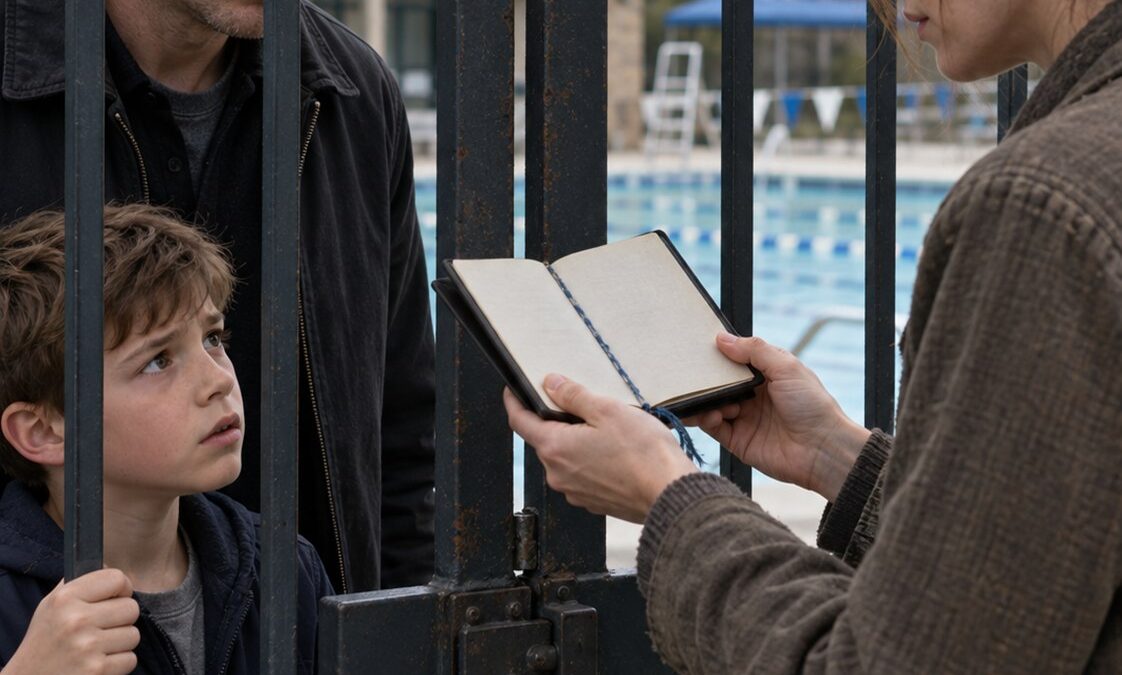
Chapter 2: The Name in Blue Ink
Nolan read the entry again.
Nolan Price.
Eighty-six thousand dollars.
Authorized for emergency transfer.
His signature appeared beneath the amount.
“I didn’t sign that,” he said.
“I know.”
Caleb stood between them at the gate.
The pool manager came across the deck with a ring of keys.
“You need something?” she asked.
“A place to talk,” Nolan said.
The manager looked at Caleb.
“Lessons are canceled,” she said gently.
“We know.”
She opened the gate.
Nolan let Caleb enter first.
The woman stepped back to give him room.
Caleb stayed where he was.
“Are you really my mom?”
“Yes,” she said.
“What’s your name?”
“Mara.”
“I know that.”
He swallowed.
“I wanted to hear you say it.”
Mara pressed her lips together.
Nolan asked the manager for the empty party room.
She led them past stacked chairs and a drained teaching pool.
The air smelled of chlorine and wet concrete.
Caleb walked beside Mara.
He did not touch her.
She did not reach for him.
In the party room, Nolan set the ledger on a plastic table.
“Where has this been?”
“In a storage unit.”
“Whose?”
“Mine.”
“Tessa said the books were destroyed.”
“She told me that too.”
Caleb took the chair nearest the door.
Nolan noticed.
For three years, the boy had asked questions Nolan could answer only in pieces.
He knew how to wait for a grown-up to change the subject.
Nolan hated that he had learned it.
“Tell him what happened,” Mara said.
Nolan looked at her.
“Tell me first.”
“He was there.”
“He’s nine.”
“He asked.”
Caleb folded his arms.
“I’m also right here.”
Nolan sat.
“Your mother was accused of taking money.”
“From the hospital?”
“From a charity that helped families.”
“Did she?”
“No,” Mara said.
Nolan stared at the page.
“I believed she did.”
Caleb’s face tightened.
“Is that why she went away?”
“I went to prison,” Mara said.
The words landed hard.
Caleb looked at the table.
“For stealing?”
“For signing a paper I never signed.”
Nolan turned the ledger toward her.
“This says I signed it.”
“That’s the problem.”
The manager appeared with three cups of water.
She set them down and left without a question.
Mara pushed the fullest cup toward Caleb.
He stared at it.
Then he drank.
It was the first thing he had accepted from her.
“What’s the blue thread for?” he asked.
“I tied it there yesterday.”
“Why?”
“So I could find the page with your father’s name.”
Nolan opened to the first page.
Mara’s careful handwriting ran down the columns.
Dates.
Donors.
Payments.
Small notes about families who needed rides.
He remembered this book.
Mara used to carry it home in a canvas grocery bag.
She had balanced the charity’s accounts at their kitchen table while Caleb slept.
“She didn’t let anyone take it,” Nolan said.
“I made copies for the office,” Mara said.
“Tessa kept those.”
Caleb looked up.
“Aunt Tessa runs the charity.”
“Yes,” Nolan said.
“She gave my class new books.”
“She did.”
“Did she take the money?”
Mara closed the ledger.
“That’s what we have to prove.”
Nolan heard footsteps outside.
He rose before the door opened.
It was only the manager, pointing toward the clock.
A children’s team would arrive soon to use the room.
“We can go to my truck,” Nolan said.
Mara shook her head.
“Not with the book.”
“What does that mean?”
“Tessa knows I have it.”
“How?”
“She called me this morning.”
Nolan felt his phone in his pocket.
Tessa called him every Saturday after Caleb’s lesson.
She always asked what the boy had learned.
“She said she hoped I’d enjoy seeing the pool,” Mara added.
Caleb looked at Nolan.
“She knew we’d be here.”
“She knows our routine,” Nolan said.
Mara held the ledger with both hands.
“I chose the pool because Caleb would be with you.”
“Why the ledger?”
“Because I thought you’d look at it.”
Nolan had not looked at her letters.
He had returned every envelope.
Some had come back again.
Eventually, they stopped.
“What do you need from me?” he asked.
“The truth about this signature.”
“I never made it.”
“Will you say that where it counts?”
Nolan looked at Caleb.
“Yes.”
Mara slid a loose sheet from the back cover.
It was a carbon copy, thin and gray at the folds.
The transfer authorization bore his name.
It also bore a time.
2:17 p.m.
Nolan remembered that afternoon.
Caleb had been admitted with a fever after his surgery.
Nolan had slept in a chair beside the bed.
He could still see the paper cup of soup on the windowsill.
“I was at the hospital,” he said.
“So was I.”
Mara put her finger on a mark beside the signature.
Not a letter.
A narrow slash.
“That’s the mark Tessa used,” she said.
Nolan remembered it on grocery lists and birthday cards.
His sister crossed her sevens the same way.
Mara had noticed it before the trial.
No one had listened.
Nolan lifted the carbon copy toward the light.
The slash ran through the date.
He had never written dates that way.
Caleb watched his father’s expression.
“You believe her now?”
Nolan answered carefully.
“I believe I need to find out what happened.”
Mara accepted that.
She had waited years for even those words.
Then Nolan turned another page.
His name appeared on a second transfer.
It was dated three months later.
Mara had already been in prison.
* * *
Nolan took a photograph of each page.
Mara watched him save the images.
“Keep the originals with you,” he said.
“I brought them for you.”
“Then we’ll keep them safe together.”
That afternoon, he called the attorney who had handled Mara’s appeal.
He expected voicemail.
A woman answered on the fourth ring.
“Priya Shah.”
“Nolan Price.”
There was a pause.
“Ms. Velez’s husband?”
“Former husband.”
“I know who you are.”
“I have something you need to see.”
“So does she.”
“She’s here.”
Mara took the phone.
She explained the ledger and the second transfer.
Priya asked questions without raising her voice.
Where had the book been stored?
Who had held the key?
Was the storage bill current?
Had Mara written in it after the investigation began?
Mara answered each one.
The unit was in her name.
Her old employer had paid the first year while her case was pending.
After that, Mara’s mother paid it from Ohio.
Mara had retrieved the book six weeks earlier.
She had told Priya the day she found it.
Priya had advised her to keep it sealed and arrange an examination.
“Why bring it here?” Priya asked.
“Because Caleb was here.”
Priya was quiet for a moment.
“We’ll talk about that separately.”
Mara accepted the correction.
Priya asked them to come to her office Monday morning.
She also asked Nolan to write down his memory of the hospital visit that day.
“Tonight,” she said.
“Before you talk it over too many times.”
Nolan wrote it at his kitchen table.
Caleb sat beside him doing math homework.
Tessa called at six.
Nolan let it ring.
She called again.
Caleb looked up.
“You always answer Aunt Tessa.”
“I know.”
“Is she mad?”
“I don’t know.”
“Are you?”
Nolan put down his pen.
“I’m confused.”
Caleb considered that.
“Me too.”
On Monday, Priya met them with an empty evidence envelope.
She wore a plain blue suit and carried a legal pad filled with dates.
Caleb waited with a receptionist in the next room.
Nolan could see him through a glass wall.
Mara placed the ledger on Priya’s desk.
Priya photographed its cover and every loose edge.
She noted the page with the blue thread.
Then she asked Mara to tell the story from the beginning.
Mara had been the volunteer bookkeeper for Harbor House Families.
The charity paid for travel, meals, and short hotel stays when children needed treatment away from home.
Tessa had founded it after helping Nolan and Mara during Caleb’s surgery.
Nolan had thanked her publicly.
So had Mara.
For two years, donations grew.
Then the accountant Tessa hired noticed missing payments.
The charity’s online records showed Mara’s username approving them.
The bank had copies of two transfer forms.
Both carried Nolan’s signature as a second authorizer.
Tessa said she had discovered the problem.
She gave the records to police.
Mara said she had never made either transfer.
She said the paper book would show her actual entries.
But the book was gone from their house.
Tessa told police Mara had taken it.
“I thought I had,” Mara said.
“I packed badly that week.”
She had put the ledger in storage during a leak in their kitchen.
The storage receipt had been mailed to her old email address.
She found it after she was released.
At trial, her defense lawyer had seen the receipt.
He had believed the electronic records mattered more.
He had not requested the unit’s access log.
“I should have gone there myself,” Mara said.
“You were on bail conditions,” Priya replied.
“And your lawyer told you the unit was empty.”
Nolan kept his hands flat on his knees.
He had testified that he recognized Mara’s username.
He had also testified that Tessa had never used their home computer.
Both things were true as far as he knew.
Neither proved Mara had made the transfers.
“I told them she couldn’t have been at the bank,” Nolan said.
“They said she’d sent the forms.”
Priya wrote that down.
“I need the trial transcript.”
“I have it,” Mara said.
Priya glanced at her.
“Of course you do.”
Mara almost smiled.
After a jury found her guilty, Mara had served twenty-seven months.
She had left prison eleven months earlier.
She worked at a plant nursery outside the city.
Her coat had belonged to a coworker.
The manager let her keep it when winter came.
Caleb appeared at the glass wall.
He held up a drawing of a shark.
Nolan held up a thumb.
Mara looked away quickly.
Priya noticed.
“We’ll finish soon.”
“No,” Mara said.
“Finish it properly.”
Priya asked Nolan about the first date.
He told her about Caleb’s fever.
He could remember the nurse’s name because she had written it on the whiteboard.
He could remember calling Tessa from the hall.
She had brought clean clothes.
“Did she have access to your wallet?” Priya asked.
“Yes.”
“She bought food for us.”
“Did you sign any charity forms that day?”
“No.”
“Could you have signed one without remembering?”
“No.”
He had been frightened and tired.
He knew that.
He also knew what a request for eighty-six thousand dollars would have meant.
Priya did not argue.
She requested hospital records with Nolan’s written permission.
She requested the bank’s original forms through the prosecutor’s conviction review process.
She also asked for the storage facility’s surviving records.
Some would be gone.
Some might not.
“Who else saw the paper book?” she asked.
“Tessa,” Mara said.
“She helped me set up the columns.”
“Anyone else?”
“The old accountant, Mr. Bell.”
“He retired before the investigation,” Nolan said.
“He moved to Oregon.”
Priya wrote his name.
Mara remembered one more person.
Tessa’s assistant, Devyn, sometimes collected receipts.
Devyn had left Harbor House just before Mara’s trial.
Priya knew where to start.
Outside the office, Caleb showed Mara his shark.
“It’s a nurse shark,” he said.
“I didn’t know they could do that job.”
“They don’t.”
“They should get a different name.”
He gave a small laugh.
Nolan saw how much it cost Mara to keep her hands at her sides.
On the drive home, Caleb asked whether he could see Mara again.
Nolan said they would decide together.
He called Mara that evening.
“Would Wednesday work?”
“Yes.”
“We can meet at the park.”
“Yes.”
“Caleb asked for you.”
Mara made a sound he could not quite hear.
“I’ll be there.”
Two days later, Priya called with a first result.
The storage facility still had its access log.
No one had opened Mara’s unit between the leak and her release.
The ledger had been there throughout the investigation.
Priya sent that fact to the prosecutor.
It did not clear Mara by itself.
It did make one trial claim impossible.
Tessa had told the jury she saw Mara carrying the ledger out of the house after the transfers were discovered.
Mara had placed it in storage eleven months earlier.
Nolan sat down on his kitchen floor.
He remembered how firmly Tessa had spoken.
She had never said she might be mistaken.
“She lied under oath,” he said.
“Yes,” Priya replied.
“And the storage log says she never had the book.”
The first lie pointed straight at Nolan’s sister.
* * *
Tessa came to Nolan’s diner on Thursday.
He was setting out clean mugs.
The breakfast rush had ended.
She wore a dark wool coat and carried a bag of Caleb’s favorite rolls.
“Your phone broken?” she asked.
“No.”
She put the bag down.
“Then answer it.”
“I spoke to Priya Shah.”
Tessa’s smile held for a second.
“Why would you do that?”
“Mara found her ledger.”
“So she says.”
“I saw it.”
“Books can be changed.”
“The storage record says she put it away before the transfers.”
Tessa lifted a mug.
Nolan took it from her.
“Don’t rearrange my counter.”
She stared at him.
He had never spoken to her that way.
“This is what she does,” Tessa said.
“She gets close enough to make you doubt yourself.”
“I remember the hospital.”
“We all remember different parts.”
“I didn’t sign those forms.”
“I never said you did.”
“You testified you watched Mara take the ledger.”
“I thought I saw it.”
“You were certain.”
“I was trying to protect you.”
A server came from the kitchen.
Nolan sent him on an early break.
Tessa waited until the door closed.
“Caleb needs stability,” she said.
“He has it.”
“He had it.”
Nolan felt the edge beneath her words.
“Don’t bring him into this.”
“She brought him to a locked gate.”
“She made a bad choice.”
“That’s generous.”
“So is leaving those rolls here.”
Tessa picked up the bag.
“Think about who paid your rent after the trial.”
“I have.”
“Good.”
She left without another word.
An hour later, the diner’s landlord emailed Nolan.
The lease renewal would be delayed pending review of a guarantor.
Tessa had guaranteed the lease when Nolan first opened.
The timing was plain.
The email said nothing improper.
Nolan forwarded it to Priya.
Then he called a commercial tenant lawyer.
He needed to know what the lease allowed.
He also needed a second place to feed his son if the answer was bad.
That afternoon, Mara found a note on her car at the nursery.
It contained no name.
Return what belongs to the foundation.
She photographed it before touching it.
Her manager checked the parking lot camera.
A delivery truck blocked the view.
Mara gave the note to Priya.
Priya advised her to report it.
Mara did.
An officer took the report and the photograph.
No one promised an arrest.
That evening, Nolan told Caleb he would be late to the park.
Caleb insisted they wait.
“He said four,” Caleb told Mara when she arrived.
“He’s coming.”
“I know,” she said.
Caleb rolled a pebble beneath his sneaker.
“My dad makes pancakes when he’s worried.”
“Does he?”
“They get really big.”
“He did that when you were little.”
“He won’t tell me things.”
“He’s trying to find the right words.”
“Are you?”
“Yes.”
Caleb looked toward the path.
“Were you scared in prison?”
Mara could have given him a smaller answer.
She thought of all the smaller answers he had already heard.
“Yes.”
“Did you think about me?”
“Every day.”
“Did you write?”
“Every month.”
“Dad said you didn’t.”
“He might not have known.”
Nolan arrived carrying three paper cups of cocoa.
He heard the last sentence.
“I knew,” he said.
Caleb turned.
Nolan handed him a cup.
“I returned them.”
“Why?”
“I thought she’d stolen from people who needed help.”
“You could have told me she wrote.”
“I should have.”
Caleb walked to a bench.
He sat with his cocoa between his hands.
Nolan followed but left space.
“I’m sorry,” he said.
Caleb stared at the path.
Mara did not ask the boy to forgive either of them.
She sat at the other end of the bench.
A dog passed wearing a raincoat.
Caleb watched it.
“That dog has better clothes than us,” he said.
Mara looked at her worn sleeves.
“He probably has more coats.”
Caleb smiled without turning.
For twenty minutes, they talked about dogs.
They talked about school lunches.
They talked about the nurse shark.
When Caleb grew cold, Nolan wrapped his scarf around the boy’s neck.
Mara held the empty cups while he tied it.
Their hands touched once.
Neither pulled away sharply.
Afterward, Priya called.
She had located Devyn, Tessa’s former assistant.
Devyn was willing to speak to the prosecutor.
She had kept calendar invitations from the charity office.
One invitation showed Tessa meeting a bank officer on the first transfer date.
Another showed her visiting Nolan’s hospital floor that afternoon.
Nolan already knew about that visit.
The new fact lay in the attachment.
Tessa had sent the bank officer a scan of Nolan’s signature the night before.
Priya paused to make sure Nolan understood.
It was taken from his diner lease.
Devyn had forwarded the email because Tessa told her to arrange the meeting.
“Why save it?” Nolan asked.
“Devyn saved every instruction after Tessa blamed her for a tax filing error.”
Mara listened on speakerphone.
“What did Tessa use the money for?” she asked.
“Devyn remembers an urgent property payment.”
“Which property?”
Priya read the address.
It was the building that housed Harbor House.
Tessa had told the board the charity owned it.
The land records showed she owned it herself.
The charity paid her rent.
She had fallen behind on the mortgage.
The missing money went to keep her building.
* * *
The prosecutor assigned an investigator named Rafael Ortiz.
He did not ask Mara to retell everything at once.
He asked where each record had come from.
The storage log came from the facility.
The calendar invitations came from Devyn’s work archive.
The lease signature came from Nolan.
The ledger came from Mara’s locked unit.
Rafael made copies.
He arranged for the originals to be examined.
Priya sat beside Mara through every meeting.
Nolan attended when he could.
Caleb stayed at school.
Rafael warned them that even strong new evidence moved slowly.
Mara nodded.
She had learned the speed of official answers.
The next week, a bank records officer produced the original transfer forms.
The ink signatures were real ink.
They had been written by a person.
That did not mean Nolan had written them.
An examiner compared the forms with dated examples of Nolan’s writing.
She found differences in how he joined letters and made his sevens.
Her report did not name the writer.
It concluded the signatures were unlikely to be Nolan’s.
The bank’s record also showed where the money went.
It did not go to an account Mara controlled.
It moved first to a charity account opened by Tessa.
Then it paid the past-due mortgage on Tessa’s building.
The second transfer followed the same route.
At trial, prosecutors had shown only the first destination.
Tessa had described that account as a routine reserve.
No one had followed the money further.
Rafael did.
He asked the bank for the account application.
Tessa had signed it.
Devyn confirmed Tessa controlled it alone.
Mr. Bell, the retired accountant, joined a video call from Oregon.
He remembered advising Tessa that rent from the charity to her own building needed clear board approval.
She had ended his contract the following month.
He had kept the email.
“I didn’t know about stolen money,” he said.
“I knew she disliked being questioned.”
The board called an emergency meeting.
Priya advised Mara to attend.
Rafael said he could observe, but the criminal investigation would remain separate.
Tessa was still chair.
Several board members had stood beside her during Mara’s trial.
They had believed her.
Some had visited Nolan and Caleb afterward.
Mara dressed in the only suit she owned.
It was too loose at the shoulders.
Caleb asked why she looked nervous.
“Some people there think I hurt them,” she said.
“Are you going to tell them you didn’t?”
“Yes.”
“Then wear the blue shoes.”
“Why?”
“They’re loud.”
“They squeak.”
“That’s what I mean.”
She wore them.
Nolan drove her to the meeting.
In the car, he handed her a folder.
Inside were copies of every letter she had sent from prison.
“I asked for them back,” he said.
“After I returned them.”
Mara touched the top envelope.
The stamps had been canceled twice.
“Why keep them?”
“I couldn’t throw them away.”
“Did you read them?”
“After the pool.”
She closed the folder.
“I wrote about Caleb.”
“I know.”
“I wasn’t writing to make you take me back.”
“I know that now.”
They arrived early.
The board met in a room above the charity’s food pantry.
Boxes of diapers lined one wall.
Tessa sat at the head of the table.
She saw Mara’s shoes first.
“You found an audience,” she said.
Mara pulled out a chair.
“I found my book.”
Tessa’s eyes moved to the ledger.
Nolan stayed beside Mara.
The board secretary opened the meeting.
Priya asked to present the records before anyone voted.
Tessa objected.
“This is a personnel matter,” she said.
“It became a criminal matter,” Priya replied.
“It always was.”
Tessa folded her hands.
“Then let the courts handle it.”
“They are,” Rafael said from the doorway.
He introduced himself.
He did not claim anyone had been charged.
He said the board needed accurate records to protect the charity.
That got their attention.
One board member asked about the families expecting hotel payments that month.
Another asked whether donations could still be used.
Tessa answered smoothly.
“Harbor House is operating.”
“Will it keep operating?” the secretary asked.
“That depends on whether you let a convicted thief run this meeting.”
Mara gripped the table’s edge.
Nolan looked at her.
She nodded once.
Priya placed the storage log before the secretary.
Then the bank account application.
Then Mr. Bell’s email.
The secretary read each page.
Others leaned close.
Tessa listened without interrupting.
When Priya finished, Tessa turned to Nolan.
“You remember how Caleb’s hospital bills came due,” she said.
“Yes.”
“You remember who brought groceries.”
“Yes.”
“I spent my own money before this charity had a dollar.”
“Yes.”
“Do you believe I wanted to ruin your family?”
Nolan hesitated.
For years, he would have answered for her.
Now he looked at Mara.
“I believe you did,” he said.
Tessa’s face hardened.
“I kept this place open.”
The secretary tapped the bank application.
“With an account you didn’t disclose.”
“It was a reserve.”
“Your mortgage was paid from it.”
“I intended to repay it.”
“With what?” a board member asked.
Tessa spread her hands.
“Every family here needed the building.”
The argument was effective.
The building did hold food and meetings.
Parents had slept upstairs during hospital visits.
Several board members feared that losing it would hurt them.
Tessa knew their fear.
She used it.
“If you remove me today,” she said, “the bank could call the loan.”
“We need legal advice about that,” the secretary said.
“Then get it.”
Priya opened Mara’s ledger to the page with blue thread.
She passed it down the table.
“These entries were written before either transfer,” she said.
“Mara listed both expected account balances.”
“They do not include the missing money.”
Tessa shrugged.
“She could have planned around it.”
“She put the book in storage months earlier,” Nolan said.
“She could have written ahead.”
Mara heard a board member whisper that it was possible.
She felt the old trial room close around her.
Then Priya laid the carbon copy on the table.
“The transfer form was made from this sheet,” she said.
The paper had three pressure marks.
Two matched Tessa’s handwriting on board notes from that same week.
The third was Nolan’s copied signature.
An examiner had found that the pen stopped where a copied line ended.
The hand that wrote it had traced rather than signed.
Tessa studied the paper.
“An expert can be wrong.”
“Yes,” Rafael said.
“That’s why we checked the bank records.”
He showed the account path.
From the charity.
Through Tessa’s reserve.
To her mortgage lender.
A board member pushed back his chair.
Tessa raised one hand.
“I told you I intended to repay it.”
“You told police Mara took it,” Nolan said.
“I believed she had.”
“You opened the account.”
“I was protecting the charity.”
“You sent my signature to the bank.”
“That was for the lease.”
“The email says transfer authorization.”
Tessa looked at Devyn.
She had entered quietly with Priya.
Devyn placed her old work phone on the table.
The email was still in its archive.
A records specialist had verified the account and timestamps.
Tessa’s voice lost its calm.
“You kept that?”
“You told me to send it,” Devyn said.
“I kept my work.”
The secretary turned to Rafael.
“What happens now?”
“The investigation continues,” he said.
“Your lawyer can advise you on the charity.”
He asked Tessa to come with him to answer questions.
She said she would speak through counsel.
He gave her a card.
No one blocked the door.
No one had to.
The board voted to suspend Tessa’s authority over its accounts.
They appointed two members to approve essential payments while a lawyer and an outside accountant reviewed the books.
The food pantry would open the next morning.
Mara waited until the vote ended.
Then she stood.
Her blue shoes squeaked across the floor.
Tessa stopped beside Nolan.
“You’ll regret teaching Caleb to distrust his own family.”
Nolan moved closer to Mara.
“I’m teaching him to ask what happened.”
Mara picked up the ledger.
“And to listen when someone answers.”
Three months later, the court set aside Mara’s conviction.
The prosecutor dismissed the charge against her.
The state’s investigation into Tessa’s accounts continued.
She later pleaded guilty to theft and making false statements.
The court ordered repayment and imposed a sentence.
The charity sold Tessa’s building and moved its pantry to a smaller rented space.
Families kept receiving help.
Mara’s name was cleared in a public record.
She read the order twice before she believed the words would stay there.
* * *
Winter came slowly.
Caleb began seeing Mara every Wednesday after school.
Nolan brought him to the nursery at first.
Mara showed him which plants could survive frost.
Caleb named a fern Professor Wet.
“It’s accurate,” he said.
“It’s rude,” Mara replied.
“It can be both.”
By January, he had a shelf of seedlings at Nolan’s apartment.
Most were alive.
Nolan called that a triumph.
Mara called it generous grading.
They learned ordinary things about each other.
Caleb hated the sound of balloons popping.
Mara put hot sauce on eggs.
Caleb liked books with maps.
Mara read the last page first when she was nervous.
He made her promise not to do it with his favorite series.
She promised.
Then she asked whether he wanted her at his school concert.
He said yes.
He also asked Nolan to come.
They sat in the same row.
Caleb checked from the stage.
Both waved.
Afterward, a parent asked Mara if she was Caleb’s mother.
Mara let Caleb answer.
“She is,” he said.
“She works with plants.”
That was all he offered.
It was enough.
Nolan’s diner survived the lease review.
The guarantor clause did not give Tessa the power she had suggested.
His landlord accepted a new guarantor after seeing the diner’s records.
Nolan still lost sleep that month.
He paid the tenant lawyer from money he had saved to replace the fryer.
For a while, breakfast came from a smaller pan.
A regular customer called the hash browns “limited edition.”
Nolan told him that sounded expensive.
The customer ordered them again.
One evening, Nolan asked Mara to come by after closing.
He had put the letters on a clean table.
Caleb was at a friend’s house.
“I owe you an apology,” he said.
“Yes.”
“I let the trial become the whole story.”
“Yes.”
“I should have told Caleb you wrote.”
“Yes.”
He accepted each answer.
Mara sat across from him.
“I thought you knew I hadn’t signed those forms.”
“I wanted to.”
“You testified.”
“I told the truth as I understood it.”
“You stopped trying to understand.”
He nodded.
“I did.”
The kitchen fan hummed behind them.
“I’m sorry,” he said.
Mara looked at the letters.
“I believe you.”
“I don’t expect anything from that.”
“Good.”
They sat awhile.
Then she asked if he had read the one dated Caleb’s eighth birthday.
“I did.”
“I was angry in that one.”
“You had reason.”
“I’m still angry sometimes.”
“You have reason.”
Mara pushed the letter back toward him.
“You can keep these.”
“They’re yours.”
“They’re what I wanted you to hear.”
Nolan took them home.
He put them in a drawer Caleb could open when he chose.
Mara set one firm boundary.
She would make her own plans with Caleb when he felt ready.
Nolan could know where they were.
He could not decide what they said to each other.
He agreed.
They found a family lawyer to put a parenting schedule in writing.
Caleb was included in the conversations that concerned him.
The adults handled the paperwork.
That spring, a donor offered Mara a job as the charity’s new director.
The salary was good.
So was the chance to repair what Tessa had damaged.
Mara thanked the board and declined.
She liked the nursery.
She liked going home when her shift ended.
She did agree to review the charity’s books once a month with its new accountant.
The board paid for independent audits.
It also posted simple reports so donors could see where the money went.
Mara brought her ledger to the first meeting.
She showed the new staff how she had tracked rides and hotel nights.
A young volunteer asked whether she wanted it displayed in a case.
“No,” Mara said.
“It belongs where people can use it.”
They made copies of the blank pages.
The original went home with her.
Caleb helped her put fresh thread through its spine.
He chose green.
“Blue is for the bad page,” he said.
Mara touched the old thread.
“Blue helped us find it.”
“Green can help us find the next one.”
She let him tie the knot.
In May, Caleb asked if he could spend a whole Saturday with Mara.
Nolan was at the sink when he asked.
He turned off the water.
“Do you want to?” he said.
“Yes.”
“Then let’s ask her.”
Caleb made the call himself.
Mara answered from the nursery.
“Could we go somewhere?” he asked.
“Sure.”
“Just us?”
There was a brief pause.
“If your dad knows the plan, yes.”
“He’s right here.”
“What would you like to do?”
Caleb looked at Nolan.
Then at the swim bag by the door.
“The pool,” he said.
Mara’s answer came softly.
“I’d like that.”
On Saturday, she met him outside the gate.
The pipe had been repaired months before.
Children shouted beneath the high windows.
Nolan stood with them until Caleb reached for Mara’s hand.
“You have my number,” Nolan told her.
“I do.”
Caleb held up his towel.
“I can swim the whole length now.”
“I’d like to see.”
Nolan opened the gate for them.
He watched Caleb lead her in.
For once, his son did not look back to check whether anyone was following.
That evening, Mara brought him home tired and hungry.
Caleb had talked through lunch.
He had shown her the deep end.
He had lost a race to a girl two years younger and demanded a rematch.
“He won that one,” Mara said.
“She was tired,” Caleb admitted.
Nolan made pancakes.
They were very large.
“Worried?” Caleb asked.
“Hungry.”
“You make them big for both.”
Nolan put another on Mara’s plate.
She stayed for dinner.
When she left, Caleb hugged her without being asked.
Then he asked when he could do it again.
* * *
Four years later, the pool closed for a Saturday morning repair.
Caleb was thirteen.
He complained about the timing.
Mara told him his arguments would be stronger after breakfast.
Nolan brought pancakes in a paper bag.
They ate them on a bench beside the gate.
The plaza had new trees.
The gate was the same.
Mara carried the black ledger because the charity’s accountant wanted to copy an old page about travel costs.
Its cover had worn smooth.
Green thread held the spine.
Blue thread still marked the transfer page.
Caleb noticed it when she set the book down.
“Can I see?”
She handed it over.
He turned past lists of names.
Past receipts for gas.
Past the page that had changed their lives.
At the back, he found a newer entry.
Pool lessons.
One Saturday.
Three people.
Under payment, Mara had written: pancakes.
Caleb laughed.
“That’s terrible bookkeeping.”
“It balances,” Nolan said.
Caleb closed the ledger.
A repair worker opened the gate.
Mara rose.
Caleb stayed on the bench.
He held out the book to her.
“Remember when I asked if you could come home?”
“Yes.”
“I was afraid you’d say no forever.”
Mara sat beside him.
“I know.”
“You don’t live with us.”
“No.”
“But you come home with me.”
“Whenever you ask.”
Caleb put his palm against the gate.
Mara placed hers beside it.
There was room for both hands on the same side.
Nolan picked up the pancake bag.
Inside, one remained.
He offered it to Mara.
She broke it in half and gave a piece to Caleb.
The gate stood open.
They went in together.
THE END








