The Women of Harbor Unit Knew Nell Voss Controlled Every Work Shift, Until a Newcomer Refused to Sign One Orange Card
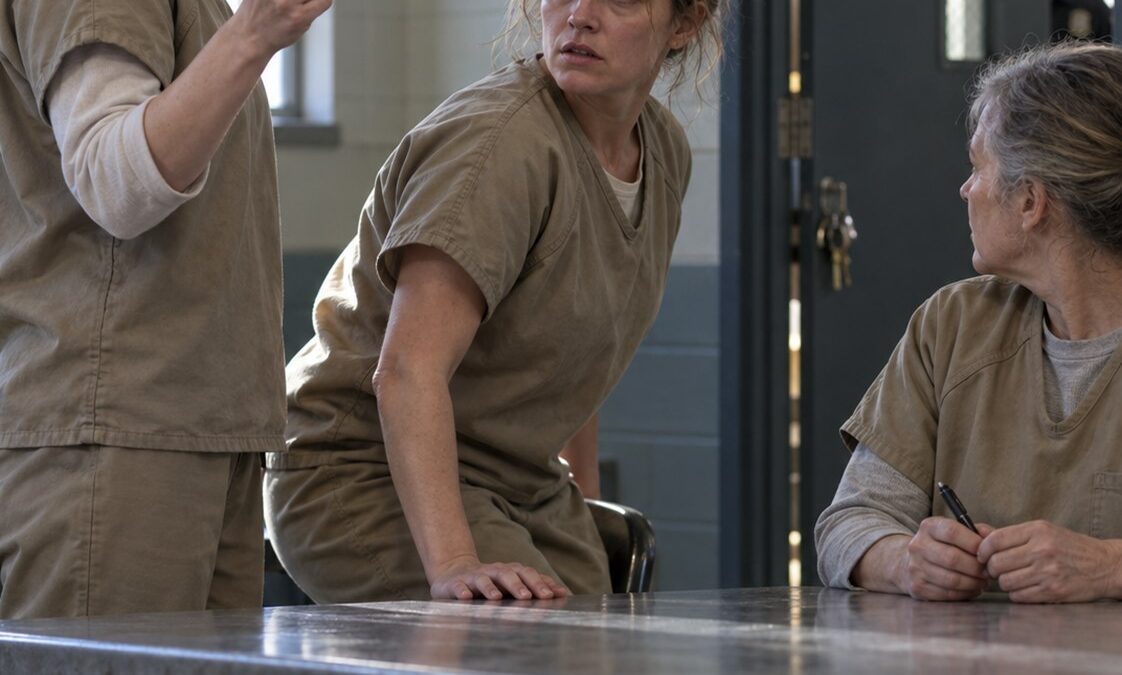
Chapter 2: The Hours That Stayed
The keys stopped rattling.
Ivy still held up the card.
The man at the door wore a workshop badge.
PROGRAM DIRECTOR: CAL RUSK.
He smiled at the room.
“Everything all right?”
Nell rose from her chair.
“Fine.”
June gripped the edge of her seat.
Rusk looked at the orange card.
His smile remained.
“That belongs in my office.”
“It has June’s name,” Ivy said.
“Then June can return it.”
June did not move.
Rusk stepped into the dayroom.
One of Nell’s women backed away.
The other watched Nell’s face.
“You’re the transfer,” Rusk said.
“Ivy Keene.”
“I remember your file.”
Ivy disliked the ease of that sentence.
Rusk held out his hand.
“Give me the card.”
“After June reads it.”
“She already knows her hours.”
“Does she know mine are on it?”
Rusk lowered his hand.
Nell moved between them.
“Cal, take it tomorrow.”
“I’m taking it now.”
June made a thin sound.
Ivy glanced at her.
June’s skin had gone gray.
“She’s going to fall,” Ivy said.
“I’ll call medical,” Nell said.
Rusk stayed by the door.
Nell guided June into her chair.
Her grip was careful.
Nothing about it matched her reputation.
Ivy set the card on the table.
She kept one finger on it.
“Get an officer,” Rusk told Nell.
“There is one outside.”
“Then use him.”
Nell went to the door.
Rusk watched her leave.
June leaned toward Ivy.
“Please don’t sign it.”
“You heard her,” Ivy said.
Rusk’s eyes narrowed.
“June gets confused.”
“I heard her clearly.”
The officer arrived with Nell.
He called medical on his radio.
Only then did Rusk touch the card.
Ivy pressed it flat.
“Evidence,” she said.
“Of what?”
“I’d like that answer too.”
The officer looked between them.
Rusk gave him a patient smile.
“A clerical mistake.”
“Then nobody needs to hide it,” Ivy said.
Medical came quickly.
A nurse checked June in the dayroom.
June had skipped lunch.
Her blood pressure was low.
She said she felt better after water and crackers.
The nurse wanted her examined anyway.
June resisted until Nell spoke.
“Go with her.”
“You’ll keep my place?”
Nell nodded.
“I’ll keep your place.”
The promise surprised Ivy.
Rusk waited until June had left.
“You’ve delayed a sick woman’s paperwork,” he said.
“She told me not to sign.”
“She’s frightened of losing her hours.”
“That makes two of us.”
He turned to the officer.
“I’ll document the error.”
The officer reached for the card.
Ivy let him take it.
“Please note the number,” she said.
Rusk’s smile thinned.
The officer read the edge aloud.
“Four eight one seven.”
He wrote it in his pocket notebook.
Ivy repeated the number once.
Nell heard her.
Rusk heard her too.
“Come by the workshop tomorrow,” he said.
“We can straighten this out.”
“Will June be there?”
“If she’s well enough.”
“I’d like her there.”
Rusk studied her face.
“Of course.”
He left with the officer.
The door shut.
The dayroom came slowly back to life.
A television murmured overhead.
Someone moved a chair.
Nell remained standing.
“You don’t know what you touched.”
“I know the card was wrong.”
“That isn’t what I meant.”
Ivy looked at her.
Nell had ruled the room through certainty.
Now she kept checking the door.
“Why did you want me to sign?”
Nell rubbed her wrist.
“Because Cal said June would lose everything.”
“Did you believe him?”
“I’ve seen him make things disappear.”
The words came out quietly.
Ivy waited.
Nell glanced toward the hall.
“Three years ago, June reported missing wages.”
“What happened?”
“Her hours vanished from the state record.”
“Who fixed them?”
“No one.”
June had worked anyway.
Every week since.
Nell sat down.
The two women behind her stayed silent.
Ivy thought of June counting thirty-six hours.
She thought of her own signature on that old loan.
She had once believed a hurried mark could be corrected later.
Sometimes later arrived with a judge.
Nell spoke before Ivy could.
“I wasn’t making you steal June’s hours.”
“Then whose hours were they?”
Nell met her eyes.
“Yours.”
* * *
The next morning, Ivy found Nell outside the workshop.
A painted line crossed the floor.
Inmates waited behind it for assignments.
Nell stood on the other side.
She had no official badge.
People still left space around her.
“You said those were my hours,” Ivy said.
“They were going to be.”
“I hadn’t been assigned a shift.”
“Cal assigned you yesterday morning.”
“Before intake finished?”
Nell nodded.
“That happens here.”
“Working before you arrive doesn’t.”
Nell looked toward the workshop door.
“Keep your voice down.”
Ivy did.
“Tell me how it works.”
Nell considered refusing.
Instead, she led Ivy to an empty bench.
No one followed.
The workshop made canvas supply bags.
Inmates were paid a small hourly wage.
Approved hours also counted toward a state reentry program.
For June, those credits mattered more than the pay.
Cal ran the workshop through a private contract.
His office submitted the hours.
The prison reviewed them each month.
Nell assigned jobs because Cal told her to.
In return, he kept June on light work.
“He said her hands were getting too slow,” Nell said.
“Her hands are unsteady.”
“She can still sew straight.”
“Then why threaten her?”
“Because I argued about the hours.”
Ivy watched the door.
“What did you see?”
“Cards with names crossed out.”
“Whose names?”
“Women who had left.”
Nell swallowed.
“Some who hadn’t arrived yet.”
Ivy felt the shape of it.
A roster could be padded.
Payroll could be skimmed.
Credits could be shifted.
The card had carried Ivy’s future name.
June’s name had been written above it.
“Was June supposed to sign for me?”
“She refused.”
“So he tried me.”
“He wanted your signature beside June’s work.”
“Why?”
“He said it would correct a backlog.”
“Did you believe that?”
“No.”
Nell looked away.
“I thought it might protect June.”
The workshop door opened.
Cal stepped out with an officer.
He greeted Nell warmly.
He greeted Ivy by her full name.
“Come inside.”
“Is June here?” Ivy asked.
“Still with medical.”
“Then I’ll wait.”
Cal checked his watch.
“The paperwork closes today.”
“Which paperwork?”
“Your assignment.”
“I haven’t accepted one.”
“There’s a waiting list.”
“Then offer it to the next person.”
His smile disappeared.
“You’d throw away a paid position?”
Ivy had forty-eight dollars in her account.
She needed shoes with intact soles.
She needed money for the bus on release day.
She pictured June’s shaking hand.
“Yes.”
Cal stepped back.
“Your choice.”
The officer escorted the waiting women inside.
Nell remained on the bench.
“You just lost your first week,” she said.
“I know.”
“You’ll feel that later.”
“I already do.”
Nell almost smiled.
Then she saw Cal watching through the window.
Her face closed again.
At lunch, Ivy asked for a grievance form.
She wrote only what she knew.
She had been asked to sign card 4817.
The card listed hours she had not worked.
The officer had taken it at a stated time.
She asked that it be preserved.
She named June as a witness.
Then she stopped.
Nell’s name stayed off the page.
Ivy would not offer someone else’s account.
She delivered the form through the unit officer.
He stamped her copy.
The stamp mattered.
She had learned that in a county payroll office.
Paper could vanish.
A receipt made vanishing harder.
Later, June returned from medical.
She looked tired.
She sat across from Ivy.
“I shouldn’t have let you stand there alone.”
“You were ill.”
“I’ve been scared for three years.”
“I understand.”
June shook her head.
“You don’t yet.”
She had entered the reentry program after years of work.
Its housing partner reserved rooms by review date.
Without verified credits, June would miss that date.
The next opening could be months away.
“My daughter says I can stay with her,” June said.
“She has three kids and a one-bedroom apartment.”
“I don’t want her choosing who sleeps on the floor.”
Ivy listened.
June’s fear had a calendar.
That made it harder to dismiss.
“Do you have copies of your hours?”
“Some.”
“Where?”
“With my legal papers.”
“Keep them.”
June gave a small, dry laugh.
“That’s the first thing I’ve kept right.”
That evening, Ivy wrote to a legal aid clinic.
She had worked with payroll records for four years.
A card number was rarely random.
A printer assigned numbers in order.
The orange card bore tomorrow’s sequence.
Someone had prepared it before her first shift.
She explained this as an observation.
She did not call it proof.
She requested the workshop roster and printing log.
She requested June’s credit history.
She also requested her own assignment record.
Three days passed.
Nell kept her distance.
Cal gave Ivy no work.
The other women noticed.
One offered Ivy half a packet of crackers.
“Welcome to unpaid retirement,” she said.
Ivy laughed.
Then the legal aid clinic wrote back.
An attorney named Paige Alder would visit Friday.
Paige had represented June once before.
June had never mentioned her.
“I thought she’d gotten tired of me,” June said.
“She asked to see both of us.”
June’s eyes filled.
“I didn’t know she still cared.”
Friday brought rain against the visiting-room glass.
Paige arrived with a narrow folder.
She was direct and careful.
“Your grievance is preserved,” she told Ivy.
“The card was logged into the prison’s evidence cabinet.”
“Will they keep it?”
“I’ve asked the inspector general’s office to preserve it too.”
Paige turned to June.
“I reviewed your state credit record.”
June braced herself.
“Did I lose more?”
“Yes.”
Nell, who had agreed to attend, gripped the table.
Paige laid out a printed history.
The entries had dates.
They had revision codes.
Ivy followed the columns.
June had earned 184 eligible hours last year.
The workshop reported only 96.
The missing 88 had been moved.
“To whom?” Ivy asked.
Paige pointed at the destination field.
The name was not Ivy’s.
It was a woman released eighteen months earlier.
Nell leaned closer.
“She wasn’t even here.”
“Exactly,” Paige said.
Ivy checked the revision date.
It fell on a Sunday.
The workshop had been closed.
“Who made this change?”
“The account has Cal’s initials.”
Nell shook her head.
“He says the state system makes mistakes.”
“Systems do,” Paige said.
“This entry had a human login.”
Paige showed them the next page.
The released woman’s wages had been redirected too.
Not to an inmate account.
To a vendor adjustment account.
Ivy recognized the label.
It looked administrative.
Its purpose would need checking.
Then she saw the approver’s code.
She read it twice.
The code belonged to the unit office.
Nell saw her expression.
“What?”
Ivy pointed.
“The workshop couldn’t approve its own correction.”
“Who could?” June asked.
Paige looked at Nell.
“Deputy Warden Sloane.”
* * *
By Monday, Cal knew about the visit.
He did not say how.
At breakfast, Ivy’s workshop application returned.
DENIED: INCOMPLETE TRAINING.
She had attended no training.
The decision was accurate in one narrow sense.
It also kept her away from the records.
Nell’s usual seat stood empty.
Her two followers spoke softly.
June ate without looking up.
A woman beside Ivy slid over a note.
NELL MOVED TO ANOTHER UNIT.
The woman took the paper back.
She tore it into tiny pieces.
Ivy finished her breakfast.
She reported the transfer to Paige.
The unit officer said Nell had requested it.
Nell had told Ivy she would stay.
People changed their minds.
Ivy wrote that down too.
That afternoon, June’s housing review moved forward.
The notice gave her six days.
Her credits were still wrong.
“If they meet now, I’ll miss the threshold,” she said.
Paige called the reentry office.
An employee there agreed to flag the file.
The review would be delayed two weeks.
June sat with the news.
“Two weeks,” she said.
“Enough to check the records,” Paige told her.
“Maybe.”
Paige did not promise more.
Ivy trusted her for it.
After the call, June opened a small packet.
Inside was a photograph of her daughter.
Three children crowded into the frame.
One held a cake with crooked frosting.
“My grandson made that,” June said.
“What flavor?”
“Mostly frosting.”
Ivy smiled.
June put the photo away carefully.
“I want to bring them something I made.”
“You sew those bags.”
“I’ve sewn a thousand bags.”
“Then you have options.”
June’s laugh came easier.
For a moment, the room felt ordinary.
Then an officer called Ivy’s name.
Cal had filed a conduct report.
He claimed she had disrupted the workshop line.
Ivy read the form.
It described the day she refused the card.
It omitted the card.
It also put her inside the workshop.
She had never crossed the painted line.
“Can I respond in writing?”
The officer handed her a pen.
Ivy wrote a short account.
She listed the witnesses.
She asked that the corridor camera be preserved.
The officer took both pages.
He gave her a copy.
That evening, Nell returned.
No announcement.
No explanation.
She sat at the far table.
Ivy crossed the dayroom.
Nell’s jaw was tight.
“Did you ask to move?”
“No.”
“Then why are you back?”
“June’s review.”
Nell glanced toward her.
“They tried to make me sign a statement.”
“What kind?”
“That you threatened Cal.”
“Did you?”
“I wrote what I saw.”
“Will that cost you?”
“It already did.”
Nell had lost her preferred workshop job.
Her pay was gone too.
She had also lost the place from which she ruled.
The two followers stayed by the television.
Neither came over.
Nell noticed.
“They were never really mine,” she said.
“I don’t think people can be.”
“Easy to say on your fourth day.”
“Fair.”
Nell let the silence sit.
Then she pushed a folded page toward Ivy.
It was her own written statement.
She had given a copy to Paige.
It described the orange card.
It described Cal ordering Nell to get Ivy’s signature.
It included a sentence about Deputy Warden Sloane.
Sloane had met Cal in the workshop office twice weekly.
Nell had carried attendance folders to her.
“What was in them?” Ivy asked.
“I wasn’t allowed to look.”
“Did you?”
“Once.”
Nell kept her voice low.
“The names changed between the workshop and her office.”
“Whose names?”
“Women who couldn’t check.”
Released women.
Transferred women.
Women assigned elsewhere.
Some wages were routed to the adjustment account.
Some credits were shifted to make the totals look balanced.
Nell had seen the pattern.
She had also enjoyed the power Cal gave her.
She said so plainly.
“I made people afraid.”
“Yes.”
“I told myself that kept them working.”
“Did it?”
“It kept them quiet.”
Nell looked at June.
“I owe her an apology.”
“You owe her the truth first.”
“I know.”
A week later, Paige returned with news.
The inspector general had opened an inquiry.
The printing contractor kept a log.
Card 4817 was printed before Ivy arrived.
The blank template already contained her name.
The prison’s intake record showed her arrival time.
Those two records came from separate systems.
Cal could call one a mistake.
Both would be harder.
Ivy asked about Sloane.
Paige’s face stayed guarded.
“Investigators requested her approval records.”
“Did she give them?”
“Not yet.”
“Can she refuse?”
“She can make the process slow.”
Paige had requested June’s review be postponed again.
The reentry office agreed pending verification.
June had time.
Nell had given investigators her statement.
Cal had responded by denying she ever handled folders.
The cameras showed her carrying them.
He changed his account.
Now he said she carried sealed documents.
Ivy noticed the wording.
“He’s leaving Sloane out.”
“He is,” Paige said.
“Why?”
“Perhaps she can still protect him.”
Two days later, Sloane visited Harbor Unit.
She spoke to staff.
Then she asked Ivy to step aside.
An officer stood nearby.
Sloane’s uniform was immaculate.
“I hear you’re concerned about records,” she said.
“Yes.”
“The state takes that seriously.”
“I hope so.”
“False accusations can affect your release plan.”
Ivy watched the officer.
He watched the floor.
“I wrote what I saw.”
“Stick to that.”
“I intend to.”
Sloane gave a small nod.
“Good.”
She walked away.
Nell had watched from the dayroom door.
“That’s how she does it,” she said later.
“Does what?”
“Sounds helpful while showing you the edge.”
The next morning, Paige obtained a copy of the workshop contract.
She read it with Ivy and June.
The vendor received a fee for every verified hour.
It also received a bonus when participants completed reentry training.
“Who owns the vendor?” Ivy asked.
“It’s a nonprofit corporation.”
“Who runs it?”
“Cal.”
“Who approves its invoices?”
Paige turned a page.
Sloane supervised that office.
That was troubling.
It was not yet a crime.
Paige said so.
Ivy checked the contract amendments.
One had raised the per-hour fee.
Sloane had signed the recommendation.
Again, lawful on its face.
Then June remembered something.
“Cal stopped letting us see our totals.”
“When?” Paige asked.
“After they raised the fee.”
Nell nodded.
“He said the printer broke.”
“It printed 4817,” Ivy said.
Paige closed the folder.
“That’s worth telling the investigators.”
They gave separate statements.
June described the missing totals.
Nell described the folders.
Ivy described the card and the timing.
No one needed to agree on every detail.
The records could do that work.
Three days later, Paige came back early.
She had permission to share one finding.
The adjustment account led to a bank account.
The account belonged to a consulting company.
Cal had signed its checks.
Someone else owned half of it.
Paige placed the ownership filing on the table.
The second owner had used her middle name.
Her full legal name appeared below.
Evelyn Sloane.
* * *
The inquiry became public at a scheduled review meeting.
It happened in the prison’s education room.
June’s reentry credits were on the agenda.
So were the workshop records.
A state program reviewer attended.
Two investigators sat beside her.
Paige represented June.
Ivy and Nell had permission to speak.
Cal came in carrying a folder.
Sloane came in without one.
She looked at the seats.
Then at the investigators.
“Is this necessary?” she asked.
The reviewer answered.
“June Bell’s hours need a decision.”
“Her file is complicated.”
“We’ll take our time.”
June sat between Paige and Ivy.
Her hands shook.
Ivy placed her own palms on the table.
June copied her.
The reviewer began with June’s submitted hours.
Cal argued they were provisional.
He said the orange cards were working notes.
He said the state portal held the official numbers.
“That portal has errors,” Paige said.
“We reported them,” Cal replied.
“When?”
“After Ms. Keene raised the issue.”
Ivy watched the reviewer write.
Cal sounded reasonable.
He had dates ready.
He had explanations for every gap.
Released women sometimes remained on rosters.
Transferred women sometimes had late corrections.
Vendor adjustment accounts handled overpayments.
Each sentence described something possible.
Together, they described June’s missing year.
Sloane supported him.
“Our office was trying to keep placements available,” she said.
“The contract served many women.”
She turned toward June.
“I know this has been upsetting.”
June looked at her.
“Will I get my hours?”
“That depends on verification.”
“I worked them.”
“No one is calling you dishonest.”
June’s mouth tightened.
Ivy had heard that sentence before.
It often preceded a missing signature.
The reviewer asked Cal about card 4817.
“A duplicate,” he said.
“The wrong template printed.”
“Why was Ivy’s name on it?” Paige asked.
“I had reserved a position.”
“Before her transfer?”
“We receive advance rosters.”
Ivy knew that could be true.
Paige did too.
She moved to the next question.
“Why were June’s hours on Ivy’s card?”
“An operator copied a row.”
“Who?”
“I haven’t identified that person.”
Cal spread his hands.
“I’ve asked for an internal review.”
Sloane nodded.
“We can address any clerical failures.”
For a moment, Ivy thought they might succeed.
A mistake could explain a card.
A process could absorb the rest.
The reviewer looked at June.
“Do you have anything else?”
June swallowed.
“I have my copies.”
She laid out seven folded cards.
She had kept them with her legal papers.
Cal’s expression barely changed.
“These aren’t official,” he said.
“I know,” June replied.
“They were all you gave me.”
Nell leaned forward.
“I handed out those cards.”
“Under whose direction?” an investigator asked.
“Cal’s.”
Cal shook his head.
“Nell controlled the floor.”
“Yes,” Nell said.
“I did.”
She did not soften it.
“I scared women into obeying.”
The room held still.
“I also carried your folders to Deputy Warden Sloane.”
Sloane sat straighter.
“Those were routine deliveries.”
“Then the camera should show them.”
“It will.”
Nell nodded.
“I hope it does.”
Cal looked at the reviewer.
“You can see the resentment here.”
Nell’s hands stayed flat.
“She has reason to resent me,” she said of June.
“I have reason to tell the truth.”
The reviewer turned back to Paige.
“Where is the independent record?”
Paige asked an investigator to present it.
He had obtained the card printer’s log.
The printer used numbered stock.
Each orange card had a fixed edge number.
Card 4817 had been printed at 8:12 that morning.
Ivy arrived at 11:46.
The template loaded at 8:06.
The template already named Ivy.
Cal repeated his explanation.
“Advance roster.”
The investigator nodded.
“That explains her name.”
Cal relaxed slightly.
“It doesn’t explain the hours,” the investigator said.
He displayed the template history.
At 8:09, June’s completed hours were copied into Ivy’s row.
At 8:11, the destination account changed.
It became the vendor adjustment account.
At 8:12, card 4817 printed.
The printed card carried a faint alignment mark.
Ivy had noticed the number.
She had not noticed the mark.
The investigator showed it under a lamp.
It matched the printer log’s error image.
Card 4817 was the card from that print run.
No later duplicate could explain it.
Cal looked toward Sloane.
She kept her eyes on the table.
“That could be an operator error,” she said.
“Who authorized the destination change?” the reviewer asked.
Sloane reached for a glass of water.
The investigator answered.
“Your office approved it at 8:10.”
“My staff use shared terminals.”
“Your office issued individual credentials.”
“Credentials can be misused.”
“That is why we checked the camera.”
Sloane put the glass down.
The camera outside her office showed her entering alone.
It showed no one else before the approval.
The system recorded her badge at the terminal.
Neither fact alone settled everything.
Together, they narrowed her explanation.
The second investigator spoke.
She had obtained records from the consulting company.
Its invoices mirrored the adjustment transfers.
The ownership filing named Sloane.
The bank records showed payments to her.
Cal began speaking at once.
“Those were permitted consulting fees.”
“From a company you controlled?” Paige asked.
“Disclosed under the rules.”
“Where is the disclosure?”
Cal opened his folder.
He searched.
He stopped.
Sloane took over.
“The company advised multiple programs,” she said.
“The overlap looks poor.”
She looked directly at the reviewer.
“It was an attempt to fund a workshop facing cuts.”
She argued well.
The prison had few paid positions.
The nonprofit had kept machines running.
Some women had learned skills.
Some had received wages.
She spoke of all of them.
June listened.
Then she asked one question.
“Why did you take mine?”
Sloane’s face changed.
Only for a second.
“We were correcting records,” she said.
“You knew I needed those hours.”
“You were told your file needed review.”
“You told Cal to keep me working.”
Cal stared at the table.
The reviewer asked whether June had proof.
June touched her seven cards.
“These are some of my days.”
Paige supplied the rest.
Workshop machine logs recorded bag batches.
June’s workstation appeared beside each batch.
Staff shift reports placed her there.
A maintenance technician had signed one report.
None depended on Nell’s word.
The reviewer read the dates.
The investigators read them too.
June had worked the missing hours.
The reviewer could restore her credits through the state process.
She said she would begin that correction.
Sloane turned to Ivy.
“You’ve made a very clean story.”
Ivy felt Nell move beside her.
She answered before Nell could.
“I only showed them a card.”
“You know how easy a record is to misunderstand.”
“I do.”
Ivy thought of her own conviction.
A signature had meant what it said.
She had wished the facts were kinder.
They hadn’t been.
“That is why I asked them to check it.”
Sloane had no reply.
The meeting ended without handcuffs.
The investigators collected records.
The prison placed Cal on leave.
Sloane was removed from oversight duties.
Those steps took the afternoon.
The legal steps took longer.
June’s credits were corrected first.
The reentry office confirmed her eligibility in writing.
She called her daughter.
She cried through most of the call.
She had to call back to give the address.
Over the following months, investigators audited the workshop.
They compared state credits with machine logs.
They checked bank transfers and contract invoices.
Women who had left were contacted.
Some had missing wages.
Others had lost reentry credits.
The state recovered funds for their accounts.
Paige helped June track the corrections.
Ivy gave one formal statement.
Nell gave three.
Neither changed the substance.
Cal eventually pleaded guilty to fraud charges.
He agreed to repay money he had diverted.
Sloane contested the charges against her.
At trial, prosecutors presented the card, the log, the camera, and the bank records.
A jury found her guilty.
The court set restitution after a separate hearing.
Ivy did not attend every day.
She had a life to keep inside those walls.
She worked in the library.
She bought the shoes she needed.
June sent a letter from her new room.
The envelope held a photograph.
A bed.
A window.
A cake with crooked frosting.
* * *
Six weeks after the review meeting, Nell asked Ivy to sit.
They met in the dayroom.
Nell no longer claimed the central chair.
No one claimed it.
Women moved it as needed.
Nell held a work application.
The library had an opening.
“I can read fine,” she said.
“I’ve seen you read.”
“Paige said I should put down references.”
“You want me to be one?”
“I want to ask.”
Ivy considered it.
Nell had told the truth.
She had also used fear for years.
Both things belonged to her.
“I’ll speak about what I know,” Ivy said.
“That’s fair.”
“I won’t say you were kind in this room.”
Nell nodded.
“I wouldn’t believe you.”
They sat quietly.
Then Nell said, “I owe you an apology.”
“I know.”
“I tried to make you sign.”
“You tried to make June sign first.”
Nell accepted that.
“I told myself I was protecting her.”
“You knew she was afraid of you.”
“Yes.”
“And you let that help Cal.”
“Yes.”
Nell’s answer was steady.
It did not ask to be forgiven.
Ivy looked at the application.
“You told the investigators the same thing?”
“Every time.”
“Good.”
Nell folded the paper.
“I used to think being feared meant I could keep people safe.”
“Did it?”
“Sometimes I could keep Cal away for a day.”
“And the next day?”
“He came back.”
A television played quietly.
Across the room, two women argued over a puzzle.
No one lowered their voice for Nell.
It looked uncomfortable.
It also looked possible.
Ivy signed as a reference.
She described Nell’s willingness to correct records.
She included the date she had seen it.
Nell read the sentence.
“That’s it?”
“That’s what I know.”
Nell smiled faintly.
“It’ll do.”
June’s first letter arrived that Friday.
She had a room in a shared house.
Her daughter lived across town.
The grandchildren visited on Sundays.
June had found a sewing shop.
It paid more than the workshop.
It also showed employees their time sheets.
June had underlined that sentence twice.
Ivy read the letter aloud to Nell.
Nell laughed at the time-sheet part.
Then she turned serious.
“Does she mention me?”
“Yes.”
“What does she say?”
Ivy held up the page.
“She asks whether you’re eating enough.”
Nell stared at her.
“She should hate me.”
“She gets to choose.”
Nell looked toward the window.
“I sent an apology.”
“I know.”
“She hasn’t answered.”
“That is also her choice.”
Nell nodded.
Ivy did not make it easier for her.
A month later, the prison offered Ivy a workshop assignment.
Cal’s nonprofit no longer ran it.
The state had taken temporary control.
An officer explained the pay.
He explained how hours would be displayed.
Every worker could request a printed record.
Ivy asked who reconciled the totals.
The officer showed her the new procedure.
It used separate approvals.
It also gave workers a way to dispute entries.
“Are you applying?” he asked.
Ivy thought about it.
The money would help.
The work itself was honest.
She accepted.
Her first shift began at eight.
She made six canvas bags.
One seam wandered badly.
June would have noticed.
Ivy imagined her laughing.
At the end of the shift, Ivy received a record.
Her name was correct.
Her hours were correct.
She put the page with her legal papers.
She checked the next one too.
Some women teased her for it.
Then they began checking theirs.
Nell got the library job.
She spent mornings shelving books.
She spent afternoons helping women find forms.
She was good at locating things.
She was less good at being patient.
“It’s filed under housing,” she told one woman.
“I looked.”
“Then we’ll look again.”
Ivy heard the effort in her voice.
It mattered more than polish.
Near Christmas, June visited for an approved program event.
She stood at the front of the education room.
She spoke about finding work after release.
She brought a canvas bag she had made at the sewing shop.
Its seams were straight.
Its price tag made Nell whistle.
June saw Nell sitting in the back.
Afterward, she walked over.
Nell stood.
“I got your letter,” June said.
“I wasn’t sure.”
“I needed time.”
“I understand.”
June held the bag between them.
“I don’t want you deciding for me again.”
“I won’t.”
“That includes helping.”
Nell nodded.
“You can ask me.”
“I can.”
June looked at Ivy.
“You taught her that?”
“I made one suggestion.”
“Several,” Nell said.
June smiled.
She did not hug Nell.
She did shake her hand.
For both women, that was enough.
Ivy’s release date came in late spring.
She had saved for a bus ticket.
She also had money restored to her account.
The audit found two shifts wrongly listed as unpaid training.
The amount was small.
The correction mattered.
Paige met with her before she left.
“The state offered you a job interview,” she said.
“As what?”
“Records assistant for the new program.”
Ivy laughed.
“Of course they did.”
“You don’t have to take it.”
“I know.”
Ivy thought of June.
She thought of the women still checking their hours.
She took the interview.
The offer came two weeks later.
It paid enough for rent and groceries.
It required boundaries she liked.
She would work off-site.
She would never approve her own entries.
She accepted.
Her first task was plain.
Match completed hours to submitted hours.
Ask when they differed.
Keep the original record.
June called on Ivy’s first day.
“Are you nervous?”
“A little.”
“Good.”
“Why good?”
“It means you’ll read every line.”
Ivy did.
* * *
Four years later, Harbor Unit held a small opening.
The old workshop had become a training room.
The dayroom had new chairs.
The work board still hung by the door.
It no longer carried a single person’s decisions.
Assignments were posted with an appeal number.
Ivy came as a program visitor.
June came as an employer.
Her sewing shop now trained people leaving prison.
Nell had been released the previous year.
She worked at a public library.
The three women entered together.
Nell stopped beside the chair where she once sat.
“That thing’s still here.”
June inspected it.
“The leg still wobbles.”
“I told them that nine years ago.”
“You told everyone many things,” June said.
Nell took the point with a smile.
Across the room, an officer handed Ivy a display folder.
Inside was a copy of card 4817.
The original remained in state evidence storage.
The copy showed June’s name.
It showed Ivy’s empty signature line.
Its orange edge had faded in the light.
The training room used it to teach record keeping.
Ivy had agreed to that.
June had too.
Neither wanted a trophy.
They wanted workers to know what to check.
Nell looked at the card.
“I told you to put it down.”
“You did.”
“I was afraid.”
“So was I.”
June came closer.
“What did you say that day?”
Ivy remembered the door.
The keys.
The card shaking slightly in her hand.
“Ask whoever printed this why tomorrow’s number is on it.”
June nodded.
“That was a good question.”
“It took a lot of people to answer.”
There had been a lawyer.
An investigator.
A printer log.
Women who kept their cards.
Women who finally spoke.
Ivy closed the folder.
The officer called the new class to order.
June stepped forward to teach the first session.
Nell found seats for two late arrivals.
Ivy stayed by the board.
A young woman paused beside her.
She studied the posted shifts.
“What if my hours are wrong?” she asked.
Ivy showed her the appeal number.
“Ask,” she said.
The woman wrote it down.
Then she joined the others.
June began with a canvas bag.
Nell steadied the wobbly chair.
Sunlight crossed the orange card.
This time, every name stayed with its own hours.
THE END








