They Laughed When a 19-Year-Old Cleaner Challenged the Unbeaten Rodeo Star for $1 Million—Then She Touched the Orange Tag 😳
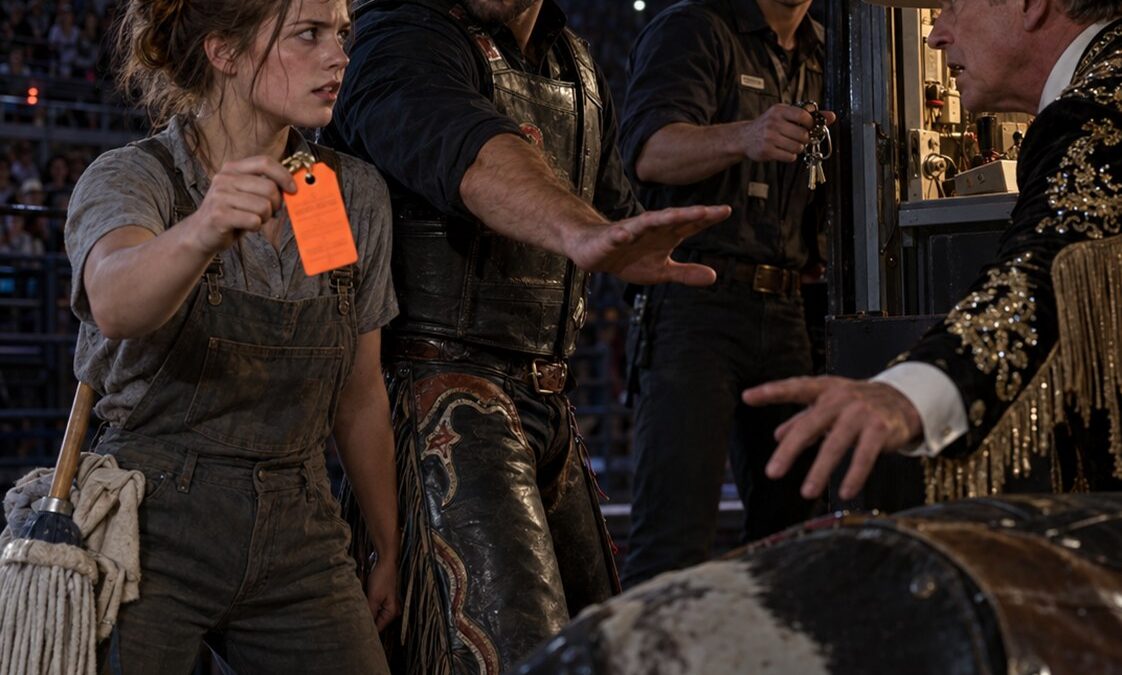
Chapter 2: Forty-Seven Seconds
The room went black.
The bull stopped so hard that June pitched forward.
Her fingers closed around the rope.
A thousand people shouted.
Some called for lights.
Some called her name.
June listened for the motor.
It hummed beneath her.
The machine had power.
The screens did not.
Someone had shut off the show.
“Stay there!” Colter called.
“Gladly.”
A narrow beam found her.
Colter had switched on his phone.
June saw his boots at the edge of the padded floor.
Then she saw Ezra.
He was already walking toward the control booth.
“Stop him,” June said.
Colter turned.
“Why?”
“Because the lights didn’t trip the breaker.”
Ezra reached the booth door.
June pointed at the glowing timer.
It still read 47.0.
“The timer has power,” she said.
Colter caught up with Ezra.
“Open it.”
Ezra kept his hand on the latch.
“We need to secure the equipment.”
“That’s what I’m asking.”
A backup light came on.
Then another.
June climbed down carefully.
Her knees shook when she reached the floor.
She hoped nobody could see.
Ezra could.
“You got your stunt,” he said.
“You stopped my ride.”
“Power failure.”
“Only above us?”
Ezra gestured toward the dark screens.
“Clearly.”
Colter looked at the lit exits.
At the timer.
At the booth keypad beside Ezra’s hand.
“Open it,” he said again.
Ezra’s jaw tightened.
“The technician has the key.”
“Then call him.”
The technician was already there.
His name was Denny Pike.
He looked about June’s age, though she knew he was twenty-four.
He had once borrowed her mop bucket to catch a leak backstage.
Now he held a ring of keys without choosing one.
“Denny,” Ezra said, “give me a minute.”
June stepped closer.
“Did you cut the screens?”
Denny shook his head.
Ezra swung toward him.
“Think before you speak.”
Denny lowered his eyes.
Colter moved between them.
“Open the booth, Denny.”
The key scraped in the lock.
Inside stood a control console, two monitors, and a strip of orange plastic caught beneath one corner of the desk.
June recognized its color.
She looked down at the tag in her hand.
The same orange.
Ezra reached past her.
She pulled it away.
“You don’t get to touch this.”
“I own that tag.”
“It has my mother’s signature.”
“That doesn’t change who owns it.”
June held it where Colter could see.
On the front were a serial number and a date.
On the back was her crooked black mark.
Colter frowned.
“Why bring an inspection tag to a riding contest?”
“Because this machine isn’t new.”
Ezra gave a short laugh.
“Nobody said it was.”
“You said my mother failed to inspect it.”
“She did.”
June pointed at the serial number.
“She inspected the machine you told the public had been destroyed.”
Denny looked up.
Ezra said nothing.
June looked through the booth window at the bull.
Five years earlier, its malfunction had thrown a rider at a county fair.
The rider had recovered.
June’s mother had lost her certification, her job, and most of her friends.
Ezra had blamed her inspection in every interview.
Then he had announced that the machine was gone.
June pressed the tag against the glass.
“My mother never cleared that machine for a ride,” she said.
“She ordered it locked out.”
* * *
Ezra tried to close the booth.
Colter planted one hand against the door.
“People are filming,” he said.
Ezra looked past him.
Phones glowed all around the arena.
The audience had fallen quiet enough to hear Denny breathing.
“Then let’s give them the truth,” Ezra said.
He took the microphone from a stagehand.
June had watched him use it for nearly a year.
He could turn any accident into a punch line.
He could make a sponsor sound like a savior.
He could make a woman with twenty years of safety work sound careless.
“Folks,” he began, “we have an old family disagreement.”
June reached for the microphone.
Ezra held it above her.
She waited.
Colter took the spare microphone from its stand.
He handed it to June.
A few people cheered.
June wanted them quiet.
She needed to hear herself think.
“The tag says LOCK OUT,” she said.
She held it under a camera.
The words filled the screens when they came back on.
Ezra’s technician had restored the video feed.
The timer still read 47.0.
“My mother signed that instruction five years ago.”
Ezra spread his hands.
“The equipment was repaired.”
“Show the release inspection.”
“We have records.”
“Then show one.”
Ezra smiled.
“Do you carry every paper from your family’s business?”
“We never owned a business.”
Colter looked at the tag.
Then at the bull.
“Did you ride this machine at the fair?” he asked.
“No.”
“My mother was working there.”
Colter turned to Ezra.
“You told me that accident was on a different model.”
“It was.”
June read the serial number aloud.
Denny flinched.
She saw it.
“So did Colter.”
Denny leaned toward the console.
“I need to shut the motor down.”
“Do it,” Colter said.
Ezra caught his wrist.
“You answer to me.”
Denny looked at June.
She nodded.
He pressed the stop switch.
The motor’s hum faded.
For the first time, the arena felt still.
June’s hands began shaking.
She folded the tag between her palms.
Colter noticed.
“You all right?”
“I got off.”
“That wasn’t my question.”
June almost laughed.
Her mother asked it the same way.
“I will be.”
A security supervisor arrived with two guards.
Ezra spoke first.
“She disrupted a live event.”
“I entered your challenge,” June said.
“Then a fault shut it down.”
Ezra pointed at her.
“Because you tampered with the controls.”
“I never went near them.”
The supervisor asked everyone to step away from the booth.
Colter refused to leave until Denny came out.
Denny brought no papers.
He did bring his phone.
“The controller stores activity,” he said quietly.
Ezra stared at him.
“That isn’t your job to discuss.”
Denny slipped the phone into his pocket.
The supervisor called the fire marshal assigned to the event.
June gave the marshal the tag.
She made him photograph both sides before she let it leave her hands.
Then she called her mother.
June had rehearsed that call a hundred ways.
Every version began with good news.
This one began with, “Mom, are you sitting down?”
Her mother was.
She listened without interrupting.
When June finished, the line stayed quiet.
“Where did you find it?” her mother asked.
“In our tin of old receipts.”
“I told you to throw those out.”
“You told me to throw out the grocery coupons.”
“That was six years ago.”
“I kept those, too.”
Her mother made a small sound.
It could have been a laugh.
It could have been something else.
“Come home,” she said.
“I will.”
“June.”
“What?”
“I never inspected that bull after Ezra bought it.”
June looked at the tag again.
Her mother had written the lockout at the county fair.
The tag belonged to the machine’s original owner.
Ezra had shown photographs of a different machine being dismantled.
June knew because her mother had spent years pointing out the frame shape.
But knowing at home was different from proving it in public.
“How did he get your tag?” June asked.
“He wasn’t supposed to.”
A marshal called June back.
She promised her mother she would call again.
Colter stood beside the control booth.
His face had lost the easy confidence from the posters.
“I need to tell you something,” he said.
“Then tell the marshal.”
“I will.”
The marshal joined them.
Colter took a breath.
“At every show, I was told the machine had a programmed recovery at forty-seven seconds.”
“What did that mean?” the marshal asked.
“It eased the bucking.”
June looked at the frozen timer.
“How much?”
“Enough to finish the ride.”
“Did the rules say that?”
Colter shook his head.
Ezra’s name flashed across the screen behind them.
His own advertisement called Colter undefeated at maximum difficulty.
Colter stared at it.
“I thought every challenger got the same program,” he said.
Denny spoke from the booth doorway.
“They didn’t.”
* * *
The arena emptied slowly.
People wanted refunds.
Others wanted interviews.
A few wanted June’s photograph.
She said no to all of them.
The fire marshal had stopped the demonstration.
A city inspector secured the control booth.
The show’s staff wheeled barriers around the bull.
Nobody touched the console after Denny powered it down.
June watched until an inspector sealed the booth door.
Then she went home.
Her mother sat at their kitchen table in a faded blue sweater.
The final notice lay beside her mug.
June had hoped she could return with the million.
Instead, she brought an orange tag and a story nobody had finished checking.
Her mother took her hand.
“Your feet are cold,” she said.
June looked down.
Her work shoes were still damp from mopping.
“I forgot my other pair.”
“You forget everything you own at work.”
“Not everything.”
June set the tag on the table.
Her mother didn’t touch it.
For a long moment, she only read.
There were three lines in her own handwriting.
LOCK OUT.
UNSTABLE RESPONSE AT MAXIMUM SETTING.
DO NOT RETURN TO SERVICE.
Beneath them sat her signature.
June had seen that signature a thousand times.
Her mother had written school notes with the same careful loop.
“Tell me the whole thing,” her mother said.
June did.
She described the timer.
The screens.
Colter’s phone.
Denny’s face when she read the serial number.
Her mother listened.
At the end, she folded the landlord’s notice and slid it beneath her mug.
“That paper can wait until morning.”
“It says five days.”
“I can read.”
June leaned against the counter.
“I thought I could win.”
“You entered to make him show the controls.”
“I also wanted to win.”
“I know.”
“I’m sorry.”
Her mother stood.
She crossed the kitchen and hugged her.
June had gotten taller that year.
Her mother still reached her easily.
“You don’t owe me an apology for wanting us to stay here,” she said.
The next morning, June took the bus to the county office with her mother.
The old fair had been run by a private company.
The county had issued permits and kept incident reports.
They asked for the original inspection file.
A clerk found it in an archive box.
Her mother’s tag number appeared on page four.
So did the serial number.
The incident report listed a rider who had fallen during a test after her mother’s lockout.
It listed an operator who had removed the tag.
His name was Ellis Brant.
Ezra’s former operations manager.
June had heard Ezra name him on television.
Ezra said Brant had acted alone.
Brant had lost his job.
June’s mother had lost hers.
The clerk copied the pages.
June paid twelve dollars and eighty cents.
That left her twenty-three dollars until Friday.
Outside, her mother offered to repay her.
“No.”
“I have cash.”
“Buy bread.”
“We have bread.”
“Then buy the good kind.”
They walked toward the bus stop.
Her mother held the copied report so tightly its edge bent.
“This says I locked it out before the test,” she said.
“Then why did they blame you?”
“Ezra’s company said the tag went on after the fall.”
“The date is here.”
“His lawyer said I filled it in later.”
June looked at the clerk’s stamp.
It showed the office had received a copy of the lockout notice two days before the fall.
“Did your lawyer see this?”
“I had a lawyer for three weeks.”
“What happened?”
“I couldn’t pay him.”
A bus pulled up.
They stayed where they were.
June pointed at the receipt stamp.
“He had this.”
“He had a report from Ezra’s company.”
“That’s different.”
Her mother stared at the stamp.
“Very different.”
That afternoon, June returned to the convention center.
She had a shift.
She had not slept enough.
The supervisor offered her the evening off.
June asked if she would be paid.
The supervisor said no.
June collected her mop.
Colter found her in the service corridor.
He was carrying a paper bag.
“I bought sandwiches,” he said.
“We have a vending machine.”
“It sold me one last night.”
“That sounds right.”
He offered the bag.
June hesitated.
“You weren’t in on it?” she asked.
“I should have asked more questions.”
“That isn’t what I asked.”
“No.”
She took a sandwich.
Colter leaned against the wall while she ate.
He told her about his first contract.
Ezra had recruited him from small rodeos.
He had ridden the bull at a demonstration.
Ezra called the setting ten.
Colter had lasted sixty seconds.
After that, Ezra marketed him as unbeatable.
“I thought the machine eased for everybody,” Colter said.
“Why?”
“The operator told me it was a safety feature.”
“Did you see it work?”
“No.”
“You trusted him.”
“Yes.”
June folded the sandwich wrapper.
“My mother trusted a supervisor once.”
Colter accepted that.
He did not ask for forgiveness.
He handed her a business card instead.
A lawyer’s name was written on the back.
“She represents riders,” he said.
“Does she represent cleaners?”
“I asked.”
The lawyer’s name was Tessa Grant.
June called her during her break.
Tessa said she could meet both Mercers without a fee for the first consultation.
She also told June not to hand her original tag to anyone else.
“The marshal has photos,” June said.
“Good.”
“Did Colter tell you everything?”
“He told me enough to want the records.”
“Can we get them?”
“Some.”
“How?”
“Preservation requests first.”
Tessa explained what that meant.
The event company would be told to keep its contracts, maintenance logs, videos, and controller data.
The city could preserve material for its safety inquiry.
Their lawyer could ask for records through a civil case if there was a sound basis.
She never promised a million dollars.
June liked her better for that.
Before they hung up, June asked one question.
“If the old report clears my mother, why did the county never say so?”
Tessa paused.
“Let’s find out who received it.”
The answer arrived two days later.
The county’s distribution sheet listed four recipients.
The fair operator.
The insurer.
The state licensing office.
And Ezra Wynn.
* * *
Ezra’s lawyers sent June a letter on Friday.
It demanded the return of the tag.
It said she had damaged his business.
It said any further public claim could bring a lawsuit.
June read it at the laundromat.
Her mother’s blue sweater turned behind the glass.
Tessa read a photograph of the letter and called back.
“Keep it,” she said.
“That’s all?”
“Keep the envelope, too.”
“He says I stole it.”
“Your mother took it home when the fair released her belongings.”
“Can we prove that?”
“Her termination receipt lists inspection materials.”
June looked at her mother.
“Did you keep that?”
“Tin.”
“Of course.”
Their kitchen tin held grocery coupons, old rent receipts, June’s school photographs, and the termination receipt.
The receipt listed an orange lockout tag among the personal papers returned.
Ezra’s demand could not change that.
Still, the letter reached their landlord.
He called June’s mother.
He had seen a video of June at the show.
He wanted to know when the million would arrive.
“We haven’t won anything,” she told him.
He asked for rent by Monday.
June heard every word.
She had been ready to fight Ezra.
The landlord frightened her more.
He knew where they lived.
He could turn a key.
Tessa directed them to a local housing counselor.
The counselor checked the notice and the lease.
She helped June’s mother arrange a payment plan for the arrears.
June picked up two extra cleaning shifts.
Colter offered money.
June refused.
He didn’t argue.
The next day, sandwiches appeared in the staff refrigerator with her name on a paper bag.
She texted him.
Is this your idea of subtle?
He replied.
No.
She ate one.
At the city safety office, Denny gave a recorded statement.
He had not caused the blackout.
He said Ezra had ordered him to install a remote cut switch the week before.
Ezra called it a safeguard for bad publicity.
The switch could blank the screens and stop the timer while leaving the motor powered.
Denny had disliked it.
He had installed it anyway.
He showed the inspector where it sat beneath the console.
Then he showed him a photo from the installation.
The small switch was fastened beside the remote receiver.
Its label read SHOW HOLD.
June learned that from Tessa.
She wanted to ask Denny why he had obeyed.
Tessa said she could.
She also said he had already answered in his statement.
He had a job.
His mother lived with him.
His rent was due.
June hated how familiar that sounded.
Denny brought another fact.
The controller kept a log of every change made through Ezra’s remote.
It recorded speed settings, pauses, and display commands.
The city’s technician copied the data in Denny’s presence.
Ezra’s lawyer observed.
Everyone signed a form describing what had been taken.
The log was dull.
Rows of times.
Columns of commands.
Numbers June understood only after the technician explained them.
Colter’s championship rides showed the same change.
At forty-seven seconds, the motor dropped to a gentler pattern.
The screen continued to display level ten.
The challengers’ rides showed no such change.
Some ended before forty-seven seconds.
Two reached it.
Their settings stayed hard.
June stared at those two rows.
One belonged to a nurse from Tulsa.
The other belonged to a truck mechanic from Reno.
Both had been laughed off the stage.
Neither had known the rules were different.
The city inspector called it a serious safety issue.
Tessa called it evidence for the riders’ claims.
Colter called it cheating.
June called the nurse.
She found her through a public interview.
The woman’s name was Patrice Bell.
She remembered the ride.
She remembered Ezra telling her she had “almost joined the big leagues.”
“I thought Colter was amazing,” Patrice said.
“He is good,” June answered.
“I can believe both things.”
Patrice agreed to speak with Tessa.
The mechanic did, too.
By the following week, other former challengers had called.
Some wanted the prize.
Some wanted their entry fees back.
One wanted Ezra to say his name correctly.
Meanwhile, June’s mother studied the old county file.
She read it three times at the kitchen table.
Then she noticed an attachment missing from the copy.
The index listed a test video.
The archive box did not contain it.
Tessa requested the county’s digital record.
The clerk searched an older server.
The video was there.
It had been uploaded before the accident.
The county’s timestamp appeared in its record.
June and her mother watched it in Tessa’s office.
The camera showed the bull at the fair.
It bucked while nobody rode.
June’s mother walked into view.
She pointed to the console.
A supervisor stopped the motor.
Her mother fixed an orange tag to the main switch.
The camera moved closer.
The word LOCK OUT filled the frame.
Then Ezra appeared at the edge of the picture.
He spoke to the supervisor.
There was no sound.
June’s mother looked at him.
Ezra pointed toward the tag.
The video ended.
Her mother gripped the arm of her chair.
“That was the afternoon before the fall.”
Tessa replayed the last ten seconds.
“Do you know what he said?”
“No.”
“Can you tell from the picture?”
“He wanted the machine running for a sponsor.”
“How do you know?”
“He told me at the time.”
Tessa wrote that down.
She asked who else had heard it.
Her mother named Ellis Brant.
The man Ezra had blamed for removing the tag.
Tessa contacted his lawyer.
Brant had moved to Iowa.
He still had a copy of his old employment contract.
He also had an email.
It was from Ezra.
It told him to “clear the hold before Saturday’s demonstration.”
Brant had never shown it publicly.
His lawyer had advised him to preserve it while an employment claim was pending.
That claim had settled privately.
The email still existed.
The sender address belonged to Ezra.
The company’s retained mail archive contained the same message.
Tessa called June with the news.
June was on a bus.
She missed her stop.
“Why did Brant keep quiet?” she asked.
“His settlement required confidentiality.”
“Can he speak now?”
“About safety, yes.”
June watched the streets slide past the window.
Her mother had carried blame for five years.
Brant had carried it, too.
Ezra had carried neither.
Tessa sent June the line from the email.
Clear the hold.
June read it twice.
The architect had signed his name.
* * *
The city held a public safety hearing.
It concerned the convention center’s permit and the touring machine.
It could not decide every civil claim.
It could decide whether the bull could operate there again.
It could put the evidence where sponsors, riders, and regulators would see it.
June sat beside her mother.
Tessa sat on the other side.
Colter and Denny waited behind them.
Ezra entered with two lawyers and a smile prepared for cameras.
June knew that smile.
She had watched him use it while mops dried backstage.
When the hearing began, Ezra’s lawyer spoke first.
He said the company valued safety.
He said the old county fair accident had no bearing on the current permit.
He said June’s challenge had created confusion.
Then Ezra spoke.
“I built a show people love,” he said.
“I hired experts.”
“I hired riders.”
“I took risks with my own money.”
He looked at June.
“Now one employee finds an old tag and calls that a conspiracy.”
June’s mother shifted in her chair.
June touched her hand.
Tessa had told them to let him finish.
Ezra argued well.
The current machine had passed a basic equipment check in three states.
No one had suffered serious harm on his tour.
Every contestant had signed a waiver.
The challenge rules mentioned that ride patterns could vary.
He read that line aloud.
Several people in the room nodded.
June had read it, too.
She had worried all night.
Then the city inspector took his turn.
“The equipment check did not review hidden control commands,” he said.
“The waiver did not authorize a false display.”
He described the recovered controller log.
A large screen showed its rows.
Colter’s rides appeared in blue.
Other riders’ appeared in gray.
At forty-seven seconds, the blue lines changed.
The gray ones did not.
Ezra’s lawyer said the difference reflected Colter’s skill.
The inspector pointed to the command column.
The machine had received a new instruction.
A rider’s skill could not send it.
Ezra leaned forward.
“You can’t say who pressed the button.”
“That is correct,” the inspector said.
Ezra sat back.
For a moment, he looked pleased.
Then Denny was called.
He explained the remote.
He explained who carried it.
Ezra said others had access.
Denny agreed.
Then he described the night June entered.
The blackout command had come from Ezra’s assigned remote.
Ezra held it on the arena floor in the event video.
The inspector played the footage.
June watched herself climb onto the bull.
She saw Colter beside the gate.
She saw Ezra raise the remote.
At forty-seven seconds, his thumb moved.
The screens went dark.
The room at the hearing stayed bright.
No one spoke for a few moments.
Ezra’s lawyer asked whether the remote might have been triggered by accident.
Denny said it could.
“Would that explain the old rides?” the lawyer asked.
“No.”
“Why?”
“The same command appeared at the same point in forty-three recorded championship rides.”
Ezra rubbed his forehead.
His lawyer changed subjects.
The old accident, he said, still had no relevance.
Tessa stood.
She introduced the county video.
The screen showed June’s mother placing the lockout tag.
It showed Ezra beside her.
Tessa offered the county’s upload record.
The date preceded the accident.
Then she held up the original tag.
June recognized her black mark on its back.
Tessa explained it simply.
June had marked it at thirteen.
Her mother had taken it home with the papers listed on her termination receipt.
Its serial number matched the county file.
Its wording matched the video.
It was the same tag.
Ezra had said the warning came after the accident.
The dated video showed it came before.
His lawyer objected to treating a public hearing like a trial.
The chair agreed that the hearing could not decide criminal intent.
She allowed the evidence because it concerned the machine’s safety history.
Ezra stood.
“You think I wanted a rider hurt?”
June’s mother faced him.
“I told you to stop the demonstration.”
“You warned everyone.”
“I warned you.”
“You couldn’t know what would happen.”
“That’s why I locked it out.”
Ezra turned to the chair.
“I was trying to save the event.”
There it was.
His reason.
A sponsor had paid for the fair demonstration.
A canceled ride would have cost him the contract.
Years later, Colter’s unbeaten streak had made the tour valuable.
A fair contest threatened that money.
Ezra had kept the old machine.
He had kept the old habit.
When June climbed on, he had stopped the show before anyone could watch her reach the same easy finish.
Tessa introduced Brant’s email.
The company archive confirmed its address and date.
Brant’s lawyer confirmed the preserved copy.
Ezra’s lawyer asked for time to review it.
The chair granted a recess.
June went outside.
She stood near a trash can and tried to eat a granola bar.
Colter joined her.
“You held up,” he said.
“My mother did the talking.”
“You climbed on the bull.”
“You gave me a microphone.”
“I should have asked about the settings years ago.”
“Yes.”
He accepted it.
June took another bite.
“I still think you can ride,” she said.
“That helps.”
“I’m not saying you’d beat Patrice.”
“That helps less.”
She smiled.
It surprised them both.
When the hearing resumed, Ezra’s lawyer offered a narrower explanation.
The old email might refer to clearing an administrative hold.
The repeated forty-seven-second changes might reflect an approved performance setting.
The blackout might have been accidental.
One explanation at a time, each sounded possible.
Together, they sat badly.
Then Colter spoke.
His contract described his ride as identical to the challengers’ rides.
Ezra had signed it.
Colter had brought the original and the company’s digital copy.
He described the recovery Ezra had promised him.
He described believing it applied to everyone.
“I won’t call myself undefeated under those rules,” he said.
Ezra stared at him.
“You’re throwing away everything I built for you.”
Colter looked at the audience.
“You built a scoreboard.”
The chair suspended the permit for the machine pending further review.
She referred the records to the relevant state agencies.
She also ordered the company to preserve its equipment and data.
The local district attorney’s office later reviewed the false displays and the old incident.
Tessa warned June that an investigation would take time.
It did.
By winter, Ezra’s company had settled claims from former challengers without admitting every allegation.
A state regulator revoked its authorization to run the touring challenge under the advertised rules.
Ezra pleaded guilty to a financial fraud charge tied to the prize promotion.
The court ordered restitution and barred him from running a similar contest while he served his sentence.
The old fair accident produced no new criminal charge.
Its records were corrected.
The correction said June’s mother had ordered the machine out of service before the test.
That sentence mattered most to her.
Ezra sent one last message through his lawyer.
He claimed June had ruined a business that paid dozens of people.
June asked Tessa to send back one line.
“Tell him to pay them what he owes.”
* * *
Spring came slowly.
June still cleaned the convention center.
She no longer worked the rodeo hall.
There was no rodeo hall to work.
A home improvement expo took the space.
She learned which exhibitors left screws on the floor.
She learned which ones remembered her name.
Her mother returned to inspection work on a limited schedule.
The state licensing office reviewed the corrected fair record.
It restored the credential she had lost.
On her first morning back, June packed her lunch.
Her mother inspected the sandwich.
“You cut the crusts off.”
“You used to.”
“You were seven.”
“I’ve had a busy week.”
Her mother put the crusts back in the bag.
“We don’t waste food.”
“Inspector Mercer has spoken.”
“Inspector Mercer has rent.”
They paid it on time that month.
The housing counselor helped them settle the remaining balance.
June put the landlord’s final notice in the kitchen tin.
Her mother asked why.
“Proof we survived it.”
“Proof we should clean out the tin.”
They kept it.
Money came later.
Former challengers received portions of the restitution.
The civil settlements varied.
June’s ride had ended before sixty seconds.
She had no claim to the advertised million under the contest rules.
Tessa had explained that from the start.
June was disappointed anyway.
She admitted it to her mother.
“One million would have bought a lot of good bread,” she said.
“An unreasonable amount.”
“We could’ve tested every bakery in the state.”
“Think of the bus fare.”
Colter received an offer from a streaming company.
It wanted a special about the scandal.
He called June before signing anything.
“They want you in it,” he said.
“Doing what?”
“Talking about the tag.”
“Would they pay me?”
“Yes.”
“How much?”
He told her.
She sat down.
It was more than she earned in six months.
Tessa reviewed the offer.
The contract gave the company broad control over June’s words and her mother’s old photographs.
June asked for changes.
The company refused some.
She turned it down.
Colter called again.
“You don’t have to do it for me.”
“I wasn’t going to.”
“I figured.”
“Are you doing it?”
“I don’t know.”
He eventually declined, too.
Instead, he returned to live rodeo events that used animals and riders under established safety rules.
He asked June’s mother to review one event’s equipment procedures.
She agreed after the organizer paid her normal rate.
Colter asked June whether that felt awkward.
“Only if you call her your personal inspector.”
“I wasn’t planning to.”
“Then you’re safe.”
Denny left Ezra’s company.
For a while, he repaired arcade machines.
Then he began training with an independent equipment firm.
He wrote June an apology.
It was short.
He said he had installed the blackout switch.
He said he knew it could hide what happened during a ride.
He said he should have refused.
June read the note at the kitchen table.
She wrote back.
Thank you for telling the truth.
I’m glad you left.
She did not write that everything was fine.
She did not invite him over.
That was enough.
One Saturday, Patrice Bell came to town.
She had a nursing conference nearby.
June met her for coffee.
Patrice brought the mechanic from Reno on a video call.
He held up a check from the settlement.
“I’m fixing my truck,” he said.
“Romantic,” Patrice told him.
“The passenger door will open again.”
“Now that’s romance.”
June laughed harder than the joke deserved.
They talked about the ride.
Patrice had reached fifty-five seconds without a recovery setting.
She knew that now.
She had known it in her hands at the time.
Ezra had made her doubt herself.
“I wish we could run it fair,” Patrice said.
June pictured the bull’s lowered head.
She pictured the timer.
“No thanks.”
“I didn’t say you had to ride.”
“Good.”
Patrice stirred her coffee.
“What will you do?”
June looked through the window.
Across the street, workers were repairing the library steps.
One checked a level.
Another waited for his signal.
“I’ve been thinking about machines,” she said.
“Riding them?”
“Keeping people off the broken ones.”
Her mother had noticed.
June asked more questions at home now.
She wanted to know why an inspector tagged one switch but not another.
Why a log mattered.
Why a date could save a person.
Her mother never made the answers easy.
She put manuals on the table.
She asked June to find the rule herself.
June enrolled in a community college maintenance program that fall.
She kept her job.
She studied on the bus.
She learned that machines told stories through wear, settings, repairs, and the things people chose not to write down.
Colter visited the center one afternoon.
He found June crouched beside a floor scrubber.
A drive belt lay across her knees.
“Is it supposed to look like that?” he asked.
“No.”
“Good to know.”
She held out a flashlight.
“Point this here.”
He did.
The belt had frayed where a guard was loose.
June showed him.
“You caught it early,” he said.
“It made a new sound.”
“I wouldn’t have heard it.”
“You weren’t listening for it.”
Colter kept the light steady.
When she finished, he asked whether she wanted to see a local equipment shop.
His friend managed it.
They took apprentices.
June looked at him.
“Is this an offer you made for me?”
“It’s an invitation to meet someone.”
“Can I say no?”
“Yes.”
“Then ask again on Friday.”
He smiled.
“Friday.”
She went.
The manager asked hard questions.
June answered some.
For the others, she said, “I don’t know.”
The manager offered her a paid trial shift.
She accepted.
Her last evening at the convention center, she cleaned the floor where the bull had stood.
The home improvement expo had packed up.
The concrete showed ordinary scuffs.
No lights.
No audience.
No timer.
She found a loose washer under a table and dropped it in her pocket.
At home, her mother was mending the seam of June’s work jacket.
“Ready?” she asked.
“For tomorrow?”
“For whatever comes after.”
June considered giving a brave answer.
Instead, she sat beside her.
“I’m ready to learn.”
Her mother handed back the jacket.
“That’ll do.”
* * *
Six years later, June stood beneath the convention center lights again.
The room had changed.
There was no bull.
There were workbenches.
There were students in safety glasses.
At the center stood an old drive motor with its cover removed.
June had brought it from the shop.
Her mother had helped her choose it.
The free workshop taught young workers how to spot a fault and report it before anyone got hurt.
Patrice came whenever her shifts allowed.
Colter carried chairs.
He had discovered that folding chairs could defeat him faster than any rodeo event.
Denny taught a session on control logs.
He still apologized when he saw June’s mother.
She thanked him for his work and kept their meetings professional.
The boundary suited them both.
June’s mother sat in the front row.
Her hair had gone nearly white.
She still corrected June’s labels.
“Is that the main disconnect?” she called.
June looked up.
“Yes.”
“Then say main disconnect.”
A student laughed.
June grinned.
“Inspector Mercer is here for quality control.”
“Someone has to be.”
On the workbench lay the orange tag.
Its ink had faded.
The fold June made that night still crossed its corner.
A clear sleeve protected it now.
June had asked her mother’s permission before bringing it.
She held it up for the students.
“Five years after my mother wrote this, I used it to ask a question.”
She showed them the serial number.
Then the instruction.
“Read what’s in front of you,” she said.
“If someone tells you it means something else, ask them to show you why.”
A girl in the front row raised her hand.
“Were you scared when you got on the bull?”
“Yes.”
“Did you think you’d win?”
“I thought I might.”
June glanced at her mother.
“I needed the money.”
The girl waited.
“What happened at forty-seven seconds?”
“Someone stopped the clock.”
June placed the tag beside the motor.
“But the machine kept telling us what it knew.”
After the workshop, the girl stayed to help put away tools.
Her father worked nights.
She wanted a job at the shop.
June gave her the application.
“Can I ask you something?” the girl said.
“Sure.”
“Will you look at it before I send it?”
“Yes.”
June’s mother watched from the next bench.
Colter wrestled a folding chair into its rack.
Patrice called out advice he did not need.
Denny checked that the motor was disconnected.
The room sounded different now.
People asked.
People answered.
Nobody had to shout over a timer.
June slipped the orange tag into its sleeve.
Her mother held out the kitchen tin.
It was scratched and full of papers.
June put the tag inside.
“What else is in there?” the girl asked.
June’s mother lifted the lid.
“Grocery coupons.”
“Are they still good?”
“Not even close.”
They laughed.
June closed the tin and carried it toward the light.
THE END








