Twelve Minutes Before I Proposed, a Girl Beneath the Theater Stage Held My Lost Lover’s Baton and Called Me Her Father
Chapter 2: The Four Names
Renata came down the stairs alone.
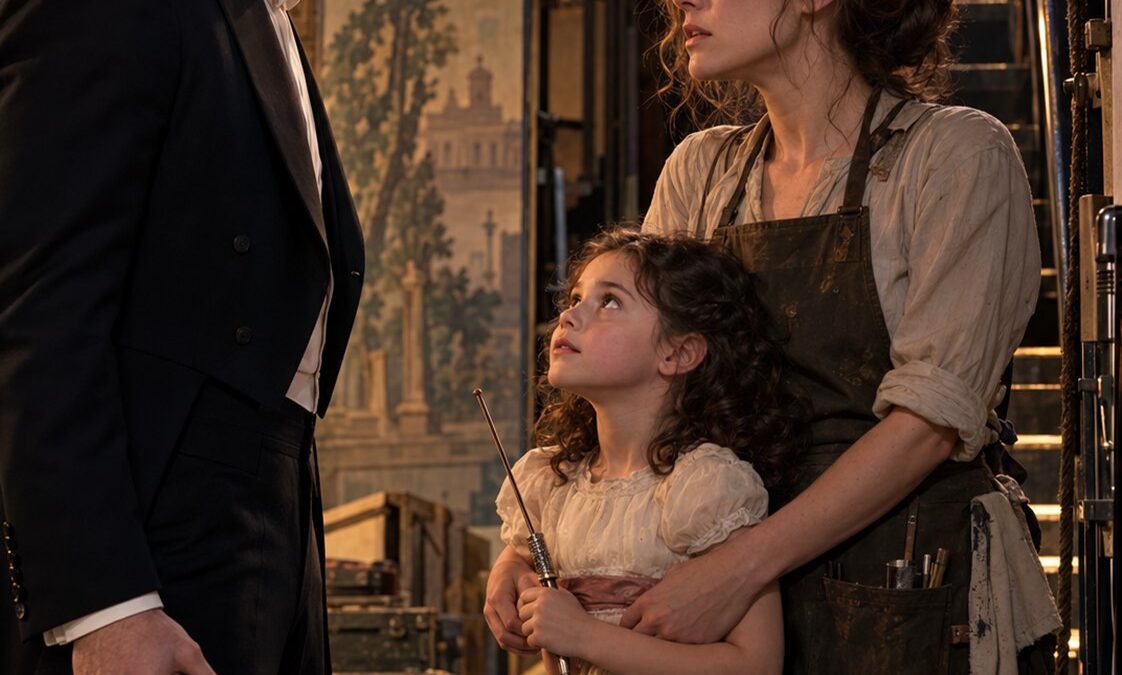
June stood above us.
Iris stood beside me.
The baton lay between her fingers.
Renata looked at the child once.
That was enough.
“You need to return upstairs,” she told me.
“No.”
“Evelyn’s father is waiting.”
“He can wait.”
Renata’s gaze moved to Iris.
“You were told to leave.”
“I was hired to work,” Iris said.
“Your contract can be ended.”
“So can this conversation.”
I had heard Iris speak that way once before.
She had been twenty-nine then, arguing with a building inspector over the roof of a neighborhood music school.
The inspector had been wrong.
Iris had made him read his own report aloud.
Now her hand shook against the baton.
I wanted to take it.
I did not.
“June has three siblings,” I said.
Renata smoothed one cuff.
“This is hardly the place.”
“It’s the only place you came.”
A door slammed somewhere backstage.
June flinched.
Iris climbed one step and touched her daughter’s shoulder.
“I’m here,” she said.
The child nodded without looking away from Renata.
I understood then that she had heard more than a passing remark.
Iris understood it too.
“Who spoke to her?” she asked.
“I have no idea,” Renata said.
June pointed upward.
“You did.”
Renata’s expression held.
“I was speaking to your mother.”
“You said he didn’t want us.”
Iris drew June close.
For years, I had trusted Renata to handle the conversations no one else could bear.
She had run our company while my father was ill.
She had sat outside my hospital room after the wreck.
She had arranged tonight.
“I never said that,” I told June.
She looked to Iris for help.
Iris gave me none.
June had every right to doubt a stranger.
“We need to get her upstairs,” Iris said.
“Where are the other children?”
“With my brother.”
“Are they safe?”
“Yes.”
That single word eased something in my chest.
Renata glanced at her watch.
“You have eight minutes.”
I took out the ring box.
For one terrible instant, Iris thought I meant to show it to her.
I saw it in her face.
I closed my hand around it.
“I’m going to speak to Evelyn,” I said.
“And then I’m coming back.”
“You made a promise upstairs,” Renata said.
“I haven’t made it yet.”
Iris led June past me.
At the landing, she turned.
“Seven years ago, I tried to tell you,” she said.
“I know.”
“No, Julian.”
Her voice dropped.
“I told Renata while you were in the hospital.”
* * *
Evelyn met me behind the stage curtain.
She wore a cream gown and an expression I had never seen on her.
It was concern without calculation.
“Your aunt says there’s a disturbance,” she said.
“There is.”
“Are you hurt?”
“No.”
I opened the ring box.
Then I closed it again.
“I can’t propose tonight.”
Evelyn looked toward the audience.
Her father was speaking to a donor in the front row.
“Tell me why.”
“I’ve just learned I have children.”
She stepped back.
“How many?”
“Four.”
Her eyes widened.
“When did you learn?”
“Minutes ago.”
She looked at the ring.
“Does their mother know about us?”
“She knows about you.”
“That wasn’t quite my question.”
I deserved the correction.
“Yes,” I said.
“I loved her.”
Evelyn pressed her lips together.
Our arrangement had never claimed to be a romance.
It had claimed to be honest.
“I’ll tell my father,” she said.
“I’ll come with you.”
“Let me give him the first sentence.”
I put the ring box away.
She watched me go.
No announcement was made that night.
The guests were told I had received urgent family news.
For once, the explanation was exact.
I found Iris at the side exit.
June slept against her brother’s shoulder.
His name was Owen.
He was broad and gentle, with the patient eyes of a man who had carried four sleeping children at once.
I asked Iris whether we could speak somewhere private.
She chose her workshop.
It occupied two rooms above a closed bookstore.
Violin cases lined one wall.
Four pairs of small shoes waited beneath a bench.
I stopped at the doorway.
Iris noticed.
“Don’t wake them,” she said.
Owen took June to the adjoining room.
The other three were already there.
Through the open door, I saw a boy asleep beneath a blue blanket.
A girl lay beside him.
Another boy had one foot hanging from the cot.
I wanted to know their names.
I made myself sit down first.
Iris set the baton on the worktable.
“You gave me this after my first concert,” she said.
“I remember.”
“You dropped it before I could open the box.”
“I remember that too.”
“I kept it because I wanted the children to know you were real.”
I looked at her.
“Renata told me you left with someone else.”
“She told me you wanted me gone.”
“She showed you something?”
“A letter.”
“Signed by me?”
“Yes.”
I had never written it.
She read my face.
“I brought it,” she said.
“Why tonight?”
“The contractor asked for every instrument I’d repaired.”
She touched the baton.
“I wasn’t planning to see you.”
“But you brought the letter.”
“I’ve carried it in my music case for six years.”
She opened a drawer.
The paper was folded into quarters.
I read it once.
Then again.
It said I would provide money if she kept her pregnancy private.
It said I wanted no contact.
The signature looked like mine.
The language did not.
I had been raised to believe every obligation survived discomfort.
The letter offered payment in exchange for silence.
“May I photograph this?” I asked.
“Yes.”
“Keep the original.”
“I intend to.”
I asked what happened at the hospital.
Iris sat across from me.
“I called your office when I learned I was pregnant.”
“Who answered?”
“Renata.”
“She told you I was hurt?”
“Yes.”
“Did she let you see me?”
“No.”
Renata had said I was recovering and that contact would upset me.
Two days later, a lawyer had visited Iris at the music school.
He had brought the letter.
He had offered an apartment and a monthly payment.
She refused both.
A week later, her school lost its lease.
I knew the landlord.
It was a company Renata controlled.
Iris watched me make the connection.
“I left town,” she said.
“I had four babies to keep safe.”
I looked toward the room where they slept.
“You knew there were four?”
“By then.”
“Did you try again?”
“After they were born.”
She had sent a photograph and a note to my office.
The envelope had come back unopened.
Inside it was a card stating that further contact would be referred to counsel.
She still had the card.
“I thought you had chosen,” she said.
“I thought you had too.”
Neither of us spoke for a while.
At last, I asked their names.
“June,” she said.
“Ellis, Willa, and Simon.”
Four names.
Four children sleeping on the other side of a door.
I stood and crossed to the window.
“I don’t expect you to trust me tonight,” I said.
“Good.”
“But I want the truth checked.”
“So do I.”
I called the one attorney who had worked for my father and never for Renata.
* * *
Marian Bell arrived the next morning.
Iris chose a café near her workshop.
I brought no driver inside.
Marian brought a legal pad and three questions.
Who had written the letter?
Who had delivered it?
Where were the original records?
I could answer none of them.
That troubled me more than any accusation.
Marian examined the paper without taking it from Iris.
“The signature may be copied,” she said.
“Can you prove that?”
“An examiner can compare it.”
She asked Iris for permission to scan the letter.
Iris agreed.
Then Marian asked me for records from my hospital stay.
I had been unconscious for eleven days after the wreck.
The date on the letter fell on the fourth day.
“I couldn’t have signed it,” I said.
“You may have signed something before the accident,” Marian replied.
“Or someone may claim you did.”
She was right.
We needed records, not certainty in my voice.
My father’s old office kept dated copies of every outgoing legal document.
Renata had moved those files after he died.
Marian knew where.
So did I.
We went to the company archive that afternoon.
Iris stayed with the children.
I had asked to meet them.
She said another day.
I accepted it.
In the archive, I found the outgoing mail ledger.
Nothing to Iris appeared.
There was an entry for a payment to a legal courier on the letter’s date.
The billing code belonged to Renata’s office.
Marian photographed the page.
“That shows her office paid for something,” she said.
“It doesn’t show what.”
We asked the courier company for its retained invoice.
Its manager said he would release it to Marian with the right authorization.
By evening, we had it.
The delivery address was the music school.
The sender was listed as an outside law firm.
Marian recognized the firm.
It had represented Renata personally for years.
I called the attorney named on the invoice.
He said he needed to review his files.
Marian arranged a formal request.
I wanted to drive to his office and make him remember.
Instead, I went to Iris’s workshop.
She opened the door halfway.
“Any news?”
“Enough to keep looking.”
She considered that.
“June asked if you live in a castle.”
“I don’t.”
“She’ll be disappointed.”
For the first time since the theater, Iris almost smiled.
I asked whether I could leave something for the children.
“What?”
“My phone number.”
She handed me a pencil.
I wrote it on a plain card.
No crest.
No title.
Just Julian and the number.
At the door, I noticed a fresh envelope beneath her worktable.
Iris saw me looking.
“It came this afternoon.”
It contained notice that her workshop’s lease would end in thirty days.
The landlord was another company Renata controlled.
Marian read the notice over the phone.
“The timing matters,” she said.
“It may still be a lawful termination.”
“Find out,” I told her.
“I am.”
The next morning, the attorney who had delivered the letter called Marian.
His file had been archived off-site.
He was willing to provide a copy.
He also remembered one detail.
The instruction to deliver the letter had come directly from Renata.
* * *
Renata called before noon.
“I hear you’re asking about old invoices.”
“I am.”
“You should come to the office.”
“I have a meeting with Marian.”
“She can attend.”
I asked Marian to record the invitation in her notes.
Then I went.
Renata’s office overlooked the river.
A model of the proposed Stroud partnership sat on her table.
New warehouses.
New financing.
A clean drawing of ground we had owned for generations.
She did not offer me a chair.
“You embarrassed Evelyn,” she said.
“I told her the truth.”
“You have no proof those children are yours.”
“We’re arranging a test.”
“Of course you are.”
She slid a folder across the desk.
It contained figures for our waterfront project.
There was a funding gap.
I recognized the amount.
It was almost exactly what the Stroud bank had offered to advance.
“You came close to leaving this buried,” she said.
“What created the gap?”
“Costs.”
“Which costs?”
“We can discuss that after you repair your engagement.”
Marian opened the folder.
“I’d like copies,” she said.
Renata looked at her.
“You’re here as Julian’s guest.”
“I’m here as his lawyer.”
Renata’s face barely changed.
I took the folder.
“The proposal is over,” I said.
She crossed to the window.
“Your father gave me this company when you were too young to hold it.”
“He gave you a role.”
“He trusted me to preserve it.”
I thought of June beneath the stage.
“You told a child I didn’t want her.”
“I told her mother to leave.”
“June heard you.”
Renata turned.
“Children hear all sorts of things.”
Marian closed her pad.
“We’re done for now.”
Outside, she asked for authority to retain an independent accountant.
I signed it.
I also asked my operations director to preserve financial records and restrict access to old archive boxes.
He agreed in writing.
Those were small, careful acts.
They felt harder than anger.
The parentage test took several days.
Iris chose the clinic after talking to her own lawyer.
Her lawyer chose how the results would be shared.
I respected both decisions.
While we waited, I met the children in a public park.
Owen stayed nearby.
Iris introduced me by my name.
June watched me from a bench.
Ellis asked whether I knew how to skip stones.
Willa asked why adults wore black shoes to a playground.
Simon said nothing.
I answered what I could.
My first stone sank.
Ellis showed me how to hold the second.
It skipped twice.
He looked pleased for both of us.
Simon moved closer after that.
On the walk back, June handed me the baton.
“Mom says you gave her this.”
“I did.”
“Can you use it?”
“Badly.”
She considered my answer.
“Good,” she said.
“Why?”
“Then she can teach you too.”
I carried that sentence home.
The results arrived the following Tuesday.
The tests established that I was the father of all four children.
I read each name separately.
Then I read them together.
Marian called an hour later.
The accountant had found transfers from the waterfront project to a consulting company.
The consulting company belonged to Renata.
She had been using new financing to replace money she had already taken.
* * *
The accountant’s report gave us a trail.
It did not tell us why Renata had hidden my children.
Marian found that answer in my father’s trust.
He had left a share of the waterfront company to any children I might have.
Until a child was identified, Renata controlled the votes attached to that share.
She also had to account for the company’s use of trust property when a beneficiary appeared.
Four children meant four beneficiaries.
Their existence would bring an independent trustee into the records she had kept to herself.
I read the provision twice.
“She knew,” I said.
“She had a copy,” Marian replied.
We brought the documents to the independent trustee named in the trust.
He was retired but still living.
He remembered Renata objecting to the clause when my father signed it.
He gave Marian his own copy and agreed to speak with investigators.
Iris came to the next meeting.
She brought the original letter in a clear sleeve.
Her lawyer sat beside her.
Nobody asked her to surrender it.
The attorney who had delivered it arrived with his file.
He looked older than I remembered.
He admitted Renata had instructed him to visit Iris.
He said he believed the signature was mine.
“Did you speak to me?” I asked.
“No.”
“Did you see me sign?”
“No.”
He produced the instruction he had received.
It directed him to deliver the letter and offer payment.
It did not identify the person who had written it.
Then he showed us a second page.
Renata had asked him to report whether Iris accepted.
His answer was brief.
She refused.
Iris kept her eyes on the table.
“You knew I refused,” she said to no one.
The attorney nodded.
Marian asked him to preserve the file.
He agreed.
A document examiner later found that my signature on the letter had been reproduced from an older agreement.
The tiny break in the final stroke appeared in both.
On the older agreement, it was a defect from a scanned copy.
I had signed the original years before I met Iris.
Someone had used the scan.
We gave the findings and financial records to the authorities through counsel.
An investigator interviewed me.
Another interviewed Iris.
They asked for originals and followed up with the courier and the former attorney.
The company’s board put Renata on leave while the accounting continued.
She called me that night.
“You’ve handed our name to strangers,” she said.
“I handed them records.”
“You think they’ll distinguish between me and you?”
“They’ll have to.”
She let the silence stretch.
Then she said, “Ask Iris what she told your father.”
The line went dead.
My father had been ill during the year we met.
He had died before the children were born.
Iris went very still when I repeated Renata’s words.
“I never met him,” she said.
But the next morning, Owen found a photograph in their mother’s old things.
It showed Iris outside my father’s house.
Beside her stood Renata.
The date on the back was three days before my accident.
Iris stared at it.
“I went there to tell your father,” she said.
“Renata said he was too ill to see me.”
“She took the photograph?”
“She asked a guard to record who had come.”
Marian examined the date.
Renata had known about the pregnancy before I was hurt.
* * *
The board hearing was held at our company offices.
Evelyn attended for the Stroud bank.
Her father came with her.
The independent trustee sat beside Marian.
Iris chose to attend with her lawyer.
She wore a navy coat and carried her music case.
The baton was inside.
I had asked her to bring it.
She had asked why.
“Because Renata says you took it after we separated,” I told her.
“I want her to say that with you present.”
The board chair called the meeting to order.
The accountant laid out the transfers.
Renata challenged the way several had been classified.
She was prepared.
Some payments, she argued, had covered real services.
Some had been approved by managers who reported to me.
She showed contracts and invoices.
For an hour, she made the missing money look like a dispute over bookkeeping.
Then she turned to the children.
“No one here disputes a father’s duty,” she said.
“But Julian knew nothing of these children for six years.”
She looked at me.
“Why should a private family matter decide who manages a company?”
It was a question several directors wanted answered.
Marian gave it to the trustee.
He read my father’s provision aloud.
Renata had controlled the trust’s voting share while no beneficiary was identified.
Every relevant transaction was subject to review once a beneficiary appeared.
“This is precisely my responsibility,” he said.
Renata folded her hands.
“Then review the transactions.”
“We have,” he replied.
Evelyn’s father asked why the Stroud financing had been described as urgent.
Renata spoke of rising construction costs.
The accountant showed payments to her company.
She said they were authorized fees.
He showed the same work billed again by other contractors.
She said he misunderstood the contracts.
For a moment, I could see how she had kept the board uncertain for years.
She knew which questions had easy answers.
She drew everyone toward those.
Iris opened her music case.
Renata watched.
Iris placed the baton on the table.
“You said I took this after Julian dismissed me,” she said.
“I said you kept it.”
“You told me he had dismissed me.”
Renata looked toward the board chair.
“This is becoming a personal argument.”
“It is personal,” Iris said.
She turned the silver handle beneath the lights.
There was a date engraved along the side.
My father’s last birthday.
I had given Iris the baton at a concert three weeks later.
An old program and photographs from that concert established the date.
Iris had brought them.
I stood beside her in one photograph.
In another, Renata stood behind us, applauding.
She could no longer claim she had believed we were strangers when Iris came to the house.
“That proves you were acquainted,” Renata said.
“Yes,” Marian replied.
“The photograph from your security guard proves you knew Iris came to tell the family she was pregnant.”
Marian placed the guard’s archived visitor entry on the table.
He had confirmed it in an interview.
Renata’s initials appeared beside the instruction denying Iris entry.
The board chair studied the page.
“Why was that visit kept from Julian?”
Renata said my father had been dying.
He had needed peace.
“And Julian?” the chair asked.
“He was making decisions with consequences.”
She finally looked at me.
“You would have abandoned the waterfront plan for a woman who could barely pay her rent.”
I let the words settle.
“Perhaps,” I said.
“That was my decision to make.”
Her eyes hardened.
“Your father built all this for you.”
“He also left a place in it for my children.”
The chair suspended the hearing.
The board voted to remove Renata from her management role pending the investigation.
The Stroud bank withdrew its proposed financing.
Evelyn shook my hand outside the room.
“I hope the children get time with you,” she said.
“They will, if Iris agrees.”
“That sounds like a beginning.”
It was.
The legal process lasted months.
Investigators established that Renata had authorized the false letter and concealed the transfers.
She eventually admitted responsibility as part of a resolution in court.
The company recovered part of the money and pursued the rest through civil proceedings.
No judge could return the first six years.
At a later hearing, Renata saw me beside Iris.
“You’ll discover that love makes poor decisions,” she said.
“Then I’ll take responsibility for mine.”
She looked away first.
* * *
Spring came slowly to Detroit.
I learned the children’s schedules by doing ordinary things.
Ellis liked his toast almost burned.
Willa asked questions while I brushed my teeth.
Simon listened to the same song until I could hum it.
June corrected my grip on the baton every Saturday.
Iris let me visit twice a week at first.
Then she let me take them to the library.
Owen came the first time.
By summer, he stayed home.
There were difficult days.
Simon cried when a plan changed.
June asked whether I would vanish after a work trip.
I called from the airport.
Then I called when I arrived.
Then I came back when I said I would.
Iris watched those small promises more closely than any grand one.
We had our own harder conversations.
I apologized for accepting Renata’s account without seeking Iris myself.
Iris apologized for believing a letter over everything she had known of me.
Neither apology erased the years.
We agreed not to ask the children to carry that loss.
My family’s lawyers offered to buy Iris’s workshop building.
She refused.
“It would be yours then,” she said.
“Unless it belonged to the people using it.”
She made me explain what I meant.
Together with Marian, we helped the music school she once defended secure a building of its own.
Its board included teachers and parents.
Iris kept her workshop separate.
She wanted her work to remain hers.
I admired her more for saying so.
The children received what the trust owed them.
An independent trustee managed it.
I signed the necessary papers and went back to learning how to pack lunches.
One afternoon, Evelyn visited the music school to hear its student orchestra.
She brought no bank proposal.
She sat beside June and applauded every piece.
Afterward, June asked whether Evelyn had once been my girlfriend.
Evelyn looked at me.
“We considered it,” she said.
“Then your father had somewhere more important to be.”
June accepted that answer.
Children sometimes recognized a clean ending faster than adults.
By autumn, Iris and I could talk without a lawyer’s calendar between us.
We walked along the river while Owen kept the children for an hour.
I told her I still loved her.
She stopped.
“I’m not the woman who left seven years ago.”
“I know.”
“You can’t earn that time back.”
“I know that too.”
She took my hand.
“I need you to keep being their father,” she said.
“Whatever happens with us.”
“I will.”
That was the boundary.
It was also the first promise she allowed me to make.
Months later, at the music school’s winter concert, she asked me to sit beside her.
There was an empty chair on her other side.
June had saved it for the baton.
Ellis was onstage with a cello almost as tall as he was.
Willa waved from the second row.
Simon pretended not to see us looking.
Iris leaned close.
“When this is over,” she said, “would you like to come home with us?”
I asked whether she meant for dinner.
She smiled.
“I thought we could start there.”
* * *
Five years later, the theater reopened.
The company had sold its interest in the building during the long work of setting its accounts straight.
A local arts foundation had restored it.
Iris’s students played the first concert.
She conducted.
June stood beside her, holding the baton until it was time.
Ellis tuned his cello backstage.
Willa had recruited three friends to hand out programs.
Simon checked every seat in our row twice.
He was eleven and determined to make sure none of us missed a note.
I stood beneath the stage before the doors opened.
I could see the place where June had hidden among painted scenery.
There was new flooring.
The work light remained.
Iris found me there.
“You’re standing in my way,” she said.
I moved aside.
She laughed softly and handed me the baton.
The shallow dent still crossed its silver handle.
Once, I had thought of it as proof of a night I lost.
June had carried it back to me.
Now it had four sets of fingerprints on it, and Iris needed it for the concert.
I returned it to her.
Above us, the children called her name.
She took my hand as we climbed the stairs.
The seats filled.
The lights lowered.
Four children found their places.
And when Iris raised the baton, all of us were there to see it.
THE END








