Twenty Minutes Before I Proposed for the Sake of My Empire, Three Identical Boys Showed Me a Visitor Badge I Had Never Seen
Chapter 2: The Name Beneath Mine
I read the papers in the gallery.
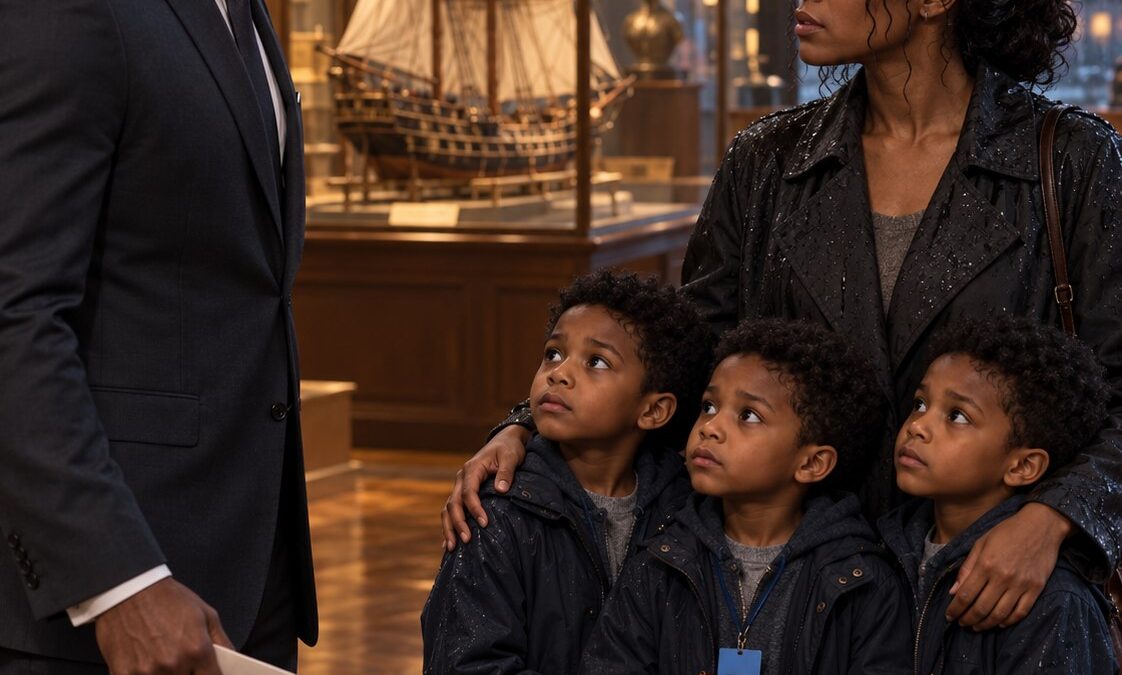
Nora stayed beside the boys.
The quartet played upstairs.
The petition named me as a concerned relative.
It alleged that Nora had hidden the children from their father and had threatened to leave the state with them.
An emergency hearing had been requested for the following morning.
At the bottom sat a declaration bearing my name.
I had never signed it.
“Who gave you this?” I asked.
“A man outside my building.”
“When?”
“An hour ago.”
The eldest boy pressed against her coat.
The youngest watched me.
The middle one watched the guards.
All three understood more than they should have needed to.
I looked at the security supervisor.
“Who told you to stop Ms. Kessler?”
“Mrs. Vescari’s office, sir.”
“My aunt has no authority over my guests.”
His hand fell from his radio.
“Understood.”
I turned back to Nora.
“Is there somewhere quiet?”
“There was.”
She meant before she had walked into my family’s event.
I led them into a small education room beside the gallery.
A paper moon hung above a row of folding chairs.
The boys sat together beneath it.
Nora remained standing.
I called my attorney, Daniel Cho.
He answered on the second ring.
“I need you at the museum,” I said.
He heard something in my voice.
“How soon?”
“Now.”
I sent him the petition.
Then I called the woman waiting upstairs.
Celeste Ashford answered herself.
“Is there a problem?”
“Yes.”
“Is everyone safe?”
That was Celeste.
Even on the night of a carefully negotiated engagement, she asked the useful question first.
“They are.”
“Then tell me the rest when you can.”
“The proposal won’t happen.”
A pause.
“I’ll handle the room,” she said.
She hung up before either of us could make an apology into a speech.
Nora had heard enough.
“You could have gone upstairs.”
“I couldn’t have signed a lie.”
“That didn’t stop you seven years ago.”
The boys looked up.
I lowered my voice.
“I didn’t sign the letter you received.”
“You haven’t seen it.”
“I know what it said.”
Her eyes sharpened.
“How?”
“Because Marion told me what she intended to tell you.”
Nora gripped the back of a chair.
“What did she say?”
“That she had warned you our life would be difficult.”
“She wrote that you would report me for stealing.”
I went still.
The middle boy reached for her hand.
Nora let him take it.
“I was pregnant,” she said.
“I know that now.”
“I didn’t know it then.”
She had come to tell me.
The badge was from that day.
I looked at my name, struck through with a thick black line.
Marion had been in my office while I was away.
“She said you refused to see me,” Nora said.
“Where was I?”
“Your father’s funeral.”
I closed my eyes.
Marion had sent me to the cemetery alone after the service.
She had told me Nora was already gone.
When I opened my eyes, Nora was watching.
“I came back that night,” she said.
I looked down at the badge.
The reverse held another mark I had missed.
A second entry stamp.
9:14 P.M.
“She told me you never returned,” I said.
Nora shook her head.
“That was when I returned.”
* * *
Daniel arrived before the music upstairs ended.
He brought a colleague who handled family law.
Amara Bell introduced herself to Nora first.
Then she knelt to greet the boys.
No promises.
No questions they could not answer.
She read the petition at the folding table.
“This is a request,” she said.
“There is no order removing anyone.”
Nora sat down at last.
“The man said they could come tonight.”
“He was wrong.”
“Or he wanted me frightened.”
Amara looked at me.
“That seems likely.”
She called the court clerk’s public number and confirmed that a hearing request had been submitted.
Then she called the attorney listed on the papers.
His office answered.
He had never heard of Nora Kessler.
The bar number belonged to a retired lawyer in another state.
Daniel photographed every page.
He asked Nora to keep the originals.
“Who knew you were coming?” he asked.
“Nobody.”
“Then why were the papers ready?”
Nora looked at the boys.
“They were delivered before I decided to come.”
She had found the badge that afternoon while clearing a drawer.
The petition had arrived at her apartment less than two hours later.
She had planned to call a lawyer.
Then she saw the museum invitation online.
My name.
The hour.
Marion’s name beside it as host.
“I needed to put the badge in your hand,” she said.
I understood.
Marion could have intercepted a call.
She could not erase what I had already seen.
The boys were tired.
I asked a museum attendant for water.
She returned with three cups and a box of crackers from the staff room.
The youngest inspected the box.
“Are these for everyone?”
“Yes,” I said.
He gave the first packet to Nora.
Her eyes filled.
She turned away before the boys noticed.
Daniel studied the badge under the room’s bright light.
“It’s from your old headquarters?”
“Yes.”
“Did you use a contractor?”
“Mercer Access.”
I remembered their blue plastic cards.
I remembered the printer that left a faint white stripe along one edge.
The badge had it.
“Mercer may still have records,” Daniel said.
“Seven years is a long time.”
“The building was sold three years ago,” I said.
“Mercer prepared the transfer archive.”
I knew because I had signed the sale myself.
I called the building’s present owner.
By midnight, Daniel had the name of the records company holding the archive.
We did not open it ourselves.
Amara wanted the records preserved through counsel.
Daniel sent the request before the night ended.
I asked Nora where she had lived after leaving.
“Duluth first,” she said.
“Then here.”
She had returned to Chicago when the boys turned four.
She worked as a restoration technician at a public library.
“Why didn’t you contact me then?”
She reached into her coat and produced an old letter.
My letterhead.
My signature.
I read the sentence accusing her of stealing from the Vescari foundation.
Then the sentence promising to pursue charges if she contacted me.
“I never wrote this.”
“I hoped that was true,” she said.
“But I had three babies to protect.”
I placed it beside the badge.
The signature looked like mine.
The language did not.
I had never called the foundation “our charitable arm.”
Marion did.
It was in every speech she gave.
Daniel noticed my expression.
“What?”
“She wrote this.”
“That’s an inference,” he said.
“I know.”
“We’ll find proof.”
Nora drew her coat tighter.
“There’s something else.”
She told us she had worked for the foundation before she left.
Her last project had been grants for families displaced by a warehouse fire.
She had found payments to a company with no staff and an address belonging to a mailbox store.
She had asked Marion about it.
Two days later, she had been turned away from my office.
“What company?” Daniel asked.
“Harborlight Advisory.”
I knew the name.
Harborlight had been paid to oversee the merger planned for tonight.
The lie had not begun with the children.
It had begun with money.
* * *
By morning, Nora and the boys were at her sister’s apartment.
Amara had arranged for the sister to stay with them.
Daniel and I met at his office.
The records company sent an acknowledgment.
The visitor log still existed.
So did the entrance footage from that year, kept as part of a dispute over the old building’s sale.
We would need time to obtain certified copies.
We did not have to guess about the fake petition.
Amara filed a response and alerted the court to the false attorney information.
The clerk placed the matter before a judge.
A brief hearing was set for the next afternoon.
That was all.
No dramatic rescue.
No instant victory.
Paper had to answer paper.
At noon, Marion called.
I let it ring.
She called again.
I answered.
“The guests have been told the weather interrupted things,” she said.
“Celeste told them the truth.”
“She told them the proposal was postponed.”
“It’s canceled.”
A silence.
“Because of Nora?”
“Because of you.”
“You have no idea what she brought into that gallery.”
“Three children.”
“And an accusation.”
“I have the badge.”
Marion breathed once, slowly.
“That badge proves she entered a building.”
“It proves you crossed my name out.”
“Reception would have done that.”
“Then reception can explain why.”
She ended the call.
Twenty minutes later, Nora texted a photograph.
A black car was parked across from her sister’s building.
No one had approached.
I sent the photograph to Daniel.
He advised Nora to report it if the car remained or its occupants contacted her.
It left before the police arrived.
The boys had seen it.
That mattered more than Marion intended.
I wanted to send my own men.
Instead, I asked Nora what she needed.
“A ride to the hearing,” she said.
“You’ll have one.”
“And please don’t come with six people.”
“I’ll come alone.”
She sent back one word.
Good.
That evening I visited the apartment with food.
Nora’s sister, Tessa, opened the door.
She looked me over.
“You can leave it here.”
“I’d like to see them.”
“You can ask Nora.”
Nora appeared behind her.
She let me in.
The apartment smelled of tomato sauce and damp mittens.
Three pairs of shoes stood beneath the radiator.
The boys were building a city from cardboard boxes.
The eldest introduced himself as Miles.
The middle was Theo.
The youngest, who had carried the badge, was Jude.
I repeated their names.
Jude pointed to a narrow cardboard bridge.
“It keeps falling.”
I knelt.
“It needs support underneath.”
He handed me a strip of folded card.
For twenty minutes, that was all I was allowed to be.
A man holding up a bridge.
After dinner, Nora showed me the boys’ school pictures.
Miles looked directly at the camera.
Theo had blinked.
Jude had tried not to smile and failed.
I asked if I could keep the extra copy.
Nora hesitated.
Then she gave me one.
“Tomorrow doesn’t decide everything,” I said.
“It decides whether I sleep,” she answered.
My phone rang.
Daniel.
The records company had found the original visitor transaction.
Two entries.
The same badge.
The second had been manually denied at 9:14 p.m.
The account used to deny entry belonged to Marion’s executive assistant.
“That’s proof she stopped me,” Nora said.
“It’s proof her office did,” Daniel answered.
Then he told us what else the archive held.
The assistant had attached a note to the transaction.
It said: PER M. VESCARI, NO CONTACT WITH A.V.
Nora sat down.
I held the phone tighter.
Daniel continued.
“Harborlight’s registered manager was Marion’s assistant.”
* * *
The hearing lasted eleven minutes.
Amara showed the judge the false bar number.
She showed him the unsigned declaration that claimed to be mine.
I testified that I had not authorized the petition.
The court denied the emergency request.
The judge referred the filing for investigation.
He did not decide who the boys’ father was.
He did not decide what Marion had done seven years earlier.
He removed the immediate threat.
Nora walked out carrying Jude’s hand.
On the courthouse steps, she leaned against the rail.
I gave her room.
“Thank you,” she said.
“I should have found you.”
“You believed something false.”
“I stopped looking because it was easier.”
She did not excuse me.
I did not ask her to.
Amara arranged a private paternity test with everyone’s consent.
We used a reputable lab.
The results took several days.
During that time, I saw the boys twice.
At the library, Miles showed me a book about ship engines.
At a diner, Theo asked if my house had a dog.
“No.”
“Why?”
“I never thought I had time.”
He considered that answer.
“That’s not a very good reason.”
“No,” I said.
“It isn’t.”
The lab confirmed what the gallery had already told my heart.
I was their father.
Nora read the report twice.
Then she folded it and put it away.
She had never needed convincing.
She had needed the world to stop calling her a liar.
Daniel kept working.
The foundation’s old files showed Harborlight had billed for work never completed.
A forensic accountant traced the payments through two companies Marion controlled.
The amount was substantial.
It had grown over seven years.
The proposed merger would have moved foundation oversight into a new board.
Marion had nominated its members.
After the merger, an internal review would have been much harder.
Daniel took the records to the foundation’s independent trustees.
He also referred the suspected fraud to the appropriate authorities.
I signed the referral.
Marion sent me a message.
You will ruin your father’s name for a woman who left you.
I read it at Nora’s kitchen table.
Jude was asleep on the couch.
Theo and Miles were arguing softly about the cardboard bridge.
Nora saw my face.
“What did she say?”
I showed her.
She read it once.
“Your father gave my mother a grant when she was sick,” she said.
“I remember.”
“He came to see the library she built with it.”
My father had died believing the foundation was the best part of our name.
Marion had counted on that love to keep me quiet.
“She’s used him for years,” I said.
“And she expects you to protect him by protecting her.”
Nora slid the phone back.
“What will you do?”
I looked at Jude.
His hand rested open against the cushion.
“I’ll tell the truth.”
The next morning, Daniel called.
The records company had located the old lobby footage.
Nora entered twice on the day she disappeared.
At 9:14 p.m., Marion was at the reception desk.
She took the badge from Nora.
Then she returned it after writing on it.
There was no audio.
There did not need to be.
Marion had been there herself.
* * *
The foundation board met on a Thursday.
Its trustees knew my family.
They knew Marion better.
She had chaired their dinners for nineteen years.
I asked Nora whether she wanted to attend.
“Yes,” she said.
“You don’t owe them anything.”
“I owe myself the chance to speak.”
Amara came with her.
Daniel came with the records.
Celeste attended as a trustee of her family’s charitable fund.
She greeted Nora before she greeted me.
Marion sat at the far end of the table.
Her expression did not change when we entered.
The board chair opened the meeting.
Daniel explained the payments first.
Dates.
Invoices.
Companies.
Bank records supplied under the board’s audit authority.
Marion listened without interrupting.
When Daniel finished, she folded her hands.
“I approved those contracts,” she said.
“The work was confidential.”
“The invoices list site visits,” a trustee said.
“Some work was remote.”
“The addresses were vacant lots.”
“That is an administrative error.”
She made it sound possible.
For a moment, several people wanted it to be.
Then she turned to Nora.
“This woman worked for the foundation before funds went missing.”
Nora sat still.
“She disappeared when questions were raised,” Marion continued.
“She has now returned with children and a grievance.”
I felt the old story trying to close around her again.
Nora opened her bag.
She placed the blue badge on the table.
“I came to Adrian’s office twice,” she said.
“I was denied the second time.”
Marion gave it a brief glance.
“A visitor badge is not an audit.”
“No,” Nora said.
“It’s my answer to your story.”
Daniel displayed the certified entry record.
Marion’s assistant had denied the visit.
The attached instruction named Marion.
Then he showed the footage.
The room watched Nora enter the lobby.
They watched Marion step behind the desk.
They watched her take the badge.
I remembered sitting alone at my father’s grave that night.
I had believed Nora was already on a plane.
Marion’s face remained composed.
“I was protecting Adrian,” she said.
“From what?” Celeste asked.
“An employee making allegations she could not prove.”
Nora leaned forward.
“I had copies.”
“Copies you never produced.”
“Because you told me he would have me arrested.”
Marion looked toward me.
“You were grieving,” she said.
“She was pregnant.”
“I didn’t know.”
Nora’s fingers tightened around the badge.
Marion looked at the board chair.
“Everything I did was to keep this family intact.”
It was the strongest argument she had.
She had stood beside my father through his illness.
She had kept the business running after his death.
Everyone at that table remembered it.
I stood.
“You told me Nora took money.”
“She did.”
“Where is the transfer?”
Marion said nothing.
Daniel placed a bank statement on the screen.
The account named on the old receipt had never belonged to Nora.
It belonged to another company controlled by Marion.
The transfer had moved between her own accounts.
The board chair removed his glasses.
Celeste asked the question Marion had avoided.
“Who authorized the payment?”
The forensic accountant’s report identified the login.
Marion’s.
That was the independent confirmation.
The badge showed what had happened to Nora.
The bank records showed why.
Marion’s counsel asked for a recess.
The board voted to suspend her authority pending investigation.
Her lawyer advised her not to speak further.
She stood anyway.
“You will regret putting a scandal above your family,” she told me.
I looked at the badge in Nora’s hand.
“My family is here,” I said.
Marion left with her lawyer.
The trustees referred the financial records to investigators.
Months passed before charges were filed.
The false petition was examined separately.
The evidence linked its preparation to Marion’s assistant and payment to a vendor from one of Marion’s accounts.
The assistant cooperated.
Marion eventually pleaded guilty to financial offenses connected to the foundation and to the false filing.
The court imposed restitution and a sentence.
The trustees recovered what they could and changed the foundation’s controls.
None of it gave us back seven years.
It did give Nora a public record of the truth.
* * *
By winter, I knew which boy liked his toast cut diagonally.
Miles.
Theo wanted every corner left intact.
Jude ate whichever piece he could reach first.
I learned this in Nora’s kitchen on Saturdays.
The first time I arrived early, I brought a model ship.
The boys played with its box.
I brought bagels the next week.
They ate those.
Nora found this very funny.
I accepted the lesson.
Our arrangements came slowly.
We used lawyers for the formal parts.
We used calendars for the ordinary parts.
School pickups.
Dental appointments.
A Saturday at the aquarium.
There were days the boys ran toward me.
There were days one of them wanted Nora.
I learned not to make either day a verdict.
Celeste visited the foundation after the board appointed a new director.
She had no interest in our family’s shipping merger.
Neither did I.
We unwound the engagement plans without a fight.
Later, she sent Nora a box of children’s books.
Inside was a note.
The boys should inherit better stories than the ones we were handed.
Nora put it on the refrigerator.
The foundation offered to pay for the boys’ education.
I asked Nora before responding.
“They have what they need,” she said.
“The families from the warehouse fire still don’t.”
So the trustees used recovered funds to reopen the grants Marion had diverted.
Nora helped design the application process.
She insisted it be simple enough for someone with three children and a full-time job to finish in one evening.
I watched her cross out a page of needless questions.
“Will they listen to you?” I asked.
“They asked me here.”
“That wasn’t my question.”
She looked up.
“They will.”
I smiled.
She caught it.
“What?”
“I remember when you used to correct my contracts.”
“They needed correcting.”
“They did.”
The ease between us frightened me more than our arguments had.
It was tempting to call it a return.
We were not returning.
We were meeting each other after seven lost years.
One evening, after the boys were asleep, I apologized without asking her to make me feel better.
“I should have called you myself.”
“You should have.”
“I let Marion speak for both of us.”
Nora set down her tea.
“I kept the letter,” she said.
“I read it whenever I thought about finding you.”
“I understand.”
“I’m going to keep it.”
I looked at her.
“Why?”
“Because I need to remember what happened.”
I nodded.
“And I need you to remember that I won’t hand you every decision because you arrived.”
“I don’t want you to.”
She gave me a look.
“Sometimes you do.”
She was right.
I had offered to buy her a larger apartment without asking.
I had tried to move the boys to a different school.
I had called a doctor she had already chosen.
Each offer had come from fear dressed as generosity.
“I’ll ask first,” I said.
“That would help.”
I did.
In spring, I asked before taking the boys to meet my mother’s oldest friend.
I asked before putting their photographs in my office.
I asked Nora before attending a school performance where Jude had one line and delivered it too quietly for the back row.
I sat in the front.
Afterward, he asked if I had heard him.
“Every word,” I said.
He studied my face.
Then he took my hand.
That summer, Nora invited me to a picnic by the lake.
The boys ran ahead with a kite.
She stayed beside me.
“Theo asked if we were getting married,” she said.
“What did you tell him?”
“That grown-ups don’t marry because children ask.”
“Good answer.”
“He said he’d ask again later.”
I watched the kite rise.
“What would you tell him then?”
“I don’t know.”
I did not press.
A year earlier, I had been ready to propose to someone I barely knew because a room expected it.
Now I could wait beside the woman I loved without making her answer for an audience.
“That’s all right,” I said.
Nora slipped her hand into mine.
It was enough for that day.
* * *
Three years later, we returned to the museum.
The boys were nine.
They had grown into different expressions of the same face.
Miles read every label.
Theo asked questions the guides had to research.
Jude still carried small things in his pockets.
A stone.
A ticket.
A blue visitor badge in a clear sleeve.
Nora had kept it after the hearing.
She had given it to him that morning because he asked.
We stood beneath the model of my family’s first ship.
The same place where I had first seen them.
The same polished floor.
A different life.
Jude held up the badge.
“Your name is crossed out,” he said.
“It was.”
“Mom said you came anyway.”
“I did.”
He turned it over.
The old entry stamps were faint now.
The evidence had done its work.
Nora joined us.
We had married the previous autumn in her sister’s garden.
No cameras.
No merger.
Three boys had carried the rings and argued afterward about who had walked fastest.
Nora touched the sleeve around the badge.
“Ready?” she asked.
The museum had offered to add it to a small exhibit about the foundation’s restored grants.
Nora had agreed on one condition.
The label would tell the truth about the people who were turned away and the people who came back.
Jude handed the badge to the curator.
Then he took my hand.
The boys went ahead toward the ship gallery.
Nora stayed beside me.
Once, she had stood in this room and said she had brought proof.
She had.
She had brought our sons.
Their shoes sounded against the floor as they ran back to call us.
I followed them with Nora’s hand in mine.
THE END








