When the Governor’s Son Was Trapped Beneath a Collapsing Stage, the Housekeeper Held Up One Rusted Key
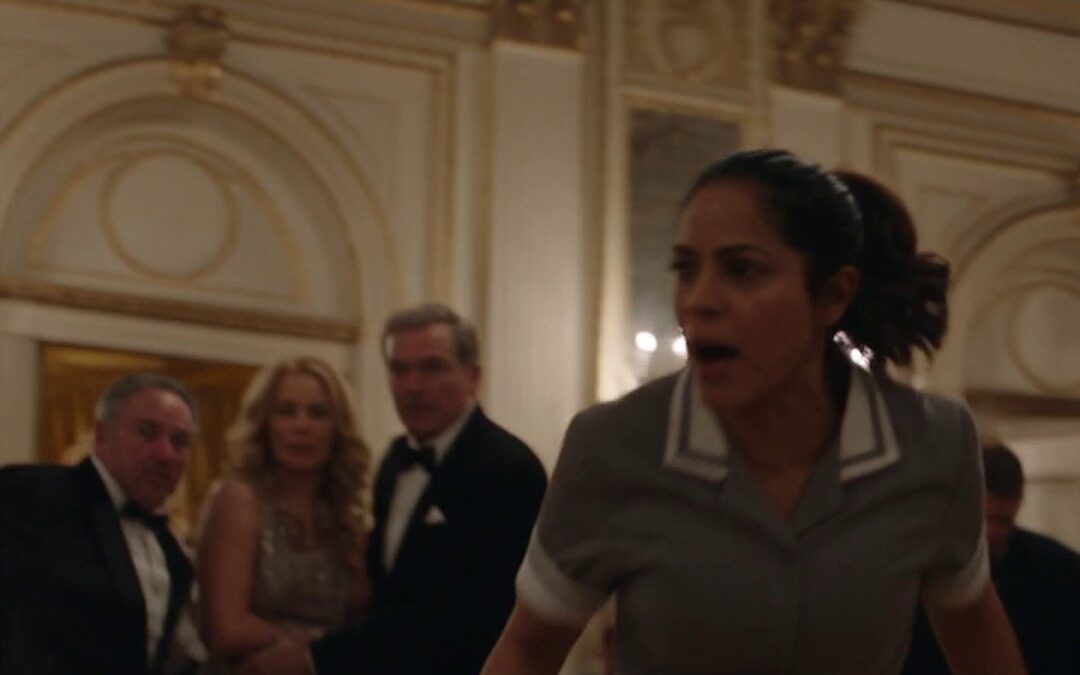
Chapter 2: What the Key Opened
“You said it was gone.”
Mrs. Vale had spoken softly.
The room had heard her anyway.
Governor Everett Vale stared at the key in Tessa’s fist, then at his son beneath the stage.
“Get Miles out.”
The crew shifted their hands along the frame.
“Not that corner,” Tessa said.
The foreman glanced at her.
“The left support is buckling.”
A bolt had torn through the wood beneath its steel foot. The platform tilted another fraction, and the painted moon shivered overhead.
“Jack the other side,” Tessa said. “Slowly.”
The foreman nodded to his crew.
They raised the platform by inches.
Tessa slid onto the floor and reached beneath it. Miles caught her sleeve with both hands.
“Don’t leave me.”
“I won’t.”
“Keep your head down.”
“I am.”
“Your hand, too.”
She pulled his shoulder clear, then guided his head away from the edge. Her wrist struck metal. Pain flashed white, but she kept hold of him until the crewmen lifted the frame high enough.
Everett dropped to his knees.
“Buddy.”
Miles clung to Tessa’s coat.
“Don’t make me go with her.”
Everett stopped reaching.
“I won’t.”
Mrs. Vale took one step toward them.
“I’m your mother.”
Miles pressed his face into Tessa’s sleeve.
“You told me not to say anything.”
Everett lowered himself until he was level with his son.
“What did she tell you?”
“That I had to keep the key.”
“Why?”
“She said it would keep Dad from forgetting.”
The medic wrapped Miles in a blanket and checked his knee. There was a bruise, no obvious injury, but he recommended a hospital evaluation.
Everett agreed.
Mrs. Vale objected.
“He doesn’t need a hospital.”
“He was pinned beneath a stage,” Everett said.
“It wasn’t on him.”
“It was over him.”
“It was an accident.”
Tessa looked at the little key.
“What room does it open?”
Mrs. Vale’s mouth tightened.
“Not here.”
“Then where?”
“Everett, we can speak privately.”
“No. What room?”
“There is no room.”
“You just said the key was gone.”
“I was startled.”
“Because it belonged to my brother?”
Mrs. Vale glanced at Tessa.
Miles reached for Tessa’s hand.
“Can she come with me?”
Everett nodded.
“If she wants to.”
Tessa followed the medic and Miles through the side entrance. Outside, the rain shone on the drive. Police cruisers blocked the service lane, their lights washing the wet stone blue and red.
Everett climbed into the ambulance with his son.
Tessa watched the doors close.
The ambulance pulled away.
Sergeant Imogen Price waited beside a patrol car with a notebook in hand. Her uniform was damp at the shoulders.
“Start with what you saw,” she said.
Tessa described the failing brace, the shifted platform, the key, and Mrs. Vale’s reaction.
“Did you see anyone touch the support?”
“No.”
“Did you see what caused it to fail?”
“No. I heard it break.”
“Did the boy hit his head?”
“I don’t think so.”
“Did you?”
“My wrist.”
“Can you move it?”
“Yes.”
“Does it hurt?”
“Yes.”
Price looked at the key, still in Tessa’s palm.
“Do you recognize it?”
“My brother wore one like it.”
“Is he deceased?”
“He was declared deceased. They never showed us a body.”
Price paused.
“How long ago?”
“Eleven years.”
“Why do you think that key was his?”
“I made the notch.”
Tessa described filing the tiny cut as a teenager, impatient with a nail clipper and a pocketknife. Price photographed the key, then placed it in an evidence bag.
“Would you give a DNA sample for comparison?”
“Yes.”
Price marked the bag and handed it to an officer.
“Don’t touch anything else in the scene.”
“I won’t.”
“You said your brother was declared deceased. Was there a search?”
“Yes.”
“Did they find him?”
“No.”
“Then what did they find?”
“One boot by the creek.”
“Anything else?”
“No.”
“Who told your family he was dead?”
“The county.”
Price wrote that down.
Everett came through the hospital doors after Miles was settled. His tie was gone. A crease marked his forehead.
“Your wife says the key was gone,” Tessa told him.
“I heard.”
“Why would she know?”
“I’ll ask her.”
“You should.”
“I’ve asked people too late before.”
Tessa didn’t answer.
Price requested the estate’s security footage and the foundation records. Everett gave permission to preserve both.
“Get the originals,” Tessa said.
Price looked at her.
“Why?”
“The camera clocks drift. Six minutes a month. If someone exports a clip, the timing can be made to look different.”
Everett frowned.
“How do you know?”
“I maintain schedules and inventory. A delivery disappeared once. The camera showed it on the wrong shelf.”
“Did you find it?”
“On the right shelf, after we fixed the clock.”
Price made a note.
The hospital scan showed no serious injury. Miles would stay overnight for observation. Everett came back to the waiting room while Tessa sat with her hands folded around a paper cup she hadn’t touched.
“What do you know about Nico?” she asked.
“After he disappeared, my father said he’d stolen medical supplies from one of our clinics.”
“Did you believe that?”
“I did.”
“He volunteered there.”
“I know that now.”
“Did you ever ask for proof?”
“No.”
“Why not?”
“I was twenty-six. My father told me the county had identified him.”
“That isn’t the same as seeing a body.”
“No.”
“Did your father help my mother after Nico vanished?”
Everett’s face changed.
“He paid her rent.”
Tessa stared at him.
“My mother never told me.”
“I don’t know what she was told.”
“She worked two jobs. She lived above a laundromat. Did your father think money could replace an answer?”
“I don’t know.”
“You don’t know a lot.”
“I do.”
The answer was plain, without defense.
Price returned from a call.
“We’ve requested a warrant for the family archive,” she said. “Until then, no one touches the records room or its contents.”
Everett nodded.
“I’ll preserve the area.”
“Your wife has keys?”
“She does.”
“Then I’ll need those accounted for.”
“I’ll arrange it.”
Tessa watched him.
“You’ll arrange it, or you’ll tell her?”
“I’ll tell her.”
“Good.”
Everett offered Tessa a ride back to the estate.
She refused.
He accepted the refusal and waited while Price arranged a patrol car.
Before they left, Miles woke.
“Miss Tessa?”
“I’m here.”
“Will you stay?”
“As long as they let me.”
He looked toward the chair beside his bed.
“Where’s Dad?”
“Right there.”
Everett came to the bedside.
“Mom said Uncle Nico was bad,” Miles said.
“I heard.”
“Did he steal?”
“I don’t know.”
“Can we find out?”
“Yes.”
The answer was too quick, but Everett didn’t take it back.
Miles studied his face.
“You’ll really look?”
“Yes.”
“Even if Mom gets mad?”
Everett sat down.
“Yes.”
Miles looked to Tessa.
“Can you help?”
“I can help look for answers.”
He seemed to consider that.
“Okay.”
***
The archive sat beneath the estate’s library. The next morning, Price and another officer photographed each cabinet before opening it. Their camera shutters clicked in the low-ceilinged room. Everett waited with his hands clasped behind his back.
Tessa searched the clinic records by year. She knew the way household files were organized: not by importance, but by whoever had last needed them.
“Here,” she said.
A thin folder was wedged between two foundation grants.
The label read Vale Rural Health Program.
Price put on gloves and opened it.
Inside was a clinic inventory sheet, three receipts, and a typed report accusing Nico of taking a locked medical case.
Tessa read the report twice.
“That clinic didn’t stock this medication.”
Everett looked at the page.
“How do you know?”
“I worked on the estate’s clinic drives. I’ve seen the supply lists.”
“You started years later.”
“And I read the county clinic lists when I arranged the flu drive. This was a pediatric clinic. It couldn’t store those doses.”
Price photographed the report.
“Don’t mark it,” she said.
“I’m not.”
A second folder held a payment receipt to Tessa’s mother, dated three days after Nico vanished. The amount could have covered a year’s rent. The memo line read “retainer.”
Tessa sat down.
“What was my mother supposed to do for that money?”
Everett had no answer.
“Was it my father?” he asked Price.
“It’s in his foundation’s records,” Price said. “That doesn’t tell us who approved the payment.”
Another file listed Harlan Pike as medical director and emergency liaison. Pike now chaired the Vale Civic Foundation. His signature appeared on the clinic report.
Tessa recognized a defect in its type.
“The lowercase e sits high.”
“Could be any machine,” Price said.
“It could. But the clinic typewriter had the same defect.”
Everett looked at the folder.
“Where is the typewriter?”
“In storage,” he said. “The estate kept equipment from the closed clinic.”
He led them to a basement room. Beneath a canvas cover sat an old gray typewriter. Dust had settled between its keys. The lowercase e was crooked.
Price photographed the machine before anyone touched it.
A service tag underneath showed it had been repaired two months after Nico disappeared.
“Can the type be matched?” Everett asked.
“An examiner can compare the defects,” Price said. “It won’t identify the typist by itself.”
“Still worth doing,” Tessa said.
Price nodded to her.
“You noticed it.”
“I noticed it on the page.”
The stage inspection added another concern. An officer had called with the first report: the brace bolt had been replaced the day before the fundraiser. The wood beneath it showed fresh scratches.
“Someone pushed the support sideways,” Tessa said.
“Can you tell from the footage?” Price asked.
“Maybe. But we need the original. The time stamps drift.”
“What caused the drift?”
“The system clock was never reset after a power failure. I reported it last year.”
“And no one fixed it?”
“They said it was close enough.”
Price wrote that down.
Before leaving the archive, Tessa noticed a steel door at the end of the corridor.
“What’s in there?”
“An old records room,” Everett said.
“Who has the key?”
“Me, my father, and Maeve.”
“Could this key open it?”
“Possibly.”
“Why would Nico have it?”
“I don’t know.”
“Did you know he had it?”
“No.”
“Did your father?”
Everett didn’t answer.
Price closed her notebook.
“We’ll get the warrant and have the lock examined. Nobody opens it before then.”
The key stayed with the evidence team.
***
The next morning, Miles sat with a blanket around his shoulders. His knee was bruised, but the scan was clear. Tessa sat beside the couch in Judith’s guest room, where Everett’s sister had brought him after the hospital released him.
“Your mom gave you the key from her desk?” Tessa asked.
“Yes.”
“Did she say why?”
“She said it was safe with me.”
“Did she tell you about Nico?”
“Only when Dad was gone.”
Everett paused in the doorway.
“What else did she tell you?”
Miles looked at him.
“I called Uncle Nico last month.”
The room went still.
“Who answered?” Tessa asked.
“A man. The phone was bad.”
“What did he say?”
“He said my name. Then he said, ‘Tell your father the room still has a door.’”
Everett came in and sat beside his son.
“Why didn’t you tell me?”
“Mom said you’d get angry.”
“Have I gotten angry when you asked questions?”
“Sometimes.”
Everett looked down.
“Then you had reason to worry.”
Miles rubbed the blanket’s hem between his fingers.
“Are you angry now?”
“No.”
“Are you going to take the key?”
“It’s evidence. The police have it.”
“Will I get it back?”
“When they’re done.”
“What if they aren’t done?”
“I’ll ask them to return it.”
Miles kept his gaze on Everett.
“You promise?”
“I’ll ask.”
“That’s not a promise.”
“No,” Everett said. “It isn’t.”
Miles seemed to accept the honesty, if not the answer.
The doctor discharged him that afternoon. Everett’s sister Judith took him home. Miles asked Tessa to come along. Everett agreed, and Tessa promised only to help look for answers.
That evening, state investigator Arlo Chen joined Price. He asked Tessa to tell the story from the moment she heard the brace break.
“I heard it before I saw the platform move,” she said.
“Did you see anyone near the support?”
“No.”
“Did anyone ask you to go under the stage?”
“No.”
“Why did you?”
“He called me.”
“What did you notice?”
“The key. Then the brace.”
“Did you know the key mattered before he gave it to you?”
“I knew the notch.”
Chen noted her answer.
He interviewed her about the clinic, the typewriter, and the archive. She told him she would search her late mother’s boxes.
In her apartment above the bakery, Tessa found a faded blue cord in a green tin. The bakery’s mixer rumbled through the floor. A small brass ring remained at one end of the cord. The key had once hung there.
Beneath the tin was a scrap of paper in her mother’s handwriting:
If Everett ever asks, tell him the door was locked from inside.
Tessa read it once.
Then again.
She photographed the note and called Chen.
He asked her to leave everything where it was.
“I haven’t moved anything else.”
“Good. We’ll document the tin tomorrow.”
“What does it mean?”
“I don’t know yet.”
“Could it mean the records room?”
“It could.”
“Could it mean Nico was inside?”
“It could mean several things.”
Tessa looked at the words again.
“Then we need the room opened.”
“We’re working on the warrant.”
***
The former clinic nurse, Lorna Beck, met them at a diner outside Hartford. She sat with her hands folded around a cup of tea. Chen placed his notebook on the table but did not open it until she nodded.
“Nico didn’t steal medicine,” she said. “He found a second set of inventory books.”
“Who kept them?” Tessa asked.
“The clinic director. Pike’s father ran it, and Harlan started signing approvals.”
“What was missing?”
“Supplies billed to the clinic that never reached patients.”
“Did you see the books?”
“I saw copies of delivery slips. Nico showed me a mismatch.”
“Did you report it?”
“I reported what I could confirm.”
“What happened next?”
“An audit began. Then Nico disappeared.”
Lorna’s fingers tightened around her cup.
“I saw him the night before the storm. He was packing copies of the inventory.”
“Where was he taking them?”
“To Everett’s father.”
“Did he get there?”
“I don’t know.”
“Did he say why he trusted Malcolm Vale?”
“He thought Malcolm would stop Pike.”
“Did Malcolm?”
“I don’t know.”
Lorna had seen a draft report on Harlan’s desk after Nico vanished. It accused him of stealing a medical case. She had never seen a body, though she’d heard Pike tell the deputy that Nico had fled.
“Did you say that in your statement?” Chen asked.
“I tried. The deputy said it wasn’t important.”
“Would you testify to what you remember?”
“I will.”
“Did you keep a copy of your own report?”
“No. The county took it.”
“Do you remember who took it?”
“Deputy Crane.”
Chen wrote down the name.
Lorna also remembered the clinic’s security contractor: Orson Bell, now the governor’s security chief.
“Did you see Bell with Nico that night?” Tessa asked.
“No. I saw him at the clinic earlier that week.”
“What did he do?”
“He checked the back door and asked about the storage room.”
“Was that unusual?”
“He was security. It didn’t seem unusual then.”
Chen asked for every detail she could recall. Lorna described the old clinic corridor, the stack of medicine crates, and Nico’s habit of checking the inventory twice before he signed anything. Her memory did not answer where he went. It did give the investigators a source for the missing inventory and a witness to the false report.
That night, Bell went missing. The estate’s video archive had a thirteen-minute gap in the north hall footage. Price’s team preserved the original files for restoration.
Everett called his wife.
“You told Miles Nico might be alive.”
“I received a letter.”
“When?”
“Months ago.”
“Why didn’t you tell me?”
“I thought you’d destroy the evidence.”
“What evidence?”
“I gave it to Orson.”
“Why?”
“He said he could protect it.”
“Did he?”
“I don’t know.”
“Where is it now?”
“I don’t know.”
Bell’s office held an envelope with no return address. Inside was a short letter, dated eleven years earlier:
Everett, the records were changed. I have the original pages. I need you to open the door before Pike gets there.
Nico’s handwriting was unmistakable to Tessa.
The letter had no postmark. Maeve said Bell had brought it to her.
“Why would he write to me?” Everett asked.
“Because he thought your father would help,” Tessa said.
“Did he know my father?”
“He may have met him at the clinic.”
“I’ve seen no record of that.”
“The recording might tell us.”
Chen asked the judge for a warrant to open the records room.
It was granted before midnight.
***
The small brass key matched a cabinet inside the room. A locksmith opened it under police supervision.
The room smelled of cedar and old paper. A desk stood against one wall. The cabinet sat beside shelves of files, most of them labeled by year. Price photographed the room before anyone stepped across the threshold.
“You can look from here,” she told Tessa.
Tessa stayed at the doorway.
The cabinet held a notebook, a cassette recorder, and a photograph of Everett and Nico together at a clinic picnic. Both wore brass keys on cords.
“You knew him,” Tessa said.
“We met once,” Everett replied.
“You look like friends.”
“We talked for an afternoon. I don’t remember what about.”
“Do you remember that picnic?”
“I remember the clinic. Not the conversation.”
“Why are you wearing the same key?”
“My father gave it to me.”
“When?”
“After the clinic closed.”
“Did he explain?”
“He said it belonged to the family.”
“And you never checked?”
“No.”
The notebook listed medical shipments, dates, and amounts. Some supplies had been billed twice; others had never arrived. Beside the entries were the names Harlan Pike, Orson Bell, and Everett’s father, Malcolm Vale.
A note at the back read: North room. Original pages. Copy for E.
Price photographed every page before the evidence team placed the notebook in a protective case.
The cassette label said Nico, January.
Chen arranged a digital transfer. The recording began with Nico saying the inventory copies matched the delivery slips.
A second voice, older and distorted, said, “I’ll take these to Malcolm.”
“Pike knows?” Nico asked.
“Pike knows I found them.”
Everett recognized his father’s voice.
The recording continued with a brief shuffle, then Nico speaking alone.
“If this gets to Everett, tell him I kept the original pages. I told him the door would open.”
The tape clicked off.
Everett stared at the recorder.
“You knew he had the evidence,” Tessa said.
“I didn’t.”
“Your father did.”
“Yes.”
“Why didn’t he tell you?”
“I don’t know.”
“Were you close?”
“To my father?”
“To Nico.”
“I met him once.”
“You have a picture together.”
“We worked at a picnic for a few hours. That doesn’t make us close.”
“Did you like him?”
Everett considered the question.
“I remember he was careful with the patients. He knew their names.”
“Did you ask your father about him afterward?”
“No.”
“Why not?”
“I didn’t think there was anything to ask.”
Tessa looked at the photograph again.
“Maybe that was the problem.”
Everett didn’t defend himself.
The clinic accounts led investigators to Northbridge Medical Services, a company with no staff and a storage-unit address. Bank records connected the company to Pike. Supplier records showed that medication meant for two rural clinics had been redirected. The amounts in Nico’s notebook matched the transfers.
The records did not show who had physically taken the supplies. They did show that the accusations against Nico were false.
The rent payment to Tessa’s mother came from the same company. Its memo line read “family accommodation.”
“Could she have been paid to stay quiet?” Tessa asked Chen.
“Nothing proves that,” he said.
“She may have believed it was help,” Everett said.
“She may have known it came from the Vales,” Tessa replied. “She never told me.”
“She may also have been afraid,” Chen said.
“Of who?”
“We don’t know.”
Tessa turned to Everett.
“Did your father tell you he was paying her?”
“No.”
“Would you have asked if he had?”
“I’d like to think so.”
“That isn’t an answer.”
“No,” he said. “I don’t know.”
The next afternoon, Tessa found a white envelope beneath her apartment door. It held a photograph of Miles beneath the stage. A red circle marked his face.
On the back, someone had written:
Stop opening doors.
She didn’t touch the paper again. She called Price, then waited in the bakery office while the officers arrived. The hallway camera showed a delivery worker entering the building at 3:18. The bakery had expected no delivery. The visitor’s face was hidden beneath a cap.
Everett arrived after the evidence team.
“You should have called me.”
“I called the police.”
“I could have sent guards.”
“That’s why I didn’t.”
He looked at the photograph.
“Someone used the security feed.”
“Or a phone,” Chen said. “We’re checking access.”
Tessa listed everyone who could have reached the archive: Bell, Maeve, the control-room operator, Everett, and possibly Pike.
“Someone knows what Miles looks like under that stage,” Everett said.
“Lots of people were there,” Price replied.
“Not everyone had this angle.”
“We’ll compare the image to the archived camera views.”
Everett turned to Tessa.
“You can stay at the estate.”
“No.”
“Your apartment isn’t safe.”
“It’s my home.”
“I can put people downstairs.”
“I don’t want your people watching me.”
“They would be protecting you.”
“They would be answering to you.”
Everett stopped.
Tessa accepted a patrol near her building, but not a guard who would restrict her movements. Price made sure the officers knew the distinction.
Chen’s team found Bell at a motel the next morning. He agreed to speak with them in a public conference room, his attorney beside him. He said Pike had called him on fundraiser night and told him to keep the family from making “another mistake.” Bell had left because he feared what would happen when the records surfaced.
“Did he tell you to disappear?” Chen asked.
“No.”
“Did he tell you to alter footage?”
“No.”
“Did you delete the north hall video?”
“I did.”
“Why?”
“I was trying to keep the family out of the news.”
“You removed thirteen minutes.”
“I did.”
“What happened during that time?”
“Nothing.”
“Then why erase it?”
“I thought the room had been entered.”
“By whom?”
“I don’t know.”
“Did you see anyone?”
“No.”
“What happened the night Nico disappeared?”
“I escorted him from the clinic.”
“Where did he go?”
“Malcolm Vale arranged a safe place. I didn’t drive him.”
“Who did?”
“Malcolm’s driver. Elliot Ward.”
“Did you see Nico after that?”
“No.”
“Did you see a body?”
“No.”
“Then why did the report claim he was identified?”
“Pike told the deputy he’d been.”
“Did you correct that?”
“No.”
“Why?”
“I was afraid.”
Tessa watched him.
“Did you know my mother was waiting for news?”
“Yes.”
“Why didn’t you tell her?”
“Malcolm said she’d hear from Nico when it was safe.”
“And she didn’t.”
“No.”
“Did you believe Malcolm?”
“I did.”
“Why?”
“He was the governor’s father. He said Nico was safe.”
“That didn’t make it true.”
“No.”
Bell’s attorney ended the interview. The evidence supported further investigation, but not every accusation. Bell remained a witness and a suspect in the stage incident.
***
Harlan Pike held a foundation board meeting two days later. Chen and Price attended with a court order. Tessa joined as a witness.
Pike stood beside the projector, composed and confident. The board members sat around a long table. A bowl of untouched fruit stood near the water pitcher.
“You saved the boy,” Pike told Tessa. “You should be proud.”
“I am.”
“Then you understand how fragile a family can be when strangers spread rumors.”
“I understand how frightened children get when adults lie.”
Pike’s gaze rested on her for a moment, then moved to the projected account records.
“These are preliminary.”
“Suppliers confirm the shipments went elsewhere,” Chen said.
“Subcontractors are common.”
“Northbridge had no employees,” Everett said.
“I processed hundreds of forms. Your father approved the transfers.”
“He signed them,” Everett said.
“Then perhaps your anger belongs at home.”
“My father is dead.”
“So is the man you’re using as a witness.”
“No body has been found,” Chen said.
Pike shifted to the report accusing Nico.
Tessa stood.
“The clinic typewriter produced this.”
“You can’t prove who typed it.”
“No,” Chen said. “But a forensic examiner matched the page to the machine.”
“Not to me.”
“Your signature is there,” Everett said.
“It was added after the report was prepared.”
A handwriting expert had already confirmed the signature was genuine. Pike still had an answer for every point.
“You’re using a family tragedy to destroy the foundation,” he said.
“The clinics are underfunded,” one board member said. “We need answers.”
“I kept them open.”
“On paper,” Everett replied.
Pike turned toward Tessa.
“You want your brother back. Nothing I say will satisfy you.”
“That’s true,” she said. “I want the records to match.”
“You’re a housekeeper.”
“I’m the one who noticed the raised e.”
The room went quiet.
A board member glanced down at the report. Another turned the page toward the light as if the type defect might be visible from across the table.
Price presented the separate evidence that Bell had altered the stage support. Bell’s phone location placed him at the equipment room; a stagehand remembered him asking for the platform to be set at a narrower angle. The state could not prove Pike ordered the alteration, but the records and threat warranted further investigation.
Pike listened without interrupting.
“So you have a missing man, an old accounting dispute, and a damaged stage,” he said when Price finished. “You have no proof I sent the threat.”
“That’s correct,” Chen said.
“You have no proof I ordered Bell to touch the stage.”
“That’s correct.”
“Then why are we here?”
“Because the board asked for an explanation,” the chair said.
Pike faced the board.
“I built the clinic program. I kept doors open when the grants dried up.”
“You approved the accounts,” Everett said.
“I trusted my staff.”
“You signed the report calling Nico a thief.”
“I relied on the county.”
“Did you see a body?” Chen asked.
Pike looked directly at him.
“No.”
“Did you see Nico leave the clinic?”
“Yes.”
“Did you see him after that?”
“No.”
“Did you tell the county he was dead?”
“I told them he had fled.”
“Your statement says you saw him enter the river.”
“I may have said that.”
“Did you?”
“I was under pressure.”
“From whom?”
“Everyone wanted answers.”
“That doesn’t answer the question.”
Pike’s jaw tightened.
The board suspended him from executive duties. Pike surrendered his phone under the court order. He left under escort, not in handcuffs.
At the door, he turned to Everett.
“Your wife will have a choice to make.”
“Leave her out of this,” Everett said.
“I didn’t put her in.”
Maeve remained after the board meeting.
“Why did you give Miles the key?” Everett asked.
“Orson said Nico had left something for the family. He said the room should be opened.”
“Did you know the stage brace was changed?”
“No.”
“Did you send the threat?”
“No.”
“Can you prove it?”
“No.”
Chen told her she would need to give a full statement.
“I will,” she said. “Even if it implicates my husband.”
Tessa asked about the payment to her mother.
Maeve admitted she knew Malcolm had paid her, but didn’t know why.
“Did you believe him when he said Nico had made a mistake?” Tessa asked.
“I wanted to.”
“That isn’t the same thing.”
“No.”
“Did you tell my mother where the money came from?”
“No.”
“Did you think she knew?”
“I don’t know.”
“Did you ever ask?”
“No.”
Maeve sat down slowly.
“I should have.”
“You should have done a lot of things.”
“Yes.”
Tessa didn’t soften the words for her.
***
The investigation took months.
The contractor confirmed that the stage brace had been replaced with a cheaper bolt. The house supervisor said Bell had directed the change. Bell’s phone placed him near the equipment room. A stagehand confirmed Bell had asked for the platform to be set at a narrower angle.
Bell eventually admitted he had altered the support to create a controlled failure during an empty rehearsal. He intended to force an evacuation and reach the security archive. He said he hadn’t known Miles would crawl beneath the stage.
“Did you know the boy would be at the fundraiser?” Chen asked.
“Yes.”
“Did you expect him near the stage?”
“No.”
“Did you think the brace could fail while people were present?”
“I thought the crew would catch it.”
“Why replace it with a cheaper bolt?”
“I had the wrong part.”
“Was that an accident?”
“The choice to alter it was deliberate.”
“Did Pike ask you to?”
“He said I had to recover the records.”
“Did he say to damage the stage?”
“No.”
“Did you think he meant to create a diversion?”
“Yes.”
The prosecutor charged Bell with reckless endangerment, tampering, and obstruction. The evidence did not establish that Pike had ordered the stage alteration.
The photograph threat remained untraced. The visitor’s face was hidden, and the delivery uniform had been bought with cash. Price kept the case open.
Two months after the fundraiser, a public hearing exposed the foundation’s account transfers. Lorna testified about the missing inventory. A supplier confirmed that shipments had been redirected. A former bookkeeper explained how Northbridge Medical Services had been created after Pike supplied the account numbers.
The bookkeeper’s voice shook on the first question. It steadied when the prosecutor asked her to describe the invoices.
“They were marked delivered,” she said.
“Were they?”
“Not to the clinics.”
“Where did the forms say they went?”
“To Northbridge.”
“Did Northbridge have a warehouse?”
“Not that I saw.”
Tessa testified about the raised e, the key, and her mother’s rent payment. She described the notch she had made and the way she recognized it in Miles’s hands.
A board lawyer asked, “You cannot prove the payment silenced your mother, can you?”
“No.”
“You cannot prove she knew it came from the foundation?”
“No.”
“You cannot prove she signed an agreement?”
“No.”
“What can you prove?”
“That she received money. That she never told me. That the accusation against my brother was false.”
Everett referred the family records to investigators and acknowledged that he had believed a report without checking it.
Pike said he had approved routine transfers without knowing the medicine went missing. The board removed him as chairman. The state froze what remained of Northbridge’s accounts. Pike was later charged with fraud and falsifying business records. He pleaded not guilty.
Outside court, a reporter asked Tessa whether she felt vindicated.
“No. My brother is still missing.”
Everett stood nearby.
“Do you accept blame?” the reporter asked him.
“Yes.”
“For what?”
“For believing a report without checking.”
“Did your father cover up the clinic theft?”
“I don’t know.”
“Did he help Nico escape?”
“I don’t know.”
A second reporter turned to Tessa.
“Do you blame the governor?”
“Yes.”
Everett did not interrupt.
Maeve approached Tessa after the cameras turned away.
“I’m sorry.”
“Did you use Miles to force the room open?”
“I wanted the room opened. I didn’t want him hurt.”
“Did you know Bell changed the brace?”
“No.”
“Did you send the threat?”
“No.”
“Can you prove that?”
“No.”
“Then I can’t trust you.”
“I understand.”
“Do you?”
“I’m trying.”
“Trying is private.”
Maeve nodded.
“May I see Miles?”
“That’s his choice.”
“Of course.”
“Don’t say it for me.”
“You’re right.”
Tessa returned to work. Everett didn’t offer her a ride.
That was the first boundary he kept.
***
The records did not solve Nico’s disappearance. Investigators found that Malcolm had paid for a temporary room the week after the storm. An old county ledger listed a patient as N. Ruiz, then “transferred north.” A nurse’s log from a closed hospital described a young man with a frost injury who had been transferred to a recovery center under the name N. Reyes.
The year matched Nico’s.
The recovery center had closed. Its remaining records could not confirm the patient’s identity.
Tessa gave the state a photograph of Nico. A fingerprint comparison was impossible; the surviving hospital record contained none.
The lead created hope without certainty.
Six months passed. No one called from the recovery center. No one recognized the photograph.
The lie that Nico had stolen from the clinic was officially discredited. His disappearance remained open.
Bell pleaded guilty and received a prison sentence. Pike entered a plea on financial charges, admitted approving transfers to Northbridge, and agreed to restitution. He claimed he had believed the company was a legitimate subcontractor.
The court found that he had falsified the report about Nico. That finding did not establish what happened after Nico left the clinic. His appeal remained pending.
Everett’s foundation reopened the clinic grants under independent oversight. He sold the unused north wing to a community health nonprofit. The money restored two rural clinics. The communities chose how to use the funds.
Tessa stayed on at the estate with written hours, a salary review, and an outside contact for staff complaints. She refused a charitable title and proposed a paid apprenticeship program in maintenance, event safety, and inventory.
“Not a family charity,” she told Everett. “Paid work. Outside certification. Employee choice.”
“You’d design it?”
“I’d design the schedule.”
He put the boundaries in writing.
The first class included twelve workers. Tessa taught them how to check equipment and how to report a broken lock without waiting for permission.
Everett asked to attend.
“Sit in the back,” she said.
He did.
At the break, he asked, “Do you think I’m a good father?”
“I think you’re trying.”
“That isn’t an answer.”
“It’s the one I have.”
“What should I do?”
“Listen to your son.”
He did. He began asking Miles before changing plans. He stopped letting security answer for the family.
Maeve and Everett separated. Maeve moved into the east guesthouse. She saw Miles when he asked, and never pressed him to call her Mom. Miles set his own boundaries: she would not tuck him in, and he would not keep secrets for her.
“I can come to your school play?” she asked.
“I’ll think about it.”
“That’s enough,” she said.
It was not forgiveness. It was room to choose later.
***
Five years after the fundraiser, the restored clinic opened. It had two exam rooms, a small waiting area, and a mural of hills. No donor names covered the walls.
Lorna sat in the front row at the opening. Miles, now sixteen, held one end of the blue ribbon. Tessa held the other.
“Ready?” he asked.
“Your side.”
“I’m holding it.”
“Then cut.”
The ribbon fell. A little girl ran into the waiting room and asked if it was a hospital.
“Almost,” Miles said.
“It has doctors.”
“That’s the hospital part.”
“Is it free?”
“It depends on your insurance,” Tessa said. “We’ll help your family figure it out.”
Everett stood beside her.
“Your brother would have liked this.”
“Maybe. He also found what was wrong with the old program.”
“Both can be true.”
Maeve came over.
“Would you like me to walk you to my car?” she asked Miles.
“Not today.”
“Okay.”
“Maybe at Thanksgiving. Ask me then.”
“I will.”
She left without turning back.
Everett watched her go.
“Don’t,” Tessa said.
“I didn’t say anything.”
“You were going to.”
He nodded and stayed with his son.
***
Seven years after the fundraiser, the estate opened its auditorium to the public. The stage had new braces, each marked with an inspection label. The old moon backdrop hung in the lobby.
Miles, now eighteen, stood in the wings with the brass key on a cord.
“Are you nervous?” Tessa asked.
“Yes.”
“Good.”
“Why?”
“It means you understand the room.”
The clinic’s scholarship students filled the front rows. Everett sat among them. Maeve had been invited and declined.
Miles stepped through the curtain.
“I was eleven when this stage failed,” he began. “I remember the wood moving. I remember being afraid. I remember Tessa asking me to keep my head down.”
He touched the key.
“My mother gave me this. She said it would keep someone from forgetting. I didn’t understand what she meant.”
He looked toward Tessa.
“It doesn’t open the past. It reminds us to check the doors.”
The audience listened as he spoke about the clinic, the false accusation, and his uncle’s continuing absence.
“We still don’t know where Nico went,” he said. “But the lie about him is gone. The clinics are open. The records are public. The people who were hurt can speak.”
He glanced at Everett.
“Dad learned to listen.”
Everett lowered his head.
“Some doors need to stay closed,” Miles said. “Some need to be opened. And some need someone standing beside you.”
After the applause, they returned to the lobby. Miles placed the key beside the old photograph. The blue thread still passed through its ring.
For years, the key had meant a secret kept.
Now it meant a choice made openly.
The repaired stage waited beneath steady lights.
No one was under it.
No one was asking them to be quiet.
The door stayed open.
THE END


