“Who Gave You That Moth?” the Foundation Chair Asked a Stagehand, Then Her Husband Ordered the Curtain Closed
Chapter 2: What the Curtain Hid
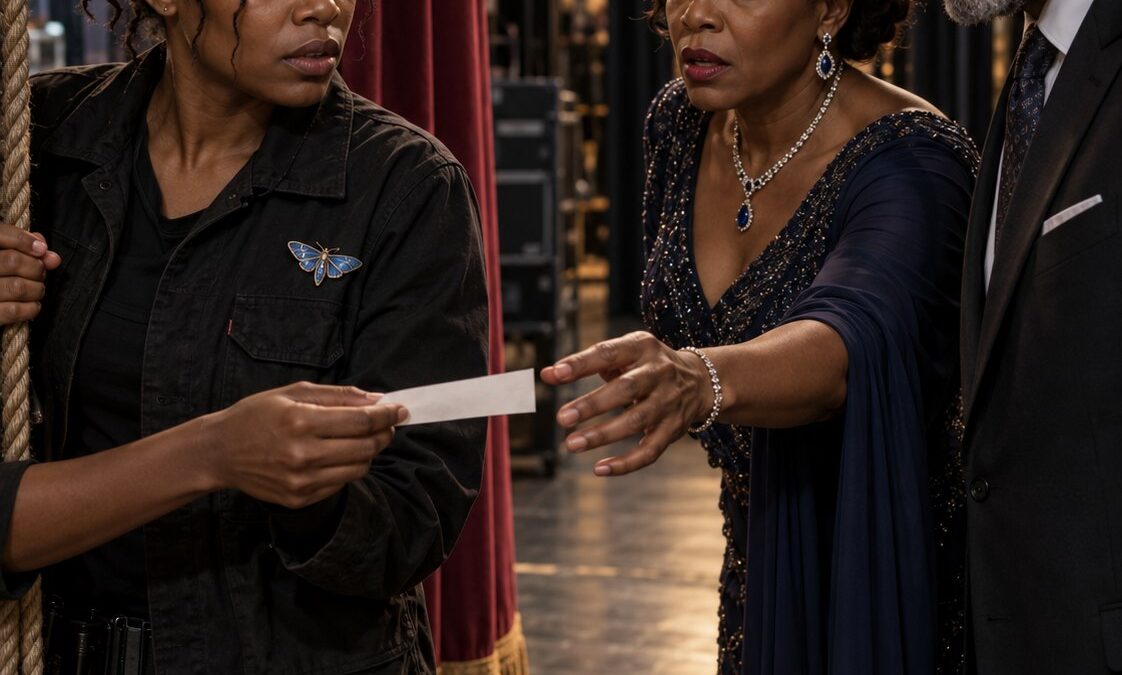
The curtain stopped six inches above the floor.
June had caught the rope around a cleat.
Adrian looked toward the operator’s booth.
Nobody moved.
Celeste ducked beneath the velvet hem.
June stood waiting with the paper.
Up close, Celeste looked older than she had beneath the cameras.
“Let me see,” she said.
June held out the strip.
She kept one hand on it.
The number was RB-0417.
Below it, in faded pencil, a child had written: MY MOTH FINDS ME.
Celeste touched the first word.
“Did you write this?”
“I don’t remember.”
“Your seventh birthday was April seventeenth.”
June looked at the number again.
Ruth had kept her adoption papers in a kitchen drawer.
The agency’s reference was RB-0417.
She had assumed it meant Ruth Bennett and a date.
“June,” Celeste said.
“That isn’t my name.”
“It was.”
Adrian came under the curtain.
“Celeste, the guests are waiting.”
“She has the number.”
“You’re making a spectacle of a stranger.”
June refastened the pin.
“I can leave.”
Adrian nodded at once.
Celeste saw it.
“If she leaves,” Celeste said, “I leave with her.”
“The foundation owns this theater.”
“Then it can open without me.”
June’s headset crackled.
The stage manager asked whether to raise the curtain.
June pressed the button.
“Keep it down.”
Adrian’s jaw tightened.
“You’ll lose your job,” he told her.
“Then I’ll find another one.”
The answer surprised June.
She needed the money.
She also needed to know why this man had recognized a pin he claimed had been buried.
Celeste pulled out her phone.
“I’ll call our attorney.”
“Our attorney?” June asked.
Celeste stopped.
“No.”
She put the phone away.
“You choose someone.”
June thought of the legal aid number Ruth had made her save.
Ruth had worried about everything.
A landlord’s deposit.
An injury at work.
An adoption file that never quite added up.
“She knew there was a problem,” June said.
“Who did?”
“Ruth.”
Adrian looked toward the curtain.
June saw the movement.
Ruth had given her the pin when she was nine.
She had said it arrived with June.
She had never said from where.
Celeste unfastened her bracelet and set it on the stage.
June frowned.
“What’s that for?”
“My hands need something to do.”
It was the first ordinary thing she had said.
June slid the paper into her wallet.
Celeste let her.
Adrian reached for his phone.
“Stay away from my records,” June said.
He gave a small, careful smile.
“I wouldn’t know where to find them.”
June looked at the number again.
The agency that issued it had closed twenty years earlier.
Someone had written its reference on a birthday gift.
Someone who knew where she was going.
Celeste stared at Adrian.
“You arranged her adoption.”
* * *
June slept badly in Ruth’s old house.
By morning, Celeste had left three messages.
None asked June to call her mother.
The last said, “I found an independent lawyer.”
June called back.
They met at a public records office.
June brought the pin, the paper, and Ruth’s folder.
Celeste brought attorney Miriam Voss.
Miriam first checked the folder’s dates.
June’s adoption had been finalized in another county in December 2004.
The papers said a woman named Cora Lane had surrendered custody in August.
June had never heard that name.
“There should be an earlier placement record,” Miriam said.
“There isn’t one,” June answered.
Ruth had asked for it twice.
Both requests had come back incomplete.
Miriam photographed the pages with June’s permission.
Then she pointed to a signature.
“Do you recognize this?”
June did.
Not the name.
The slant.
The long stroke beneath the last letter.
Adrian signed theater notices the same way.
“It could be someone else,” Miriam said.
June appreciated that.
They had one small piece of paper and a frightened woman’s memory.
Miriam would not build a case from either.
She requested certified records.
She also arranged a DNA test through a laboratory both women chose.
Celeste paid her own fee.
June paid hers from her savings.
Celeste offered to cover it.
June shook her head.
“I want a result nobody can say you bought.”
Celeste accepted that.
While they waited, June returned to the theater.
Her supervisor had removed her from the reopening crew.
He would still pay the hours she had worked.
June emptied her locker.
A coil of cable lay across the floor.
She picked it up automatically and wound it properly.
The supervisor watched her.
“You didn’t have to come in.”
“My tools are here.”
He pointed at the blue moth.
“That hers?”
“I’m finding out.”
Outside, Celeste waited by the loading entrance.
She held two coffees.
June took one.
They stood among delivery trucks.
“What did he tell you?” June asked.
Celeste’s cup remained closed.
“That you wandered away during a summer party.”
June listened.
“A river ran behind the property.”
“Did anyone see me fall?”
“No.”
“Was there a body?”
Celeste shook her head.
“Then why did you believe it?”
“I believed the searchers.”
June looked at her.
“They searched for three days,” Celeste said.
“Adrian told me the current had taken you.”
“He told the police?”
“He handled everything.”
The trucks rattled past.
Celeste set her coffee down.
“I should have read every page.”
June had spent years wishing someone had.
She said nothing.
Miriam called that afternoon.
The county clerk had found no death certificate for June Calder.
Celeste had never asked for one.
There was an order declaring the child presumed dead, issued years after she vanished.
Adrian had signed the petition.
The order cited a search report.
Miriam had requested that too.
June opened Ruth’s folder again.
Behind the court copies was a thin envelope.
Ruth had written: GIVE THIS TO HER WHEN SHE ASKS.
Inside was a receipt from a private placement service.
It carried the same reference number.
RB-0417.
The amount paid was $18,000.
The payer was Calder Arts Foundation.
June read it twice.
Then she called Miriam.
The lawyer asked for a photograph.
June sent it.
A minute later, Miriam called back.
“That wasn’t an adoption fee,” she said.
“How do you know?”
“The foundation’s public accounts list it as stage equipment.”
* * *
Adrian’s first letter arrived before the DNA result.
It came from a law firm across town.
The letter demanded that June stop using the Calder name in public.
June had not used it anywhere.
It also warned her against removing foundation property.
She pinned it to Ruth’s refrigerator.
Miriam came over that evening.
She read the letter standing up.
“He’s trying to make you return the pin.”
“He called it a copy.”
“Now he calls it property.”
June watched her place the letter in a folder.
“Can he fire me?”
“He doesn’t employ you directly.”
“The theater does.”
Miriam did not pretend that made June safe.
She said her firm would answer the letter.
They would also ask the theater to preserve its camera footage.
June gave her the name of the stage manager.
Then she showed Miriam something else.
For four years, June had checked equipment deliveries at the theater.
Every item had two records.
One recorded payment.
The other recorded where the item went.
She had found the old foundation invoice online.
The $18,000 “stage equipment” charge listed no delivery.
Its internal code began RB.
“Maybe it’s accounting shorthand,” Miriam said.
“Maybe.”
June turned the page.
Other RB charges appeared each year.
Small ones.
Travel.
Storage.
A final payment six months after Ruth adopted her.
Miriam photographed every entry.
She sent them to a forensic accountant.
The next day, the DNA laboratory called.
The results strongly supported a biological mother and daughter relationship.
June asked the technician to repeat the words.
She wrote them on the back of an envelope.
Then she sat at Ruth’s kitchen table.
Celeste arrived an hour later.
June handed her the report.
Celeste read it quietly.
“I thought I might be wrong,” she said.
“So did I.”
“I want to tell you everything.”
“Start with the party.”
Celeste took off her coat.
June noticed she had brought no handbag.
No photograph.
Nothing she could use to make June feel seven again.
There had been a fundraiser at the family’s riverside property.
June had lost a game and run toward the gate.
Celeste had gone after her.
An employee stopped her with news of a broken pipe.
When she returned, June was gone.
Adrian organized the search.
A child’s shoe was found near the water.
“Mine?” June asked.
“That’s what he said.”
Celeste looked at the blue moth.
“You hated those shoes.”
June touched the chipped wing.
Ruth used to say she hated stiff leather shoes.
It was a small thing.
It hurt more than the report.
Celeste took a breath.
“The day before you disappeared, you asked me why Adrian had locked the theater.”
“Did I?”
“He said you’d misunderstood.”
“What was inside?”
“I never found out.”
June thought of the payments.
She had worked beneath that theater’s stage for four years.
She knew every storage room.
One remained locked by the foundation.
At dusk, Miriam called.
The accountant had traced the first RB payment to a placement company.
The company’s registered agent had been Adrian’s personal attorney.
The later payments went to that attorney’s office.
June asked what they bought.
“We still have to prove that,” Miriam said.
Then she told them something worse.
The attorney had also drafted the petition declaring June dead.
* * *
The next morning, June’s employee badge stopped working.
Her supervisor met her at the loading door.
“I didn’t ask for this,” he said.
“I know.”
He gave her a letter.
The theater had suspended her pending a review of “confidential records.”
June read it in the street.
Adrian had moved quickly.
Miriam told her to keep the letter.
She requested the personnel file and challenged the suspension.
She also advised June to stop searching theater records herself.
June had already copied what she was authorized to see.
They would get the rest through proper channels.
Celeste invited June to lunch.
June suggested a diner near Ruth’s house.
Celeste arrived early and took a corner booth.
She had ordered nothing.
“Adrian has asked me to come home,” she said.
“Did you?”
“No.”
They ordered soup.
June told her about Ruth.
Ruth had repaired radios at a county transit garage.
She made pancakes on Tuesdays because her shifts ended early.
She had cried at June’s high school graduation and denied it in every photograph.
“She was good to me,” June said.
“I’m glad.”
Celeste stirred her soup.
“I’m grateful to her.”
June looked up.
“That sounds hard to say.”
“It is.”
Celeste gave a brief, embarrassed smile.
June returned it.
For a moment they ate.
Then Celeste put down her spoon.
“I thought about you every day.”
June could not answer that with a matching claim.
Celeste seemed to understand.
“You don’t owe me those years back,” she said.
June nodded.
She could work with that.
Miriam joined them with news.
The old placement company’s records had been stored by its insurer.
A court order would be needed for some files.
The company’s former director, Evelyn Marr, was alive.
Miriam had found her through a business filing.
“She says she remembers the Calders,” Miriam said.
“She wants immunity before she talks.”
Celeste went still.
“What did she do?”
“We don’t know yet.”
June asked about the theater room.
Miriam had filed a preservation request.
No one could lawfully clear it without risking consequences.
That evening, June went home to another envelope.
There was no return address.
Inside was a photograph of her at seven.
She stood outside a roadside motel.
The blue moth shone on her coat.
On the back, someone had written: SHE WAS SAFE.
June called Miriam.
A detective collected the envelope.
June gave him the letter from Adrian’s attorneys too.
No one told her the photograph proved who had sent it.
No one told her to be brave.
Celeste came and sat beside her.
Ruth’s old radiator clicked behind them.
June turned the picture face down.
“I don’t remember that place.”
“You don’t have to.”
“You want me to.”
“I want you safe now.”
The detective called the next day.
The motel had closed years ago.
Its old registration book had been donated to a local historical society.
He would request it.
Miriam had meanwhile reached Evelyn’s lawyer.
Evelyn would speak to investigators under a formal agreement.
Before that meeting, she gave Miriam one fact to check.
Adrian’s attorney had booked the motel room.
The reservation was made two days before June disappeared.
* * *
The foundation board met the following Thursday.
Celeste requested an emergency session.
Adrian had spent the week calling trustees.
June knew because two of them called her.
One offered to “settle the misunderstanding.”
The other asked whether she had considered how much Celeste had suffered.
June told both to speak with Miriam.
She attended the meeting anyway.
Miriam sat on one side of her.
Celeste sat on the other.
Adrian faced them across a polished table.
Eight trustees filled the remaining chairs.
A detective waited outside.
The board chair began with the theater’s reopening.
Celeste interrupted him.
“This concerns the foundation’s accounts.”
Adrian folded his hands.
“It concerns a woman making a personal claim.”
June placed the blue moth on the table.
“It concerns this, too.”
Adrian barely glanced at it.
“I’ve seen hundreds of costume pins.”
“This one was mine,” Celeste said.
“You believe it was.”
“I remember making it.”
He turned toward the trustees.
“Grief makes resemblance feel like proof.”
It was a careful argument.
June could see why people trusted him.
He spoke softly.
He never called her a liar.
He called her mistaken.
Miriam distributed the laboratory report.
Adrian read the first page.
His expression held.
“Biology doesn’t establish the circumstances,” he said.
“No,” Miriam agreed.
“That is why we have records.”
She passed out the certified adoption order.
Then the placement receipt.
Then the foundation payment ledger.
Adrian looked at the receipt.
“Old expenses can be misclassified.”
June opened her notebook.
“I check deliveries for a living.”
She showed the trustees the code.
“Stage equipment has a receiving record.”
She pointed to the empty field.
“This payment didn’t.”
The board chair examined it.
Adrian leaned forward.
“An empty field isn’t a conspiracy.”
“No,” June said.
She set the pin beside the invoice.
“The letters on its back are my initials.”
Adrian gave a tired smile.
“Anyone could have added them.”
Celeste reached for the pin.
June nodded.
Celeste turned the clasp.
Beneath it sat the narrow place where the paper had been folded.
“I put her adoption reference here,” Celeste said, then caught herself.
June looked at her.
“You didn’t know that number.”
“No.”
Celeste faced Adrian.
“I put a birthday note there.”
Adrian’s hand moved against the table.
June had seen that movement when the curtain fell.
Miriam laid out a photograph from the placement company’s archive.
It showed the pin and paper on an intake form.
The form carried RB-0417.
The child’s name field was blank.
The date was the day after June vanished.
The trustees studied it.
Adrian looked at Miriam.
“Where did you get that?”
“The insurer’s custodian produced it under subpoena.”
“That form could refer to another child.”
Miriam placed a second document beside it.
A motel registration listed June’s height, age, and blue coat.
Adrian’s attorney had signed it.
The detective had verified the original book.
Adrian pointed to the signature.
“My attorney acted without my knowledge.”
A trustee asked why the foundation had paid him.
Adrian answered at once.
“Legal services often cover sensitive family matters.”
Then the door opened.
Evelyn Marr entered with her own lawyer.
She did not look at June.
She addressed the detective.
“I brought the placement log.”
Her lawyer handed over a sealed folder.
Evelyn said Adrian had ordered the transfer.
He had told her Celeste was unfit and had agreed privately.
He had supplied a document bearing Celeste’s signature.
Celeste looked at the copy.
“That isn’t mine.”
Evelyn nodded.
“I know that now.”
Adrian stood.
“She’s bargaining for herself.”
“She is,” Miriam said.
“Her account still has records.”
The detective asked Adrian to remain available.
He did not announce an arrest.
The board voted to place Adrian on leave.
It also preserved the accounts and the locked theater room.
Adrian looked at June.
“You’ve destroyed the only work that kept your mother standing.”
June picked up the pin.
“She stood up herself.”
The room stayed quiet.
The following months moved more slowly.
Investigators compared signatures.
The foundation’s independent auditors traced diverted funds.
The locked room held old contracts, not a hidden child’s history.
Its shelves had been used to store records Adrian controlled.
A grand jury heard testimony.
Adrian’s attorney cooperated after charges were filed.
He confirmed the motel booking and the false surrender document.
The old search report proved real.
Adrian had sent searchers to the river after arranging June’s removal elsewhere.
He had used their honest work to support his lie.
By spring, Adrian pleaded guilty to fraud and related offenses.
Evelyn admitted her role.
The court imposed sentences and ordered restitution through a separate process.
June attended one hearing.
She left before reporters gathered outside.
* * *
June returned to work at the theater in May.
The suspension had been withdrawn.
Her supervisor apologized beside the loading door.
He handed her a new badge.
“It should open everything you’re assigned,” he said.
“Good.”
“And only that.”
“Even better.”
He laughed.
It was the first laugh June had heard there in months.
Celeste came to a rehearsal a week later.
She asked before entering June’s work area.
June let her in.
The stage was full of ladders and taped marks.
Celeste stared at a light hanging above them.
“Did you put that there?”
“Yes.”
“It looks difficult.”
“It is when someone watches.”
Celeste moved out of the way.
June tightened the fitting.
Afterward they bought sandwiches and ate outside.
Their meetings had become regular.
Some were easy.
Some ended early.
They talked about Ruth often.
Celeste asked to see her photographs.
June brought three at a time.
In one, Ruth wore a paper crown at June’s twenty-first birthday.
In another, she had grease on her cheek.
Celeste liked that one best.
“I wish I could thank her,” she said.
“You can remember her.”
“I will.”
Celeste told June about the foundation’s new board.
An independent trustee now chaired it.
Money taken from programs would be restored as the court process allowed.
Celeste had set aside her own funds for training grants in stagecraft.
“I wanted to ask you to run them,” she said.
June shook her head.
“I already have a job.”
“You could choose the students.”
“That’s a lot of power.”
“You’d use it well.”
“Maybe.”
June looked at the theater doors.
“Let working technicians choose.”
Celeste considered it.
“That’s better.”
June smiled.
“You can still pay.”
“I suspected that part.”
The grants began that fall.
Applications came from apprentices who could not afford unpaid placements.
June helped design the paid hours.
She stayed off the selection panel.
Celeste asked before naming the program.
June chose Ruth Bennett’s name.
At the dedication, she wore the blue moth.
A reporter asked whether it represented the Calder family.
“It reminds me who raised me,” June said.
She thought of Celeste standing beside her.
“And how I found them.”
Later, Celeste asked about the words June had said at the board meeting.
“She stood up herself.”
“I meant them.”
“I know.”
“I was angry with you, too.”
Celeste’s eyes lowered.
“You had reason.”
“You let him answer every question.”
“I did.”
June waited.
Celeste met her gaze.
“I’m sorry.”
June had imagined an apology for months.
It did not restore the lost years.
It made the next hour easier.
“I need you to tell me things directly,” June said.
“Even when they’re ugly.”
“I will.”
“And don’t call my supervisor for my schedule.”
Celeste looked startled.
“I only did that once.”
“Once was enough.”
Celeste nodded.
“Understood.”
They walked to the bus stop together.
Celeste offered June a ride.
June pointed to the arriving bus.
“I’ve got one.”
“Dinner Sunday?”
“Text me Saturday.”
“I can do that.”
Celeste hesitated.
“May I hug you?”
June looked at the bus.
Then at her.
“Yes.”
It was brief.
It was enough.
* * *
Three years later, the theater reopened another curtain.
This one had been made by apprentices.
Their names were stitched along its lower edge.
June stood on the stage with a headset.
Celeste waited in the front row.
Ruth Bennett’s training grants had paid every apprentice who worked on it.
June checked the rope.
The blue moth sat above her pocket.
Its chipped wing remained chipped.
Celeste had once offered to have it repaired.
June had declined.
The pin had survived as it was.
A young apprentice hurried over.
“Who gave you that moth?”
June glanced at Celeste.
She remembered the first time she had heard those words.
The stopped curtain.
The paper beneath the clasp.
The woman who had come under the velvet hem.
“My mothers,” June said.
The apprentice looked confused.
June smiled.
“You can meet one after the show.”
The house lights dimmed.
Celeste lifted a hand from her seat.
June lifted hers.
The curtain rose.
THE END








