“Why Is My Missing Daughter’s Name Carved Under Your Bread Board?” the Donor Asked, Then Shut Down Her Own Gala
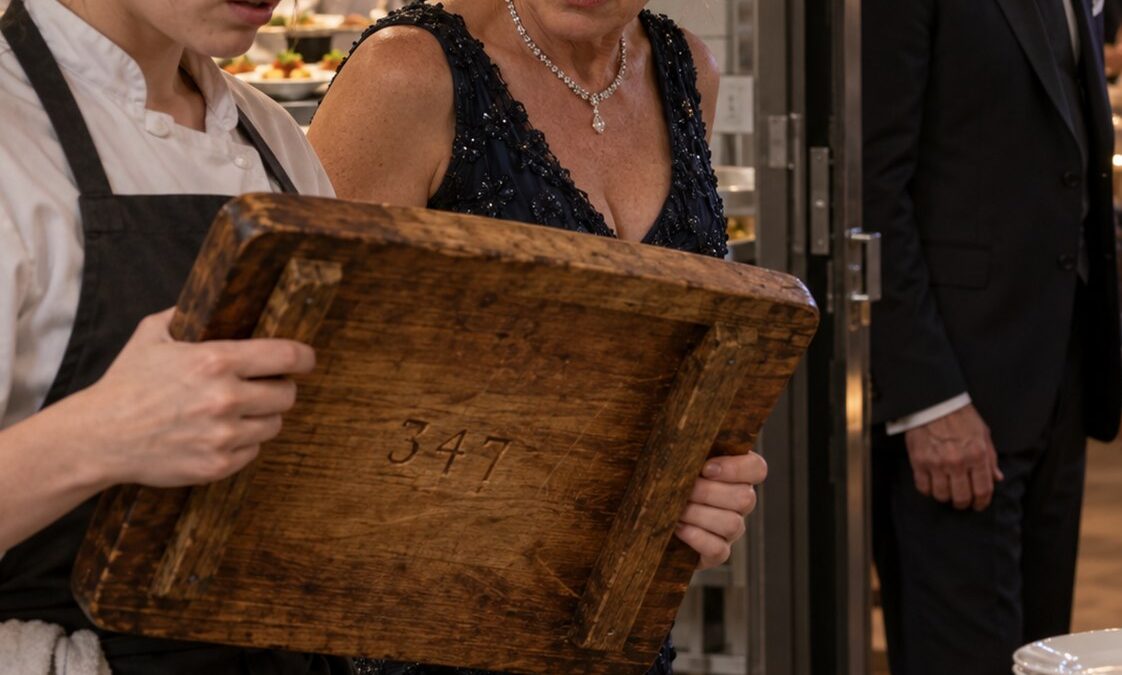
Chapter 2: The Address Beneath the Name
Tess held the board toward the light.
Juliet knew the street.
She knew the house.
Adrian owned it now.
“West Briar Road,” Tess read.
Her eyes moved to him.
Adrian reached for the board.
Tess drew it against her chest.
“Don’t,” she said.
“I can explain.”
“Then start.”
A chef turned off the nearest burner.
The kitchen grew quieter.
Adrian glanced at the open serving hatch.
“Close that.”
“No,” Juliet said.
The chef stayed where he was.
Tess set the board on a dry counter.
Juliet touched the carved numbers.
Forty-two West Briar Road.
Her parents’ former house.
Nora had spent summers there.
Juliet had sold it to Adrian after her father died.
“What does the address mean?” Tess asked.
Juliet searched her face again.
“It was my father’s house.”
“Mine too,” Adrian said quickly.
Tess’s hands closed.
“I lived there until I was nine.”
Juliet turned toward him.
Adrian shook his head.
“She’s confused.”
“I remember the blue stairs,” Tess said.
“The stairs were blue,” Juliet answered.
“My mother said I imagined them.”
“What did she call you?”
“Tess.”
“Before that?”
“I don’t remember.”
Adrian took out his phone.
“Your speech is due.”
Juliet did not move.
Beyond the hatch, guests waited beneath Nora’s name.
For years, Juliet had paid to keep that name visible.
She had never imagined Nora might see it.
Tess’s lower lip trembled.
She pressed it flat.
“I need to finish my shift.”
“I’ll pay you for it,” Juliet said.
“I didn’t ask you to.”
“I know.”
A banquet director entered, breathless.
“Mrs. Vale, the room is waiting.”
“Tell them dinner is delayed.”
“Adrian says the board is a misunderstanding.”
“Adrian can wait too.”
The director looked between them.
Then she went back out.
Tess reached for a towel.
Her hands were wet.
Juliet passed her a clean one.
Tess accepted it without looking up.
“My mother kept that board in a closet,” she said.
“She hated when I used it.”
“Why bring it here?”
Tess looked at Adrian.
“He called yesterday.”
Adrian’s phone disappeared into his pocket.
“He asked me to bring proof,” Tess said.
“He said a woman here might finally tell me who I was.”
Juliet felt the counter beneath her palm.
Adrian had brought Tess here.
He had also tried to pull Juliet away.
“What woman?” Juliet asked.
Tess swallowed.
“He said her name was Juliet.”
* * *
Adrian said nothing until Juliet asked for the police.
Then he said Tess’s mother had contacted him years ago.
“She believed Tess might be Nora,” he said.
“Why didn’t you tell me?”
“She had no proof.”
“She had the board.”
“She knew about the board.”
Juliet heard the difference.
Tess heard it too.
She took her apron from a hook.
“I’m going home.”
“Where is your mother?” Juliet asked.
“In assisted living.”
“Can she speak with us?”
“She had a stroke last spring.”
Tess pulled on her coat.
“She can answer some questions.”
Adrian stepped aside.
He did not offer to drive.
Juliet took the board in a paper bakery bag.
Tess insisted on carrying it herself.
In the lobby, Juliet asked the director to tell the guests the truth she knew.
“I found a possible lead about Nora.”
The director stared.
“That’s all?”
“That’s all I know.”
Juliet made no announcement from the stage.
She went with Tess through the side entrance.
A foundation driver waited outside.
Tess declined the car.
They took a cab.
During the ride, Juliet studied the photograph on Tess’s phone.
A woman in a winter coat stood beside a little girl.
The girl looked nine.
She held the bread board like a shield.
“Her name is Ruth Bell,” Tess said.
“She raised me.”
“Was she kind?”
Tess watched the passing windows.
“Yes.”
Juliet let that answer stand.
At the care home, Ruth recognized Tess.
She did not recognize Juliet.
Then Tess laid the board on her blanket.
Ruth’s expression tightened.
“You shouldn’t have taken it.”
“Why?”
“He said he would leave us alone.”
“Who?”
Ruth looked at Juliet.
Her fingers worked against the blanket.
“Adrian.”
Juliet pulled up a chair.
“I need to know what happened.”
Ruth closed her eyes.
“I worked at West Briar.”
As a housekeeper, she explained.
For one summer.
Tess found a glass of water.
Ruth drank slowly.
“She was already there when I arrived.”
“Nora?” Juliet asked.
Ruth nodded.
“Adrian said her mother had abandoned her.”
Juliet’s chair scraped the floor.
Ruth flinched.
Juliet steadied it.
“I never abandoned her.”
“I know that now.”
Ruth had known the girl as Annie.
Adrian said she was a relative’s child.
He paid Ruth to care for her while he traveled.
At night, the child cried for Juliet.
Ruth thought Juliet was a woman who had walked away.
“Then why did you take her?” Tess asked.
Ruth looked at her.
“Adrian told me he couldn’t keep you.”
He had offered Ruth money.
She had refused it.
He had returned with a folder.
Inside were documents naming Ruth as Tess’s guardian.
Ruth had signed papers she barely understood.
Two months later, Adrian sold the house.
Ruth and Tess moved north.
“Why didn’t you come forward?”
Ruth’s eyes filled.
“I was afraid they’d take her.”
Juliet looked at Tess.
Tess had gone very still.
“You told me my parents died,” she said.
“I told you what he told me.”
Ruth reached for her.
Tess did not take her hand.
Juliet asked about the folder.
Ruth remembered a legal office.
She remembered the building.
Tess found the firm online.
It still operated, under a different name.
Juliet called her attorney from the hallway.
She asked for help preserving records.
She asked how Tess could verify her identity.
The attorney recommended separate counsel for Tess.
Juliet gave Tess the number of an independent lawyer.
Tess wrote it down.
She did not thank her.
By morning, they had arranged a voluntary DNA test through an accredited lab.
Juliet also called the detective assigned to Nora’s old case.
He had retired.
His successor agreed to meet them.
At the station, a clerk brought out a copy of Nora’s disappearance file.
The original was in secure storage.
The report said Nora had vanished from a lakeside picnic.
Adrian had been supervising her.
He reported that she had wandered toward the water.
Search crews found one shoe.
No body was found.
Juliet remembered the shoe.
She remembered Adrian bringing it to her.
Tess read the report twice.
“I don’t remember a lake.”
“You were seven,” the detective said.
“I remember blue stairs.”
The detective turned to the witness list.
There were three adults.
Adrian.
A groundskeeper.
A woman named Ruth Bell.
Ruth’s statement said she had seen Nora leave with Juliet.
Juliet looked up.
“I was in another city.”
The detective checked the file.
Her flight records had confirmed it.
Ruth had later recanted, saying she was mistaken.
The correction sat behind the original statement.
Juliet had never seen either page.
Her old attorney had handled the case.
She had trusted him.
Tess closed the folder.
“He gave me to Ruth after the search.”
“That appears possible,” the detective said.
“We’ll verify the documents and dates.”
Juliet wanted a faster answer.
She had waited twenty years.
She held her tongue.
The detective photographed the board.
He asked who had carved the address.
Juliet remembered Nora doing it at breakfast.
Adrian had brought the board from West Briar.
Nora wanted the house’s address beneath her name.
“If I get lost,” she had said, “someone can bring it back.”
Tess traced the cuts with one finger.
Juliet remembered correcting the crooked seven.
Nora had refused.
By afternoon, the legal office found an archived file.
Tess’s new lawyer reviewed it first.
The guardianship papers were dated six weeks after Nora disappeared.
The child’s name was Annie Bell.
A later name change made her Tess.
The supporting birth record named a woman who had died years before.
The lawyer took copies to the detective.
Juliet waited with Tess outside his office.
Tess looked at her.
“Why did Adrian pick tonight?”
Juliet had wondered the same thing.
She called the gala director.
Had Adrian asked for anything else?
The director checked her messages.
He had requested a photographer for the kitchen entrance.
He had also asked her to keep Juliet’s announcement brief.
Juliet ended the call.
“He wanted a scene,” she said.
“He got one.”
“And he was ready to call you a fraud.”
Tess folded her arms.
“Why?”
Juliet thought of the dedication.
Of the reporters.
Of the foundation board meeting next week.
Then she remembered something Adrian had said that morning.
He could not risk an audit now.
* * *
The DNA result would take days.
Adrian moved before it arrived.
At eight the next morning, the foundation released a statement.
It described Tess as a former employee of a troubled household.
It said she had approached Adrian with an unverified claim.
It called Juliet’s response understandable grief.
Juliet read it in her kitchen.
She called the foundation office.
“Who approved this?”
The communications director hesitated.
“Mr. Vale.”
“I’m the chair.”
“He said you were taking leave.”
Juliet looked at the board on her table.
Tess had let her keep it overnight.
She was due to return it at noon.
“Send me the board’s minutes,” Juliet said.
“There was no meeting.”
“Then take the statement down.”
The director promised to try.
Ten minutes later, Tess called.
A reporter was outside her apartment.
Her supervisor had removed her from the weekend schedule.
“I didn’t call anyone,” Tess said.
“I know.”
“You can say whatever you want.”
“I’m going to correct it.”
“Please don’t say I’m your daughter yet.”
Juliet stopped.
“I won’t.”
“Ruth is frightened.”
“I understand.”
Tess let out an uneven breath.
“No, I don’t think you do.”
Juliet looked out at her garden.
“You’re right.”
She called her attorney.
Together they drafted a short statement.
Tess was cooperating with investigators.
Her identity remained unverified.
The foundation’s statement had been issued without Juliet’s approval.
No one should contact Tess or Ruth.
Juliet put her own name on it.
The foundation’s largest donor called within an hour.
He had seen the kitchen photographs.
He advised Juliet to rest.
She told him the board meeting should proceed.
“I’ll be there,” she said.
He paused.
“Adrian says you’re distressed.”
“I am.”
“That doesn’t make him right.”
Juliet had chaired the foundation for twelve years.
She knew its bylaws.
Adrian could speak for it only when she authorized him.
She sent the statement to every trustee herself.
By noon, the false one was gone.
Tess still had no shift.
Juliet offered to cover her wages.
Tess refused.
The offer embarrassed them both.
Juliet tried again.
“I can ask the banquet company to correct the record.”
“That I did my job?”
“That you did.”
“Then ask them that.”
Juliet did.
The manager apologized and restored Tess’s schedule.
Tess chose not to return.
She had spent enough hours in that kitchen.
They met at Ruth’s care home.
Ruth was asleep.
Tess sat beside her bed, peeling an orange.
She handed Juliet half.
Juliet accepted it.
For a while, they ate in silence.
“My mother used to peel them in one piece,” Tess said.
Juliet looked at Ruth.
“She taught you?”
“Yes.”
Tess separated another segment.
“You taught Nora anything?”
“She could make a bed so neatly I hated disturbing it.”
Tess gave a small, surprised smile.
“I can’t.”
“She also sang to the dog.”
“Badly?”
“Very.”
Tess looked at the floor.
“I sing badly.”
Juliet wanted to seize on that.
She did not.
The lawyer called near evening.
The lab had confirmed Juliet and Tess were mother and daughter.
Juliet listened to the explanation twice.
Tess asked to hear it from the lawyer herself.
Juliet passed over the phone.
Tess sat through the call without moving.
Afterward, she put the phone on the table.
Ruth woke and saw their faces.
“Oh,” she said.
Tess took her hand this time.
The room felt too small for twenty years.
Juliet stepped into the hallway.
She called the detective.
He had news as well.
Investigators had found a payment from Adrian’s private account to the old legal office.
It was made the week before Nora disappeared.
The office ledger described the work as emergency child placement.
The lawyer on the file had died.
His former assistant remembered the case.
She also remembered who had ordered the false birth record.
Adrian had signed the request himself.
Juliet leaned against the wall.
She had believed her brother made one terrible choice after Nora vanished.
The file showed he had prepared before taking her.
The detective spoke again.
They had found the reason.
Nora’s grandmother had left her a controlling share of the family foundation’s endowment.
Juliet had managed it while Nora was a child.
If Nora was declared dead, the share passed to Adrian’s charitable trust.
Juliet remembered the declaration.
She had opposed it.
Adrian had said the foundation could not remain in limbo forever.
He had brought her a judge’s order seven years after Nora disappeared.
She had signed the papers placed before her.
Adrian had controlled the trust since.
The detective said investigators were reviewing its transfers.
Juliet ended the call.
Tess stood in Ruth’s doorway.
“Was it him?”
Juliet nodded.
“He planned it.”
* * *
The board meeting began behind closed doors.
Juliet arrived with her attorney.
Tess came with hers.
The detective attended by invitation to receive documents.
Adrian was already seated.
A folder lay before each trustee.
Juliet recognized his preparation.
For two decades, he had prepared every room before she entered it.
He stood when Tess appeared.
“You should have called me.”
Tess stayed beside the door.
“You called me first.”
Adrian looked around the table.
“I did.”
He spoke calmly.
He said he had received a message about the bread board.
He said he had brought Tess to the gala so Juliet could see for herself.
He admitted mistakes in the old guardianship file.
He blamed a lawyer who could no longer answer.
“I was trying to protect my sister,” he said.
Juliet sat down.
“From what?”
“From another false hope.”
“You knew she was Nora.”
“I suspected.”
“You signed her papers.”
“I signed what the lawyer put in front of me.”
A trustee opened the folder.
Adrian had included Ruth’s recanted statement.
He had included Juliet’s petition declaring Nora dead.
He had included photographs of Tess in the kitchen.
The pictures showed Juliet grabbing the sink.
They did not show Adrian holding her wrist.
Tess’s lawyer rose.
“My client has a verified DNA result.”
She placed the report before the trustees.
Adrian barely looked at it.
“I’m relieved,” he said.
His voice softened.
“I hoped I was wrong about her.”
Juliet knew the move.
If he could welcome Tess now, he might survive the rest.
The trustees turned toward the detective.
He spoke carefully.
The investigation was active.
He would not announce charges.
He could explain what records had been authenticated.
The legal office had provided its original ledger.
A bank had provided records of Adrian’s payment.
The original guardianship file contained a birth record with impossible dates.
Adrian folded his hands.
“I trusted counsel.”
The detective nodded.
“That is your account.”
Tess placed the bread board on the table.
Adrian’s gaze followed it.
“Wood isn’t evidence of a crime,” he said.
“No,” Tess said.
“It’s evidence of where I was.”
She turned it over.
The trustees leaned forward.
Her carved name was plain.
The address sat beneath it.
Tess slid a photograph beside the board.
She had found it in Ruth’s old box that morning.
It showed her at nine, outside the West Briar house.
The board was in her arms.
A date was printed on the back by the photo shop.
Juliet had seen that photograph in the cab.
Now she saw what stood behind Tess.
Adrian’s car.
His license plate was readable.
He had told police he sold the house months earlier.
He had told Juliet he had never returned.
“I drove by,” he said.
“I worried about her.”
Tess looked at him.
“You knew I was there.”
“I knew you were safe.”
“You knew my mother was looking.”
Adrian’s jaw tightened.
The detective asked for the photograph.
Tess’s lawyer handed it over with the original envelope.
Adrian looked at Juliet.
“You were falling apart,” he said.
“I found you on the bathroom floor.”
Juliet remembered that night.
He had held her while she cried.
“You needed the search to end,” he said.
“You decided that for me.”
“I kept the foundation alive.”
“You took my child.”
His calm broke.
“For what?” Tess asked.
Adrian turned to her.
“You have no idea what that endowment cost to build.”
“It was left to me.”
“You were seven.”
“I grew up.”
No one spoke.
Adrian looked from Tess to the board.
Then he pushed his chair back.
Juliet thought he would leave.
Instead he addressed the trustees.
He described hospitals the foundation had funded.
Scholarships it had paid for.
A wing bearing Nora’s name.
“Everything I did stayed in the family’s work,” he said.
Juliet had brought the foundation’s audit reports.
She opened the first one.
Under Adrian’s control, money had also moved to companies he owned.
The trustees could see the addresses.
The detective already had the records.
The board voted to suspend Adrian’s authority.
It authorized an independent review.
Adrian watched Juliet sign the resolution.
“You’ll ruin the thing that kept her alive,” he said.
Juliet looked at Tess.
“She kept herself alive.”
Adrian left with his attorney.
The detective followed to arrange an interview.
Tess remained beside the board.
Juliet did not reach for her.
Months passed before the case reached court.
Investigators traced the payments.
Ruth gave a sworn statement.
The former legal assistant identified the instructions Adrian had given her.
The court set aside the old declaration of death.
Tess’s legal identity was corrected through the proper process.
Adrian pleaded guilty to fraud and related charges.
His sentence included prison time and restitution.
The foundation recovered some money.
An outside board oversaw the rest.
After the hearing, Adrian asked to speak to Juliet.
She listened with Tess’s permission.
He said he had loved Nora.
Juliet believed he loved the idea of her.
“You can tell yourself what you want,” she said.
“You can’t tell my daughter who she is.”
* * *
In the spring, Tess found work at a neighborhood bakery.
She liked the early hours.
She liked that nobody discussed her family while she washed pans.
Juliet visited once a week.
At first, she bought bread.
Then she learned the bakery closed at two.
They began meeting afterward.
Sometimes they walked.
Sometimes they sat with coffee and had little to say.
Tess kept the board in her apartment.
It leaned beside her kitchen window.
She still called Ruth her mother.
Juliet never asked her to stop.
Ruth had raised her.
Ruth had also lied.
Both things were true.
Tess visited the care home every Sunday.
Juliet went only when invited.
One afternoon, Ruth asked Juliet to stay.
She folded a napkin across her lap.
“I should have looked for you.”
“Yes,” Juliet said.
“I was afraid.”
“I know.”
“I loved her.”
“I can see that.”
Ruth’s hands shook.
“I’m sorry.”
Juliet accepted the apology.
She did not offer forgiveness she did not yet feel.
On the walk home, Tess said, “Thank you for being honest.”
Juliet touched the strap of her bag.
“I’m trying.”
Tess glanced at her.
“You don’t have to say that every time.”
“I know.”
“You said it yesterday.”
Juliet smiled.
“I’m trying to stop.”
Tess laughed.
The sound surprised them both.
The foundation offered Tess the shares her grandmother had left her.
Her lawyer explained the documents.
Tess read every page.
She accepted what was hers.
She did not take Adrian’s seat.
Instead, she helped create a grant for adults correcting stolen or falsified identity records.
The grants covered legal help and travel.
Tess insisted that applicants keep their privacy.
Juliet had imagined making the grant in Nora’s name.
Tess chose neither Nora nor Tess.
She called it the Homeward Fund.
“That sounds like a railway,” Juliet said.
“Then people will remember it.”
Juliet stopped offering advice.
The harder choice was the children’s wing.
Its entrance still carried Nora’s name.
Tess stood beneath the sign one rainy afternoon.
Juliet waited beside her.
“Do you want it removed?”
Tess shook her head.
“A little girl was missing.”
“She was.”
“She deserves her name up there.”
Juliet looked at her grown daughter.
“And you?”
“I get to decide where mine goes.”
A nurse came through the doors.
She recognized Tess from the news.
Tess braced herself.
The nurse only asked whether they needed directions.
They did.
She showed them the new reading room.
On the way out, Tess stopped at a vending machine.
Juliet watched her choose orange juice.
“You hated that as a child,” Juliet said.
“I hate it now.”
“Then why buy it?”
“Ruth asked for some.”
Juliet took the bottle when Tess needed both hands for her coat.
Such small errands became possible between them.
They did not repair the missing years.
They made room for the present.
That summer, Tess invited Juliet to dinner.
She had cooked too much pasta.
Ruth had taught her the sauce.
Juliet arrived with flowers.
Tess pointed to the counter.
“Put them there.”
The bread board hung above it.
Its carved side faced out.
Juliet paused.
“I can turn it around,” Tess said.
“No.”
Tess took the flowers.
“I was going to ask you something.”
Juliet waited.
“Would you tell me about my seventh birthday?”
Juliet remembered the cake.
The dog.
Nora’s stubborn insistence on carving wood.
“Yes,” she said.
“Only if you want to hear it.”
“I asked.”
Juliet sat at the table.
Tess put down two plates.
She asked questions until the pasta cooled.
* * *
Five years later, Juliet returned to the banquet kitchen.
The children’s wing was marking its anniversary.
Tess had agreed to speak.
She had written her remarks on a card and left it at home.
Juliet found her in the kitchen.
She was helping the baker move a tray.
“You’re a guest,” Juliet said.
“I know where the trays go.”
The chef handed Tess a towel.
Juliet took one too.
They carried the last tray to the counter.
There was no speech waiting at the serving hatch.
The guests would hear Tess when she was ready.
Tess had brought the bread board.
It rested on a stand near the doorway.
Juliet turned it over.
NORA.
Forty-two West Briar Road.
The cuts had darkened with age.
Tess stood beside her.
“You still think I ruined it?” she asked.
“You did.”
Tess smiled.
Juliet ran a finger above the letters.
The child had wanted someone to bring it home.
The board had traveled through Ruth’s closets, Tess’s apartments, and one crowded kitchen.
Now Tess had brought it back herself.
Outside, people took their seats.
The foundation had new trustees.
Ruth had a room with a garden view.
The Homeward Fund had helped forty-three people.
Tess had her own bakery.
Juliet had a daughter who sometimes called just to complain about the weather.
Tess picked up the board.
“Come with me?”
Juliet offered her arm.
Tess took it.
Together, they walked through the serving hatch.
THE END








