“Why Is My Missing Son’s Compass in Your Hand?” the Airfield Owner Asked the Mechanic, Then Her Sister Locked the Hangar
Chapter 2: What the Needle Kept
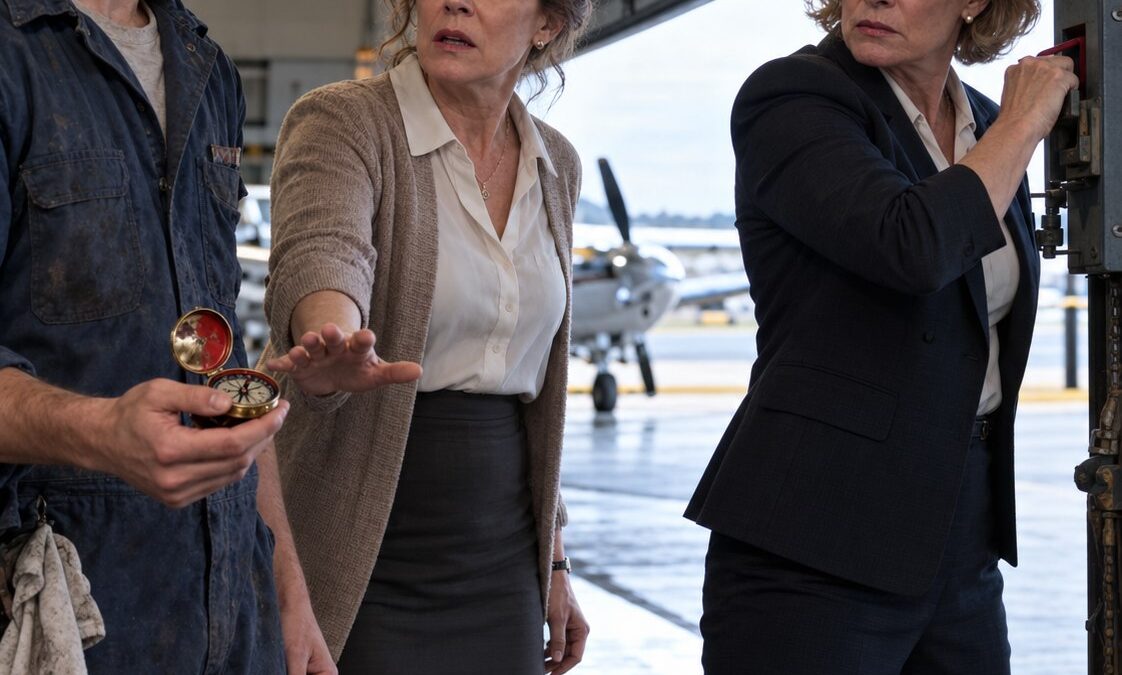
The hangar door stopped halfway down.
Nolan looked at Vera.
She had gone still beside the switch.
“What did you mean?” he asked.
Vera folded her arms.
“I meant your father accepted money.”
“You knew my father?”
“I knew of him.”
Irene stepped toward her sister.
“How?”
“Let’s take this somewhere private.”
“No.”
A warning buzzer sounded overhead.
The door had stopped low enough to trap Nolan’s service cart inside.
His unfinished inspection sat beneath the plane’s open panel.
“Lift the door,” he said.
Vera glanced at her watch.
“The flight can wait.”
“The pilot needs to know why.”
Irene reached past Vera and pressed the switch.
The door rose.
“You can tell him,” she said.
Nolan pulled out his phone and called the pilot.
He explained that another mechanic had to complete the inspection.
Then he logged the work he had done.
Vera watched each entry.
“You’ve just walked away from your shift.”
“I’ve recorded why.”
He photographed the screen.
Only then did he take off his gloves.
Irene stood beside the open toolbox.
Up close, she looked nothing like the woman in the airfield’s portraits.
Her hair was coming loose.
She had a small cut on one finger from the toolbox latch.
Nolan handed her a clean shop towel.
She took it without looking away from the compass.
“May I see it again?”
He held it out.
She did not take it.
“Could you open it?”
Nolan pressed the clasp.
Inside the lid, someone had scratched a crooked N.
“That was done before he was born,” Irene said.
“My husband thought we should wait until we knew his name.”
Vera said, “You don’t need to tell him this.”
Irene touched the cut on her finger.
“He scratched the letter anyway.”
Nolan looked at the mark.
Ellis had never known what it meant.
“He was always going to be Nolan?” he asked.
“Yes.”
It was the first thing she had said that felt meant for him.
Vera moved toward the exit.
“I’m calling counsel.”
“I’ll call mine,” Irene said.
“You haven’t spoken to her in years.”
“Then she’ll hear from me.”
Nolan pocketed the compass.
He needed Ellis’s papers.
He also needed to keep his own hands steady.
Irene took one step toward him.
She stopped herself.
“I know I’m a stranger,” she said.
“That part’s true.”
“I won’t ask you to believe me.”
“Good.”
He picked up his bag.
At the door, Irene spoke again.
“The hospital never let me see him.”
Nolan turned.
Vera’s gaze dropped to the floor.
“I thought there had been an emergency,” Irene said.
“I thought they were trying to spare me.”
Nolan remembered the way Vera had recognized the compass.
“What did they tell you happened?”
Irene swallowed.
“They said my son died before I woke up.”
Vera finally looked at her.
“You were told what you needed to know.”
Irene’s face changed.
Not with grief.
With understanding.
“There was no hospital emergency,” she said.
* * *
Ellis Price kept his important papers in a metal bread tin.
Nolan had laughed at it when he was fourteen.
Ellis had told him that anyone searching for money would overlook stale crackers.
The tin sat on the top shelf of Nolan’s apartment.
He had carried it through three moves.
Now he set it on the kitchen table.
Irene waited by the window.
Nolan had allowed her to come because Vera knew the address on his employee file.
Irene had asked first.
That mattered.
Her attorney, a woman named Tessa Grant, arrived twenty minutes later.
Nolan showed her the envelope marked FOUND WITH NOLAN.
Inside were an intake receipt, two old photographs, and a letter.
Ellis had written the letter during his final illness.
Nolan had read it once.
He had stopped when the words blurred.
Tessa read the receipt first.
“A private placement agency,” she said.
“Is that good?” Irene asked.
“It means we have somewhere to start.”
The receipt named Nolan as Baby N.
The date matched the day after Irene gave birth.
The agency had closed eighteen years earlier.
Tessa photographed the receipt.
She asked Nolan before touching anything else.
“Ellis picked me up two weeks later,” he said.
“He wasn’t married.”
“He didn’t need to be.”
Ellis had been a county bus driver.
He had become Nolan’s foster parent first.
When the placement agency closed, a judge had approved the adoption.
Nolan remembered Ellis crying outside the courtroom.
He had been seven.
Ellis told everyone the wind had got in his eyes.
Tessa lifted one photograph.
A younger Ellis stood beside a crib.
The red compass hung from its rail.
The second showed a woman outside the agency.
Her face was partly turned away.
Irene came closer.
“Is that Vera?”
“It might be,” Tessa said.
Nolan looked again.
The coat was familiar from an old portrait in the terminal.
But a coat proved little.
Tessa placed the photograph back inside its sleeve.
“We’ll get the original scanned.”
Irene nodded.
She had begun reaching for it.
She let her hand fall.
The letter was shorter than Nolan remembered.
Ellis had written that Nolan came with a compass and an envelope of medical records.
The records had vanished from the agency’s file before the adoption hearing.
Ellis had asked why.
A director told him that the birth family requested privacy.
Ellis wrote down the director’s name.
Then he wrote something Nolan had missed.
I met the woman who arranged your placement.
She said your mother knew.
Nolan read that line twice.
“Ellis believed her?”
“He wrote down what she claimed,” Tessa said.
There was a difference.
Irene sat at the kitchen table.
“I didn’t know.”
Nolan believed she believed that.
It did not settle anything.
“Can a test answer it?” he asked.
“Yes,” Tessa said.
“With both of you agreeing.”
Irene looked at Nolan.
He nodded.
Tessa found an accredited lab that could arrange separate collections with identity checks.
She explained what the test could establish.
She also explained what it could not.
A match would show whether Irene was his mother.
It would not tell them who had taken him.
Nolan called the agency director’s number from Ellis’s letter.
The line was disconnected.
Tessa found a current address through a professional directory.
The director, Mae Corbin, now lived forty miles away.
They drove there the next morning.
Mae opened her door only after Tessa identified herself.
She was seventy-eight and leaned on the frame.
“I remember the baby,” she said.
Nolan felt Irene stiffen beside him.
Mae invited them in.
She had kept no agency files at home.
She had kept a notebook of placements she worried about.
Nolan’s was on page forty-three.
The entry listed a woman who paid the agency’s emergency transport bill.
Not a name.
A company.
Kessler Airfield Services.
Irene stared at the page.
“That company belonged to my father.”
“Who could authorize payment?” Tessa asked.
“At the time, Vera ran its accounts.”
Mae closed the notebook.
“She came with a lawyer.”
“Did you meet his mother?” Nolan asked.
“No.”
“Did anyone?”
Mae looked at Irene.
“I was told you signed the release.”
“I didn’t.”
Mae’s face tightened.
“I should have asked to see you.”
Nolan wanted to be angry at her.
He was.
He also saw how long she had carried that sentence.
Tessa requested permission to copy the page.
Mae agreed.
Outside, Irene stopped beside the car.
She did not ask Nolan to comfort her.
That was another thing he noticed.
“My father’s company paid to move you,” she said.
“Your sister could have used it.”
“She did.”
Tessa’s phone rang.
It was the lab confirming their appointments.
Nolan watched Irene answer with her name.
Then Tessa came back to them.
“There’s another signature to find,” she said.
“The release?”
“Yes.”
Irene looked toward the road.
Vera had not merely known where the baby went.
She had sent him there.
* * *
Three days later, Nolan’s airfield badge stopped working.
He found out at five in the morning.
His supervisor came outside with a paper cup of coffee.
“I didn’t request it,” the man said.
“Then who did?”
“Executive office.”
Nolan took the coffee.
He had worked the early shift for four years.
He knew when the hangar heater failed.
He knew which aircraft had a stubborn latch.
He knew the supervisor’s daughter had just started college.
“I need my final pay statement,” Nolan said.
“You’ll get it.”
“And a copy of my inspection log.”
His supervisor nodded.
“I already saved it.”
Nolan finished the coffee in the parking lot.
Then he called Tessa.
By noon, she had sent a letter asking the company to preserve his employment records.
She also referred him to an employment lawyer.
“Vera can’t erase what happened in the hangar,” she said.
“She can stop me paying rent.”
Irene offered to cover it.
Nolan refused before she finished.
She did not argue.
Tessa helped him apply for temporary work with an independent maintenance shop.
The owner had seen Nolan’s certifications.
There was an opening.
It paid less.
It started Monday.
That evening, Irene brought dinner to Nolan’s apartment.
She had asked if she could.
He opened the door to find her holding two paper bags.
“I don’t know what you like,” she said.
“Ellis always said to ask.”
“He sounds sensible.”
“He was.”
They ate at the kitchen table.
Irene asked about Ellis.
Nolan told her he fixed broken radios even when replacements were cheaper.
He told her Ellis never missed a school concert.
He left out the final months in the hospital.
Those belonged to him for now.
“What was my father like?” Nolan asked.
Irene set down her fork.
“Patient.”
“Is he alive?”
“He died six years ago.”
Nolan looked at the compass beside his plate.
“I’m sorry.”
“He would have liked Ellis.”
“You don’t know that.”
“I know what you’ve told me.”
That answer was fair.
Nolan opened the compass.
The needle settled toward the window.
“Ellis said this didn’t tell you where home was.”
“What did it tell you?”
“Which way you were facing.”
Irene smiled for the first time.
It passed quickly.
Tessa called while they were clearing the plates.
The lab had released the report.
She asked whether they wanted to hear it together.
Nolan put the phone on speaker.
The test supported a biological mother and son relationship.
Tessa gave them a moment.
Irene sat down.
Nolan stayed standing.
There was no sudden memory.
No feeling that arranged twenty-four years into a neat line.
There was a fact.
A large one.
Irene raised her eyes.
“May I be glad?”
He had not expected the question.
“Yes,” he said.
She pressed the shop towel from the hangar against her eyes.
She had kept it.
After the call, Tessa sent the report to both of them.
Then she sent something else.
Her investigator had located an old company audit.
Kessler Airfield Services had paid the placement bill through a consulting account.
That account also paid Vera’s personal attorney.
The attorney had died.
His records were held by a successor firm.
A court order might be needed to see them.
“There’s more,” Tessa said.
Irene gripped the phone.
Her father had created a trust for his first grandchild.
When Irene was told Nolan died, Vera had presented a death certificate.
The trustee released the trust’s voting rights to Vera.
For twenty-four years, she had controlled a block of airfield shares.
“She needed me gone,” Nolan said.
“She needed everyone to believe you were,” Tessa replied.
The next morning, Vera’s lawyer sent Nolan a letter.
It accused him of taking property from Irene’s family.
It offered money if he returned the compass and signed a confidentiality agreement.
Nolan read it twice.
Then he forwarded it to Tessa.
He did not reply.
By afternoon, the company announced an emergency board meeting.
Its stated purpose was to address “false claims concerning historic records.”
Tessa advised Irene to attend.
Nolan asked to come too.
Vera had made him the subject.
He intended to be present.
That night, Irene called him.
“I found something in my father’s files.”
“A contract?”
“A letter from the trustee.”
It warned that the death certificate lacked a hospital registrar’s seal.
Her father had asked Vera to correct it.
Vera had told him the hospital lost the original.
Irene’s father had accepted that answer.
A year later, he died.
Nolan looked at the red compass on his table.
“Why take a baby for shares?” he asked.
Irene was quiet.
Then she said, “The shares let her hide what she’d already taken.”
* * *
The board met in the terminal conference room.
Through the glass wall, Nolan could see the hangar.
A plane stood where his toolbox had been.
Vera sat at the head of the table.
Six directors faced her.
Two knew Irene well enough to stand when she entered.
Nolan chose a chair beside Tessa.
Vera did not look at him.
Her lawyer did.
“We can handle this privately,” Vera said.
Irene took her seat.
“You chose the meeting.”
“I chose to protect the company.”
Tessa placed a folder before each director.
Vera kept her hands folded.
The first pages contained the DNA report.
The next showed the agency notebook.
The third held the old audit entry.
Vera’s lawyer leaned forward.
“None of this proves misconduct by my client.”
“That’s why we requested the original records,” Tessa said.
“And you don’t have them.”
Vera turned to the board.
“My sister lost a child.”
No one spoke.
“Now a young man has appeared with an object she recognizes.”
“He has a verified test,” Irene said.
“Yes, Irene.”
Vera’s voice stayed gentle.
“He may be your son.”
Nolan felt the shape of her argument before she reached it.
She would accept him.
Then she would claim Irene gave him away.
Vera lifted a document from her folder.
“This is the release Irene signed.”
She handed copies around.
Nolan watched Irene read.
Her face drained.
The signature looked like hers.
Tessa examined the page.
“Where is the original?”
“With counsel.”
“Which counsel?”
“Our family attorney at the time.”
“He’s deceased,” Tessa said.
“His successor holds the archive.”
“Then you’ll authorize access?”
Vera spread her hands.
“Of course.”
Nolan knew she expected the delay to help her.
A director looked toward Irene.
“Could you have signed it while medicated?”
“No.”
Vera lowered her voice.
“You told me you couldn’t raise him alone.”
Irene turned.
“My husband was alive.”
“You two had separated.”
“For three weeks.”
“You were frightened.”
Irene looked at the signature again.
Nolan remembered Ellis’s letter.
The woman said your mother knew.
He understood why Vera had planted that sentence.
If he believed it, Irene became the person he had to fight.
Tessa slid another photograph across the table.
It showed Vera outside the placement agency.
Vera barely glanced at it.
“I helped with the arrangements,” she said.
“I’ve never denied that.”
“You denied knowing him,” Nolan said.
“I said I knew of your father.”
“You knew my name at the hangar.”
“It was on your badge.”
Nolan touched the compass in his pocket.
He had brought it because Irene asked whether he would.
That morning, its clasp had caught on the lining.
He had taken it to a repairer near his new job.
The repairer found a thin paper circle beneath the back plate.
Nolan had not opened it.
He wanted the people in this room to see it removed.
He placed the compass on the table.
Vera’s eyes followed it.
“My dad wrote that the medical papers vanished,” Nolan said.
“But this stayed with me.”
Vera shook her head.
“A compass is not a record.”
“No,” Nolan said.
“It’s a place someone put one.”
Tessa introduced the repairer, who waited outside.
The board chair invited him in.
He explained how the back plate opened.
He also showed them a photograph he had taken that morning.
A narrow paper circle lay inside.
He had replaced the plate without disturbing it.
In front of the board, he removed it again.
The circle held a hospital identification number.
It had been cut from a newborn wristband.
On its reverse was a handwritten date.
Irene stared.
“I put that there.”
Vera let out a short breath.
Irene turned toward the directors.
“The nurse brought his band after they told me he died.”
“I kept it because it was all they gave me.”
She looked at Nolan.
“Later, I put it inside the compass.”
Nolan had already heard this from her.
Tessa had written it down two days before the repairer found anything.
The statement sat in a sealed envelope with her notes.
The repairer passed the paper to Tessa.
She checked the number against a certified hospital register obtained that morning.
The numbers matched.
The register listed a living male infant.
It showed a transfer to a private agency the next day.
There was no death entry.
A director removed his glasses.
“Who approved the transfer?”
Tessa turned a page.
“The hospital copy names Vera Kessler.”
Vera reached for her water.
Her hand missed the glass.
“That was an administrative signature.”
“Then the release should settle it,” her lawyer said.
Tessa nodded.
“The original will.”
She placed another page before the board.
The successor firm had supplied a scan overnight after Vera authorized access.
The document was dated the day Irene gave birth.
But the firm’s own inventory dated its arrival six weeks later.
Its cover letter came from Vera.
Vera’s lawyer read it.
“That doesn’t establish forgery.”
“No,” Tessa said.
“We’ve asked the court to determine that.”
She pointed to a second record.
The witness named on Irene’s release had been assigned to a hospital in another state that day.
The hospital had confirmed his schedule.
No one spoke for several seconds.
Vera stood.
“I kept the company operating.”
Irene stayed seated.
“You took my son.”
“You would have lost everything.”
“You made sure I did.”
Vera looked at Nolan.
“Ellis Price took the placement money.”
Nolan stood too.
“Ellis paid for my school shoes.”
“He paid for my braces.”
“He sat through every fever.”
He held her gaze.
“Whatever you paid for, you didn’t buy him.”
The board chair asked Vera to leave.
She refused.
A company officer accompanied her to the hall.
The directors voted to suspend her access to company records.
They appointed independent counsel to review the trust and the old accounts.
Tessa sent the evidence to the county prosecutor.
She made clear to Nolan that an investigation would take time.
He wanted it to.
The facts deserved more than one dramatic afternoon.
Four months later, investigators obtained the original release.
An examiner concluded Irene’s signature had been copied onto it.
Financial records showed Vera had moved company funds through contracts she controlled.
The hospital transfer had used the forged release.
Vera pleaded guilty to fraud and falsifying records.
The court ordered restitution and imposed a prison sentence.
The board recovered control of the voting shares.
The judgment could not return Nolan’s childhood.
No one in the courtroom claimed it could.
When Vera was led out, she looked back at him.
“You’ll spend your life wondering whether she wanted you.”
Nolan held the compass closed in his hand.
Then he answered.
“I asked her.”
* * *
Spring reached the airfield in slow, wet mornings.
Nolan worked at the independent shop across town.
His supervisor there trusted him with difficult inspections.
His landlord renewed the lease.
Nolan paid the rent himself.
Irene visited on Sundays.
The first time, she brought expensive coffee Nolan did not like.
The second time, she asked what Ellis had kept in the cupboard.
She arrived with ordinary ground coffee after that.
They did not talk about the case every week.
Some Sundays, they talked about engines.
Irene understood less than she claimed.
Nolan liked that she kept trying.
Once, she held a flashlight while he repaired a kitchen cabinet hinge.
“It’s upside down,” she said.
“The hinge?”
“The flashlight.”
She was right.
They laughed for longer than the mistake deserved.
Nolan had not known if they would ever laugh together.
Irene showed him photographs of his father.
His father had liked terrible neckties.
Nolan recognized his own ears.
That startled him more than the lab report had.
He took Irene to the cemetery where Ellis was buried.
She brought flowers.
At the grave, she stood with both hands at her sides.
“I wish I could thank him,” she said.
Nolan looked at the name cut into stone.
“You can.”
Irene thanked Ellis for raising him.
She thanked him for keeping the compass.
She apologized for the years Nolan had spent wondering.
Nolan did not correct her.
He had wondered.
He had also been loved.
Both things were true.
The trust settlement came that summer.
Its value was larger than Nolan could picture.
Tessa walked him through it with a separate financial adviser.
Irene told both of them that Nolan should decide without her.
He did.
He kept enough to protect his future.
He set aside a fund for children leaving foster care.
It paid for tools, tuition, and the first months of rent.
He named it after Ellis.
The airfield board offered Nolan a senior job.
It came with an office and a salary that made his old supervisor whistle.
Nolan turned it down.
He liked the shop where he worked.
He also wanted to know that a job was his because he could do it.
Irene accepted the answer.
A month later, she asked him to dinner with several relatives.
“Will they stare?” he asked.
“Probably.”
“Will you tell them to stop?”
“Yes.”
He went.
One aunt cried into her napkin.
A cousin asked thoughtful questions about his work.
Another asked about the trust.
Irene answered that one before Nolan had to.
Afterward, she apologized in the parking lot.
“For inviting me?”
“For leaving you to guess how they’d behave.”
“You didn’t know.”
“I could have asked you what you needed.”
Nolan thought about that.
“You can ask next time.”
“I will.”
He did not call her Mom.
She never asked him to.
On his twenty-fifth birthday, she came to the repair shop carrying a cake.
She had checked with the owner first.
The icing leaned to one side.
Nolan suspected she had decorated it herself.
His coworkers sang badly.
Irene sang worse.
After they left, she gave him an envelope.
Inside was a photograph of the compass before his birth.
It lay open on her kitchen table.
The crooked N was already scratched into the lid.
On the back, his father had written, For Nolan, when he finds his way.
Nolan read it several times.
“I don’t want you to feel you owe us anything,” Irene said.
“I know.”
“I wanted you to have his words.”
Nolan slipped the photograph back into its envelope.
“Thank you.”
Irene touched the cake box.
“Could I ask you something?”
He nodded.
“May I put your picture beside his at home?”
Nolan knew which picture she meant.
It showed him grinning beside a stubborn engine.
He had sent it to her in May.
“Yes,” he said.
She smiled.
“Beside mine too?”
“Wherever it fits.”
That evening, Nolan opened the compass.
The paper circle remained in a protective sleeve with the case files.
The needle still worked.
He thought of Ellis teaching him to hold it flat.
He thought of Irene waiting for an answer instead of taking one.
For the first time, he called her.
“Are you home?” he asked.
“I am.”
“I have more cake.”
“I have plates.”
“I know.”
He went over.
* * *
Four years later, Nolan returned to the hangar with a group of apprentices.
Most had come through the fund named for Ellis.
They had spent the morning learning inspections at the independent shop.
Irene had arranged a tour of the airfield.
She waited near the open door.
There was no toolbox between them now.
The same lights shone overhead.
One apprentice noticed the red compass in Nolan’s hand.
“Does that thing still work?”
Nolan opened it.
The needle turned.
“It tells you which way you’re facing,” he said.
The apprentice frowned.
“Isn’t that what a compass does?”
“Sometimes that’s enough.”
Irene heard him.
She smiled but let him finish the lesson.
They walked past the plane together.
Ellis’s fund had helped forty-seven young adults.
The airfield had new directors.
Vera’s restitution payments still arrived.
Nolan’s photograph hung in Irene’s home.
Beside his father’s.
Beside hers.
At the hangar door, Irene stopped.
“May I see it?”
Nolan placed the compass in her hand.
She checked the needle.
Then she gave it back.
Nothing needed to be proved.
Outside, the apprentices waited beneath a clear sky.
Nolan closed the compass and joined them.
THE END








