He Came Home Early to Find His Daughter Cutting Herself Out of Family Photos—Then His Wife Saw the Postcard

Chapter 2: The Postmark
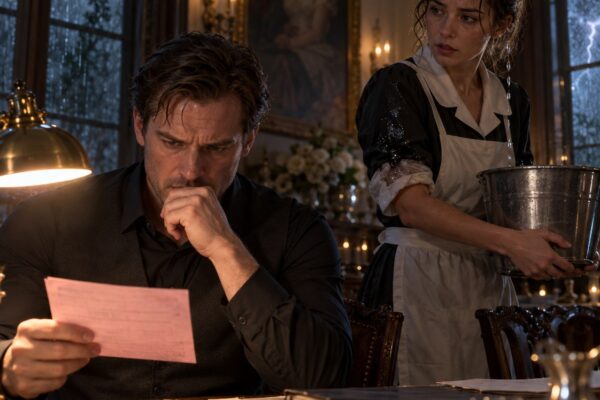
Adrian read the postcard twice.
The date stayed the same.
Three days ago.
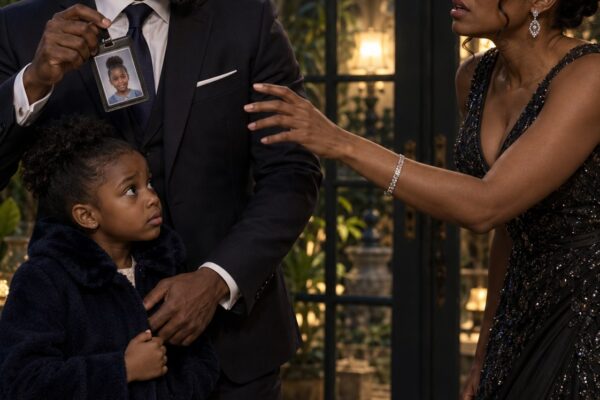
June’s fingers tightened around his.
“Daddy?”
“I’m here.”
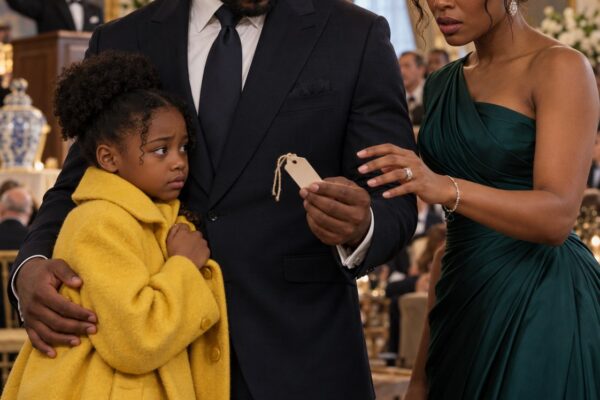
Celeste held out her hand.
“That belongs to me.”
Adrian turned the card over.
A lighthouse stood against a pale blue sky.
Ruth had sent cards with that lighthouse before Nora died.
Adrian remembered June keeping them under her pillow.
He had stopped seeing them after the wedding.
“You told June her grandmother died?”
Celeste looked toward the windows.
“She misunderstood.”
June shook her head.
“You told me after Christmas.”
“I said Ruth was very sick.”
“You said she went to heaven.”
Celeste’s mouth opened.
Nothing came out.
Adrian crouched beside his daughter.
The cut photograph showed June at four, sitting between him and Nora.
Nora’s face remained whole.
June’s had been sliced through one eye.
“Did you want to do this?”
June looked at the scissors.
“No.”
“Why did you?”
“Celeste said I kept asking for people who weren’t here.”
Adrian took the scissors gently.
He set them beyond June’s reach.
“You never have to cut another picture.”
Celeste folded her arms.
“You’re frightening her.”
“She was frightened when I arrived.”
“I was teaching her to let go.”
“Of her own face?”
Celeste glanced at the postcard again.
Adrian took out his phone.
“Ruth’s number hasn’t changed.”
“You can’t call her now.”
“Why?”
“She’s recovering.”
“From what?”
Celeste’s gaze flicked to June.
Adrian understood the warning.
There were things Celeste did not want said before a child.
He carried June to the sofa.
She weighed less than he expected.
That realization hurt more than Celeste’s words.
“I’ll be right here,” he told her.
He called.
The line rang once.
Twice.
A woman answered.
“Hello?”
Adrian gripped the phone.
“Ruth?”
The woman made a small sound.
“Adrian?”
Across the room, Celeste went still.
“Are you all right?” Adrian asked.
“I am now.”
June slid off the sofa.
“Grandma?”
For a moment, neither adult spoke.
Then Ruth began to cry.
“I’ve been trying to reach you,” she said.
* * *
Adrian put the call on speaker.
June leaned against his leg.
Ruth asked her about school.
June described the class hamster and its habit of hiding pencils.
She did not mention the scissors.
Adrian watched her face soften.
He had forgotten how quickly Ruth could make her laugh.
After a few minutes, he promised they would call again.
Ruth asked him to stay on the line.
“I need to tell you something first.”
Celeste stepped toward them.
“Adrian, June needs dinner.”
June had been told to work through dinner.
Adrian had seen her untouched plate on the sideboard.
“She’ll have it,” he said.
Ruth heard the edge in his voice.
“Is Celeste there?”
“Yes.”
“Then ask her about my letters.”
Celeste reached for the phone.
Adrian moved it away.
“What letters?”
“I sent one every month.”
“To June?”
“To both of you.”
Ruth’s voice grew steadier.
“The last three came back unopened.”
Celeste gave a sharp laugh.
“We moved the household mail to the office.”
Adrian had moved nothing.
His company mail went to his office.
Everything personal came to the house.
He looked at the lighthouse postcard.
This one had reached June.
How?
“She found it herself,” Celeste said quickly.
Nobody had asked.
June raised her hand as if she were in class.
“It fell out of the blue book.”
Celeste stared at her.
“What blue book?” Adrian asked.
“The one on the top shelf.”
Nora had made a blue cloth album during June’s first four years.
It held photographs, ticket stubs, and notes in her small, slanted handwriting.
Adrian thought it had been lost during the renovation.
Now half its pages lay across the dining table.
He picked up the cover.
Nora had stitched a yellow star near the spine.
June touched it with one finger.
“Mommy made that.”
“She did.”
“She put Grandma’s address inside.”
Adrian opened the front cover.
The address was there.
So was a folded envelope, tucked beneath the lining.
Celeste came forward.
“I haven’t seen that.”
“You told June to cut this album.”
“It was falling apart.”
Adrian pulled out the envelope.
It contained six postcards.
All carried recent dates.
None was addressed in Ruth’s handwriting.
Each was marked RETURN TO SENDER in black ink.
Inside the envelope lay a note from Celeste.
Adrian recognized the stationery from her desk.
Please keep these away from June until she stops asking.
His stomach tightened.
Celeste saw the note.
“I was protecting her from confusion.”
“Ruth was alive.”
“She had been ill.”
June looked up.
“Can sick people send postcards?”
“Yes,” Adrian said.
Celeste’s cheeks reddened.
“Adrian, she used to call at all hours.”
Ruth spoke through the phone.
“I called on her birthday.”
“Repeatedly,” Celeste said.
“Once each year.”
Adrian asked Ruth to photograph her sent letters.
She said she had kept copies.
Ruth had also kept the postal receipts.
She had worked for thirty years as a librarian.
Keeping records came naturally to her.
Adrian gave June the dinner Celeste had left covered.
While June ate, he photographed the album exactly as it lay.
He photographed the envelope and both sides of every card.
He used the phone’s date stamp.
Celeste watched him.
“You’re making me look like a criminal.”
“I’m recording what I found.”
“Over postcards?”
“Over what you told my daughter.”
He asked Ruth one more question.
“Why didn’t you call my office?”
“I did.”
His hand stopped.
“Your assistant said you didn’t wish to speak.”
Celeste looked away.
Adrian’s assistant was Celeste’s cousin, Beth.
She had joined the office eight months after the wedding.
He had accepted Celeste’s recommendation.
“I never said that,” Adrian told Ruth.
“I know that now.”
Ruth paused.
“Nora wanted us to stay close.”
Adrian shut his eyes.
He had believed Ruth withdrew because she blamed him for Nora’s death.
Ruth had believed he had shut her out.
In the middle, June had lost them both.
“There’s something else,” Ruth said.
“What?”
“Nora asked me to keep an account for June.”
Adrian looked at Celeste.
“The college trust?”
“No,” Ruth said.
“The account Nora opened before she died.”
* * *
June fell asleep on the sofa.
Adrian called his sister, Tessa, to stay with her.
Tessa arrived in twenty minutes.
She took one look at the cut photographs and said nothing.
Adrian appreciated that.
June needed a familiar voice.
He needed facts.
He called the attorney who had handled Nora’s estate.
Evelyn Price answered from home.
“Yes, there was a separate trust,” she said.
Nora had created it with the proceeds from a small software company.
She had sold her share years before the diagnosis.
The money was for June’s education, medical needs, and everyday care.
Adrian was one trustee.
Ruth was the other.
“Celeste told me it was folded into the estate,” he said.
“It wasn’t.”
Evelyn went quiet.
“Adrian, I sent you the annual statements.”
He had never seen them.
Evelyn gave him the dates and file numbers.
The statements had gone to his home address.
She had received electronic acknowledgments from his account.
Adrian used that account for family paperwork.
Celeste knew the password.
They arranged to meet the following morning.
Evelyn asked him to bring the postcards.
“And June?” she asked.
“She stays with my sister.”
“Good.”
Celeste stood in the doorway as he finished.
“You’ve always let me handle the house.”
“I did.”
“You traveled for weeks.”
“I did.”
“You asked me to help June move forward.”
“I asked you to love her.”
Celeste’s expression hardened.
“Love doesn’t make a child grateful.”
Adrian put his phone down.
June shifted in her sleep.
Tessa laid a blanket over her.
“Go upstairs, Celeste,” Adrian said.
“You can’t order me out of my home.”
“Then use the guest room.”
Celeste looked at Tessa.
“Are you hearing this?”
“I heard June,” Tessa said.
Celeste left.
Adrian stayed beside his daughter.
He remembered the first time June called Celeste by name.
It had been quiet and hopeful.
He remembered believing that quiet meant peace.
In the morning, Ruth came to Evelyn’s office.
Adrian had not seen her in nearly two years.
She was thinner, walking with a cane after a fall.
She reached for him anyway.
“I thought you hated me,” she said.
“I thought you hated me.”
They stood apart for a moment.
Then Adrian stepped forward.
Ruth held him tightly.
Evelyn gave them time.
When they sat down, she laid out the trust records.
Nora had funded the account four months before she died.
The trust allowed reasonable spending for June.
Both trustees had to approve withdrawals above ten thousand dollars.
Ruth had approved none.
Yet the statements showed four payments over that amount.
Each went to a company called Northline Family Services.
“Therapy?” Adrian asked.
“That was the description,” Evelyn said.
June had never gone to therapy.
Adrian would have supported it if she needed it.
He had never heard of Northline.
Evelyn showed him the approval forms.
His signature appeared on every one.
Ruth’s appeared beside it.
Ruth adjusted her glasses.
“That is not my signature.”
Adrian knew his own.
The strokes looked close.
They were too close.
Every form repeated an identical hesitation in the letter M.
He photographed them.
His job involved financing construction projects.
He had reviewed enough contracts to recognize copied marks.
“I want the original electronic files,” he said.
Evelyn had already requested them from the trust administrator.
She also asked the bank to preserve account records.
Adrian called a family lawyer separately.
He wanted advice about June’s care while they investigated.
The lawyer told him to document what June said in her own words.
She warned him against asking leading questions.
Adrian listened.
This was not a problem he could solve by being angry.
Ruth opened her bag.
She took out a neat folder of returned mail.
There were photographs of birthday cards.
There were receipts.
There was a copy of a letter Celeste had mailed in Adrian’s name.
Ruth handed it to him.
It said June found visits upsetting.
It asked Ruth to stop contacting the family.
At the bottom was Adrian’s signature.
He had never written it.
Beneath that, in smaller print, was an address for all future replies.
It belonged to Beth’s office.
* * *
By noon, Beth knew Adrian had called Evelyn.
She sent him a message saying she was ill.
Then she sent another.
Please don’t let Celeste say I invented this.
Adrian showed both messages to his lawyer.
He did not answer Beth himself.
The lawyer arranged a recorded interview with Beth’s counsel present.
Beth arrived looking exhausted.
She admitted redirecting Ruth’s calls.
Celeste had told her the grandmother’s health made her confused.
Beth had believed it at first.
Then Celeste asked her to copy Adrian’s signature onto the letter.
Beth refused.
Celeste said she would handle that herself.
“Why did you stay?” Adrian asked.
“I needed the job.”
Beth looked at the table.
“That doesn’t excuse what I did.”
She handed over office logs.
Ruth’s calls were entered under a false category.
Three trust messages had also been routed to Celeste.
Beth had kept screenshots after Celeste began blaming her.
Adrian took the records to his lawyer.
He made no promise about Beth’s job.
At home, Tessa had made June grilled cheese.
June sat at the kitchen island drawing a lighthouse.
Ruth sat beside her, watching every stroke.
“Grandma remembers the bell,” June told Adrian.
“The bell?”
“At the lighthouse.”
Ruth smiled.
“We visited when she was three.”
June drew a small yellow bell above the sea.
Adrian had been on a flight that day.
He had missed many days.
He could not recover them by apologizing once.
“Can Ruth stay for dinner?” June asked.
“If she wants to.”
“I do,” Ruth said.
Adrian asked June if she wanted to show Ruth the blue album.
June looked uncertain.
“We can leave it alone,” he said.
“I want to show her Mommy’s star.”
They sat together in the living room.
Ruth touched Nora’s stitching.
For the first time that day, she smiled without crying.
The doorbell rang.
Celeste had returned with her attorney.
She also had a typed statement.
It claimed June had damaged the album during an emotional episode.
Celeste said the cuts were an accident.
Adrian told her his attorney would accept the statement.
He did not sign it.
Celeste noticed Ruth on the sofa.
“You came into my house.”
“Adrian invited me,” Ruth said.
Celeste turned to him.
“You’re letting her turn June against me.”
June pulled closer to Ruth.
Adrian moved between them.
“Please leave her out of this.”
“She already is in it,” Celeste said.
Her attorney touched her arm.
Celeste lowered her voice.
“Ask your daughter what she broke last month.”
June stared at the floor.
Adrian knew about a porcelain lamp.
Celeste had said June threw it.
He had paid to replace it from an account for household expenses.
June had apologized over the phone while he was in Denver.
He knelt in front of her.
“You can tell me later.”
“I didn’t touch it.”
“I hear you.”
Celeste’s attorney asked to speak privately.
Adrian’s lawyer joined by phone.
The conversation lasted six minutes.
Celeste wanted to remain in the house.
Adrian wanted temporary distance while June’s account was reviewed.
Their lawyers agreed Celeste would stay elsewhere that night.
The family lawyer would address longer arrangements.
Nobody raised their voice.
That seemed to disappoint Celeste.
As she collected her coat, Ruth studied her.
“You sent me a photograph,” Ruth said.
Celeste turned.
“What photograph?”
“A picture of June crying beside the broken lamp.”
Adrian felt the room tilt.
Ruth took out her phone.
The picture had arrived the day after Adrian’s Denver call.
Its message said June became distressed after hearing from Ruth.
Ruth had stopped calling for six weeks.
Adrian looked closely.
The lamp stood unbroken behind June.
On the table sat a cardboard shipping box.
Its printed label read NORTHLINE FAMILY SERVICES.
Celeste reached for her coat.
Adrian’s lawyer spoke through the phone.
“Please don’t remove any documents.”
Celeste laughed once.
“It’s a shipping box.”
Adrian enlarged the label.
Under the company name was a registration number.
He knew the format.
It belonged to an entity registered by Celeste’s brother.
* * *
The trust administrator sent the original files the next morning.
Evelyn examined them with an independent document specialist.
The specialist could not identify an author from a digital image.
She could show that Ruth’s supposed signatures were identical overlays.
The same scan had been placed on four forms.
The bank supplied transfer confirmations under subpoena later.
For now, Evelyn had enough to ask the administrator to freeze further payments.
Adrian reported the suspected fraud.
He also gave investigators Beth’s logs and Ruth’s returned letters.
The officers did not arrest Celeste that afternoon.
They took statements.
They sought records.
They warned Adrian not to confront anyone about the transfers himself.
He followed that advice.
Within days, the bank traced Northline’s account.
It belonged to a company Celeste’s brother, Warren, had formed.
Warren had once run a consulting business.
It had closed with debts.
Northline had no therapists on staff.
It had no clinic.
Its invoices described sessions June had never attended.
Celeste had used photographs of June crying to support them.
The lamp picture was one.
Another showed June leaving Nora’s memorial service.
Adrian remembered that day.
June had been four.
He had carried her to the car.
The invoice called the photograph evidence of a recent behavioral crisis.
Adrian read that line three times.
Then he set the paper down.
Tessa found him in his office.
“Come home,” she said.
“I have to finish this.”
“You’ve finished enough for today.”
He wanted to argue.
Instead, he went home.
June was at the table with Ruth.
They were repairing the album.
Ruth had found archival sleeves.
She slid each cut photograph inside without hiding the damage.
“Can they go back together?” June asked.
“Some can,” Ruth said.
“And some can stay like this.”
June considered that.
“Mommy is still in them.”
“Yes.”
Adrian sat beside her.
He told her he should have listened sooner.
She kept her eyes on the photograph.
“Will you go away again?”
“I have work next week.”
Her shoulders dropped.
“I can change that trip.”
“You always have trips.”
He could not deny it.
“I did,” he said.
“I’m changing how I work.”
June glanced at him.
“For real?”
“For real.”
He had already called his partners.
The company could manage one project without him on site.
He had acted as though nobody else could.
It had cost his daughter too much.
Two weeks later, Evelyn called everyone to her office.
Adrian and Ruth attended with their lawyers.
Celeste came with hers.
Warren’s lawyer attended separately.
A bank representative joined by video.
No child was present.
Evelyn laid out the trust terms first.
Then the payments.
Celeste said Nora had wanted June to receive help.
“June was grieving,” she said.
“Adrian was gone.”
“I was working,” Adrian said.
“That is the same thing to a child.”
The words landed.
They were cruel.
They were also close enough to truth to hurt.
Celeste saw that.
“I kept that house functioning.”
“You also kept Ruth out,” Evelyn said.
“Ruth undermined me.”
“I sent birthday cards,” Ruth replied.
Celeste leaned forward.
“You weren’t there when June woke crying.”
“I would have been.”
“You don’t know that.”
Ruth looked at her.
“I know you told her I died.”
Celeste turned to the bank representative.
“The services were real.”
The representative asked for the provider’s credentials.
Celeste said Warren handled staffing.
Warren’s attorney said his client had relied on Celeste.
For one minute, blame moved between them.
Then Evelyn placed the blue album on the table.
Celeste’s face changed.
It was the first object she had tried to destroy.
Evelyn opened to a page Nora had written.
Nora had listed Ruth’s address.
Below it she had written an instruction to June.
If someone says Grandma can’t come, ask Daddy to call her.
Adrian had seen the line only the night before.
Nora wrote it when Ruth had knee surgery.
Its ordinary purpose did not make it less painful.
Celeste said the album proved nothing about money.
“She’s right,” Evelyn said.
She turned the page.
A postcard had left a faint rectangle on the paper beneath it.
That postcard carried the first recent postmark.
Celeste had said she had not seen it.
Yet the envelope under the lining contained Celeste’s note directing that later cards be kept from June.
It showed concealment.
The financial proof came next.
The bank displayed account ownership.
Warren’s company had received every transfer.
Then the document specialist showed the repeated signature image.
Finally, Beth’s logs showed Celeste accessing the trust messages before each approval.
Celeste’s attorney requested a private break.
Evelyn agreed.
Adrian went to the corridor.
He looked out over the street.
Ruth stood beside him.
“Nora trusted me to notice,” he said.
“She trusted both of us.”
“I didn’t.”
“You are noticing now.”
“That doesn’t undo it.”
“No,” Ruth said.
They went back inside.
Celeste’s attorney said she would not answer more questions.
Celeste insisted on one last sentence.
“June will remember who stayed with her.”
Adrian met her eyes.
“She’ll remember who told her the truth.”
* * *
The legal process took months.
Investigators interviewed staff and examined bank records.
Warren admitted preparing invoices for sessions that never happened.
Celeste had supplied the photographs and approved the amounts.
Beth cooperated.
Her account helped establish how the messages were diverted.
Adrian testified about the signatures.
Ruth testified about the letters.
A judge approved repayment from accounts investigators had frozen.
Warren and Celeste each entered pleas on fraud charges.
Their sentences included restitution and supervised conditions.
Celeste no longer lived with them.
Adrian did not let June learn the details from strangers.
With help from June’s pediatrician, he told her the plain truth.
Celeste had lied about Ruth.
She had taken money meant for June.
Adults were handling it.
June was safe.
June asked the question he had expected.
“Was I bad?”
“No.”
“Was the album bad?”
“No.”
“Why did she make me cut it?”
Adrian looked at the repaired pages.
“She wanted to hide what was inside.”
June considered that.
“Mommy put Grandma’s address there.”
“She did.”
“And Grandma came.”
“She did.”
On Saturdays, Ruth came for pancakes.
She made them too thick.
June preferred them that way.
Adrian learned the recipe and still made them too thin.
Ruth laughed at him once.
It was the first laugh the house had held in months.
Adrian reduced his travel.
He hired a project lead he should have trusted years earlier.
Some evenings he got home before June.
On others, he called and told her exactly when he would arrive.
If he was late, he said so.
He stopped using promises as a substitute for presence.
In spring, Evelyn explained the restored trust.
June’s money would remain protected.
Adrian and Ruth would continue as trustees, with an independent reviewer added.
Adrian agreed immediately.
He also repaid the trust for expenses he had approved without checking.
Evelyn told him the recovered funds covered most losses.
He paid anyway.
The account was June’s.
He had been responsible for it.
One afternoon, his company’s partners offered him a larger role.
It came with more money and constant flights.
Adrian declined.
He did not turn the offer into a speech.
He suggested another partner who wanted it.
At home, June was planting marigolds with Ruth.
Adrian changed his shoes and joined them.
June assigned him the heaviest watering can.
“Because you’re strong,” she said.
Ruth raised an eyebrow.
“That’s what she told me.”
June smiled.
There were difficult days.
A photograph could still upset her.
She sometimes asked if Ruth might disappear.
Ruth answered every time.
“I’ll tell you where I’m going.”
“If you’re sick?”
“Then I’ll tell you that too.”
June wanted the blue album beside her bed.
Adrian asked whether she wanted the damaged pictures removed.
“No.”
“Are you sure?”
“That’s where you found me.”
He had no answer.
He sat on the floor while she turned the pages.
There was Nora holding June at the beach.
Ruth teaching her to roll dough.
Adrian asleep in a chair with a newborn against his chest.
June studied that one.
“You were there.”
“I was.”
“Then you went away a lot.”
“Yes.”
She closed the album.
“I like when you come back before dinner.”
“I do too.”
He asked if he could sit with her a little longer.
She moved over to make room.
* * *
Five years later, June stood at the dining table.
She was eleven and nearly as tall as Ruth’s shoulder.
The blue album lay open before her.
A new photograph waited beside it.
Adrian had taken it that morning at the lighthouse.
June stood between him and Ruth.
The old bell hung above them.
Ruth had insisted they use the timer so Adrian appeared too.
June slipped the photograph into an empty sleeve.
She had left that space herself.
Across from it sat the picture Celeste had made her cut.
The seam through June’s face was still visible.
She looked at it without flinching.
“Do you want to replace that one?” Adrian asked.
“No.”
She touched the new photograph.
“Put this one next to it.”
Adrian handed her the lighthouse postcard.
The ink had faded, but the date remained clear.
Three days before he came home.
June placed it between the two photographs.
Then she read Ruth’s message aloud.
“I miss you every day.”
Ruth, standing in the doorway, answered her.
“Not anymore.”
Adrian watched June close the album.
Nora’s yellow star rested beneath her hand.
The photographs were safe.
Ruth was there.
June looked up and asked what time dinner would be.
“Six,” Adrian said.
“I’ll be here.”
“I know,” she said.
THE END