She Sewed Her Son’s Coat Beneath My Hotel While My Payroll Said She Was Paid—Then I Saw Where Her Wages Went
Chapter 2: The Account Ending in 4406
The doors moved again.
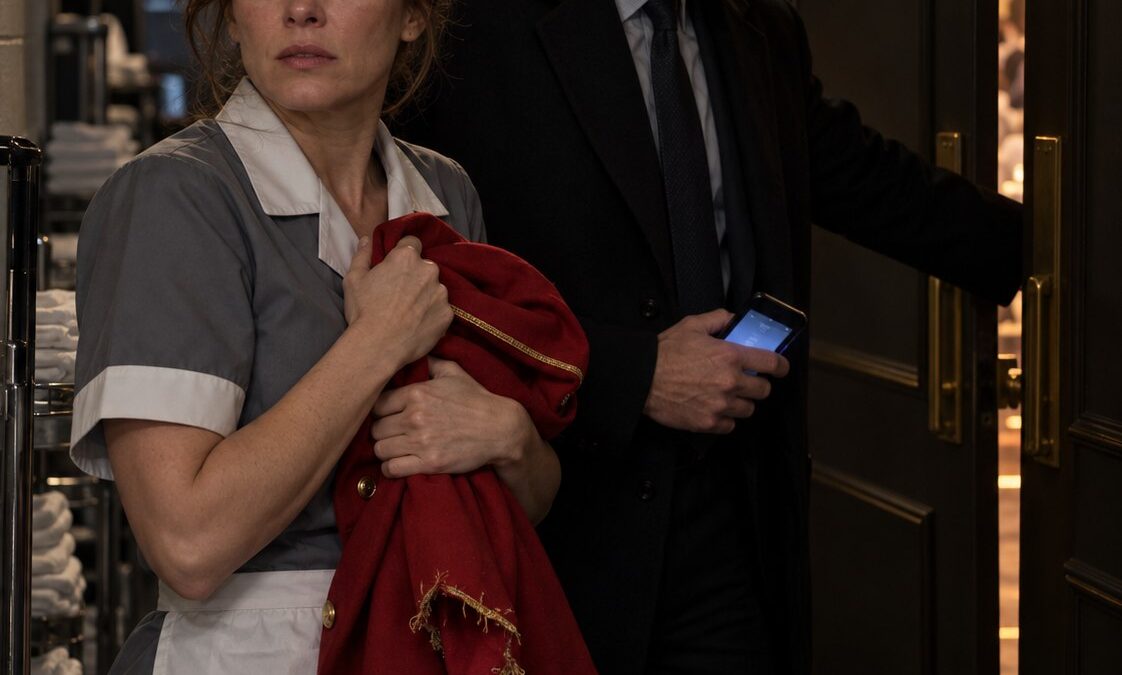
Nell gathered the coat.
I stood between her and the ballroom.
The motion sensor above the doors clicked, and a cleaning cart rolled into view.
Its wheels struck the threshold.
The night porter followed, carrying a stack of folded linen.
He stopped when he saw me.
“Sorry, Mr. Vale.”
“Did someone send you?”
“Payroll called.”
He glanced at Nell.
“They said the corridor needed clearing.”
I looked at the time.
Two minutes since the file alert.
“Leave the cart,” I said.
He did.
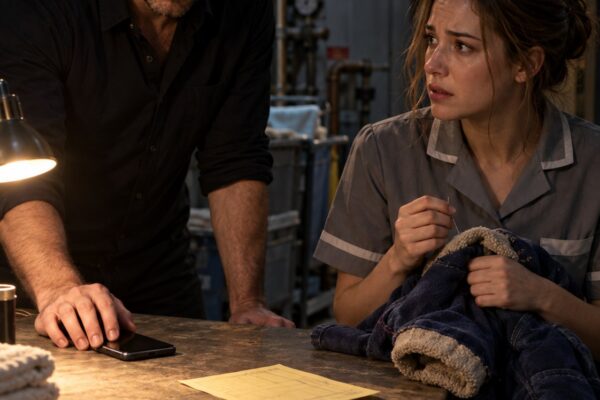
When his footsteps faded, Nell pressed the red coat against her chest.
“She knows we’re here.”
“She knows someone opened your file.”
“That’s enough.”
A phone rang somewhere inside the ballroom.
The sound carried through the empty room.
Nell picked up her needle.
“Please don’t call my supervisor.”
“I won’t.”
“If they cancel tomorrow, I lose the week.”
“I understand.”
“No,” she said.
“You don’t.”
She was right.
I had never counted on a shift I hadn’t worked yet to buy groceries already needed.
I stepped away from the doors.
“Tell me what you need tonight.”
“My pay.”
“I can arrange an advance.”
“I need what I earned.”
The distinction landed harder than her refusal.
I put my phone away.
“You’ll get it.”
Nell studied my face.
“Who pays me if you’re wrong?”
“I do.”
“You already said you did.”
I had no answer.
The phone in the ballroom stopped ringing.
A second later, my own phone lit up.
Tessa.
I let it ring.
Nell watched the name disappear.
“You can answer.”
“I’ll speak to her after I secure the records.”
“She’ll say I stole the statement.”
“Did you?”
“It has my name on it.”
“Then she’ll need a better argument.”
Nell reached for the pay statement.
I handed it back.
She folded it along the old creases, keeping the punched star visible.
“That mark,” I said.
“Do you know why it’s there?”
“Mr. Pike printed it after I complained.”
“Did he explain why?”
“He said the first copy had a formatting error.”
“What error?”
“He wouldn’t show me.”
The replacement copy had been printed at 4:12 p.m. on a Thursday.
I remembered that Thursday.
A lender had visited Tessa’s office.
We were refinancing the oldest property in the group.
Tessa had asked for privacy.
I had given it to her.
Nell stood.
The red coat slid from her arm.
I caught it before it reached the tile.
The sleeve opened where she had been sewing.
“I ruined it,” I said.
“No.”
She took it gently.
“The thread was already coming loose.”
“I can have someone finish it.”
“My neighbor can.”
She tucked the needle into a scrap of cloth.
“Her daughter watches my kids when I work late.”
“Are they home with her now?”
“Yes.”
Nell looked toward the service exit.
“The heating was supposed to come back today.”
I removed my jacket and held it out.
She stared at it.
“The coat is for my son.”
“I know.”
She took the jacket because she was shivering.
That felt less like a kindness than an indictment.
My phone buzzed again.
This time it was the building manager.
The message said the ballroom cameras had gone offline for maintenance.
I looked up at the black dome above us.
The little green status light was dark.
“Did you tell anyone you’d be here?” I asked.
“My supervisor.”
“Anyone else?”
“No.”
I walked to the service door and checked the corridor beyond it.
Empty.
Nell waited with the coat beneath her arm.
“I need you to leave through the public lobby,” I said.
“They’ll see me.”
“That’s why.”
We crossed the quiet hotel together.
At the lobby desk, I asked the clerk to call a car for Nell and enter the trip under my name.
I asked him to note the time.
Nell heard both requests.
“You want a record.”
“Yes.”
“Good.”
Outside, rain shone on the pavement.
She paused beneath the awning.
“Tessa didn’t just tell me to be grateful,” she said.
“What else?”
“She asked whether I knew what happened to people who accused your family of stealing.”
The car arrived.
Nell got in without waiting for my reply.
I stood under the awning until its taillights disappeared.
Then I called the one person Tessa could not remove from my payroll system.
The independent auditor.
Before I reached her, Nell sent a photograph of the replacement statement.
On its back, in small handwriting, was a date and a number.
The date was the Thursday the lender visited.
The number was a case reference from our own employee hotline.
Nell had reported the missing money nine months earlier.
* * *
By six that morning, the auditor had made three things clear.
Nell’s report existed.
It had been closed.
And the person who closed it was Tessa.
Mara Bell, our outside auditor, spoke through the car speakers while I drove to her office.
“Don’t use the company network,” she said.
“I haven’t.”
“Don’t suspend anyone yet.”
“I’m aware.”
“Gideon.”
“I heard you.”
She waited until I stopped at a light.
“I need you to hear the rest.”
The employee hotline was administered by a firm we hired.
Reports arrived in a portal.
A company officer could respond, but could not erase the original submission.
Tessa had marked Nell’s case resolved.
Her response said Nell had confused gross wages with net wages.
That explanation would have been thin for a worker missing a few dollars.
Nell was missing hundreds every week.
“How did Tessa close it alone?” I asked.
“You gave her that authority.”
The light changed.
I drove on.
Mara’s office occupied two rooms above a pharmacy.
She had refused a larger space for fifteen years.
She said it kept her honest about what an audit could prove.
By the time I arrived, she had printed the hotline record.
Nell had written seven sentences.
She listed the amount her card received.
She listed the amount on her statement.
She asked where the difference went.
At the bottom, she had added that her hours vanished after her first question.
Tessa’s response was dated the same afternoon.
Mara slid another page across the desk.
“This is the account change request.”
It bore Nell’s name.
It also carried a digital acknowledgment box.
The box had been checked from a workstation inside the hotel.
“Could Nell have used it?” I asked.
“She says she didn’t.”
“I know what she says.”
Mara held my gaze.
“I’m telling you what we can prove.”
She pointed to the login record.
The request came from a payroll terminal.
Mr. Pike’s terminal.
His credentials had been used.
That did not prove he had entered it.
It did prove Nell had not submitted the request from her phone, as the form claimed.
“Who owns the account?” I asked.
“We need a bank response.”
“How long?”
“With a lawyer and a preservation request, perhaps days.”
“Perhaps?”
“Banks don’t hand over customer records because you’re angry.”
She was right again.
I was becoming accustomed to that.
Mara called our outside counsel.
I called the hotel’s general manager and told her to preserve access logs, camera records, and payroll backups.
I did not explain the allegation over the phone.
I asked her to make the request in writing and copy Mara.
Then I drove to Nell’s building.
I stayed outside.
She had agreed to speak after the children left for school.
The building stood above a closed shoe store, six blocks from a busy avenue.
One window had plastic taped inside it.
I wondered which room belonged to her children.
Nell came down wearing my jacket.
She had finished sewing the red sleeve.
The gold thread made a bright line across it.
“My neighbor did the stitches,” she said.
“She did good work.”
“She always does.”
We went to a diner across the street.
Nell ordered coffee.
I ordered breakfast for two.
When the plates arrived, she slid mine back to me.
“I didn’t agree to be fed.”
“I was hungry.”
“That’s your second plate.”
I took it.
She looked tired enough to fall asleep sitting up.
I asked about the hotline report.
“I wrote it on my break,” she said.
“What happened afterward?”
“Mr. Pike called me downstairs.”
“Was Tessa there?”
“No.”
“He said someone had corrected the statement.”
“And your hours?”
“He said payroll couldn’t pay hours my supervisor hadn’t approved.”
“Did you keep the schedules?”
Nell pulled a thin notebook from her bag.
She opened it to a page ruled in pencil.
Every day had a start time and an end time.
Some entries had initials beside them.
“The ballroom captain signs when we do event cleanup,” she said.
“Why keep your own record?”
“My father drove trucks.”
“He said a promise gets lighter every time someone repeats it.”
She closed the notebook.
“I kept the weight.”
That was how Nell contributed the thing none of my executives had thought to preserve.
She knew where she had been.
She knew who had seen her.
She knew which hours vanished only after she asked about the money.
Mara arrived with counsel an hour later.
They photographed the notebook with Nell’s permission.
Our lawyer, Daniel Ross, explained the next steps in plain terms.
We would preserve company records.
We would ask the card provider for Nell’s payment history.
We would ask the bank holding account 4406 to preserve its records.
We would report the suspected fraud to the authorities.
Nell listened closely.
“Will my supervisor know?”
“Eventually,” Daniel said.
“Can she take my shifts before that?”
“She can try.”
I said, “She won’t.”
Nell looked at me.
Daniel answered before I could repeat myself.
“We’ll document any schedule change.”
Mara checked the hotline portal again.
This time she found an attachment hidden beneath the case response.
It was a photograph Nell had uploaded.
A card balance screen.
The date matched the replacement statement.
“Why didn’t you mention this?” I asked.
“I forgot I sent it.”
“You had a lot happening.”
“My daughter had a fever.”
Nell looked at the picture.
“I was trying to explain it without sounding desperate.”
Mara turned her laptop toward us.
The case had a second internal note.
It was visible only to company officers.
Tessa had written that Nell’s complaint was part of a coordinated attempt to damage the hotel before the refinancing.
“She accused you of a scheme,” I said.
“She never met me.”
Mara scrolled.
There was a list of three other employee numbers.
Nell leaned forward.
“I know her.”
“Who?”
“The first one.”
It belonged to a linen attendant who had left in spring.
The second was a kitchen porter.
The third was a housekeeper on another floor.
All three had filed similar reports.
All three cases were closed by Tessa.
Mara opened the attached payroll summary.
Each worker’s wages had been redirected to an account ending in 4406.
One account.
Four employees.
The address on its enrollment form was the address of Tessa’s private office.
* * *
By noon, the hotel had become the most dangerous place I owned.
Nobody had threatened me.
Nobody had raised a hand.
But people who depended on their paychecks were working inside a building where someone could change the numbers above their names.
That was danger enough.
The general manager called.
Nell’s supervisor had removed her from the next three schedules.
The reason entered was “availability concern.”
The change had been made forty minutes after Nell left the hotel.
“Restore the shifts,” I said.
Daniel, sitting beside me, shook his head.
I corrected myself.
“Preserve the original schedule and the change,” I said.
“Then give Nell paid leave while we investigate.”
The manager agreed.
I asked her to offer the same protection to the other workers once we could reach them.
Daniel wrote it down.
“We’ll need the policy to cover everyone affected,” he said.
“It will.”
My family’s old answer to betrayal had been a closed door and a private visit.
I could picture men who still owed us favors waiting beside their phones.
I did not call them.
Daniel contacted the district attorney’s office.
Mara arranged a forensic copy of the payroll records with a specialist her firm used.
The general manager preserved the security logs.
Those steps felt slow.
They were also the first steps that might hold up when Tessa hired a lawyer.
At three, Nell called.
“My card is locked.”
“Who told you?”
“The machine at the grocery store.”
“Where are you?”
“Outside.”
I heard traffic and a child asking whether they could go home.
The child did not sound hurt.
That was enough to make me grip the phone.
“I can send someone.”
“No one from the hotel.”
“All right.”
I asked Daniel to call the card provider.
Then I asked Nell if her neighbor could bring the children home while we met nearby.
“She already has them,” Nell said.
“She came when I called.”
Nell named the diner.
I went alone.
She was waiting in a booth with a shopping bag at her feet.
The bag was empty.
She did not ask me to buy anything.
“Did Tessa lock it?” she asked.
“We don’t know yet.”
“Will you find out?”
“Yes.”
A server brought water.
Nell held the glass with both hands.
“I told you this would cost me.”
“I know.”
“You said I’d get my wages.”
“You will.”
“I need them before a judge decides anything.”
That was practical.
I had been thinking in evidence.
She had been thinking in days.
Daniel joined us by phone.
He said the hotel could issue Nell an emergency payment for wages it could verify as unpaid.
The payment would be recorded as such.
It would not require her to sign away a claim.
Nell asked him to repeat the last part.
He did.
“I want it in writing,” she said.
“You’ll have it.”
She nodded.
Then she asked for the same offer to go to the other workers.
“I don’t know them all,” she said.
“They might be standing outside stores too.”
Daniel made a note.
So did I.
Later that evening, the card provider confirmed Nell’s card had been suspended after a fraud warning.
The warning had come from the employer account.
The request used Tessa’s credentials.
We could not yet prove she personally sent it.
We could prove someone had used her access after she learned Nell had spoken to me.
Mara called with another finding.
The payroll system recorded every bank change in two places.
One was the employee file.
The other was a nightly archive kept by the software company.
Our copy showed account 4406.
The archive showed something stranger.
The account had been added through a batch file containing forty-two employees.
Thirty-eight had never complained.
Some received a portion of their wages on cards, as Nell did.
Others were paid through accounts that did not appear on their statements.
The totals varied.
Small amounts were easier to overlook.
Large amounts had been taken from workers least able to risk a dispute.
Mara spoke carefully.
“The diversion began before this refinancing.”
“How long?”
“Almost four years.”
I stood beside my office window.
The street below filled with people leaving work.
“Where did the money go?”
“We have part of the answer.”
The account belonged to a company called East Lantern Holdings.
It had bought a neglected hotel across the river.
The purchase happened eight months earlier.
I remembered Tessa bringing me that building.
She had urged me to buy it.
I had refused.
The numbers were weak, and the roof needed replacing.
She had called me timid.
Now Mara sent the incorporation record.
East Lantern’s manager was Tessa.
The money was funding the property I would not buy.
That still left a question.
Why had she taken wages for years before buying it?
The answer arrived in a scanned letter from our lender.
Tessa had pledged the building as collateral on a loan tied to our hotel group.
She had no authority to do that.
She had used a forged approval bearing my name.
When I called her, she answered on the first ring.
“You found Nell,” she said.
“I found the account.”
Tessa went quiet.
Then she said, “You have no idea what I kept from falling apart.”
* * *
We agreed to meet the next morning.
Daniel insisted on a conference room with witnesses.
Mara wanted the employees’ representatives present.
The district attorney’s office asked us to preserve everything and avoid promising anyone an arrest.
I agreed to all of it.
Tessa arrived before nine.
She wore the same dark suit she had worn to my wife’s memorial.
For years, I had mistaken the steadiness of her face for honesty.
She looked at the people around the table.
Mara.
Daniel.
The general manager.
A representative from the employees’ union.
Nell and two of the workers whose reports Tessa had closed.
An investigator sat beside the door.
He introduced himself before we began.
Tessa’s lawyer arrived three minutes later.
Nobody raised a voice.
Mara laid out the records.
The account changes.
The hotline reports.
The payment cards.
The batch file.
The lender letter.
Tessa listened without touching the papers.
Then her lawyer spoke.
“Your client has a complicated payroll system,” he said to Daniel.
“Those records require interpretation.”
“They do,” Daniel said.
“That’s why the auditor is here.”
Tessa folded her hands.
“I can explain the hotel purchase.”
“Then do,” I said.
“My uncle built a group of businesses that looked clean from the street,” she said.
“You know what they were.”
Everybody at the table knew my family’s reputation.
Few knew the exact history.
Tessa looked at the investigator.
“I spent years keeping lenders from asking questions about old transfers.”
She turned back to me.
“You wanted a legitimate company.”
“I still do.”
“You wanted it without seeing the debt that came with it.”
Her argument had force because part of it was true.
I had relied on her.
I had celebrated clean reports without asking enough about the people who produced them.
Tessa continued.
“East Lantern gave us a place to move liabilities.”
“Whose liabilities?” Mara asked.
“Family ones.”
“Which accounts?” Daniel asked.
Tessa looked at her lawyer.
He answered for her.
“She is not waiving any privilege.”
Tessa ignored him.
“The loan bought time.”
“For what?” I asked.
“To keep your hotels open.”
She turned toward Nell.
“You think I enjoyed taking money from staff?”
Nell’s face stayed still.
“I think you did it.”
“I kept eight hundred people employed.”
“You took from us first.”
Tessa’s lawyer touched her arm.
She pulled away.
“Do you know what happens when a lender calls a loan?” she asked Nell.
“Do you know how many shifts disappear?”
Nell reached into her bag.
She placed the red coat on the table.
The gold thread crossed one sleeve.
“I know what happened to mine,” she said.
Tessa looked away.
For a few minutes, her explanation almost worked.
The hotel group had inherited old obligations.
The property purchase was real.
The lender’s letter was real.
A jury might believe she had done terrible things to prevent something worse.
Then Mara opened the replacement pay statement.
The punched star sat at its lower edge.
“This copy was printed after Nell complained,” she said.
“Payroll said it replaced a formatting error.”
Tessa’s lawyer leaned forward.
“What does the star prove?”
“By itself, only that this is a replacement.”
Mara placed the original template beside it.
The original showed a line for a voluntary split deposit.
The replacement did not.
Somebody had removed the line before printing Nell’s copy.
The missing line would have shown the account ending in 4406 receiving most of her wages.
Tessa said, “Pike handled statements.”
“He did,” Mara said.
“He signed a written account of what happened this morning.”
Daniel gave copies to the investigator and Tessa’s lawyer.
Pike said Tessa ordered him to remove the split deposit line from replacement copies.
He had kept the email.
The investigator examined the header.
The email alone was not the only proof.
The payroll software company had preserved the layout change.
Its log showed Tessa’s credentials approving it from her office computer.
The hotel’s access record placed her in that office.
Her phone connected to its network at the same time.
Tessa stared at the pages.
Pike’s statement said he had helped because Tessa promised him a promotion and warned him he would lose his job if he refused.
He also admitted taking a bonus from East Lantern.
No one at the table treated him as innocent.
He was cooperating with investigators.
Nell touched the punched star.
“You changed this after I asked,” she said.
Tessa said nothing.
“You knew what the line showed.”
“I knew you wouldn’t understand it.”
“I understood my children were cold.”
Tessa’s lawyer asked for a break.
The investigator stood.
He said he had enough to continue the formal process outside the room.
He did not handcuff anyone.
He asked Tessa and her lawyer to come with him for a recorded interview.
Tessa rose slowly.
At the door, she looked back at me.
“You’ll lose the company when they see all of it.”
“Then they’ll see all of it.”
Her last look went to Nell.
“Your money won’t save the hotel.”
Nell lifted her son’s coat from the table.
“It wasn’t yours to spend.”
The case took eighteen months.
There were subpoenas, bank records, and hearings.
The lender discovered Tessa had forged my approval.
An independent review found no hidden family debt that required the diversion.
There had been old obligations, but they were recorded and funded.
Tessa had used that history as cover.
East Lantern had been her investment.
She expected the riverfront district to rise in value.
When I refused to buy the building, she bought it for herself with stolen wages and a loan secured by a forged document.
She pleaded guilty to fraud and theft.
Pike pleaded guilty to a lesser charge and gave evidence about the payroll changes.
The court ordered restitution.
East Lantern was sold to help pay it.
The company paid the workers the missing wages before the sale was complete.
That payment did not depend on recovering money from Tessa.
A separate review found forty-two affected workers and four years of diversions.
Every one of them received a calculation they could challenge.
Some did.
Two corrections increased the amounts.
Nell received her wages, interest, and compensation under a settlement reviewed by her own lawyer.
I paid that lawyer’s fee without choosing her or seeing her advice.
Tessa went to prison.
The hotel stayed open.
Those two facts did not cancel each other.
* * *
Six weeks after the sentencing, I found Nell in the staff dining room.
She was arguing with a vending machine.
“It took my dollar,” she told me.
“Did you report it?”
“I’m preparing a case.”
The machine dropped two bags of pretzels.
Nell looked at them.
“Settlement.”
I laughed.
It surprised both of us.
She handed me a bag.
Her son’s red coat hung over the chair beside her.
He had outgrown it again.
This time she had not stretched the sleeves.
She was taking it to her neighbor’s younger child.
The gold thread remained.
“How’s the heat?” I asked.
“Working.”
“And the new place?”
“Too close to a fire station.”
“That sounds loud.”
“My daughter waves at every truck.”
Nell had moved two blocks away.
The rent was lower because the building belonged to a nonprofit housing group, not to me.
She had chosen it after looking at several apartments.
I had offered to help with the deposit.
She had accepted only after Daniel put the amount in writing as part of the wage settlement.
Nell liked documents.
She had reason to.
The staff dining room filled as the afternoon shift changed.
People nodded at her.
Some nodded at me.
Others did not.
I had learned to accept both.
The new payroll process gave workers access to their pay details on paper or by phone.
Any bank change required their confirmation through a separate channel.
The hotline went to an outside firm whose reports reached the board and the worker representatives at the same time.
Mara checked the first six months.
She found two errors.
Both were corrected before payday.
I wished the system had existed earlier.
That wish paid nobody.
Nell opened her pretzels.
“You look like you came to make a speech.”
“I came to ask about the training job.”
She set the bag down.
The general manager had offered Nell a paid role teaching new staff how to document hours and report problems.
It came with regular daytime hours.
Nell had not answered.
“I read the description,” she said.
“And?”
“It says I’d report to human resources.”
“Yes.”
“I don’t trust human resources.”
“You could help change it.”
“That’s a familiar invitation.”
I sat across from her.
“I know.”
“You want the person who complained to reassure everyone.”
“No.”
“Then what do you want?”
I considered my answer.
“I want the job to exist because it’s needed.”
“It can exist without me.”
“It can.”
She nodded.
“Good.”
Nell had already applied for a bookkeeping course at the community college.
Her father had taught her to keep records.
Now she wanted to learn the rest.
The course met twice a week.
She could keep her hotel job while attending.
“I might apply for the training role later,” she said.
“If it’s still open.”
“We’ll keep recruiting until we fill it.”
“That sounds normal.”
“I’m trying to learn normal.”
She smiled once.
Then she grew serious.
“I need to say something.”
I waited.
“When we were in that corridor, I thought you’d protect Tessa.”
“I know.”
“I was afraid you’d protect the company first.”
“I did that before I met you.”
“You didn’t know.”
“I had enough chances to know.”
Nell looked at the coat.
“I can accept the apology,” she said.
“I can’t be grateful you finally checked.”
“I wouldn’t ask you to be.”
She reached for a pretzel.
“That’s the boundary.”
“Understood.”
Outside, a fire engine passed.
She glanced toward the window.
“My daughter will be furious she missed that.”
I stood to leave.
“Nell?”
“What?”
“May I ask one more thing?”
“You just did.”
“May I fund the bookkeeping program’s next scholarship?”
She narrowed her eyes.
“Through the college?”
“Yes.”
“With no speech?”
“Yes.”
“And no photograph of me?”
“Absolutely.”
“Then ask the college.”
I did.
They accepted.
They also told me how many students needed evening childcare more than tuition.
The scholarship changed shape before it began.
Nell was pleased.
She would not let me name it after her.
That was also right.
In autumn, she finished her first course with the highest grade in her class.
She told me because I had asked how it went.
Her son started keeping a notebook of his own.
He recorded every bus he saw from their window.
His sister drew fire engines beside the entries.
One Saturday, Nell invited me to a small celebration at her neighbor’s apartment.
I asked if she was certain.
“I wouldn’t have invited you otherwise,” she said.
I brought a bakery box and left my phone in my pocket.
Her neighbor opened the door.
The children were busy constructing a cardboard city across the living room floor.
Nell introduced me by my first name.
That was enough.
Her son showed me a hotel he had made from a cereal box.
“It has a roof that doesn’t leak,” he said.
“Strong design.”
He pointed to a paper door.
“And everyone gets paid.”
I looked at Nell.
She was watching him, smiling with her whole face.
I did not try to turn his sentence into a lesson.
I helped him tape the roof.
* * *
Five years later, I walked through the ballroom after a winter fundraiser.
The tables were cleared.
The chandeliers had been dimmed.
A service door stood open at the far end.
Beyond it, one emergency light shone on the corridor tile.
I stopped where Nell’s crate had stood.
The crate was gone.
The floor had been repaired.
A small sign beside the time clock explained how workers could check their wages and report a problem outside management.
I had read its wording so many times that I knew it by heart.
Nell had written the clearest sentence.
You deserve an answer you can verify.
She no longer worked at the hotel.
After finishing her certificate, she had joined a small accounting firm.
Two years later, she helped start a nonprofit that reviewed wage records for workers who could not afford an accountant.
My company paid for some of its clinics.
Other companies did too.
Nell had insisted on several sources of funding.
She said independence should appear in the bank account as well as the brochure.
I heard footsteps.
Nell came through the service door carrying a garment bag.
She had attended the fundraiser as a guest speaker.
She had refused a car home because the train was faster.
“You’re standing in the cold,” she said.
“I noticed.”
“You should try a coat.”
She opened the garment bag.
Inside was the red coat.
The sleeve still carried its gold seam.
Her son had outgrown it years ago.
The neighbor’s child had outgrown it too.
Now Nell took it to the clinics.
She hung it behind her table when she spoke about pay records.
“People always ask about the thread,” she said.
“What do you tell them?”
“That my neighbor fixed it.”
She looked at the coat.
“And that I kept the statement.”
The original replacement statement lived in a sealed case file now.
Nell had a certified copy.
The punched star was still visible.
It had once marked a lie made after she asked for the truth.
In court, it had helped show exactly when that lie was made.
At her clinics, she showed workers how to read the numbers around it.
I held the garment bag while she fastened the zipper.
“How are the kids?” I asked.
“My son wants to build bridges.”
“And your daughter?”
“She wants to drive the fire truck across them.”
“That seems fair.”
Nell took the bag.
For a moment, we stood where I had first asked whose coat she held.
Back then, she had been afraid to miss a shift.
I had been certain I knew what my company paid.
Neither of us needed to return to that night.
But the corridor was part of what we had made afterward.
Forty-two workers paid.
A stolen building sold.
A cousin held accountable.
A payroll system anyone could question.
A boy with warm sleeves.
A girl who still waved at fire trucks.
Nell looked toward the lobby.
“I should go.”
“Would you like me to walk with you?”
“You can.”
We crossed the bright floor together.
At the exit, she put on her own coat.
She checked the zipper, tucked the garment bag beneath her arm, and stepped into the winter air.
This time, she was going home because she chose to.
THE END