He Erased His Wife’s Name From the Grand Station Clock—Then the City’s Most Feared Billionaire Stopped Its Unveiling
Chapter 2: The Weight of Time
The tower smelled of oil.
Nell had missed it.
That annoyed her.
She had spent enough evenings here to know every creak in the stair, including the one Preston stepped on behind her.
Roman heard it too.
He looked back.
Preston stopped climbing.
“You said you wanted an inspection,” he told Roman.
“I do.”
“Then let her work.”
“That is the plan.”
Preston stayed on the step.
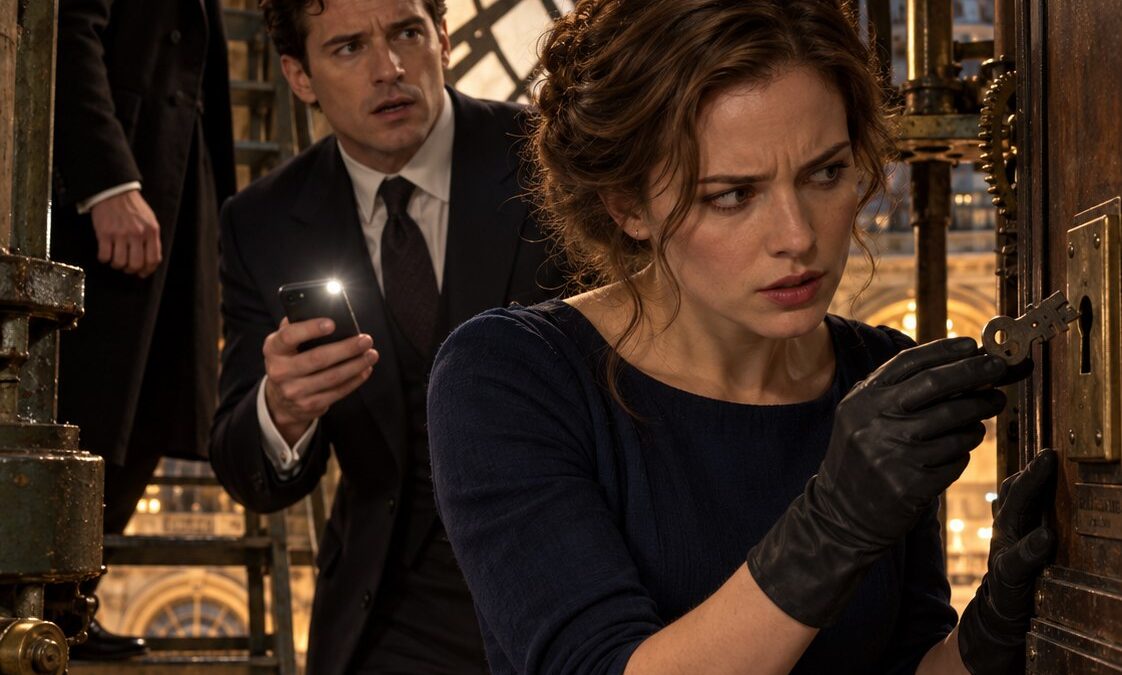
Nell reached the upper landing.
The clock’s machinery filled most of the room.
Below them, music drifted through the floor.
Above them, the minute hand moved against the glass.
Nell held her key at the cabinet lock.
Her hands were steady.
She wanted them to be steady when Preston saw.
“Has anyone been inside since Tuesday?” she asked.
“Maintenance,” Preston said.
“Which company?”
“The contractor.”
“That isn’t a company.”
Roman took out his phone.
“Give me the name.”
Preston looked at him.
“It’s in my office.”
“Call your office.”
The clock scraped.
Nell turned the key and opened the cabinet.
A strip of fresh metal shone across the old iron frame.
It should not have been there.
She touched it with one finger.
The strip shifted.
The bell above them gave a small, false tap.
Roman came close enough to see.
“What is it?”
“A brace,” Nell said.
“Is it supposed to move?”
“No.”
She reached past it and found the counterweight cable.
Fresh fibers stood out along one edge.
Nell drew her hand back.
“Keep everyone away from the floor beneath the bell,” she said.
Roman was already dialing.
He gave quiet instructions.
No announcement.
No panic.
Clear the central circle.
Keep the guests by the ticket windows.
Preston watched him.
“You’ll cause a scene.”
“A small one,” Roman said.
“That is the point.”
Nell studied the brace.
It had been fastened with two new screws.
One was loose.
A licensed clock mechanic could have done better work half asleep.
Nell picked up a folded service record wedged behind the frame.
Her name appeared at the bottom.
So did her signature.
She had never seen the page before.
“Who gave this to the foundation?” she asked.
Preston did not answer.
The page certified a new counterweight assembly.
It listed a price of $480,000.
Nell looked at the machinery.
The weight hanging before her was older than her marriage.
She knew its dented corner.
She had made that dent herself while moving it six inches with a hand lift.
The date on the certificate was Thursday.
She had inspected the clock on Tuesday.
“You paid for a new one?” Roman asked.
“I approved a replacement,” Preston said.
“There is no replacement.”
“It may still be in transit.”
“The certificate says installed,” Nell said.
Preston looked toward the stairs.
Roman did not block him.
A guard was waiting at the bottom.
“I can explain the paperwork,” Preston said.
“Please do,” Roman replied.
Nell folded the page carefully.
Her father had taught her that a lie often arrived on better paper than the truth.
She hated remembering him now.
For sixteen years, people had said he had signed off on faulty repairs to the station’s west clock.
The clock had stopped during a platform evacuation.
Nobody had been hurt, but the failure ended his contract.
He died with the stain still on his name.
Nell looked at the fresh brace.
It had been fitted to a screw hole she knew.
Her father had drilled that hole years before the accident.
The public report said he had never inspected this mechanism.
The clock scraped again.
Nell closed the cabinet.
“Someone used Dad’s old repair drawing,” she said.
Roman looked at her.
“How can you tell?”
“The brace fits his test hole.”
“That hole appears on a drawing?”
“In his notebook.”
Preston’s gaze sharpened.
Nell kept talking.
“The notebook stayed with me.”
She had brought it here for eighteen months.
She had left it in the workshop whenever her hands were dirty.
Anyone on the restoration team could have copied it.
Preston had taken it home twice.
He had said he wanted to understand her work.
That memory changed shape in an instant.
Nell gripped the winding key.
Roman noticed.
He held out his handkerchief.
She almost laughed.
“My hands aren’t bleeding.”
“I know.”
He offered it anyway.
She used it to wipe the grease from her fingers.
Then she handed it back.
“I’m sorry,” he said.
“For what?”
“I signed the grant without meeting you.”
“That was a long list of people.”
“I had your name.”
Preston made a sound behind them.
Neither turned.
Roman watched Nell’s face.
“My father kept the west clock report,” he said.
“Why?”
“He never believed it.”
Nell had known Roman’s foundation funded the terminal.
She had not known his father cared about its clocks.
Roman reached into his coat and removed a small photograph.
The west clock stood open.
A younger man in work clothes smiled beside it.
Nell recognized her father before she recognized the boy at his side.
The boy was Roman.
“My father was the station supervisor,” Roman said.
“He saw yours leave before the failure.”
Nell looked at the photograph again.
For sixteen years, she had believed her father faced that accusation alone.
“He tried to say so,” Roman said.
* * *
They stopped the program at eleven twenty-eight.
The gala moved into the old departure hall.
A polite announcement blamed an electrical inspection.
Nobody believed it.
They followed the staff anyway.
Nell stayed in the tower while a city building inspector arrived.
Roman’s operations chief, Inez Calder, came with him.
She wore a plain suit and carried a tablet.
She spoke first to Nell.
“What did you touch?”
“The cabinet lock and the service record.”
“Anything else?”
“The brace with one finger.”
Inez wrote it down.
Roman introduced the inspector.
Mr. Bellamy asked Nell to show him the damaged cable.
She did.
He photographed it from three angles.
Then he asked her to step back while he checked the mountings.
Preston waited below with a lawyer he had found among the guests.
Celeste waited near him.
Neither came upstairs.
Bellamy called for a second engineer before declaring the area safe.
That meant nobody could reopen the hall tonight.
Roman accepted it without argument.
Preston did not.
At the foot of the tower, Nell heard him say the closure would cost the foundation half a million dollars.
Roman answered, “Then send me the invoice.”
Bellamy sealed the cabinet.
Nell kept her key.
He recorded its notch and photographed both sides.
He also took the false certificate.
The original stayed in his evidence envelope.
Nell received a copy.
That small courtesy nearly undid her.
For weeks, Preston had spoken of documents around her as if they belonged to everyone else.
Now the inspector asked for her account and wrote down every word.
Inez found an empty ticket office where Nell could sit.
She brought coffee in a paper cup.
Nell drank it cold.
Roman entered when Inez invited him.
He left the door open.
“I spoke to the foundation’s counsel,” he said.
Nell looked up.
“About me?”
“About the certificate.”
“That usually means me.”
“It names you.”
“It also lies.”
“Counsel agrees it needs examination.”
Nell studied him.
“Do you?”
“I heard your warning before I saw the page.”
“That’s not proof.”
“No,” Roman said.
“It’s why I listened.”
She put down the cup.
He had enough power to make his belief feel like a verdict.
He seemed to know it.
“An independent examiner will compare the signature,” he said.
“The foundation will preserve every project record.”
“Preston controls those records.”
“He controls some copies.”
Inez had already requested the files from the foundation’s outside bookkeeper, the city grant office, and the contractor.
The clock project had public money attached.
That meant more people had records than Preston preferred.
Nell asked for the invoices.
Roman gave her the copies he had.
She read them at the ticket counter.
A replacement counterweight.
A new safety brake.
A workshop fitted with benches.
Tools for twelve apprentices.
Her finger stopped on a line for a brass cabinet lock.
“Who ordered this?” she asked.
Inez checked the invoice.
“Eversmith Heritage.”
“That isn’t our cabinet lock.”
“How do you know?”
Nell set her key on the counter.
“The lock takes this key.”
“It’s original?”
“The body is original.”
“The faceplate isn’t.”
She lifted the key.
The notch in its handle caught the light.
“My father filed this notch in 2001.”
“You mentioned that upstairs,” Roman said.
“Last spring, the lock began sticking.”
“I asked Preston to hire a locksmith.”
“He said one was coming.”
A man had come.
He wore an Eversmith jacket.
Nell had watched him remove the faceplate.
The cabinet opened smoothly afterward.
She had thanked him.
Now she looked at the invoice.
It billed the foundation for an entirely new security cabinet.
The photograph attached showed a polished steel box Nell had never seen.
Inez enlarged the image.
“The location tag says tower level,” she said.
“It was never installed.”
“We can check the contractor’s delivery record.”
“The man changed one plate,” Nell said.
Roman stood beside the window.
“Did you sign his work order?”
“Yes.”
Nell remembered writing her name with the key still in her other hand.
She had signed to confirm that the cabinet opened.
The form had been mostly blank.
She felt heat rise into her face.
“I should have checked it.”
“What did he tell you it was?” Inez asked.
“A locksmith’s service slip.”
“Then that is what you agreed to sign.”
Preston would say something different.
Nell knew his voice well enough to hear it already.
Inez called the contractor from the ticket office.
She put the call on speaker after telling the person on the line.
Eversmith had no employee assigned to the station that day.
The jacket might have been genuine.
The man was not on its payroll.
Their actual technician had visited two weeks earlier.
He had found the lock sound.
Inez asked for the service logs to be preserved.
The manager agreed.
Nell looked at the key again.
Her father’s notch was a tiny rough line.
She had touched it thousands of times.
The false locksmith had studied that key while fitting the plate.
Had he copied it?
Had he used it?
Roman watched her.
“What are you thinking?”
“That I let a stranger into the clock.”
“You let a man Preston arranged into a repair job.”
Nell did not thank him.
She needed the distinction, but it did not make her feel better.
Inez’s tablet chimed.
The outside bookkeeper had sent a payment list.
Three invoices for the clock had been paid to a subcontractor called Meridian Workshop Services.
Nell knew that name.
She had seen it on the plans for the apprentice room.
The first payment was for $480,000.
The second covered the brake.
The third covered benches, tools, and instruction.
“Where is Meridian based?” Roman asked.
Inez opened the registration.
“An office suite on Mercer Street.”
Nell looked up.
Preston had rented that suite two years earlier.
He called it his investment office.
She had helped him carry a desk into it.
Inez read the owner field.
“Celeste Marr.”
Nell sat very still.
Celeste had claimed credit for the clock and the workshop.
Now her company had been paid for both.
Preston could no longer say the gala plaque was a harmless mistake.
Roman’s phone rang.
He listened, then put it down.
“Bellamy found the old west clock file,” he said.
“What does it say?”
“The original report is missing its signed witness page.”
“Someone removed it?”
“The archive copy never had one.”
Nell thought of her father’s photograph.
Of the boy beside him.
Of the paper she had found in the cabinet.
The forgery on that paper was recent.
The older lie had survived sixteen years.
“Preston found my father’s notebook in our house,” she said.
Roman nodded.
“But someone knew where to look for the west clock report long before Preston met you.”
Inez turned her tablet toward them.
The city archive’s withdrawal log named the person who borrowed that report the week before its witness page disappeared.
It was Roman’s father.
* * *
Roman read the log three times.
Nell let him.
The name on it was Gideon Thorne.
He had supervised the terminal before Roman bought the port company.
He had died six years earlier.
Roman did not explain him away.
“Where did the log come from?” he asked Inez.
“The city archive.”
“Is it complete?”
“That page is a scan of the bound register.”
“We should see the original.”
“We will.”
Nell moved toward the door.
Roman stepped aside.
“You can leave,” he said.
“I know.”
“I’ll have someone take you home.”
“I know the way.”
She left with her key and the copy of the certificate.
At the far end of the hall, Preston stood beside a floral arrangement.
Celeste was gone.
He came toward Nell.
“I’ve been trying to reach you.”
“My phone is off.”
“I need to tell you something.”
“Tell the inspector.”
“This concerns your father.”
That stopped her.
Preston saw it.
He always knew which door to try.
“Roman’s family buried the report,” he said.
“You knew?”
“I suspected.”
“How long?”
He looked toward the ticket office.
“A while.”
Nell waited.
“Roman is using you,” Preston said.
“He needs someone to blame for the clock.”
“You put my name on the certificate.”
“I did not.”
“Then who did?”
“People at the foundation.”
“Which people?”
“I can help you find out.”
“You had eighteen months.”
A server passed them with an empty tray.
Preston lowered his voice.
“If this becomes a criminal inquiry, they’ll look at your signature.”
“They should.”
“They’ll look at our accounts too.”
Nell frowned.
“Our accounts?”
“The workshop payments went through a trust.”
“Whose trust?”
“Yours.”
Nell felt a coldness that had nothing to do with the drafty hall.
“I have no trust.”
“You signed papers last year.”
“Which papers?”
“For the old shop lease.”
She remembered a stack of documents Preston brought home one night.
He had said the landlord needed her signature before renewing her father’s workshop.
She had read the lease.
He had turned pages for her.
“You used my shop,” she said.
“I was protecting it.”
“From what?”
Preston’s phone buzzed.
He ignored it.
“Nell, come home with me.”
“No.”
“You need me.”
That sentence had worked on her for years.
Tonight, it sounded like a threat.
Roman appeared at the end of the hall.
He stopped far enough away to let her answer for herself.
Nell looked at Preston.
“I need a lawyer,” she said.
His expression closed.
“You’re choosing him?”
“I’m choosing someone whose name isn’t on the invoice.”
Preston walked away.
He did not look back.
The next morning, Nell met a lawyer in a small office above a pharmacy.
Roman had offered three names.
She chose a fourth after asking Inez who represented the terminal’s union during the sale.
Her name was Harriet Boone.
She had gray hair, a battered briefcase, and no interest in Roman’s reputation.
Harriet reviewed the lease, the false certificate, and the trust documents.
Nell had signed the lease.
Her signature on the trust application looked similar.
Harriet would not call it forged without an examiner.
The application also contained a scanned identification card Nell had reported lost the previous year.
“That gives us a date to check,” Harriet said.
She requested certified copies from the bank.
She told Nell to preserve every message from Preston.
Then she asked about the old shop.
Nell gave her the address.
Harriet knew it.
Her father had repaired the courthouse clock for twenty-nine years.
“He kept copies,” Nell said.
“Of what?”
“Every job he finished.”
They went together.
Nell unlocked the workshop after eight months away.
Preston had called the rent a foolish expense.
She had kept paying it from the school district contracts.
The room smelled of dust and brass filings.
A row of small clocks stood along one wall.
Her father’s notebooks filled a cabinet beneath them.
Nell found the west clock volume.
There were drawings of the tower.
There was the test hole she had recognized.
There was also a folded envelope taped behind the last page.
She had never noticed it.
The tape was old and brittle.
Inside was a carbon copy of a maintenance request.
Her father had asked the station supervisor to shut down the west clock.
The date was three days before it failed.
Gideon Thorne had signed the bottom.
Nell stared at the signature.
“It proves he knew,” Harriet said.
“It doesn’t prove what he did afterward.”
A second sheet lay beneath it.
A handwritten note asked Gideon to inspect an unauthorized electrical cable running through the clock room.
Nell knew the handwriting.
Her father had been angry.
The pen marks pressed through the page.
He had warned that the cable could snag the mechanism.
Roman arrived only after Harriet called him.
She showed him the copies.
He read them without speaking.
“My father said your father warned him,” he told Nell.
“When?”
“Years ago.”
“Why didn’t you tell me last night?”
“I had a photograph and a memory.”
“You had his word.”
“And a log showing he took the report.”
Nell wanted to be angry at someone simple.
Roman refused to become one.
Harriet called the archive and arranged to inspect the bound log.
Roman called his father’s former assistant, who still lived nearby.
Neither call could answer the question that day.
That afternoon, someone slid a white envelope beneath the workshop door.
Nell saw it move across the floor.
She did not see who delivered it.
Harriet photographed it before opening it.
Inside was a copy of Nell’s bank trust application.
A red circle marked her signature.
On the back, someone had written:
You already signed once.
There was no demand.
There did not need to be one.
Harriet called the police nonemergency line and reported the note.
She also called the bank’s fraud department.
Nell stood beside her father’s workbench.
Roman had stayed near the door.
He looked at the note only after Harriet handed it to him.
“Preston?” he asked.
“I don’t know,” Nell said.
“I’d like to.”
“So would I.”
Harriet’s phone rang.
The bank had found the trust’s opening deposit.
It came from Meridian Workshop Services.
The money then moved through two more accounts.
The final recipient was a company that owned a controlling interest in the terminal redevelopment.
Roman knew the company.
He said its name once.
“Alden Quay Holdings.”
Nell had heard Preston mention it as a competitor.
Harriet asked who owned it.
Roman’s face changed.
“My aunt.”
He called Inez.
She confirmed the registration.
The owner was Sylvia Thorne, Gideon’s younger sister.
Roman looked at the old carbon copy in Nell’s hand.
Sylvia had been the terminal’s legal counsel when the west clock failed.
She had negotiated the sale after Gideon’s death.
She now stood to gain from the station’s reopening contracts.
Nell looked at the warning her father had written sixteen years ago.
The cable had run through the clock room for a reason.
Sylvia had wanted the west clock to fail.
* * *
Harriet would not let anyone take that last sentence to the press.
They had a possible motive.
They did not yet have proof.
Roman agreed.
He and Nell did not speak for an hour after Sylvia’s name surfaced.
Harriet worked through the bank records.
Inez traced the old station contracts.
Nell read her father’s notebook again.
The unauthorized cable had served a private communications room above the west platform.
The room belonged to a company Sylvia advised.
That company had been trying to persuade the city that the terminal was too costly to maintain.
After the clock failure, the city suspended passenger service on that platform.
Three years later, a private buyer leased the whole west wing.
Sylvia’s firm represented the buyer.
Nell laid the pages side by side.
“She used the failure,” Nell said.
Roman shook his head.
“She may have caused it.”
Harriet held up a hand.
“Those are different claims.”
Nell nodded.
She was grateful for the interruption.
Anger made a satisfying story.
Evidence made a useful one.
The next day, the city archive produced the bound withdrawal log.
Gideon had borrowed the report.
He had returned it two days later.
A clerk’s stamp confirmed it.
The archive had no record of the witness page ever being attached.
Roman’s father might have taken it.
Or someone might have removed it before he saw the file.
His former assistant remembered Gideon bringing home a sealed envelope that week.
She had not opened it.
She had given his office boxes to Roman after the funeral.
Inez found the boxes in company storage.
Harriet and Nell watched as Roman opened them.
The sealed envelope lay inside the third box.
Gideon had written two names on it.
One was Nell’s father.
The other was Sylvia.
Inside was a copy of the missing witness page.
It had Gideon’s signature.
It said Nell’s father warned him of the cable before the failure.
Gideon had also attached a letter to the transit board.
The board’s receipt stamp showed it had been delivered.
Harriet photographed every page.
“Why keep a copy sealed?” Nell asked.
Roman read the letter again.
“My father trusted paper more than people.”
Nell looked at him.
“That sounds familiar.”
He gave a brief, tired smile.
The letter named the unauthorized cable.
It named the company that owned the communications room.
It did not accuse Sylvia.
It did establish that Nell’s father had reported the hazard.
Roman gave the originals to Harriet for safekeeping.
Then he called the city attorney.
The old failure deserved review.
The current fraud demanded it.
That evening, Sylvia called Roman.
He put her on speaker with Harriet present.
“Nephew,” she said.
“You sound tired.”
“I’ve had an interesting week.”
“Then you should get some rest.”
“You know Meridian Workshop Services?”
“A vendor.”
“Celeste Marr owns it.”
“She works hard.”
“She invoiced us for a counterweight that doesn’t exist.”
A pause.
“Contractors make errors,” Sylvia said.
“Three paid invoices?”
“Ask your finance people.”
“We are.”
“I hear your clockmaker has become excitable.”
Nell sat across the table.
Roman did not look at her.
“She identified a damaged cable,” he said.
“Before it hurt anyone.”
“Convenient.”
“For the guests, yes.”
Sylvia laughed once.
“You always did enjoy a dramatic room.”
“Come to the foundation board meeting Friday.”
“Why?”
“We’re reviewing the project.”
“My lawyer will attend.”
“You should too.”
When the call ended, Harriet wrote down the time.
“She’ll prepare,” she said.
“So will we.”
On Friday, the board met in the terminal’s former boardroom.
It had windows overlooking the central hall.
The clock stood silent behind protective barriers.
Nell entered with Harriet.
Roman stood beside the board chair, not at the head of the table.
Preston sat with his lawyer.
Celeste sat two chairs away.
Sylvia arrived last.
She wore a cream suit and carried a thin folder.
Her first look went to Nell’s key.
Nell had placed it on the table.
The iron looked ugly against polished wood.
She left it there.
The board chair opened the meeting.
Inez presented the invoices.
A city inspector’s report confirmed the old counterweight remained installed.
An engineer had removed the loose brace and documented the damaged cable.
The clock could be repaired.
It could not safely have run through the unveiling.
Celeste said her company had subcontracted the installation.
She produced a purchase order.
Preston said he relied on her assurances.
Sylvia said the foundation had been careless.
For ten minutes, she sounded like the only adult in the room.
She acknowledged the false billing.
She regretted it.
She promised cooperation.
Then she turned to Nell.
“The restoration lead signed the completion certificate,” Sylvia said.
Harriet spoke.
“The signature is disputed.”
“Of course it is.”
“The examiner has a report,” Harriet said.
Sylvia lifted an eyebrow.
“Then show us.”
Harriet did.
The examiner found evidence the signature had been copied from Nell’s lease and printed onto the certificate.
The ink did not cross the paper fibers like a pen stroke.
Sylvia studied the page.
“That clears the signature,” she said.
“It does not clear the work.”
Nell leaned forward.
“I did the work.”
“You failed to notice the cable.”
“It was changed after Tuesday.”
“What proves that?”
Nell picked up the key.
“This does.”
Sylvia smiled faintly.
“A key?”
“My father notched it.”
Nell showed the board the small mark.
“The locksmith changed the cabinet faceplate last spring.”
“Your account says he did,” Sylvia said.
“The new plate still takes this original key.”
“That seems sensible.”
“It would be, if the invoice were for a faceplate.”
Nell slid the photograph across the table.
It showed a polished security cabinet.
“The invoice claims a new cabinet was installed.”
“The photograph could be of a proposed unit.”
“It has a location tag,” Inez said.
Sylvia turned to her.
“An incorrect one.”
Nell waited.
The point of the key was not its age.
It was its shape.
“When the false locksmith filed the new plate, he copied this key,” she said.
“He copied the notch too.”
She placed an enlarged photograph beside the invoice.
The polished cabinet in the invoice had a key inserted in its lock.
Its handle had the same notch.
“I thought you said it was never installed,” Sylvia said.
“It wasn’t.”
“The cabinet in that picture was staged.”
Nell placed a second photograph beside it.
This one came from Eversmith’s supplier catalog.
The cabinet stood in a showroom.
The walls and floor matched the invoice photograph.
The key did not.
Someone had inserted Nell’s key into the staged shot to make it appear connected to the tower.
“I took that photograph?” Sylvia asked.
“I don’t know.”
Nell turned the key over.
Her father had scratched a tiny W beneath the handle years ago.
It was visible in the invoice photograph.
“I left this key in the workshop twice,” Nell said.
“Both times Preston took my father’s notebook home.”
Preston sat straighter.
“That proves nothing.”
“It proves someone with access to my key helped stage the billing.”
Sylvia folded her hands.
“Many people could have borrowed it.”
“Yes,” Nell said.
“That’s why we checked.”
Inez opened a delivery log.
A courier had carried the staged cabinet photograph from Meridian’s office to Alden Quay Holdings.
The foundation’s outside bookkeeper had preserved the original invoice email.
Its attached image still contained the sender’s file history.
The file had been edited on Sylvia’s office computer.
An independent technician retained by the city had verified that history from the original email attachment.
Sylvia looked at the technician’s signed statement.
Her smile vanished.
“That computer serves the entire office,” she said.
“Then your staff can tell investigators who used it,” Harriet replied.
The board chair asked Preston about the trust in Nell’s name.
He glanced at his lawyer.
His lawyer advised him not to answer.
Celeste stared at the table.
The board chair turned to Sylvia.
“Did you direct these payments?”
Sylvia looked at Roman.
“You brought me here to disgrace me.”
“I asked you to explain them.”
“You know what this station was,” she said.
“A ruin.”
“It was public property,” Nell said.
“A public drain.”
“People used it.”
“People use many things that cannot pay for themselves.”
Sylvia’s argument was polished.
She had kept the redevelopment solvent, she said.
She had saved jobs.
She had made private investors accept a difficult project.
A few false invoices were wrong, but she called them the work of ambitious contractors.
The board listened.
Nell understood why.
Sylvia knew every contract in the room.
She knew which members feared the project would collapse.
She knew how to make theft sound like maintenance.
Then Harriet asked one question.
“Why did Alden Quay receive the workshop grant?”
Sylvia looked at her.
“I haven’t seen that transfer.”
Harriet handed the chair a certified bank record.
Meridian had received the grant payment.
The money passed through the trust opened in Nell’s name.
It arrived at Alden Quay the next morning.
Sylvia’s company used it toward a purchase of the station’s west wing.
The bank had supplied the records under the foundation’s fraud request and Nell’s own complaint.
“You can examine the chain,” Harriet said.
Sylvia did not touch it.
The board chair recessed the meeting.
The city attorney’s investigator, who had been observing with the board’s permission, asked to speak with Sylvia and her counsel.
No one announced an arrest.
No one needed to.
Preston rose so quickly his chair rolled back.
Celeste caught it before it struck the wall.
Nell picked up her key.
Sylvia stopped beside her.
“Your father could never understand what it took to keep this place alive,” she said.
Nell met her eyes.
“He understood when it was unsafe.”
“He lost everything for being right.”
“He left me the proof,” Nell said.
Sylvia walked on.
* * *
The clock stayed silent for nine weeks.
During the first week, reporters camped outside Nell’s workshop.
She stopped answering the door after one asked whether she regretted marrying Preston.
She had regrets.
She did not owe them to a stranger with a microphone.
Harriet filed for divorce.
She also helped Nell correct the trust record.
The bank froze the account after her fraud report.
Investigators traced the money without asking Nell to repay funds she had never controlled.
Preston’s lawyer contacted Harriet.
Preston wanted to apologize in person.
Nell declined.
He sent a letter.
She read it once.
It said he had felt small beside her skill.
It said Celeste made him feel important.
It said Sylvia had offered him a position, then drawn him into things he did not know how to leave.
He admitted bringing Nell a stack of papers and misleading her about the trust.
He admitted giving her key to the false locksmith.
He did not admit creating the forged certificate.
Nell put the letter back in its envelope.
“Does he deserve an answer?” Harriet asked.
“He has one,” Nell said.
It was the divorce petition.
Celeste agreed to cooperate with investigators.
She provided messages showing Sylvia had approved the staged cabinet photograph and directed the workshop transfers.
She also admitted that Meridian billed for work it did not do.
Nell did not forgive her for taking the plaque.
The plaque mattered less than Celeste thought.
It had shown Nell, in a single ugly instant, what her marriage had become.
Sylvia’s case took longer.
The city reviewed the old west clock failure.
Gideon’s letter, the receipt stamp, and Nell’s father’s notebook led to an amended public report.
It stated that her father had warned the supervisor about the cable before the failure.
The report did not claim every question from sixteen years ago had been answered.
It cleared the accusation that he had concealed the hazard.
Nell carried a copy to his grave.
She read him the plainest sentence.
He had reported the danger.
Then she stood there until the wind lifted the paper.
Roman waited by the gate.
He had asked whether she wanted company.
She had said yes.
That was the first time she had said it without feeling she owed him something.
They walked back to the car.
“The report is late,” she said.
“It is.”
“He would have corrected the comma on page two.”
Roman looked at her.
“Is it wrong?”
“No.”
“He would have found another one.”
She laughed.
It surprised her.
It surprised him too.
The foundation board voted to recover the false payments.
Roman stepped away from the vote because of Sylvia.
The grant for the apprentice workshop remained.
So did its unused budget.
A week later, Roman came to Nell’s shop with a proposal.
The foundation would fund twelve places.
The city would provide a room in the terminal.
Nell would direct the program.
Her salary would be generous.
She read every page.
Then she pushed the agreement back.
Roman looked disappointed, but he said nothing.
“The apprentices need wages,” she said.
“They’re budgeted.”
“Below the city trade rate.”
“They’re learning.”
“They’re working on public clocks.”
He picked up a pen.
“What rate?”
She told him.
He wrote it down.
“And I want the room governed by an independent board,” Nell said.
“That seems reasonable.”
“Not by your foundation alone.”
“Agreed.”
“Or by me alone.”
“Agreed.”
“And I keep my own shop.”
Roman looked around at the small room.
Half the clocks still had handwritten labels from her father.
“I expected that,” he said.
“I know.”
“You could have let me make the offer.”
“You did.”
He smiled.
The revised agreement took two weeks.
Harriet checked it.
Nell signed.
The first apprentices arrived in January.
One came from a bus maintenance crew.
Another had spent ten years repairing kitchen appliances.
A third could take apart a watch but had never held a clock key.
They asked good questions.
They broke two harmless springs.
They learned to label every screw.
Nell made them write their names on their work sheets.
She made them check each other’s measurements.
Roman visited once a month.
He never interrupted a lesson.
He brought sandwiches when the room ran late.
The apprentices became comfortable enough to make jokes about his reputation.
One asked whether he owned the whole river.
“Only the wet part,” he said.
Nell told him that made no sense.
“I’m a businessman,” he replied.
“I didn’t promise sense.”
Their evenings changed slowly.
At first, he walked her to the train because the press still waited near the terminal.
Then the reporters left.
He kept asking if she wanted company.
Sometimes she did.
Sometimes she didn’t.
He accepted both answers.
In March, the divorce became final.
Preston pleaded guilty to fraud tied to the grant and the trust application.
He agreed to restitution and received a sentence set by the court.
Celeste entered a separate agreement after turning over her records.
Sylvia faced charges involving the current transfers.
Her lawyers contested them.
Months later, she was convicted on the financial counts the records supported.
The old cable scheme remained unresolved as a criminal matter.
The city’s amended report was enough to restore Nell’s father’s reputation.
Nell could live with a truthful limit.
She had spent too many years listening to Preston promise certainty he did not possess.
One evening, Roman found her polishing the winding key at the workshop table.
The notch caught beneath the cloth.
“It’s cleaner than my shoes,” he said.
“That is a low standard.”
“Cruel.”
“Accurate.”
He stood beside the bench.
“Would you have dinner with me?”
“We have dinner.”
“Usually in a room full of apprentices.”
“They’re good company.”
“They are.”
Nell set down the cloth.
“What are you asking?”
“A table for two.”
“You know people will talk.”
“Yes.”
“They already do.”
“Yes.”
“My life has been public enough.”
“I know.”
She looked at the key.
The old iron lay between them.
“I need this to stay mine,” she said.
“The shop.”
“The work.”
“The mistakes I make next.”
Roman nodded.
“They will.”
“You don’t get to solve everything.”
“I’ve noticed.”
“And if I say no?”
“I’ll bring sandwiches on Thursday.”
Nell believed him.
That mattered more than the invitation.
“Dinner,” she said.
“Just dinner?”
“For now.”
He smiled as if that were plenty.
It was.
* * *
Four years later, Nell stood beneath the Grand Terminal clock with a little girl on her shoulders.
The girl was her niece.
She wore yellow boots and carried a paper train ticket Nell had punched herself.
“Again,” the girl said.
“You’ve heard it three times.”
“I like four.”
“Then four it is.”
The central hall was crowded with commuters.
A train announcement covered the first low movement of the clock.
Nell felt it through the floor anyway.
The bell rang.
Her niece counted each strike.
The clock kept perfect time.
Above the old ticket windows, a modest plaque listed the people who had restored it.
Nell’s name was there.
So were the names of the apprentices who had completed its later repairs.
There was room for more.
Roman joined them with two cups of coffee and a small carton of milk.
The girl demanded the milk.
He handed it over.
“You negotiated poorly,” Nell told him.
“She looked determined.”
“She’s six.”
“She has excellent representation.”
The girl drank through a straw.
Roman took Nell’s hand.
They had married the previous spring in her workshop.
No velvet rope.
No photographer waiting for a public mistake.
Her father’s key had hung on the wall behind them.
It hung there now when Nell was home.
Today she had brought it for the new apprentice class.
Each student would learn why a tool carried a mark.
Each would learn why a signature mattered.
Each would learn to stop a clock when something sounded wrong.
Nell looked across the hall.
The place where she had found her name in the trash now held a public reading table.
Her father’s amended report was available in the station archive.
The workshop doors stood open.
Preston’s letters had stopped.
Celeste had repaid what the court required.
Sylvia’s name had left the foundation board.
The clock rang once more.
Her niece held out both hands.
“Can I turn the key?”
“When you’re older,” Nell said.
“How much older?”
“Old enough to listen first.”
Roman glanced at Nell.
She knew what he remembered.
A rope.
A room full of strangers.
The question he had asked before she crossed.
Can you make it safe?
Nell shifted the child on her shoulders.
She looked at the clock, then at the people passing beneath it.
“Yes,” she said.
THE END