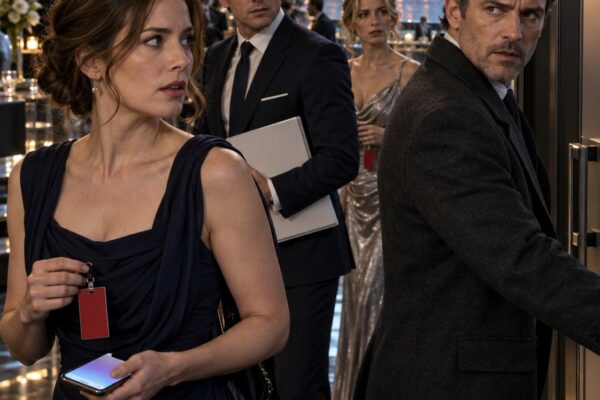
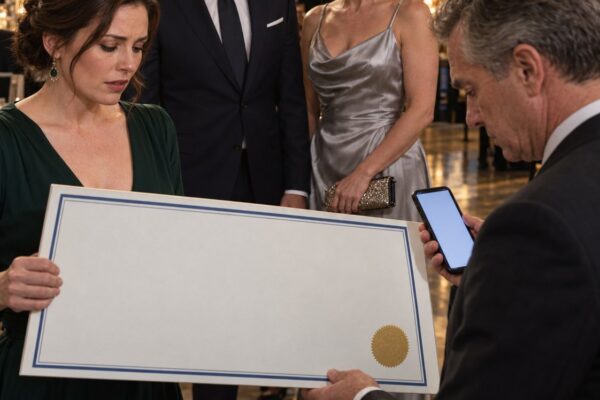
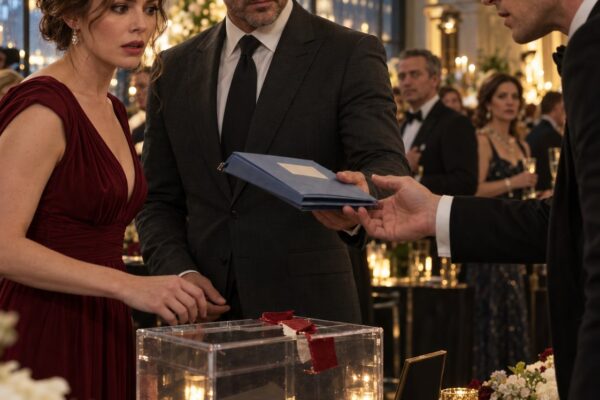
She Had $12 After Her Banquet Shift When She Wrapped a Billionaire’s Daughter in Wet Linen and Walked Into the Fire
Chapter 2: The Blue Square
Wren’s voice was barely audible.
The sprinklers had stopped.
Water still dripped from the ceiling.
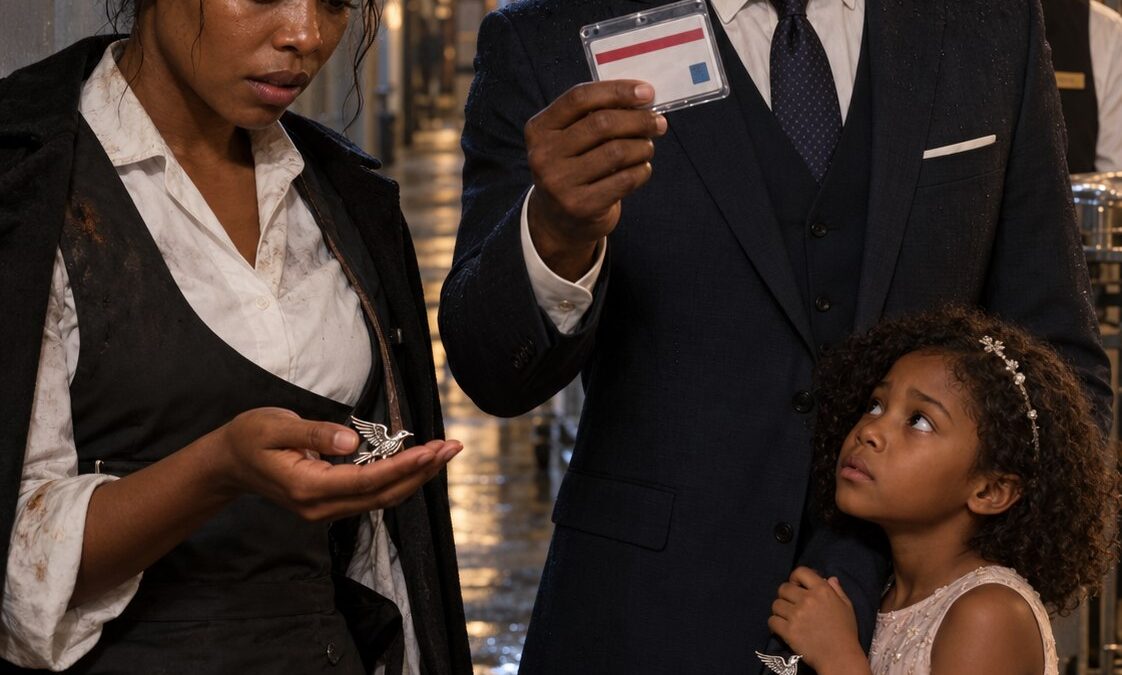
Silas set the card down.
“Tell me exactly what happened,” he said.
Wren held his sleeve.
“Aunt Celeste said Mom’s pin was behind the curtain.”
“She sent you to get it?”
“She said it was a surprise.”
I opened my hand.
The silver pin lay against my palm.
It was shaped like a bird in flight.
Silas didn’t reach for it.
“Did she put it there?”
Wren nodded.
“She said you wouldn’t let me have it until I was older.”
Silas shut his eyes for one second.
When he opened them, his voice was steady.
“Rafi, take Wren to the lobby.”
“I want Nina,” Wren said.
“The medic is helping Nina.”
“I want her to keep the pin.”
“Then she will.”
Rafi, the security officer, held out his hand.
Wren took it reluctantly.
She looked back twice.
Silas waited until she had turned the corner.
Then he picked up the card.
“Celeste runs the foundation,” he said.
“I know.”
“Her office approves the event materials.”
“Does it approve fire effects?”
“No.”
The medic dressed my shoulder.
It hurt enough to make the passage blur.
“You’ll need the hospital,” he said.
Silas was already reaching for his phone.
“My driver can take you.”
“An ambulance is coming,” the medic said.
“Then I’m following it.”
I shook my head.
“You should be with your daughter.”
“She’ll be with me.”
I watched the water drip from his jacket.
He had put it around me before he saw the card.
That mattered.
“My phone,” I said.
Rafi returned with my canvas bag.
He had left Wren with a uniformed hotel manager in the lobby.
I found the photograph.
The control box.
The card.
And behind them, a stack of folded curtains marked with an inspection date.
I showed Silas.
His gaze settled on the time above the picture.
“Six forty-one,” he said.
“The doors opened at seven.”
“The vendor says you authorized a change at seven twelve.”
“I was collecting plates at seven twelve.”
The banquet captain stood nearby.
“I saw her,” he said.
“You’ll tell the investigator,” Silas said.
A fire officer came into the passage.
She took our names and separated us for brief statements.
Silas did not object.
He gave her the card in its sleeve.
I gave her the photograph.
Then I remembered something.
“There were two cards,” I said.
The officer looked up.
“The one I saw before dinner had a white corner.”
Silas held up the plastic sleeve.
The card inside had a red corner.
“I only noticed because it looked freshly cut,” I said.
The officer wrote that down.
The medic helped me stand.
I still held Wren’s pin.
Silas noticed my closed fist.
“She said you could keep it for now,” he said.
“I’ll give it back.”
“When she’s ready.”
In the elevator to the ambulance entrance, he stood beside me without speaking.
At the doors, I looked at him.
“Your sister sent her there,” I said.
“Yes.”
“Before the machines started.”
“Yes.”
He met my eyes.
“I believe you, Nina.”
Those four words hit harder than the pain.
Because two years earlier, when I’d worked for a Halden company, nobody had.
“I wrote to you once,” I said.
His face changed.
“About what?”
“An unsafe hotel kitchen.”
“I never received it.”
The elevator opened.
I stepped toward the ambulance.
“Your office told me you read it.”
* * *
The hospital kept me overnight.
The burn on my shoulder was painful but limited.
My arm needed several stitches where a metal curtain hook had caught it.
The doctor checked my breathing and cleared me to go home the next morning.
Silas was waiting in the corridor.
Wren sat beside him, eating crackers.
She climbed down when she saw me.
“Does it hurt?”
“Some.”
“I brought your bag.”
“Thank you.”
She handed it over with both arms.
Silas waited until she went to choose a drink from the vending machine with Rafi.
Then he gave me a sheet of paper.
It was the incident report from the hotel kitchen.
Two years old.
My name appeared under EMPLOYEE COMPLAINT.
Below it, a box had been checked.
WITHDRAWN BY EMPLOYEE.
“I didn’t withdraw it,” I said.
“I know.”
“You checked?”
“My counsel found the original email.”
I read the address at the bottom.
The message had gone to a foundation mailbox.
“That wasn’t the address I used.”
“The person at our employee line forwarded it there.”
“Why?”
“We’re finding out.”
The kitchen had been at another Calder property.
I had reported a faulty exhaust fan and a contractor who kept resetting its alarm.
Three days later, I was fired for abandoning my shift.
I hadn’t abandoned anything.
I’d waited outside with my coworkers until the fire department said we could return.
The written complaint had gone nowhere.
My supervisor said Silas Halden had personally rejected it.
I’d believed him.
Silas watched me read.
“I signed no decision about you,” he said.
“That didn’t get my job back.”
“No.”
“Or the rent I lost.”
“No.”
He accepted each answer without defending himself.
Wren returned with a bottle of apple juice.
She offered me the first sip.
I took it.
The fire officer called that afternoon.
Her name was Lieutenant Ortega.
She asked whether I could identify the two versions of the cue card.
I could.
Ortega showed me photographs, each taken and labeled by investigators after the fire.
The white-corner card was found under the control box.
The red-corner card had been handed to Silas in the passage.
Both carried my signature.
The white one approved a harmless light cue.
The red one ordered the effects machines moved closer to the curtain.
It also listed a fluid that the vendor had not brought.
“Which one did you touch?” Ortega asked.
“The white one.”
“Where?”
“At the control box.”
“Did you sign either?”
“No.”
She showed me a larger image of the white card.
The signature was printed beneath the plastic coating.
I leaned closer.
The name looked like mine because it was mine.
I’d written it on dozens of payroll sheets.
“The V in Vale is broken,” I said.
Ortega waited.
“My pen slipped on my first payroll form.”
The bottom stroke never joined the top.
Every later form looked different.
Both cards had the broken V.
Someone had copied my first form.
Ortega made a note.
“Who had access to it?”
“The staffing agency,” I said.
“And whoever hired them.”
The agency had supplied workers to foundation events for years.
Its account manager, a woman named Della Price, called me that evening.
She sounded frightened.
“An investigator came for the payroll files,” she said.
“Then give them the files.”
“I have.”
“Why are you calling me?”
“Because your form wasn’t requested by the hotel.”
“Who requested it?”
Della swallowed audibly.
“The foundation office.”
I looked across my small kitchen.
The overdue rent notice sat under a chipped mug.
“When?”
“Yesterday morning.”
I wrote the time on the notice.
The next day, I met Ortega at the hotel.
Silas was there with his attorney, Jonah Kline.
The grand hall smelled of wet carpet.
The curtain had been removed.
Its blackened track remained.
Ortega showed us a still image from a service camera.
The effects vendor was wheeling his case into the hall.
Behind him stood Celeste Halden.
She held a red folder.
The camera could not show what was inside.
“She told me she was checking donor signs,” Silas said.
Jonah’s phone buzzed.
He read the message.
“The vendor’s lawyer has contacted investigators,” he said.
“Is he talking?” Silas asked.
“He wants to.”
Ortega gave Jonah a measured look.
“We’ll handle the interview.”
“I understand.”
I studied the camera still.
The vendor’s case had two latches.
One was open.
I had seen the case before guests arrived.
Both latches had been closed then.
“Can you show the next frame?” I asked.
Ortega moved forward.
Celeste stepped between the camera and the case.
In the following frame, the vendor was alone.
The open latch had been shut.
I pointed.
“Something happened there.”
Ortega saved the frames.
Silas leaned over the screen.
“Celeste knew that camera was there.”
“She also knew how to block it,” I said.
Ortega asked for my statement.
When we finished, Jonah received another message.
The foundation’s document system kept a record of every print job.
The red card had come from a machine assigned to one office.
Celeste’s.
* * *
By evening, Celeste had a statement ready.
She was horrified by the fire.
She was grateful Wren was safe.
She had sent Wren backstage to find the pin before the finale, believing the area was empty and secure.
The vendor, she said, had acted without her knowledge.
Her statement named me twice.
Once as the person who warned about a smell.
Once as the person whose signature appeared on the cue cards.
Silas read it in my kitchen.
He had come with Jonah to show me before it reached the news.
Wren was at home with Rafi and her nanny.
“You didn’t have to bring this here,” I said.
“You deserved to see it first.”
I folded the page.
“She’s setting me up.”
“Yes.”
“You still sound surprised.”
“I’ve known her forty years.”
“And I’ve known her four days.”
He looked around my kitchen.
One chair had a cracked seat.
The refrigerator hummed loudly.
I wished he hadn’t seen either.
Then he noticed the rent notice.
I turned it face down.
He said nothing.
Jonah’s phone rang.
He stepped into the hallway.
Silas remained by the door.
“I owe you an apology,” he said.
“For believing her?”
“For letting my name end your job two years ago.”
“You didn’t know.”
“I should have known how complaints reached me.”
“That sounds like a problem you can fix.”
“I intend to.”
I sat down because my shoulder throbbed.
He moved the other chair closer, then stopped.
“May I?”
I nodded.
He sat.
For the first time, he looked tired.
“My wife collected bird pins,” he said.
“Wren said this one was hers.”
“Evelyn wore it on the day Wren was born.”
I looked at the silver wings in my hand.
“Why was Celeste holding it?”
“She helped sort Evelyn’s things after the funeral.”
“Does Wren know?”
“She knows her mother wore it.”
He didn’t try to take it back.
Outside, a car door slammed.
Silas looked toward the window.
A black sedan idled across the street.
Its headlights went out.
“Is that yours?” I asked.
“No.”
He called Rafi.
Within minutes, the sedan drove away.
Rafi had noted the plate from another vehicle nearby.
Silas did not pursue it.
Jonah returned from the hallway.
“Ortega needs to hear about that car,” he said.
“Call her,” Silas said.
I had expected him to issue some terrible order.
Instead, he asked whether my building had a working front lock.
It did.
He asked whether I wanted a patrol check.
I did.
That night, someone slid an envelope under my door.
Inside was a copy of my old kitchen complaint.
Across the top, in black marker, were four words.
YOU SIGNED THAT TOO.
I called Ortega.
She came herself.
She collected the envelope, the copy, and the building’s camera footage.
The hallway camera had caught a delivery worker leaving it.
The worker told police he’d been paid through an app to take an envelope to my door.
The sender used a false name.
Ortega traced the payment request through the app’s records.
While she worked, I sat at my kitchen table with the original complaint Silas had given me.
The copied signature on the cue cards came from my first payroll form.
The old complaint carried a different signature.
I had written it slowly in block letters after my supervisor said my handwriting was hard to read.
Whoever sent the threat hadn’t checked.
I showed Ortega.
She photographed both.
The next morning, the vendor spoke through his lawyer.
He admitted moving the machines.
He said Celeste gave him the red card and promised a bonus.
He claimed she had assured him the curtain was fire resistant.
He had not known Wren would be backstage.
Ortega did not tell us whether she believed him.
She did tell us one thing he had brought.
A copy of Celeste’s written instructions.
The document ordered the effects moved near the rear curtain.
It also ordered the hall’s paper donation records placed behind it before the show.
Silas stared at the second line.
“Those records were going to the auditors on Monday,” he said.
Jonah looked at him.
“Were they the only copies?”
“No.”
“Did Celeste know that?”
Silas took out his phone.
His foundation controller confirmed the answer within an hour.
A second set of records existed on a secure server.
The paper records had been altered.
The digital entries showed transfers to a consulting company controlled by Celeste.
The first transfer was three years old.
The total was more than two million dollars.
The complaint I had filed at the hotel kitchen had gone to the same foundation mailbox because that contractor billed the foundation.
Celeste had intercepted it.
The kitchen contractor and the consulting company shared an accountant.
Silas set down the phone.
“She was covering the transfers,” he said.
Jonah shook his head.
“That’s part of it.”
The controller had found one more file.
On Monday, Silas had planned to announce an outside review of every foundation contract.
Celeste had signed a personal guarantee for the consulting company’s debts.
If the review exposed the transfers, she would lose far more than her position.
Ortega arrived with the payment record for the envelope at my door.
It led to Celeste’s personal assistant.
Then she showed us the vendor’s instructions.
At the bottom was a handwritten addition.
PUT THE GIRL BEHIND THE CURTAIN BEFORE THE LIGHT CUE.
Celeste had written it.
* * *
Silas did not confront his sister at home.
Ortega asked him to let the investigation run.
He agreed.
The foundation board had already called an emergency meeting to suspend Celeste’s access to its accounts.
Jonah asked me to attend as a witness.
“You can say no,” he told me.
“I know.”
I went.
The meeting took place in a plain conference room above the hotel.
No cameras.
No banquet guests.
The people there had signed the foundation’s checks and approved its budgets.
They needed to know why a child had nearly been hurt at their event.
Celeste sat at the far end of the table.
She wore a gray suit and no jewelry.
When I entered, she looked at my bandaged shoulder.
“You should be resting,” she said.
“I rested last night.”
Silas pulled out a chair for me.
Celeste watched him do it.
The board chair, a retired judge named Mrs. Fenwick, called the meeting to order.
Jonah laid out the financial records.
The controller explained how the transfers had been found.
An independent accounting firm had checked the destination account.
Celeste did not deny receiving the money.
She denied stealing it.
“The consulting company arranged hospital partnerships,” she said.
“Every dollar had a purpose.”
“Where are its reports?” Fenwick asked.
“Some were lost.”
“In a fire that didn’t reach your office?”
Celeste kept her voice calm.
“The originals were among the event materials.”
The controller shook his head.
“No reports were listed in the inventory.”
Celeste turned to Silas.
“You know what I built here.”
“I do.”
“You left the daily work to me.”
“I did.”
“Then you cannot pretend surprise at expenses.”
The argument landed.
Several board members glanced at the ledger.
Silas had trusted her with a great deal.
He said so.
“I trusted you.”
“You benefited from it.”
“I did.”
Celeste looked at me.
“And now a temporary worker has become your moral witness.”
I kept my hands on the table.
“I saw a card,” I said.
“You saw a card and decided to touch equipment.”
“I didn’t touch the equipment.”
“Your signature says otherwise.”
“Your printer says otherwise.”
She smiled faintly.
“A printer records a document.”
“It doesn’t sign it.”
“That is exactly my point.”
She had found a gap.
The print log proved where the card came from.
It did not prove who used the printer.
Jonah opened another folder.
Ortega and a prosecutor had cleared its contents for the board’s limited purpose.
The foundation’s access records showed Celeste entering her office alone before the event.
Her assistant confirmed she had been sent out.
The vendor’s written instructions were next.
Celeste leaned forward.
“That addition is not mine.”
Ortega was waiting outside the room.
Fenwick asked her in.
Ortega explained that the handwriting comparison was still part of an open investigation.
No one in that room should treat it as a final ruling.
Celeste seized on that.
“Then why am I here?”
“Because the board can suspend access during an investigation,” Fenwick said.
“And destroy my reputation before one ends?”
She looked around the table.
“I put the pin behind a curtain for my niece.”
“I made a foolish choice.”
“I did not set a fire.”
For a moment, I believed she might win the room.
Then I saw the pin on the table beside my hand.
Wren had asked me to hold it.
I picked it up.
Celeste’s eyes followed it.
“You said you put this there for Wren,” I said.
“Yes.”
“When?”
“Before the guests arrived.”
“I found it behind the curtain after the sparks began.”
“I know.”
“Wren told us you said it was a surprise.”
“It was.”
I turned the pin over.
On the back was a small clasp.
A black thread was caught in it.
I’d seen the thread at the hospital but hadn’t known what it meant.
Now I did.
“The curtain was red,” I said.
Celeste frowned.
“The thread is black.”
The stage manager had worn a black jacket.
So had Celeste.
That proved nothing by itself.
I set the pin down.
“What did you fasten it to?” I asked.
“I placed it on the floor.”
“It was hooked to the curtain hem.”
Celeste said nothing.
“When I picked it up, I pulled it free.”
I had remembered the tug only when I turned the clasp.
Ortega took a photograph without touching the pin.
She had brought an evidence sleeve because she’d asked me to bring it.
The stage crew’s photographs showed the curtain before it was removed.
Near the floor, a small black loop was sewn into the hem.
The pin had hung there at Wren’s eye level.
Celeste had placed a treasured object exactly where Wren would see it and stay.
She could still claim she hadn’t expected the fire.
Then Jonah laid down a second document.
A message from Celeste’s phone to the vendor, recovered under a warrant and released for the meeting.
WAIT UNTIL SHE IS IN PLACE.
The vendor had replied with one word.
READY.
Celeste looked at the message.
Her hands went flat on the table.
“It meant the donation boxes,” she said.
Ortega answered.
“The boxes weren’t moved until later.”
The hotel camera confirmed that.
Silas stood.
“Wren was there.”
Celeste looked up at him.
“I knew Nina was watching the service door.”
My stomach turned.
“You counted on me.”
“I counted on someone getting her out.”
“You set a fire beside her.”
Celeste’s face hardened.
“You have no idea what failure costs in this family.”
I thought of my rent notice.
Of two years spent wondering why telling the truth had cost me my job.
“I know what your choices cost,” I said.
Fenwick called for a vote.
The board suspended Celeste’s access unanimously.
Ortega asked Celeste to come with her to answer further questions.
Her attorney stood beside her.
Celeste rose without a struggle.
At the door, she turned to Silas.
“You’ll pay that girl and call this justice.”
I looked at her.
“You can’t buy back the minutes Wren spent waiting for you.”
Celeste had no answer.
The criminal case took months.
The vendor pleaded guilty to offenses related to the unsafe effects and agreed to testify.
Celeste was charged over the diverted funds, the forged records, and her role in the fire.
Her lawyers challenged the messages and the vendor’s account.
The court admitted the records.
She eventually pleaded guilty to the financial charges and to a charge arising from the fire.
The judge imposed prison time and ordered restitution.
Silas’s foundation recovered some of the money through its insurer and the consulting company’s remaining assets.
The board published the audit.
It also published the complaint process it should have had years earlier.
My old kitchen complaint was finally investigated.
The contractor lost its foundation work.
My supervisor had lied about my shift.
He admitted it when payroll and fire department records contradicted him.
No one could give me those two years back.
At least the record now told the truth.
* * *
Six weeks after the board meeting, Wren came to my apartment with a drawing.
Silas carried a box of soup behind her.
In the drawing, I wore a huge white cape.
Wren wore one too.
“We look like ghosts,” I said.
“They’re blankets.”
“That’s better.”
She studied my shoulder.
The bandage was gone.
The scar was narrow and pink.
“Does it still hurt?”
“Only when I carry heavy things.”
She pointed at the soup.
“Dad can carry those.”
“I’ve noticed.”
Silas set the box on my counter.
He had asked before coming.
He always asked.
The first time he’d offered to cover my rent, I’d said no.
He hadn’t argued.
Then Jonah helped me file a claim against the hotel and the event contractors.
Their insurers paid my medical bills and lost wages.
The staffing agency corrected my employment record.
Silas offered a separate gift.
I asked him to put it toward safety training for temporary workers instead.
He did.
He showed me the program before it began.
Workers could report hazards directly.
Their names would be protected during the first review.
A real person would answer within a day.
“Will you let them test it without you watching?” I asked.
“Yes.”
“Good.”
He smiled.
Wren sat at my table and drew another cape.
This one had pockets.
Silas watched her.
“She hasn’t had a nightmare in four nights,” he said.
“That’s good.”
“She still asks whether you’d come if she needed you.”
“What do you tell her?”
“That I’d call you first.”
I looked at him.
“And what do you tell her after that?”
“That she’s safe with me.”
He said it as a promise he intended to keep.
Over the following months, ordinary things returned.
I found a steady job managing linens at a small hotel.
The pay covered my rent.
The owner listened when I pointed out a blocked fire exit.
On Sundays, Wren and I baked bread in Silas’s kitchen.
She dusted flour over everything she loved.
Rafi claimed the mixer was a security risk.
Even Silas laughed at that.
He and I became familiar slowly.
He learned that I hated expensive coffee.
I learned he couldn’t fold a fitted sheet.
He came to my neighborhood without bringing a driver to the door.
I went to his house without feeling I had to earn a chair.
Once, Wren asked why we never held hands.
Silas nearly dropped a bowl.
I told her the dough was ready.
She was not fooled.
That evening, he walked me home.
The street was cold and bright.
“I need to say something,” he said.
“I know.”
“I should have looked more closely at the foundation.”
“Yes.”
“I should have found your complaint.”
“Yes.”
“I can’t promise I’ll never miss something again.”
“Don’t promise that.”
He put his hands in his coat pockets.
“What can I promise?”
“That you’ll listen when someone tells you what you missed.”
“I can do that.”
I believed him.
I also knew belief could be tested.
“My life stays mine,” I said.
“It should.”
“My work.”
“Yes.”
“My apartment.”
“Yes.”
“And if I say no to something, that’s the answer.”
“It is.”
He waited.
Then he asked, “May I take you to dinner?”
“You may.”
“Friday?”
“I work Friday.”
“Saturday?”
“I can do Saturday.”
He walked me to my door.
He did not step inside.
When I turned, he held out his hand.
I took it.
Months later, Wren asked whether I would come to her school concert.
She asked every adult she trusted.
Rafi had already bought a ticket.
I went.
She missed her first note, found the second, and sang the rest with her whole face.
Silas cried quietly.
I passed him a tissue.
He passed me one back.
Afterward, Wren ran into our arms.
Her pin flashed on the collar of her blue coat.
She had asked for it when the investigation ended.
I had returned it myself.
She wore it on days she wanted to feel brave.
* * *
Three years later, the Calder grand hall reopened after a full renovation.
The foundation held no gala there.
Instead, it invited the workers who had rebuilt the place.
Stagehands.
Cooks.
Cleaners.
Electricians.
Temporary staff who had pushed for better rules.
Wren, now ten, asked to speak.
Silas looked at me before he answered her.
I shrugged.
“She knows what she wants to say.”
We stood near the service passage while she waited.
The new curtain was pale blue.
Its fire safety label was visible to anyone who looked.
Wren touched the bird pin on her coat.
“Are you nervous?” I asked.
“A little.”
“Then you’re paying attention.”
She smiled.
Silas reached for my hand.
He still waited for me to take it.
Wren stepped up to the microphone.
She thanked the workers who kept people safe before anyone noticed a problem.
She thanked the people who spoke up when something was wrong.
Then she thanked her father.
And me.
When she came down, she ran straight through the open passage door.
I caught her in a hug.
Silas joined us.
For one moment, we stood where I’d once wrapped her in wet linen.
The pin’s silver wings pressed against my hand.
Wren looked up at me.
“You said you wouldn’t leave me.”
“I meant it.”
“I know.”
The hall behind us filled with applause.
The passage door stayed open.
We walked through it together.
THE END