My Husband Let His Mother Accuse Me of Stealing Clinic Money, Then the Paper in My Hand Changed Everything
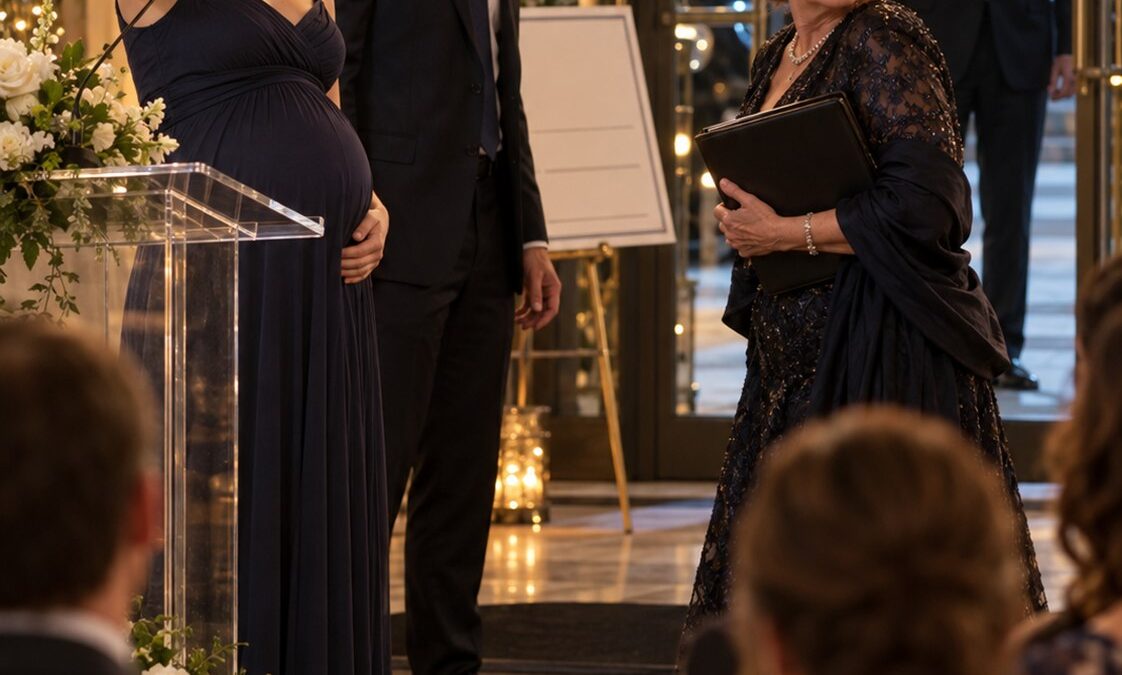
Chapter 2: The Number on the Stub
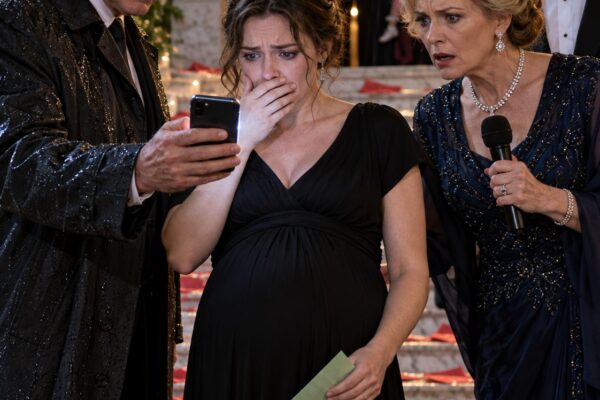
Gideon Vail entered without a coat.
Rain darkened one shoulder of his suit.
He saw the stars first.
Then Tessa.
“Are you all right?”
“Yes.”
He waited for her to meet his eyes.
“The baby?”
“Still kicking.”
Only then did he look at Lenore.
A clinic driver followed him through the doors.
Marisol Vega had come straight from her shift.
Her work jacket was damp at the cuffs.
Tessa had called her from the stage stairs while Lenore spoke.
Marisol stopped beside the podium.
“The evening route needs an answer,” she said.
“The driver’s card was declined again.”
Lenore turned to the audience.
“This is exactly the disruption Tessa planned.”
Marisol held her ground.
“There are patients waiting.”
Gideon offered Tessa his hand.
She took it long enough to step down from the stars.
He did not reach for the microphone.
“What do you need?” he asked.
“For the route to run.”
He took out his phone.
“The trust has an emergency operating reserve.”
Lenore straightened.
“You cannot release funds during an inquiry.”
“I can fund tonight’s fuel directly.”
He called the trust administrator.
Tessa heard him authorize a temporary card for Marisol’s route.
He asked for the amount to be recorded separately.
That mattered to her.
Missing money had already been blamed on loose records.
Marisol checked her watch.
The first patient on her route finished work at eight.
A missed stop meant another week before the clinic returned.
“Tell the administrator the card needs to work at the station on Mercer,” Tessa said.
Gideon repeated the address.
He waited while the administrator checked the account.
Lenore reached for the microphone.
Tessa held it against her side.
“The guests should hear both sides,” Lenore said.
“They heard yours.”
“They deserve an explanation.”
“So do the people waiting for Marisol.”
Gideon ended the call.
“The card will be ready in ten minutes.”
Marisol looked at Tessa.
“Can you get there?”
“If the stairs are clear.”
A staff member moved the fallen box away from the stairway.
Nobody had thought to do it before.
Marisol left to collect the card.
Only then did Gideon face the stage.
“I’ll ask everyone to remain available,” he said.
“The board needs witness statements.”
Lenore glanced toward the doors.
“You intend to hold my guests here?”
“No.”
He looked at the guests.
“If you leave, please give the secretary your contact information.”
A few people headed for the table near the exit.
Others stayed.
One donor lowered the phone he had been holding up.
Tessa could still see her face on its screen.
The torn edge of a paper star filled the corner.
She looked away.
Reed was still holding the route folder.
Tessa held out her hand.
He returned it.
“I should have asked you first,” he said.
“Yes.”
His face tightened.
“I thought the form might explain things.”
“You had seen my report.”
“I had.”
There was nothing useful he could say after that.
Tessa turned to Gideon.
“I’m angry you didn’t tell me you were coming.”
“I came when your message reached me.”
“I sent one sentence.”
“It was enough.”
He touched her elbow as another star stuck beneath her shoe.
Tessa picked it up using the podium for support.
The handwriting belonged to a woman on Marisol’s Tuesday route.
Thank you for coming after work.
Tessa tucked it into the folder.
Gideon noticed the yellow stub.
“May I see it?”
She handed it over.
It was a driver’s copy of a vehicle delivery claim.
The foundation had paid a vendor for a refrigerated clinic van.
The vehicle number crossed out on the stub did not match the invoice.
Marisol had written the corrected number after the first one failed her check.
“I thought they sent an old vehicle,” Tessa said.
“That was your report?”
“My report asked where the new one was.”
Lenore spoke from the stage.
“There was a replacement.”
“Then the vendor will have its records,” Gideon said.
Reed stared at the stub.
“What is it?” Tessa asked.
He rubbed his thumb along the folder’s edge.
“That number was on another form.”
“Which form?”
“The one I signed.”
Gideon looked at him.
Reed answered before anyone asked again.
“The receipt saying the new van had arrived.”
Tessa felt the baby move beneath her hand.
“When did you sign it?”
“Six weeks ago.”
“The clinic never got a new van.”
“I know that now.”
“No,” Tessa said.
“You knew it then.”
Reed could not look at her.
The room had quieted around them.
He had signed for a van nobody had delivered.
* * *
The board secretary had reserved a meeting room upstairs.
Tessa asked that Marisol return when her route ended.
She wanted the person who had checked the vehicle to be heard.
Gideon agreed.
They did not take Lenore’s folder as proof of theft.
They copied the disputed form and put the original in a sealed envelope.
A staff member logged who handled it.
Tessa watched him write the time.
She asked him to add that Reed had carried the folder downstairs.
Reed gave the staff member his name.
Lenore looked offended by the detail.
The screen in the atrium went dark.
By then, photographs of the VOID check had already spread.
Tessa turned her phone face down.
The clinic still needed a morning schedule.
She called the dispatcher and confirmed the stops.
The dispatcher had seen the video.
She did not ask about it.
“Should I move the Cedar Street visit?” she asked.
“No, the elevator’s working again.”
“I’ll leave it there.”
“Thank you.”
Tessa ended the call.
Only then did she notice her hands shaking.
Reed waited by the meeting room door.
“I can explain the receipt.”
“You can explain it to the board.”
“I want to explain it to you.”
“You had six weeks.”
He let her pass.
The foundation’s outside accountant joined by video.
Her name was Priya Shah.
She requested the invoice, the payment record, and the delivery packet.
The disputed authorization carried Tessa’s typed name.
The signature appeared on a separate page.
Priya asked who had assembled the packet.
Reed said his mother’s office had.
Lenore objected.
“My office processes hundreds of documents.”
“Then there will be a document log,” Priya said.
“There is.”
“Please preserve it.”
Tessa opened her route folder.
Inside was the report she had filed three weeks earlier.
It listed the clinic’s three vans.
It also listed every shift lost to repairs.
Tessa had attached the yellow stub because Marisol brought it to her.
The first vehicle number had been crossed out by hand.
The corrected number belonged to an older van they already used.
Priya asked why Marisol had made the correction.
“She checks numbers before accepting equipment,” Tessa said.
“She noticed the printed one was wrong.”
The vendor’s invoice described a new refrigerated vehicle.
It included the printed number from the stub.
Tessa knew the clinic had no fourth van.
That was what she could prove herself.
She left the ownership question to the records.
Gideon called the board’s lawyer.
The lawyer advised them to request the state vehicle record through the proper channel.
She also told everyone to preserve email and payment records.
“No one edits a shared file,” she said.
“No one contacts the vendor alone.”
Lenore folded her arms.
“You are treating a clerical error like a crime.”
“A clerical error can be corrected,” Priya said.
“I need the supporting documents.”
The vendor was called Northline Mobile Services.
Its invoice claimed delivery at four on a Thursday afternoon.
Tessa turned a page in her folder.
“The clinic lot was closed that afternoon.”
Reed looked up.
“Why?”
“A water main broke.”
The city had shut the street.
Tessa had moved all three vans to the church lot two blocks away.
She had kept the city notice with the route change.
Priya requested copies.
“Someone could have delivered it to the church,” Lenore said.
“They could have,” Tessa replied.
“The driver’s log will show it.”
Tessa found the church lot schedule.
All three vehicles had been listed by number.
Marisol had checked them in that morning.
The church caretaker had initialed the page when he locked the gate.
“Did you keep a copy of the key log?” Priya asked.
“The church did.”
“Please send its contact information.”
Tessa wrote it down.
Reed watched her organize the papers.
“You were checking this from the beginning,” he said.
“I was doing my job.”
Marisol returned after nine.
She had finished the route and fueled the van.
She identified the stub and her handwriting.
“The vendor driver asked me to sign,” she said.
“He showed me our old van.”
“Did you sign?” the lawyer asked.
“No.”
“I gave the stub to Tessa.”
“Did you see another vehicle?” Priya asked.
“No.”
“The driver said the new one was being cleaned.”
“Did he say where?”
“He said to call the office.”
Marisol glanced at Tessa.
“We called twice.”
Tessa found the dates in her report.
The first call had gone unanswered.
On the second, someone had promised a return call.
None came.
The original delivery packet contained a receiver’s signature.
It was not Marisol’s.
It was Reed’s.
He closed his eyes.
“I signed at my mother’s office,” he said.
“Why?” Priya asked.
“She said delivery was confirmed and the driver had missed the manager.”
“You knew Marisol was checking the van.”
“I knew she was scheduled to.”
Lenore leaned forward.
“Reed was helping us finish a grant deadline.”
He looked at his mother.
“You told me the new vehicle was at a service depot.”
“It was.”
“Which depot?”
“We can ask Northline.”
“We will,” Priya said.
The lawyer had a copy of the payment instruction.
The foundation had sent eighteen thousand dollars as an initial payment.
The rest of the van purchase had not been released.
That was the amount on the screen downstairs.
Tessa’s name appeared on the payment request.
She asked to see the page before it.
There was a gap in the scan.
The numbered cover sheet went from page twelve to page fourteen.
“Where’s thirteen?” she asked.
Priya checked the upload history.
“Page thirteen was replaced.”
“By whom?”
“I can see the account used,” Priya said.
“I need the underlying log before I name the person.”
Lenore rose.
“This has gone far enough for one night.”
Gideon stood, too.
“The records can wait until morning.”
“The preservation notice cannot.”
The lawyer sent it to the foundation officers.
She read the subject line aloud before sending.
Reed gave her the address for his work account.
Lenore refused to provide her assistant’s personal number.
“The notice can go to the office,” the lawyer said.
“It has.”
Reed’s phone lit up beside him.
He read the message and went pale.
“What is it?” Tessa asked.
“My mother’s assistant says the office has been cleared.”
Lenore reached for her own phone.
Priya saved the log to a separate board account.
She looked up from the screen.
“The replacement page was uploaded from Reed’s account.”
* * *
Tessa slept poorly.
Every time she closed her eyes, she saw stars falling.
At dawn, she sat at the kitchen table with her route folder.
Reed came in carrying a glass of water.
He set it near her.
She accepted it.
Neither of them mistook that for peace.
“I used my login for her office,” he said.
“How often?”
“I don’t know.”
“That’s an answer you should find.”
He sat across from her.
“I thought I was keeping the foundation running.”
“You kept signing things you hadn’t checked.”
“My mother said the board trusted us.”
“Marisol trusted your signature, too.”
He stared at the table.
Tessa went to work.
The clinic had no replacement vehicle.
It did have enough fuel for the day’s route.
Marisol met her at the dispatch desk.
“You should be home.”
“I’m making the schedule.”
“I can make it.”
“You hate making it.”
“I hate your handwriting more.”
Tessa laughed despite herself.
For a moment, the room felt ordinary.
Then the clinic director arrived.
Two funders had called about the gala video.
One wanted an explanation before releasing next month’s support.
The other offered to wait for the board’s findings.
Tessa wrote both names down.
She did not ask anyone to trust her word alone.
The director looked at the half-filled schedule.
“You don’t need to handle their calls,” she said.
“I know the route questions they’ll ask.”
“Then I’ll take you into the meeting.”
They called the funder together.
He asked whether the clinic had received a new van.
“No,” Tessa said.
He asked whether the evening visits were still running.
“Yes.”
Marisol held up the fuel receipt from the night before.
Tessa gave him the amount and the route time.
She did not guess about the missing payment.
The funder said he would wait for the review.
By noon, Priya had the first records.
The printed vehicle number belonged to a van taken out of service years earlier.
That record came from the state vehicle office.
Northline had not answered the lawyer’s request for delivery documents.
The service depot Lenore named had no booking for that vehicle.
Its manager gave the lawyer a written response.
Tessa added the responses to a dated list.
She wanted to know what had been checked and what remained uncertain.
The missing page thirteen had once been a purchasing approval.
The system kept its earlier version.
It contained no signature from Tessa.
The replacement used an image of her signature from a mileage form.
Priya showed her both pages side by side.
A small break in the ink matched.
“So somebody copied it,” Tessa said.
“That appears to be what happened,” Priya replied.
“The source file and upload log can establish more.”
Tessa remembered the mileage form.
She had signed it after driving a patient home during a snowstorm.
Reed had seen her fill it out.
The thought made her look at the upload account again.
She closed the file before guessing.
Gideon called from the trust office.
He had asked an independent reviewer to examine the grant.
He had also removed himself from decisions about Tessa’s employment.
“I can still be your father,” he said.
“I know.”
“You sound tired.”
“I am.”
“Come to dinner.”
“After the route.”
The lawyer called that afternoon.
Someone had accessed the foundation office overnight.
The building’s security company had retained entry records and hallway video.
Lenore had entered with her assistant.
The assistant left carrying two archive boxes.
The lawyer had asked them to preserve both.
“Are the boxes gone?” Tessa asked.
“We’re working to recover them.”
At four, Tessa found a note tucked beneath her car’s wiper.
It carried no signature.
Withdraw your report before the clinic pays for it.
She photographed it where it lay.
Then she called the lawyer.
Reed wanted to drive over.
Tessa told him to stay where he was.
The lawyer advised her to give the note to local police.
Tessa did.
She made no claim about who had written it.
An officer asked whether anyone had seen the person leave it.
Tessa said no.
He recorded the time and gave her a case number.
She put it on her dated list.
Before driving away, she called the director.
“The note mentions the clinic.”
“Do we need to close?”
“I don’t know.”
The director spoke with the lawyer.
They kept the day’s remaining appointments.
They also asked staff to report anything unusual.
Tessa hated how quickly the note had reached everyone.
She hated that she had been right to show it.
That evening, she ate soup at Gideon’s table.
He had warmed bread badly.
The center was cold.
“The microwave has settings,” Tessa said.
“I chose one.”
“The wrong one.”
He put the bread back in.
Tessa watched him through the kitchen doorway.
When she was young, his repair shop had been above a laundromat.
She had thought the smell of warm cotton belonged to his work.
Only later had she learned he restored records cabinets for courts and libraries.
He had founded the health trust after her mother died.
He had never wanted Tessa to owe a job to his name.
She understood that choice.
She also understood its cost tonight.
“I wish I’d known you were on the board,” she said.
“You knew I supported the clinic.”
“I didn’t know how much.”
“I should have told you.”
She nodded.
“I needed the choice to tell Reed.”
“I’m sorry.”
The microwave beeped.
Neither moved.
Gideon asked about the baby’s appointment.
“It went well.”
“Good.”
“She kicked when Marisol complained about my handwriting.”
“She has sound judgment.”
Tessa smiled.
For several minutes, they ate.
Then Priya called.
Northline’s bank had acknowledged the lawyer’s preservation request.
The foundation’s own records showed why the initial payment mattered.
A family company had advanced money to Northline.
The vendor payment reimbursed that advance.
Priya had found the entry in a ledger kept by Ashford House, Lenore’s hotel.
Reed appeared on one side of the entry.
His mother approved the other.
“What was the advance for?” Tessa asked.
“That’s what we’re checking.”
Priya sent the ledger page.
Tessa saw the date.
It was two days before Lenore announced the new van.
Below it sat a second line.
The money had been charged against Ashford House’s overdue renovation loan.
Lenore had used the clinic’s van payment to cover her hotel debt.
* * *
The foundation held a special board meeting two days later.
It took place at Ashford House.
Lenore had insisted on the location.
The ballroom still held flower arrangements from another event.
Tessa came with Marisol and the clinic director.
Reed arrived alone.
Gideon sat with the other trust representatives.
He greeted Tessa, then let the independent reviewer lead.
A recorder sat on the table.
The reviewer asked each speaker to identify themselves.
Tessa gave her name and clinic role.
Lenore gave three titles before the reviewer stopped her.
The yellow stub lay inside a clear sleeve.
Tessa could see Marisol’s handwriting through it.
Lenore’s lawyer spoke first.
The hotel had faced a temporary cash shortage, he said.
Northline remained obliged to deliver a van.
The transfer was an advance between related businesses.
He called the foundation’s payment premature.
He called the gala accusation regrettable.
One board member asked whether Northline had been told about the transfer.
The lawyer said its records were still being reviewed.
Another asked why the hotel ledger mentioned the clinic payment.
“It recorded a reimbursement,” he said.
“For what?”
“An advance against the vehicle.”
The reviewer wrote down the answer.
Lenore took over.
“I believed Tessa had approved the purchase,” she said.
“Her name was on the request.”
Tessa watched several board members turn toward her.
Lenore continued.
“When she raised concerns, I believed she was distancing herself.”
The argument landed.
Tessa could see why.
Her name was on the page.
Reed had used his account.
The vendor had promised a van.
A messy office could explain some of it.
The reviewer asked Lenore who ordered page thirteen replaced.
“I don’t know.”
“Who selected Tessa’s mileage form?”
“I don’t know.”
“Who authorized the hotel transfer?”
“I did.”
“Did the board approve using restricted clinic funds?”
Lenore looked down the table.
“I understood the vendor could fulfill the order.”
“That wasn’t the question.”
Her lawyer asked for time to review the records.
The board granted a recess.
Tessa walked into the corridor.
Reed followed at a distance.
“I found something,” he said.
“Give it to the reviewer.”
“I will.”
He held a printed email.
His mother had sent it to her assistant the night before the gala.
It directed the assistant to display Tessa’s authorization page.
A second sentence concerned the stars.
Put her thank-you box onstage; let people see what she betrayed.
Tessa read it twice.
Reed had received a copy because he managed the event screen.
“You saw this before the gala?”
“I saw it that afternoon.”
“And stayed quiet.”
“I thought she meant to confront you.”
“She did.”
He did not ask her to soften the answer.
“I’m giving the reviewer the original email,” he said.
“You should.”
He went back into the ballroom.
Marisol joined Tessa.
“You can leave if you need to.”
“I want to hear the decision.”
“You don’t have to prove you can stand through it.”
Tessa looked at her.
“Thank you.”
She sat for the rest of the meeting.
The reviewer presented the yellow dispatch stub.
Marisol explained the crossed-out number.
She had refused to sign because the vendor had shown her a vehicle the clinic already owned.
The vendor’s driver had left the stub behind.
Tessa had attached it to her report.
Lenore’s lawyer asked whether Marisol could identify the driver.
“I could identify him if I saw him,” Marisol said.
“But this stub has his company’s printed order number.”
The reviewer pointed to the number.
Northline had used it on the invoice.
Then the reviewer presented the independent vehicle record.
The printed number belonged to a van no longer in service.
The named depot confirmed it had received no new clinic van.
Together, those records ended the delivery claim.
The reviewer turned to the approval page.
The earlier saved version contained no Tessa signature.
The new one contained a copied image from her mileage form.
The upload came through Reed’s account.
Reed spoke before Lenore could.
“I let my mother’s office use my login.”
The reviewer asked whether he knew about the copied signature.
“No.”
“Can you verify that?”
“I can give you my messages and calendar.”
Lenore’s lawyer touched her sleeve.
She pulled away.
“The vehicle was coming,” she said.
“Where is it?” Marisol asked.
Northline’s manager had finally replied that morning.
No vehicle had been assigned to the foundation order.
His letter was before the board.
Lenore read it.
Her hand stayed on the paper.
The reviewer opened a second message from Northline.
Its manager had provided the order history.
The request had been entered as a proposed purchase.
Nobody had scheduled a build or delivery.
The manager had also confirmed that the old van number came from information supplied with the request.
Lenore’s lawyer asked whether Northline had received the initial payment.
The reviewer pointed to the bank record.
It had.
“That doesn’t establish who sent the wrong number,” the lawyer said.
“No,” the reviewer replied.
“It establishes what Northline was paid to deliver.”
The reviewer laid out the hotel ledger next.
Ashford House owed money on its renovation loan.
The family company’s advance to Northline had covered part of that payment.
The foundation’s restricted funds had reimbursed the family company.
Lenore had approved the entries.
Priya had checked the ledger against the foundation’s bank record.
The amounts and dates matched.
A bank confirmation showed the loan payment reaching its lender.
Lenore stared at Gideon.
“You could pay that loan in an afternoon.”
Gideon gave her no answer.
Tessa did.
“You had patients waiting for a van.”
“The clinic had three.”
“One was in the shop every other week.”
“The order would have been filled.”
“You told those donors I stole the money.”
Lenore’s face hardened.
“You embarrassed this family with your report.”
Tessa kept her voice level.
“I filed it with the board.”
“You knew what it would do.”
“I knew we had no van.”
For a moment, Lenore looked toward Reed.
He did not speak for her.
The reviewer asked to play the gala video.
Tessa had not expected that.
The first frame showed her on the stage.
She asked for the sound to be lowered.
The reviewer agreed.
Lenore watched herself empty the box of stars.
A board member reached forward and stopped the video.
“I’ve seen enough of that,” she said.
The reviewer handed out Reed’s email instead.
Its timestamp preceded the gala.
Lenore had planned the display of Tessa’s supposed authorization.
She had also planned the box.
Her lawyer read the message carefully.
He asked whether Reed had altered it.
The reviewer said the original remained in the foundation’s mail system.
Priya had preserved its record.
Reed had surrendered his copy as well.
Lenore looked at Tessa again.
Tessa kept her hands on her folder.
The board voted to suspend her authority over foundation funds.
It also barred Reed’s login while the records were reviewed.
The clinic grant would remain available under independent controls.
Gideon abstained from the vote.
The foundation referred its findings to the appropriate authorities and brought a civil claim for repayment.
There was no arrest in the ballroom.
There was a request to turn over records.
There was a date by which Lenore had to respond.
The reviewer asked about the archive boxes.
Lenore’s lawyer said they were being preserved at his office.
The reviewer requested a list of their contents.
The lawyer agreed to provide one.
Tessa wrote down the date.
She wanted the promise in her own notes, too.
As guests began leaving, Lenore approached Tessa.
“You’ll always be known for that stage.”
Tessa held the yellow stub inside her folder.
“People will remember who put me there.”
She walked out with Marisol.
Months passed.
The civil case reached a settlement.
Lenore’s businesses repaid the restricted funds and the review costs.
She resigned from the foundation board.
Her lawyer acknowledged in the signed agreement that Tessa had not authorized the payment.
The foundation issued a public correction.
The separate official inquiry continued after the settlement.
Tessa gave her statement once, with the records beside her.
She did not spend the baby’s first weeks watching for updates.
* * *
Their daughter was born on a rainy Tuesday.
Tessa named her June.
Marisol sent a card covered in tiny vans.
Gideon arrived with a blanket he had washed twice.
“It smelled like the shop,” he said.
“It smells like you,” Tessa replied.
He held June only after Tessa asked him to.
He sat very still.
“You may move,” she told him.
“I’m considering it.”
June opened one hand against his shirt.
He looked at Tessa for instructions.
“She does that,” Tessa said.
“I’ll remember.”
The clinic hired another route coordinator during Tessa’s leave.
Tessa trained her from home for two mornings.
After that, she stopped checking the schedule.
Marisol brought it by once and held it out.
Tessa shut the door halfway.
“That looks like work.”
“It is.”
“I’m on leave.”
“I wanted to see if you meant it.”
Marisol put the schedule away.
They drank coffee while June slept.
Marisol had brought a list of baby names her drivers had suggested.
One had written Battery.
“He said she kept you going,” Marisol explained.
“He isn’t naming a child again,” Tessa said.
Marisol laughed.
Tessa looked at the quiet phone on the table.
The clinic could run without her for an afternoon.
She let it.
Reed rented a small apartment nearby.
He visited his daughter at agreed times.
He brought diapers, learned where everything belonged, and left when the visit ended.
At first, he apologized every time he came.
Tessa finally asked him to stop repeating it.
“I heard you,” she said.
“I’m trying to show you.”
“Then keep showing up for June.”
He did.
He also answered the reviewer’s questions about his account.
His access had enabled the false page, even if his mother had directed it.
He accepted the foundation’s decision to remove him from his role.
Finding other work took time.
Tessa did not solve that for him.
One afternoon, Reed arrived carrying June’s favorite cloth book.
The corner had been repaired with neat blue stitches.
“Did you sew this?”
“I watched a video.”
“It shows.”
“I can redo it.”
“No.”
June grabbed the page and grinned.
Tessa smiled at her daughter.
Reed saw it, then looked away.
“I’m sorry about the folder,” he said.
She knew which day he meant.
He had taken it from their kitchen table.
He had put her work in Lenore’s hands.
“You trusted her accusation more than my report.”
“Yes.”
“I can raise June with you,” Tessa said.
“I can’t be your wife again.”
He nodded.
The words hurt him.
She had allowed herself to say them anyway.
A week later, Reed asked whether his mother could meet June.
Tessa stood at the kitchen sink.
The question did not surprise her.
She had known it would come.
“Has she asked you?” Tessa said.
“She’s asked to see a photograph.”
“That isn’t the same thing.”
“No.”
Tessa dried her hands.
“I won’t arrange a visit while she blames me.”
Reed nodded.
“I understand.”
“If that changes, we can discuss it.”
He did not ask her to promise more.
Lenore never asked Tessa directly.
Reed stopped raising the subject.
The foundation offered Tessa a new position.
She could oversee the clinic’s expansion.
The salary was far above anything she had earned.
Gideon called to make sure she knew the offer had come from the independent board.
She thanked him.
Then she asked for the job description.
The role had more meetings than patients.
It required travel she did not want.
Tessa declined.
She proposed a smaller route planning role instead.
She also asked the board to fund a second dispatcher and a maintenance reserve.
The directors reviewed the proposal.
They approved both.
The recovered money helped pay for a vehicle after a new bidding process.
Marisol inspected it before anyone signed.
She checked every number.
Tessa stood beside her with June in a carrier.
“Well?” Tessa asked.
Marisol walked around the van once more.
“It exists.”
“That’s a promising start.”
“And the refrigeration works.”
She handed the inspection sheet to the director.
Nobody asked Reed to sign for it.
Gideon offered to buy Tessa a house closer to the clinic.
She refused the house.
She accepted his help fixing the stairs in her own building after the landlord agreed.
“You make giving difficult,” he told her.
“You keep offering buildings.”
“Stairs, then.”
“Stairs.”
When June began sitting up, Tessa took her to the clinic.
Patients and staff made room around the stroller.
The woman who had written the star about keeping her job stopped by the desk.
She had heard about the gala.
“I wish I’d been there,” she said.
“I’m glad you weren’t.”
“I could have said what your work meant.”
Tessa looked at June.
“You just did.”
Before leaving, the woman asked whether the evening route still ran.
“Every Tuesday,” Tessa said.
That answer pleased her more than the settlement notice.
* * *
Five years later, the foundation held a public open house.
It was in the same glass atrium.
The clinic’s new vehicle stood outside the doors.
June ran ahead of Tessa, then remembered the rule and came back.
She wore a paper star on her jacket.
Marisol had written her name on it.
Inside, families were making new stars for the clinic’s wall.
No one had put Tessa on a stage.
She had asked for that.
Gideon helped children reach the display board.
He had repaired its loose hinge that morning.
June inspected his work.
“It still squeaks,” she told him.
“I left that so you’d know it was mine.”
“That isn’t how repairs work.”
“She takes after you,” Gideon told Tessa.
A volunteer asked Tessa to speak to a new family.
They needed an appointment after work.
She showed them the Tuesday route on a printed schedule.
The mother checked the stop nearest her building.
“That’s close enough to walk,” she said.
Tessa handed her a pen.
Reed arrived with June’s rain boots.
He had brought the wrong pair to pickup.
June took them from him.
“These are the good ones,” she said.
“I know.”
“You forgot.”
“I did.”
She forgave him before she sat down to change shoes.
Tessa watched him hold the boots steady.
He looked up.
“May I take her to see the van?”
“Ask June.”
June had already started toward it.
Reed followed.
Tessa stayed by the table.
From her folder, she took the yellow dispatch stub.
Its creases had deepened.
She had kept it after the case closed.
On the back, she had written three words: Check the number.
Marisol saw it.
“You still have that?”
“I do.”
“Want it on the wall?”
Tessa shook her head.
The new inspection sheet was displayed near the door.
It showed a real vehicle, accepted by the people who used it.
The old stub could go home.
June returned with her father.
She stopped beneath the star wall.
“Mom, yours fell.”
A paper star lay near Tessa’s shoe.
June picked it up and reached for her hand.
Together, they pinned it where everyone could see.
The evening route runs.
THE END