My Husband Handed His Mother My Bag at the Gala, Then She Found the One Thing She Had Planted There
Chapter 2: What the Pouch Held
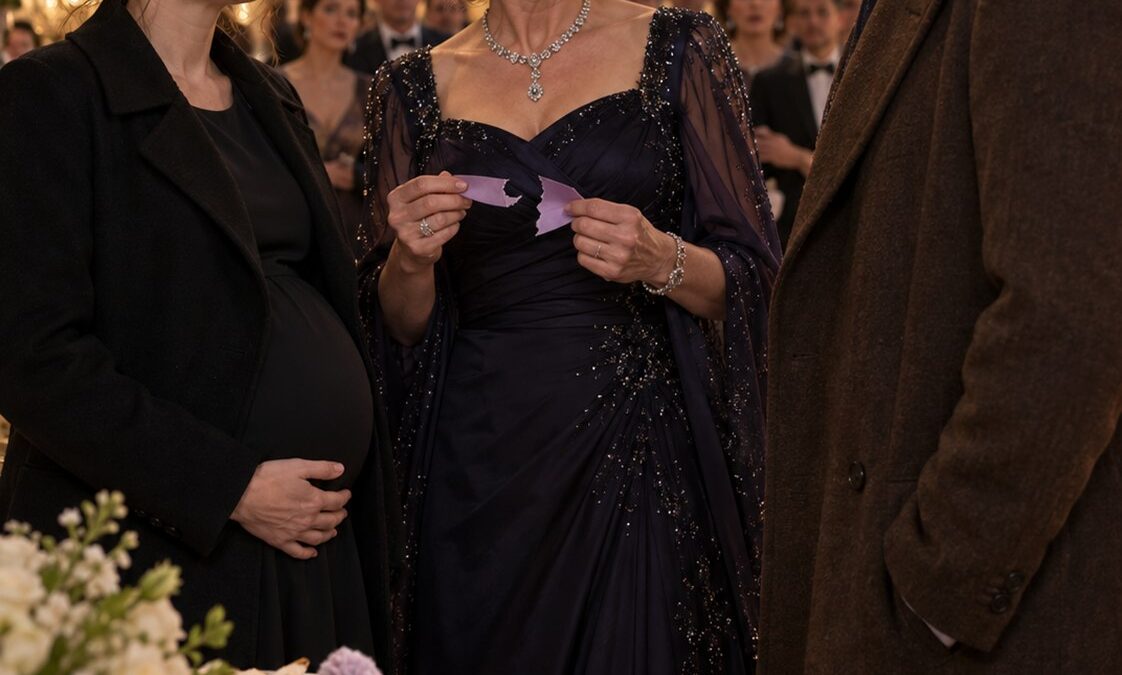
Beatrice looked at the empty pouch.
Then at Gideon.
“You have no idea what was here.”
“I do,” he said.
The foundation’s general counsel, Naomi Price, came to Tessa’s side.
“Are you all right?”
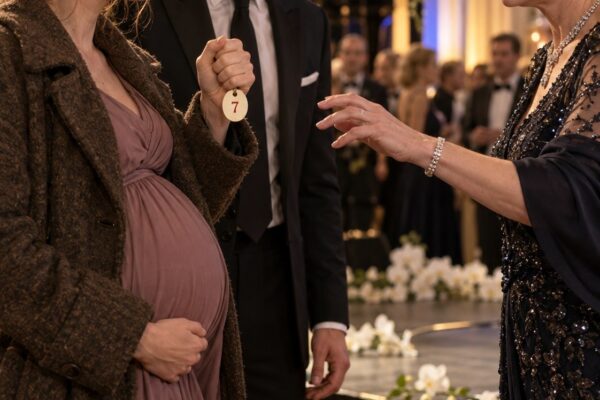
Tessa looked at her scattered belongings.
“I need a chair.”
Naomi brought one from the nearest table.
Julian finally bent for the baby hat.
Tessa took it before he could offer it.
Gideon saw the exchange.
His jaw tightened.
He addressed Beatrice.
“The original deed is recorded with the county.”
“Then perhaps your daughter stole a copy.”
“The pouch held an acknowledgment.”
Beatrice’s fingers closed around its torn edge.
“What acknowledgment?”
“The one requesting a review of your proposed sale.”
Several guests turned toward the presentation screen.
It still showed a drawing of the promised clinic.
Beneath it, smaller words named Harrow Foundation and its development partner.
Tessa had read those words when she arrived.
She had assumed the partner would build the clinic.
Gideon watched her read them again.
“The buyer wants the entire site,” he said.
Beatrice straightened.
“That is a gross misunderstanding.”
“Then the review should be easy.”
Naomi placed a hand on the empty pouch.
“Please leave it on the table.”
Beatrice did.
Tessa rubbed her back.
The ache eased when she sat.
Gideon lowered his voice.
“Should I call your doctor?”
“No.”
“Tell me if that changes.”
He took off his coat and laid it across the back of her chair.
It was the old brown coat she knew.
One pocket had been stitched twice.
Julian stood across from them, still holding her bus schedule.
“I thought there was a deed,” he said.
Tessa looked up.
“You thought I took it?”
“I thought they had found the seal.”
“You handed her my bag before she found anything.”
He set down the schedule.
“I’m sorry.”
“Later.”
Naomi asked a staff member to keep guests away from the table.
She photographed the pouch and the strip where they lay.
Then she asked Tessa a question.
“When did you last see that strip?”
“Never.”
“Can you tell where it came from?”
“Not yet.”
Tessa pointed to the backing paper.
“It hasn’t sealed anything.”
Naomi leaned closer.
“The numbers match.”
“Numbers can be ordered twice.”
Beatrice gave a short laugh.
“Listen to this performance.”
Gideon looked at her.
“Did you order a second set?”
“No.”
“Then you’ll welcome a check.”
The room had grown quiet enough for Tessa to hear the air moving overhead.
Naomi took a sealed folder from her own case.
She held it up without opening it.
“I received the acknowledgment this afternoon,” she said.
“The pouch was placed here for tonight’s signing ceremony.”
Beatrice blinked.
“Then what was missing?”
“The paper naming your transaction for review.”
Gideon kept his eyes on her.
“The original deed stayed where it belonged.”
Tessa gripped the baby hat.
Beatrice had accused her of stealing a deed that had never entered the room.
Julian turned to his mother.
“You told me you saw it.”
“I saw what our staff prepared.”
“No,” Naomi said.
“You told me yesterday that its removal would halt the review.”
Beatrice’s face changed.
Only for a moment.
Tessa saw it.
So did Gideon.
Naomi opened the folder and drew out a copy of the request.
At the top was Tessa’s signature.
It was neat and familiar.
It was also false.
Tessa rose so quickly the chair shifted.
“I never signed that.”
Gideon held the paper where she could see it.
“I know.”
Her mother’s name appeared below hers.
Tessa’s mother had been dead for nine years.
The room tipped slightly.
Gideon steadied her elbow.
“Sit,” he said.
She did.
Naomi covered the signature with a blank sheet.
Tessa kept looking at the place where it had been.
“The pouch wasn’t about a missing deed,” Gideon said.
“It was supposed to make you withdraw a complaint bearing your forged name.”
* * *
The guests were asked to leave the presentation area.
Some did.
Others waited near the bar, pretending not to watch.
The promised clinic stayed on the screen.
Tessa wanted it turned off.
She wanted to know how her mother’s name had appeared on that page.
Naomi called the foundation’s document custodian.
Then she called the county recording office.
She spoke plainly into both phones.
No one was asked to take Gideon’s word.
Naomi had received a scanned acknowledgment on Tuesday.
A courier brought the paper copy that afternoon.
Its purpose was narrow.
It allowed an independent review of documents concerning the clinic site.
It did not transfer land.
It did not authorize a sale.
Someone had substituted signatures on an attached consent page.
Tessa examined the copy under the light.
Her own signature looked convincing from a distance.
Up close, the capital T began too far to the left.
She always left room for the date.
There was no date.
Her mother’s signature had been copied from an older letter.
Tessa knew which one.
“It’s from the scholarship application,” she said.
Gideon looked at her.
“The one she wrote for my first archive course.”
He remembered it.
Her mother had been proud that Tessa wanted to preserve old records.
She had written the letter at the kitchen table.
When Tessa turned twenty-five, Gideon had given her the original.
She kept it in a box at home.
Julian knew about that box.
He had helped her move it into their apartment.
“The letter was in our bedroom,” Tessa said.
Julian looked at the floor.
Beatrice answered before he could.
“Your mother signed hundreds of papers.”
“She signed that one differently.”
Tessa pointed to the tail of the last letter.
“She had a sore wrist that week.”
Naomi photographed it.
She did not call it proof.
She said it gave them a document to compare.
Tessa appreciated the distinction.
At the archive, certainty had to survive another pair of eyes.
The document custodian arrived carrying a ledger.
Her name was Mrs. Bell.
She had worked for the foundation for seventeen years.
Beatrice spoke first.
“You should have brought the deed.”
Mrs. Bell frowned.
“There was no deed on my list.”
She opened the ledger.
Naomi asked who had packed the pouch.
“I did.”
“What went inside?”
“The acknowledgment and the revised consent page.”
“Who gave you the revised page?”
Mrs. Bell looked at Beatrice.
“Your office.”
“Which person?” Naomi asked.
“Mr. Harrow’s assistant brought it.”
Julian lifted his head.
“My assistant?”
“Mr. Julian Harrow.”
“That’s my office.”
Tessa watched him struggle with the difference.
A message sent through his office carried his name.
He could deny knowing the contents.
He could not deny where it had come from.
Naomi asked for the delivery record.
Mrs. Bell turned a page.
The revised consent had arrived at 4:08.
The pouch was sealed at 4:17.
At 5:36, Beatrice had requested it for the ceremony.
At 6:12, she signed for it.
The accusation came a few minutes later.
Mrs. Bell had noted every handoff.
“It never went near Tessa,” she said.
Beatrice’s expression hardened.
“Your ledger doesn’t account for every minute.”
“It accounts for mine.”
Gideon asked Mrs. Bell to leave the book with Naomi.
She did.
No one asked her to choose a side.
Tessa studied the entry for the security seal.
The number was 4182.
Beside it was a small mark indicating a packet of two.
“Why two?” she asked.
Mrs. Bell turned the ledger toward her.
“The supplier sends paired strips for long pouches.”
“Did you use both?”
“I used one.”
“Where was the spare?”
“In the preparation drawer.”
Beatrice looked toward the service corridor.
The drawer was in a room assigned to her staff.
Tessa placed the violet strip beside the ledger.
There was no torn edge.
It had been lifted cleanly from its sheet.
Mrs. Bell shook her head.
“That one was the spare.”
Naomi bagged it in a clean paper envelope.
She wrote the date and time across the flap.
Tessa told her what she had seen.
Naomi wrote that down too.
Then the county recording office called back.
The original trust deed had been recorded thirty-one years earlier.
Its public record remained intact.
The newer documents were the problem.
Naomi put the call on speaker so everyone present heard the same answer.
A consent to sell had been filed three weeks ago.
It named the foundation as seller.
It named a company called North Quay Holdings as buyer.
It claimed Tessa had approved the transfer as a family trustee.
Tessa had never attended a vote.
She had never signed a consent.
Gideon asked for the filing number.
Naomi wrote it in the ledger’s margin.
Tessa looked at the drawing of the clinic.
If the land was sold, what would happen to the building?
Naomi said the plans attached to the filing showed a small health suite on the ground floor.
Above it were private residences.
The public clinic promised tonight would occupy less than a tenth of the site.
“Did the donors know?” Tessa asked.
“I don’t believe so,” Naomi said.
Beatrice folded her arms.
“They funded medical care.”
“They funded the building shown behind me,” Gideon said.
Tessa saw another sheet in Naomi’s folder.
It was a notice sent to her apartment.
The address was correct.
The delivery confirmation bore Julian’s signature.
Tessa had never seen the notice.
“Julian,” she said.
He stared at it.
“I thought it was about a board dinner.”
“You signed for it.”
“I left it with the other mail.”
“Where?”
He said nothing.
Naomi turned to the consent page.
“The filing lists him as the person who witnessed your signature.”
Tessa looked at her husband.
He had stood beside her as Beatrice emptied her bag.
Now he stood beside a paper claiming he had watched her sign.
* * *
Julian asked for a minute alone with Tessa.
She declined.
They sat at opposite ends of the preparation room.
Naomi remained by the door.
Gideon made a call to Tessa’s doctor at her request.
Her backache had faded, but she wanted advice.
The nurse asked a few ordinary questions.
Tessa answered them.
The nurse told her when to call again and what changes would warrant an assessment.
Tessa put her phone away.
Julian had listened without interrupting.
When she looked at him, his face was pale.
“I signed the witness line,” he said.
Tessa waited.
“Mom told me you’d approved the clinic plan.”
“She knew I hadn’t.”
“I didn’t.”
“You could have asked.”
“I know.”
“That paper could sell my mother’s land.”
He flinched at the word mother.
“She said your father was delaying everything.”
“Did she show you my signature?”
“She showed me a page.”
“Did you watch me sign it?”
“No.”
“Then why did you say you did?”
He rubbed both hands over his face.
“She said it was a formality.”
Naomi spoke from the door.
“A witness statement is never a formality.”
Julian nodded.
He had no defense for it.
Tessa did not supply one.
A staff member brought tea.
Tessa accepted a cup.
Julian reached for a second.
The staff member placed it in front of him.
For a few minutes, no one spoke.
Tessa thought of the notice delivered to their apartment.
She thought of all the mail Julian opened when she worked late.
At the archive, she worked four ten-hour shifts.
On those nights, she arrived home after nine.
Julian often left her supper in the microwave.
She had mistaken care in one part of their life for honesty in every part.
Naomi’s phone rang.
A foundation accountant wanted to speak with her.
The accountant had seen the gala program.
It listed North Quay Holdings as the project partner.
Her name was Elsie Ward.
She had refused to approve two payments to that company.
Beatrice’s office had approved them afterward.
Naomi asked Elsie to send the invoices.
A minute later, they arrived.
One was for design work.
One was for “site readiness.”
The amounts were large enough to require board notice.
The notices had been drafted.
They had never been circulated.
Naomi opened the attachments.
Tessa could see the names on the payment instructions.
North Quay Holdings.
A bank account.
An address shared with Harrow Properties.
Beatrice had chaired Harrow Properties before she moved to the foundation.
Julian read it over Naomi’s shoulder.
“That company is inactive.”
“It was,” Naomi said.
“It reopened this spring.”
Tessa looked at him.
“Did you know?”
“No.”
He took a step back.
Naomi called an outside attorney who handled the foundation’s governance work.
She asked the attorney to review the filings independently.
Gideon made another call.
He asked the land trust’s trustees to preserve their records.
He told them to make no public accusation yet.
Tessa heard the restraint in his voice.
She had expected him to sweep the room clear with a command.
Instead, he asked for copies.
Beatrice entered the room without knocking.
“Your guests are leaving,” she told Gideon.
“They were your guests,” he said.
“They came because I built this foundation.”
“You built much of it.”
“You let me do the work.”
“Yes.”
Her eyes went to the invoices.
“You have no right to my company’s books.”
“We have a right to our foundation’s payments.”
Beatrice looked at Tessa.
“You could end this tonight.”
“By doing what?”
“Say you misplaced the page.”
“I didn’t.”
“Say you were mistaken about signing.”
“I wasn’t.”
“You have a child coming.”
Tessa set down the tea.
“My child isn’t a reason to lie.”
Beatrice’s voice softened.
“Your father’s clinic can still happen.”
“On one floor of your apartments?”
“It will serve people.”
“Who gets the apartments?”
Beatrice did not answer.
Naomi asked her to leave.
Beatrice stayed long enough to say one thing to Julian.
“You know what happens to this family if she goes forward.”
Julian looked at Tessa.
For once, he did not ask her to let something pass.
He opened the door for his mother.
She walked out.
The outside attorney called back.
A preliminary search showed that North Quay Holdings had one controlling member.
It was listed through another company.
The attorney needed the underlying registration.
Naomi asked for it.
They waited.
Tessa unfolded the baby hat.
A small stitch had come loose along the brim.
Gideon found his glasses in his coat pocket.
He could see the thread, though he could do nothing about it.
Tessa smiled despite herself.
“Mom taught me to mend that way,” she said.
“She did.”
“She would hate this.”
“She would.”
“She’d have brought snacks.”
“She would have brought enough for everyone.”
The attorney called again.
Naomi listened.
Then she wrote a name beneath the bank account.
She turned the paper so Tessa could read it.
Beatrice Harrow.
* * *
By morning, the gala photograph was everywhere.
Someone had posted Tessa beside the table, her belongings on the floor.
The caption called her a thief.
The photograph showed the baby hat near her shoes.
It did not show the unused backing on the violet strip.
Tessa sat at Gideon’s kitchen table while Naomi sent preservation notices.
The apartment was small.
Gideon had lived there since Tessa was sixteen.
Its radiator clicked whenever the heat came on.
A newspaper had already called him “the secret force behind the clinic land.”
He folded it under a bowl of oranges.
“I should have told you more,” he said.
“You told me about the trust.”
“I didn’t tell you how much Beatrice depended on it.”
Tessa peeled an orange.
“Why?”
“Your mother wanted you to decide what the land meant to you.”
“You could have told me I was a trustee.”
“We did.”
“At nineteen.”
“You were busy leaving home.”
She remembered signing a packet.
She remembered her father explaining that any sale would need an independent review.
She had forgotten how close the question might come.
“I should have read it again,” she said.
Gideon shook his head.
“Beatrice counted on all of us trusting her.”
At noon, Naomi arrived with the outside attorney, Martin Keene.
He brought certified copies of the trust deed and the sale filing.
He also brought a timeline.
The clinic land could not be sold without the consent of its family trustee.
Tessa held that seat.
Her signature had been submitted on a document she had never seen.
Julian had signed as witness.
Beatrice’s company was positioned to buy the property.
The foundation had already paid that company for work.
Martin spoke carefully.
“Those facts justify a court request to pause the transaction.”
“Will it stop tonight’s accusation?” Tessa asked.
“No.”
“Will it stop the sale?”
“A judge can decide that quickly.”
Naomi had already retained separate counsel for the foundation.
The foundation’s board would meet that evening.
Julian had agreed to preserve his messages and devices.
He wanted to make a statement.
Martin advised him to have his own lawyer.
Tessa was relieved.
She did not want his apology mixed with her legal decisions.
A messenger brought a letter before lunch ended.
It came from a law firm representing Beatrice.
The letter said Tessa’s public allegations had damaged the foundation.
It demanded that she retract them.
It offered to settle privately.
The settlement included a payment large enough to cover years of her salary.
In exchange, she would confirm her signature and sign a confidentiality agreement.
Gideon read the number once.
Then he handed the letter to Martin.
Tessa read the part about her signature twice.
“She wants me to make it real.”
“Yes,” Martin said.
“What happens if I don’t answer?”
“We proceed with the injunction.”
Tessa nodded.
She had twenty-three dollars in her checking account until payday.
Her car needed new tires.
The baby’s crib came from a neighbor.
Beatrice knew enough about her life to name a number that would hurt to refuse.
Tessa placed the letter on the table.
“No.”
Martin took notes.
Naomi’s phone buzzed.
Elsie Ward had located a board packet she had prepared in March.
It contained the full clinic design funded by the donors.
It also contained a later version sent from Beatrice’s office.
The later version replaced the clinic with residences.
Elsie had flagged the change.
Her question went unanswered.
Tessa asked why Elsie had kept the email.
“Accountants keep questions,” Naomi said.
They went to the foundation office that afternoon.
Elsie met them at the door.
She was small, brisk, and angry.
She showed them the invoices.
She showed them the drafts.
She showed them a message from Beatrice’s office instructing her to change the project code.
The message did not mention Tessa.
It did mention the purchaser.
North Quay Holdings would receive credit at closing for its earlier “site readiness” work.
That credit would reduce the price paid to the foundation.
Martin photographed the documents.
Elsie copied them to a secure drive for counsel.
She asked whether speaking up would cost her job.
Naomi told her the board would be informed she had preserved records.
She did not promise there would be no trouble.
Elsie preferred that answer.
On the way out, Tessa noticed a photograph in the lobby.
Her mother stood beside Beatrice at the clinic’s first fundraising dinner.
Both women smiled.
Her mother’s hand rested on a cardboard model of a courtyard.
Tessa stopped.
“There was supposed to be a garden.”
Naomi followed her gaze.
“The current drawings don’t have one.”
“My mother insisted on it.”
Gideon touched the photograph’s frame.
“She wanted people waiting for care to have somewhere quiet.”
Tessa took a picture.
Outside, Julian waited beside the curb.
He had called ahead.
Tessa agreed to hear him with Gideon and Naomi nearby.
Julian held out his phone.
His mother had sent him a message that morning.
It told him to say Tessa had taken the pouch home by mistake.
Below it was an older message.
Dated the day before the filing.
“I have her signature from the letter,” Beatrice had written.
“Just witness the page.”
Julian’s hands shook.
“I should have stopped then.”
“Yes,” Tessa said.
“I thought it was about keeping the clinic open.”
“You didn’t ask me.”
“No.”
Martin asked for the messages through Julian’s lawyer.
Julian agreed.
Tessa looked at the photograph on her phone.
Her mother had known Beatrice for years.
“She knew exactly what she was taking,” Tessa said.
Gideon nodded.
The garden.
The clinic.
The right to decide.
* * *
The board meeting took place three nights later.
It was held in the same glass-roofed hall.
Tessa had asked for that.
She wanted the people who had watched the accusation to hear the documents read aloud.
The board invited donors whose restricted gifts were affected.
Mrs. Bell attended.
So did Elsie.
Julian came with his lawyer.
Beatrice arrived last.
She wore a dark suit and carried no papers.
For ten minutes, she seemed prepared to listen.
Then Naomi presented the sale filing.
Beatrice stood.
“I found a way to keep this foundation alive,” she said.
“Donations had fallen.”
“Construction costs had risen.”
“The original clinic could not be built.”
A board member asked why donors had not been told.
“Because they would have walked away,” Beatrice said.
No one interrupted.
She pointed at the revised design.
“The health suite would serve patients.”
“The residences would pay for it.”
Gideon asked who would own the residences.
“A development company.”
“Yours,” he said.
“I disclosed my prior work.”
“Did you disclose your controlling interest?”
“I intended to before closing.”
She said it evenly.
For a moment, Tessa understood how Beatrice had held that room for years.
She knew when to admit a hard fact.
She offered a practical answer for every objection.
Then she turned toward Tessa.
“My daughter-in-law saw the plans.”
Tessa had seen the display card at the gala.
She had not seen the sale documents.
Beatrice held up a copy of the consent page.
“Her signature is there.”
Martin rose.
“The court has been asked to pause the transfer.”
“A request is not a finding,” Beatrice said.
He acknowledged that it was not.
Beatrice faced the board again.
“Let the judge decide.”
“Meanwhile, this foundation needs leadership.”
She asked the board to reject Naomi’s proposal to suspend the transaction.
A few members looked uncertain.
One asked Gideon why he had stayed quiet so long.
Gideon took his time.
“I believed the board would see every material change,” he said.
“That trust was misplaced.”
Beatrice seized on it.
“Exactly.”
“He trusted me because I delivered.”
She pointed toward the guests.
“Many of you are sitting in rooms I paid to restore.”
Tessa could see the argument working.
The restored hall was real.
The foundation’s other clinics were real.
So was the false page.
She stood.
Her back ached.
She waited for it to ease.
“I don’t know every number in this room,” she said.
“I know how this seal works.”
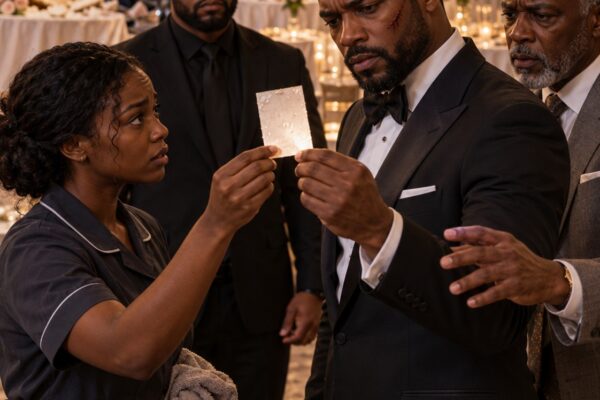
Naomi placed the violet strip beneath the document camera.
Its number filled the screen.
4182.
Tessa laid a fresh strip beside it.
Mrs. Bell had obtained one from the same supplier.
Tessa pressed the fresh strip across a paper envelope.
She tried to lift it.
The violet film broke.
A hidden word appeared in silver.
VOID.
She held up the pieces.
“The strip from my bag still had its backing.”
“It never closed the pouch.”
Beatrice folded her arms.
“Then someone planted it.”
“Yes,” Tessa said.
The room held still.
Mrs. Bell opened her ledger.
She read the entry for the paired strips.
One had sealed the pouch.
The spare had remained in the preparation drawer.
The drawer was accessible to Beatrice’s office.
Beatrice objected.
“Accessible to half the staff.”
“That’s true,” Naomi said.
She called Elsie forward.
Elsie presented the supplier invoice.
Beatrice’s office had requested a replacement sheet of numbered strips two days before the gala.
The order named serial 4182.
It had been delivered to Beatrice’s personal assistant.
“That still proves nothing about the bag,” Beatrice said.
“It proves a spare was available,” Martin replied.
Naomi showed the room a second record.
The hall’s service corridor camera had captured Beatrice’s assistant entering the preparation room with Tessa’s bag during the reception.
The assistant had carried it there after offering to take Tessa’s coat.
Tessa remembered the offer.
She had refused the coat check because she was cold.
She had let the assistant hold her bag while she adjusted the baby hat inside it.
The footage showed less than a minute.
It showed the assistant returning the bag.
It did not show what happened inside.
Naomi said so.
Then Julian stood.
His lawyer nodded.
“My mother told me there would be a strip in Tessa’s bag,” Julian said.
“She told me to make sure the bag was searched.”
Beatrice turned sharply.
“You misunderstood me.”
“Maybe,” Julian said.
“I should have asked.”
He looked at Tessa.
“I should have asked her.”
Naomi displayed the message from Beatrice about Tessa’s copied signature.
It bore the date, time, and sender information.
The room went quiet.
Beatrice sat down.
She did not confess.
She argued that she had meant to prepare a draft.
She argued that Julian had witnessed a later approval.
She argued that everyone was trying to save a clinic.
Tessa listened.
Then she asked one question.
“If I approved it, why offer me money to say I did?”
Beatrice looked at the table.
Martin gave the board a copy of the settlement letter.
A member moved to suspend the sale and refer the documents for investigation.
The motion passed.
Beatrice lost her authority to act for the foundation that night.
The board voted for an independent review.
No one announced a criminal verdict.
No one needed to.
Outside, reporters waited.
Tessa walked past them with Gideon.
Beatrice followed.
At the door, she said, “You’ve made your child’s family a spectacle.”
Tessa stopped.
“My child watched me tell the truth,” she said.
She went home.
The court paused the sale the following week.
Investigators obtained the original files, the messages, and the foundation’s payment records.
The assistant described what Beatrice had asked her to put in Tessa’s bag.
Months later, Beatrice admitted to filing a false consent and misusing foundation funds.
She was ordered to repay the money and was barred from managing the foundation.
Her sentence included supervised time and community service.
Julian’s false witness statement was addressed separately.
He cooperated, accepted a penalty, and lost his board seat.
The recorded trust deed stood.
The land remained protected.
* * *
By spring, Tessa could pass the hall without looking at its doors.
She did not have to pass it often.
Most days involved quieter things.
Laundry.
Bills.
A baby who preferred being carried to sleeping.
Her daughter arrived healthy on a rainy Thursday.
They named her Wren.
Gideon cried when he held her.
Then he denied it while searching for a cloth to wipe his face.
“You’re dripping on her,” Tessa said.
“I’m holding her securely.”
“Both can be true.”
The crib still came from the neighbor.
The tires were new.
Tessa had returned to the archive part time.
She liked its steady light and careful work.
Some mornings, she brought Wren to Gideon’s apartment before her shift.
He had bought a secondhand stroller and repaired its loose wheel.
He had also purchased six picture books for a child who could barely focus on one.
“You can stop buying them,” Tessa told him.
“I can.”
He did not.
The foundation’s new board contacted Tessa about the clinic.
They wanted to restore the original plan.
They had recovered some of the misused funds.
Other donors had recommitted theirs.
Construction would take longer than promised at the gala.
The board asked Tessa to serve as a trustee representative.
She asked for the budget first.
Naomi smiled when she heard that.
Tessa read every page.
She asked why the garden had disappeared from one estimate.
A designer said it could be added later.
Tessa said her mother had insisted on it from the beginning.
The revised estimate included the garden.
At the next meeting, the board offered Tessa an honorarium.
She accepted payment for the hours she worked.
She refused an additional gift Beatrice’s family offered privately.
The gift came with no written conditions.
It still felt like a price placed on silence.
Tessa asked the board to put it toward patient transportation if the family wished to give.
The family did.
She did not thank Beatrice.
Julian asked to meet in a public café.
Tessa brought Wren.
Gideon sat at another table, pretending to read a newspaper.
Julian noticed him.
He said nothing.
For a while, Julian looked at his daughter’s hands.
“She has your fingers,” he said.
“She does.”
“I missed a lot.”
“Yes.”
“I’m sorry for the gala.”
Tessa waited.
“I’m sorry I signed that paper.”
“I’m sorry I let my mother speak for you.”
He swallowed.
“I knew how she treated you.”
“Then you know the gala wasn’t the start.”
“I do.”
He had begun paying support under their agreement.
He had followed the schedule for seeing Wren.
He had arrived on time for the last six visits.
Tessa saw the effort.
She also saw what it could not erase.
“I want to be her father,” he said.
“You are.”
“I’d like to spend more time with her.”
“We can review the schedule when she’s older.”
He nodded.
“Can we talk about us?”
“No.”
The answer hurt him.
She let it stand.
He looked at Wren.
“May I hold her?”
Tessa considered him.
Then she passed Wren across the table.
“Support her head.”
“I remember.”
He did.
Wren pulled at the edge of his sleeve.
For the first time that afternoon, Julian smiled without trying to persuade anyone.
Tessa drank her coffee while it was still warm.
That was enough for one meeting.
In the summer, the clinic broke ground.
The old building on the site had to be taken down.
Before the work began, Tessa walked through it with Gideon.
Her mother had once staffed a small advice desk there.
The desk was gone.
A pale rectangle remained on the wall where its sign had hung.
Gideon ran a finger along the mark.
“She met Beatrice here,” he said.
“Was Beatrice always like this?”
“She was generous when she wanted to be.”
Tessa thought about that.
“Mom liked her?”
“For a while.”
“Did Mom know about the land clause?”
“She wrote it.”
Tessa turned toward him.
“She didn’t trust Beatrice?”
“She wanted the clinic protected from anyone.”
That felt like her mother.
Practical.
Warm.
Unwilling to leave the future to goodwill alone.
They went outside.
The site manager showed them where the new garden would be.
It faced east.
Patients would see morning light from the waiting room.
Tessa stood there until Wren grew restless in her carrier.
“May I take her?” Gideon asked.
Tessa handed her over.
He walked her along the fence, naming every machine he could see.
He got two names wrong.
A worker corrected him.
Wren fell asleep anyway.
* * *
Four years later, the clinic opened beneath the same glass roof where the gala had been held.
The foundation had rented the hall for one evening.
This time, the guests were staff, patients, donors, and neighbors.
No one had to buy a ticket.
The presentation table stood near the doors.
Its white cloth was gone.
Children had covered it with drawings of the new garden.
Wren added a purple bird with six legs.
“It can run fast,” she explained.
“That seems useful,” Tessa said.
Julian arrived with his wife and their young son.
He asked Wren before lifting her.
She said yes and showed him the bird.
Their arrangements were ordinary now.
A calendar.
Shared birthdays.
Some difficult conversations handled before Wren heard them.
Beatrice had written twice after her sentence ended.
Tessa had answered once.
She had said Wren could decide whether to know her when she was older.
Until then, Beatrice was to contact Tessa alone.
The boundary remained.
Gideon came carrying a small frame.
Inside was a violet security strip.
Its backing was still attached.
Tessa laughed when she saw it.
“You kept that?”
“Naomi returned it after the case closed.”
“I thought you’d throw it away.”
“I nearly did.”
He turned the frame over.
On the back, he had written one sentence.
It never closed the pouch.
Tessa read it aloud.
Wren asked what it meant.
“It means someone tried to make a thing look used when it wasn’t,” Tessa said.
Wren considered that.
“Like a pretend ticket?”
“Something like that.”
Gideon hung the frame beside a photograph of Tessa’s mother.
In the photograph, she stood beside the old cardboard model.
Her hand rested on its little courtyard.
At the new clinic, the courtyard was real.
There were benches.
There were trees.
There was room for a stroller beside every path.
Naomi joined them.
“The first appointments start Monday,” she said.
Tessa looked toward the open doors.
The hall no longer held the sound of Beatrice’s accusation.
It held Wren’s running footsteps.
Gideon’s laugh.
The low voices of people who had come to see what their donations had built.
Tessa remembered Beatrice saying the original deed was gone.
She remembered her bag emptied on the table.
She remembered Julian handing it over.
Those things had happened.
So had everything after.
The false filing had been stopped.
The money had been repaid.
The clinic had been built.
Julian had apologized, and Tessa had chosen her own life.
Wren had a father who asked permission.
She had a grandfather who bought too many books.
She had a mother who knew exactly what belonged to her.
Wren ran back with a paper flower from the garden display.
“Can we take this home?”
Tessa checked with the volunteer.
The volunteer said yes.
Tessa tucked the flower behind Wren’s ear.
Above them, the glass roof caught the last light.
THE END