The New Housekeeper Made His Silent Sister Speak—Then the Crime Boss Found Four Years Hidden Inside a Silver Moth Brooch
Chapter 2: What Nell Remembered
“The woman who pulled you out?”
Gideon kept his distance.
Nell watched his hands.
He put them at his sides.
“Yes,” she said.
Mara stayed beside the piano.
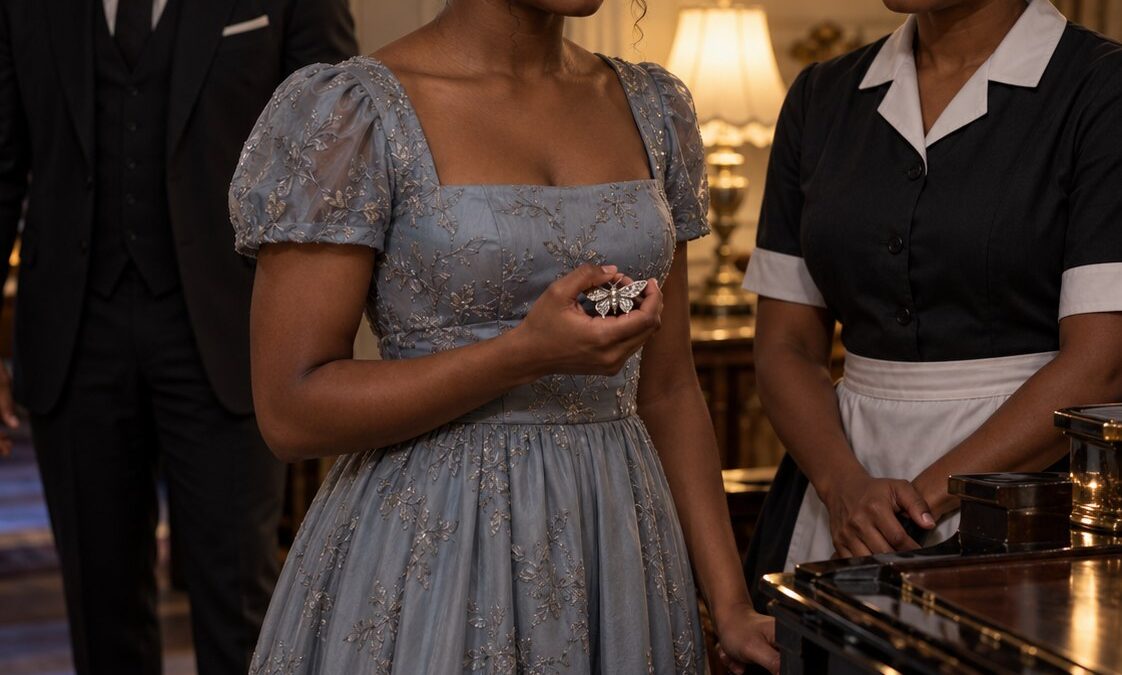
The brooch lay in Nell’s palm, its silver wings bent at the tips.
Gideon knew it.
He had seen it fastened to a black coat at dinners, funerals, and board meetings.
He wanted to say the name.
He wanted Nell to be wrong.
“Take your time,” he said.
Nell’s eyes moved to the door.
“It’s open,” Gideon added.
“I know.”
Her voice was thin.
It was still her voice.
Mara pulled out the piano bench.
Nell shook her head.
“Don’t sit down?”
“Not yet.”
Gideon had spent four years arranging chairs for Nell.
At doctors’ offices.
At meals.
At the end of corridors where she had stopped walking.
He had never thought to ask whether she wanted one.
Mara reached for the brooch.
Nell closed her fingers.
“May I?” Mara asked.
Nell considered it.
Then she handed it over.
Mara placed it on the piano, well away from the keys.
Gideon looked at her.
“Where did you find it?”
“In a box marked winter clothes.”
“Who opened the box?”
“Nell.”
“Why?”
“She asked me to bring it down.”
Nell glanced at him.
“I remembered the coat.”
Gideon’s throat tightened.
Their mother had died in a crash on a wet November road.
Nell, fifteen then, had been found outside the car.
A passing driver had called for help.
That was what the police report said.
Gideon had been in Baltimore that night.
He had returned to a hospital room full of machines, flowers, and people explaining what Nell could no longer tell him.
“She told you about the coat?” he asked Mara.
“She showed me a drawing.”
Mara took a folded sheet from her apron.
The drawing was careful.
Two silver wings.
A small red stone.
And beneath them, a square shape Gideon recognized as a car window.
“I thought it might help,” Mara said.
“You thought?”
“I knew she wanted to look.”
Gideon studied the drawing again.
Nell had drawn the stone exactly.
It was missing from the brooch now.
“Where did this come from?” he asked.
Nell touched her pocket.
“Under my bed.”
“The drawing?”
“The stone.”
She brought out a tiny red chip.
Gideon stared at it.
Nell held it near the empty setting.
The edges met.
Mara said nothing.
For months after the crash, Nell had kept things beneath her bed.
Gideon had told the staff to leave them alone.
He had called that respect.
He had never looked at what she was guarding.
“Why didn’t you show me?” he asked.
Nell’s face changed.
Mara moved closer, but waited.
“I tried.”
“When?”
“At the hospital.”
Gideon remembered her reaching for his sleeve.
He remembered a doctor saying she needed rest.
He remembered allowing the doctor to lead him out.
Nell pressed the stone into her palm.
“She said you’d go after her.”
“Who said that?”
Nell looked straight at him.
“Aunt Celia.”
* * *
Celia Voss had worn the brooch for twenty years.
Gideon had bought it for her himself.
He was twelve, proud of the money he had earned sweeping the floor of his father’s warehouse.
A jeweler had replaced its clasp twice.
The second repair, Celia once complained, had left a scratch along one wing.
That scratch was on the brooch atop the piano.
Still, Gideon did not call her.
He called his lawyer.
Anika Bell arrived within the hour.
She asked Nell if she wanted to speak with her.
Nell said yes.
She asked whether Gideon should stay.
Nell looked at him for a long moment.
“Yes.”
Anika listened without interrupting.
Nell remembered rain.
Her mother’s hand on the steering wheel.
Headlights behind them for miles.
Then a hard sound.
The car turning.
Glass at her feet.
A woman opening the passenger door.
“What did she say?” Anika asked.
Nell rubbed the red stone between her fingers.
“She asked where the folder was.”
“What folder?”
“I don’t know.”
“Did you see her face?”
“Yes.”
“Are you sure who it was?”
Nell’s eyes flicked to Gideon.
“I was sure then.”
Anika nodded.
“That is enough for today.”
Gideon wanted to ask a hundred questions.
Anika stopped him with a glance.
Nell went upstairs with Mara.
Only when her steps had faded did Anika turn to Gideon.
“We need the original case file.”
“I can get it.”
“Through the police.”
He met her eyes.
“I know.”
Gideon’s reputation had opened plenty of doors.
Some had led to rooms he regretted entering.
Four years earlier, he would have made Celia sit across from him and answer until morning.
Now Nell was upstairs.
She had finally used her voice.
He would not teach her that speaking led to another frightening night.
Anika called a detective she knew in the state police.
Gideon called the jeweler.
The jeweler remembered the brooch.
He could provide repair invoices and photographs.
Then Mara came back downstairs.
She held a worn paper notebook.
“I should have shown you this when I arrived,” she said.
Gideon looked at the cover.
Hale Auto Body.
“Your family?”
“My father’s shop.”
Mara had applied under her mother’s surname.
Her references were real.
Her job history was real.
So was the reason she had chosen this house.
“My father fixed Celia’s car three days after the crash.”
Gideon felt Anika turn toward her.
“Did he keep records?” Anika asked.
“He kept everything.”
Mara opened the notebook.
Each job had a date, a vehicle number, and a list of parts.
Celia’s sedan was there.
New front bumper.
Right headlamp.
Paint along the passenger side.
Gideon read the total twice.
“Why didn’t your father tell the police?”
“He did.”
Mara took a folded letter from the back of the notebook.
The state police had acknowledged his tip.
A second letter, sent months later, said the damage could not be connected to Nell’s crash.
“My father didn’t believe them,” Mara said.
“He died last spring.”
“I found these while closing the shop.”
Anika examined the pages.
“Where are the repair photographs?”
“In storage.”
“We’ll need them.”
Mara nodded.
“I can bring them.”
Gideon looked at her.
“You took a job here to get close to Nell.”
“Yes.”
“You should have told me.”
“You would have put me out.”
He could not honestly disagree.
“I knew you might,” Mara said.
“I thought she deserved a chance to recognize the brooch before I handed it over to anyone else.”
“And if she hadn’t?”
“I would have taken the records to Anika.”
Anika raised an eyebrow.
“We’ve never met.”
“I knew your name.”
Gideon almost smiled.
He did not.
“Was that all?” he asked.
Mara’s face tightened.
“No.”
“My father received two calls after he wrote that letter.”
“From whom?”
“He never learned.”
“He stopped parking at home for a while.”
Gideon looked toward the stairs.
Nell had been living inside that fear for four years.
The police report arrived the next morning.
The passing driver’s statement was brief.
She had found Nell on the shoulder.
She had not seen anyone take Nell from the car.
The first account of that rescue came from Celia.
* * *
By noon, Gideon had read every page twice.
Celia’s statement said she had driven to the hospital after receiving his call.
Gideon had made that call from Baltimore.
He checked its time against his old phone bill.
Her statement placed her at the crash scene before he had known there was a crash.
Anika found the same problem.
“Memory can fail,” she said.
“Paper usually doesn’t.”
“People put mistakes on paper.”
“So we check.”
Mara brought the repair photographs in a flat envelope.
She had kept them inside her father’s old desk, still in the sleeves he used for customers.
Celia’s license plate appeared in two frames.
The broken headlamp appeared in three.
On the bumper, a narrow strip of pale paint crossed the dark finish.
Nell’s mother had driven a pale blue car.
Anika gave the photographs to the detective.
The detective requested the original crash photographs from storage.
Gideon waited at home.
It was the hardest useful thing he could do.
That evening, Nell asked to eat in the kitchen.
Gideon found her sitting at the small table with Mara.
A bowl of soup stood in front of each woman.
There was a third place.
“I can take mine elsewhere,” Gideon said.
Nell shook her head.
He sat.
Mara slid the bread toward him.
Nell watched until he took a piece.
For a few minutes, spoons touched bowls.
Then Nell said, “She came to my room.”
Gideon set down his spoon.
“When?”
“After the hospital.”
“Celia?”
Nell nodded.
“She said you thought I blamed you.”
“For what?”
“For letting Mom go alone.”
Gideon remembered that argument.
His mother had wanted to meet a lawyer.
He had offered a driver.
She refused.
“I blamed myself,” he said.
“I never blamed you.”
Nell stared into her soup.
“Celia said if I told you about the road, you’d hurt her.”
“I might have frightened her.”
“I know.”
He could hear how much that answer cost her.
Mara rested her hands around her bowl.
Gideon tried again.
“I’m sorry I gave you reason to believe it.”
Nell looked up.
“You didn’t come to my room after that.”
“I thought you wanted space.”
“I was waiting.”
He could not fix four years at a kitchen table.
He could stay at it.
“I’m here now,” he said.
Nell nodded once.
It was not forgiveness.
It was enough for dinner.
The next afternoon, someone forced the lock on Mara’s apartment.
Nothing valuable disappeared.
Her father’s spare shop keys were gone.
So was an empty film box beside her desk.
Mara called the police first.
Then Gideon.
When he reached her building, two officers were taking photographs.
Mara stood in the hallway, pale and furious.
“The negatives weren’t in it,” she said.
“Where are they?”
“At my bank.”
Gideon looked at the damaged door.
“You can stay at the house.”
“I don’t need your permission to go somewhere safe.”
“No,” he said.
“I’m offering a room.”
Mara searched his face.
“For tonight,” she said.
Anika arranged for a locksmith.
The detective collected the building’s camera footage.
No one in Gideon’s household touched the apartment.
By morning, an officer had identified the man on the footage.
Owen Price.
Celia’s driver for eleven years.
Celia called Gideon before he could call her.
“I hear Nell is talking,” she said.
He stood in the kitchen doorway.
Nell was washing a cup.
“Some,” he answered.
“She must be confused.”
“She knows what she saw.”
A pause.
“You always did believe whoever needed rescuing most.”
Gideon watched Nell put the cup down.
“She has a name, Celia.”
“I know her name.”
“Then use it.”
Celia’s voice cooled.
“Ask your housekeeper about her father’s debt.”
The line ended.
Mara heard enough to turn.
“My father owed money when the shop closed,” she said.
“To whom?”
“Celia bought the note.”
“Did she contact you?”
“Yesterday.”
Mara took an envelope from her apron.
Inside was a demand for payment by Friday.
It had arrived at the house, where Celia’s office handled forwarded mail.
Anika read it that afternoon.
The amount was real.
The deadline had been changed.
Under the loan terms, Mara had months.
Celia had wanted her frightened now.
The detective called with news from the crash file.
Paint recovered from Nell’s mother’s car was consistent with Celia’s sedan.
It could not identify one car by itself.
The repair photographs could narrow it further.
And Celia’s insurer had a claim from the same week.
She had told them she struck a loading dock.
Gideon stared at the report.
His mother had never reached the lawyer she meant to meet.
Anika had found the appointment in the lawyer’s calendar.
His mother planned to ask about withdrawals from Nell’s trust.
Celia had managed that trust.
“She followed Mom,” Gideon said.
Anika closed the file.
“Yes.”
Mara looked toward the stairs.
Nell was up there, learning that the door to her room could stay open.
The person who had kept her afraid lived four miles away.
* * *
Celia called a family meeting before Anika could finish preparing one.
Her message went to the trustees of Nell’s inheritance.
It said Gideon had hired a stranger who was feeding Nell memories.
It said the family needed to protect a vulnerable young woman.
For a moment, Gideon considered refusing.
Anika advised him to attend.
“The trustees need to hear Nell if she wants to speak,” she said.
“And they need to see the records.”
They met at Anika’s office.
A neutral place.
Two trustees came in person.
A third joined by video.
The detective sat at the end of the table as an observer.
Celia arrived with Owen.
He stopped when he saw the detective.
Celia did not.
Her silver pin held her collar closed.
She had replaced the moth months earlier.
“I hope Nell isn’t here,” she said.
“She asked to be,” Anika replied.
Nell sat beside Mara.
Gideon took the chair on her other side.
Celia looked at the arrangement.
“So this is what you call independence.”
Nell’s hands tightened.
Gideon stayed still.
Anika began with the trust accounts.
For four years, Celia had approved payments to a consulting company.
The invoices described care planning and security.
The company’s registered address led to Owen’s brother.
Celia did not flinch.
“Nell needed constant care.”
“She did,” Gideon said.
“And I paid for it.”
“Your payment covered the household,” Celia answered.
“The trust covered specialists.”
Anika laid out appointment records.
Several specialists had never seen Nell.
One practice had closed before its last invoice.
Celia read the page.
“That is an accounting matter.”
“It is,” Anika said.
“There is also the crash.”
Owen shifted in his chair.
Celia noticed.
She lifted a hand, and he stopped.
“My sister died because she drove in heavy rain,” Celia said.
“Her daughter has lived with that knowledge since she was fifteen.”
Nell stared at the table.
“She was following us,” she said.
Celia turned slowly.
“You remember headlights.”
“I remember your face.”
“You remember what someone put in your hands this week.”
Mara’s cheeks colored.
“I asked Nell what she wanted from the box,” she said.
“You came here with a story.”
“I came with records.”
“From a father who hated our family.”
Mara looked at Gideon.
“He disliked Celia after she dismissed his letter.”
Celia leaned forward.
“He needed money.”
“He did,” Mara said.
“He kept the photographs anyway.”
One trustee asked to see them.
Anika passed copies down the table.
Celia looked at the first.
“That could be any accident.”
“The insurer said loading dock,” Anika replied.
“Your driver gave them that account.”
Owen spoke.
“I wrote what Mrs. Voss told me.”
Celia turned toward him.
“You may leave.”
The detective looked up.
“Please stay, Mr. Price.”
Celia folded her hands.
“This has become theater.”
Nell pulled the brooch from her pocket.
It sat inside a clear sleeve now, with the red stone in a separate sleeve.
She had asked Anika to keep them that way.
“I had this under my bed,” Nell said.
Celia’s gaze landed on it.
Gideon saw recognition.
He had hoped, foolishly, for surprise.
“That was stolen from me,” Celia said.
“When?” Anika asked.
“Years ago.”
“Did you report it?”
“No.”
“Did you ask anyone here?”
“I assumed it was lost.”
Nell placed the stone beside the empty setting.
“It broke when she pulled me out.”
Celia’s expression softened.
“I did visit you at the hospital, darling.”
“You were there before the ambulance.”
“No.”
Nell swallowed.
“You asked about the folder.”
Celia’s eyes moved to Gideon.
His mother’s appointment had concerned the trust.
A folder might have held the records.
But Nell’s memory and the brooch could still be disputed.
Anika knew it.
She opened a second file.
The hospital had kept the clothes Nell arrived in.
They had been photographed and then released to Celia, who signed for them.
One photograph showed the red stone caught in the cuff of Nell’s coat.
The time on the intake record preceded Celia’s claimed arrival at the hospital.
Celia stared at it.
“You cannot prove where a child picked up a stone.”
“No,” Anika said.
“The stone supports what she remembers.”
She passed the next page to the detective.
It was an independent report from the state lab.
The pale paint on Celia’s bumper photograph was consistent with the finish of Nell’s mother’s car.
More telling, a small broken piece recovered from that car’s rear panel matched the shape and material of Celia’s replacement headlamp housing.
The lab had compared the original stored evidence with the repair photographs and a retained part from Hale Auto Body.
Mara’s father had saved damaged parts for a month in case insurers asked questions.
He had photographed the box before disposing of it.
Its label carried Celia’s vehicle number.
The detective spoke at last.
“Mrs. Voss, we would like a formal interview.”
Celia looked at him.
“Then request one through my lawyer.”
“I will.”
No one arrested her at the table.
No one needed to.
The trustees voted to suspend Celia’s access to Nell’s accounts pending a full audit.
Anika requested preservation orders for the company records.
The detective left to seek warrants.
Celia rose.
At the door, she faced Mara.
“You put yourself in this house because you wanted a rich family to make your life right.”
Mara stood too.
“I wanted my father’s letter read.”
Celia had no answer for that.
Owen did.
He asked to speak with the detective before he left.
Three weeks later, he gave a recorded statement with his lawyer present.
Celia had called him after the crash.
He had moved her car before the police arrived.
He had also changed her insurer’s account from a roadside collision to a loading dock.
He said Celia wanted the folder because it listed transfers from Nell’s trust.
His statement led investigators to bank records the trustees had never seen.
Months passed.
Celia pleaded guilty to fraud and to charges connected with leaving the crash scene and concealing her involvement.
The judge heard from Nell in a written statement.
Nell wrote it herself.
She asked Gideon to read only one sentence before she sent it.
I was fifteen, and she made my brother feel dangerous to me.
He gave the page back without correcting a word.
* * *
Spring arrived slowly.
The kitchen windows stuck when the air turned damp.
Mara showed Nell how to ease the frames open with the flat of her hand.
Nell showed Gideon.
He had owned the house for years.
Neither woman let him forget it.
Gideon’s first offer to Mara came through Anika.
It was a check large enough to clear her father’s debt and reopen the shop.
Mara returned it.
At breakfast, she explained why.
“You can pay my wages,” she said.
“You can thank me.”
“But I won’t take money for what Nell said.”
Gideon put down his coffee.
“The debt is unfair.”
“It is.”
“Let me help challenge it.”
“That I’ll accept.”
Anika reviewed the loan.
Celia’s company had charged fees the agreement did not allow.
The lender withdrew them.
Mara arranged a payment schedule for the rest.
She kept her job at the house for another month, then resigned.
Nell took the news badly.
She stopped speaking through most of dinner.
Afterward, Mara found her in the music room.
“I’m moving twenty minutes away,” Mara said.
Nell looked at the piano.
“I know.”
“I can still come on Thursdays.”
“You don’t have to.”
“I want to.”
Nell touched the closed lid.
“People said that before.”
Mara pulled up the bench.
“Then you can decide each Thursday.”
Nell sat beside her.
The next week, she called Mara to ask whether the buses were running in the rain.
Mara took the bus.
Gideon watched Nell greet her at the front door.
There were no doctors in the hall.
No carefully arranged surprise.
Nell simply opened it.
Gideon changed things he could change.
He stopped sending staff to speak for her.
He asked before inviting visitors.
When a trustee requested a private update on Nell’s progress, Gideon gave him Nell’s number and asked him to make the request himself.
Nell declined.
She enjoyed telling Gideon afterward.
“You looked nervous,” she said.
“I was.”
“Good.”
Her smile came quickly now.
It also disappeared sometimes.
On those days, Gideon did not demand to know why.
He left tea outside her door if she asked him to.
He learned the difference.
One afternoon, Nell brought him the brooch.
Anika had returned it after the case ended.
The jeweler could repair the setting.
Gideon offered to take it.
Nell shook her head.
“I don’t want it fixed.”
“What do you want?”
“A box.”
They found one lined with plain cotton.
Nell put the brooch and the red stone inside, separately.
Then she placed the drawing on top.
“It belongs to me,” she said.
“It does.”
She closed the lid.
It stayed on a shelf she could reach.
Mara had begun helping at her father’s old shop on weekends.
A former employee wanted to buy it.
She was deciding whether to join him.
Gideon drove over one Saturday and found her sorting bolts at a workbench.
“You don’t need another offer,” she said.
“I know.”
He looked at a row of labeled drawers.
“Your father liked order.”
“He liked knowing where to find things.”
“I owe him an apology I can’t give.”
Mara set down a jar.
“His letter reached the police.”
“I read it.”
“That matters.”
Gideon held her gaze.
“I owe you one too.”
She waited.
“I treated you as a threat because you knew something I didn’t.”
“You had reason to be careful.”
“I also had reason to listen.”
Mara looked out through the open garage door.
A car rolled past.
“My job mattered to me,” she said.
“I know.”
“When you thought of firing me that first day, I could tell.”
He remembered the music room.
He remembered Nell’s hand closing around the moth.
“I’m sorry.”
“I believe you.”
She returned to the drawers.
Gideon did not ask for more.
Over the summer, they met for coffee twice.
The first time, Mara chose a table near the door.
The second time, she chose the window.
Gideon asked before he sat beside her.
She laughed at him.
“You can sit down.”
“I’m practicing.”
“Keep practicing.”
When Nell turned twenty, she wanted dinner at the house.
Mara came with a cake tilted slightly in its box.
Gideon opened it.
“The bakery did that?”
“The bus did.”
Nell declared it the best side.
They ate it first.
After dinner, Gideon walked Mara to her car.
The street was quiet.
“I’d like to see you next week,” he said.
“Coffee?”
“Dinner.”
Mara leaned against the door.
“As what?”
“A date, if you want one.”
“And if I don’t?”
“I’ll still see you at Nell’s birthday next year.”
Mara smiled.
“Ask me again tomorrow.”
“Why tomorrow?”
“I want one evening where the cake is the important thing.”
He looked toward the lit windows.
“Fair.”
The next morning, he called.
She said yes.
* * *
Five years later, Nell played the piano with both hands.
The music room door stood open.
Gideon heard her from the hall and paused there, just as he had once before.
Mara came up behind him.
“Are you going in?” she whispered.
“When she finishes.”
Nell saw them in the mirror above the piano.
She kept playing.
On the shelf stood the cotton lined box.
The silver moth remained inside it.
Nell had kept it through two moves and a year studying music in another city.
She came home with her own stories now.
Some she told Gideon.
Some she kept.
Both were hers to choose.
When the last note faded, she turned on the bench.
“You can come in,” she said.
Gideon stepped across the threshold.
Mara followed.
Nell lifted a small wooden frame from the piano.
It held her old drawing of the moth.
Beneath it was a photograph of her mother, taken on an ordinary sunny afternoon.
“I’m taking these back with me,” Nell said.
Gideon looked at the two pictures.
“Good.”
“You don’t mind?”
“I want you to have them.”
“I know.”
She wrapped the frame for the trip.
Mara picked up the sheet music Nell had left on the floor.
Nell took it from her and tucked it into her bag.
“Got everything?” Gideon asked.
Nell checked the shelf.
She opened the little box once.
The brooch was there.
So was the stone.
She closed it and carried it herself.
At the door, Gideon moved aside to let her pass.
Nell stopped.
“You can tell me,” he said softly.
She remembered the words.
This time, she smiled.
“I’m going to miss you.”
He reached for her bag.
“May I?”
“Yes,” she said.
Then she walked ahead of them into the sunlight.
THE END