A Hotel Maid Dragged the City’s Most Feared Man Beneath a Table — Then the Ceiling Fell Where He Had Stood
Chapter 2: The Second Slip
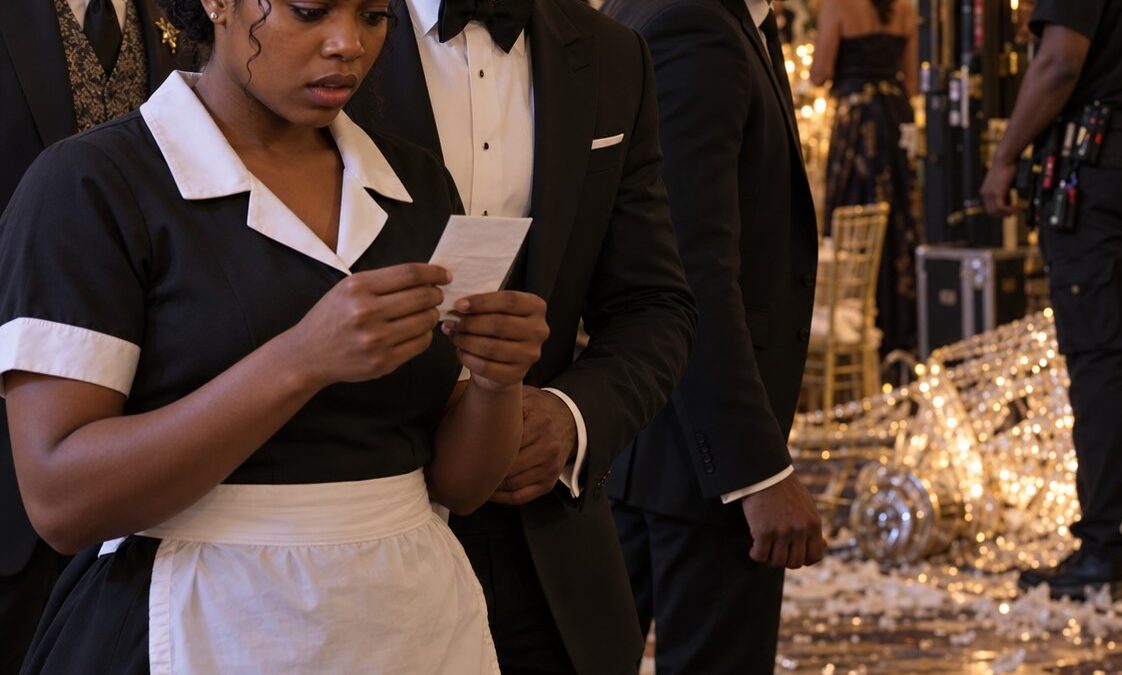
Nora put her hand in her apron.
Her fingers found a second fold of paper.
She had not put it there.
The man in the rigging jacket stopped when Tomas turned toward him.
Cassian watched Nora’s face.
“What is it?”
“A receipt.”
“For what?”
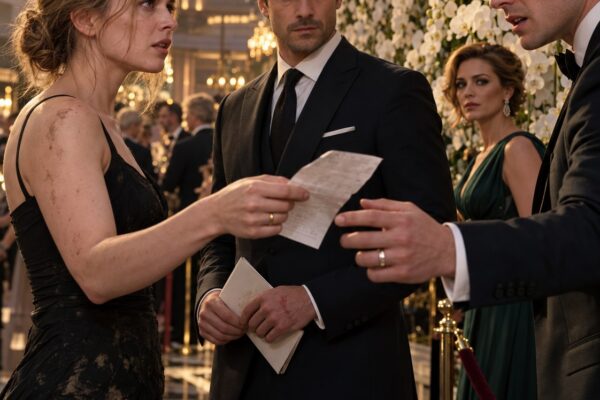
She opened it.
The paper was thin enough to show the blue ink through its back.
At the top was the hotel’s service desk number.
Below it, someone had written Nora Bell.
The time was 8:12 p.m.
The item was listed as an envelope.
The signature at the bottom was hers.
Except it wasn’t.
Nora looked up.
“I never signed this.”
The man in the jacket moved toward the exit.
Tomas spoke quietly into his radio.
Two hotel guards stepped into the corridor ahead of him.
“Don’t touch him,” Cassian said.
Tomas frowned.
“We need to know who he is.”
“The police can ask.”
A crystal bead rolled from the table and struck Nora’s shoe.
Her ankle hurt where Tomas had grabbed it.
Cassian noticed.
“Can you walk?”
“Yes.”
“You’re favoring it.”
“It’ll pass.”
He pulled a chair from an untouched table and set it behind her.
Nora hesitated.
“You don’t have to.”
“I know.”
She sat.
Adrian approached with his phone still in his hand.
“The house manager says the receipt is standard.”
Nora held it up.
“The number isn’t.”
Adrian’s smile remained.
“What’s wrong with it?”
“Service desk receipts start with a six.”
“This starts with a nine.”
“The contractor desk uses nines,” Elise said from behind him.
She had crossed the ballroom without Nora seeing her.
Elise’s voice was steady now.
“My charity uses the same desk for deliveries.”
Adrian turned to her.
“Are you certain?”
“I’ve signed enough of them.”
Nora examined the receipt again.
An envelope.
Her name.
A false signature.
Somebody wanted a record that she had accepted something before the chandelier fell.
Cassian took the paper by its edges.
“We’ll give this to the police.”
Adrian held out his hand.
“I can preserve it.”
Cassian folded his hand around the receipt.
“You’ve done enough.”
A uniformed officer entered through the service doors.
Behind her came another officer and the hotel manager.
Nora felt the old dread return.
Managers had a way of standing beside uniforms.
Cassian stood beside Nora instead.
He told the officer what Nora had seen.
He included the chair.
He included the work order.
He included the false receipt.
He did not call the fall an accident.
The officer asked Nora to describe the chain.
“It jerked sideways first,” Nora said.
“Like somebody released it.”
“You saw a person?”
“No.”
She hated how small the answer sounded.
Cassian’s cut had begun to bleed again.
Elise handed him a clean napkin.
He pressed it to his cheek.
“Why were you reading the orders?” he asked Nora.
“My brother died behind a locked service door.”
Cassian lowered the napkin.
“Where?”
“The Calder House.”
He knew the name.
She saw it before he spoke.
“That hotel belonged to my father,” he said.
Nora gripped the chair.
“The report said the door had been inspected.”
“I remember.”
“My brother tried it anyway.”
Cassian looked at the yellow slip.
Nora had spent seven years believing the Vale family had decided what the report would say.
She had never expected one of them to ask her to stay.
The officer returned from the service corridor.
“The man in the jacket gave us a name,” she said.
“He says he came here to warn Ms. Bell.”
Nora rose.
The officer looked at the receipt.
“He also says someone paid him to put that in your apron.”
* * *
The rigging worker’s name was Owen Beck.
He waited with the officers in a small conference room off the ballroom.
Nora saw him through the glass door.
He was younger than she had thought.
His hands shook around a paper cup.
The officer asked Nora to identify him.
She did.
Then she asked why he had not warned anyone before the chandelier fell.
Owen stared at the cup.
“I thought they were lowering it after the gala.”
“Who told you that?”
“The job sheet.”
Nora placed the yellow order on the table.
Owen shook his head.
“That isn’t what I got.”
He had a photograph on his phone.
His sheet said to inspect the chain before guests arrived.
The signature at the bottom appeared to be his.
He said it had been added.
The officer took photographs of his screen.
She asked the hotel to preserve its work records and security footage.
She asked Owen to stay.
Adrian appeared in the doorway.
“The ballroom is cleared,” he said.
“The press is outside.”
Cassian did not turn.
“Then give them the truth we have.”
“We don’t have much.”
“We have a fallen chandelier.”
Adrian’s jaw tightened.
Cassian noticed.
So did Nora.
Elise offered to call the hotel’s general manager.
Nora stopped her.
“Please call the night engineer first.”
Elise looked surprised.
“Why?”
“The work order was behind his schedule.”
They found the engineer in the loading bay.
His name was Mr. Dalca.
He had worked at the hotel for twenty-two years and wore a flashlight clipped to his belt.
He remembered pinning the cleaning order at four that afternoon.
He remembered its blank handwritten box.
“I checked the chain last month,” he said.
“It held.”
The officer asked who could enter the rigging access room.
“Engineering,” he said.
“And contractors with a desk receipt.”
Nora held up the paper from her apron.
Dalca read the number.
“That one was printed today.”
“You can tell?”
He pointed to the lower corner.
“New receipt books have the hotel’s current address.”
The address had changed eighteen months earlier.
Cassian studied the paper.
“What envelope was signed out?”
Dalca shook his head.
“The desk logs it.”
The desk clerk was still on duty.
She remembered an envelope addressed to Nora because maids rarely received deliveries during a gala.
A man wearing a contractor badge had brought it.
He had asked the clerk to hold it until Nora finished serving.
“He came back for it,” the clerk said.
“He said she’d signed already.”
“Did you see her?” the officer asked.
“No.”
The clerk looked miserable.
“I shouldn’t have handed it over.”
Nora asked for the time.
“Eight thirty-six.”
Three minutes before she saw the chain move.
The clerk showed the officer the desk log.
There was a signature.
It looked more like Nora’s than the one on the receipt.
Nora saw how it had been made.
“May I look closer?”
The officer slid the log toward her.
The letters tilted uphill.
Nora’s own signature did too.
She had signed hundreds of shift sheets at that desk.
One lay under the log every day.
“Whoever wrote this copied my timecard,” she said.
The officer photographed both pages.
Cassian looked at the clerk.
“Do you remember the contractor?”
“Dark jacket.”
“Name?”
“He turned his badge backward.”
The officer requested the desk camera footage.
Nora went with Cassian to the building office.
He could have sent someone else.
Instead, he waited while the technician found the recording.
At 8:11, a man in a dark jacket set an envelope on the counter.
His back faced the camera.
At 8:36, he returned.
This time he turned enough for Nora to see his profile.
It was Owen.
Nora stepped away from the screen.
“He lied.”
“Possibly,” Cassian said.
“He put the receipt on me.”
“He said he did.”
“He also took the envelope.”
Cassian asked the technician to save the full recording for the officer.
On the way out, Nora’s phone rang.
Her supervisor.
Nora answered.
“You’re off the schedule,” the woman said.
“Until we know what happened.”
Nora stopped walking.
“My rent is due Friday.”
“I’m sorry.”
The call ended.
Cassian had heard enough.
“I’ll speak to the manager.”
“No.”
“He can’t punish you for this.”
“He already has.”
Nora slipped the phone into her apron.
“If you fix it for me, he can undo it when you leave.”
Cassian considered that.
“What would last?”
“A written decision.”
“Then we’ll ask for one.”
They found the officer speaking with Owen.
He had changed his story.
A stranger had paid him five hundred dollars to carry the envelope, he said.
He had not seen what was inside.
He had never touched the chain.
The officer asked for the stranger’s number.
Owen gave it to her.
Nora looked at the work order again.
A small code sat beside the cleaning time.
C14.
Her stomach tightened.
The old Calder House inspection report had carried the same code.
She had kept a copy since her brother died.
She knew because she had read it until the paper softened at its folds.
Cassian saw her face.
“What is it?”
“This order came from the same contractor system.”
“The one that inspected Calder House?”
Nora nodded.
Cassian took out his phone.
He called his office and asked for every Calder House maintenance contract from seven years ago.
Adrian appeared at the end of the hall.
He had come to ask whether Cassian needed a car.
Cassian ended the call.
Then he said the contractor’s name aloud.
“Pike Facilities.”
Adrian stopped.
His family had owned it before he joined the Vale company.
* * *
By morning, the chandelier was secured behind a police barrier.
An independent engineer examined the rigging with the hotel’s insurer present.
Nora gave the officer her old Calder House report.
The officer copied it and returned the original.
She warned Nora that a shared code did not prove a shared cause.
Nora knew.
She also knew who might have kept the rest.
Her brother’s friend, Daniel Price, had been on the same maintenance shift the night of the fire.
He had moved out of the city afterward.
Nora had his number.
She called him from the hotel café.
Daniel answered on the fourth ring.
When she told him about the chandelier, he went quiet.
“C14 again?” he asked.
“You remember it?”
“I remember who told us to use it.”
Nora looked across the café.
Cassian stood at the counter, buying two coffees.
“Who?”
Daniel asked if they could speak in person.
He now ran a repair shop forty minutes away.
Cassian offered a car.
Nora accepted only after the officer said she wanted to meet Daniel too.
They drove north with the officer in a separate vehicle.
Tomas sat beside the driver.
He had apologized to Nora that morning.
He had used few words.
“I hurt your ankle.”
“Yes.”
“I was wrong.”
“Yes.”
He had nodded.
The bruise was still there.
Nora respected the apology more because Tomas had not asked her to make it easy.
Daniel’s shop smelled of warm rubber and coffee.
He looked older than twenty-seven.
He gave Nora a paper bag.
Inside were copies of work orders from the Calder House.
Daniel had taken them when the hotel closed.
“I couldn’t make sense of them then,” he said.
The officer spread them on a clean workbench.
The door that trapped Nora’s brother had been scheduled for repair two weeks before the fire.
A later order marked it complete.
The signature belonged to a technician Daniel knew.
“That man was overseas,” Daniel said.
“I have a picture of his departure card.”
The officer asked Daniel to send it to her.
Cassian found another page.
A request to replace the door’s latch had been denied.
The denial came from Pike Facilities.
Nora remembered the official report.
It blamed an electrical fault and called the locked door unrelated because the exit was supposedly clear.
“It wasn’t clear,” she said.
Daniel rubbed his forehead.
“No.”
Nora’s brother had gone back for a coworker.
Both reached the service door.
Only the coworker made it through after firefighters forced it open.
Nora had never been told that part.
Daniel had been afraid to tell her.
He said it plainly.
“I thought it would hurt you more.”
Nora looked at him.
“It hurts that you decided for me.”
He nodded.
“I know.”
The officer photographed the records and took Daniel’s statement.
She explained that the old case would need its own review.
The new case gave investigators a reason to compare the systems.
That afternoon, Cassian’s company lawyer found the current contractor agreement.
Pike Facilities had been dissolved years earlier.
Its software and client records had been sold to a larger firm.
Adrian had kept a private consulting contract with that firm.
He had never listed it on the conflict disclosures he signed for Cassian’s company.
Cassian read the contract twice.
Adrian entered his office without knocking.
“You’re looking into my old business.”
“I am.”
“Because a maid found a code?”
“Because you didn’t disclose the contract.”
Adrian closed the door.
Nora stood beside the desk.
He glanced at her.
“Some people see a pattern wherever they’ve been hurt.”
“Some people leave paperwork,” she said.
Adrian smiled faintly.
“You should go home.”
Cassian stepped toward him.
Adrian raised a hand.
“I mean she needs rest.”
Nora knew better.
A message appeared on her phone as Adrian left.
It came from an unknown number.
A photograph of her apartment door.
No words.
She showed Cassian.
He called the officer.
Nora called her landlord and asked him to keep the entry camera recording.
Then she called her neighbor, who had a spare key and a loud dog.
The officer arranged a patrol visit.
Cassian offered her a room at another hotel.
Nora almost refused.
Then she thought of her neighbor opening the door first.
“I’ll take one night,” she said.
“Your choice.”
At the hotel, she ate a grilled cheese sandwich from room service.
Cassian ate the other half because she had ordered too much.
His phone kept lighting up.
He turned it face down.
“Why did you stay with Adrian?” she asked.
“My father trusted him.”
“That isn’t an answer.”
Cassian watched the rain on the window.
“He stayed when my father was sick.”
Nora pulled the plate closer.
“People can do one decent thing.”
“Yes.”
“And still do another.”
“Yes.”
The officer called before midnight.
The engineer had found deliberate interference with the chandelier’s safety catch.
The building camera showed Adrian entering the contractor desk at 8:02 p.m.
Owen had entered six minutes later.
The officer had not yet found who sent the photograph of Nora’s door.
Then Cassian’s lawyer sent one more record.
Adrian’s consulting fees rose whenever a Vale property failed an inspection and had to hire emergency repairs.
Cassian read the numbers.
Nora watched his face harden.
Adrian had made money from the Calder House door.
He had made money from tonight’s failed inspection too.
* * *
The company board met two days later.
The police investigation was still open.
Cassian had no intention of holding a trial in a conference room.
He needed the board to suspend Adrian’s authority while the records were examined.
Adrian had called the meeting first.
When Nora entered, every director looked at her uniform.
She had worn it on purpose.
Her supervisor had restored her shifts in writing that morning.
The hotel’s manager had also agreed to a review of its service desk procedures.
Nora sat beside the company lawyer.
Elise sat on Cassian’s other side.
She and Cassian had postponed their wedding.
Neither had offered the board an explanation.
Adrian stood at the end of the table.
He spoke calmly.
He said the chandelier had failed after years of poor hotel maintenance.
He said the contractor code was common.
He said his consulting agreement had been approved by Cassian’s father.
He had a signed letter.
The directors passed it around.
Cassian looked at the signature.
“It’s his,” he said.
Adrian nodded.
“My disclosure was late.”
“That doesn’t make me a criminal.”
One director asked why Nora was there.
Adrian answered before anyone else.
“She believes my old company caused her brother’s death.”
Nora felt the attention settle on her.
The director looked uncomfortable.
Adrian turned to her.
“I’m sorry for your loss.”
Nora said nothing.
He continued.
“The service door was inspected by the city.”
“The city relied on our report.”
The lawyer placed the old report on the screen.
A director leaned forward.
Adrian did not flinch.
“Then let the city review it.”
“We have,” said a woman at the doorway.
The officer from the hotel entered with a city fire investigator.
They had been invited to present what they could release.
The officer did not accuse Adrian.
She showed the board the hotel’s preserved camera footage.
Adrian at the contractor desk.
Owen collecting the envelope.
Adrian spoke first.
“I had a meeting with the desk supervisor.”
The supervisor’s calendar confirmed a meeting.
It did not confirm its purpose.
Adrian looked at Cassian.
“You know what this is.”
Cassian waited.
“You need someone to blame.”
“For what?”
“For the empire your father left you.”
The room stayed quiet.
Adrian turned to the directors.
“He was going to announce a safety audit.”
“He would have found failures.”
“He would have needed a villain.”
Cassian’s jaw moved once.
Nora understood why Adrian had chosen that argument.
The audit was real.
The failures might be real too.
Adrian could make Cassian’s search for him look like fear of bad publicity.
A director asked whether the yellow order could have been written by any hotel employee.
“It could,” the officer said.
Adrian opened his hands.
“There.”
Nora asked to see the original.
The officer gave it to her inside a clear sleeve.
Nora looked at the handwritten instruction she had seen in the ballroom.
Then she turned the paper over.
A faint line of blue numbers ran along the bottom edge.
She had missed them under the ballroom lights.
“The receipt,” she said.
The officer handed it over.
Nora placed the two sheets together.
The blue numbers aligned.
The false receipt had been torn from the same printer strip as the work order.
Adrian’s smile disappeared.
The fire investigator took both pages.
He held them against the window.
The cut edges matched.
The officer explained that the contractor desk printer numbered jobs in sequence.
Its stored log showed the work order and receipt printed seconds apart.
The account used was Adrian’s personal contractor account.
His lawyer could challenge what that meant.
He could not make the numbers vanish.
Adrian folded his arms.
“Someone had access.”
“Possibly,” the officer said.
“We’re investigating that.”
She turned to the board.
“The independent engineer also found tool marks on the safety catch.”
“The pattern matches a wrench recovered from the rigging room.”
“The wrench carries a partial print.”
She did not say whose.
She did not need to.
Owen had given a second statement that morning.
The officer had checked his bank account and phone records before bringing it to the prosecutor.
Owen said Adrian had promised him twenty thousand dollars to disable the catch.
He said he had believed the ballroom would be empty.
When he learned Cassian would sit beneath it, he tried to send a warning.
He sent the photograph of the order to Cassian.
He wrote, SHE HAS THE OTHER ONE, because Adrian had told him Nora had found a slip and must have the envelope too.
Owen had not known what was in it.
The envelope held a copy of the old Calder House latch request.
Adrian had brought it to the hotel to destroy it in the rigging room furnace.
The desk clerk had kept its delivery scan.
The officer had recovered the envelope from Owen’s locker.
Adrian gripped the chair behind him.
“You believe him?”
“The records support parts of his statement,” the officer said.
“We’re still checking the rest.”
The board voted to suspend Adrian’s access.
Nobody applauded.
Adrian looked at Nora as the officers asked him to come with them for further questioning.
“You think he’ll keep your job safe?”
Nora stood.
“My work keeps it safe.”
She held his gaze.
“The records can speak for my brother.”
Adrian left with his lawyer and the officers.
Months passed before the criminal case ended.
Owen pleaded guilty to a lesser charge and testified.
Adrian pleaded guilty to fraud, falsifying records, and his role in the chandelier sabotage.
The court sentenced him to prison and ordered restitution.
A separate review corrected the Calder House findings.
It could not bring Nora’s brother back.
It put the denied latch repair in the public record under his name.
That mattered to her.
* * *
Spring came slowly.
Nora’s ankle healed.
The hotel replaced the chandelier with a smaller fixture and added an independent inspection schedule.
Her supervisor began asking the service staff to review work orders at the start of each shift.
The first meeting lasted eleven minutes.
Nora had never seen so many people grateful for a short meeting.
Cassian’s audit uncovered three more buildings with deferred repairs.
He paid to fix them.
He also published the findings.
It cost him contracts.
Elise helped him explain the work to the tenants.
They remained friends after ending their engagement.
She told Nora over coffee that she and Cassian had been excellent at standing beside each other in photographs.
“That’s a skill,” Nora said.
“Apparently not a marriage.”
Elise laughed.
She had never known about Adrian’s consulting fees.
Her charity’s desk records had helped establish the timeline.
Nora thanked her for speaking up that night.
Elise looked down at her cup.
“I wish I’d looked harder sooner.”
“So do I.”
It was enough.
Daniel visited Nora one Sunday.
They took flowers to her brother’s grave.
He told her more about that night.
She told him when she needed him to stop.
He did.
On the way home, he bought two terrible gas station coffees.
Her brother would have mocked them.
They drank them anyway.
Cassian came to Nora’s apartment building in June.
He waited in the lobby until she came down.
He carried a folder.
“That looks expensive,” she said.
“It might be.”
Inside was an offer to lead a new safety program for service workers across his properties.
The pay was more than twice her wages.
Nora read every page.
“You chose the title.”
“I asked people who do the work.”
“You chose the salary.”
“I asked them that too.”
She closed the folder.
“I’ll take it if the workers choose the committee.”
“They will.”
“And if the reports go to the city when a repair is denied.”
“That’s in the third section.”
She opened it again.
He waited.
There were no cameras in the lobby.
No directors.
No room full of guests to watch him make an offer.
Nora liked that.
“I’ll think about it,” she said.
“Good.”
“You thought I’d say yes.”
“I hoped.”
She handed him back the folder.
“You can leave it.”
He smiled.
Then the smile faded.
“I owe you an apology.”
“You gave me one at the hotel.”
“That was for the chair.”
He had thanked her for saving him before she left that night.
Nora remembered.
“This is for Calder House,” he said.
“My family accepted a report that should have been questioned.”
“I accepted Adrian’s explanation for years.”
“I can’t repair what that cost you.”
“No.”
“I can keep asking harder questions.”
Nora leaned against the lobby wall.
“That’s your job now.”
“It is.”
She studied him.
“Don’t ask me to forgive the whole company in one conversation.”
“I won’t.”
“And don’t send Tomas when you want to talk to me.”
Cassian winced.
“Fair.”
“He’s fine.”
“I’ll tell him.”
“Don’t.”
That made him laugh.
Nora took the job in July.
The committee elected its own chair.
It was not Nora.
It was a dishwasher named Bev who could find an unsigned repair request in a room full of executives.
Nora loved her within a week.
The work was slower than a dramatic rescue.
It involved budgets, phone calls, site visits, and arguments over door closers.
Some days she missed the clean end of a shift.
Most days she liked seeing a problem fixed before anyone was hurt.
Cassian visited the office once a month.
He knocked.
That took practice.
In October, he asked Nora to dinner.
She said no.
He nodded and did not ask why.
In November, she asked him to walk with her after a committee meeting.
They bought hot pretzels from a street cart.
He got mustard on his coat.
She laughed so hard she had to stop walking.
At the corner, he asked again.
“Dinner?”
“Yes.”
“Friday?”
“Yes.”
He looked relieved.
Nora pointed at his coat.
“You have to change first.”
“I own another one.”
“Good.”
They walked on.
Nothing had been decided for her.
That was why she could choose it.
* * *
Five years later, Nora stood beneath the ballroom ceiling.
The new fixture gave off warm light.
It weighed less than a third of the old one.
A framed yellow work order hung in a small exhibit near the service entrance.
Nora had argued against displaying the original.
The museum had agreed to use a copy.
The original remained with the case records.
Beside it was her brother’s photograph and a description of the safety program that now covered forty-two buildings.
The program had no heroic name.
Bev had vetoed six.
Cassian called that its first sound decision.
Tonight’s gathering honored the workers who had reported hazards early.
Nora wore a dark suit.
She still noticed the service doors first.
They opened freely.
Daniel arrived late with flowers.
Elise arrived on time with three reporters she had persuaded to cover the workers instead of the guest list.
Tomas stood near the entrance.
He had become fond of Bev.
Bev pretended not to notice.
Cassian found Nora beside the display.
He had a fresh cut on one finger.
“What happened?”
“An envelope.”
“You should avoid dangerous paper.”
“I’ve been told.”
He looked at the photograph of her brother.
“He would have hated this room,” Nora said.
“Probably.”
“He would have eaten everything in it.”
“That I believe.”
She touched the frame.
For years, the yellow paper had meant that someone had seen a danger and left it for someone else.
Now it hung beside records of repairs made because people had spoken.
Cassian offered his hand.
“Dance?”
Nora looked at the empty space where his chair had once stood.
“Is the ceiling secure?”
“Bev inspected it herself.”
“Then yes.”
They crossed the floor.
The musicians began a slow song.
Nora saw Daniel smiling.
Elise raised her glass.
Bev checked a door before taking Tomas’s hand.
Some things had healed.
Some things still hurt.
The doors opened.
The records stayed.
Her brother’s name was spoken.
Cassian drew Nora gently into the music.
Five years earlier, there had been no time for a speech.
Tonight, she had all the time she wanted.
THE END