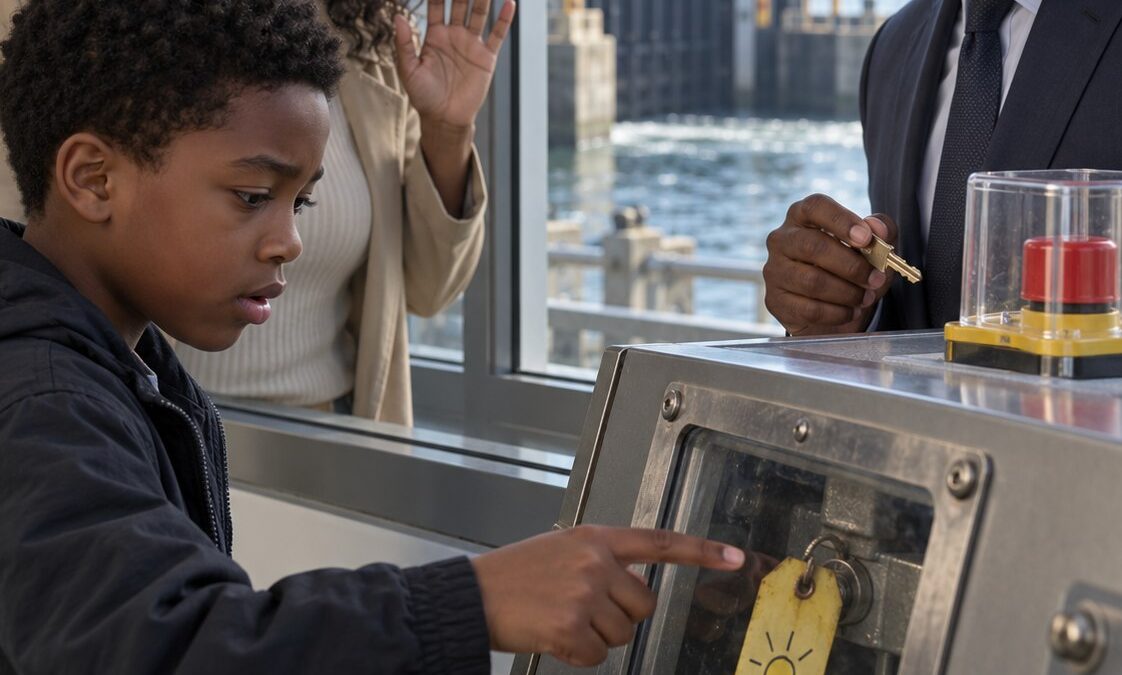
A yellow tag caught in the floodgate window told a boy his missing mother was trapped where the water would rise
Chapter 2: Twelve Rays
The numbers changed again.
Owen watched the display.
Ninety seconds.
His mother struck the window with her palm.
There was no sound through the glass.
Only her mouth moving.
Colin reached the panel.
Owen caught his wrist.
“Give me the key.”
“Let go.”
“She’s behind that window.”
“I can see that.”
The admission stopped Owen cold.
Colin tried to pull away.
Owen held on.
“Then open it.”
“The controls are delicate.”
“The water’s coming in.”
A woman from the front row stepped between them.
She wore a hard hat over a neat gray suit.
Owen recognized her from the ceremony program.
She was the state inspector.
“My name is Patel,” she said.
She held out her hand.
“Give me the key, Mr. Mercer.”
Colin looked past her.
The cameras were still pointed at him.
“Of course.”
He gave her the key.
“Someone put her in there,” Owen said.
Patel studied his face.
“Where’s the access door?”
Colin pointed toward the service building.
“It won’t open during a cycle.”
“Then call the crew who can stop it.”
“I already have.”
He held up his phone.
Patel glanced at its blank screen.
“Call them now.”
Colin’s jaw tightened.
She took out her own phone.
Owen turned back to the window.
His mother had sunk below its lower edge.
The display read sixty-eight seconds.
He shouted her name.
She rose again, gripping the frame.
Water glinted around her waist.
Patel spoke rapidly into the phone.
Then she ran toward the service building.
“Stay here,” she told Owen.
Owen followed her.
“I know the door.”
“That doesn’t mean it’s safe.”
“She showed me last summer.”
His mother had repaired the chamber lights then.
She had made him wait outside with a bag of sandwiches.
He remembered its green door.
He remembered two workers having to turn its wheel together.
Patel stopped at the service building.
Two crew members rushed out.
One carried a long metal handle.
“Shut the upstream valve,” Patel told them.
“Control room’s already on it,” one said.
“The chamber drain failed.”
“Then use the manual isolation.”
The older worker looked at Owen.
“You’re Tessa’s kid.”
“She’s in there.”
The man swore under his breath.
They ran.
Owen reached the green door first.
The wheel would not move.
The worker fitted his handle over it.
Patel gripped the other side.
Together, they turned.
Once.
Twice.
The display in the distance went dark.
The horn stopped.
Water spilled from the door’s lower seal.
Owen stepped back.
The workers pulled it open.
His mother came out between them.
She was soaked and shaking.
But she was walking.
Owen reached her before anyone else.
For a moment, she held him so tightly he could hardly breathe.
“Did you get my message?” she asked.
“I got one.”
Her arms loosened.
“What did it say?”
He looked toward Colin.
“That I shouldn’t come looking.”
Tessa’s face changed.
“I never sent that.”
* * *
An ambulance crew checked Tessa beside the service building.
They wrapped her in blankets.
Owen sat near enough to touch her sleeve.
Colin stood twenty feet away.
He was talking to two police officers.
Owen could not hear him.
He could see how easily Colin smiled.
Tessa followed his gaze.
“I should have told you sooner,” she said.
“About him?”
“About what I found.”
“You knew?”
“I knew something was wrong.”
She took his hand.
“Colin wasn’t supposed to know I’d found it.”
Patel returned with an officer.
His name was Detective Shaw.
He asked if Tessa felt able to speak.
She nodded.
Shaw turned off his body camera for her medical assessment, then opened a recorder with her consent.
Tessa told him she had worked on the gate’s pumps.
Three weeks earlier, she had noticed a replacement part with the wrong rating.
It controlled drainage from the inspection chamber.
The paperwork named an approved manufacturer.
The part itself carried a different stamp.
“Could it have been a mistake?” Shaw asked.
“That’s what I thought.”
She had photographed the stamp.
She had also checked the serial number against the manufacturer’s public catalog.
It belonged to a smaller pump.
The smaller pump cost far less.
Owen watched Shaw write that down.
“Who signed for the replacement?”
“Colin.”
Colin ran public works.
He also supervised the gate contract.
Tessa had married him two years before.
That made the answer hurt.
Shaw asked about the last six days.
Tessa described a call from Colin.
He said a technician had found another problem.
He asked her to meet him at the service building.
She went after Owen fell asleep.
“I left him a note,” she said.
Owen looked up.
“There wasn’t one.”
“I put it under the sugar bowl.”
Every morning since her disappearance, Owen had poured cereal in Colin’s silent kitchen.
The sugar bowl had disappeared.
Colin had said ants were getting into it.
Tessa told Shaw she found the chamber door open.
Colin was waiting inside.
He asked for her phone.
When she refused, he closed the door.
There was no signal in the chamber.
She had used the inspection tags she kept in her work bag to mark each day.
She had found a maintenance tap.
She had drunk from it.
Twice, someone had passed food through the upper service hatch.
She never saw who.
“Why didn’t you call out?” Shaw asked.
“I did.”
The chamber sat inside thick concrete.
The service building was locked after hours.
During the day, motors covered her voice.
She knew the public ceremony was scheduled.
She knew the drainage system was faulty.
She had held one tag against the window with a loose strip of gasket.
It was the only thing bright enough to show outside.
Owen touched its damp paper.
The crooked sun had begun to bleed.
“I saw it.”
“I hoped you would.”
An officer brought over Tessa’s work bag.
It had been found in Colin’s garage.
Inside was her phone.
Shaw sealed it in an evidence bag.
There was no outgoing message to Owen in its recent history.
That did not yet prove who had sent the message he saw.
Owen offered his own phone.
Shaw photographed the screen.
The message came from Tessa’s number.
Tessa stared at it.
Colin had taken her phone.
He had known her passcode.
She had given it to him months earlier, when she broke her wrist and needed help answering calls.
Owen felt suddenly cold.
“I thought you meant it,” he said.
“I know.”
“I got mad at you.”
“I would have been mad too.”
Patel came back from the control room.
The crew had preserved the controller logs.
She had seen something she wanted Shaw to know.
The emergency stop had worked.
Someone had separately commanded the chamber’s drain valve to close.
The command came from Colin’s access card.
* * *
Police kept Colin at the waterfront.
They did not arrest him immediately.
Shaw wanted the records secured first.
Tessa wanted Owen somewhere warm.
He refused to leave until she came with him.
They went to the hospital together.
Doctors checked her lungs and temperature.
They gave her dry clothes.
Owen bought two chocolate milks from a vending machine.
Tessa took one sip.
“You still hate the strawberry kind?”
“It tastes like medicine.”
“It does.”
He had missed hearing her agree with him.
She asked about school.
He told her his math teacher had sent home assignments.
He had completed none.
“That’s understandable,” she said.
“It’s still due Monday.”
“We’ll ask for more time.”
“Colin said school would help me settle down.”
Tessa lowered her carton.
“He won’t decide things for you again.”
Shaw arrived that evening.
He had a woman with him.
She introduced herself as Elena Price, an investigator from the state contractor board.
Price had checked the purchase order Tessa described.
It listed the expensive drainage pump.
The supplier’s invoice listed the smaller one.
Both had been paid.
The difference went through a second company as an “installation adjustment.”
That company belonged to Colin’s former business partner.
“Is he the one who brought food?” Tessa asked.
“We’re looking into it,” Shaw said.
Owen told them about the sugar bowl.
An officer searched the house under a warrant.
The bowl was in the garage.
Tessa’s note was still beneath it.
The paper had stuck to a ring of dried syrup.
Owen read it with her permission.
Back after I check the pumps. Love you. Save me cereal.
He folded his hands in his lap.
She had meant to come back before breakfast.
Shaw showed Tessa a photograph of the chamber door.
A strip of dark rubber had been wedged across the inside release.
Tessa recognized the material.
It came from the spare gasket kit in Colin’s office.
That mattered.
She had tried the release each day.
She had wondered whether she was too weak to move it.
She was not.
Before Shaw left, Owen asked a question.
“Did he make the water come in?”
Shaw took a chair.
“The gate cycle was scheduled,” he said.
“The chamber should have been dry.”
“Did Colin know it wouldn’t be?”
“We’re finding out.”
Owen looked at his mother.
She reached for him.
He stepped close enough for her hand to rest on his shoulder.
That night, the hospital gave them adjoining beds in a quiet room.
Owen woke when Tessa cried out.
He switched on the lamp.
“Door’s open,” he said.
“I know.”
He checked it anyway.
Then he brought the chair beside her bed.
The next morning, Price returned.
She had found a calendar invitation in Colin’s work account.
It called the gate cycle a final demonstration.
Colin had moved it from the following week to the day after Tessa disappeared.
He had approved the change himself.
* * *
The town had planned a celebration after the gate opened.
Instead, its council called an emergency meeting.
The project was suspended.
The state ordered an independent inspection.
Shaw asked Tessa to attend the meeting.
She could refuse.
She chose to go.
Owen chose to sit beside her.
The room smelled of wet coats and old coffee.
Neighbors filled every chair.
Some had watched Owen press the emergency stop.
Others had only seen the video.
Colin sat with an attorney.
He looked rested.
Tessa did not.
A council member began with the gate’s safety.
Price explained what her team had confirmed.
The drainage pump did not match the approved plans.
The drain valve had been closed by a manual command.
Its access record named Colin’s card.
Colin’s attorney stood.
“A card can be borrowed.”
Price agreed.
“A card can also be reported missing.”
Colin had made no such report.
The attorney pointed out that Tessa had access to the chamber.
She had gone there voluntarily.
No one in the room disputed that.
Then Colin spoke.
“I made an error in judgment,” he said.
“I thought Tessa was upset about the project.”
“I wanted her to take a few days.”
Someone behind Owen muttered angrily.
The council chair asked for quiet.
Colin looked directly at Tessa.
“I had food brought to her.”
“You locked the door,” she said.
“I asked you to rest.”
“You blocked the release.”
“I didn’t know it was blocked.”
Owen felt Tessa’s hand tighten around his.
Colin turned to the council.
“This family has been under strain.”
He mentioned their arguments over work.
He mentioned Tessa’s long shifts.
All of it was true.
He arranged those truths around the closed door.
For a moment, Owen saw people considering his version.
Shaw stood at the back.
The meeting was not a trial.
He did not interrupt.
The chair asked Tessa whether she wanted to respond.
She took the yellow tag from an envelope.
It had dried crooked.
Its sun was barely visible.
“I filled these out for every chamber visit,” she said.
“The date, the equipment, the work completed.”
She held it up.
“Colin signed this one.”
Owen stared.
He had only looked at the sun.
Below it was a signature.
Tessa explained that Colin had entered the chamber after she did.
His signature confirmed an inspection.
The time was printed by the handheld scanner.
He had reported the chamber empty.
Colin’s attorney rose again.
“That document could have been prepared earlier.”
Price walked to the front.
Her office had obtained the scanner records from the state system.
The tag’s serial number matched an entry uploaded that night.
The scanner also recorded Colin’s employee number.
And its timestamp placed him inside the chamber forty minutes after Tessa arrived.
“That doesn’t prove I trapped her,” Colin said.
“No,” Price answered.
She handed the chair another document.
It was the valve history.
The drain had closed three minutes after Colin scanned the tag.
It had stayed closed for six days.
The chair called a recess.
Shaw met Colin outside the room.
Two officers stood with him.
Owen did not watch them leave.
He watched his mother put the tag back in its envelope.
Later, in a courthouse, more evidence was heard.
The business partner admitted Colin had ordered the cheaper pump.
He admitted carrying food to the service hatch.
He said Colin told him Tessa was there by choice.
Shaw found the message to Owen in a backup of Tessa’s phone.
It had been sent from her account after Colin took it.
A judge allowed the phone records, scanner records, and valve logs into evidence.
Colin pleaded guilty to fraud and unlawful imprisonment.
The case concerning the dangerous gate cycle was resolved with a separate plea.
He received a prison sentence.
His partner received a lesser sentence after cooperating.
The contractor board suspended the company involved.
The town sued to recover what it had paid.
The council had to answer its own question, too.
Its managers had ignored earlier complaints about Colin’s invoices.
An independent audit made those failures public.
On the day of sentencing, Colin spoke once to Tessa.
“You would have lost that job anyway.”
She held the yellow tag between two fingers.
“I kept my son,” she said.
* * *
Spring came late to the harbor.
Tessa returned to work in May.
She did not work on the floodgate.
The town had hired an outside firm to rebuild its drainage system.
Tessa took a position inspecting pumps for the county.
She chose shorter shifts.
Some afternoons, she collected Owen from school.
He pretended this embarrassed him.
Then he waited by the door five minutes early.
They moved into an apartment above a bakery.
The stairs were narrow.
The kitchen was bright.
On their first morning, Owen burned toast.
Tessa said the smoke alarm sounded familiar.
He threatened to move back out.
She asked whether he planned to take the toaster.
He stayed.
The town offered Tessa a settlement.
Her lawyer explained each part.
Medical costs.
Lost wages.
The failure to protect an employee who had reported a defect.
She accepted what covered those losses.
She used some of it to start a small fund for workers who needed help reporting safety problems.
Owen designed its first flyer.
He drew a sun in the corner.
It had twelve rays.
Tessa said it was perfect.
Owen said the lettering leaned left.
They used it anyway.
His school gave him time to finish his missed assignments.
His math teacher returned a test with a note.
You can ask for help before the last minute.
Owen put it on the refrigerator.
Tessa read it aloud whenever he claimed homework had disappeared.
Some things remained difficult.
A closed service door made Tessa pause.
The floodgate’s horn made Owen stop walking.
They had ways through those moments.
Sometimes they talked.
Sometimes they waited.
Neither told the other to hurry.
One Saturday, Tessa brought home a sugar bowl.
It was blue, with a chipped lid.
Owen found a note beneath it.
Gone for milk. Back in ten. Love you.
He left the note there until she returned.
Then he put it in a drawer.
The bakery owner, Mrs. Vale, asked if Owen wanted a weekend job.
He could label boxes and count change.
He liked the counting.
He disliked the pink icing that got on everything.
By summer, he had saved enough for a used bicycle.
Tessa offered to pay half.
“No,” he said.
“I want to know I bought it.”
She understood.
At the courthouse, Tessa had never asked him to forgive Colin.
Now she asked something else.
“Do you want to hear the letters he sends?”
Colin had written twice from prison.
Owen looked at the unopened envelopes.
“No.”
“All right.”
“You can read them if you want.”
“I don’t want to.”
She put them away.
He knew she was sorry for trusting Colin.
She had said it plainly.
Owen had told her something plainly, too.
He had spent six days believing her message.
A piece of him was still angry about those days.
“I understand,” she said.
They were sitting on the kitchen floor when she said it.
The bicycle lay between them in pieces.
She passed him a wrench.
He held the rear wheel steady.
They worked until it turned freely.
In September, the rebuilt gate passed its first full inspection.
The county invited Tessa to watch the test.
She asked Owen whether he wanted to come.
“You can say no,” she told him.
He looked at the invitation.
Then at his bicycle beside the door.
“I want to see it work.”
* * *
Five years later, the harbor path ran beside the gate.
The town had added a public viewing area.
A sign explained how the system worked.
Another listed the workers who maintained it.
Tessa’s name was among them.
She had helped review the final design.
Owen, now seventeen, read the sign while she checked the time.
He was due at a college interview across town.
They had come early at his request.
The inspection window was clear.
No water stood behind it.
The chamber door remained open during public tests.
Two workers checked it together before any cycle began.
Owen watched them do it.
One held a clipboard.
The other pointed toward the open door.
He remembered a yellow square against the glass.
For years, he had kept that tag in a drawer.
Its ink had faded.
Its date had not.
Tessa had asked the town to display a copy.
The original belonged to Owen.
He carried it now inside a clear sleeve.
“Do you want to leave?” she asked.
“In a minute.”
The workers completed their checks.
One waved to the control room.
A small light changed from red to green.
The gate moved.
Slowly.
Water passed on the far side.
The chamber stayed dry.
Owen waited until the gate rose again.
Then he put the sleeve back in his pocket.
At twelve, he had seen a crooked sun and followed it.
He had broken a cover.
He had pressed a button.
Other people had opened the door.
He knew each part mattered.
Tessa held out the car keys.
“Your interview,” she said.
“Right.”
He took them, then stopped.
“Did I tell you what I’m studying?”
“Three times.”
“Good.”
“Engineering,” she said.
“Possibly.”
“You made me drive here to say possibly?”
He smiled.
Beyond her, the inspection window caught the morning light.
Nothing moved behind it.
That was what he had wanted to see.
He walked beside his mother toward the car.
THE END