He Made His Wife Tend the Gala’s Orchid Wall While His Mistress Took the Credit—Then the Feared Hotel Owner Crossed the Rope
Chapter 2: The Copper Tag
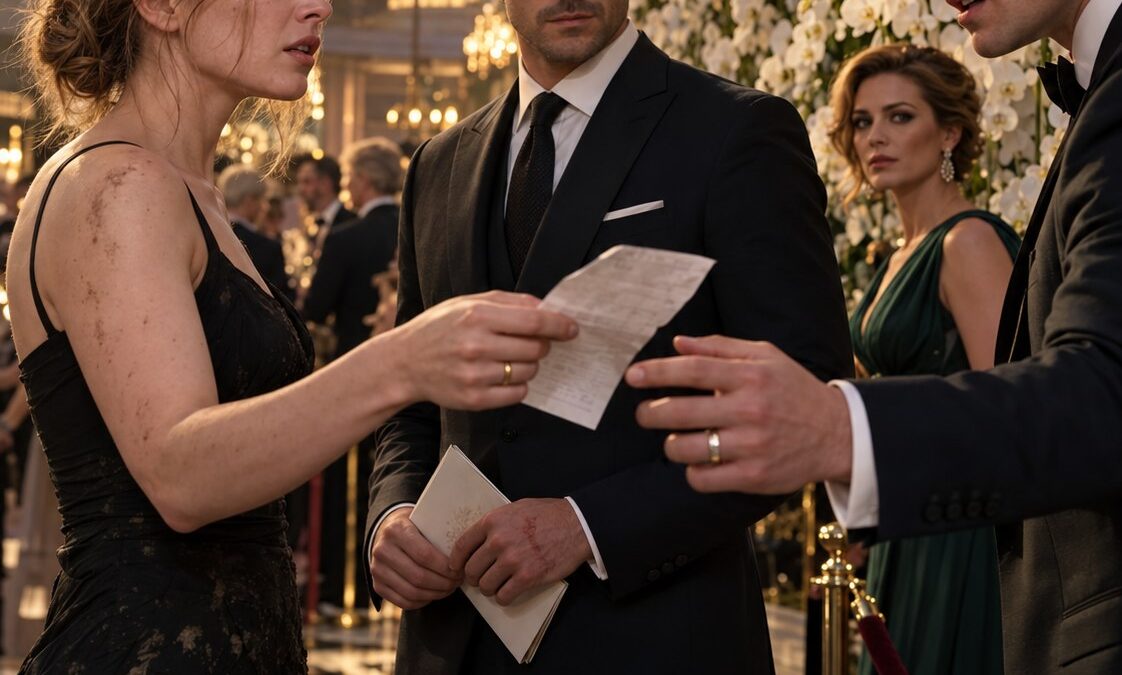
Ronan turned off the microphone.
The click sounded enormous.
Bernice reached for the receipt.
Ronan folded it into the program.
“Please leave that with me.”
“It belongs to the foundation,” Bernice said.
“It came from a program in my hotel.”
Pierce looked at Wren.
“You need to come upstairs.”
“No.”
“We can clear this up.”
“You had all afternoon.”
Celeste took one step back.
The cameras were still raised.
Ronan asked his events director to pause the program.
He did not call for guards.
He did not ask anyone to leave.
He asked Wren whether she wanted a quieter place.
“The wall,” she said.
She walked back to it.
The copper tag hung beneath the oldest orchid.
Her father’s block letters marked its front.
HAZEL STAR.
On the reverse, he had stamped a date.
June 14, 2018.
Below it sat a tiny mark shaped like a crooked H.
Wren rubbed soil from the metal.
“My father tagged this plant when he divided it.”
Ronan crouched beside her.
“Could there be others?”
“Three divisions came from it.”
“Where are they?”
“One died.”
“One’s at my nursery.”
“This one?”
“The third.”
Pierce reached the open rope.
“You’re making a scene over a receipt.”
“You printed the receipt,” Wren said.
“I didn’t.”
“You sent the program.”
“Design files.”
“And the receipt?”
He looked toward his mother.
Bernice was speaking to a hotel employee across the room.
Wren knew that look.
Pierce used it when he needed someone else to decide what he should say.
Ronan unfolded the page.
The receipt listed three hundred mature Hazel Star orchids.
It listed delivery that morning.
Its unit price was thirteen hundred dollars.
A final charge covered installation.
Wren read it twice.
“There aren’t three hundred Hazel Stars.”
“How many?” Ronan asked.
“Three ever existed.”
Pierce gave a humorless laugh.
“Botanical names get reused.”
“Not my father’s cultivar name.”
“You can prove that?”
Wren held up the tag.
“I can start.”
Ronan did not take it.
Wren appreciated that.
He asked whether she wanted a photograph.
She nodded.
He used his phone while she held the tag against the plant.
Then he photographed the receipt.
Bernice arrived.
“We have donors waiting,” she said.
“The program can wait,” Ronan replied.
“The children these grants serve cannot.”
Wren faced her.
“Which children received these orchids?”
Bernice’s mouth tightened.
“They were purchased for the launch.”
“From me?”
“Our records say so.”
“Then your records are false.”
“We will review them.”
“I want a copy.”
Bernice looked at Ronan.
“You have created a spectacle.”
“I found one,” he said.
Pierce took Wren aside by stepping close enough that the others could still hear.
“We’ll go home after this,” he said.
“We don’t live at the same address tonight.”
He looked down at her ring.
“Don’t decide that in public.”
“You made the private decision.”
His expression hardened.
“You have no idea what this could do to you.”
Wren felt fear.
She let it arrive.
Then she held the tag more firmly.
“Tell me.”
Pierce’s eyes moved to the receipt.
Bernice answered for him.
“There are financial questions.”
“About my nursery?”
“We hope they have innocent explanations.”
Ronan spoke quietly.
“Wren, I had auditors here tonight.”
Bernice turned.
“You said the review was next month.”
“It began last week.”
Ronan met Wren’s eyes.
“My hotel committed a million dollars to the greenhouse program.”
He indicated the receipt.
“This was in the expense packet.”
“Why didn’t anyone call me?”
“We were going to.”
Pierce made a sound under his breath.
Ronan heard it.
“So were you, apparently.”
Wren looked at the false signature.
She had never seen that curling final letter on anything she signed.
Pierce had.
He had once teased her for ending her name with a sharp downward stroke.
The receipt’s writer had copied her first four letters carefully.
Then guessed.
She looked at him.
“You told them I signed it.”
Pierce said nothing.
Bernice said, “No one has accused you.”
Wren read the line beneath the signature.
Payment approved by Pierce Leland.
She held the paper where he could see it.
“Your son did.”
* * *
The first records arrived before midnight.
Ronan asked his hotel counsel to preserve the event program and the purchasing packet.
Wren asked for her own lawyer.
That made Bernice visibly impatient.
It made Ronan step back.
“You should choose someone independent,” he said.
Wren called Nadia Pike.
Nadia had helped her father settle a lease dispute years earlier.
She now handled small business matters in a two-person office above a bakery.
She answered on the fourth ring.
Wren gave her the short version.
Nadia gave her a shorter instruction.
“Do not sign anything tonight.”
“I wasn’t planning to.”
“People rarely plan to when someone puts a pen in their hand.”
Wren almost smiled.
Nadia arrived forty minutes later wearing a raincoat over pajamas.
She listened to Wren first.
Then she asked Ronan for copies.
His counsel brought them into an empty hotel office.
The original purchasing packet stayed sealed in the counsel’s custody.
Wren kept the copper tag with the plant.
Nadia insisted on that.
“It proves what Wren knows firsthand,” she said.
“It doesn’t prove who wrote the invoice.”
Ronan nodded.
“What would?”
“Bank records, vendor registration, delivery records, and whoever approved payment.”
Pierce’s name appeared on the approval page.
The vendor registration named Wren Leland as owner of Leland Garden Supply.
Wren had never used that business name.
Her company was Halden Nursery.
Her father’s surname remained painted across its old wooden sign.
The registration listed her home address.
It also listed her business tax number.
Wren sat very still.
“Pierce files our taxes,” she said.
Nadia marked that down.
The vendor account had been created seven months earlier.
The receipt for the orchid wall was one of nine invoices.
Together they totaled just over seven hundred thousand dollars.
Wren turned the pages.
Raised beds.
Heating controls.
Volunteer training.
Three hundred Hazel Star orchids.
“Those plants would fill a warehouse,” she said.
“They would,” Ronan replied.
“There aren’t that many in the world.”
Nadia looked at her.
“How do we show that?”
Wren thought of her father’s notebooks.
He had logged every division and every sale.
Hazel Star had never been sold.
He had made it from two older plants over years of patient work.
She still had the original registration letter from the regional orchid society.
It did not grant ownership of a species.
It recorded his named hybrid and its parentage.
“I have his records,” she said.
“Where?”
“At the nursery.”
Pierce had a key.
For the first time, that ordinary fact frightened her.
Nadia noticed.
“Call your manager.”
Wren called Mina Alvarez, who ran the morning shifts.
Mina answered groggily.
“Is the roof leaking again?”
“No.”
Wren explained enough.
Mina became fully awake.
“I’ll go in early.”
“Don’t go alone.”
“My brother lives downstairs.”
“Bring him.”
Wren heard Mina reach for a pen.
“Which files?”
“Dad’s blue cabinet.”
“The one nobody touches.”
“That one.”
Mina promised to photograph the cabinet before opening it.
Nadia approved.
They arranged to meet there at seven.
Ronan asked whether Wren had somewhere to stay.
She considered the apartment she shared with Pierce.
Her clothes were there.
Her father’s records were at the nursery.
Her bed no longer felt like hers.
“Nadia has a couch,” Nadia said.
“I have an actual guest room.”
“Your office is smaller than my potting shed.”
“My guest room isn’t.”
Wren accepted.
Ronan offered a car.
She declined until Nadia pointed at the rain and her muddy dress.
“Consider it a ride,” Nadia said.
“Not a life decision.”
At the nursery, morning light showed frost at the edges of the greenhouse glass.
Mina had already made coffee.
Her brother waited near the entrance, holding the photograph of the locked cabinet on his phone.
The seal of dust across its doors was intact.
Wren opened it.
Her father’s notebooks stood in date order.
She found the 2018 volume.
On June 14, he had written three short lines.
Hazel Star divided.
Three living roots.
Copper marks applied.
Beside the note, he had sketched the crooked H.
Wren touched the page.
His handwriting slanted toward the bottom margin.
He had never liked ruled paper.
Mina placed a mug beside her.
“He’d be furious about the price,” she said.
Wren laughed once.
“He charged me twelve dollars for my first plant.”
“He gave it back.”
“He made me write a receipt.”
Nadia photographed the notebook in place.
Then she photographed every relevant page.
Wren found the orchid society letter in another folder.
The foundation’s invoice used her father’s exact cultivar name.
Its date claimed delivery yesterday.
The hotel’s loading dock log, supplied by Ronan, recorded Wren’s rented van and license plate.
It recorded sixty-two plants.
That included ferns and moss trays.
The invoice claimed three hundred orchids alone.
Ronan’s counsel confirmed the dock log came from the hotel’s ordinary security records.
Nadia requested the original van rental contract.
Wren found the charge on her bank app.
Eighty-six dollars.
She had paid to carry a supposedly $412,000 delivery.
By noon, Nadia had sent preservation notices to the foundation and to Pierce’s accounting firm.
She had also contacted a financial crimes investigator at the district attorney’s office.
The investigator agreed to take an initial statement.
Nobody promised an arrest.
Nobody promised a clean answer.
Wren liked Nadia more for saying that aloud.
While they waited, Wren searched her nursery records.
The foundation had once paid Halden Nursery.
Two years earlier, it bought seed trays for a school project.
Wren found the invoice.
It was for eight hundred and forty dollars.
Pierce had arranged the order.
The payment came through a check signed by Bernice.
The delivery receipt bore Wren’s real signature.
Its last letter drove sharply downward.
Nadia put both signatures side by side.
“Someone had a model,” she said.
Wren studied the forged one.
“The first four letters are traced.”
“How can you tell?”
“They wobble where I usually write fast.”
“And the last?”
“They stopped tracing.”
Nadia enlarged the old receipt.
Faint indentation surrounded its signature.
Someone had pressed hard enough to leave a guide beneath the paper.
Pierce had kept copies of foundation receipts at home.
Bernice controlled the files at the office.
Wren could not yet tell which had done it.
Then Mina returned from the front greenhouse.
“There’s something you need to see.”
She carried a cardboard shipping sleeve.
It had been tucked behind the old seed cabinet.
Wren recognized it immediately.
Pierce had brought it to the nursery in spring.
He said Bernice wanted plant photographs for the gala program.
Inside were Wren’s diagrams.
The originals.
The one printed under Celeste’s name lay on top.
Across its back, in Bernice’s neat blue ink, were four words.
Use her work.
Keep her separate.
* * *
Wren read the words again.
The room smelled of damp earth and coffee.
Nadia photographed the note before anyone touched it.
Mina said Pierce had collected the sleeve twice, then returned it both times.
“He said the foundation’s printer needed better scans.”
“Why was it behind the cabinet?” Wren asked.
“He left it on the counter,” Mina said.
“I put it somewhere dry.”
The sleeve did not prove fraud.
It proved Bernice knew whose work Celeste had claimed.
It also proved Wren’s exclusion had been discussed before the gala.
Nadia placed it in a clean envelope.
“Now we find out why,” she said.
The answer began arriving that afternoon.
The district attorney’s investigator, Tessa Ward, met them at Nadia’s office.
She listened without treating Wren as either a hero or a suspect.
She asked who could access the nursery’s tax number.
She asked who controlled the foundation’s vendor system.
She asked whether Wren had ever received the money.
“No,” Wren said.
“Have you checked every account?”
“Every account I know about.”
Tessa wrote that phrase down.
She explained that bank records would be requested through the proper process.
Wren gave written permission for her own business records to be reviewed.
Nadia stayed beside her.
Ronan’s auditors supplied a summary of the foundation expenses they had flagged.
Seven of the nine questionable invoices had been paid.
The money had not gone to Halden Nursery.
It had gone to a new account under Leland Garden Supply.
The account had been opened at a bank where Pierce’s firm kept clients.
Tessa would not guess who opened it.
Wren appreciated that too.
She had spent the night hearing people guess about her.
At four, Pierce called.
Nadia put him on speaker after Wren agreed.
“You need to stop talking to strangers,” he said.
“Nadia isn’t a stranger.”
“The investigator is.”
“She introduced herself.”
“This is bigger than you understand.”
“Explain it, then.”
There was a pause.
“You’re angry about Celeste.”
“Yes.”
“You’re making an accounting error into a crime.”
“Whose accounting error?”
Pierce exhaled.
“Mother will sort it out.”
“I asked you.”
“Please come home.”
Wren looked at the nursery key on Nadia’s desk.
“Did you sign the payment approvals?”
“Yes.”
“Did you check the deliveries?”
“That wasn’t my job.”
“Then why was your name on them?”
“Because I trust my mother.”
Wren waited.
Pierce did not ask whether she was all right.
He did not ask whether she had a place to sleep.
He asked for the sleeve of drawings.
Nadia ended the call.
A few minutes later, Mina reported that the nursery’s account with its heating supplier had been frozen.
The supplier had received a notice claiming Halden Nursery was under investigation for unpaid foundation purchases.
Wren called them.
The manager sounded embarrassed.
“We didn’t send it out,” he said.
“Who did?”
“A law office representing the foundation.”
The notice was careful.
It did not directly accuse Wren.
It said her business might face a substantial repayment claim.
The supplier had paused credit until someone clarified it.
Wren’s greenhouses needed heat.
The forecast called for a hard freeze in two nights.
Nadia asked the supplier to send the notice.
Then she drafted a response.
Ronan called while Wren was counting what she could pay immediately.
He had heard from his counsel about the notice.
“I can cover the heating bill,” he said.
“No.”
“I can pay the supplier directly.”
“That still makes it your money.”
“Your plants need heat.”
“I know what they need.”
He went quiet.
Wren regretted her tone, then decided she was allowed to keep it.
“I can pay the oldest balance,” she said.
“They’ll turn credit back on if they withdraw the notice.”
“What can I do?”
“Ask your auditors whether the notice came from their file.”
“I’ll ask.”
“Then tell me what they say.”
He did.
The notice cited a draft loss estimate from the auditors.
It had been sent only to foundation officers for comment.
Bernice’s office had turned that preliminary number into a threat.
Ronan’s counsel wrote to the supplier confirming the review was ongoing and no finding had been made against Halden Nursery.
Nadia sent the same clarification with Wren’s records.
By evening, the supplier restored credit.
Wren paid the old balance herself.
It left forty-one dollars in her account.
Mina handed her an envelope.
“What’s this?”
“My brother and I had a collection jar.”
“No.”
“It’s a loan.”
“You two are terrible lenders.”
“We know where you work.”
Wren took the envelope because the heater made a sudden knocking sound, and she was too tired to argue with both Mina and a machine.
That night, Ronan came to the nursery.
He stayed near the door.
He had brought no lawyers and no photographers.
He carried a paper bag from the bakery beneath Nadia’s office.
Nadia had apparently told him where to find the good sandwiches.
Wren ate half of one while checking the thermostat.
Ronan watched her test the pipes.
“You did this every winter with your father?”
“Since I was twelve.”
“Did he ever let you sleep?”
“He claimed plants grew better when watched.”
“Was he right?”
“No.”
Ronan smiled.
It changed his face.
Then he looked at the copper tag hanging from her coat pocket.
“You could remove that plant from the hotel.”
“I could.”
“Why haven’t you?”
“Because it’s still alive there.”
He nodded as if that answer made sense.
Wren asked about his auditors.
Ronan said he had commissioned the review after a hotel employee noticed greenhouse purchases charged against the launch event.
The costs were far above what his own florists had estimated.
He had trusted Bernice’s charity for years.
He had failed to ask enough questions.
“People were impressed by the program,” he said.
“So was I.”
“That isn’t an excuse.”
“I didn’t ask for one.”
They stood beside a row of small seedlings.
The heater knocked again.
Ronan reached toward it, then stopped.
“I don’t know how to fix that.”
“I do.”
Wren tightened the loose cover screw.
The knocking ceased.
For a few minutes, the greenhouse was warm and quiet.
Then Nadia called.
She had received the foundation’s formal demand letter.
It claimed Wren personally authorized every disputed invoice.
Attached was a board resolution making her an unpaid procurement adviser.
The signature at the bottom was hers.
The date was three weeks before her father died.
Wren had spent that entire week at his bedside.
She had never attended the meeting.
Bernice had made her a scapegoat before the greenhouse program existed.
* * *
Tessa obtained the board minutes the next morning.
The resolution was buried in a packet from a routine foundation meeting.
Four trustees had signed the minutes.
None remembered Wren being discussed.
One remembered Bernice adding a late consent item after lunch.
The foundation’s secretary had kept the original agenda.
It did not mention a procurement adviser.
Nadia gave Tessa Wren’s father’s hospital visitor records.
They did not prove Wren never signed a document elsewhere.
They did establish where she spent most of that week.
Wren found something stronger.
Her father’s old calendar lay inside the blue cabinet.
On the date of the supposed resolution, he had written that Wren took him to an oncology appointment.
He had also written, in his cramped hand, “Pierce came with papers.”
Wren remembered.
Pierce had brought insurance forms to the hospital.
He said one needed her signature to keep her father’s coverage current.
She had signed at a small table beside a vending machine.
She had not read it carefully.
She hated admitting that.
Nadia did not let her blame herself.
“Find the insurance paperwork,” she said.
Wren did.
Her father had kept copies.
The real form bore Wren’s signature.
Its page edges had small staple holes.
The foundation resolution showed the same holes on a scanned signature page.
Someone had copied her signature from the insurance form.
Tessa sent both documents for examination.
She warned them that a comparison would take time.
Meanwhile, the money kept moving.
Ronan’s auditors traced payments from Leland Garden Supply to three vendors.
One sold greenhouse equipment.
One was a legitimate landscaping company that said it had refunded an overpayment.
The third was a property company called Eastbank Holdings.
Its ownership was obscured behind another company.
Nadia requested public property records.
Wren searched the address.
Eastbank held a warehouse near the river.
Pierce had taken her past it in the car six months earlier.
He said the foundation might turn it into a teaching center.
The building’s windows were boarded.
Its roof needed replacing.
No children had ever visited it.
Ronan knew the property.
“It’s across from my hotel’s loading yard,” he said.
“Bernice approached me about buying it last year.”
“Did you?”
“No.”
“Why?”
“The price was absurd.”
Wren heard paper moving on his end.
“I told her the site needed work.”
“She bought it anyway?”
“That appears to be the question.”
Tessa answered it.
A court-authorized request for bank records showed Eastbank had used foundation money to service a private loan on the warehouse.
The loan was coming due.
If the foundation’s new grant arrived, Eastbank could keep the property.
If it did not, the lender could foreclose.
Bernice had arranged a gala to raise the very funds that would save her investment.
The public greenhouse program gave the money a respectable destination.
The fake plant invoices gave it a route.
And Wren’s forged signature gave Bernice someone to blame if the route was discovered.
Pierce called again.
This time Wren did not answer.
He left a message.
“I told Mother this had to stop.”
He said nothing else.
Nadia saved it.
Celeste came to the nursery before closing.
Mina met her at the door.
Wren watched from the potting bench.
Celeste wore a plain gray coat.
Without the green gown and the cameras, she looked younger.
“I need five minutes,” she said.
“You can speak with Nadia present.”
Celeste accepted.
She had not known about the invoices, she said.
She had known Wren designed the wall.
Bernice had offered Celeste a contract to lead publicity for the greenhouse launch.
Pierce had told her his marriage was over.
She believed him because she wanted to.
Wren let that sit between them.
Celeste did not ask to be forgiven.
She brought emails.
In them, Bernice instructed the printer to place Celeste’s name on the diagram.
Pierce had replied, “Wren will be working the display.”
Celeste’s response read, “Does she know?”
Pierce had written, “She knows what she needs to.”
Nadia forwarded the messages to Tessa with Celeste’s permission.
Celeste looked at the seedlings.
“I should have asked her myself.”
“Yes,” Wren said.
Celeste flinched.
Wren did not soften the answer.
After Celeste left, Wren went outside.
The air carried a wet, metallic chill.
Ronan was waiting beside his car because he had come to deliver copies of the hotel’s insurance records.
He saw her face.
He did not ask for a summary.
“Bad day?”
“Useful day.”
“Those can be worse.”
Wren leaned against the nursery wall.
“Pierce knew.”
“Yes.”
“I spent years trying to understand why he became distant.”
Ronan waited.
“It wasn’t work,” she said.
“It wasn’t the stress of helping his mother.”
“He had to keep me close enough to use my name.”
The door opened behind them.
Nadia stepped out with her phone.
Tessa had found Eastbank’s ownership filing.
The company’s controlling owner was not Pierce.
It was Bernice Leland.
* * *
The foundation trustees called an emergency meeting two days later.
Bernice insisted it be private.
Ronan insisted the independent auditors attend.
Nadia attended with Wren.
Tessa did not sit at the table.
She had her own investigation.
Wren was relieved to keep those lines separate.
The meeting took place in a hotel conference room without orchids.
A row of water glasses stood untouched.
Bernice arrived with counsel.
Pierce arrived alone.
Celeste had declined Bernice’s request to attend.
Wren took the chair across from the trustees.
Ronan sat at the end of the table because his hotel’s pledge was the largest pending gift.
He did not speak for her.
The board chair, a retired school principal named Evelyn Shaw, opened the meeting.
She asked Bernice to explain the procurement records.
Bernice’s lawyer stood.
He laid out a polished argument.
The foundation had bought plants and equipment for several projects.
Wren had long assisted its events.
She had signed an adviser resolution.
Her nursery had access to the plants.
A new vendor account had been created because her old business name supposedly could not handle the larger contracts.
Some invoices were preliminary.
Some deliveries were scheduled for later dates.
A confusing paper trail did not establish theft.
Wren listened.
It was a better argument than Pierce could have made.
It nearly worked.
Two trustees exchanged doubtful looks when Bernice described Wren’s unpaid help as an informal arrangement.
That part was true.
Wren had helped.
Bernice turned toward her.
“You wanted this program to succeed.”
“Yes.”
“You knew we were trying to fund it quickly.”
“Yes.”
“You brought your plants to the gala.”
“Yes.”
“Then perhaps we all failed to document things as carefully as we should have.”
Wren folded her hands.
“I documented my plants.”
Bernice’s lawyer smiled faintly.
“Mrs. Leland, no one disputes your skill.”
“They disputed my name on the program.”
Pierce shifted.
Bernice ignored him.
“A credit mistake was corrected immediately.”
“After Mr. Mercer read it aloud.”
Evelyn raised a hand.
“Let us stay with the money.”
Nadia placed the receipt on the table.
“The invoice claims three hundred Hazel Star orchids were delivered to this hotel.”
Bernice’s lawyer leaned forward.
“Botanical naming can be imprecise.”
“Not this time,” Wren said.
She placed the copper tag beside the invoice.
“My father named this plant.”
She opened his notebook to the 2018 entry.
“Three divisions existed.”
“One died.”
“One remains at my nursery.”
“The third is at the Alder.”
The lawyer studied the page.
“You cannot account for every later division.”
“I can account for this one.”
She showed photographs taken each year.
The oldest plant had not been divided since her father’s death.
Its roots, shape, and copper tag were visible.
The regional orchid society’s registration letter confirmed the name and original grower.
The hotel’s dock log confirmed how many plants Wren delivered.
Nadia passed the independent auditor’s inventory sheet across the table.
Their count matched Wren’s list.
Sixty-two plants total.
One Hazel Star.
The lawyer changed course.
“An erroneous description does not prove the amount was improper.”
“No,” Wren said.
“The bank records will help with that.”
Bernice’s expression altered for the first time.
Ronan’s auditor explained what the foundation had supplied voluntarily and what investigators had obtained through legal process.
The account receiving payments under Leland Garden Supply was opened using Wren’s business tax number.
It was not controlled by Wren.
Its authorized signer was Pierce.
Pierce’s hand moved to his water glass.
He did not drink.
The auditor continued.
Funds moved from that account to Eastbank Holdings.
Public filings identified Bernice as Eastbank’s controlling owner.
The warehouse loan statements showed payments matching the transfers.
Bernice’s lawyer objected to the word “matching.”
The auditor gave the trustees the dates and amounts.
Each was exact.
Evelyn read them slowly.
Bernice said the transfers were temporary advances for the planned teaching center.
She had expected board approval.
The board chair looked around the table.
No trustee had approved them.
No trustee had been told Eastbank belonged to Bernice.
Pierce finally spoke.
“I approved the invoices.”
Bernice turned sharply.
“I handled the vendor account,” he said.
“Pierce,” his mother warned.
He looked at Wren.
She held his gaze.
“I knew Wren hadn’t signed the adviser resolution.”
The room stayed still.
Bernice’s lawyer put a hand on his arm.
Pierce pulled away.
“Mother told me it was an old consent form.”
“You brought me the signature at the hospital,” Wren said.
“Yes.”
“You knew what you were taking?”
“I knew it wasn’t insurance paperwork.”
Wren felt the answer in her hands.
She had expected it.
Expectation did not make it smaller.
Pierce looked down.
“I told myself the projects would happen later.”
“Did you tell yourself that when you made the staff badge?”
He had no answer.
Bernice rose.
“We are discussing complex financing, and you are making this personal.”
“You used my name,” Wren said.
“You used my father’s plant.”
“You made me stand beside it while you praised someone else.”
Bernice’s eyes sharpened.
“You accepted years of help from this family.”
“I worked for what I have.”
Bernice looked at the trustees.
“My mistake was trusting an arrangement without a contract.”
Evelyn closed the folder.
“Your mistake is for investigators to determine.”
The trustees voted to suspend Bernice from all foundation duties.
They froze new disbursements and placed the greenhouse grants under temporary independent oversight.
Ronan withdrew his pending gift from Bernice’s control.
He pledged the same amount to the independent program once its accounts were secure.
The meeting ended without handcuffs.
Wren had not expected any.
Evidence needed review.
People deserved counsel.
The children promised greenhouses deserved a plan that survived the case.
Over the following months, investigators examined the bank records, the forged resolution, the scanned signature page, and the foundation’s payments.
A document examiner concluded the signature on the resolution had been reproduced from Wren’s hospital insurance form.
Pierce entered a plea for his role in the false invoices and transfers.
He agreed to testify.
Bernice fought the charges longer.
Her lawyer argued she intended to repay the foundation after refinancing the warehouse.
The loan records, internal messages, and hidden ownership defeated that account.
She was convicted of fraud and ordered to make restitution.
Pierce received a separate sentence that included restitution and supervision.
Celeste lost the publicity contract.
She gave investigators her emails and returned the fees tied to the false credit.
No one asked Wren to call that justice complete.
The legal outcome cleared her name.
It did not return the year she had spent doubting her own judgment.
At the final hearing, Bernice passed her in the corridor.
“You could have kept this inside the family,” Bernice said.
Wren looked at her.
“I tried to keep the plants alive.”
Then she walked into the courtroom.
* * *
Spring came slowly to Halden Nursery.
The first warm day made the greenhouses smell like wet stone and new leaves.
Mina hung a handwritten sign above the counter.
HAZEL STAR: NOT FOR SALE.
Underneath she added:
PLEASE STOP ASKING.
Wren made her take down the second line.
Mina moved it to the cash register.
Customers still asked.
Some came because they had read about the case.
Some pretended they had not.
Wren sold them basil, gloves, and honest advice about overwatering.
The foundation’s new trustees offered her a paid role designing the teaching greenhouses.
She accepted the work with a written contract.
Nadia reviewed it.
Mina framed the first page as a joke.
Wren hung it in the office because the joke pleased her.
The program began with two sites, not six.
The trustees chose schools that already had staff ready to care for them.
Wren preferred two living greenhouses to six impressive plans.
Ronan visited the nursery often enough that Mina started leaving an extra mug near the kettle.
He paid for every plant he took home.
The first three died.
Wren refused to replace them for free.
“You own hotels,” she told him.
“Apparently, that skill doesn’t extend to mint.”
“Mint grows through pavement.”
“Mine had ambition.”
“It needed water.”
“I gave it water.”
“Once.”
Ronan bought another.
He sent Wren a photograph of it every Sunday.
She answered only when it looked thirsty.
Their conversations grew around ordinary things.
A leaking greenhouse hinge.
A hotel cook who wanted to grow herbs.
The terrible music Ronan played while driving.
He had grown up in a family that treated asking for help as a weakness.
Wren had grown up with her father asking neighbors to lend tools and returning each one sharpened.
Neither tried to turn the other into a lesson.
One evening, Ronan offered to pay off the nursery’s remaining loan.
Wren set down her tea.
“No.”
“I expected that.”
“Then why ask?”
“Because the offer is real.”
“So is my answer.”
He nodded.
She watched him for a moment.
“The school sites need emergency repair funds,” she said.
“Those are already budgeted.”
“Build a reserve they can control.”
“I can propose that.”
“Ask the trustees first.”
“I will.”
She appreciated that he had learned the difference.
Pierce wrote from his supervised residence.
The first letter apologized for the invoices.
The second apologized for Celeste.
The third finally named the staff badge.
Wren read each one once.
She did not answer immediately.
When she did, she wrote in clear, plain sentences.
She believed he understood what he had done.
She did not want him at the nursery.
She would communicate through counsel about the divorce and restitution.
She hoped he learned to live without making someone else pay for his comfort.
He did not write again.
The divorce became final in early summer.
Wren placed her gold ring in a small tin with old nursery keys.
She did not throw it away.
Eight years had been real, even when the final year was built on lies.
Her father had taught her to label things accurately.
Ronan came by after closing that day.
He found Wren washing pots.
She told him about the papers.
He handed her a clean towel.
No speech followed.
That was what she needed.
Later, they walked through the greenhouse.
The second Hazel Star division had begun to bud.
Wren showed him the swelling stem.
“It takes its time,” she said.
“Does it always bloom?”
“No.”
“Do you still wait?”
“Yes.”
He smiled.
At the door, he stopped.
“May I ask you to dinner?”
“You’ve asked before.”
“I’ve asked about sandwiches.”
“And tea.”
“And emergency mint consultation.”
“Your mint remains an emergency.”
“This is dinner.”
Wren studied him.
There was no audience.
No program.
No one waiting to assign her a place.
“Yes,” she said.
Ronan’s smile came slowly.
“Friday?”
“Friday.”
“Can I pick you up?”
“You can ask.”
“I just did.”
“Then yes.”
Mina, who had been watering plants on the other side of the bench, made a loud show of finding something urgent outdoors.
Wren called after her.
“The hose is still running.”
“I know,” Mina said.
She turned it off.
At dinner, Ronan asked about her father.
Wren told him how he stamped the crooked H because he had never mastered a straight one.
Ronan told her his first hotel job had been unloading laundry at five in the morning.
His family had owned the building, but the manager had not known his name.
“I was terrible at folding sheets,” he admitted.
“That explains the mint.”
“Everything explains the mint.”
They stayed until the restaurant began stacking chairs.
On the way out, he offered his arm.
Wren took it because she wanted to.
The distinction mattered.
* * *
Five years later, the Alder’s glass roof still caught the evening light.
The orchid wall had been rebuilt twice.
Its oldest plant remained in the center.
Wren stood before it with a class of twelve adults training to run neighborhood greenhouses.
One student pointed at the copper tag.
“Is that the famous one?”
“It’s the oldest one.”
“That’s not what I asked.”
Wren smiled.
“The tag was made by my father.”
She turned it gently.
The date and crooked H caught the light.
“He wanted whoever cared for the plant next to know where it began.”
Across the room, Ronan waited with their coats.
He no longer tried to keep mint at home.
He had become good with rosemary.
Their daughter sat beside him, solemnly counting the white blooms.
Wren finished the lesson and crossed the floor.
The little girl held up five fingers.
“I found five.”
“There are more,” Wren said.
“I know.”
She took Wren’s hand.
Ronan held out her coat.
“Ready?”
“In a minute.”
Wren looked back at the wall.
The first time she had stood there, a badge had named her by a job someone else chose.
Now the greenhouse students knew her work.
The foundation’s two original sites had grown into seven.
Mina ran the nursery’s training program.
Nadia still reviewed every contract.
Pierce had completed his sentence and paid what he could.
Bernice’s appeal had failed.
Celeste had sent a brief letter years earlier accepting responsibility for the stolen credit.
Wren had kept no copy.
The copper tag stayed with the living plant.
Its meaning had changed.
It no longer marked evidence waiting to be found.
It marked a place where something had survived careful hands.
Ronan noticed her looking.
“Would you like another minute?”
Wren shook her head.
“I’m ready.”
Their daughter pulled gently on her hand.
They crossed the open floor together.
No rope stood in their way.
THE END