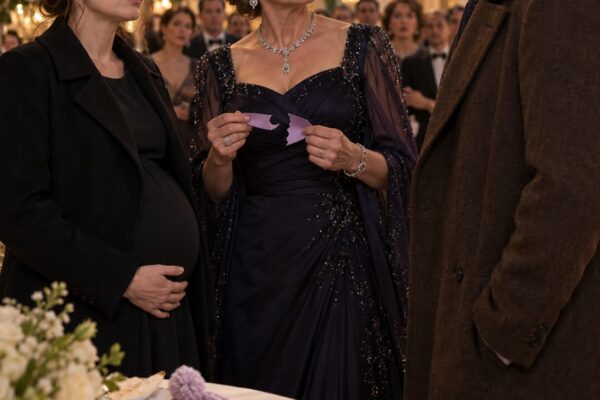
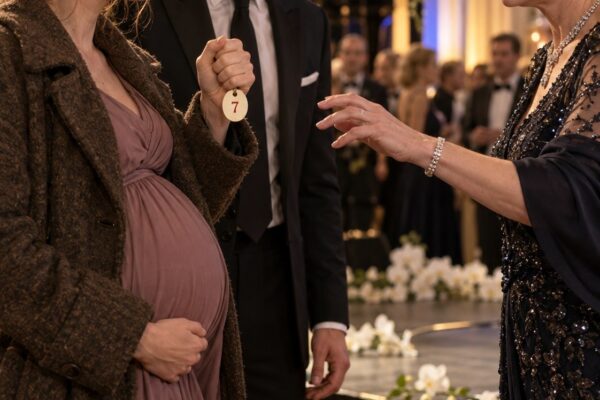
At His Family’s Theater Opening, My Husband Called Me a Vandal, Then My Mother Asked Who Signed the Repair Order
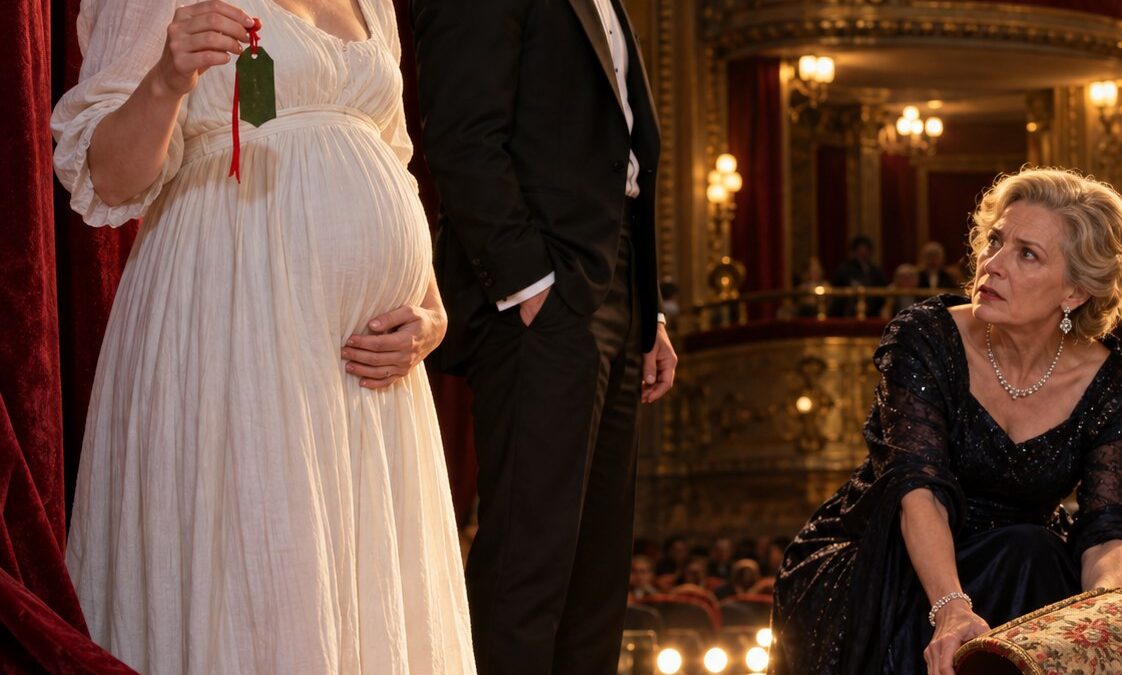
Chapter 2: The Signature Upstairs
Nobody answered June.
The curtain lay between the footlights and the first row.
A pin rolled off the stage.
Its small click carried through the room.
Tessa held the green tag by its string.
June came down the balcony stairs without hurrying.
Her coat was plain.
Her shoes were wet from the rain.
Beatrice recovered first.
“June, this is a family matter.”
“It became a trust matter when you invited donors to see a funded restoration.”
“The curtain failed.”
“That much is visible.”
June stopped beside the stage.
Her eyes moved over Tessa’s face.
“Are you hurt?”
“No.”
“Do you need to sit?”
“Soon.”
June nodded once.
It was the first kindness Tessa had received all evening, and she nearly cried.
She stayed standing.
Reid cleared his throat.
“We should let the guests leave.”
“Yes,” June said.
“Please ask them to remain in the lobby.”
Beatrice laughed sharply.
“You cannot hold people here.”
“I have no intention of doing that.”
June turned to the audience.
“The theater will close while its rigging is checked.”
A few guests were already moving.
The stage manager, Ellis Ward, appeared near the side exit.
He had worked at the theater for thirty-two years.
“Ellis,” June said, “please keep everyone off the stage.”
He nodded.
Reid reached toward the fallen fabric.
Ellis stepped into his path.
“The rail hasn’t been secured.”
“I own this theater.”
“You own a company that leases it,” June said.
Reid stopped.
The distinction was small.
His reaction was not.
Beatrice moved closer to June.
“The Harlan family restored this place.”
“Several people did.”
“We kept it from being demolished.”
“Your contractors worked here.”
June looked at Tessa.
“Did you attach that tag today?”
“Yes.”
“At what time?”
“Just before four.”
“Who watched?”
“Ellis.”
Ellis nodded again.
“She asked me to check the center seam.”
“I signed the inspection sheet,” Tessa said.
“Where is it?” June asked.
“In the booth.”
Beatrice folded her arms.
“Convenient.”
Tessa felt the baby shift.
She placed a palm against her stomach and waited.
June saw the gesture.
“Sit down.”
Tessa sat on the low stage step.
June took off her coat and put it beneath her.
Reid stared at them.
“You never said your mother was June Vale.”
“I told you her name.”
“You said she worked for a trust.”
“She does.”
Beatrice looked from June to Tessa.
“You arranged this.”
“No,” Tessa said.
June’s voice stayed level.
“I came because your office invited me.”
Beatrice glanced at the guests leaving through the doors.
“I invited our grant partners.”
“Yes.”
June looked up at the broken curtain.
“I expected to see their work.”
Ellis returned from the booth with a clipboard.
He placed it in June’s hands.
Tessa’s signature sat below his.
The inspection time was 3:56 p.m.
Under it was a blank line marked ADDITIONAL WORK.
Somebody had filled that line in.
RELEASE CENTER RAIL.
The handwriting was not Tessa’s.
A signature followed it.
June read the name.
Then she looked at Reid.
“It says you ordered the rail released at six seventeen.”
Reid went pale.
“That isn’t what I told them to do.”
* * *
The fire marshal arrived before the last donors reached the lobby.
Ellis had called after the curtain fell.
Nobody argued with him for doing it.
The marshal closed the auditorium pending an inspection.
A loose curtain that size could damage equipment or trap someone beneath it.
Tessa knew its weight.
She had pushed its folded panels across the stage all summer.
The inspector asked everybody to leave the rigging untouched.
He photographed the fallen fabric.
Then he photographed the rail above it.
June asked Tessa if she wanted to go home.
Tessa looked at the repair order.
“No.”
Reid stood near the orchestra seats with his phone in his hands.
Beatrice was speaking to a lawyer.
Tessa had once known what Reid would say when he came over.
He would call the evening a misunderstanding.
He would ask her to sleep before deciding how she felt.
He had used sleep to postpone every hard conversation in their marriage.
This time, he did not approach.
Ellis brought Tessa a cup of water.
“Your seam held,” he said.
“I saw.”
“That matters.”
“It matters to me.”
“The inspector will see it too.”
Tessa drank half the water.
June sat beside her.
“You should have called me about the unpaid invoices.”
“I wanted to finish the job myself.”
“You did finish it.”
“I know.”
June let that answer stand.
Tessa had grown up watching her mother make calls that changed other people’s plans.
She loved her.
She also wanted this work to carry her own name.
That wish had brought her back to the theater, even after Beatrice began treating every question about payment as an insult.
The inspector returned from the stage.
“The seam is intact below the rail,” he said.
“The upper attachments are the issue.”
Tessa rose carefully.
“May I show you my photographs?”
“Yes.”
She kept them on her phone because she documented every restoration job.
Before attaching the green tag, she had photographed both sides of the center seam.
She had also photographed the suspension straps.
Each strap passed through a steel fitting and folded back on itself.
The fittings were numbered.
“So you can match a panel to its place,” Tessa explained.
The inspector enlarged her last photograph.
All six fittings were closed at 3:59.
In his photographs after the fall, four were open.
Reid looked up from his phone.
“I asked them to lower the rail for a lighting adjustment.”
“Who is ‘them’?” the inspector asked.
“The stage crew.”
Ellis shook his head.
“My crew clocked out at five.”
“I called an outside contractor.”
Beatrice turned toward him.
“Reid.”
“What?”
“You said the adjustment was canceled.”
“I thought it was.”
June asked for the contractor’s name.
Reid told her.
It was Blackwell Event Services.
Tessa knew the company.
Blackwell had installed the temporary sponsor wall in the lobby.
Their workers carried ladders, lights, and a case of red nylon ties.
She remembered the ties because one had caught beneath her shoe.
The green tag hung from a shiny red cord.
Tessa held it up.
“Did Blackwell supply this?”
Reid looked at it.
“I don’t know.”
Beatrice stepped between them.
“This is becoming absurd.”
The inspector took the tag in a paper evidence sleeve.
“I can ask the contractor.”
Beatrice pointed at Tessa.
“She had the whole afternoon to alter anything she wanted.”
“I did,” Tessa said.
The direct answer made Beatrice blink.
“I was hired to repair a curtain,” Tessa continued.
“I touched it, and I photographed it.”
“Then perhaps you loosened the rail.”
“The fittings were closed when I left.”
“A photograph can be staged.”
“Yes,” Tessa said.
“That is why Ellis checked it too.”
Ellis raised the clipboard.
His initials appeared beside Tessa’s signature.
The inspector asked for the building’s access records.
The electronic doors logged staff cards.
Ellis printed the report from the office.
Tessa left through the side entrance at 4:14.
Reid entered the same way at 6:09.
Two temporary contractor badges followed him at 6:12.
Nobody else entered that corridor before the curtain fell.
Beatrice studied the printout.
“Those records can be wrong.”
“Then we’ll verify them,” June said.
Tessa looked at the repair order again.
The letters in Reid’s signature were cramped.
He normally signed invitations with a sweeping R.
This signature looked as though he had written it standing up.
She pointed to the line above it.
“Why is the order on the curtain inspection sheet?”
Reid swallowed.
“I couldn’t find another form.”
“You were in the booth?”
“Yes.”
“After I left?”
“Yes.”
Beatrice gripped the back of a seat.
For the first time, she seemed frightened of an answer.
The inspector asked Reid whether he had told Blackwell to open four fittings.
“No.”
He rubbed his forehead.
“I told them to lower the rail.”
“What did you tell them to do with the curtain?”
“Nothing.”
June turned the sheet over.
A carbon impression marked the back.
Someone had written another instruction on a page laid above it.
Most of the words were faint.
Tessa recognized one: REMOVE.
Ellis took the clipboard toward the booth light.
He tilted it.
“Remove the marked attachments,” he read.
Reid shook his head.
“I never wrote that.”
Tessa looked at the blank line, the hurried signature, and the carbon marks above it.
Somebody had used her inspection sheet as the bottom of a two-page order.
Reid had signed the lower page.
The instruction he denied had been written above his hand.
“Who gave you the form?” Tessa asked.
Reid’s eyes found Beatrice.
“My mother.”
* * *
By midnight, the guests had gone.
The theater remained closed.
Tessa stayed long enough to give the inspector her photographs and a written account.
Then June drove her to the apartment.
It was a third-floor walk-up above a bakery.
Reid had promised they would move before the baby came.
The promise had become harder to believe each time Beatrice delayed paying Tessa.
June carried the sewing case upstairs.
Ellis had gathered the pins.
He had even wound the measuring tape.
Tessa noticed that when she opened the case at home.
Someone had placed the prenatal appointment card on top.
June set water on the kitchen table.
“You can stay with me.”
“I know.”
“Your room is still there.”
“I know that too.”
Tessa sat down.
The kitchen smelled faintly of cinnamon from the bakery below.
Her mother waited while she called the maternity unit.
The nurse asked a few questions and advised her to come in if she had pain, bleeding, or any concern about the baby’s movements.
Tessa listened closely.
The baby moved again while she was on the phone.
She thanked the nurse and ended the call.
June had not interrupted once.
“I’m going to sleep here,” Tessa said.
“Then I’ll sleep on the couch.”
“You have work tomorrow.”
“So do you, apparently.”
“The theater’s closed.”
“I meant the truth.”
Tessa managed a tired smile.
A message arrived from Reid.
He said he had gone to his mother’s house.
He said he needed to understand what happened.
He did not apologize.
Tessa put the phone facedown.
In the morning, Blackwell’s supervisor called the inspector.
One of his workers had taken a photograph of the written order before climbing to the rail.
The picture showed two sheets.
On the upper sheet, someone had written REMOVE FOUR CENTER ATTACHMENTS BEFORE CUE.
On the lower sheet, Reid’s signature showed through a cutout.
The supervisor had kept the photograph because his crew disputed an unpaid change charge.
He gave the original file to the inspector.
He also gave the worker’s name.
Tessa learned this from a call with the inspector, Ellis, and June.
She did not need June to translate the finding.
Reid had signed a page that made the work appear authorized.
Someone had concealed the instruction above it.
Blackwell had followed the page it could see.
The inspector was still checking who prepared the order.
Tessa asked about the green tag.
“Your original may still be attached,” he said.
“The one onstage came from a box of replacement tags in the booth.”
“Who opened the box?”
“We don’t know yet.”
Tessa closed her eyes.
She had left her tag to tell the next crew the seam was sound.
Somebody had used a copy to point straight back at her.
By noon, Beatrice issued a statement.
It called the fall an unfortunate accident.
It thanked guests for their concern.
It did not mention Tessa.
That afternoon, Reid finally came home.
June was washing a cup at the sink.
Reid stopped when he saw her.
“I’d like to speak to my wife.”
“You can,” June said.
Tessa stayed at the table.
Reid sat across from her.
“I didn’t know about the cutout.”
“You knew you signed something.”
“My mother said the crew needed approval to adjust the lights.”
“You watched her empty my case.”
“I was trying to keep things from getting worse.”
“You told the audience I cut the curtain.”
“I thought you might have made a mistake and panicked.”
Tessa looked at him.
He had believed that easily.
He had believed it while she stood beside her work.
“That’s what you thought of me?”
“I didn’t know what to think.”
“You had three years to learn.”
Reid reached for her hand.
She moved it away.
He let his fingers rest on the table.
“My mother says Blackwell misunderstood the order.”
“Who wrote it?”
“She says she didn’t.”
“Do you believe her?”
He looked toward June.
Tessa waited until he looked back.
“I’m asking you.”
“I don’t know.”
His phone buzzed.
He silenced it without checking.
For a moment, Tessa hoped he might stay and finish the conversation.
Then he said, “We need to keep this private until the theater reopens.”
“The inspector has the order.”
“My family’s reputation is tied to that building.”
“So is mine.”
Reid had no answer.
After he left, June found an email from the preservation trust’s finance office.
A routine review had begun the previous week.
The trust had asked the Harlan company for receipts covering the curtain restoration.
The company had submitted a final invoice for $84,000.
Tessa read it twice.
Her entire contract was for $11,600.
The invoice listed labor by a firm she had never met.
It listed new suspension hardware she had never installed.
At the bottom was a certification.
BEATRICE HARLAN, AUTHORIZED APPROVER.
Tessa looked at her mother.
“The curtain had to fall before anyone checked the hardware.”
June nodded.
“And before anyone asked where the rest of the money went.”
* * *
Tessa did not return to the theater that week.
The inspector had closed it.
The trust had frozen the remaining grant payment.
June’s office referred the invoice and the work order to counsel.
An independent accountant began reviewing the restoration expenses.
Tessa spent two mornings at her kitchen table, matching her photographs to the dates on her invoices.
She had photographed everything.
A seam on July ninth.
A worn hem on July twenty-third.
A row of original fittings on August fifth.
Her work had always required patience.
Now patience gave each picture a place in the record.
Ellis came by with the theater’s maintenance ledger.
He brought pastries from downstairs and paid for them himself.
Tessa noticed the amount on the receipt.
“You can put that in your expense claim,” she said.
“For two rolls?”
“They’ll ask you to account for every screw.”
Ellis placed the receipt beside the ledger.
“You sound ready.”
“I sound like I know Beatrice.”
He showed her the hardware entries.
The trust’s grant had paid for new fittings.
The ledger showed an order placed.
It showed no delivery.
A supplier had marked the shipment canceled because the theater never paid the deposit.
Ellis had kept the cancellation email.
He had raised the issue twice.
Beatrice’s office had replied that the fittings would arrive after opening.
Tessa looked at the older hardware in her photographs.
Its scratches matched the maintenance ledger.
“Why did she leave it up there?” Tessa asked.
Ellis leaned back.
“The existing fittings passed inspection in the spring.”
“So she could claim new ones without installing them.”
“That’s what the records suggest.”
June had warned Tessa to keep claims precise.
A missing payment did not prove where the money had gone.
An old fitting did not explain who had ordered it opened.
They would need records from outside the family.
The accountant obtained bank records through the company’s cooperation after counsel raised the grant terms.
The trust could also require documentation before releasing further funds.
The city’s investigation followed its own course.
Tessa stayed out of both decisions.
She answered questions.
She supplied photographs.
She kept working on a much smaller job at a school auditorium.
The pay was modest.
It arrived on Friday, exactly when promised.
On Saturday, Reid sent a florist’s box.
Inside was a white orchid and a note.
He was sorry she had been hurt.
He hoped she could see how difficult the night had been for everyone.
Tessa left the orchid on the kitchen counter until the flowers began to sag.
Then she called him.
“I need you to stop sending things.”
“I wanted to show you I care.”
“Tell the inspector what you know.”
“I have.”
“Tell me what you know.”
He was quiet.
“My mother said the curtain had to come down.”
Tessa pressed the phone harder against her ear.
“When?”
“Before the guests arrived.”
“Why?”
“She said a donor wanted to see the original upper rail.”
“A donor?”
“That’s what she told me.”
“Which donor?”
“She never said.”
Tessa looked at the orchid.
“And when it fell, she said I cut it.”
“I know.”
“You heard her.”
“Yes.”
“You let her.”
Reid breathed into the phone.
“I should have stopped her.”
“Yes.”
“I’m sorry.”
It was the first plain apology he had given her.
It arrived too late to make her feel safe.
That evening, a courier delivered a packet from Harlan Properties.
It contained a notice that Tessa’s contract was under review for alleged damage.
Her final payment would be withheld.
A second page reminded her that the apartment’s lease guarantee came from the company.
Reid had insisted on that arrangement when they married.
He had called it a benefit.
The notice said the guarantee could end in thirty days.
Tessa called her landlord.
He sounded embarrassed.
He said her lease remained valid, and he would send any required notice himself.
She called June afterward.
“Your lawyer can help with the wages,” June said.
“I know.”
“I can pay the rent.”
“I know that too.”
“What do you want?”
Tessa looked at the unopened boxes of baby clothes against the wall.
“I want to choose where we live.”
“Then we’ll make that possible.”
June helped her find a tenant attorney.
Tessa retained one using money from the school job.
The attorney sent a demand for the unpaid contract balance and challenged the company’s allegation.
June paid for the first month of a nearby apartment after Tessa asked for a loan.
They wrote down the amount.
Tessa planned to repay it.
Reid came by two days later.
He found boxes in the hall.
“You’re leaving?”
“I’m moving.”
“Where?”
“Somewhere the lease has my name.”
His expression crumpled.
“I never meant for them to threaten your home.”
“They used an agreement you arranged.”
“I can get my mother to withdraw it.”
“My lawyer is handling it.”
“I’m your husband.”
Tessa rested her hands on a box.
“I needed you to remember that onstage.”
Reid lowered his eyes.
Before he left, he gave her a folded page.
“I found this in her study.”
It was an internal schedule from Harlan Properties.
The theater closure appeared as a line item.
So did an anticipated insurance payment.
Below it was a proposed sale of the leasehold to a hotel group.
The sale required the trust’s restoration restrictions to be lifted.
The figures made Tessa’s skin go cold.
The company expected far more from the sale than it had spent on the theater.
Reid had seen the schedule before opening night.
He had believed Beatrice was planning for a possible accident.
Now he could no longer say that.
Tessa placed the page inside a folder for the investigators.
At the top, beside the insurance estimate, Beatrice had written one word.
CURTAIN.
* * *
The trust called a special meeting the following Tuesday.
Its board had to decide whether to suspend the Harlan company’s lease.
The decision affected the youth theater program, the restoration workers, and a season of performances already sold.
June recused herself from the vote.
She also told the board she was Tessa’s mother.
Nobody objected to Tessa giving evidence.
The meeting took place in a library across town.
Beatrice arrived with two attorneys and Reid.
Tessa came with her attorney.
Ellis brought the maintenance ledger.
A representative from Blackwell brought the photograph of the work order.
The independent accountant brought a narrow stack of verified records.
Beatrice spoke first.
She called the curtain’s fall a costly misunderstanding.
She accepted responsibility for inadequate oversight.
She denied directing anyone to release the attachments.
“The company was trying to reopen a neglected theater,” she said.
“We made mistakes under pressure.”
One board member asked about the insurance estimate.
“We had a duty to plan for losses,” Beatrice replied.
Another asked about the proposed hotel sale.
“The building needs steady income.”
“The lease restricts that use,” the member said.
“We intended to seek consent.”
Beatrice spoke smoothly.
She had chaired fundraisers in that city for twenty years.
She knew which donors worried about empty buildings.
She knew which board members feared closing the youth program.
“Punish me if you wish,” she said.
“Please don’t punish the children who use that stage.”
Tessa thought of the school auditorium.
She thought of the theater’s summer students painting scenery in the alley.
Beatrice had chosen a strong argument.
It almost worked.
The board chair asked whether there was proof Beatrice had ordered the curtain removed.
The Blackwell photograph showed the instruction.
It did not show who wrote it.
Reid said his mother had given him the two-page form.
Beatrice denied that.
“He is confused,” she said.
“He has had a difficult week.”
Reid’s jaw tightened.
For years, that sentence had been enough to make him doubt himself.
Tessa watched him straighten the page in front of him.
“No,” he said.
“I remember her desk.”
His mother did not look at him.
The accountant asked to present her findings.
She began with the $84,000 invoice.
The firm named on it had never restored a curtain.
It was a company registered by a longtime Harlan Properties consultant.
Its bank account received the grant money.
Within days, most of the funds moved to an account used for expenses related to the proposed hotel sale.
The accountant had confirmed the transfers with bank statements provided under the grant review.
Beatrice’s attorney interrupted.
“A transfer between companies is not evidence of fraud.”
“On its own, no,” the accountant said.
She turned a page.
“The invoice certified that new suspension hardware had been purchased and installed.”
The supplier’s cancellation email lay beside photographs of the original fittings.
The trust had paid for work that had not been done.
Beatrice leaned forward.
“A clerk submitted the wrong invoice.”
“Who approved it?” asked the chair.
“My office.”
“Your signature is on the certification.”
“I approve hundreds of documents.”
Tessa looked at the woman who had accused her before an auditorium full of people.
Beatrice could make a lie sound like routine administration.
The accountant had more.
She showed the hotel group’s draft purchase terms.
They required Harlan Properties to resolve the trust’s restrictions and provide a clear route to conversion.
An insurance claim for a major restoration failure would have helped Beatrice argue that the theater could not survive as a theater.
The chair closed the folder.
“That explains a possible motive.”
“It does not prove I caused the fall,” Beatrice said.
“No,” Tessa said.
Everyone turned toward her.
She had brought the green tag.
The inspector had returned it after documenting it.
Tessa placed it beside an older photograph from her phone.
In the photograph, her original tag hung from the center seam.
The red cotton string was faded.
On its back was a small pencil mark: 4.
She had used it to remind herself which fitting to recheck after lunch.
The tag from the stage had no pencil mark.
Its cord was bright red.
“I made this mark before Ellis signed the inspection,” Tessa said.
Beatrice lifted her chin.
“Then somebody replaced your tag.”
“Yes.”
Tessa turned to Ellis.
He laid out the booth’s supply log.
At 5:48, Beatrice had signed out a replacement tag and a length of red cord.
Ellis had found the entry during the inspection and given the original log to the city.
Beatrice glanced at it.
“I was preparing a donor display.”
“That could be true,” Tessa said.
“Your tag appeared on a fallen curtain an hour later.”
Beatrice’s attorney rose.
“Many people had access to the booth.”
The board chair raised a hand.
“We understand.”
Tessa put the tag down.
She had spent days wanting this moment.
Now she wanted the board to see it clearly.
“The tag says I inspected the seam,” she said.
“My photographs show the seam held.”
“The replacement tag made my work look like the cause.”
She looked at Reid.
He met her eyes.
Then he turned to the board.
“My mother gave me the form,” he said.
“She told me the upper page was a lighting request.”
“Did you read it?” the chair asked.
“No.”
“Why did you sign?”
“Because she asked.”
Beatrice made a small sound.
“Reid.”
He kept speaking.
“When the curtain fell, she told me Tessa had returned after hours.”
“She said the photos would make it look accidental.”
Tessa had never heard that sentence.
Her hand gripped the edge of the table.
Reid looked at her.
“I knew she had no basis for saying you cut it.”
Beatrice stood.
“You told me you saw her near the stage.”
“I saw her at four.”
“You are trying to save your marriage.”
“I should have spoken that night.”
The room went quiet enough for Tessa to hear a cart pass outside the library door.
The board did not decide whether Beatrice had committed a crime.
It suspended further grant payments.
It began the process of removing Harlan Properties as the theater’s operator.
It preserved the youth program’s access under an interim agreement.
The city continued its investigation.
Months passed before charges were filed over the grant invoices and the insurance application Beatrice had submitted after the fall.
She pleaded guilty to the false grant certification and withdrew the insurance claim.
The court ordered restitution and imposed a suspended sentence with supervision.
The trust recovered the misused funds through the company’s insurers and a civil settlement.
Harlan Properties lost the theater lease.
Tessa’s wages were paid, with the balance confirmed in writing.
At the last court hearing, Beatrice passed her in the corridor.
“You could have protected Reid,” she said.
Tessa stood beside her attorney.
“I told the truth.”
Beatrice waited for more.
Tessa gave her nothing else.
* * *
The new apartment had a window over a bus stop.
Tessa could see the route number from the kitchen sink.
For the first month, she watched the buses as though she might need to leave at any moment.
Then the baby arrived.
They named her Willa.
She had Reid’s dark hair and a fierce dislike of cold wipes.
June visited with groceries.
Ellis brought a tiny knitted hat that was much too large.
Tessa returned to work slowly.
She accepted a contract restoring seats at the school auditorium.
The director paid a deposit before she touched a single screw.
Tessa put the receipt on the refrigerator.
June noticed it beside a drawing of a duck.
“You framed a payment,” she said.
“It’s a beautiful payment.”
“It’s covered in soup.”
“That makes it contemporary art.”
They laughed while Willa slept in her basket.
Laughter came more easily in the new apartment.
It did not erase the theater.
Tessa still remembered Reid’s voice carrying over the audience.
She also remembered Ellis gathering her pins after everyone left.
Both memories belonged to her.
Reid asked to visit when Willa was three weeks old.
Tessa agreed to an hour.
June stayed in the next room at Tessa’s request.
Reid washed his hands at the kitchen sink.
He looked nervous when Tessa put Willa in his arms.
“She’s so small.”
“She eats like she’s twice this size.”
Willa opened one eye.
Reid smiled at her.
For a while, nobody spoke.
Then he said, “I told my mother I wouldn’t visit her while she blames you.”
“That’s your decision.”
“I owe you an apology.”
“You already said you were sorry.”
“I said it for one night.”
He adjusted Willa’s blanket.
“I need to say what I did.”
Tessa sat across from him.
“I called you a vandal because I was afraid to contradict her.”
“I heard you.”
“I gave her your case.”
“I remember.”
“I let her threaten our home afterward.”
“Yes.”
Reid’s voice shook.
“I had chances to stop.”
Tessa looked at Willa.
She wanted her daughter to know him if he could be kind and reliable.
She could not build that reliability for him.
“You can be her father,” she said.
“We’ll arrange visits.”
“What about us?”
“We’re separated.”
He nodded, though it took him a moment.
“I understand.”
“Please keep your promises to her.”
“I will.”
“Start with Thursday.”
He came Thursday.
He brought diapers in the size Tessa had written down.
He came again the following week.
Some visits were easy.
Some were awkward.
When he canceled one, he called early and explained why.
Tessa noticed that change.
She also kept the visits written on the calendar.
In autumn, June’s trust offered Tessa a permanent position directing repairs at several small theaters.
The salary would have made life easier.
June placed the offer on Tessa’s table.
“I didn’t vote on it.”
“I know.”
“You’re qualified.”
“I know that too.”
Tessa read it carefully.
Then she declined.
June’s face fell before she could hide it.
“I want to build my own workshop,” Tessa said.
“That sounds expensive.”
“It is.”
“I can lend you the money.”
“After I repay the apartment loan.”
“You don’t have to prove anything to me.”
“I’m trying to make a plan I can carry.”
June folded her hands.
“What do you need?”
“Introductions to people who pay on time.”
June smiled.
“I know several.”
Tessa registered a small business.
She rented a workroom behind the school auditorium.
Her first large job came from a community hall whose curtains had faded to orange.
She told them the fabric could last another decade with careful repair.
The committee had expected her to recommend replacement.
They hired her that afternoon.
The theater reopened the following spring under a new nonprofit operator.
Ellis became its general manager.
The youth program came back.
On opening week, the board invited Tessa to finish a new curtain inspection.
She declined the first date.
Willa had a fever.
Ellis moved the inspection without complaint.
When she finally entered the auditorium, the stage smelled of fresh paint.
A row of students sat on its edge, waiting to rehearse.
One asked if Tessa was the woman who fixed the old curtain.
“I was one of them,” she said.
“Did it really fall?”
“Yes.”
“Were you scared?”
Tessa glanced toward the rail.
“I was angry.”
“Did you fix it again?”
“Some of it.”
Ellis had saved the original fabric.
The damaged upper panels could not carry weight.
The sound sections had become smaller curtains for the rehearsal rooms.
Tessa had chosen where to cut them.
She had kept one narrow strip.
Willa liked rubbing its soft edge between her fingers.
Before Tessa left, Ellis asked if he could hang a small display about the restoration.
He had photographs and the green tag.
Tessa considered the request.
“Show the workers,” she said.
“I have their names.”
“Show the original inspection sheet too.”
Ellis nodded.
“May I use your photograph of the seam?”
“Yes.”
He waited.
Tessa knew what he was asking.
“You can say what happened,” she told him.
“Use the facts.”
He promised.
The display went up near the back entrance.
It told visitors how the curtain had been made, repaired, damaged, and preserved.
No photograph showed Tessa standing beneath it.
She had asked for that.
One evening, she came early to a youth performance and saw a girl reading the display.
The girl studied the green tag.
“Why keep this?” she asked her friend.
“Because it was evidence,” the friend said.
Tessa passed them with Willa on her hip.
That was one answer.
It was not the only one.
* * *
Six years later, Willa stood beneath the theater’s new curtain with a paper crown sliding over one eye.
She had one line in the school play.
She practiced it for two weeks.
When her turn came, she spoke loudly enough for the back row.
Tessa heard Reid cheer beside her.
They had learned how to sit together for Willa.
He picked her up from school on Tuesdays.
He kept an extra pair of her shoes at his apartment.
He had never asked Tessa to forget the night onstage.
That made their conversations easier.
June sat on Tessa’s other side.
She had retired from the trust, though she still corrected the wording on every theater program she received.
Ellis ran the lights from the booth.
At the end of the play, the children bowed.
Willa’s crown fell.
She scooped it up and bowed again.
The audience applauded harder.
Afterward, Willa led them toward the display near the back entrance.
She pointed to the green tag.
“Mom made that one,” she said.
Tessa crouched beside her.
“I made the first one.”
“Why do they keep the other one?”
“Because people needed to know what happened.”
Willa considered this.
“Did you tell them?”
“I did.”
Above the display hung a photograph of the old curtain before it fell.
The red fabric filled the frame.
Its center seam was straight.
Tessa could see the small faded string if she looked closely.
Willa tugged her hand.
“Come see my classroom,” she said.
Reid carried the fallen crown.
June had already found a mistake in the program.
Ellis called down from the booth that he was keeping the lights on.
Tessa took Willa’s hand.
“Yes,” she said.
“Show me everything.”
THE END