I Found a Boy Holding My Name Against the Greenhouse Glass, and My Wife Said Our Son Had Died Nine Years Ago
Chapter 2: What the Card Could Prove
Victor Dacre stepped out of the car carrying an umbrella.
He didn’t hurry through the rain.
He had spent his life making other people hurry for him.
Kit slipped her hand into mine.
Milo watched the umbrella approach.
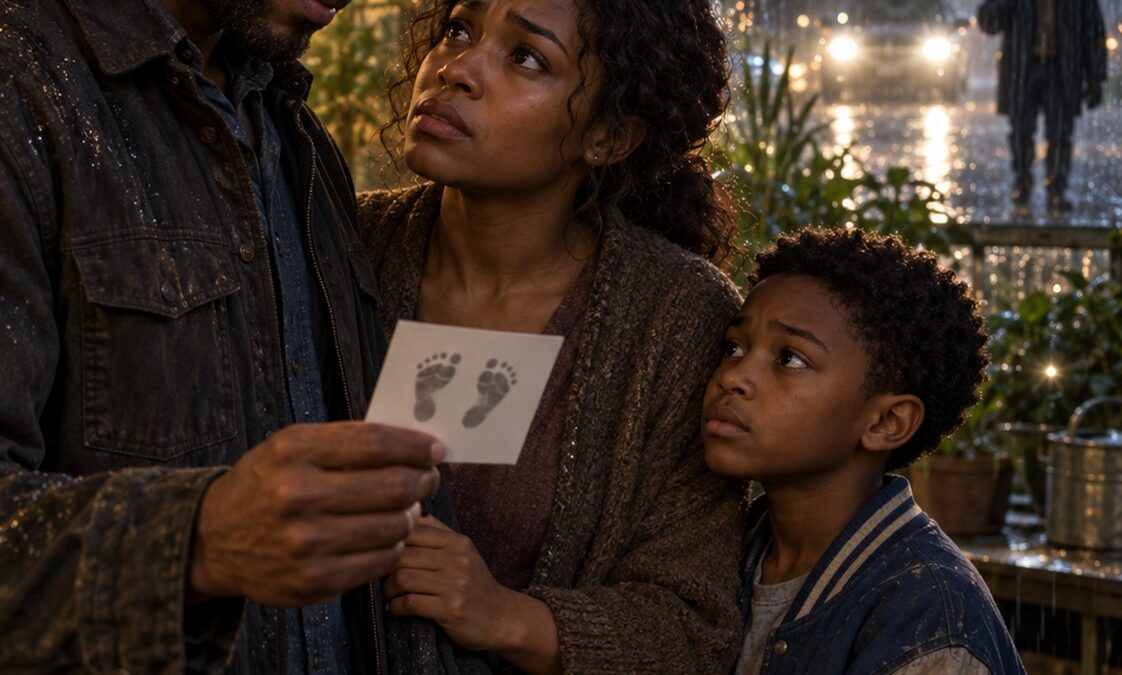
I knew his name because it was printed on the front of the card.
MILO GRANT.
That was the name we’d chosen before he was born.
Victor stopped outside the greenhouse.
“Come out, Milo.”
The boy moved behind me.
“He’s freezing,” I said.
“I can see that.”
“Then let me get him warm.”
Victor looked at Tessa.
“You were supposed to call me.”
“I did,” she said.
“You stopped answering.”
I turned to her.
“When?”
“Ellis, please get him inside.”
Victor lowered his umbrella.
“The child belongs with me.”
“No child belongs to you.”
“I have a court order.”
“Then you can show the police.”
His expression changed.
It was slight, but I saw it.
For a man who loved paperwork, Victor suddenly seemed reluctant to produce any.
I carried Milo into the house.
He weighed less than Kit had at six.
That frightened me more than the headlights.
Tessa found dry towels.
Kit brought her favorite blanket without being asked.
Milo sat at our kitchen counter, watching every door.
Victor remained on the porch.
I called 911 and said a child had arrived cold and frightened.
I gave the dispatcher Victor’s name.
Then I asked for an officer and medical help.
Victor heard me through the open window.
“You’re making this ugly,” he called.
“It already is.”
Milo flinched.
I shut the window.
Tessa warmed a cup of milk.
Her hands shook so badly that I took the cup.
Milo accepted it from me.
He looked at the jacket.
“I thought you’d recognize this.”
“I do.”
“It was in my closet.”
Tessa gripped the counter.
Victor knocked once.
Hard.
“Ellis, she’s leaving out the important part.”
“Tell me before he does,” I said.
Tessa stared at Milo.
“I was nineteen when he was born.”
“I remember.”
“Dad told you he died.”
“You told me too.”
She nodded.
Milo set down his cup.
Tessa’s voice broke.
“I saw him breathing.”
* * *
The ambulance arrived before the police.
A paramedic checked Milo while Kit and I stood in the hallway.
He was cold and tired, but alert.
The paramedic wanted him examined at the hospital.
Milo asked whether Victor would come.
“He can drive himself,” I said.
Victor heard that.
He came inside behind the officer, carrying a leather folder.
The officer asked for Milo’s name.
Victor answered before the boy could.
“Milo Dacre.”
Milo looked at his cup.
The officer turned to him.
“What do you call yourself?”
“Milo.”
Victor opened the folder.
He showed a guardianship order bearing his name.
The officer read it carefully.
Then he asked Tessa for identification.
She handed over her license.
Victor watched her as if she were an employee about to lose her job.
“This is a family dispute,” he said.
The officer looked toward Milo.
“A child came here in a storm.”
“He wandered off.”
“He says he was afraid to go back.”
Victor’s jaw tightened.
Milo had said no such thing aloud.
The officer had given him room to correct it.
He didn’t.
The officer asked Victor to wait outside while a child welfare worker was contacted.
Victor objected.
The officer repeated himself.
Victor went.
At the hospital, I learned how little a card could settle.
The footprint was Milo’s, according to its printed label.
The father line carried my name.
A handwritten name could still be wrong.
A hospital stamp could still be copied.
I knew that because I worked in records maintenance for the county water department.
People treated stamps like truth.
My job had taught me to check the record behind them.
I photographed both sides of the card.
Then I put it in a clean envelope.
Tessa watched me seal it.
“You don’t trust me.”
“I need to know what happened.”
“You should.”
She sat beside Milo’s bed.
Kit had gone home with my sister, Renée.
I had called her because she knew our address and could arrive quickly.
I had not told her what Milo might be.
I couldn’t say it yet.
Tessa could.
She waited until Milo fell asleep.
“Dad took me to the hospital,” she said.
“He stayed?”
“Through everything.”
I remembered that part.
I had been on a construction job two counties away when she went into labor early.
Victor called my foreman.
By the time I reached the hospital, Tessa was in recovery.
Victor told me the baby had died.
Tessa had turned her face to the wall.
“I held him,” she said now.
I felt the edge of the bed rail under my palm.
“For how long?”
“Maybe a minute.”
“Where did he go?”
“A nurse took him for checks.”
She looked at Milo.
“Dad said he’d handle the forms while I rested.”
The next morning, Victor brought her documents.
He said she was too young and too poor to raise a child with serious medical needs.
Milo had needed observation after birth.
Tessa’s mother had died the previous winter.
Victor controlled the savings her mother had left her.
He told Tessa she could keep seeing Milo if she signed temporary guardianship papers.
“He said you’d agreed.”
“I never saw a paper.”
“He said you couldn’t bear to visit.”
I remembered weeks of calling Tessa from motel parking lots.
She had stopped answering.
Victor had taken every call after the first day.
Tessa reached into her bag.
She pulled out a folded sheet, worn thin at the corners.
It was a copy of the guardianship petition.
My name appeared in a paragraph that said I had been notified and declined involvement.
Below it was an address.
I stared.
“That was my old apartment.”
“You lived there then.”
“Until May.”
The petition was dated September.
I had been living across town for four months.
Mail sent to the old place would never have reached me.
Tessa touched the page.
“I should have checked.”
“Yes.”
“I should have called you.”
“Yes.”
Neither answer helped her.
Neither was untrue.
She told me she had visited Milo until he was almost three.
Then Victor ended the visits.
He said Milo became upset afterward.
He told her a judge would look badly on a mother who caused him distress.
“He moved him?” I asked.
“To his house.”
“And you accepted that?”
“I kept trying to see him.”
She showed me texts.
Some asked for school pictures.
Some asked for five minutes.
Victor answered only when it suited him.
Six weeks earlier, Milo had found my old jacket in a storage box at Victor’s house.
He found Tessa’s name inside the collar.
Victor had cut away mine.
Milo searched for her online.
He reached her through the contact form at the small bakery where she worked.
Tessa met him at a public library twice.
She had promised to tell me.
Then Victor found out.
“Why tonight?” I asked.
Milo answered from the bed.
“I heard him say he was sending me away.”
His eyes were open.
“Where?”
“I don’t know.”
Tessa took his hand.
“He knew this address.”
I looked at the card again.
Alive had been written across the back in blue ink.
Tessa saw me looking.
“I wrote that when he was born.”
“Why?”
“Dad told me you were coming.”
Her voice went flat.
“I wanted you to see it first.”
* * *
The hospital social worker arrived near dawn.
Her name was Ms. Bell.
She spoke to Milo alone, then to each adult separately.
I told her what I knew.
I also told her which parts I couldn’t verify.
She thanked me for the distinction.
Victor called three times.
I let each call go to voicemail.
On the fourth, he left a message.
He said Milo was medically fragile.
He said Tessa was unstable.
He said I was a stranger with a convenient story.
The social worker listened without commenting.
By morning, she had contacted the child welfare office in Victor’s county.
A worker there confirmed his guardianship order was active.
That did not decide where Milo would sleep that night.
It meant a judge would need to hear what had happened.
Milo stayed in the hospital for observation.
Victor was told not to approach him until the worker completed her assessment.
He objected through an attorney.
I used my lunch break to visit the courthouse.
Renée came with me.
She managed a tire shop and spoke plainly to clerks, mechanics, and frightened brothers.
The clerk showed us how to request the old guardianship file.
We could inspect the public portions.
For medical records, Tessa would need to make a request as Milo’s mother.
For the complete court file, an attorney could help us ask.
Renée read the page with my address.
“You kept your lease papers?”
“I keep everything.”
“You finally have a use for that drawer.”
At home, I found the lease termination letter.
It carried a May date and the landlord’s signature.
I found a utility account opened at the new apartment in June.
I brought both to an attorney recommended by the hospital social worker.
Her name was Dana Pike.
She did not promise a miracle.
She laid the guardianship petition beside my documents.
“This address matters,” she said.
Victor’s lawyer had filed the petition.
A declaration attached to it said Victor had personally mailed notice to me.
The envelope wasn’t in the public copy.
Dana requested the full file.
She also asked whether I would take a parentage test.
“Yes.”
“Tessa?”
“Yes,” she said.
“Milo has to be treated like a person here.”
Tessa looked offended for an instant.
Then she looked ashamed.
Dana explained that a court could order testing if needed.
Milo’s age, his wishes, and his existing home all mattered.
The truth about his birth would not automatically erase nine years of legal history.
I understood that.
I hated it anyway.
On the way out, Tessa stopped beside my truck.
“I kept your jacket,” she said.
“I noticed.”
“It smelled like sawdust.”
“That was the shop.”
“I thought he’d want something of yours.”
“Why didn’t you tell him my name?”
“Dad said he’d take the visits away.”
“He did that anyway.”
She accepted the blow.
At noon, Victor’s lawyer sent Dana a letter.
It accused us of taking Milo.
Dana called the social worker before replying.
She documented the hospital visit, the police report, and Milo’s own arrival.
Then she answered through the proper channel.
Victor didn’t like that.
At four, someone from the bakery called Tessa.
Victor had visited.
He had asked her manager whether Tessa had ever frightened customers.
He had mentioned her old leave of absence.
Tessa sat down on the curb.
“He’s building a file.”
“Let him,” I said.
“He knows how to make one look real.”
Dana’s phone rang.
She listened, asked two questions, and wrote something down.
The full court file had been retrieved.
The mailed notice to me had come back unopened.
Victor had filed it anyway.
* * *
That evening, Milo asked for the greenhouse.
He was back from the hospital, staying with us under a temporary safety plan while the court set a hearing.
The plan required regular check-ins.
It also required us to keep Victor informed through the worker.
Dana told us to follow every line.
I had cleaned the greenhouse while Milo slept.
The floor was dry.
The heater worked.
I showed him how the vent opened from inside.
“You couldn’t open the door last night,” I said.
“It sticks when it rains.”
“I fixed that too.”
He tested the handle twice.
Kit handed him a packet of sunflower seeds.
“We grow the tall ones,” she said.
Milo turned the packet over.
“How tall?”
“Tall enough to hide me.”
“That’s pretty tall.”
It was the first time I saw him smile.
Tessa watched from the threshold.
She wanted to go in.
She waited until Milo invited her.
“Mom, where does this one go?”
She crouched beside him.
I stayed at the door.
There were years between us that wouldn’t close in an afternoon.
There was also a boy asking where a seed belonged.
Milo pressed one into the soil.
My phone buzzed.
A text from an unknown number showed our greenhouse, photographed from the street.
Below it were three words.
BRING HIM HOME.
I took the phone inside.
Dana told me to save the message and call the officer who had taken the first report.
I did.
An officer drove past the house twice that night.
I kept the blinds open.
At the next check-in, Ms. Bell examined the text.
Milo saw her looking at my phone.
“Grandpa sends pictures when he’s angry,” he said.
Tessa froze.
Ms. Bell put the phone down.
“What kind of pictures?”
“Where I am.”
“When did he send them?”
“When I didn’t answer fast enough.”
Milo looked at Tessa.
“He did it to you too.”
She nodded once.
Ms. Bell wrote that down.
Victor denied sending the greenhouse photo.
He had a driver.
He had employees.
He had spent years putting other hands on whatever he wanted done.
The number wasn’t registered to him.
The officer said the message alone might not prove who sent it.
I didn’t ask him to pretend otherwise.
Instead, I checked the picture.
County trucks carried tablets that stamped their inspection photos with a hidden time and location.
This photograph had no official mark.
But the reflection in our greenhouse glass showed a white sedan.
I enlarged it.
The plate was partly covered by rain.
I gave the original image to the officer.
He told me to keep it, not alter it, and let his department check the car.
That night, Tessa came to the workshop while I was repairing a loose chair rung.
“You can hate me,” she said.
“I don’t have time tonight.”
“I thought that would make it easier.”
“It doesn’t.”
She picked up a clamp and put it back.
“When Dad found out Milo had written to me, he said he’d tell everyone Kit wasn’t safe with us.”
“On what grounds?”
“Anything he could make people believe.”
I tightened the clamp.
“Did he ever threaten her directly?”
“He said, ‘You know how quickly a child can be placed elsewhere.’”
I set the screwdriver down.
Tessa looked at my hands.
“I believed him.”
“I know.”
“I need you to believe I wanted Milo here.”
“I believe that.”
She waited.
“I also believe you left me outside his life.”
She nodded.
No defense came.
Dana called the next morning.
The hospital had found its archived birth records.
Milo had been born alive, transferred to routine observation, and released five days later to Tessa.
A separate form listed Victor as an authorized adult.
Dana had asked the hospital to preserve the original pages.
She had also found the lawyer who filed the guardianship petition.
He had retired.
His former assistant still worked in town.
The assistant agreed to speak with investigators if contacted.
“She remembers the case,” Dana said.
“Why?”
“Victor had her change the notice address after the envelope came back.”
I looked at the petition.
The false address wasn’t a mistake.
Victor had chosen it.
* * *
The hearing took place nine days after Milo appeared in our greenhouse.
Milo was not required to sit through adults arguing about him.
Ms. Bell had spoken with him privately.
A court appointed lawyer had done the same.
He waited with Renée in a nearby room.
Kit stayed at school.
I wished I could have stayed home with both of them.
Victor sat beside his attorney.
He wore a dark suit and the patient expression he used at charity dinners.
His attorney began with stability.
Victor had raised Milo for years.
He had paid for school, doctors, clothes, and music lessons.
He had a large house and a familiar routine.
Tessa had visited inconsistently.
I had never visited at all.
Every sentence landed.
Some were true.
Then Victor’s attorney turned to the night of the storm.
Milo had walked several miles in bad weather.
He had entered our property without an adult.
That, the attorney argued, showed a child caught between confused loyalties.
Dana didn’t interrupt.
She waited for the judge.
Victor testified.
He said he had stepped in when two young parents couldn’t cope.
He said I had been notified.
He said Tessa preferred a quiet arrangement.
“Why tell Mr. Grant the infant had died?” Dana asked.
Victor folded his hands.
“I did not tell him that.”
I leaned forward.
Dana asked again.
Victor repeated his answer.
She showed him a note from the old guardianship file.
It was a phone log kept by his attorney’s office.
Beside my name, someone had written: FATHER INFORMED OF DEATH.
Victor said the phrase reflected a misunderstanding.
The judge asked who had supplied that information.
Victor couldn’t remember.
Dana did not let him hide inside that answer.
She produced my old lease, my new utility account, and the returned envelope.
The notice had been sent to an address I no longer occupied.
It had returned unopened.
Victor had signed a declaration afterward stating I had received proper notice.
He said his lawyer handled the mailing.
His retired lawyer’s former assistant had given a sworn statement.
She remembered telling Victor about the returned envelope.
She remembered his instruction to file anyway.
Victor’s attorney objected to part of her statement.
The judge considered the objection.
The admissible portions remained.
Victor’s face held steady.
His fingers didn’t.
Dana then introduced the hospital records.
The registrar who maintained them had certified the copies.
Milo’s birth and discharge were recorded.
There was no death record.
The footprint card matched the hospital’s card format and identification number.
The handwritten father line had been completed at the bedside, according to the chart.
Victor’s attorney argued that none of this proved I was Milo’s father.
He was right about that much.
The parentage results had arrived the previous afternoon.
The lab had used samples collected with consent and documented identification.
Dana handed the report to the judge.
I was Milo’s biological father.
Tessa gripped her chair.
For years, I’d imagined what such a fact would feel like.
I felt relief.
Then grief.
Then anger at how long Milo had lived without knowing why I wasn’t there.
Victor stared at the table.
His attorney shifted to another argument.
Biology did not undo Victor’s care.
Milo knew him.
Milo had a home with him.
Pulling him away might cause harm.
The judge listened.
So did I.
Victor had raised Milo.
That mattered.
It didn’t excuse the lie.
Ms. Bell testified about Milo’s arrival, his fear, and the safety plan.
She said he was doing well in our home.
She didn’t claim nine days could settle every question.
Milo’s lawyer reported his wishes privately to the court.
I didn’t hear the words.
I watched the judge’s face while she listened.
Then Dana held up the footprint card.
I had thought its meaning was the ink on the front.
She turned it over.
“Mrs. Grant, when did you write ‘Alive’?”
“The day he was born.”
“Why did you keep the card?”
“I didn’t.”
Tessa looked at Victor.
“My father did.”
Victor’s attorney stood.
Tessa went on.
The card had been in Milo’s room inside Victor’s house.
He had kept the one thing that plainly contradicted what he told me.
Milo found it with the jacket.
He brought both to Tessa at the library.
She had given the jacket back to him.
She kept the card until he asked for it.
“Why?” Dana asked.
“Because he wanted to show Ellis himself.”
Victor finally looked up.
“I kept a record for the boy.”
“You kept proof,” Tessa said.
Victor’s composure cracked.
“I kept him fed.”
The judge stopped the exchange.
Dana asked the court to review the old guardianship order, maintain Milo’s current placement while that happened, and restrict Victor’s contact until the investigation was complete.
Victor’s attorney argued for supervised visits.
The judge said Milo’s lawyer and the child welfare worker would advise her.
She made a temporary order.
Milo would remain with us.
Victor would have no direct contact until a further hearing.
Any communication would go through counsel.
The court referred the false declaration for investigation.
Outside, Victor stopped beside me.
“You don’t know what he needs.”
“I’ll listen to him.”
“Listening won’t pay for everything.”
“I know what things cost.”
He looked at my work jacket.
“Then you’ll come asking.”
“I won’t come to you.”
I walked back into the courthouse.
Milo was at a table with Renée, finishing a drawing.
He looked up.
“Am I going with him?”
“No.”
“Am I going with you?”
“If you want to.”
He studied me.
“I do.”
Months followed.
There were more interviews.
The court reviewed the guardianship order and the evidence of false notice.
Victor’s contact remained suspended while Milo worked with his lawyer and the child welfare worker.
Later, the court ended Victor’s guardianship and put legal custody with Tessa and me.
A separate investigation into the filing continued.
Victor eventually admitted he had signed a false declaration.
The penalty came later.
It did not return a single missed birthday.
* * *
In November, Milo left his shoes in the hallway.
I almost thanked him.
A boy who expected to stay could make a mess.
Kit complained that he was too slow getting ready for school.
Milo complained that she sang while eating cereal.
Tessa listened to both complaints like a person hearing music.
Our routines grew around him.
Wednesday was library day.
On Fridays, I taught him how to fix small things.
He liked taking objects apart.
Putting them back together took patience.
I liked watching him learn it.
Some nights were harder.
He asked why I hadn’t come before.
I told him the truth he could carry.
“I was told you died.”
“Mom knew.”
“Yes.”
“Are you mad at her?”
“Yes.”
“Are you leaving?”
“No.”
He watched me for a long moment.
Then he handed me the screwdriver.
The question came back in different forms for months.
I answered every time.
Tessa did too.
She apologized without asking Milo to make her feel better.
She told him she had been afraid of her father.
She told him fear had not made the lie fair.
Milo didn’t forgive her on command.
Some days he leaned against her while she read.
Other days he wanted space.
She gave him both.
Our marriage changed in slower ways.
Tessa answered questions even when the answer made her look worse.
She showed me the old messages.
She told me about each library meeting.
She stopped letting Victor’s threats govern our house.
I stopped pretending that one courtroom day could repair trust.
We talked after the children slept.
Sometimes we sat there with nothing solved.
Then we talked again.
Victor’s attorney offered money through Dana.
He called it support for Milo’s education.
The amount would have cleared our mortgage.
Dana read the proposed terms.
They included a request that we stop speaking publicly about the old guardianship case.
I asked her to decline it.
Money for Milo could be placed through the court without buying our silence.
Victor chose not to do that.
I took extra shifts when I needed them.
Tessa picked up mornings at the bakery.
We bought Milo a secondhand desk and let him choose the paint.
He chose yellow.
Kit chose to help.
By the time they finished, the desk had one yellow drawer and one purple one.
Neither child saw a problem.
In spring, a letter arrived from Victor.
Dana reviewed it first.
There were no threats.
Victor wrote that he wanted Milo to know he had loved him.
He did not mention what he’d done.
Milo chose not to read it then.
We put it away.
He knew where it was.
The footprint card stayed in my desk drawer.
For a while, Milo didn’t want to see it.
I understood.
It had brought us together on the worst night of his life.
One Saturday, he came into the workshop carrying the sunflower packet.
The seeds hadn’t all sprouted.
“Can we try again?” he asked.
“Sure.”
“Will Kit take over?”
“Probably.”
He considered that.
“Can we give her a row?”
We marked three rows in the greenhouse.
One for each of us.
Then Milo looked toward the house.
“Mom needs one.”
I handed him another marker.
He wrote her name himself.
That evening, Tessa stood with me beside the seedlings.
“I never thought you’d let me have this,” she said.
“He did.”
“I meant us.”
I touched the greenhouse door.
The handle moved freely.
“I don’t know everything yet.”
“I know.”
“I want to keep trying.”
She put her hand over mine.
We went inside when Kit called for dinner.
* * *
Five years later, the sunflowers reached the greenhouse roof.
Milo was fourteen and taller than Tessa.
Kit insisted she would catch him.
She was ten and already practicing.
The greenhouse door no longer stuck.
I had replaced the frame twice.
Milo had helped with the second repair.
That afternoon, he found me sorting papers at the workshop bench.
He held the footprint card.
“I want to keep this,” he said.
“It’s yours.”
“You’ve had it all this time.”
“I kept it safe.”
He turned it over.
Alive.
The blue ink had faded, but the word remained clear.
“Mom said she wrote it for you.”
“She did.”
Milo slipped the card into a protective sleeve.
He had bought it himself.
We carried it to the greenhouse.
Kit was watering her row.
Tessa was trying to convince her she’d watered it enough.
Milo held the card against the glass.
For an instant, I saw him as he had been that rainy night.
Then he lowered it.
“Can I show Kit?” he asked.
“Ask her.”
He did.
She came over at once.
He told her about the day he was born.
He told her about the night he found our house.
He chose which parts to say.
Tessa stood beside him.
I stayed close enough for every word.
The old lies had answers now.
The court order was gone.
Victor lived elsewhere and had no place in our daily lives.
Milo knew he could ask about him whenever he wished.
At the workbench sat a chair we’d repaired together.
In the greenhouse stood four uneven rows of sunflowers.
Kit pressed her palm to the glass beside Milo’s.
He pressed his against hers.
Then they ran outside to see whether their hands lined up through the pane.
They did.
THE END