The Little Girl Found Her Missing Brother’s Drawing in Her Aunt’s Perfect Clinic… Then the Locked Treatment Room Began to Open
Chapter 2: The Number on the Collar
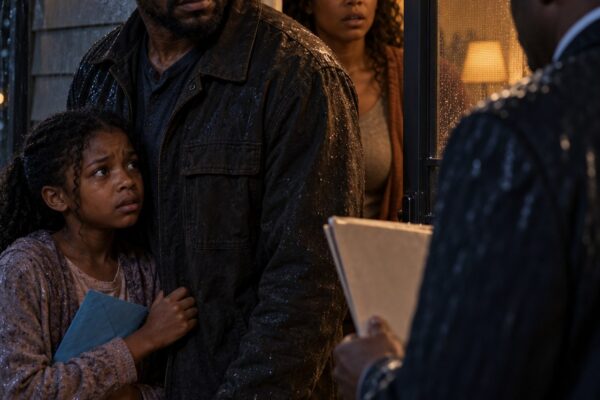
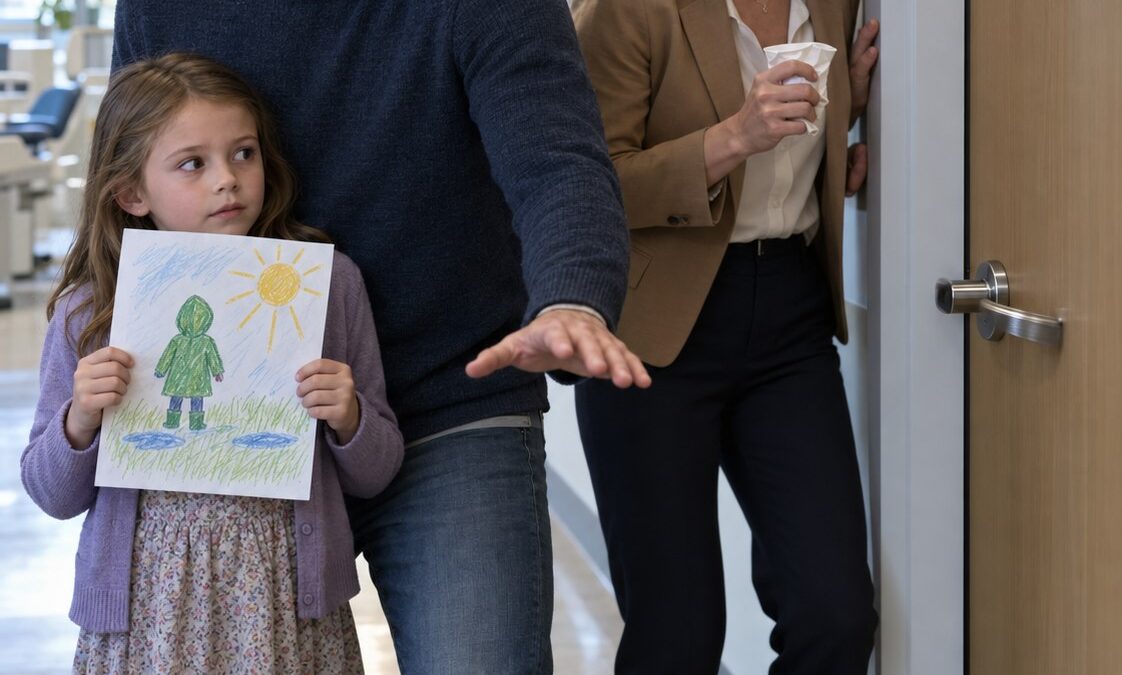
Nolan put June behind him.
“Open the door, Martin.”
No one answered.
Celia took one step back.
The woman inside tried the handle again.
“It won’t open,” she said.
Martin spoke softly.
“You should leave.”
Nolan struck the door with his palm.
“Owen?”
Two taps answered.
Then one.
Nolan’s knees nearly gave.
He pressed his forehead against the cool paint.
“I’m here, buddy.”
Celia touched his shoulder.
He shook her off.
“Call the police.”
“I already did.”
Nolan turned.
“When?”
“Before you arrived.”
Martin’s voice rose.
“That was a mistake.”
Celia faced the door.
“Let them out.”
“They’re free to leave.”
The woman rattled the handle.
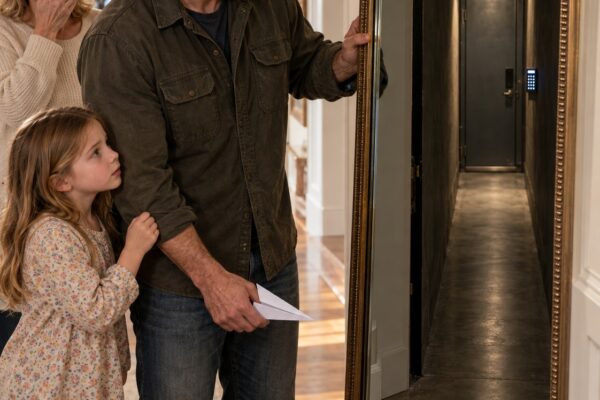
Nolan looked at the keypad beside it.
Four digits.
He looked at the drawing.
The dog’s collar said 416.
Only three.
He turned the page over.
Blue marker showed through the paper.
Behind the dog’s tail sat a small yellow sun.
Owen always gave the sun one extra ray.
For June.
“Four, one, six,” Nolan said.
June pointed to the sun.
“And seven.”
He entered 4167.
The lock released.
The door opened two inches before something heavy stopped it.
Nolan put his shoulder against the gap.
A rolling cabinet scraped across tile.
Then he saw Owen.
His son stood behind the cabinet in a green raincoat, one sleeve caught in its drawer.
He looked thinner.
He looked frightened.
He looked alive.
“Owen.”
The boy stared at him.
Martin gripped his other shoulder.
“Your father doesn’t know everything.”
Nolan pushed the cabinet hard enough to break its wheel.
Martin let go.
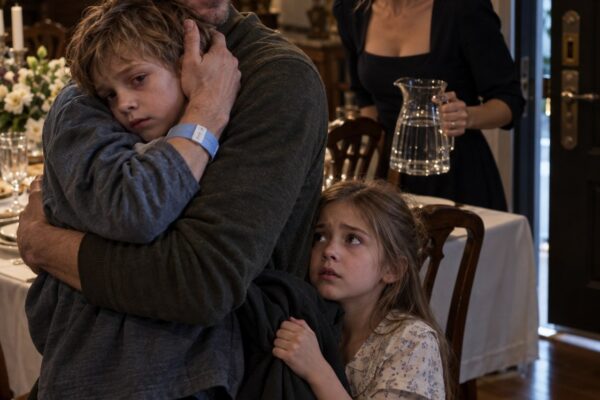
Owen ran into Nolan’s arms.
Nolan held him against his chest.
For a moment, he could not speak.
Owen smelled of soap and the grape toothpaste Celia kept in little paper packets.
June slipped around him and wrapped both arms around her brother.
“You drew me,” she said.
“I knew you’d see it.”
The woman stood beside the treatment chair.
Her name was Tessa Ward.
She had given police the van description.
Now her face was pale, and her phone was clenched in her hand.
Martin glanced at the phone.
“You have no idea what she’s done.”
Tessa looked at Nolan.
“I lied about the van.”
Nolan held Owen tighter.
Footsteps sounded from the front of the clinic.
Celia went to meet the officers.
Martin straightened his cuffs.
“She took him,” he said.
Tessa’s eyes filled.
“I did,” she said.
Owen lifted his head.
“Because he told her to.”
* * *
The first officer who entered the room asked everyone to keep their hands visible.
Nolan loosened his hold on Owen.
The boy held on harder.
“That’s my dad,” he said.
“I understand,” the officer replied.
Her nameplate read ALVAREZ.
She had been among the officers who searched the school parking lot.
Nolan remembered her kneeling beside a storm drain, looking for a dropped button.
She recognized Owen.
Her voice changed.
“Hi, Owen.”
“Hi.”
“Are you hurt?”
“No.”
“Can you walk with me?”
Owen looked at Nolan.
“May I stay beside him?”
“Yes.”
Officer Alvarez asked the others to remain in the clinic.
A second officer stayed with Martin and Tessa.
Celia led June to the waiting area, where a receptionist gave her a blanket from the supply closet.
Nolan wanted to follow both children at once.
Owen solved that by taking his hand.
The boy would not let go during the drive to the hospital.
A detective met them there.
So did a pediatric nurse.
They checked Owen’s health, gave him food, and let him rest in a quiet room.
No one asked him to tell the whole story that night.
Detective Ruth Calder spoke first with the adults.
Nolan sat across from Tessa in a small consultation room.
He could hear June talking softly to Owen through the open door.
Tessa folded and unfolded a tissue.
“I was the school’s substitute office aide,” she said.
“I know who you are.”
“I was told you’d taken him.”
“By Martin?”
She nodded.
On the day Owen vanished, Martin had called the school office.
He said Nolan was coming to collect the boy early.
Tessa had checked the approved pickup list.
Martin’s name was on it.
Nolan remembered adding him the year their mother died.
There had been days when the children needed rides and Nolan was working late.
“Martin collected Owen himself,” Tessa said.
“Then why tell police about a van?”
“Because he told me you’d called him.”
Nolan stared at her.
“He said you were taking Owen somewhere to punish Celia.”
“Why would I punish her?”
Tessa’s fingers tightened around the tissue.
“He said she’d refused you money.”
Celia sat beside the detective.
“That part happened,” she said.
Nolan looked at her.
Three days before Owen vanished, he had asked Celia for a loan.
His truck needed repairs.
Without it, he could not finish a kitchen job or pay his rent.
She had said no.
He had been angry.
Martin knew because he had walked in during the argument.
“He used that?” Nolan asked.
Celia lowered her eyes.
“I let him.”
Tessa said Martin had instructed her to call police if Nolan appeared at the school.
He claimed a lawyer was preparing an emergency custody filing.
Later, when Owen was gone, Martin told Tessa the van story would keep Nolan from being arrested before Celia could straighten things out.
“Why would you believe him?”
“I knew him.”
“Did you know him well?”
“He paid for my son’s braces.”
Nolan sat back.
Tessa wiped her face.
“I’m not asking you to forgive me.”
“Good.”
The detective asked Tessa when she learned Owen was with Martin.
“Five days ago.”
She said Martin had called her after Owen became ill at a house outside the city.
He needed someone Owen recognized.
Tessa went there and found Owen with a fever that had already begun to pass.
She stayed because she was afraid to leave him alone with Martin.
This morning, Owen needed a dental repair.
Martin brought them to the closed clinic before its first appointment.
Tessa had finally called Celia.
“And you called me,” Nolan said.
Celia nodded.
“I told Martin you were bringing June to lunch.”
“You knew Owen was here.”
“Only when Tessa called.”
Nolan looked at the detective.
“You can check that?”
“We will.”
Celia gave her the phone.
Nolan had spent eleven weeks building pictures in his head.
Owen in a gray van.
Owen on a highway.
Owen calling for him where nobody could hear.
One picture had never occurred to him.
Owen sitting at his aunt’s kitchen table.
The detective asked about the drawing.
Nolan set it down carefully.
“Owen put a code on it.”
Officer Alvarez had already photographed the door and keypad.
The clinic manager confirmed the treatment rooms used four-digit codes that staff could change.
Martin had changed that room’s code at 7:42 that morning.
The change appeared in the access log.
Nolan studied the dog’s orange collar.
“Why these numbers?”
“I don’t know yet.”
From the next room, June gave a short laugh.
Owen was telling her something.
Nolan closed his eyes.
The sound hurt in a place he had thought had gone numb.
Detective Calder slid a photograph across the table.
It showed a roadside camera image from the afternoon Owen disappeared.
Martin’s car was leaving the school route.
Owen was visible in the back seat.
The image had come in that evening.
The detective had not yet spoken to Nolan about it.
“Why didn’t the police find this before?”
“The camera owner didn’t know his system kept older clips.”
Calder explained that an investigator had returned to nearby businesses after Tessa changed her statement.
They had requested original files and found the image.
Nolan looked at Tessa.
She held his gaze.
“I told them the truth yesterday.”
That was why Celia had called him today.
It was why officers had arrived so quickly.
The room felt unsteady.
“Where was he?” Nolan asked.
Tessa told them about a rented house near Briar Lake.
Martin had leased it through a company used for clinic property.
Owen had spent most of the eleven weeks there with a hired caregiver.
The caregiver believed Martin was his guardian.
Detective Calder wrote down the name.
Then she asked the question Nolan could barely form.
“What did Martin tell Owen about his father?”
Tessa shook her head.
“Whatever it was, Owen stopped believing it.”
“Why?”
“He found your number in his coat.”
Nolan looked through the open doorway.
Owen sat on the hospital bed, drawing a dog on a paper napkin.
His green raincoat hung from the chair.
Nolan had written his mobile number inside the lining last winter.
He wrote it inside both children’s coats.
Owen had known it was there.
He simply had not had a phone.
Tessa spoke quietly.
“He kept trying to reach you.”
Nolan gripped the edge of the table.
Then Celia said something that changed the shape of every day since the disappearance.
“Martin told Owen you were the one hiding from him.”
* * *
The rented house stood behind a line of bare maples.
Detective Calder went there the next morning with a warrant.
Nolan was not invited.
He spent the morning at the hospital instead.
Owen slept until ten.
June sat beside him with a coloring book.
Every few minutes she looked up, checking that his chest still moved.
Nolan recognized the habit.
He had been doing the same thing.
When Owen woke, he asked for toast.
The nurse found some.
Owen ate the edges first, as he always had.
“Did Dad fix the truck?” he asked June.
“He fixed the heater.”
“That wasn’t what I asked.”
“The truck works.”
Nolan sat on the other side of the bed.
“I kept the passenger seat empty.”
Owen looked at his toast.
“Martin said you sold it.”
“He told you a lot of things.”
“He said you were angry because I saw the papers.”
Nolan waited.
Owen picked at a crumb.
The week before he vanished, he had gone into Martin’s home office looking for tape.
He found a folder open on the desk.
Inside was a picture of their mother.
Her signature appeared beneath a page filled with numbers.
“I knew it was wrong,” Owen said.
“How?”
“Mom wrote the first letter of her name like a loop.”
He drew the letter in the air.
“This one was straight.”
Nolan remembered that loop.
His wife, Rebecca, had used it on grocery lists and notes tucked into lunch boxes.
Owen had noticed it too.
“What did you do?”
“I asked Martin.”
June leaned closer.
“He got mad?”
“He said I wasn’t allowed in there.”
Owen looked at Nolan.
“The next day, he picked me up from school.”
Nolan kept his voice even.
“Did he hurt you?”
“No.”
“He frightened you.”
Owen nodded.
“He said you were going to get blamed for taking money.”
“What money?”
“He said I could keep you safe if I stayed quiet.”
Nolan felt June’s hand find his wrist.
Owen had spent eleven weeks trying to protect him.
Calder called that afternoon.
She had found files at the lake house.
The caregiver’s contract named Martin as the person responsible for Owen.
It described Owen as a child whose father was being investigated for fraud and whose location had to remain confidential.
The caregiver had saved every text Martin sent.
She had also written down the dates she asked to contact a lawyer and was refused.
“She’s cooperating,” Calder said.
“What about the money?”
“We’re looking.”
Nolan had something to give her.
In a box under his bed were Rebecca’s old bank statements.
After she died, he had kept everything because deciding what to throw away felt impossible.
Rebecca had worked part time at Celia’s clinic.
She helped families apply to the scholarship fund.
Her pay had been modest, but she had been proud of it.
Calder asked Nolan to bring the statements in.
He spread them across a table at the station.
There were ordinary purchases.
Gas.
Groceries.
A winter coat for Owen.
Then, in the month before Rebecca’s death, three deposits from an account named Bell Outreach Services.
Each was reversed the following day.
Nolan had seen them before.
He had assumed the clinic had made a payroll mistake.
Calder took copies.
A financial investigator joined them the next day.
She explained the limits of what they knew.
The scholarship fund paid the clinic for approved care.
Bell Outreach Services was one of its vendors.
Payments had passed through that company.
Some appeared to match work Rebecca had never done.
The investigator needed bank records and the fund’s original invoices before drawing a conclusion.
Nolan knew one thing she did not.
Rebecca had once come home angry because a parent had been told the fund was empty.
She had checked the public donation total that morning.
There should have been enough to treat dozens of children.
“She thought someone was taking it,” Nolan said.
“Did she report it?” the investigator asked.
“I don’t know.”
Celia might.
Nolan found her outside the station.
She stood by her car, still wearing yesterday’s coat.
He showed her Rebecca’s bank statement.
Celia read the name of the company.
Her face changed.
“Martin told me Rebecca approved those payments.”
“Did you ask her?”
“She was already gone.”
Rebecca had died after a sudden illness.
There was no mystery about it.
The grief had made the months afterward a blur.
Celia had been grieving too.
Martin had taken over the fund’s paperwork because neither of them wanted to read Rebecca’s name on every file.
“Why did Owen see her signature?” Nolan asked.
“I don’t know.”
“Find out.”
Celia nodded.
“I will.”
That evening, Nolan took June home.
Owen stayed at the hospital one more night because the doctors wanted him to rest and eat regularly.
June insisted on placing Owen’s pillow back on his bed.
It had been in the closet.
Nolan had moved it there after he found himself straightening it every morning.
June shook the pillow into its case.
“His room looks wrong without it.”
“It does.”
She stood in the doorway.
“Will he come home tomorrow?”
“That’s the plan.”
“Will Martin come?”
“No.”
June thought about that.
“Celia?”
“I don’t know yet.”
She walked to him.
“Celia looked scared.”
“She had a reason.”
“Was she scared for us?”
Nolan looked at the pillow.
He wanted to give June a simple answer.
She had earned a true one.
“I think she was scared she had helped him.”
June took that in.
“Did she?”
“Yes.”
Celia called after June went to bed.
She had found a file in the clinic’s old records.
Rebecca had made a written complaint about the scholarship fund.
It was dated nine days before she died.
The complaint named missing payments and asked the board to freeze Bell Outreach Services.
Celia’s voice broke.
“I never saw it.”
“Who did?”
“Martin signed the receipt.”
* * *
The clinic board met three days later.
Celia had asked Detective Calder to attend.
An attorney for the scholarship fund was there too.
Nolan sat at the back with the drawing folded inside a clear sleeve.
He had not wanted to bring it.
Owen had asked him to.
“It helped you find me,” the boy said.
Nolan had promised to keep it safe.
Martin arrived with his lawyer.
He wore a dark suit and a calm expression.
Nolan understood why parents liked him.
He remembered names.
He remembered whose child had finally smiled in a school photograph.
He spoke about people as if he had been looking after them for years.
Some of the board members looked relieved when he entered.
Martin opened with concern for Owen.
He said the boy had found papers he did not understand.
He said Nolan’s debts and anger had created a dangerous situation.
He said he had made a temporary decision that became difficult to undo once the police began searching.
“I should have told the authorities sooner,” he said.
“I accept that.”
He looked at Celia.
“I believed I was protecting a child and his father.”
Nolan felt the old anger rise.
Then he felt Owen’s hand on his sleeve in memory.
The boy had asked him not to shout.
So Nolan stayed seated.
The attorney asked about the fund.
Martin said accounting errors were being exaggerated because everyone wanted a reason for Owen’s disappearance.
He offered the board copies of clinic reports.
The attorney set them aside.
“We have the bank records,” she said.
The financial investigator had traced payments from the scholarship fund to Bell Outreach Services.
The company belonged to Martin.
Its invoices listed services that other firms had actually provided.
Over four years, nearly four hundred thousand dollars had passed through it.
The figure was still being reviewed.
Martin leaned forward.
“Those services were real.”
“The company did not perform them,” the attorney said.
“It managed them.”
“Then where are its contracts?”
Martin looked at his lawyer.
His lawyer asked to review the underlying records.
The attorney agreed.
No one declared the matter settled.
Detective Calder placed another document before the board.
It was Rebecca’s complaint.
Beside it lay the signed receipt from Martin.
He studied it.
“She misunderstood the accounts.”
“Then why hide her complaint?” Celia asked.
“I didn’t.”
“You accepted it.”
“I passed it to staff.”
“Which staff?”
Martin did not answer.
Celia’s hands shook, but her voice held.
“I let you run the fund because I trusted you.”
“That’s true.”
“You used my name to quiet people.”
“I kept this clinic operating.”
“You kept people asking for help while you took the money.”
Martin turned to the board.
“Celia has been under pressure.”
For a moment, the room tilted his way.
Celia had admitted she missed warning signs.
Martin had papers.
He had years of goodwill.
He had a lawyer.
Nolan stood.
“I have one question.”
Martin looked at him.
“Why was the room locked?”
“My client should not answer that,” his lawyer said.
Martin answered anyway.
“Owen was upset.”
“He drew a code for June.”
“He wanted attention.”
“He wanted out.”
Martin’s jaw tightened.
Nolan held up the drawing.
“I thought this number was the door code.”
“It was,” Celia said.
“Part of it.”
Nolan turned the page around.
“The numbers were also a room number.”
Martin looked at the dog’s collar.
416.
Nolan had learned it from Owen the night before.
At the lake house, Martin kept a file cabinet in the room marked 416 on the floor plan supplied to the caregiver.
Owen had seen Martin open it.
He had remembered the number.
He drew it on the dog because June would notice the new collar.
He added the sun’s seven rays so Nolan could open the clinic door.
Celia had told Calder about the clinic keypad.
Owen had told Calder about the file cabinet.
Investigators had used a warrant to open it.
Calder placed photographs on the table.
Inside were Rebecca’s original notes.
There were copies of the false invoices.
There was also a draft statement prepared for Owen.
It said Nolan had told his son to stay hidden while he withdrew money from the fund.
The statement was written in an adult’s language.
At the bottom was a blank line for Owen’s signature.
Martin’s lawyer stood.
He spoke quietly to his client.
Martin pushed back his chair.
Calder told him he was under arrest.
No one in the room celebrated.
Celia sat down heavily.
Nolan watched the officers lead Martin to the door.
Martin stopped beside him.
“You think this makes you a good father?”
Nolan thought of eleven weeks of empty beds and unanswered calls.
He thought of Owen trying to protect him with a drawing.
“I think my son knew where to find me,” he said.
Martin looked away.
The criminal case took months.
Tessa gave a full statement and faced charges for her false report.
Her lawyer explained how Martin had misled her.
The court would decide what responsibility she bore.
The caregiver gave investigators her texts, records, and notes.
The clinic board removed Martin from every role connected to its accounts.
Celia gave investigators access to the records Rebecca had tried to preserve.
Martin eventually pleaded guilty to fraud, false imprisonment, and offenses connected to Owen’s disappearance.
The judge heard from the people whose children had waited for care while the fund lost money.
Nolan did not speak about revenge.
He told the court how Owen had kept a phone number sewn inside his coat.
Martin received a prison sentence.
The court ordered restitution.
The scholarship fund began the slow work of recovering what it could.
When Martin’s lawyer suggested Nolan had helped create the confusion by arguing with Celia, Nolan answered without raising his voice.
“I asked my sister for a loan.”
He looked at the judge.
“I never gave anyone my son.”
* * *
Owen came home on a Thursday.
June had made a welcome sign.
She spelled every word correctly except “surprise.”
Owen read it twice.
“You used two Rs.”
“You used two Us.”
“That was on purpose.”
“So was mine.”
Nolan watched them argue about the sign while standing in the kitchen with two grocery bags.
He had bought too much cereal.
Owen noticed.
“We can’t eat all that.”
“We have time.”
That night, Owen asked if his bedroom door could stay open.
Nolan left his own door open too.
Around midnight, he heard Owen cross the hall.
The boy stood in the doorway holding his pillow.
“Can I sleep on the couch?”
“Sure.”
“Will you be here?”
“I’ll be right here.”
Nolan sat with him until he slept.
The next week, Owen went to see his doctor.
Then he met with a counselor who worked with children after frightening experiences.
Some days he talked.
Some days he drew houses with no doors.
Nolan drove him and waited outside.
June came along when school was closed.
She brought a book but watched the office door.
Once Owen came out holding a drawing of a dog.
The dog stood in an open yard.
June asked if he wanted her to add a collar.
“Maybe later,” he said.
She accepted that.
Celia called before she visited.
Nolan made that a rule.
She accepted it too.
The first time she came over, she brought groceries.
Nolan told her he could pay for his own.
“I know,” she said.
She put the bags on the counter anyway.
“I bought them because I didn’t know what else to bring.”
He looked inside.
Pasta.
Apples.
The cereal Owen actually liked.
“Ask next time,” he said.
“I will.”
She had closed the clinic for two days after Martin’s arrest.
Then she opened it again.
Families still needed appointments.
Staff still needed their jobs.
She hired an outside firm to review the accounts and published the findings for donors and families.
The fund’s board changed its approval process.
Celia stepped away from it while investigators finished their work.
She did not ask Nolan to admire any of that.
One afternoon, she sat at his kitchen table while Owen and June played cards in the next room.
“I should have read Rebecca’s complaint,” she said.
“Yes.”
“I should have questioned Martin.”
“Yes.”
“I wanted him to handle everything.”
Nolan rinsed a cup.
Celia waited until he turned around.
“I’m sorry.”
He believed her.
It did not erase what had happened.
“Owen decides when he sees you,” Nolan said.
“I know.”
“And if he says no, you don’t ask June to change his mind.”
“I won’t.”
The children came in arguing over a card.
Owen saw Celia.
His expression closed.
She stayed seated.
“Hi, Owen.”
“Hi.”
“I can go.”
He considered her.
“You can stay for dinner.”
Celia blinked.
“Are you sure?”
“Yes.”
He looked at Nolan.
“Dad, can she?”
Nolan nodded.
It was Owen’s choice.
Later, when Celia left, Owen stood in the doorway and watched her walk to her car.
“She believed him,” he said.
“She did.”
“Did you?”
“Never.”
Owen leaned against Nolan’s side.
“I know.”
Money arrived in pieces.
An insurance payment covered part of the truck repair.
A local contractor offered Nolan steady work.
The landlord gave him time after hearing what had happened.
Nolan paid the rent he owed.
When restitution began, a lawyer explained that the children might be entitled to funds Martin had diverted from accounts meant for their care.
Nolan asked for the paperwork.
He read it carefully.
He set aside what belonged to Owen and June.
He did not let anyone turn their names into a photograph for a fundraiser.
Celia offered to pay for the rest of their schooling.
Nolan said no.
Owen needed her to keep her promises, not make larger ones.
He told her she could contribute to the scholarship fund once its new board was in place.
She did.
That summer, Nolan fixed the porch light he had been working on when Owen called.
The homeowner had waited months to ask him back.
She stood on the steps while he fitted the new fixture.
“I’m glad your boy is home,” she said.
“So am I.”
When he got back, Owen was teaching June to throw a baseball.
Neither child was good at it.
The ball rolled under the car.
Nolan lay on the driveway to retrieve it.
Owen crouched beside him.
“Dad?”
“Yeah?”
“I was angry when you didn’t answer.”
Nolan stayed on the ground.
“I know.”
“I thought you didn’t want to hear me.”
“I always want to hear you.”
“The phone was ringing.”
“I was up a ladder.”
“I know that now.”
Nolan pulled the ball free.
“I wish I’d answered.”
Owen nodded.
Nolan sat up.
“But you didn’t do anything wrong by calling.”
“I know.”
“You can call again.”
“I will.”
June leaned out the front door.
“Are you two done talking to the car?”
Owen threw the ball.
She missed it.
All three of them watched it bounce into the street.
Then Nolan went to get it.
In September, Owen asked to visit the clinic.
Nolan did not expect that.
“For your teeth?”
“No.”
“Then why?”
“I want to see the room.”
Nolan studied him.
“We can ask Celia to meet us.”
“I don’t need her there.”
“Okay.”
Owen picked at a loose thread on his sleeve.
“Will June come?”
“If you want.”
“I do.”
Celia arranged the visit after closing.
She left the key with the office manager and stayed away.
The clinic smelled the same.
Mint.
Clean towels.
Coffee from the staff kitchen.
June went quiet in the corridor.
The drawing was gone from the door.
Owen touched the place where the tape had been.
Nolan kept a few feet back.
The room stood open.
The rolling cabinet had been repaired.
There was a new lock on the door, but it could always be opened from inside.
Owen walked in.
He looked at the chair.
Then at the window.
Then he came out again.
“That’s all,” he said.
On the drive home, June asked why he had wanted to go.
“I wanted to leave when I chose,” Owen said.
Nolan checked him in the mirror.
Owen was looking out at the city.
His hands rested open on his knees.
* * *
Seven years later, June found the drawing in a box of family papers.
She was fourteen.
Owen was sixteen and taller than Nolan had been at his age.
They had come to help Celia move the clinic into a smaller building across town.
She had asked Owen first.
He had said yes.
Nolan carried boxes while June sorted old photographs at a desk.
The drawing lay inside its clear sleeve.
The yellow house had faded.
The extra U was still bright.
Owen came into the room carrying a lamp.
“You kept that?”
“Dad did,” June said.
“It belongs to you.”
He set down the lamp.
“I drew it for you.”
“You drew it to get out.”
“I knew you’d notice.”
June held up the page.
“The dog has a collar now.”
Owen smiled at the line.
He remembered her saying it through the door.
He remembered hearing Nolan’s voice.
He remembered the keypad beep.
Some memories had softened.
That one had stayed clear.
Celia appeared at the doorway.
“The last box goes in my car.”
Owen nodded.
“I’ll get it.”
She stood aside to let him pass.
They were comfortable together now.
It had taken years.
Celia never hurried him.
Nolan came in carrying an empty box.
June slipped the drawing back into its sleeve.
“Can we take this home?”
“Of course.”
At home, Nolan set it on the kitchen table.
The table had scratches from homework, dinners, and one disastrous attempt to repair a skateboard indoors.
Owen leaned over the page.
June pointed to the stick figures.
“Mom’s hair is wrong.”
“I was nine.”
“She had curls.”
“I know.”
“You gave the dog better hair.”
“He was easier to draw.”
Nolan looked at the crooked yellow house.
Rebecca had never lived in one like it.
She would have liked it anyway.
June carried the drawing to the wall beside the back door.
There were photographs there.
School plays.
A trip to the coast.
Owen holding his first paycheck.
June missing her front teeth.
She found a place between them.
“Here?”
Owen took the frame from her.
“A little higher.”
“Then do it yourself.”
He did.
The frame hung crooked.
Nobody corrected it.
Nolan stood between his children and looked at the dog by the yellow house.
Once, the orange collar had carried the number of a locked room.
Now it marked the drawing Owen had made for someone he knew would come looking.
June slipped her hand into his.
Owen stood on his other side.
Outside, a dog barked at something passing the house.
June looked at her brother.
“See?”
Owen grinned.
“Somebody heard trouble coming.”
Nolan opened the back door, and all three stepped into the warm evening together.
THE END