The Boy Pressed His Dead Father’s Key Into a Fresh Station Memorial, and His Mother Saw the Man Who Owned It Coming
Chapter 2: Behind the Clock
Gideon did not lead them inside immediately.
He asked the worker to rope off the damaged square.
“Keep the ribbon cutting moving,” he said.
The worker glanced at the mark.
“Should I smooth that over?”
“No.”
Ellis looked relieved.
Tessa did not.
“You said you promised Owen,” she told Gideon.
“I did.”
“When?”
“Four days before he died.”
A station bell sounded above them.
Ellis flinched at its sudden weight.
Gideon noticed and stepped away from the crowded entrance.
“Could we talk inside?” he asked.
Tessa looked at the doors.
She had avoided them since the memorial notice went up.
But Ellis was watching her.
“Yes,” she said.
Gideon found a quiet bench beneath the clock.
He brought Ellis a paper cup of water.
For Tessa, he brought nothing she had not asked for.
She appreciated that.
“Owen called me from the hospital,” Gideon said.
“He was very tired.”
“He was dying.”
“I know.”
Tessa folded her arms.
“Then why didn’t you come to me?”
“I tried.”
“No one came.”
Gideon accepted that without argument.
“He said a letter would explain everything.”
“I never got a letter.”
Gideon looked up at the clock.
“Neither did I.”
A narrow door stood beneath it, painted the same green as the wall.
Ellis touched the key through his shirt.
“Dad fixed that clock,” he said.
“He fixed it twice,” Gideon replied.
“The second time, he found a room behind it.”
Tessa had heard Owen complain about old wiring and stubborn gears.
She had never heard about a room.
“Why lock it?” she asked.
“Owen asked me to keep everyone out until the reopening.”
“Why?”
“He thought someone would take what was inside.”
Tessa gave a short, disbelieving laugh.
“Everyone already said he took something.”
Gideon’s face tightened.
“I let them say it.”
That landed harder than any defense.
Ellis looked between the adults.
“Did Dad do a bad thing?”
“No,” Tessa said.
Gideon crouched again.
“I don’t believe he did.”
“You didn’t say that outside.”
“I should have.”
Gideon got to his feet and called the station manager.
He asked for her to join them at the clock.
He also asked her to bring a phone and stay while the door was opened.
Tessa watched him make the call.
“You expected the key today,” she said.
“I hoped for it.”
“He left it with Ellis.”
“Yes.”
“He was eight when Owen died.”
“I know.”
Gideon looked at the boy.
“Owen said Ellis would decide whether the room stayed closed.”
The manager arrived, breathless from the ceremony.
Her name was Willa Chen.
She had managed the building through two years of construction and remembered Owen well.
When Gideon explained, she began recording the door, the key, and everyone present.
Ellis held the key out.
Tessa took his hand.
“Together?” she asked.
He nodded.
The lock turned stiffly.
Behind the door was a space barely wider than a closet.
A work light hung from one hook.
On a shelf sat a sealed document box.
Owen’s handwriting covered the lid.
Tessa recognized the rounded O.
She reached for the box.
Gideon gently stopped her.
“Let Willa film the seal first.”
Tessa almost pulled away.
Then she saw that his hand was shaking again.
He wanted proof of what happened here.
So did she.
Willa filmed the unbroken tape.
Tessa opened the box.
Inside lay a folder, a small ledger, and an envelope addressed to Ellis.
Beneath them sat an unopened letter addressed to Gideon.
Tessa turned it over.
The postmark was from eleven months earlier.
The delivery address was the station office.
A red stamp across the front read RETURNED TO SENDER.
Someone had sent Gideon’s letter back while Gideon was inside the building.
* * *
The station manager made copies before anyone read the papers.
She wrote down who handled each item.
Gideon called the attorney who oversaw the restoration trust.
Tessa called the diner to say she would miss her evening shift.
Her manager sounded irritated until Tessa said Owen’s name.
Then he told her to take the night.
Ellis sat at the bench, swinging his feet.
The envelope with his name remained closed.
“It’s yours,” Tessa told him.
“Can we read it at home?”
“Of course.”
He tucked it beside the key.
Gideon opened his own letter while Willa filmed.
Owen had written it in careful, crowded lines.
He described a community fund created to preserve Mercer Station and help families displaced when the rail yard closed.
He had volunteered as its bookkeeper during his final year.
Money had arrived from former rail workers across the country.
Some donations were small.
One widow sent eleven dollars and a note about meeting her husband under the station clock.
The trust had announced that most of the money was gone.
Owen wrote that the announcement was false.
Gideon read the sentence twice.
“I never saw this.”
Tessa believed him.
She did not yet know what that meant.
The ledger held names, dates, and deposit numbers.
Owen had recorded them because donors often called him directly.
Many remembered him from the station.
He could tell them which bricks their fathers had laid and where the old ticket window stood.
“He kept this at home first,” Tessa said.
She remembered the brown notebook on their kitchen table.
Then it vanished during his last hospital stay.
She had assumed he carried it to work.
“He was afraid,” Gideon said.
Tessa looked at him.
“Owen was angry.”
“He was both.”
The trust attorney arrived before the ribbon cutting ended.
Her name was Dana Price.
She examined the documents, then asked everyone to stop touching them.
“These copies give us leads,” she said.
“They aren’t a complete accounting.”
“What would be?” Tessa asked.
“Bank records, trust records, and the original authorization documents.”
Gideon nodded.
“Get them.”
Dana looked at Willa.
“Preserve that video.”
Willa raised her phone.
“It’s already backed up.”
Tessa turned a page in Owen’s ledger.
A receipt number caught her eye.
She knew it.
For six months after Owen died, she had cleaned the offices upstairs at night.
The diner had not paid enough, and the station needed temporary cleaners.
Each evening, she signed an entry sheet and placed supply invoices in a numbered tray.
One invoice bore the same number as a donation deposit in Owen’s book.
“That number was on the cleaning receipts,” she said.
Dana leaned closer.
“Are you certain?”
“I wrote it on my timesheet.”
“Why?”
“The tray labels kept falling off.”
Tessa had copied the numbers so she could prove which invoices she had delivered.
She still had photographs of the sheets.
The cleaning company required them for payroll disputes.
She found one on her phone.
The receipt was dated two weeks after Owen entered the hospital.
The ledger recorded a donation that day.
The cleaning sheet showed a pickup from the station office by the trust administrator.
Someone had carried the paperwork out after Owen could no longer walk there.
Dana sent herself the photograph with Tessa’s permission.
“Who administered the trust?” Tessa asked.
Gideon did not answer quickly.
“Lenora Voss.”
The name was familiar.
Lenora had stood beside Gideon in every reopening photograph.
She was his younger sister.
* * *
By the next morning, Tessa’s photograph had vanished from her payroll account.
She had saved a copy on her phone.
At ten, the cleaning company called.
A supervisor said the station had complained about improper handling of old records.
Tessa was suspended while they reviewed it.
She sat at her kitchen table with the phone still in her hand.
Ellis watched her over a bowl of cereal.
“Did I get you fired?”
“No.”
“Because of the concrete?”
“No, sweetheart.”
She did not tell him how frightened she was.
Gideon arrived thirty minutes later.
He had heard about the complaint from Willa.
“I can speak to the company,” he said.
“Dana already has.”
“I can cover your wages.”
Tessa shook her head.
“I need my job back.”
He nodded.
Then he helped Ellis tighten a loose chair leg while they waited for Dana’s call.
Owen would have found the right screw in seconds.
Gideon found one after three tries.
Ellis laughed at him.
Gideon smiled without defending himself.
Dana called at noon.
The bank had agreed to preserve relevant records while the trust’s independent accountant reviewed them.
Dana had also found the policy governing complaints against workers at the station.
Only the property manager could file one.
Lenora Voss had done so at nine that morning.
“She says Tessa removed confidential records,” Dana said.
“I photographed my own timesheet,” Tessa replied.
“I’ve told the cleaning company.”
There was more.
An employee had placed a note beneath Willa’s office door.
It said the clock room had been opened before.
The note gave a date: three days after Owen died.
Gideon looked up sharply.
“I locked it myself.”
“Someone could have used another key,” Dana said.
Ellis pulled his key from under his shirt.
“One tooth is short,” he said.
Gideon took a closer look.
A brass shaving still clung to the filed edge.
Owen had altered the key.
The room’s lock had been changed during renovation.
He had filed the old key to fit the new one.
Someone with access to a renovation master key could also have entered.
Willa checked the work logs.
On the date in the note, the clock room appeared as a completed inspection.
The inspector’s initials belonged to Lenora.
Tessa stared at the entry.
“If she went inside, why leave the box?”
Dana answered carefully.
“We don’t know that she saw it.”
The shelf stood above eye level.
The work light had been off.
They could not build a case from a guess.
That afternoon, Tessa and Ellis returned to the station for his jacket.
He had left it under the bench.
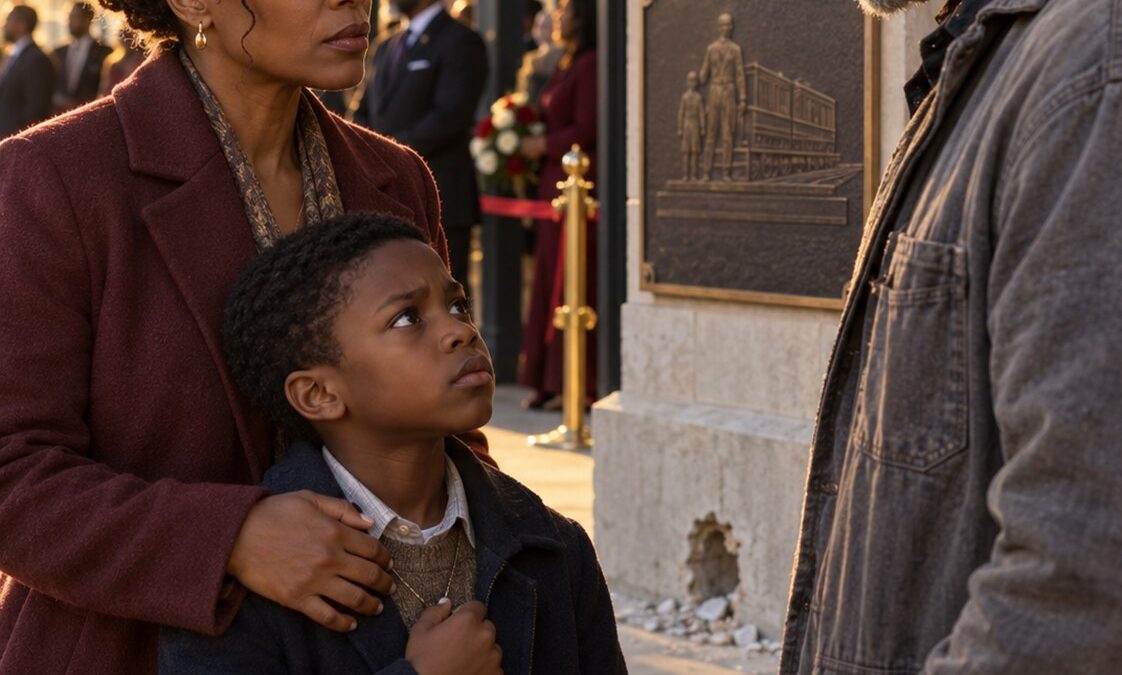
The memorial square outside was covered with a board.
A worker stood near it.
Ellis stopped.
“Did they erase it?”
“No,” Gideon said.
Tessa had not noticed him behind them.
“The concrete set overnight.”
“Will you break it out?”
“I don’t know yet.”
Ellis looked at his shoes.
“It looks ugly.”
“It looks honest.”
Tessa studied Gideon.
He spoke gently to her son.
Yet he had stayed silent when people accused Owen.
She needed to ask.
“Why did you believe Lenora?”
Gideon gazed at the board.
“She showed me a report.”
“What kind?”
“A review saying Owen altered deposits.”
“Who wrote it?”
“An outside accountant.”
“Who hired the accountant?”
He looked at her.
“Lenora.”
A car pulled into the loading lane.
Lenora Voss stepped out.
She wore a cream coat and carried a paper bag.
Her expression warmed when she saw Ellis.
“I brought pastries,” she said.
“No one had lunch yesterday.”
Ellis glanced at Tessa.
Tessa kept a hand on his shoulder.
Lenora noticed.
Her smile did not change.
“I heard the room was opened,” she said.
Gideon moved between her and the door.
“It was.”
“That must have been difficult.”
“It was useful.”
Lenora looked at Tessa.
“I hope nobody has burdened the boy with old accounts.”
“He asked why his father’s name was missing,” Tessa said.
Lenora lowered the pastry bag.
“That decision was made before I knew him well.”
“You worked with Owen for a year.”
“And I wish we’d known each other better.”
Tessa remembered Owen coming home late with ink on his fingers.
He had said Lenora was busy preparing the reopening fund.
He had never called her a friend.
Dana emerged from the station and asked Lenora to remain for a meeting.
Lenora agreed at once.
She seemed almost pleased.
That unsettled Tessa most.
Later, Dana explained why.
Lenora had already retained counsel.
She had told Gideon that Owen’s family might accuse the trust to clear his name.
She had offered to resign quietly and protect everyone from publicity.
“That sounds generous,” Tessa said.
“It also avoids a public review,” Dana replied.
Dana’s accountant found the first clear discrepancy by evening.
Donations were real.
The trust’s published report listed them too.
But payments supposedly sent to displaced families had gone to a consulting company.
The company belonged to Lenora Voss.
* * *
The trust board met the following Thursday.
Tessa spent the days before it finding every photograph of her timesheets.
The cleaning company restored her shifts and apologized after checking its own server.
It had retained the originals.
Dana asked them for certified copies.
Willa preserved the renovation logs.
The bank produced records through the trust’s formal review process.
No one asked Ellis to explain a ledger.
He went to school.
At night, he built a cardboard station with a clock made from a paper plate.
He left one space beside it for Owen.
Tessa watched him cut tiny windows with blunt scissors.
She wanted the grown-ups to be as careful with his father’s name.
The board meeting was held in the reopened ticket hall.
Gideon could have closed it to the public.
He chose not to.
Former rail workers came.
So did donors and several families who had applied for help.
The chairwoman explained that the board would hear preliminary findings, then decide what actions to take.
She warned everyone against treating allegations as verdicts.
Lenora sat beside her attorney.
She was composed.
Gideon looked older than he had at the ribbon cutting.
Tessa sat near the back with Ellis and Willa.
Dana presented the ledger first.
She explained who had found it and how the room had been opened.
She showed Willa’s video.
Then the bank records.
Then the cleaning company’s retained sheets.
The numbers lined up.
Donations had entered the trust account.
Payments had left for Lenora’s company.
Lenora’s attorney rose.
His voice was calm.
“The company provided legitimate consulting services.”
He held up contracts.
Lenora had signed them as administrator.
Gideon had approved the budget that included consulting fees.
Some board members shifted in their seats.
Lenora stood.
“The station was falling apart,” she said.
“I brought in specialists when no one else would.”
She pointed toward Gideon.
“My brother knows what this project cost.”
Gideon did not look away.
“I signed the budget,” he said.
“I did not approve payments meant for families going elsewhere.”
Lenora’s attorney turned to the ledger.
“Owen Vale made those entries himself.”
“He also controlled donor communications.”
He paused.
“Mr. Vale had access to every figure being disputed.”
Tessa felt Ellis lean against her.
She put her arm around him.
The attorney continued.
“Owen’s illness was tragic.”
“His records may be incomplete.”
It was a good argument.
A handwritten notebook alone could not settle the case.
Lenora had contracts.
She had signatures.
She had spent years beside Gideon, doing visible work.
Tessa stood when Dana invited her.
Her voice caught on Owen’s name.
She started again.
“My husband kept copies because donors called our house.”
She explained the timesheets.
She described the numbered tray and the day a trust receipt crossed her shift.
Lenora shook her head.
“Tessa cleaned the offices.”
“She didn’t see how the trust operated.”
“That’s true,” Tessa said.
“I saw who collected the papers.”
Willa displayed the company’s original sheet.
It recorded Lenora signing for the tray after Owen entered the hospital.
Lenora’s attorney objected to the word collected.
“It proves a pickup,” he said.
“It does not prove misuse.”
Dana agreed.
“It doesn’t.”
She placed another page on the screen.
The trust’s bank had provided a copy of the authorization for the consulting company.
Owen’s signature appeared on it.
The date was the same as the pickup.
Tessa gripped the edge of the table.
That day, Owen had been in a hospital bed across town.
He could still sign his name then.
Lenora’s attorney said so.
Dana nodded.
“Which is why we checked the original.”
She enlarged the document.
Beneath Owen’s signature was an imprint from a stamp used by the station office.
The imprint included a tiny defect: a break in the circle around the station clock.
Willa brought forward the office stamp.
Its circle was intact.
Lenora’s attorney frowned.
Dana showed a second stamp.
It came from the renovation archives.
A former administrator had ordered a replacement months earlier.
The old stamp had the broken circle.
Lenora had kept it in her personal filing cabinet.
Her attorney leaned toward her.
She whispered something back.
Dana continued.
“The bank also gave us its receipt for this authorization.”
“The person who submitted it used Lenora’s company email.”
There was a long pause.
It was not enough for the board to decide a crime had occurred.
It was enough to stop using trust money.
The chairwoman announced that Lenora’s authority was suspended.
An independent forensic accountant would review every payment.
The trust would refer the documents to the appropriate authorities.
Families whose applications had been denied would be contacted directly.
Lenora rose.
“You’re handing strangers a story about us,” she told Gideon.
“You’re giving them one,” he replied.
She turned to Tessa.
“None of this brings Owen back.”
Tessa stood.
“No,” she said.
“But Ellis gets to know who his father was.”
Ellis looked up at her.
Then he reached for his key.
He kept it in his own hand.
* * *
The review took four months.
Tessa learned patience by reading letters that ended with the words still pending.
The trust recovered some money through its bank and an agreement with Lenora’s company.
Other payments remained under investigation.
Prosecutors later filed charges related to the false authorization and diverted funds.
Lenora pleaded guilty to one charge under an agreement and was ordered to repay the trust.
She also lost any role in the station.
Tessa did not attend the hearing.
She read the result at her kitchen table.
Ellis asked whether Lenora would come back.
“No,” Tessa said.
“Not to the station.”
He considered that.
“Will Mr. Rusk?”
“He’s there almost every day.”
Gideon was.
He supervised repairs, argued with contractors, and kept bringing Ellis broken clocks to examine.
Ellis loved the clocks.
Tessa was less certain about Gideon.
He had missed Owen’s letter.
He had accepted Lenora’s report.
His apology could not change those things.
One Saturday, he arrived without a clock.
“I owe you both a better apology,” he said.
Tessa invited him into the kitchen.
Ellis sat at the table with his homework.
Gideon spoke to Tessa first.
“I trusted someone because she was family.”
“I let that settle a question I should have checked.”
Tessa waited.
“I’m sorry I left you alone with the accusation.”
Ellis kept his pencil still.
Gideon turned to him.
“I’m sorry your dad’s name wasn’t there.”
Ellis nodded once.
Tessa said, “You can come by.”
“But if you have concerns about Owen, you bring them to me.”
“I will.”
“And you don’t make promises to Ellis without asking first.”
Gideon looked at the boy.
“Fair.”
He took a folded document from his jacket.
The board had approved a payment to Tessa and Ellis for what the trust should have provided Owen’s family.
It also offered a larger sum from a separate fund Gideon controlled.
Tessa read both amounts.
The first would cover rent arrears, shoes, and a long-delayed visit to Owen’s sister in Ohio.
The second could change much more.
“I’ll accept what the trust owes us,” she said.
Gideon nodded.
“The other amount can go to the families who waited.”
“That’s your choice?”
“Yes.”
He folded the document again.
“We’ll put it to the board.”
Tessa smiled faintly.
“You’ll ask them with the records on the table.”
“I’ve learned to.”
Ellis finally spoke.
“Can I open Dad’s letter now?”
Tessa looked at him.
He had carried the envelope for months.
“Whenever you want.”
Gideon moved toward the door.
Ellis stopped him.
“You can stay.”
They sat together at the kitchen table.
The envelope opened unevenly.
Owen’s letter was short.
He wrote about Ellis’s first visit to the station.
Ellis had been frightened of the clock because its hands looked taller than he was.
Owen had lifted him so he could touch the minute hand while the clock was stopped for repairs.
Afterward, Ellis had asked whether time was heavy.
Owen wrote that it could be.
He told Ellis the brass key opened a room where he had put things that mattered.
He did not ask Ellis to solve anything.
He asked him to keep making marks so people would know he had been there.
Ellis read that line twice.
Then he looked at Tessa.
“Like the concrete?”
“Yes.”
“Even though you screamed?”
Tessa laughed, then wiped her eyes.
“Even then.”
Gideon asked whether Ellis wanted to visit the clock room again.
Ellis looked at his mother first.
She saw Gideon notice.
“Tomorrow?” she said.
Ellis nodded.
The next day, they found Owen’s old work light still hanging from its hook.
Gideon asked Ellis if he wanted to help choose a place for it in the station display.
Ellis asked whether it could stay in the room.
“That was Dad’s place.”
So it stayed.
The board repaired the memorial without removing Ellis’s square.
A mason cleaned the edges of the key mark and set a small brass label beside it.
OWEN VALE, it read.
STATION KEEPER AND TRUST BOOKKEEPER.
Ellis stood over the square for a long time.
“It’s not ugly anymore,” he said.
Tessa looked at the mark.
It was still crooked.
“No,” she agreed.
* * *
Six years later, Ellis returned to Mercer Station with a toolbox of his own.
He was taller than Tessa.
He had saved all summer to buy a secondhand set of clockmaker’s tools.
The great black clock had stopped that morning.
Willa, still the station manager, had called him.
Gideon was waiting beneath it.
His neck tattoo had faded further.
He pretended not to need help climbing the narrow stairs.
Ellis pretended to believe him.
Tessa watched from the ticket hall.
She worked full days at the diner now because she wanted to.
The rent was current.
Owen’s sister visited every spring.
The trust posted its accounts where donors could read them.
Families had received help.
The station doors stayed open.
Above her, Ellis called down.
“It’s only a loose connection.”
Gideon answered, “That’s what I said.”
“You said the clock was stubborn.”
“It is.”
Tessa heard Ellis laugh.
A few minutes later, the hands moved.
People passing through barely noticed.
Tessa did.
When Ellis came down, he stopped at the memorial square outside.
The little key mark remained beside his father’s name.
Time had softened its edges.
Ellis took the brass key from his pocket.
He no longer wore it on a string.
“What did Dad mean?” he asked.
“When he said people would finally listen?”
Tessa looked through the open doors.
Gideon was showing a child how to read the old departure board.
“I think he hoped we’d hear each other,” she said.
Ellis turned the key in his palm.
Then he slipped it into his toolbox.
The station clock rang the hour.
Tessa put her arm around his shoulders, and together they watched the doors fill with people coming home.
THE END