The Boy Pressed His Father’s Brass Stamp Into the Mayor’s New Floodwall, and His Mother Saw the Contractor Coming
Chapter 2: What the Stamp Held
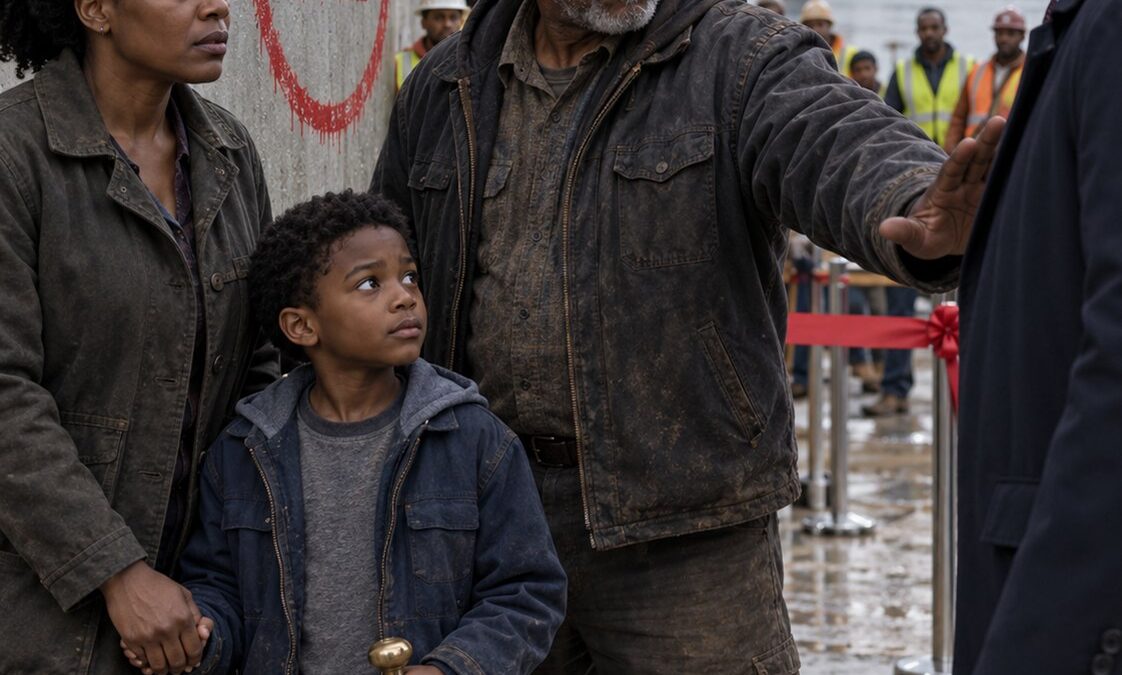
Kessler reached the ribbon smiling.
Owen hid the stamp.
Nina kept hold of his hand.
“What a crowd,” Kessler said.
His eyes went to the wall.
The smile stayed.
“What happened there?”
Harlan stepped aside.
“A mark in the finish.”
“We can patch it before the photographs.”
“No.”
Kessler looked at him.
“No?”
“Take your pictures somewhere else.”
A photographer lowered her camera.
The mayor was still inside the truck.
Kessler came closer to the wall.
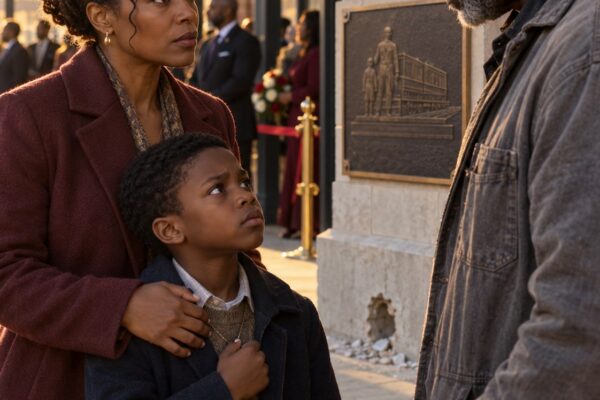
Owen moved behind Nina.
Harlan saw it.
He bent, picked up a clean rag, and handed it to the boy.
“For your hand,” he said.
Owen wiped the concrete from his fingers.
Kessler noticed the brass stamp.
“Is that city property?”
“It belonged to my husband,” Nina said.
Kessler held out his palm.
“I can check.”
She closed her fingers around it.
“No.”
The word surprised her.
For eleven months, she had answered every city question.
She had supplied Cal’s records.
She had signed forms she barely understood.
She had even apologized when Owen cried at the public meeting.
Kessler lowered his hand.
“Of course.”
Harlan spoke to the photographer.
“Did you get the wall?”
“Three frames.”
“Keep them.”
Kessler turned.
“Harlan.”
“Today’s dedication is over.”
“The mayor is here.”
“She can come back.”
A gust pushed cold river air through the fence.
Owen leaned into his mother.
Nina had left his jacket in the office.
Harlan took off his own coat and draped it over the boy’s shoulders.
It swallowed him.
“Why are you doing this?” Nina asked.
Harlan looked at the stamp.
“Cal called me the night the gate failed.”
She felt the site fall away.
“You never told me.”
“I was on another job.”
“What did he say?”
“He said someone had cleared his hold.”
Kessler’s expression hardened.
“Harlan, you were told that call was unverified.”
“I heard it.”
“You heard a frightened man in a storm.”
“I heard Cal Bell.”
Owen looked up.
“Dad called you?”
“Yes,” Harlan said.
“Did you answer?”
“I did.”
Harlan swallowed.
“I wish I’d arrived sooner.”
Kessler raised both hands.
“This can wait.”
“No,” Nina said.
She had spent eleven months waiting.
She would not give him another afternoon.
Harlan met her eyes.
“The stamp in your hand belonged to the man Cal warned me about.”
* * *
Nina took Owen to her sister’s apartment.
She called in sick to the diner.
Then she sat at the kitchen table while her sister made grilled cheese for Owen.
Harlan arrived with a copy of the flood report.
He had marked three pages.
Nina did not invite him to sit until Owen did.
“Your coat’s warm,” Owen told him.
“You can borrow it today.”
“Do you need it?”
“I have another.”
That was a lie.
Harlan’s truck held a rain jacket with a broken zipper.
Nina recognized it from the site.
She let the small kindness stand.
Harlan spread out the report.
Cal had inspected the west gate at 3:40 that afternoon.
His written finding was missing.
At 5:15, an approval appeared under Inspector Fourteen.
Warren Kessler.
At 8:06, the river rose above the warning line.
At 8:47, the gate failed.
“The report says Cal left it unsecured,” Nina said.
“It says a worker saw him leave.”
“Who?”
“The name was withheld.”
Nina turned the page.
Cal had kept a small notebook for every shift.
She still had three of them.
The fourth had been in his locker.
The city had returned the locker empty.
“He wrote down the day’s measurements,” she said.
“Did he keep copies?”
“No.”
She stopped.
At dinner, Cal often photographed a finished notebook page.
He sent the image to Nina when overtime would keep him late.
She still had the old messages.
Her phone sat on the table.
She searched November.
Photographs of rain.
A grocery list.
Owen asleep under a paper fort.
Then a picture of a notebook page, sent at 3:52.
Nina enlarged it.
Gate west.
Lower track bent.
Hold placed.
Inspector seventeen.
Cal’s handwriting slanted uphill when he was tired.
Beneath the note was another line.
“Witnessed by E. Ruiz,” Nina read.
“Who’s that?” Harlan asked.
“Elena Ruiz.”
She had worked beside Cal for six years.
“She moved after the flood,” Nina said.
“She testified?”
“According to this report, no.”
Harlan called the number he still had.
It had been disconnected.
Nina remembered a holiday card Elena sent after moving.
She found it in the shoebox with Cal’s notebooks.
The return address was two counties away.
Harlan offered to drive.
Nina’s sister offered to keep Owen.
Owen stood in the doorway, wearing Harlan’s coat.
“I want to go.”
“You’d be in the car for hours.”
“I know.”
Nina knelt.
“Adults need to check something.”
“I can tell them Dad wasn’t careless.”
“I know you can.”
She kissed his forehead.
“We’re going to bring back the proof.”
On the drive, Harlan told her about the public meeting.
He had believed the official report.
“I knew Cal checked everything twice,” he said.
“Yet you said those words.”
“I did.”
Nina watched the road.
“Why call him that night?”
“Because he knew I’d built the older wall.”
“You weren’t his boss.”
“No.”
“He trusted you.”
Harlan gripped the wheel.
“He trusted me to know what a hold meant.”
Elena Ruiz lived above a hardware store.
She opened the door with a toddler on her hip.
At the sight of Nina, her eyes filled.
“I should have called,” she said.
“Why didn’t you?”
“They said the investigation was closed.”
“Who said?”
Elena shifted the child.
“Kessler came to my house.”
He had shown her a statement with her name on it.
It said she had seen Cal walk away from the gate.
She had refused to sign.
Two weeks later, she lost her city contract.
“I told an investigator the truth,” Elena said.
“What investigator?”
“The one from the county.”
She found his card in a drawer.
Nina called him from the stairwell.
Detective Amos Reed remembered the case.
He had asked for Elena’s statement.
The city had sent a note saying she was unavailable.
Reed had never known where she lived.
He listened to Nina describe the photograph.
Then he asked her to send nothing else until they met.
“I’ll take a statement from you and Ms. Ruiz,” he said.
“Bring the phone with the original message.”
Nina went back upstairs.
Elena had something else.
On the day of the flood, Cal had asked her to photograph the hold tag on the gate.
Her phone had been damaged months later.
But she had sent that photograph to her brother.
He still had it.
He forwarded the original message while they stood there.
The image showed Cal beside the west gate.
A red HOLD mark was stamped on a paper work order.
A second stamp sat on the counter behind him.
Fourteen.
Nina stared.
“Why was Kessler’s stamp there?”
Elena’s voice shook.
“He’d taken over the signoff.”
“That morning?”
“No.”
“Then when?”
Elena looked at Harlan.
“Four months before the storm.”
* * *
Reed met them at the county office that evening.
He took statements separately.
He copied the original phone messages with their dates intact.
He gave Nina a receipt for the brass stamp.
Owen disliked handing it over.
Reed crouched to his level.
“You’ll get it back when I can return it.”
“It was my dad’s.”
“I understand.”
“No,” Owen said.
“Dad carried it.”
Reed nodded.
“I’ll write that down.”
He put the stamp into an evidence envelope while Owen watched.
Nina asked how it had entered Cal’s toolbox.
Reed could not answer yet.
“Maybe Cal took it,” she said.
“Maybe,” Reed replied.
“Would that make him a thief?”
“It might tell us he knew the stamp mattered.”
Reed had reviewed the flood eleven months earlier.
At the time, he had been asked to determine whether anyone had tampered with a public gate.
The city supplied maintenance records showing routine repairs.
No witness had disputed them.
He had closed his inquiry without charges.
“Can you reopen it?”
“I have new witnesses and original records.”
“Is that enough?”
“It’s enough to start.”
By the next morning, someone had photographed Nina outside the county office.
The picture appeared in a neighborhood group.
A caption called her son a vandal.
Another accused her of trying to force a settlement.
Nina put down her phone before Owen could see.
At work, the temporary office manager told her to stay home until the wall damage was assessed.
Her three shifts disappeared.
Harlan called within an hour.
“I can pay what they owe you.”
“No.”
“You shouldn’t lose wages over this.”
“Then tell them to restore my shifts.”
“I will.”
He did.
The manager called that afternoon.
Nina returned Monday.
Harlan said nothing about it when they next met.
He brought Owen’s clean coat.
Owen brought a drawing of the wall.
The red HOLD circle covered half the page.
“I made it too big,” he said.
“No,” Harlan answered.
“Sometimes that’s what it takes.”
Reed called them to the county office again.
His team had found a purchase record for replacement gate rollers.
It was dated six weeks before the flood.
The parts had never reached the maintenance yard.
The city’s record said they had been installed.
The supplier confirmed delivery to a private warehouse.
Kessler had signed for them.
Harlan knew the warehouse.
Pike Construction had leased space there years earlier.
He drove Reed to the address and stayed outside while officers obtained access through the owner.
The unopened parts were still on a shelf.
Their shipping labels matched the invoice.
Nina felt sick when Reed told her.
“If Cal knew, why didn’t he stop the gate?”
“He placed a hold,” Reed said.
“Someone cleared it.”
A hold required another inspector to review the problem before the gate returned to service.
Cal had done his job.
But Reed needed proof of who cleared it and how.
The stamp alone showed ownership.
It did not show who used it that day.
That evening, Nina found a voicemail she had saved.
Cal had called during his last shift.
She knew the words by heart.
“Don’t wait dinner,” he said.
“I’m staying until they lock this thing out.”
Behind his voice came a second sound.
A sharp metal clank.
Then Cal spoke away from the phone.
“You can’t sign that, Warren.”
The recording ended.
Nina had always heard only her husband.
She played it for Reed.
He asked permission to copy it.
Then he told her what the parts supplier had confirmed.
Kessler’s private warehouse belonged to a company controlled by his sister.
Nina knew the sister, too.
She was the mayor’s campaign treasurer.
The parts had been billed to the city at four times their cost.
* * *
The city council called an emergency public session.
Reed asked Nina to attend.
He warned her that the investigation remained open.
She could describe what she had personally seen and heard.
He would address the records he could release.
Harlan offered to watch Owen.
Owen wanted to sit with his mother.
She said yes.
They entered the council room together.
The mayor sat at the center table.
Kessler sat two seats away.
He looked rested.
Nina had slept three hours.
The first speaker was the city attorney.
She explained that the gate had failed during an extreme flood.
Several causes remained under review.
She asked people to avoid conclusions.
Kessler took the microphone next.
He sounded reasonable.
The parts, he said, had been moved during a warehouse transition.
The work orders were imperfect because the storm had interrupted normal procedures.
He acknowledged that Cal Bell had tried to help his coworkers.
Then he pointed toward Nina’s row.
“Grief can make old details feel newly certain,” he said.
Owen slid his hand into hers.
Nina stood.
She had brought no speech.
“I know when my husband sent me a photograph,” she said.
“I know his handwriting.”
“I know his voice.”
Kessler folded his hands.
“No one disputes your husband’s devotion.”
“You disputed his work.”
“I relied on the investigation.”
“So did I.”
She looked at the council members.
“I thought I had to.”
Harlan went to the microphone.
He explained the hold system.
A stamp number belonged to one inspector.
A second inspector could clear a hold after documenting the repair.
No repair record existed for the bent lower track.
Kessler stood.
“That is an administrative gap.”
Harlan shook his head.
“A gate with an open hold stays closed.”
“The flood was coming.”
“That’s why the rule exists.”
Kessler turned to the council.
“Closing that gate would have left the riverside blocks exposed.”
Harlan faced him.
“It was already unsafe.”
“You were not there.”
“No,” Harlan said.
“Cal was.”
The mayor asked for order.
Reed rose from the back row.
He had obtained permission to share one finding.
The supplier’s unopened replacement parts had been recovered.
They had never been installed.
A council member leaned forward.
“Then what repair did Inspector Fourteen approve?”
Kessler opened his mouth.
Reed answered first.
“That question is under investigation.”
The city attorney asked for a recess.
Nina thought the room might empty.
Instead, Elena Ruiz stood near the door.
She had driven in that morning.
Reed had taken her sworn statement before the session.
Elena held up her hand.
“I watched Cal place the hold.”
The mayor recognized her for public comment.
Elena described the bent track.
She described the paper work order.
She described Kessler taking it from the maintenance counter.
Kessler said she was mistaken about the date.
Nina took out her phone.
“The date is in the original message,” she said.
She passed it to the city attorney.
The attorney viewed Cal’s photograph.
Then Elena’s.
The stamps were visible in both.
Fourteen lay beside the work order.
Seventeen marked the hold.
Reed asked the attorney to preserve the council room’s display system.
The mayor agreed.
Nina connected her phone.
Cal’s photograph appeared on the wall behind the council.
His face was turned toward the gate.
His hand rested beside the warning.
He looked tired.
He looked certain.
The attorney enlarged the corner of the work order.
A crease crossed its lower edge.
Reed had found the original in the city’s archived paper files that morning.
The crease matched.
So did a red mark beneath the later approval.
The city’s document examiner had reported that the approval was stamped over Cal’s warning.
Kessler stared at the image.
“That proves a record was mishandled,” he said.
“Perhaps,” Reed replied.
“The rest will be tested.”
The mayor suspended Kessler from duty pending the investigation.
Two council members called for an independent review of the flood response.
The dedication remained canceled.
Outside, cameras crowded the steps.
Nina guided Owen through them.
Kessler came out behind her.
“You still can’t bring Cal back,” he said.
Nina stopped.
For a moment, she could hear the river beyond the street.
“No,” she said.
“But Owen gets to know what his father did.”
She walked on.
Three months later, the county prosecutor filed charges against Kessler for falsifying public records and fraud tied to the missing parts.
His sister faced separate fraud charges.
Neither case depended on proving that a single action had caused Cal’s death.
A civil review corrected the city’s finding about Cal.
It recorded that he had placed a safety hold and warned others before the gate failed.
Kessler eventually pleaded guilty to the records and fraud charges.
At sentencing, he admitted approving work that had not been done.
Nina read that sentence twice.
Then she put the paper down and took Owen to the park.
* * *
Winter loosened its grip slowly.
Nina’s cleaning shifts returned.
The diner manager gave her Thursdays off so she could take Owen to a counselor he liked.
Some weeks Owen talked there.
Some weeks he built towers from blocks.
He kept asking how long a hold was supposed to last.
“Until somebody checks,” Nina told him.
“Even if it rains?”
“Especially then.”
Reed returned Cal’s brass stamp in March.
He explained that the case files held photographs and records of it.
Owen carried the envelope home against his chest.
At the kitchen table, Nina opened it.
Fourteen gleamed beneath the word HOLD.
Owen frowned.
“Why did Dad keep Warren’s stamp?”
Nina had learned the answer from Elena.
On the afternoon of the storm, Cal had found it unattended beside the work order.
He took it after Kessler cleared the hold.
He planned to give it to investigators.
He had put it in his toolbox during the rush to reach the gate.
After the flood, the toolbox was returned to Nina.
For months, neither of them had noticed the tiny number.
Owen turned the stamp over.
“Dad was going to show somebody.”
“Yes.”
“I did.”
“You did.”
Harlan visited that Saturday.
He brought a small wooden box he had made in his garage.
The lid had no writing.
“I thought you might want somewhere safe for it,” he said.
Owen tested the hinge three times.
“It squeaks.”
“I can fix that.”
“I like it.”
Harlan laughed.
It was a rusty sound.
He apologized to Nina again for repeating the old report.
She believed he meant it.
That did not give him a place in every part of their lives.
“I need you to ask before speaking for Cal,” she said.
“I will.”
“And before making decisions for Owen.”
“I will.”
They let the boundary sit between them.
It held.
Weeks later, the city offered Nina a settlement for lost wages and the false finding.
Her lawyer explained each page.
Nina paid the overdue bills.
She put money away for Owen.
Then she used part of it to fund safety training for workers who wanted to challenge a cleared hold.
She asked Elena to help design it.
Harlan offered his yard for the first class.
Nina accepted the space.
She declined the sign he proposed with Cal’s name on it.
“He hated signs,” she said.
“He did,” Harlan admitted.
They held the class in April.
Twenty-three people came.
A young worker asked what to do when a supervisor told him a hold was inconvenient.
Elena gave the formal answer.
Document it.
Call the next authority.
Stay with the record.
Harlan gave the practical answer.
“Call me if you work on my crew.”
Afterward, Owen stood by the open yard door.
He had outgrown Harlan’s coat.
Harlan joined him.
“I’m fixing the squeaky hinge tomorrow,” he said.
“Don’t.”
“It still squeaks.”
“That’s how I know it’s my box.”
Harlan nodded.
A long minute passed.
Then he asked Nina, with Owen listening, whether he could take them to the river when the new gate opened.
No ceremony.
No cameras.
Just a visit.
Owen looked at his mother.
Nina looked at the man who had once stood beside the mayor.
He had learned to wait for an answer.
“Yes,” she said.
Owen smiled.
“But you have to let me inspect it first.”
* * *
Five years later, Owen stood beside the floodwall with a clipboard.
He was fourteen.
He had grown tall enough to see over the railing.
The new gate had passed its annual inspection that morning.
A city engineer had invited the public to walk the site.
Nina came after her shift.
Harlan arrived carrying three paper cups of hot chocolate.
He had retired from pouring concrete.
He still noticed every uneven edge.
The ceremonial dates remained on the wall.
So did a faint red circle near the bottom.
Workers had sealed the surface around it.
They had left the mark visible at Nina’s request.
Owen knelt beside it.
The brass stamp rested in its squeaky box at home.
It would stay there.
He traced the air above the word.
“Dad was here,” he said.
Nina stood beside him.
“Yes.”
The city’s corrected report said so.
Elena still taught the safety class.
The gate opened and closed as it should.
Harlan handed Owen his cup.
“Your inspection?” he asked.
Owen rose and studied the wall.
Then the gate.
Then the river moving safely past them.
“Looks good,” he said.
Harlan waited.
Owen took a sip.
“You can use it.”
Nina laughed.
The sound carried across the concrete.
Harlan smiled into his cup.
And together, they watched the river go by.
THE END